
Vashi Commercial Property Guide
Vashi is still one of Navi Mumbai’s strongest and most practical commercial locations, but it is not one single market. The right Vashi commercial property depends on whether you need office use, retail visibility, rental income, business branding, or long-term capital stability. In Vashi, station access, sector logic, building age, parking, common area quality, and legal clarity usually matter more than broad “prime location” claims.
To see how Vashi compares with other strong business locations, Best Commercial Areas in Navi Mumbai is a useful read.
Is Vashi actually one of the strongest commercial property locations in Navi Mumbai?
Yes, but only when you understand what kind of strength Vashi offers.
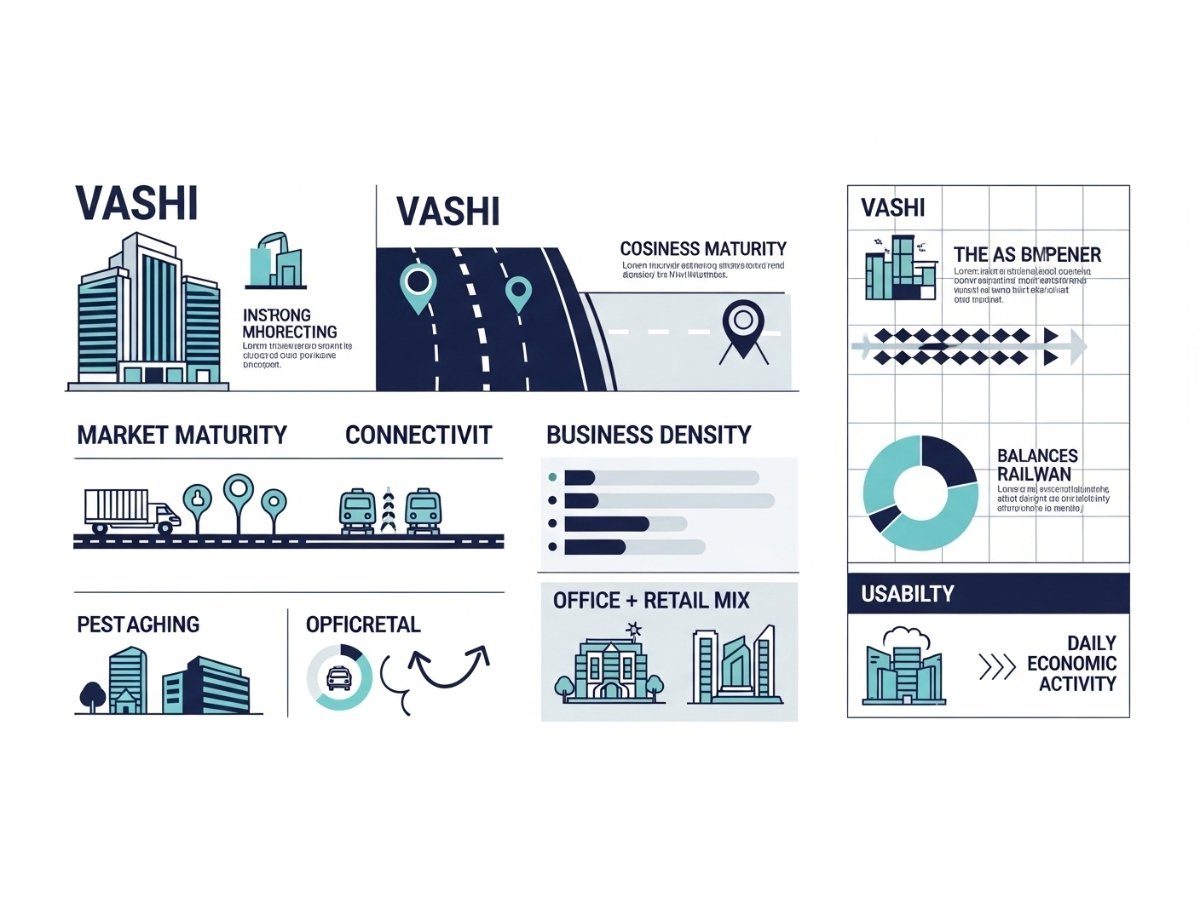
Vashi is not winning because it is the newest commercial node. It is winning because it is already mature. It has an old but deeply functional business base, strong familiarity among local companies, easy train access, strong road connectivity through the Sion-Panvel Highway and Palm Beach Road linkages, and a real daily economy built around offices, retail, trade, and services. That makes it very different from nodes that depend mostly on future promise.
At the same time, Vashi is not a clean, modern, uniform market. Some parts work because of walkability and footfall. Some work because of station-connected office demand. Some work because of APMC-side trade movement. And some old buildings keep value mainly because of address memory, not because the actual product is excellent.
Quick summary: How Vashi behaves as a commercial market
| Factor | Practical reality in Vashi |
|---|---|
| Overall market position | One of Navi Mumbai’s most established commercial nodes |
| Best strength | Mature business ecosystem with immediate utility |
| Main advantage over newer nodes | Existing demand, not just future expectation |
| Main weakness | Aging stock, parking stress, legal and transfer friction |
| Best for | Office users, high-street retailers, local professionals, selective investors |
| Not ideal for | Blind premium buying without micro-location fit |
Indicative capital values across the broader Vashi market are often seen around roughly ₹20,477 to ₹28,550 per sq ft, but that average can mislead. One property may justify its pricing because of transit access, frontage, and tenant depth. Another may sit in the same node and still struggle because the actual business usability is weak.
What kinds of commercial property are people really buying and leasing in Vashi?
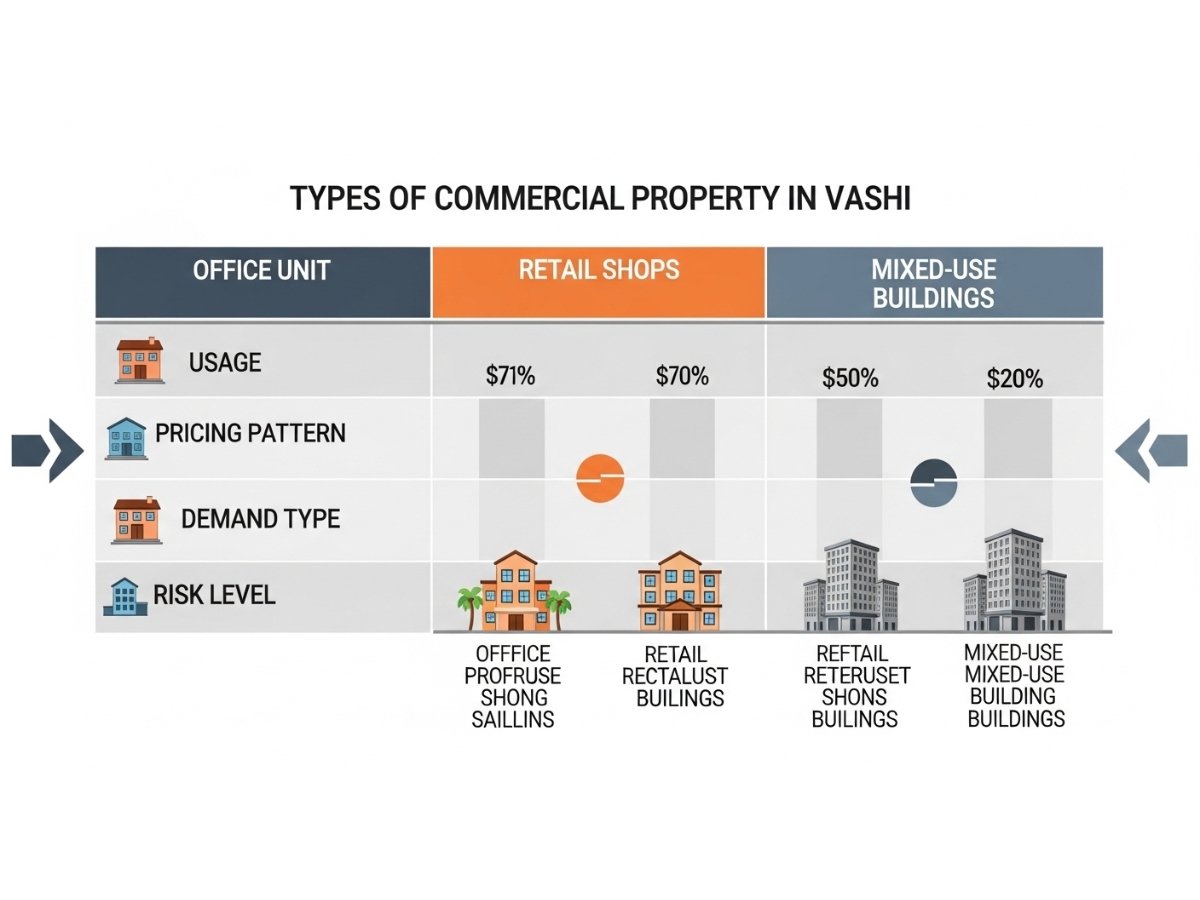
People searching for commercial property in Vashi are usually not choosing one market. They are choosing between very different asset types that behave differently in pricing, rent, vacancy, and resale.
Office units and strata commercial floors
This is one of the most active formats in Vashi, especially around station-connected and business-oriented pockets such as Sector 30A. These units attract branch offices, consultants, back offices, IT support teams, logistics support teams, finance firms, and professional service businesses.
The big advantage of Vashi office space is usability. A well-located office with lift access, clean common areas, decent parking, and true railway walkability can remain relevant for a long time. But the wrong office in an old, poorly managed building can become dead capital even if the address sounds premium.
Indicative capital values in stronger office belts can range from around ₹12,000 to ₹25,000 per sq ft for bare-shell stock and around ₹24,000 to ₹48,000+ per sq ft for fitted plug-and-play inventory. Indicative rents in better office clusters can sit around ₹80 to ₹140 per sq ft per month, especially where station access genuinely reduces commuting friction.
Shops, showrooms and street-facing retail
Retail property in Vashi works on a different logic. Here, frontage, visibility, sign exposure, pause ability, and customer conversion matter more than office prestige.
Sector 17 is the classic example. It remains one of the strongest high-street commercial belts in Navi Mumbai for businesses that need local visibility and walk-in movement. Indicative capital values for retail in stronger stretches can range from around ₹25,000 to ₹45,000+ per sq ft carpet, while indicative rents can range from around ₹200 to ₹550+ per sq ft per month. Very small visible units often command disproportionately high rates because the per-square-foot value of a strong front-facing box can be extraordinary.
But retail is also where people make the most mistakes. A road-facing unit with poor stopping convenience or hidden frontage can look “busy” and still underperform.
Mixed-use commercial stock in older buildings
This is a major part of Vashi’s identity. There are many older commercial structures where offices, service businesses, clinics, small academies, finance professionals, and local operators still function because the location is known and convenient.
Older stock can work well for the right user. A CA office, local law practice, diagnostic collection centre, coaching setup, or back office may not need a shiny tower. It may just need affordability, a known address, and workable access.
But mixed-use legacy stock comes with real caution: weak lifts, tired common areas, parking problems, outdated layouts, electrical limitations, CAM ambiguity, and future capex risk.
Which parts of Vashi work better for office use, and which work better for retail visibility?
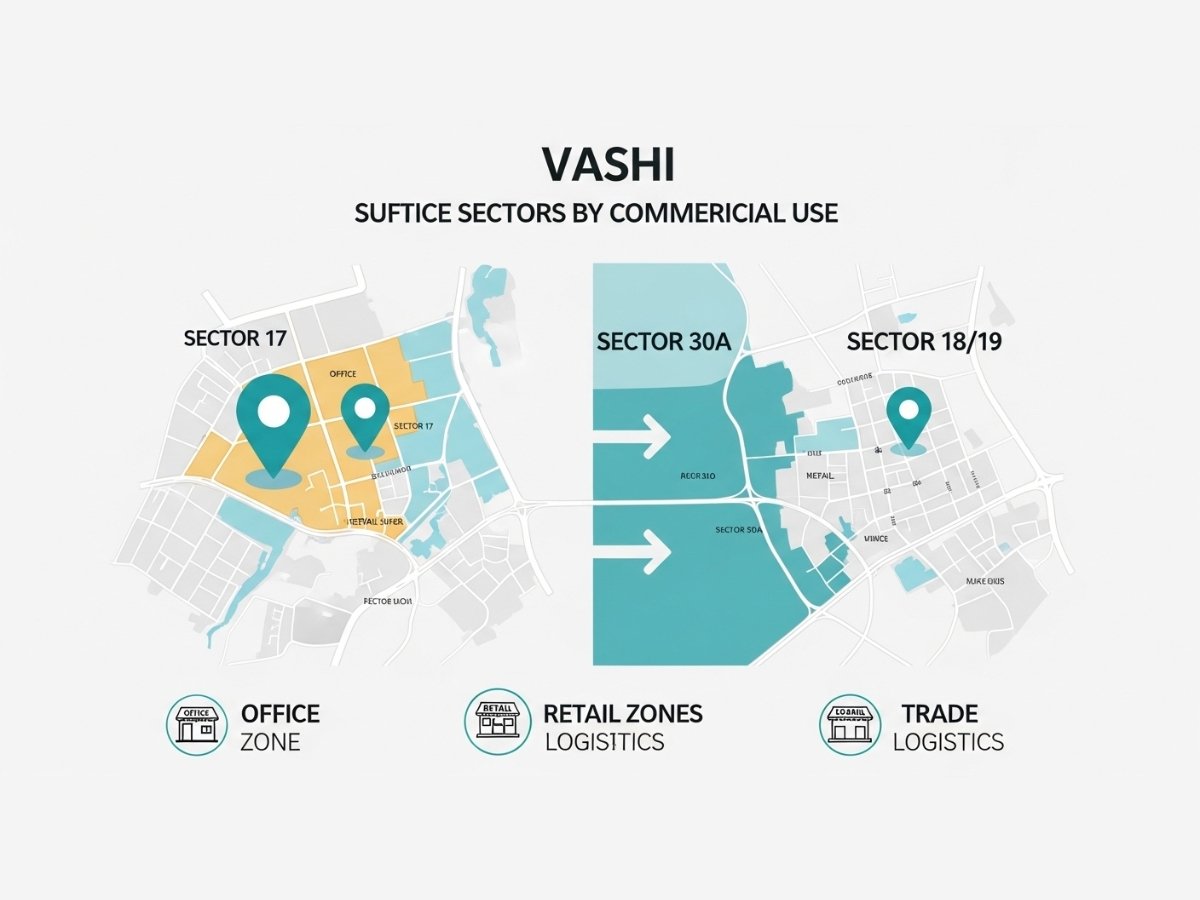
This is the section where most generic articles fail. Vashi only makes sense when you stop treating it as one label and start treating it as multiple sub-markets.
Station-linked commercial demand
The station-linked office story matters most around Sector 30A and the broader Vashi station commercial ecosystem. This zone works because daily commuting is easier. That matters more than many buyers realise.
For office occupiers, true walkable access to Vashi railway station reduces employee fatigue, makes client visits simpler, and supports better tenant absorption. A unit that is actually walkable can outperform another unit that is technically “near the station” but still needs secondary transport.
This area suits:
- corporate branch offices
- IT support teams
- consultants
- back offices
- firms with regular staff movement
- occupiers who care about brand presentation and commute convenience
The Vashi Railway Station Commercial Complex ecosystem also has a special management context through VRSCCL. That makes it important to check facility management, structural upkeep responsibility, and estate handling instead of assuming a standard building-management situation.
Sector-level road-facing and business-use logic
Sector 17 is the stronger answer for businesses that need visibility, local recognition, and pedestrian movement. It suits boutique clinics, salons, jewellery stores, branded service outlets, local finance offices, and selected retail concepts.
Sector 18 and 19, near the APMC-side ecosystem, behave differently. They are more trade-linked and movement-linked. These pockets fit wholesale, supply-chain, storage-linked, and distribution-oriented businesses far better than image-driven office users.
Pocket logic table
| Sector / Pocket | Best suited for | Weakest for | Main value driver |
|---|---|---|---|
| Sector 17 | High-street retail, clinics, salons, local consultants | Large corporate office users, heavy logistics | Footfall, visibility, local familiarity |
| Sector 30A | Office users, corporate branches, service firms | Walk-in retail dependent businesses | Station-linked commute ease, business infrastructure |
| Sector 18/19 | Wholesale trade, APMC-linked activity, supply businesses | Premium client-facing office image | Vehicular access and trade ecosystem |
This is why saying “commercial property in Vashi” is not enough. A coaching centre, a back office, and a street-facing retailer should not be shopping in the same way.
Who should buy commercial property in Vashi, and who is usually better off leasing?
Buying and leasing solve different problems.
If your business is stable, long-term, and location-dependent, buying can make sense. If your business model may change, your team may expand fast, or your format is still being tested, leasing is usually safer.
Commercial borrowing itself is not cheap. Loan rates may sit around roughly 8.00% to 12.05%, and loan-to-value usually stays around 70% to 75%. Add CIDCO transfer costs, fit-out, taxes, and working capital pressure, and the decision becomes more serious.
Buying usually suits:
- established CA, legal, or consulting firms wanting long-term address control
- stable clinics or diagnostic users needing location permanence
- strong retailers with proven local demand
- investors buying carefully underwritten pre-leased stock
- businesses that want to avoid future rent escalation and relocation friction
Leasing usually suits:
- startups and young businesses
- coaching institutes testing a catchment
- retailers checking whether a frontage actually converts
- back offices with uncertain team size
- businesses that want flexibility more than ownership
A simple practical rule: if you cannot confidently see yourself using that space for many years, locking capital into purchase may be the wrong move.
What makes one Vashi commercial property expensive while another struggles, even inside the same node?
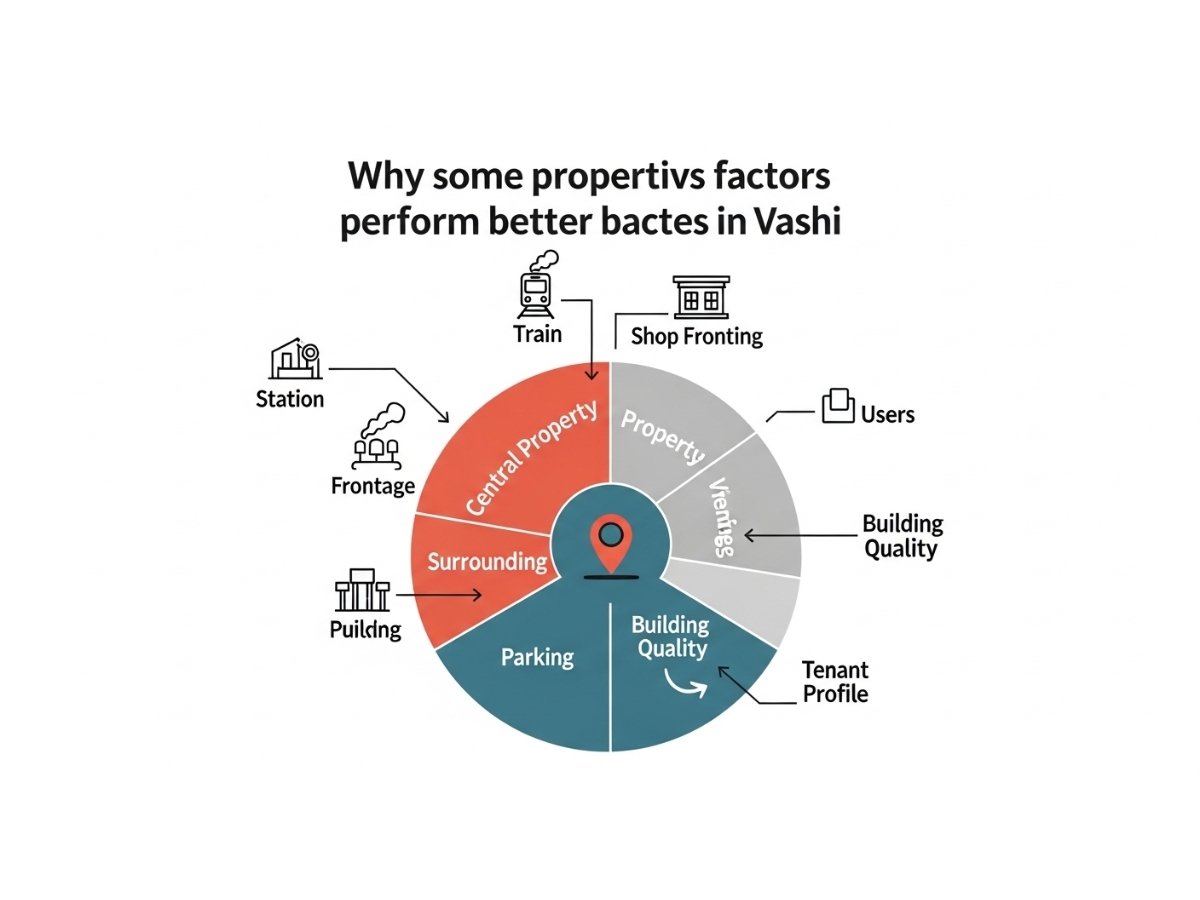
Because Vashi pricing is not about the pin code alone. It is about operational efficiency.
Station access and walkability
One office may lease faster simply because staff can walk from the station without hassle. That difference becomes even more important for companies hiring from multiple parts of Mumbai and Navi Mumbai.
Visibility, frontage and floor position
A retail unit with clear road exposure and live signage value behaves very differently from a recessed unit inside the same complex. In retail, dead frontage can destroy value.
Building age, parking and maintenance quality
A property may look cheap on paper because the building is carrying hidden friction: weak maintenance, poor lift service, aging common areas, low ceiling appeal, or no sensible parking arrangement. In Vashi, parking is not a small issue. In some commercial stretches it directly affects leasing, customer experience, and resale.
Tenant profile and business usability
Plug-and-play offices can command stronger pricing because they reduce setup time. Bare-shell stock may look cheaper, but the user may end up spending heavily before operations even begin. Similarly, a shop with high branding visibility may justify a premium if the business type can actually convert that visibility into revenue.
Are older Vashi commercial buildings still worth buying, or are they becoming riskier?
Both things are true.
Older Vashi commercial buildings are still workable in many cases. They often sit in excellent known locations, have strong address familiarity, and may offer lower entry points than newer stock. For a local consultant, clinic, back office, or coaching operator, that can be enough.
But they are undeniably becoming riskier for passive investors and premium occupiers.
The risks are practical:
- tired lifts and common areas
- outdated layouts
- lower parking comfort
- higher future maintenance burden
- weaker corporate tenant retention
- legal friction around mezzanines and structural changes
- redevelopment uncertainty
CIDCO’s redevelopment consent threshold shifting to 51% instead of 100% has made old stock more interesting on paper. But that should not be treated as an automatic redevelopment jackpot. Vashi also carries the legacy FSI issue in some older commercial belts, especially where historical approvals and current NMMC redevelopment parameters do not align cleanly. So yes, there can be speculative value. But no, it is not simple.
What should office users check before choosing a property in Vashi?
Office users should stop asking only, “Is this in Vashi?” The better question is, “Will this space actually work for staff, clients, and daily operations?”
Staff commute and station dependence
If the office depends on junior staff, support teams, or frequent hires, station-linked usability matters a lot. A property that requires awkward second-leg travel may look fine in a brochure but feel painful every day.
Lift, parking, common area quality and client impression
In office property, these details change the actual experience. A client may forgive an older building if it is functional, clean, and easy to access. They will not forgive chaos, poor common areas, or broken vertical circulation.
Floor plate practicality and business image
A law office, CA firm, or professional consultancy may do well in an older but well-kept building with a strong known address. A modern service business trying to impress institutional clients may need better infrastructure and a more formal arrival experience.
Office-user checklist
- Is the station walk genuinely easy, or only “map-close”?
- How reliable are lifts during peak hours?
- Is there dedicated parking or only public dependency?
- Are the common areas clean and professionally managed?
- Does the floor plate suit cabins, meeting rooms, and workflow?
- Is the business image aligned with your client base?
- Are CAM charges reasonable for what the building actually delivers?
What should retail buyers and tenants check before taking a shop or showroom in Vashi?
Retail success in Vashi is about conversion, not just movement.
Footfall is not the same as conversion
A busy road, crowded stretch, or famous market name does not automatically create sales. The question is whether the customer can see you, pause, enter easily, and transact comfortably.
A clinic, optical store, mobile accessory shop, or premium salon may all need visibility, but they do not all need the same type of visibility. Some rely on daily convenience catchment. Others need destination-driven trust.
Frontage, signage visibility and approach
A strong retail unit should be judged on:
- visible signage
- easy recognition from the actual traffic direction
- frontage clarity
- customer stopping convenience
- whether the unit is buried, recessed, or blocked by other structures
Daily convenience demand vs destination retail demand
This is a key Vashi filter. Daily-convenience retail works better in active local movement belts. Destination retail can work even on faster roads if the category is strong enough, such as branded showrooms or specialist service formats. Palm Beach Road-side visibility may help branding, but it does not automatically create impulse buying because high-speed traffic and pause friction reduce spontaneous conversion.
A retailer should also verify that any mezzanine or internal structural extension is legally regularised. In older Vashi stock, this is not a minor paperwork issue. It can become a major municipal risk.
How should investors judge rental income, resale potential, and vacancy risk in Vashi?
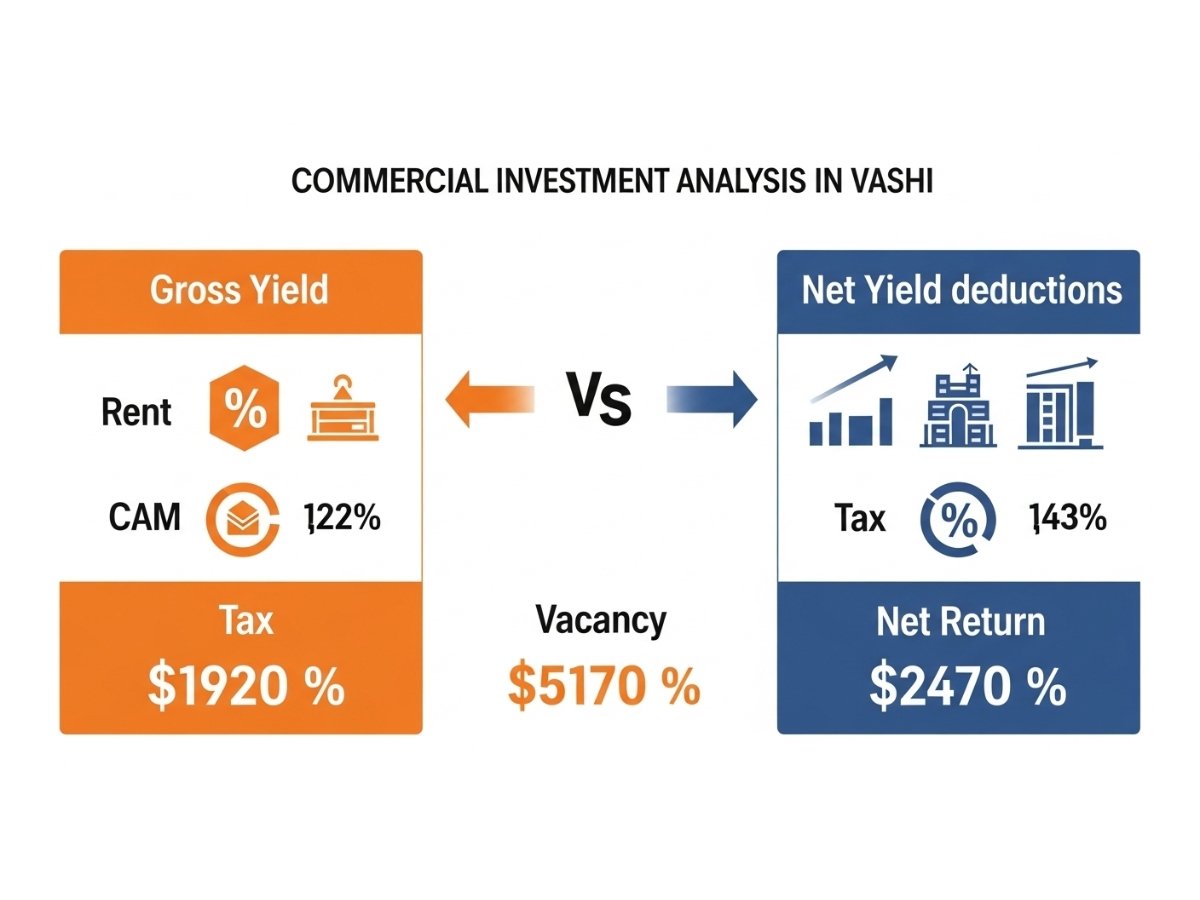
Investors need to be much more careful than marketing brochures suggest.
Vashi can produce sensible commercial income, but the biggest trap is confusing gross yield with net yield. Gross commercial rental yields are often spoken about in the 4% to 8% range for standard assets and around 8% to 10% in stronger Grade-A office situations. But net returns are a different story.
High CAM in Grade-A stock can run around ₹10 to ₹15+ per sq ft monthly. In older stock it may be lower, say around ₹4 to ₹8, but then building quality is also lower. On top of that, NMMC commercial property tax is heavier than residential, and CIDCO transfer costs must be considered in acquisition math.
A property marketed at an 8% gross return can fall sharply after taxes, CAM, vacancy allowance, and transfer cost amortisation are properly modeled.
Small-ticket investors also need to be careful. Cheap-looking strata units in weak buildings often feel affordable but may be difficult to lease, difficult to resell, and too dependent on one narrow tenant segment.
For investors, the better questions are:
- how deep is the tenant pool for this exact unit type?
- how fast can this be re-leased if the tenant leaves?
- are net returns still sensible after all holding costs?
- is the exit dependent on hype or on real usability?
What legal, authority, and document checks matter before buying commercial property in Vashi?
This is one of the most important parts of the Vashi Commercial Property Guide because the market does not operate like a simple freehold market in many other cities.
CIDCO leasehold and transfer context where applicable
Much of Vashi exists within the CIDCO leasehold ecosystem. That means the buyer is usually dealing with transfer of leasehold rights, not a simple absolute freehold sale. The CIDCO transfer process matters.
At a practical level, buyers should understand the relevance of the transfer framework involving Annexure A, Annexure B, and Annexure C, along with official NOC handling and liability transfer logic. Recent hikes in transfer charges have materially increased acquisition friction, especially in larger or more complex assets. This cost should be modeled before committing.
Building approvals, occupancy and usage clarity
Buyers must cross-check sanctioned plans, occupancy position, and actual present use. A shop sold as “commercial” is not automatically safe just because a broker says so. Mezzanines, enclosed extensions, or unapproved structural changes can create serious risk, especially in older stock.
MahaRERA relevance for newer inventory where applicable
MahaRERA matters where the inventory is newer, launched under RERA, or still within a formal project structure. It should not be forced into every Vashi deal. But where it applies, it can help confirm project approvals and disclosures.
IGR Maharashtra as a reference, not blind truth
IGR rates and official values can be used as a benchmark, not as final truth. They may help anchor pricing logic, but real transactable value in Vashi depends heavily on fit-out status, micro-location, frontage, floor position, building age, and parking reality.
What are the biggest mistakes people make when they buy or lease in Vashi just because it is “prime”?
The biggest mistake is paying for the Vashi name without checking whether the exact property actually works.
Common errors include:
- buying office space in a tired building just because the address sounds strong
- paying retail premium for a unit with weak frontage or hidden approach
- assuming station proximity automatically means success
- ignoring parking pain in high-density pockets
- paying for mezzanine area without verifying regularisation
- evaluating gross yield without tax, CAM, and transfer costs
- confusing APMC-side utility units or galas with proper retail-grade property
- assuming older stock will surely redevelop smoothly
This is where many small investors lose money. Vashi is strong, but it does not forgive lazy filtering.
So, what kind of Vashi commercial property suits what kind of buyer, tenant, or investor?
The answer depends on fit, not hype.
| User type | Usually best-fit Vashi property | Why it suits |
|---|---|---|
| CA, lawyer, consultant | Known office building in a convenient business pocket | Stable address value, manageable daily operations |
| Clinic or diagnostic service | Visible, easily accessible commercial unit in active local movement zone | Trust, accessibility, repeat customer convenience |
| Coaching setup | Lease-first approach in catchment-friendly office/commercial stock | Demand testing matters before purchase |
| Back office / support team | Station-linked office space, especially around Sector 30A type logic | Commute ease matters for hiring and retention |
| Street-facing retailer | Strong frontage retail in active local stretch such as Sector 17-type environment | Conversion depends on visibility and walk-in usability |
| Passive investor | Pre-leased, well-managed office stock with sensible net math | Better predictability than blindly chasing retail upside |
| Small-ticket investor | Only selective units with proven reletting depth | Avoid dead capital in weak strata stock |
The best Vashi commercial property is not the most expensive one. It is the one whose location, building type, legal condition, and daily usability match the exact user.
You may also want to read Vashi Commercial Rates, Rents and Market Trend for a better sense of current market movement
Conclusion
Vashi is still one of Navi Mumbai’s strongest commercial locations, but it is not a one-size-fits-all market. It works best when you match the right user to the right sub-market: office users to transit-efficient business stock, retailers to real visibility zones, and investors to assets with honest net-income math and reletting depth. If you buy or lease in Vashi only because it sounds prime, you may overpay. If you filter properly by sector logic, building age, parking, legality, and daily usability, Vashi can still be one of the most practical commercial bets in Navi Mumbai.
FAQs
Frequently Asked Questions