

Taloja MIDC Industrial Property: Hidden Costs of Truck Movement, Utilities & Road Access
In Taloja MIDC, road access, CETP fit, utilities, and truck movement often matter more than the quoted rate. A cheaper plot, shed, or unit can become costlier to run if trucks cannot enter properly, water is unreliable, sanctioned power is weak, or the property is the wrong fit for CETP-linked operations. That is the real answer. In this market, industrial usability usually decides long-term value more than the headline price does.
Many pages about industrial property stop at “good connectivity” or “MIDC infrastructure available.” That is not enough for Taloja. Here, the actual decision is more practical: can your business run smoothly from this exact location, under this exact infrastructure setup, without daily friction, avoidable delay, or compliance stress?
That is why Taloja MIDC should be judged like an operating system, not just an industrial address. Road entry, CETP dependence, water and power readiness, and daily truck movement all directly affect dispatch speed, staff movement, production continuity, and even tenant retention. If any one of these is weak, the property can underperform badly even when the entry price looks attractive.
Quick Summary: What Actually Matters Most in Taloja MIDC
| Factor | What it changes in real life | Who should care most | First thing to verify |
|---|---|---|---|
| Road access | Entry speed, loading ease, shift timing, dispatch reliability | Warehousing, fabrication, frequent-dispatch units | Full approach route to the gate, not just map distance |
| CETP fit | Whether a process-heavy unit is practically and compliantly usable | Chemical, pharma, wet-process industries | Plot-level treatment space, pipeline linkage, old tank condition |
| Utilities | Daily continuity and hidden running cost | Water-heavy and power-heavy occupiers | Storage, supply pattern, sanctioned load, drainage |
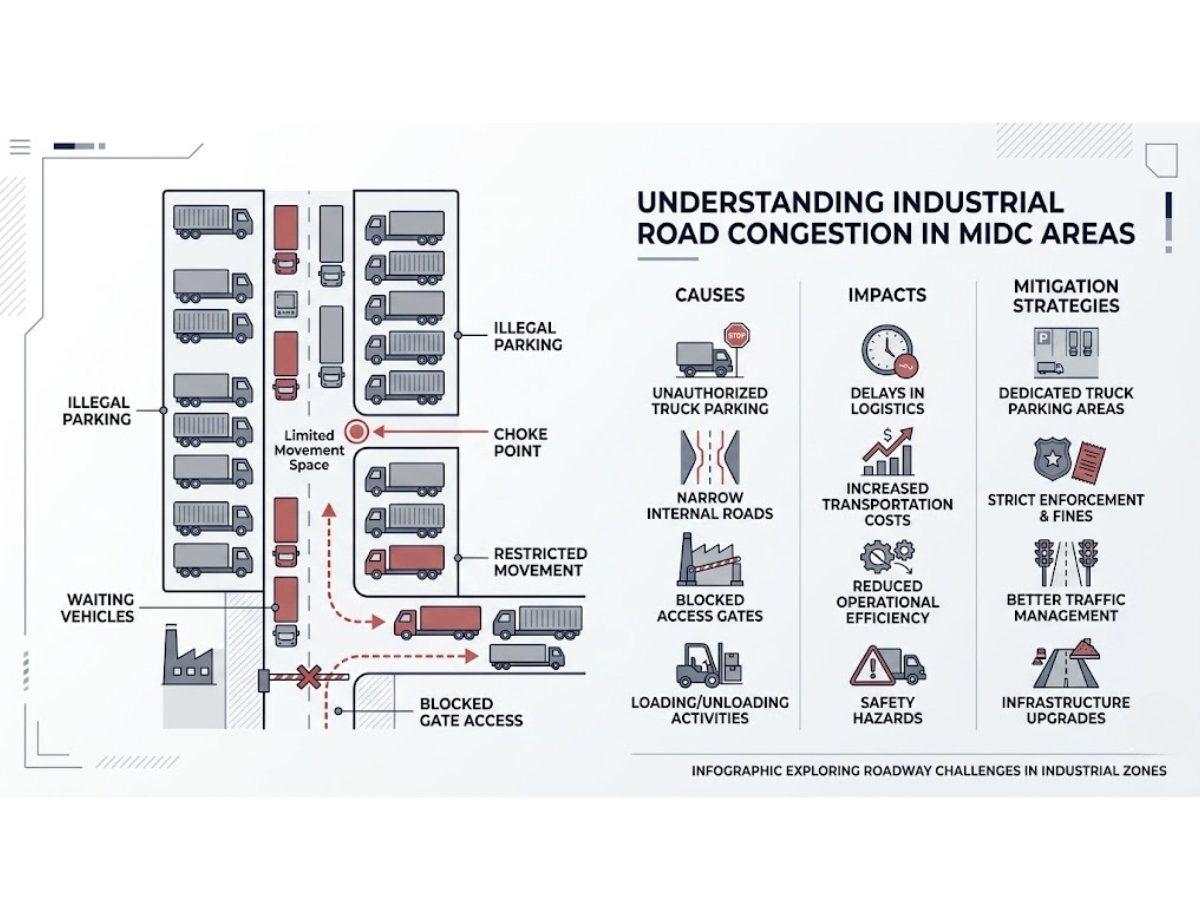
| Truck movement | Safety, blockage risk, loading time, worker commute | Logistics, manufacturing, deep internal plots | Standing trucks, turning radius, queue pressure near the gate |
Taloja MIDC is not one uniform industrial market, and these four factors often matter more than the quoted rate
One of the biggest mistakes in Taloja MIDC is assuming that all industrial stock behaves the same. It does not. Some pockets are operationally easier because roads are more usable, movement is cleaner, and utilities are less stressful. Other pockets may look cheaper only because everyday friction is higher.
That is especially important in Taloja because the market is not just one flat industrial zone. It has older and newer pockets, chemical-heavy stretches, engineering-oriented stock, deeper internal roads, peripheral access advantages, and different levels of infrastructure strain. So the question is never only “What is the rate?” The better question is “What will this property cost me to operate after I take possession?”
This is where many buyers, tenants, and even investors get trapped. A shed quoted at a lower rent can still be the weaker option if it depends on tanker water, has poor turning room, sits in a truck-pressure pocket, or is unsuitable for the level of treatment and compliance the business needs. In Taloja MIDC, true value is often decided by resilience, not by brochure price.
Why road access in Taloja MIDC should be judged by entry friction, not map distance
Map distance is a weak industrial metric. A unit may look close to a highway or a major road, but that does not automatically mean it is easy to operate from.
In industrial use, road access should be judged by friction. How long does it take to move from the main corridor to the gate? What happens at the junctions? Can a loaded vehicle enter without blocking the road? Can employees reach on time during peak movement hours? These are the real questions.
Taloja’s external access story is also still shaped by ongoing infrastructure work. The wider corridor has seen sanctioned and ongoing road projects meant to improve industrial movement. That itself tells you something important: access in and around this belt has long been operationally significant enough to need improvement. So you should not assume that every route performs equally well just because the area is marked as “connected.”
Main approach road versus internal industrial road
A property may have decent macro access but still fail on the last stretch. That last stretch matters more than most brochures admit.
The industrial user does not operate on the highway. The user operates at the gate. If the internal road is narrow in practice, damaged, poorly drained, or routinely blocked by standing heavy vehicles, the actual advantage of the location falls quickly.
This is why internal road quality matters so much in Taloja MIDC. There has been targeted focus on older blocks where deep internal road condition has affected industrial usability. For a factory, that means turnaround time, delivery discipline, vehicle wear, and operator frustration. For an investor, it means weaker tenant comfort and higher churn risk.
Junction delay, truck turning, loading-gate entry, and reversing space
This is where industrial reality becomes visible. A location can look strong on paper and still be awkward on ground.
If a truck has to wait outside for too long, reverse in multiple moves, or partially block the lane during loading, the property is operationally weaker than the rate suggests. Even a small entry issue gets amplified in daily use.
A simple example makes this clear. Suppose Unit A is slightly farther from the main access spine but has a wider gate, better turning clearance, and less standing truck pressure nearby. Unit B is marginally closer on the map but sits near a choke point where vehicles often line up. For most dispatch-heavy occupiers, Unit A is usually the better industrial decision even if the rent is higher.
How CETP fit changes whether a Taloja MIDC unit is operationally workable or legally stressful
In Taloja MIDC, CETP is not just an infrastructure line in a brochure. For the wrong business in the wrong unit, it can become the difference between stable operation and constant stress.
Taloja’s CETP system has a designed capacity of 22.5 MLD, with Phase I and Phase II forming the main operating base, and expansion activity also forming part of the broader infrastructure story. That matters because process-heavy users do not just need a property. They need a property that can realistically sit inside the effluent-handling and compliance framework of the zone.
Which users are CETP-dependent and which are less dependent
Not every occupier should give CETP the same weight.
If the business is chemical, pharma, formulation-based, or wet-process in nature, CETP fit becomes central. If the business is dry engineering, fabrication, assembly, storage, or standard warehousing, CETP may be much less important than road movement, power sanction, and shed usability.
This is where real confusion happens. People hear “CETP available” and assume that solves the problem. It does not. CETP relevance depends on what the business produces, how much effluent it generates, and whether the plot can support the required on-site handling before discharge.
Pipeline connection, pre-treatment, disposal comfort, and expansion logic
A CETP connection in the area does not mean the individual unit is ready.
For process-heavy operations, the important question is whether the plot has enough space and layout logic for primary treatment, holding, and safe operational flow. Taloja’s compliance history has shown that inlet quality is not a casual issue. That means businesses cannot treat CETP like a free pass. They have to think about their own treatment responsibility at plot level as well.
This is why a small, cheap unit in the wrong configuration can become unusable for a chemical occupier. Even if it is physically close to the collection network, it may still be operationally weak if it lacks treatment footprint, proper tank setup, or practical room for future compliance strengthening. In that situation, the low entry price stops mattering.
Which utilities in Taloja MIDC affect day-to-day performance the most
Utilities should never be read like a marketing checklist. “Water and power available” is too vague to be useful in Taloja MIDC.
The actual question is about quantity, pressure, sanction, storage, reliability, and backup cost. This is where the difference between area-level infrastructure and plot-level readiness becomes very important.
Water for process-heavy versus low-water users
Taloja has faced a structural water deficit. Industrial demand has been higher than actual supply, which has pushed many units to depend on private tanker procurement during stressed periods. That changes the economics of a property quickly.
For a low-water engineering or storage unit, the pain may be manageable. For a water-heavy process unit, it can be serious. If a factory needs large daily volumes and has weak underground storage, poor refill pattern, or end-of-line pressure issues, the problem is not theoretical. It becomes a monthly cost and sometimes even a production constraint.
This is why underground storage capacity matters more than many first-time buyers think. A property with stronger water storage and better operating comfort may justify a higher rate because it reduces the risk of emergency procurement and production disruption.
Power load, drainage, fire-readiness, and basic service reliability
Power is the second major utility filter. Taloja generally has stronger power support than water support, but that still does not mean every unit is ready for every machine profile.
A dormant shed with a low sanctioned load may not suit a heavy engineering or machinery-based occupier without time-consuming upgrades. That is a real start-up delay. Many tenants underestimate this and assume the load increase is a quick formality. It often is not.
Drainage and fire-readiness matter too, especially in monsoon-sensitive pockets or for units dealing with sensitive raw materials. A plot can be located in a recognized industrial area and still have weak practical drainage or poor on-ground readiness. Again, the market lesson is simple: area-level availability is not the same as property-level usability.
How truck movement affects dispatch time, labour discipline, safety, and even customer confidence
Truck movement in Taloja MIDC is not a side issue. It shapes daily operations in a very direct way.
The wider Panvel-Taloja belt handles a large heavy-vehicle load, and local planning and survey work has long treated truck movement as a serious operational subject in this region. That matters because unmanaged heavy vehicle standing does not only slow cargo. It changes the everyday feel of the industrial road itself.
Queueing, illegal parking, choke points, and internal road blockage
Once trucks begin standing along internal roads or near operational gates, the usable width of the road drops sharply. A road that looks fine on a quiet visit can feel completely different during active business hours.
This creates a chain reaction. Vehicles wait longer, loading becomes awkward, supplier timing slips, staff movement becomes less disciplined, and gate-side safety drops. A manufacturing unit that does not think of itself as “logistics-heavy” can still lose time every single day because truck behavior around it is unmanaged.
Why truck issues can hurt even non-logistics factories
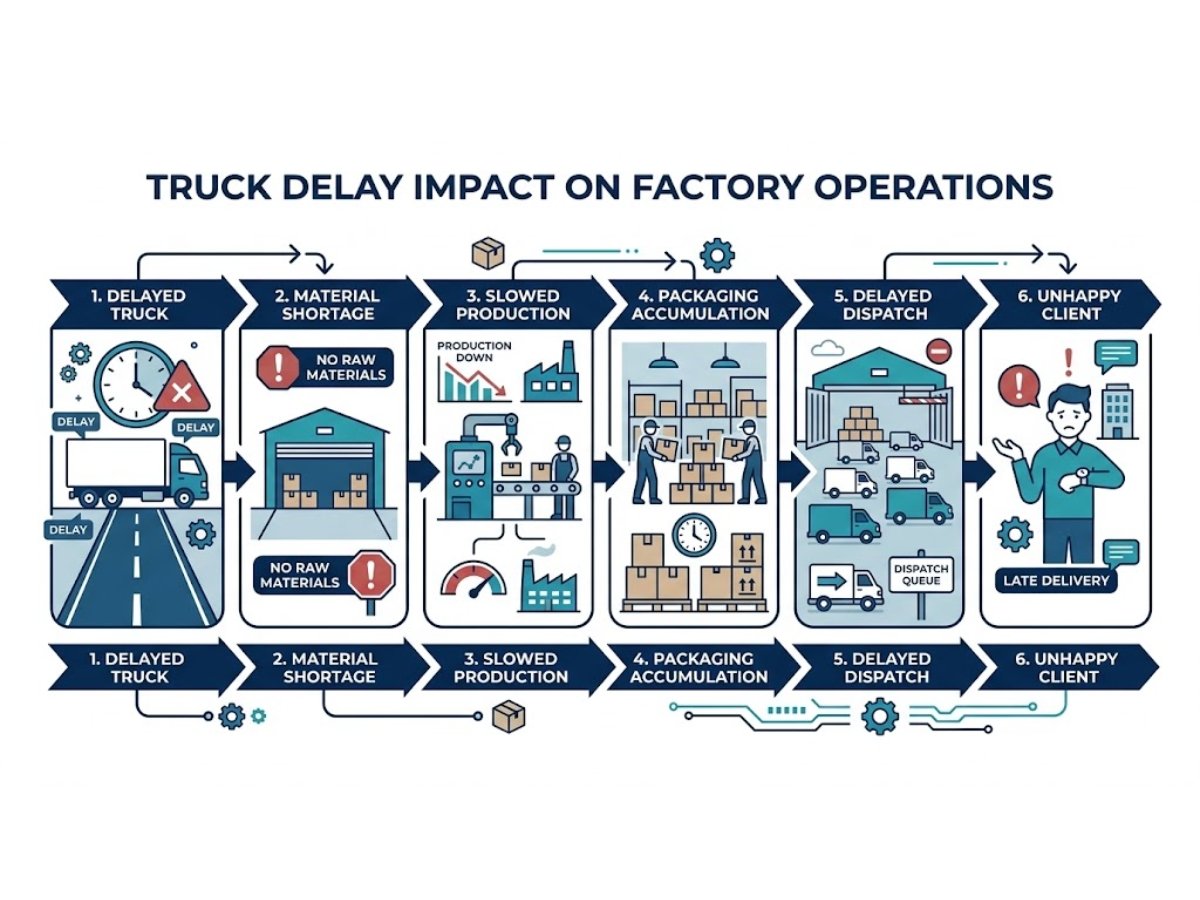
This is where the hidden cost appears. A non-logistics factory may still suffer from truck friction because raw materials arrive late, finished goods dispatch takes longer, and even visitors form a poor impression of the location. Customer confidence is part of industrial usability too.
The truck terminus story in the belt is relevant here. A planned large truck parking facility has been part of the long-running effort to reduce standing truck pressure, but infrastructure rollout timelines should always be read cautiously. The practical position today is not “problem solved.” The practical position is that truck pressure remains a real site-level due diligence factor.
Why a lower rate per sq ft can be the wrong deal in Taloja MIDC
This is the most important commercial lesson in the entire article.
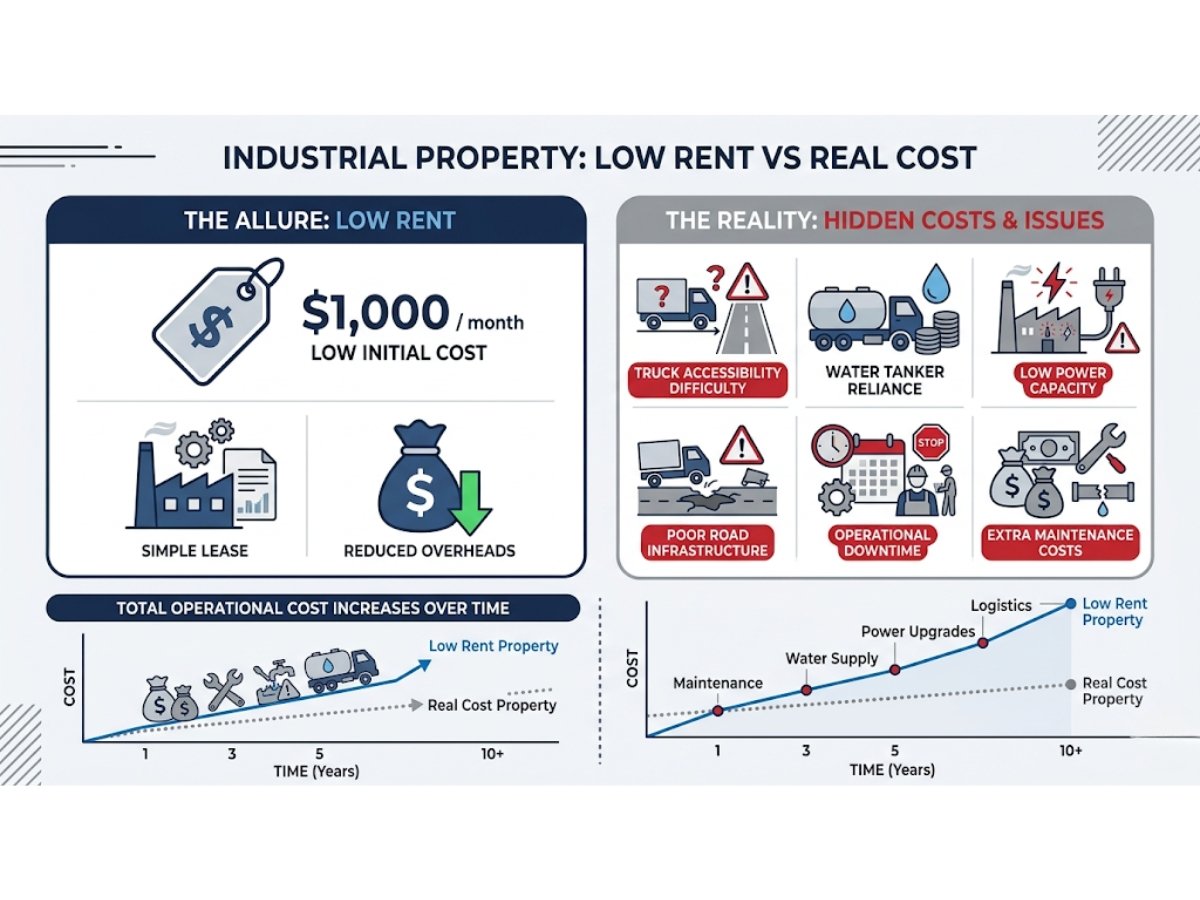
A lower rate can be the wrong deal if the property creates permanent operating drag. In Taloja MIDC, that drag usually comes from four places: movement friction, water stress, compliance mismatch, or utility mismatch.
Imagine a shed quoted at a clearly attractive rent in a deeper internal pocket. On paper, it looks like a bargain. But after occupation, the tenant discovers that trucks struggle to reverse at the gate, tanker support becomes frequent in dry periods, the old power sanction is too low for the intended machinery, and the internal road condition slows loading during monsoon months. The savings disappear.
That is why industrial pricing in Taloja should always be read with operational context. Cheap stock is not always bad. But cheap stock without infrastructure fit usually becomes expensive through time, delay, and workaround cost.
Which business types should put road access first, and which should put CETP or utilities first
Different businesses should read Taloja MIDC differently.
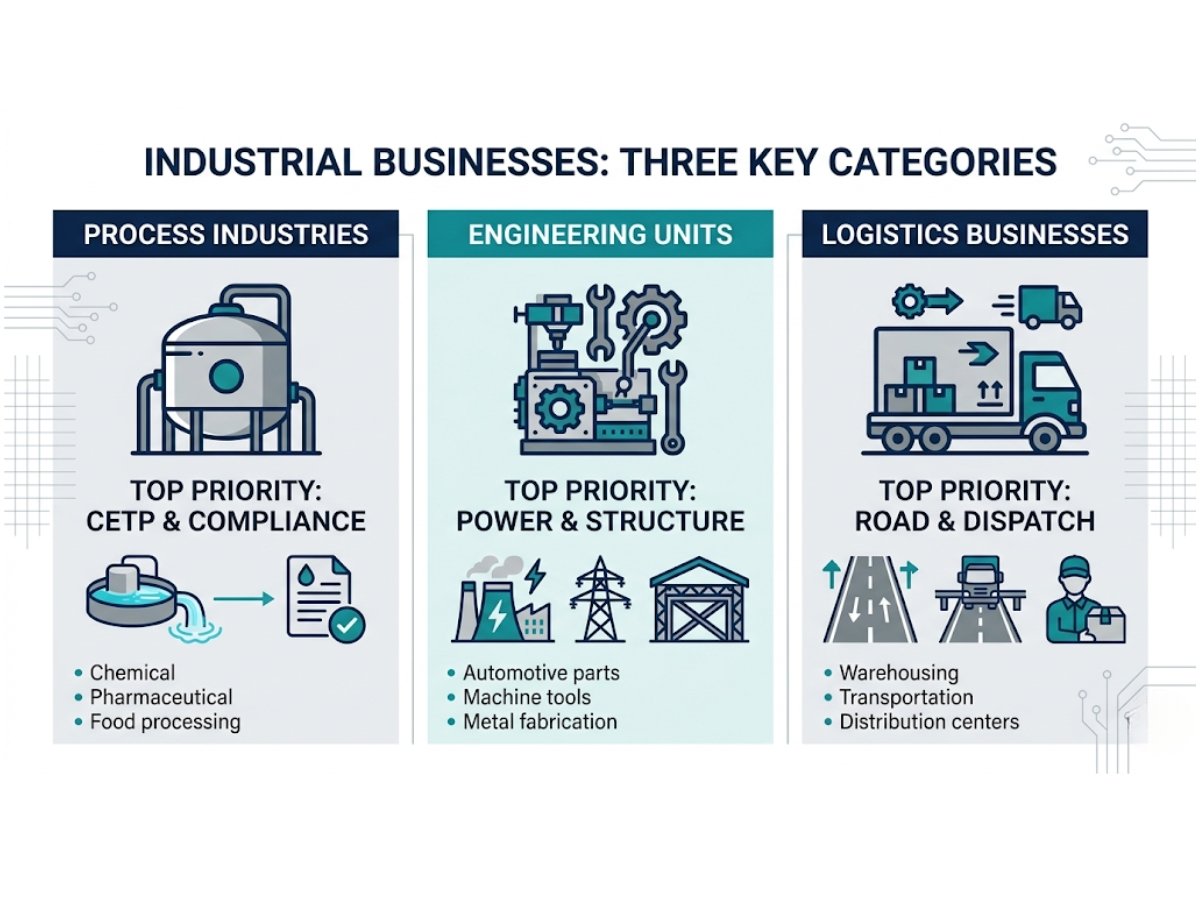
Chemical, petrochemical, pharma, and wet-process units should usually put CETP fit, treatment footprint, water handling, and compliance comfort first. For them, legal-operational viability matters more than map glamour.
Heavy engineering, fabrication, machining, and crane-dependent users should usually put power sanction, structural readiness, internal movement width, and loading comfort first. Their pain usually comes from physical operation, not from CETP.
Warehousing, 3PL, FMCG, and fast-dispatch businesses should usually put road access, quick gate entry, plinth practicality, and freedom from standing truck blockage first. For them, velocity is the business.
Passive investors should be more careful than they often are. If the asset is operationally awkward, it may attract weaker tenants, more vacancy, and lower long-term comfort in resale or leasing. In industrial property, tenant quality follows infrastructure logic more than surface-level marketing.
What to check during the first site visit before shortlisting any Taloja MIDC plot, shed, or unit
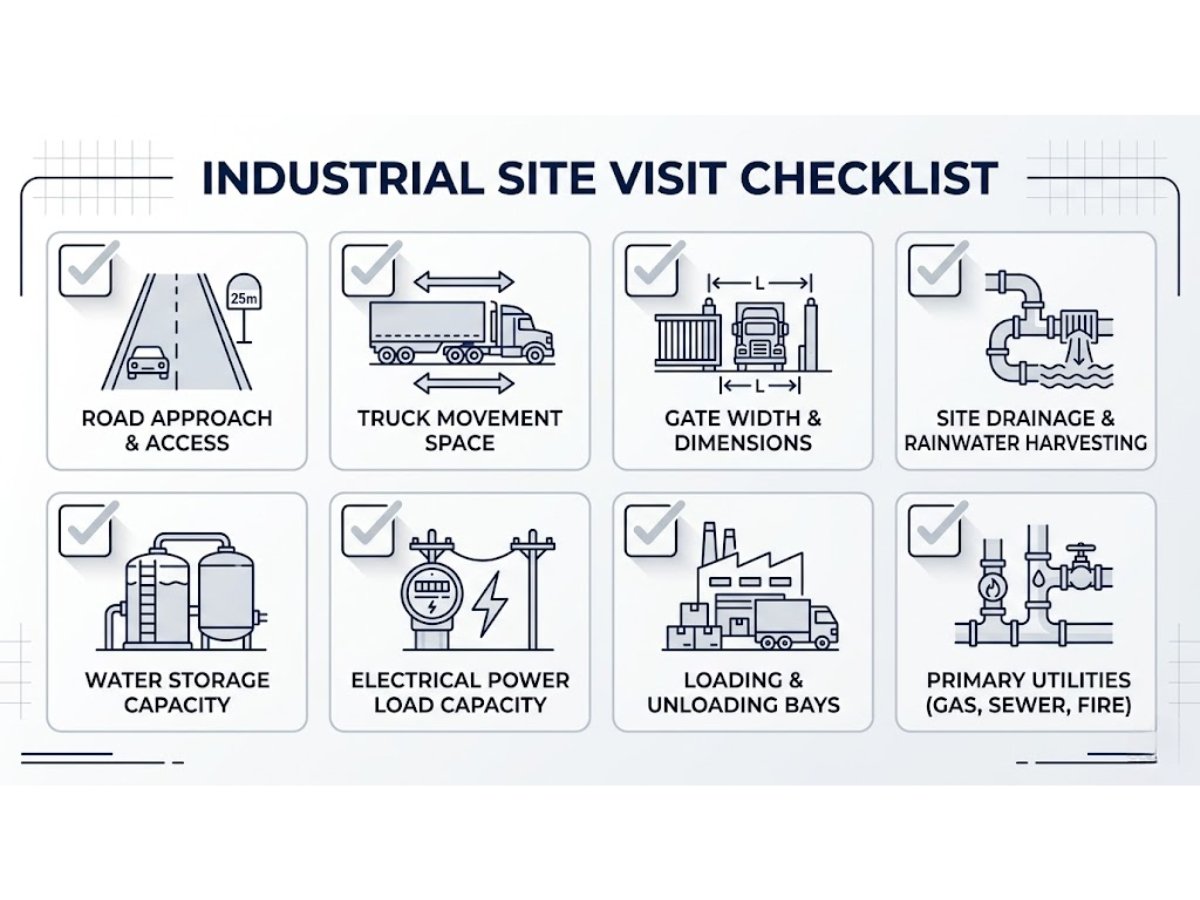
Do not do the first site visit like a brochure inspection. Do it like a pressure test.
On-ground site visit checklist
- Visit during an actual working window, not only on Sunday or late evening.
- Drive the full approach route from the main road to the property gate.
- Watch whether trucks are already standing outside or along the lane.
- Check the exact gate width and the open space directly opposite the gate.
- Ask how a 32-foot or 40-foot vehicle will enter, turn, wait, and reverse.
- Inspect storm-water drains and look for signs of waterlogging.
- Verify underground water storage, not just “MIDC water available.”
- Ask for recent electricity bills and sanctioned load proof.
- For process-heavy units, inspect tanks, treatment area, and effluent-handling footprint.
- Observe the surrounding activity pattern. The neighborhood should support your operation, not choke it.
This one checklist can save months of regret. In Taloja MIDC, the site visit matters because many of the real problems are visible only on the ground.
Red flags that sellers, brokers, and casual site tours often underplay in Taloja MIDC
The first red flag is “CETP connection available.” That line sounds reassuring but can hide the real issue. The real issue is whether the unit is actually workable for your process and whether the plot-level treatment setup is viable.
The second red flag is “ample water supply.” In a belt where water balance has been a structural concern, that claim is incomplete unless it is backed by actual storage, supply pattern, and user-fit volume.
The third red flag is “no truck problem here.” Timing can hide reality. A calm road during a non-working hour can become a daily choke point during normal operations.
The fourth red flag is “good road touch.” In industrial property, frontage is not enough. The road must be usable by the vehicle mix your business depends on.
The fifth red flag is “power can be increased anytime.” Maybe it can. But the real issue is how long it takes, what it costs, and whether that delay affects your production start.
How to compare two Taloja MIDC options without getting fooled by frontage or price alone
Use a simple weighted score instead of pure instinct.
Give each option a score out of 100 based on these four heads:
1. Road and dispatch usability – 30 points Check approach quality, gate movement, turning radius, and standing vehicle pressure.
2. Compliance and CETP fit – 25 points Relevant mainly for process-heavy users. Check whether the plot can actually support the treatment logic your business needs.
3. Utility resilience – 25 points Check water storage, likely tanker dependence, sanctioned load, drainage, and practical readiness.
4. Structural and operating utility – 20 points Check shed condition, crane suitability where relevant, plinth, height, loading comfort, and fit with your specific business.
This kind of scorecard is more useful than “I liked the property” or “the broker said it is a premium pocket.” In Taloja MIDC, the more objective your comparison becomes, the better your final decision usually gets.
Should buyers, tenants, and passive investors read these four factors differently?
Yes, and this is important.
A tenant faces the daily pain first. If water, road movement, or power sanction is weak, the tenant pays immediately through lost time and operating friction.
A buyer-user must think one step longer. The buyer is not just choosing a place to start operations. The buyer is also choosing what future upgrades, compliance costs, and utility strengthening may be needed.
A passive investor should think in terms of tenant stickiness. Will a serious occupier stay here comfortably? Or will the asset keep attracting short-term, price-sensitive users because the infrastructure fit is weak? That single difference can change yield quality and vacancy risk.
So yes, all three should study the same four factors, but the lens is different. Tenants read them as daily operating pain. Buyers read them as long-term capital logic. Investors read them as leasing quality and exit comfort.
Conclusion
Road access, CETP fit, utilities, and truck movement do not just “affect” Taloja MIDC. They decide whether a plot, shed, or unit is actually workable for the business taking it.
That is the key point to remember. In this market, the right property is not the one with the lowest quote or the most attractive pitch. It is the one where the infrastructure logic matches the operating logic of the occupier. If road entry is smooth, utility resilience is practical, CETP dependence is properly matched, and truck movement does not choke the gate, the property usually performs better over time.
So before buying or leasing in Taloja MIDC, do not ask only what the rate is. Ask what the daily friction will be. That question usually leads to the better industrial decision.