
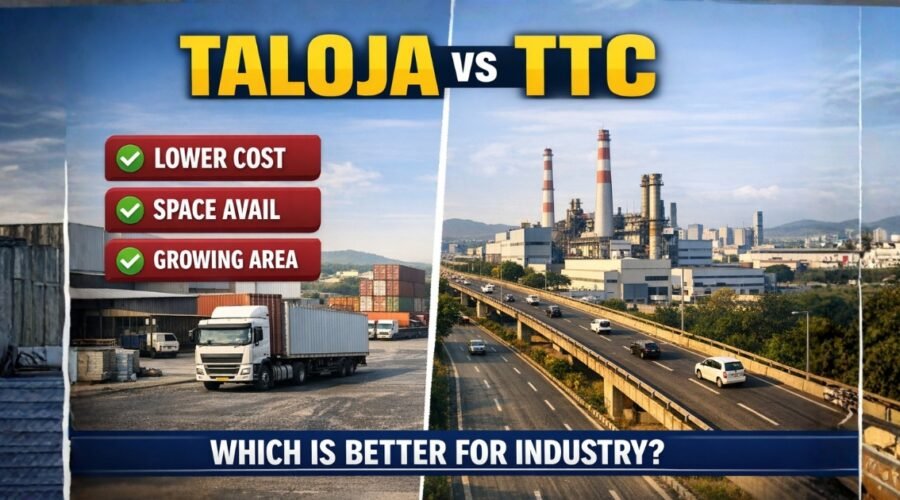
Taloja MIDC vs TTC MIDC for Industrial Users: Which Fits Better?
Taloja MIDC usually fits process-heavy, truck-heavy, land-hungry industrial users better. TTC MIDC usually fits staff-heavy, cleaner, client-facing, or hybrid industrial users better. That is the real answer. This is not a simple “which MIDC is better” question. It is a fit-by-use-case decision, and in Navi Mumbai that difference can change your rent, approvals, staffing, transport cost, and even whether the unit works operationally after you take possession.
If your factory runs on effluent handling, heavy movement, yard space, ground-floor loading, or future expansion, Taloja often makes more sense. If your business runs on manpower, daily commuting, vendor visits, client meetings, cleaner vertical industrial stock, or faster urban access, TTC usually makes more sense. The mistake is choosing by address or quote alone.
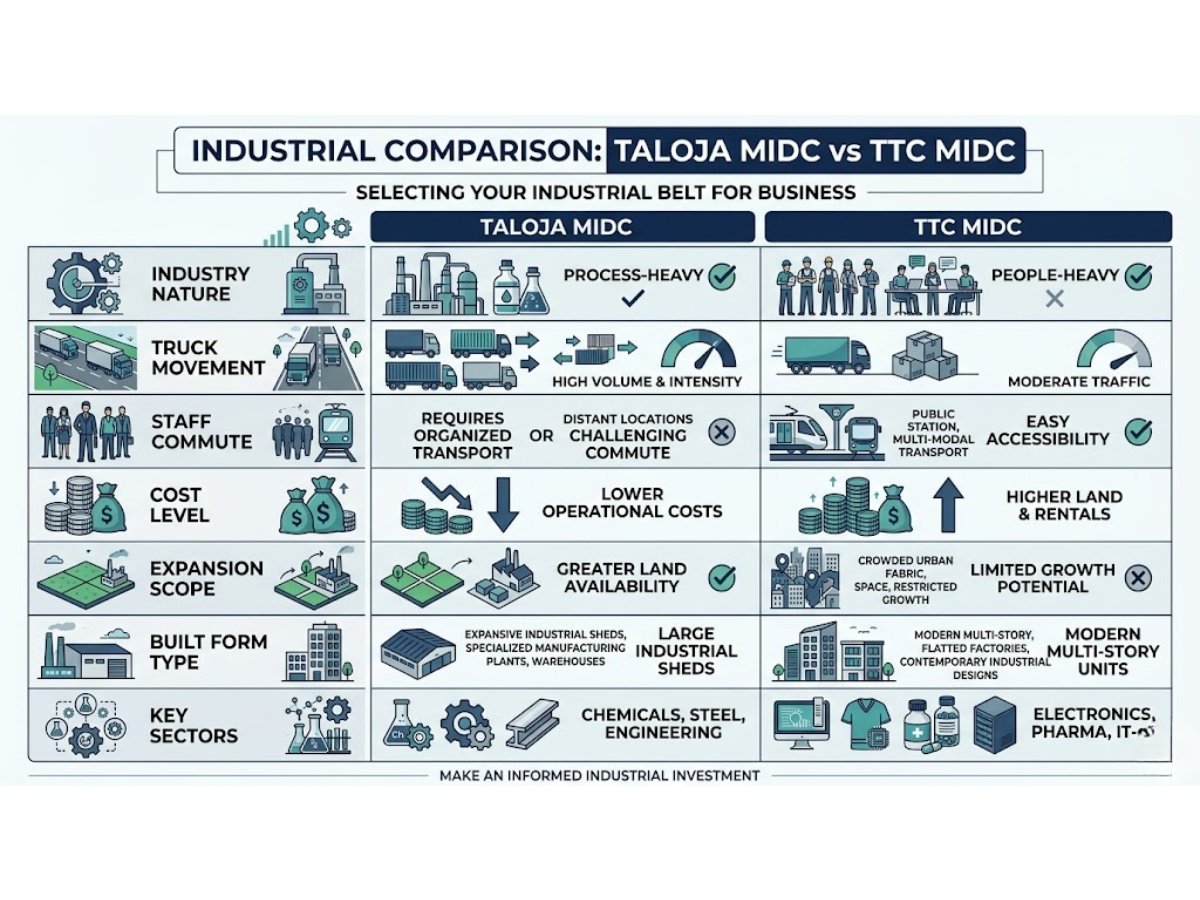
Taloja MIDC or TTC MIDC: which industrial belt fits your use better?
Before going deeper, here is the shortest practical answer.
| Your primary need | Taloja MIDC | TTC MIDC |
|---|---|---|
| Heavy process, chemical, effluent-linked operations | Usually stronger fit | Only selective fit depending on zone and approvals |
| Large plot, yard, trailer movement, crane-heavy workflow | Usually stronger fit | Often limited by built form and congestion |
| Staff commute, railway access, urban convenience | Weaker today because of last-mile gap | Stronger fit |
| Small ready industrial gala or vertical industrial unit | Limited compared to TTC | Stronger fit |
| Clean light assembly, medical device, electronics-style workflow | Can work in some cases | Usually stronger fit |
| Lower base occupancy cost | Usually better | Usually costlier |
| Client-facing or vendor-visit-heavy operation | Often less convenient | Usually better |
| Expansion-led industrial planning | Usually better | Often constrained |
A simple way to think about it is this: TTC is an urban industrial corridor. Taloja is a more horizontal, process-capable industrial belt. Neither is automatically better. The better one is the one that matches how your business actually runs from Monday to Saturday.
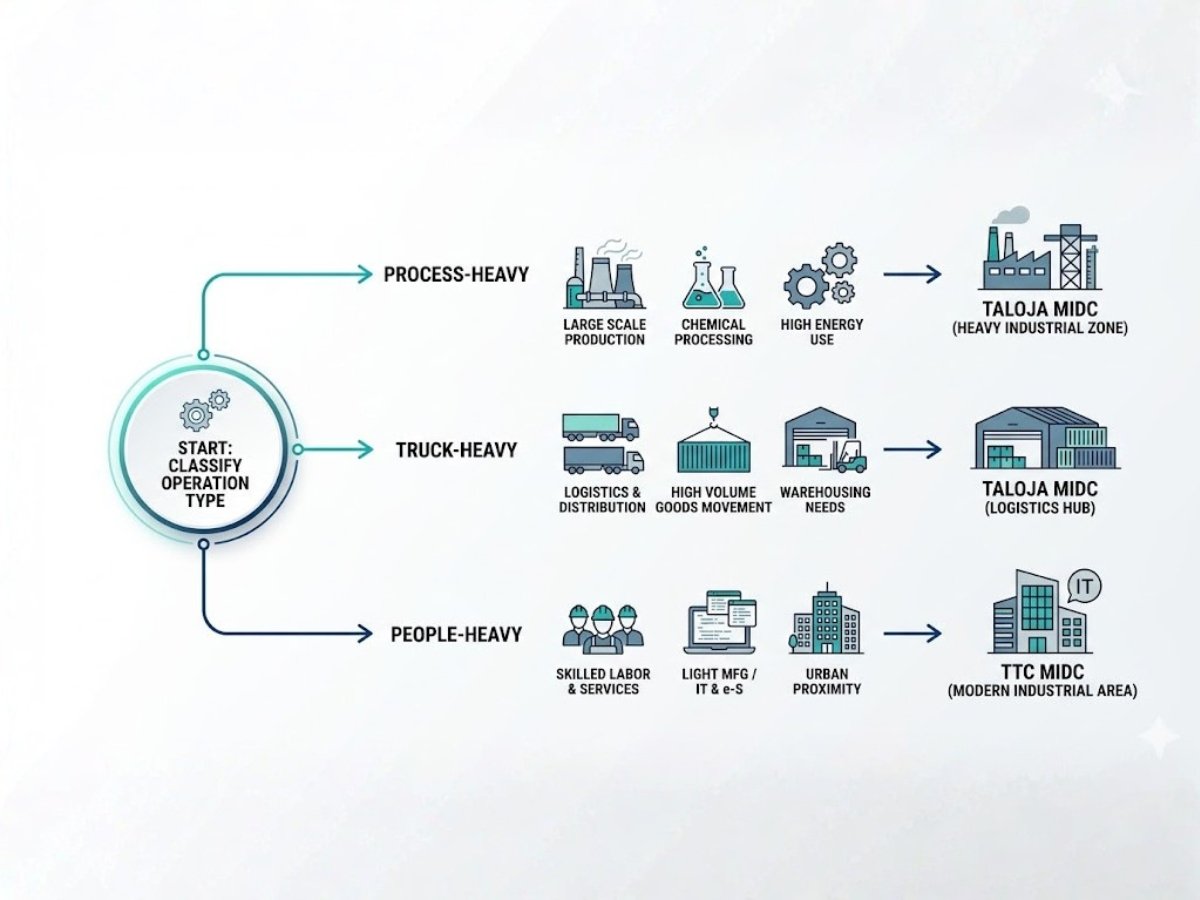
Start with this filter: is your operation process-heavy, truck-heavy, or people-heavy?
Most buyers and tenants start with rate. That is usually the wrong starting point.
A better starting point is to ask what your unit depends on the most. Does it depend on process load, vehicle movement, or people movement? That one answer usually narrows the choice very quickly.
If your operation is process-heavy, approvals and utility fit matter first. This includes chemical processing, dyeing, engineering with wet processes, certain food processing lines, and units with meaningful effluent or hazardous waste implications. In such cases, Taloja tends to be the more natural shortlist because the belt is structurally geared for heavier industrial activity, even though regulatory scrutiny is serious and cannot be taken lightly.
If your operation is truck-heavy, movement matters first. This includes structural fabrication, steel handling, large warehousing support, big loading bays, trailer parking, and units that need regular heavy inward and outward movement. Taloja usually feels more logical here because larger horizontal footprints and wider industrial layouts are easier to find.
If your operation is people-heavy, TTC gets a strong advantage. This includes light assembly, precision manufacturing, repair and service operations, industrial back-office support, and hybrid industrial-office use. TTC’s biggest edge is not image. It is daily usability. The Trans-Harbour railway line and city-side access change employee life in a real way.
One practical truth that many first-time industrial buyers miss: a unit that is cheaper on paper can become more expensive if workers struggle to reach it every day, or if trucks cannot operate comfortably once you actually start production.
Which users usually fit Taloja better, and which users usually fit TTC better?
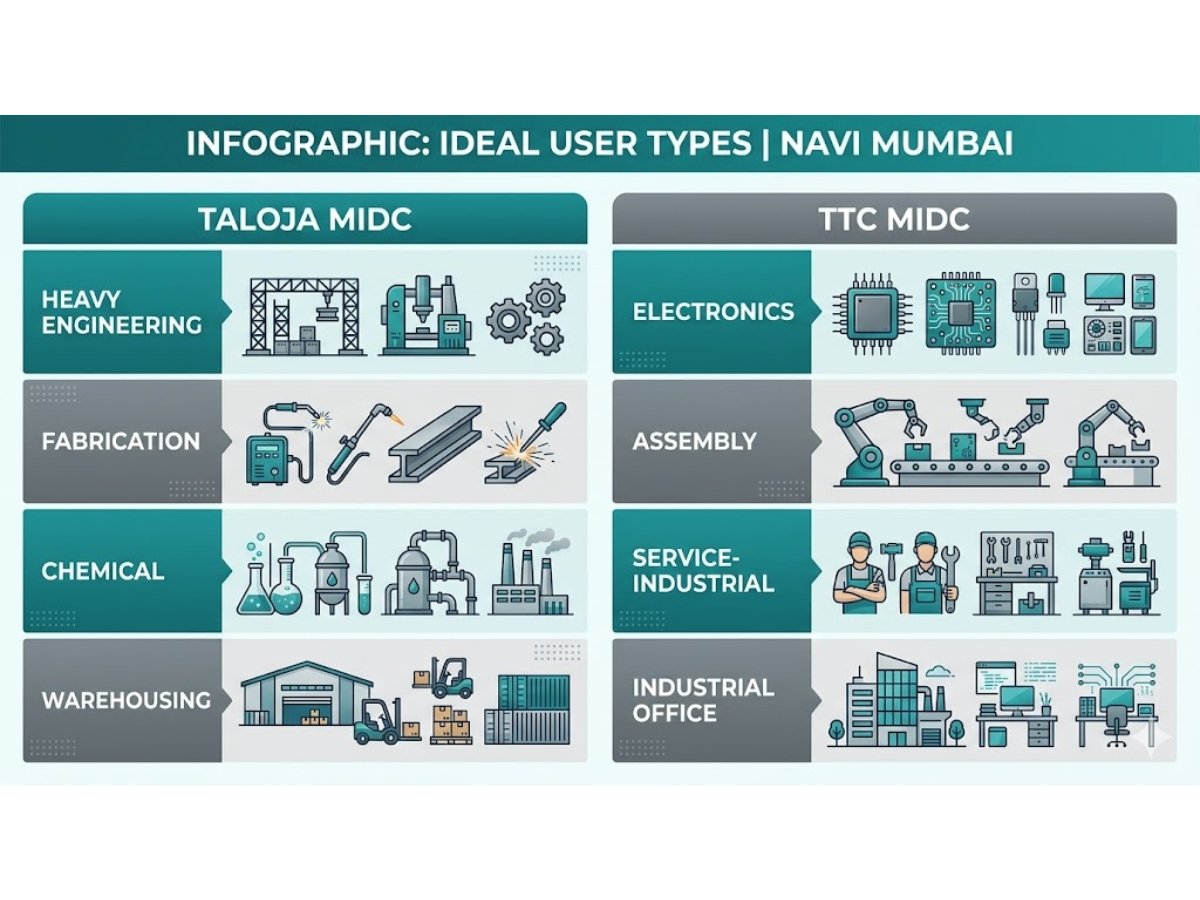
This is where the comparison becomes real. The right answer depends less on the MIDC name and more on your business model.
Users who usually fit Taloja better
Taloja usually suits heavy engineering, fabrication, chemical downstream users, bulk processing units, cold storage, larger warehousing-linked industrial operations, and businesses that need large ground-floor footprints. It also suits users who need high-tonnage crane support, more trailer handling flexibility, and more room for future plant layout changes.
It is also more natural for occupiers who think in terms of plant efficiency rather than employee convenience alone. If your factory needs larger open space, water storage planning, utility buffers, and physical industrial breathing room, Taloja usually enters the conversation early.
Users who usually fit TTC better
TTC usually suits electronics, precision engineering, medical-device style assembly, cleaner light manufacturing, service-industrial businesses, industrial offices, repair hubs, data-center-linked ecosystems, and occupiers who need a more urban industrial environment.
In practice, TTC often works better when the daily business model depends on people reaching the site easily. That includes supervisors, technicians, client teams, vendors, and white-collar support staff. In Mahape, Rabale, Airoli-side, and parts of Pawane or Turbhe, the market has evolved far beyond traditional factory-only logic.
Users who should shortlist both before deciding
Some businesses should not decide too early. Clean FMCG distribution, light e-commerce support, packaging, assembly with moderate staff strength, and smaller engineering units can fit either corridor depending on the exact building type, dispatch routes, and staffing pattern.
If that is your category, do not decide only by headline rent. Visit both. One well-located TTC gala can outperform a cheaper Taloja shed if staffing and city dispatch are central to your business. But the opposite is also true if loading, expansion, and ground handling drive the workflow.
Why “Taloja” and “TTC” are both too broad unless you also pick the right pocket and built form
A major mistake in industrial property comparison is treating both corridors like single points on a map.
They are not.
TTC is a long urban industrial belt with very different sub-markets. Mahape behaves differently from Rabale. Rabale behaves differently from Pawane. Turbhe has its own older industrial logic. A unit in Millennium Business Park type surroundings does not behave like an older industrial shed in a more traditional pocket. Rent, use suitability, loading practicality, and even neighbour profile can change sharply.
Taloja also needs phase-level thinking. Phase 1 is older, denser, and more functionally settled. Phase 2 often offers wider planning and larger layout logic, but utility maturity and last-mile comfort can differ plot to plot. Additional Taloja can behave differently again depending on allocation and process compatibility.
Built form matters just as much as location. TTC has a much stronger vertical industrial stock pattern, especially RCC galas and multi-storey industrial units. Taloja more often gives you standalone PEB sheds, larger plots, bigger yards, and more horizontal planning freedom.
This is why a small 1,500 to 3,000 sq ft occupier searching for a plug-and-play industrial gala often gets frustrated in Taloja, while a user needing a big loading apron gets frustrated in TTC. They are searching in the wrong built-form market.
Does your business need easier staff commute, vendor reach, and client movement more than heavy industrial movement?
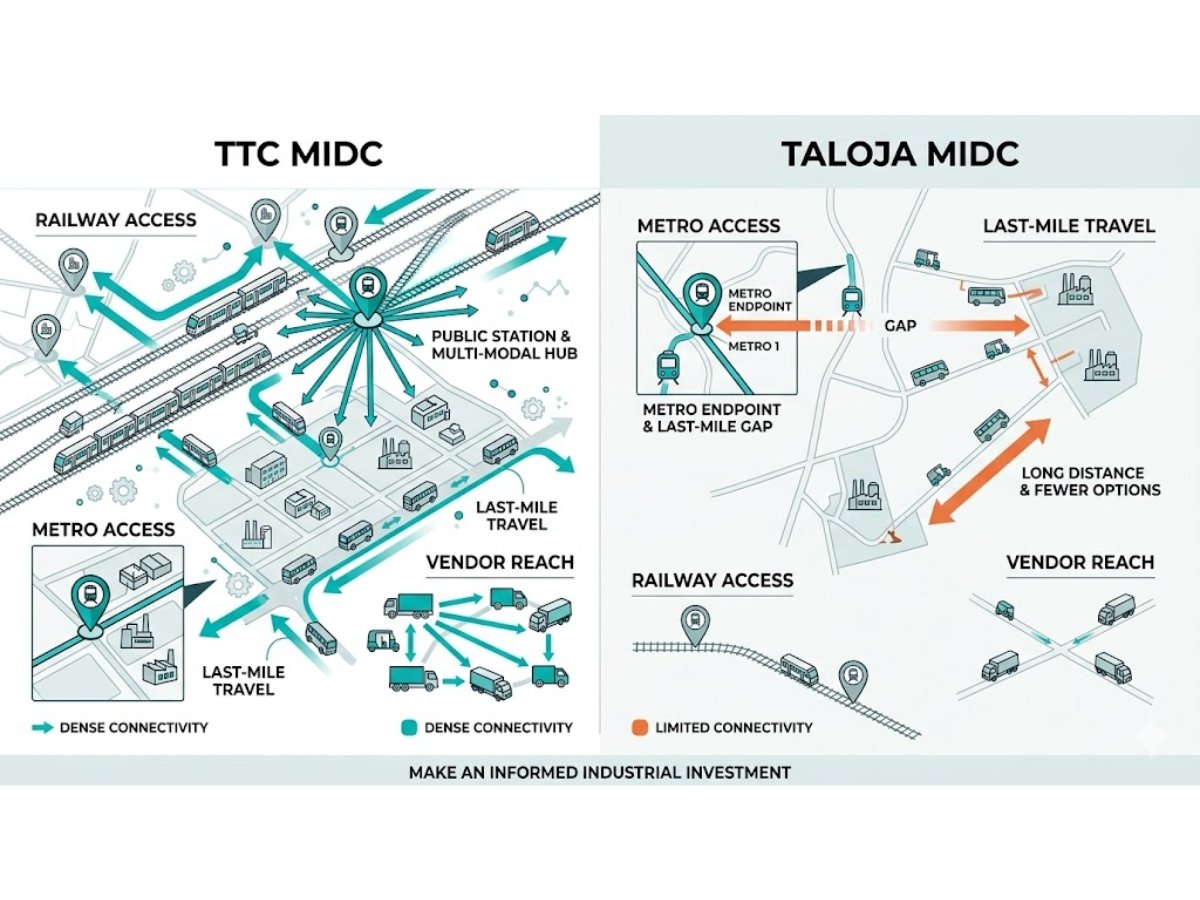
This is the section many people underestimate. But on ground, this often decides whether the unit remains practical after six months.
TTC is far better integrated with everyday urban movement. Airoli, Rabale, Ghansoli, Kopar Khairane, and Turbhe-side access gives it a very strong people-movement advantage. Staff can use the railway network and shorter last-mile trips. Vendors and clients also find it easier to reach.
Taloja is improving, but the people-side convenience is still weaker. Navi Mumbai Metro Line 1 reaches Pendhar, which is useful, but the industrial interiors still suffer from a last-mile gap. That matters more than many brochures admit. A factory owner may hear “metro aa gaya” and assume the problem is solved. It is not fully solved if workers still need a long shared-auto or shuttle leg after the station.
This becomes critical for staff-heavy operations. Imagine a clean packaging or assembly unit that saves monthly rent by moving to Taloja. On paper, it looks smart. But if machine operators and supervisors start leaving because the commute is tiring and irregular, the savings begin to leak out through attrition, late arrivals, and transport support costs.
So ask a blunt question: is your business powered more by machinery, or by people who need to reach the site reliably every day? That answer changes the shortlist more than many buyers expect.
Do you need land, yard space, heavy loading, or future expansion room?
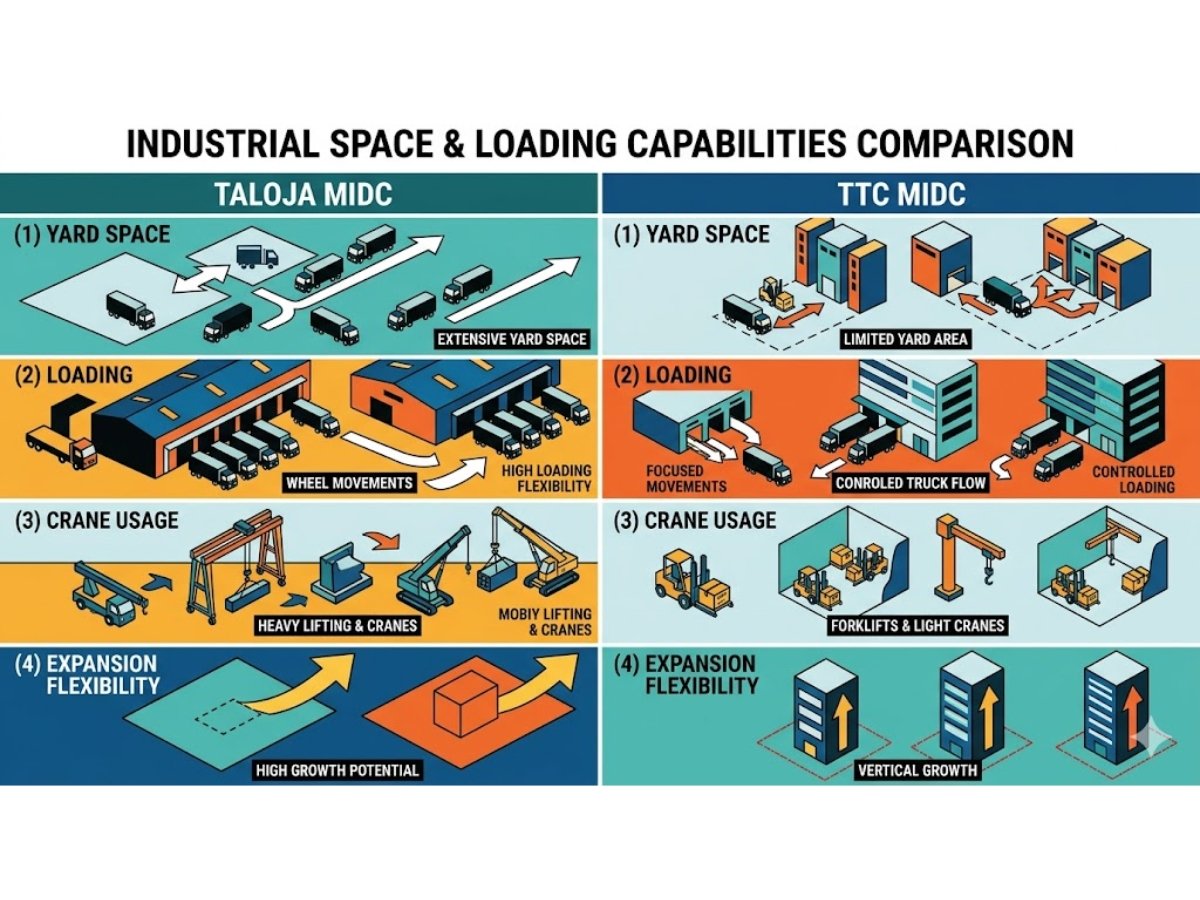
If the answer is yes, Taloja gets a clear practical edge in many cases.
Official MIDC rates themselves show the underlying land logic. TTC’s industrial base rates are significantly above Taloja’s, which aligns with what the market already tells you: TTC is a tighter, higher-value, urban industrial corridor. Taloja is comparatively more affordable at the official level and more natural for larger horizontal industrial layouts. But remember, official MIDC rates are not the same as open-market resale or lease prices. They influence transfers, charges, and calculations. They do not mean you can directly buy at that official number from the market.
Open-market patterns as of early 2025 also reflect the gap. Prevailing industrial rents in TTC were commonly seen in a much higher band than Taloja, while asking resale rates in TTC were also sharply higher. Taloja stayed lower overall, though exact numbers vary a lot by road access, power load, crane capacity, phase, and specific unit condition.
Here is where the physical test matters. If you need to park multiple trailers, turn heavy vehicles comfortably, load from ground level, install large EOT cranes, or redesign the plant later, Taloja often gives better industrial physics. TTC can still work in selected cases, but a vertical gala with shared loading cannot solve every industrial need.
On the other hand, if you need a smaller clean unit, controlled environment, better supervision access, and modest goods movement rather than full-scale heavy loading, TTC’s built form can be more efficient.
How do pollution category, approvals, utilities, and process risk change the answer?
For some industrial users, this is the whole decision.
If your process falls into higher-pollution categories, or requires serious effluent handling, the location has to work legally and technically before it works financially. Taloja is often shortlisted by these users because of its chemical-zone identity, CETP-linked ecosystem, and proximity to hazardous waste handling infrastructure. But that does not mean approval is automatic. In fact, scrutiny can be intense.
Taloja’s CETP history and NGT oversight should make any serious process user more careful, not more casual. Capacity on paper is one thing. Getting real process suitability, available load, and workable approval conditions for your unit is another. A buyer should never assume that just because a belt has chemical infrastructure, every new or transferred process will sail through.
TTC also has its own environmental and zoning realities. Some pockets work for cleaner industrial or engineering use, but they are not a blank cheque for all processes. This is especially important in more urbanized or IT-influenced pockets where built form and surrounding activity may not support your intended use.
Utilities also need decoding. In Taloja, water pressure and storage planning can become operational issues for some occupiers. A discounted shed is not really discounted if you later spend heavily on tanker support, storage upgrades, or process-side workaround infrastructure. In TTC, the problem is often less about water storage and more about whether the building and its approvals match your intended process in the first place.
So the correct order is this: first check whether the process can legally and practically run there, then discuss the commercial deal.
Is TTC worth the extra occupancy cost for your use case, or will Taloja give better industrial economics?
This is where a lot of industrial decisions go wrong, because people compare visible rent but ignore hidden operating cost.
TTC generally costs more. That much is clear from both official and market-side signals. But higher rent does not always mean worse economics. If your unit depends on daily staff attendance, city-side vendor access, urban deliveries, and fast supervision movement, TTC can justify its premium.
Taloja generally gives better headline occupancy economics, especially when the business needs space, loading, process flexibility, and larger footprints. But cheaper rent is not enough by itself.
Here is the right way to think about it. If a Taloja unit saves you a few lakhs a month on rent compared to a similar TTC option, ask whether you give that money back elsewhere through:
- shuttle buses or transport support for workers
- staff attrition and replacement cost
- extra city-dispatch fuel and time
- water storage or tanker cost
- approval-related delay cost
- inefficient internal movement because the wrong building was chosen
That is the real buy-vs-lease and Taloja-vs-TTC math. Industrial economics is not rent minus rent. It is total operating reality.
What wrong assumptions make industrial users choose the wrong MIDC?
Some mistakes repeat again and again in Navi Mumbai industrial property decisions.
The first is assuming metro connectivity has fully solved Taloja’s commute problem. It has improved the corridor conversation, but Pendhar is still not the same thing as a worker-friendly drop at the factory gate.
The second is assuming any MIDC unit can host any industrial process if paperwork is done later. That is risky thinking. Pollution category, zoning context, CETP logic, building suitability, and authority approvals can block a bad fit.
The third is assuming TTC is always “better” because it is more urban. For a heavy industrial user, that can be the wrong kind of premium. A costlier unit in a tighter corridor is not an upgrade if trucks, cranes, yard handling, or process layout suffer.
The fourth is assuming Taloja is always cheaper in the full sense. It may be cheaper in base occupancy cost, but hidden OpEx can narrow the gap.
The fifth is ignoring municipal and authority-side cost realities. TTC sits within NMMC civic logic. Taloja has had continuing Panvel-side municipal taxation concerns and industrial-township debates. A serious buyer or long-term tenant should not treat local tax and civic exposure as background noise.
What should you physically check on site before buying or leasing in either belt?
A site visit should not be limited to the front gate and the broker pitch. Industrial users need a working checklist.
- Check whether a 40-foot vehicle can actually approach, turn, and load at the site.
- Verify sanctioned power load and how difficult load enhancement will be.
- Ask about water pressure, storage capacity, and whether the unit depends on tanker support in practice.
- Check whether the unit’s built form matches your process: gala, RCC floor, PEB shed, crane support, floor loading, ceiling height.
- Review old notices, closure history, pollution-related issues, and any legacy compliance problem attached to the unit.
- Confirm all dues clearly: MIDC dues, transfer-related charges, water bills, and local civic taxes where applicable.
- In TTC, verify whether the pocket is genuinely suited for your industrial use or has drifted toward cleaner office-tech-commercial style occupancy.
- In Taloja, verify whether the exact phase and road network support your daily vehicle movement and worker access, not just occasional site visits.
This is where many industrial deals are won or lost. A unit can look attractive in a listing and still fail the operational test in fifteen minutes on site.
Final verdict: choose Taloja for these cases, TTC for these cases, and shortlist both only in these situations
Choose Taloja MIDC if your business is process-heavy, truck-heavy, yard-dependent, crane-dependent, or expansion-led. It usually fits heavy engineering, fabrication, chemical downstream users, bulk handling, large-footprint warehousing-linked industrial activity, and occupiers who need more physical industrial freedom at a lower base occupancy cost.
Choose TTC MIDC if your business is staff-heavy, cleaner, more urban-facing, more precision-led, or more dependent on daily commute convenience. It usually fits electronics, light assembly, precision engineering, industrial-office hybrids, service-industrial units, and occupiers who cannot afford workforce friction.
Shortlist both only if your use sits in the middle. That includes clean distribution, packaging, light FMCG, modest engineering, and some assembly operations where the final answer depends on the exact building, exact pocket, dispatch route, and staff pattern.
The smartest way to decide is not to ask which MIDC sounds bigger, newer, or more premium. Ask which one matches your operational lifeblood. If your business runs on process load, ground handling, and plant flexibility, Taloja often wins. If it runs on people movement, city access, and cleaner hybrid industrial usability, TTC often wins.
Neither should be seen in isolation. For some businesses, lower rate wins. For others, commute convenience, staff retention, and faster urban access create better economics despite higher rent.
Conclusion
Taloja MIDC vs TTC MIDC is not a branding comparison. It is an industrial fit comparison.
Taloja usually works better when the business needs heavy-duty industrial space, process tolerance, larger footprints, and better loading freedom. TTC usually works better when the business needs manpower access, urban convenience, cleaner built forms, and a more people-friendly industrial ecosystem.
So do not choose by brochure logic. Choose by plant logic, people logic, and approval logic. In industrial real estate, the right location is the one that still makes sense after the factory starts running.