
TTC MIDC Rates: Land Values, Rents and Unit Types Guide
TTC MIDC does not have one fixed rate. In early 2026, land values, shed rents, gala pricing, and office-linked unit rents in Mahape, Rabale, Pawane, Turbhe, and Ghansoli-side stretches can differ sharply even within the same broader belt. As a practical guide, standard industrial plots in stronger TTC pockets are often quoted around ₹45,000 to ₹60,000+ per sq m in the secondary market, mid-range sheds often around ₹36 to ₹55 per sq ft per month, and stronger large functional sheds around ₹64 to ₹70 per sq ft per month. But the headline quote alone means very little until you check road width, FSI, transfer premium, BCC status, NMMC arrears, and unit type.
That is the real starting point. TTC MIDC is not one market and not one asset class. A ready RCC factory in Rabale, an old shed in Pawane, a modern gala in Turbhe, and an office-linked industrial unit in Mahape should not be judged using the same per sq ft logic.
Quick summary: what you are really pricing in TTC MIDC
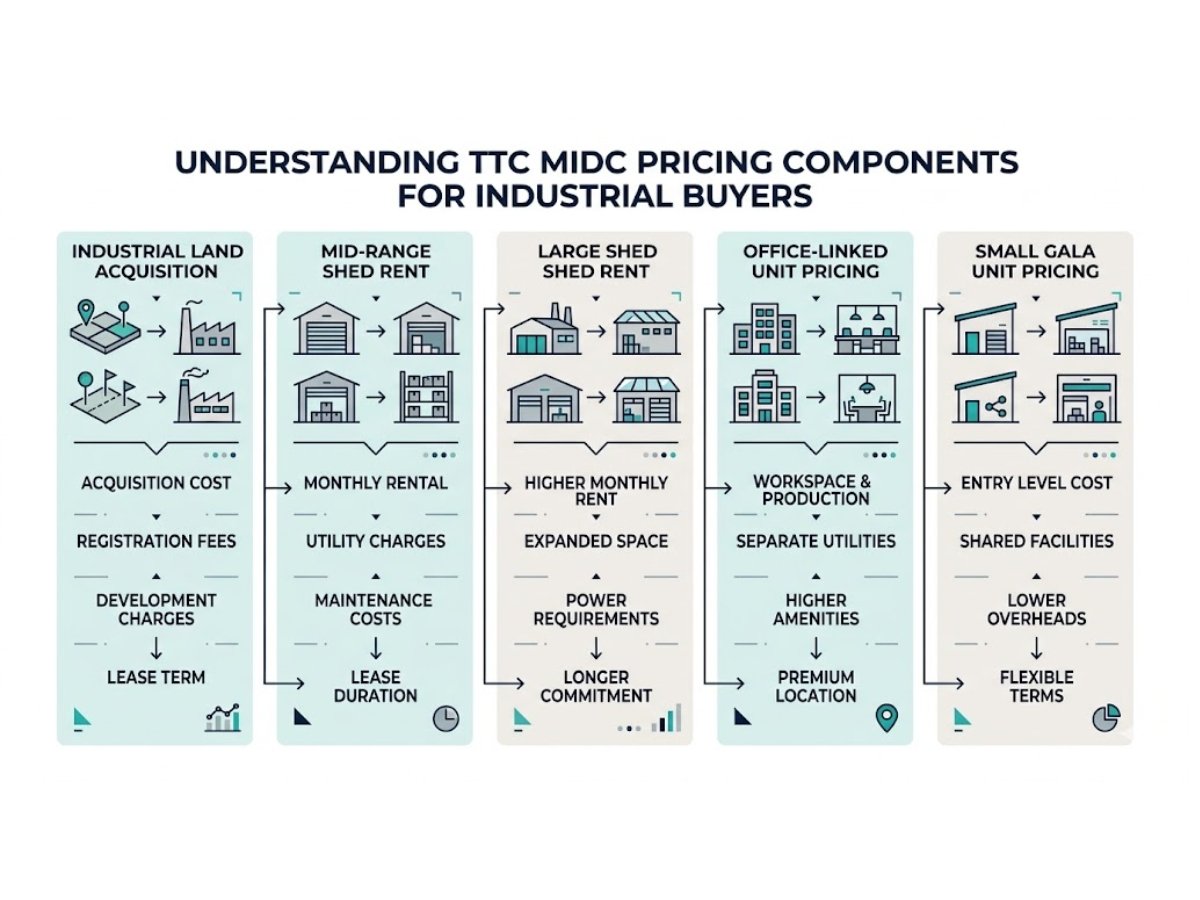
| What you are pricing | Broad pattern in TTC MIDC | What usually drives the number |
|---|---|---|
| Raw or lightly developed industrial land | Standard secondary market plots in stronger pockets are often quoted around ₹45,000 to ₹60,000+ per sq m. Prime serviced land can go much higher. | Road width, FSI potential, truck access, location, transfer status, development status |
| Mid-range industrial shed rent | Often quoted around ₹36 to ₹55 per sq ft per month | Height, loading, power, access, shed quality, location |
| Large functional industrial shed rent | In stronger Rabale or Pawane-type pockets, often quoted around ₹64 to ₹70 per sq ft per month | Heavy truck practicality, crane support, frontage, power, ready usability |
| Grade-A office-linked unit rent in Mahape | Bare-shell office rents often around ₹52 to ₹60 per sq ft per month | Corporate usability, station/staff access, fit-out cost, CAM, building quality |
| Small modern industrial gala sale price | Example formats in Turbhe-type industrial parks can sit around ₹91 lakh to ₹1.15 crore for roughly 465 to 565 sq ft carpet | Building age, carpet efficiency, goods lift, compliance, micro-location |
These are broad asking bands and practical filters, not guaranteed transaction prices. In TTC MIDC, condition, paperwork, utilities, and road logic can change the final decision far more than a portal headline.
TTC MIDC rates are not one number, and that is where most buyers go wrong
A lot of confusion begins because people ask, “What is the TTC MIDC rate?” That question sounds simple, but on ground it is incomplete.
You may be looking at any one of these:
- leasehold industrial land
- an old pre-engineered shed
- a multi-floor RCC factory building
- a small gala unit
- an office-linked industrial or IT-style space in Mahape
Each of these should be priced differently. Land value is about location, development potential, and transfer comfort. A ready building is about present usability. Rent is about operational readiness. Investor yield is a separate calculation again, because taxes, maintenance, and transfer friction can destroy an attractive-looking headline return.
This is why weak property pages fail on this topic. They throw one blended rate and move on. That is not useful in TTC MIDC.
Which TTC MIDC pockets usually quote higher or lower, and why?
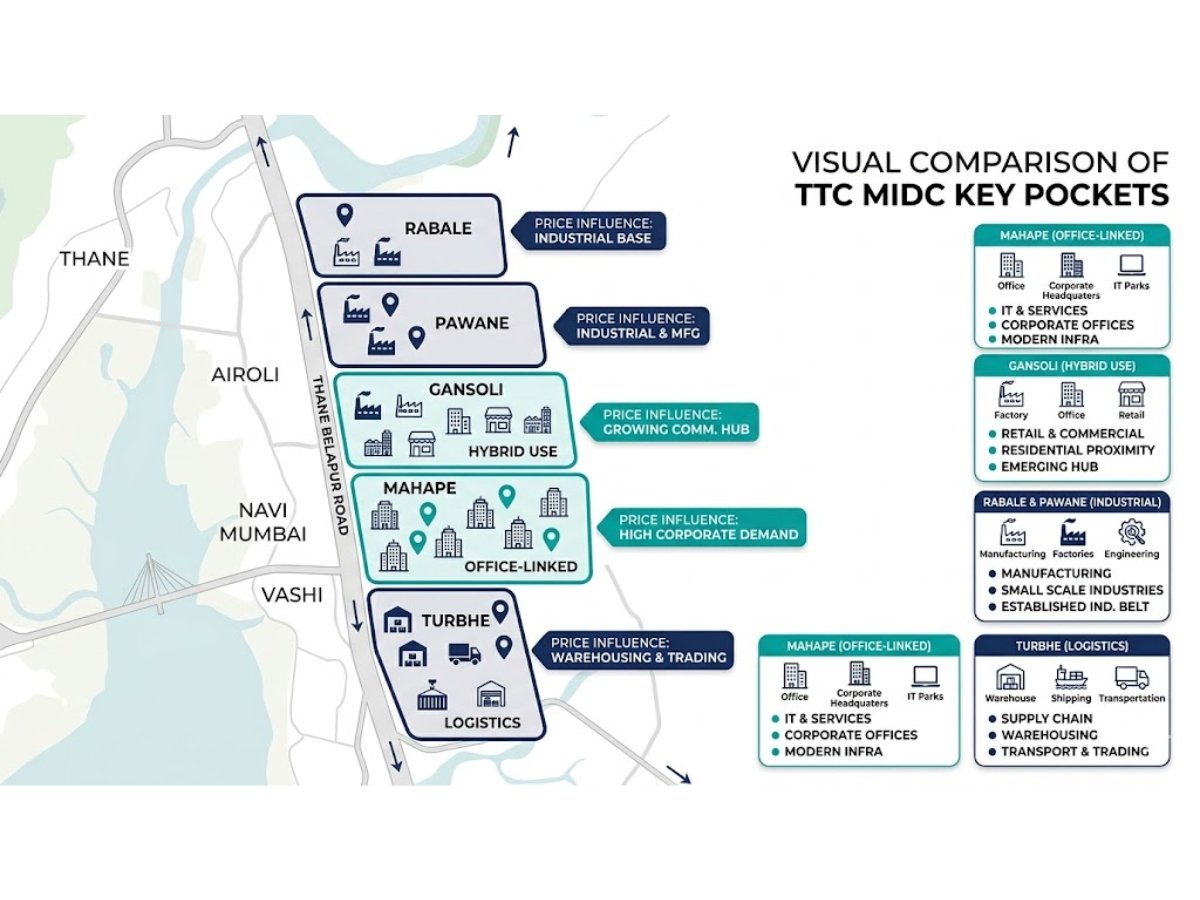
The practical way to read TTC MIDC is pocket by pocket, not just belt by belt.
Mahape
Mahape should not be read like a classic heavy industrial zone. Its price logic is influenced by office-backend demand, IT-linked buildings, and the Millennium Business Park side ecosystem. On paper, a bare-shell office-linked unit may look reasonably priced at roughly ₹52 to ₹60 per sq ft per month, but the real cost of occupancy can rise sharply once fit-out and CAM are added.
This matters because many people compare Mahape with Rabale or Pawane as if all are doing the same job. They are not. Mahape often suits cleaner, staff-heavy, client-facing, or tech-backend occupiers better than heavy truck-intensive factory users.
Rabale and Pawane
Rabale and Pawane remain stronger for core industrial use. These pockets make more sense for engineering, fabrication, warehousing, and real factory operations where road practicality, heavier utilities, and structural function matter more than office polish.
This is where larger ready sheds with proper operational utility can command stronger rents, often in the ₹64 to ₹70 per sq ft per month range in better cases. But even inside Rabale or Pawane, a broad road with turning room for large vehicles behaves very differently from an internal lane where movement becomes a daily headache.
Turbhe
Turbhe is increasingly important for logistics, distribution, FMCG movement, and smaller modern industrial formats. Its location logic is different from Mahape. Turbhe benefits from expressway-side movement, wholesale trade linkages, and supply-chain relevance.
That is why modern multi-level industrial parks and smaller RCC industrial formats can work here, especially for occupiers who do not need a large independent plot but do need operationally usable space. The catch is simple: smaller unit size does not automatically mean lower cost. Carpet efficiency, goods lift quality, truck handling, and building design matter a lot.
Ghansoli-side and office-linked edges
The Ghansoli-adjacent edges often represent a blended market. Here, industrial, office-backend, and local catchment-driven formats can overlap more than they do in older pure-manufacturing pockets.
That usually means smaller office-linked units, backend operations, and hybrid occupiers may find a fit here. But the reader should stay careful. A pocket that looks cheaper on the headline number may be cheaper because it is weaker for truck access, industrial loading, or full-scale manufacturing use.
Pocket comparison: the useful way to read TTC MIDC
| Usually fits best | Why rates move here | Main caution | |
|---|---|---|---|
| Mahape | Office-linked industrial, backend, IT/ITeS, cleaner occupiers | Corporate usability, building quality, staff access, fit-out readiness | Bare-shell rent is not the true occupancy cost |
| Rabale | Engineering, fabrication, manufacturing, stronger ready sheds | Truck movement, heavy power, frontage, industrial depth | Internal road conditions can change the asset’s value sharply |
| Pawane | Core industrial users, warehousing, functional factory units | Access, industrial stock base, ready operational structures | Old stock quality varies a lot |
| Turbhe | Logistics, FMCG, distribution, smaller modern industrial units | Supply-chain logic, movement efficiency, modern formats | Small units can look affordable but have high loaded cost |
| Ghansoli-side edges | Hybrid office-industrial, backend, lighter users | Station access, mixed-use spillover, office linkage | Not every unit here suits real industrial operations |
What unit types actually exist in TTC MIDC, and how should each be priced?
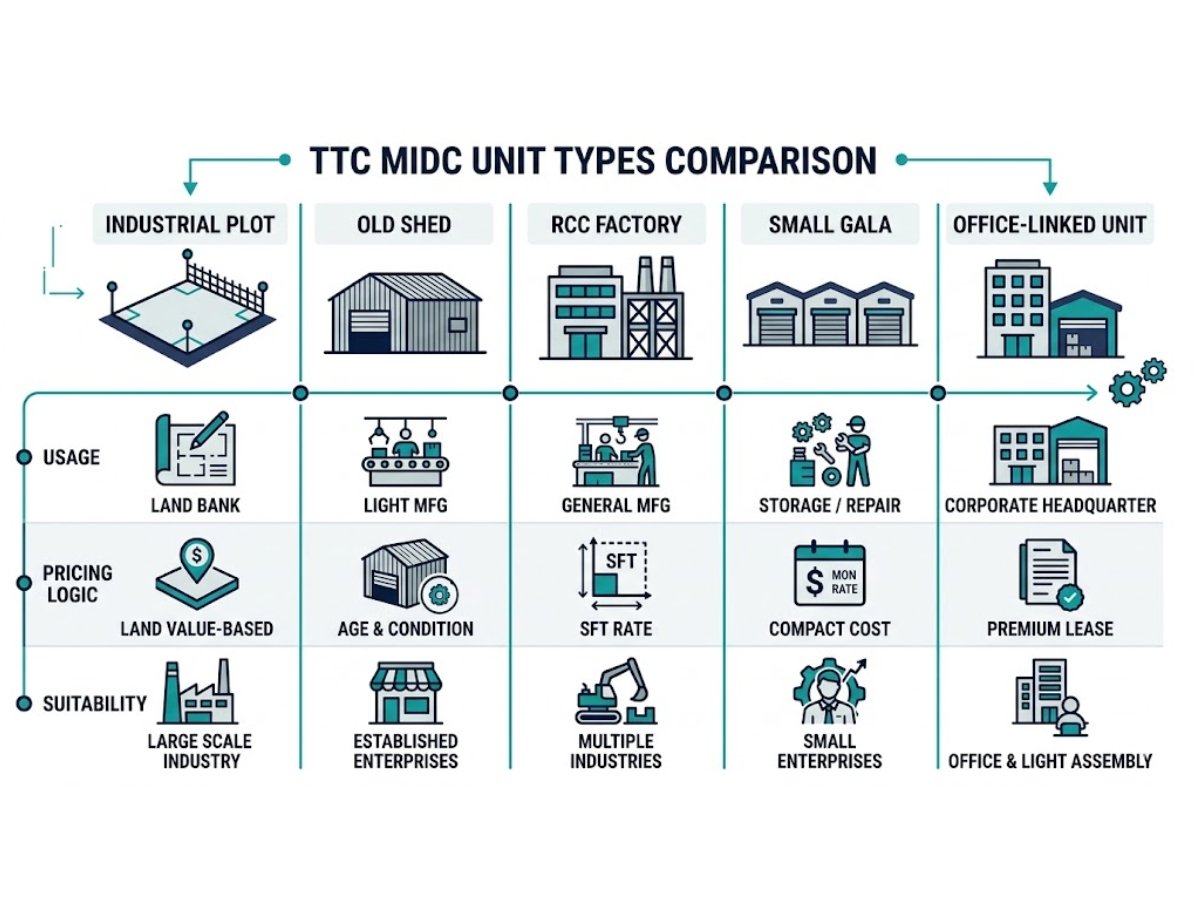
Independent industrial plot
An independent industrial plot is not just land. It is future building potential plus transfer comfort plus development pressure. Buyers must think about official MIDC base rate, market premium, road-width-driven FSI, and construction timeline risk.
In practical terms, land on a wider road has more development value because it supports more buildable volume. That alone can explain why two plots with similar area command very different prices.
Older shed or factory shed
Older sheds are often bought or leased for speed. A user can enter faster, spend less time on permissions, and start operations sooner than on raw land. But age matters. Clear height, structural condition, power connection, loading space, and roof quality matter more than brochure language.
This is one area where headline rent can be misleading. A cheaper shed may become expensive if it lacks turning radius, usable loading, or sanctioned utilities.
RCC factory building or G+1 industrial building
RCC factory buildings and multi-floor industrial formats are common in Navi Mumbai. They can work well for light industrial, engineering, storage, packaging, and smaller manufacturing users who need built space rather than open yard-led operations.
The key caution is area definition. These units are often quoted on built-up or super built-up basis. The actual usable carpet can be much lower.
Small industrial unit or gala
A small gala is often the entry point for SMEs. It gives ownership or operational presence in a known industrial belt without requiring the capital needed for a larger independent asset.
But this is also where buyers make one of the biggest mistakes. They compare gala rate per sq ft without checking loading factor, goods lift, corridor loss, floor usability, and the actual carpet area they are paying for.
Office-linked industrial or IT-style unit
This format is common around Mahape and similar pockets where industrial and commercial use-cases start to overlap. These units are not priced like heavy industrial property. They are valued more like business infrastructure.
A manufacturer should not overpay for this format unless staff-heavy operations, client meetings, office environment, and digital infrastructure really matter to the business.
What actually moves land values and rents inside TTC MIDC?
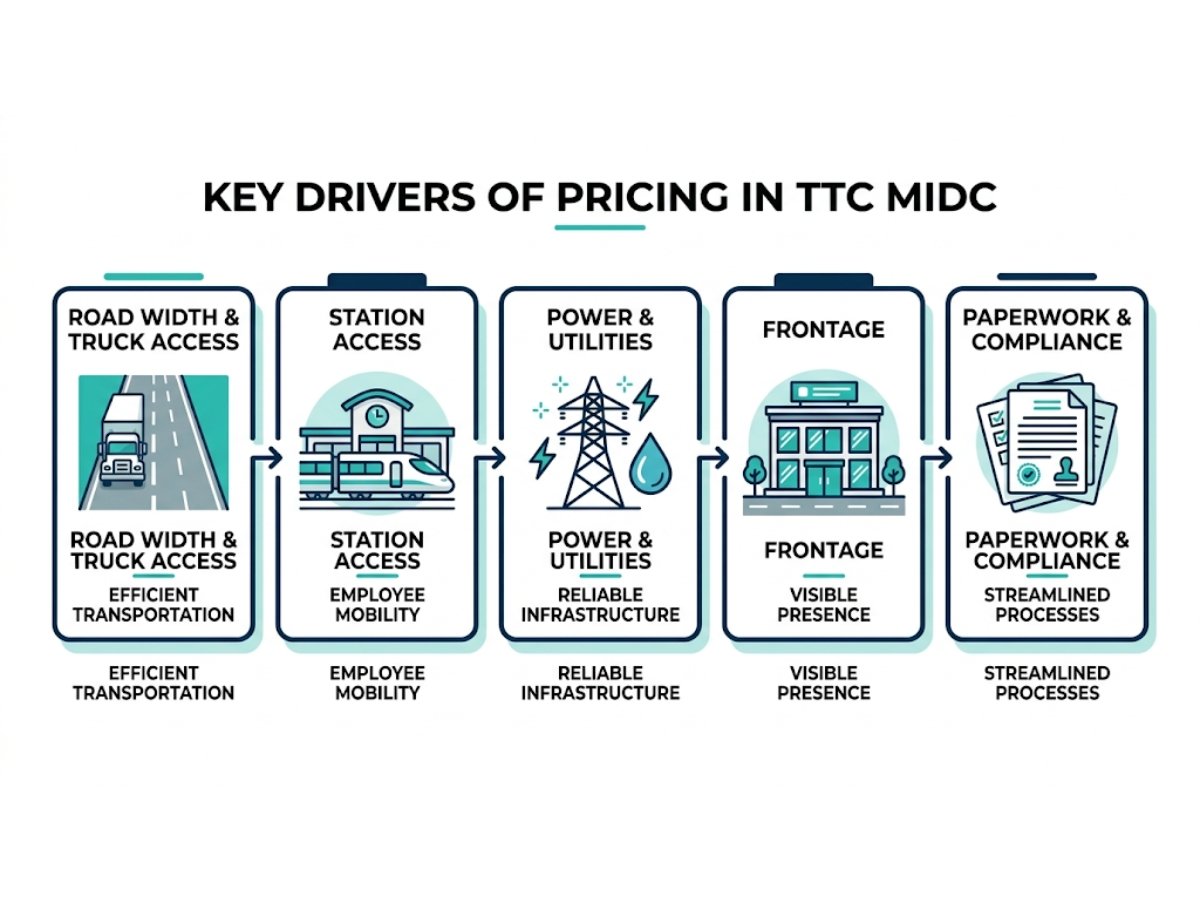
The real drivers in TTC MIDC are practical, not decorative.
Road width, truck turning, and loading practicality
This is one of the biggest value drivers in the entire belt. A plot or building on a narrow internal road may be usable for smaller goods movement, but it will underperform badly for modern logistics or heavy industrial operations.
Road width also affects FSI. A site on a wider abutting road gets more development potential. That directly changes land value.
Station access and daily staff convenience
This matters much more in Mahape, Ghansoli-side edges, and office-linked formats than in pure heavy industrial decisions. If a unit depends on daily staff commute, railway access and road approach affect rent more than many buyers first assume.
Power, water, height, and floor loading
A live industrial asset is not just a box. Sanctioned power, usable water connection, clear height, crane capacity, and floor loading can turn an ordinary-looking unit into a premium one.
In water-intensive or power-intensive businesses, this can change the total cost of occupancy in a very real way.
Frontage and client-facing usability
Frontage matters differently by use case. For a logistics shed, visibility is far less important than loading efficiency. For a unit with customer visits, vendor meetings, or corporate movement, frontage and arrival feel can influence value more.
MIDC paperwork and transfer comfort
This is a major but under-discussed pricing factor. A physically built property is not always treated as a properly developed asset by MIDC unless the paperwork trail is clean, especially the Building Completion Certificate. If BCC is missing, transfer friction can become costly.
How should a buyer or tenant read quoted TTC MIDC rates without getting misled?
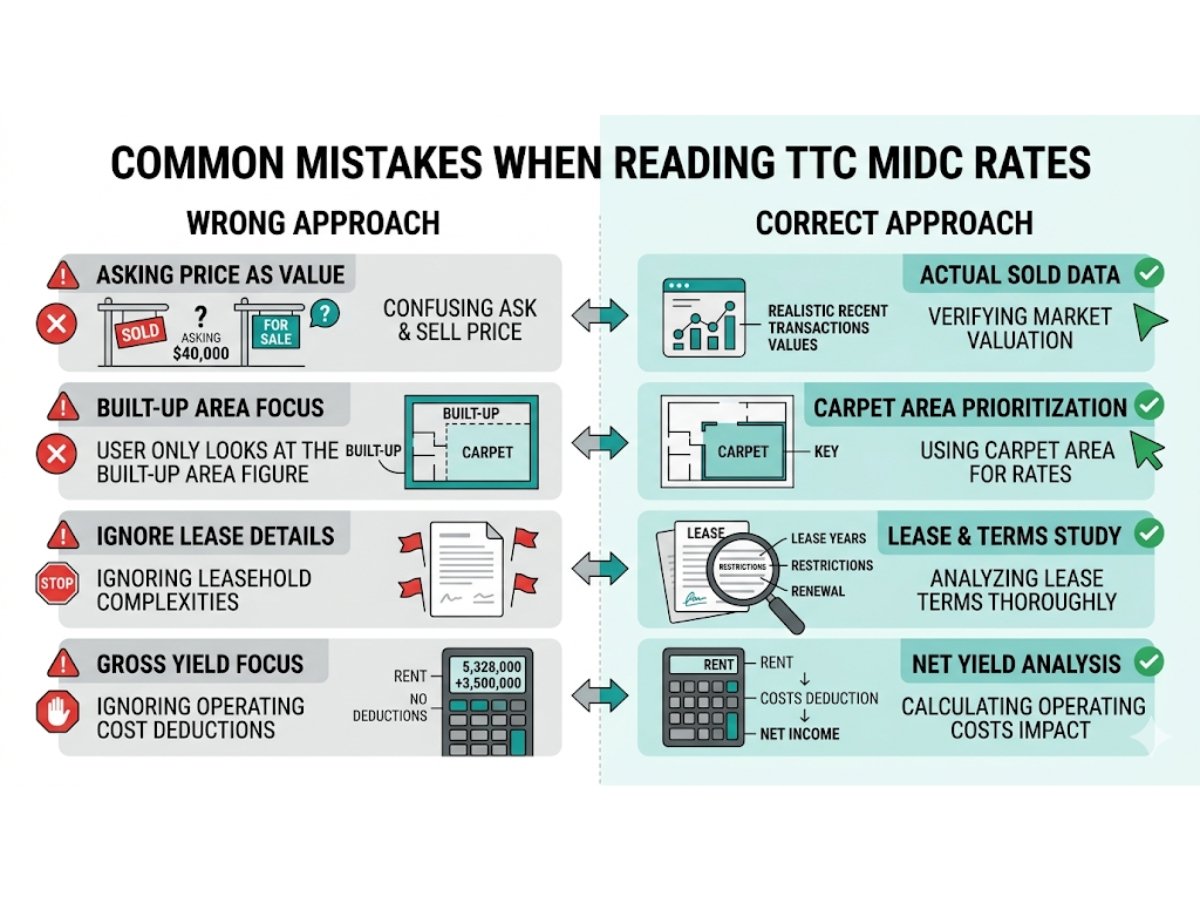
This is where most real losses happen.
Asking rate vs transacted reality
Portal listings are useful as search signals, not as final truth. In TTC MIDC, asking rates are often inflated, selectively described, or stripped of context. One listing may ignore arrears. Another may hide poor road access. A third may quote on built-up area but look attractive only because the carpet efficiency is weak.
Use asking rates as a starting filter, never as market proof.
Plot area vs built-up area vs carpet area
This is one of the most common traps in industrial galas and RCC buildings. A quoted 1,000 sq ft unit may not give you 1,000 sq ft of usable working space. In many cases, only 60 to 70 percent of the quoted figure may be real carpet.
So the correct question is not just “What is the rate per sq ft?” The real question is “Rate per sq ft of what?”
Leasehold wording vs true transfer position
TTC MIDC is fundamentally a leasehold market. People casually use ownership-style language, but the land sits within a long-lease framework, and transfers need proper MIDC concurrence.
That matters because transfer premium depends on development status. If a plot is treated as undeveloped, the transfer burden can be much heavier than on a properly developed plot with valid BCC. That single point can change a buyer’s full budget.
Preleased yield pitches and rent overstatement
An investor may hear that a unit gives 8 percent yield and feel comfortable. But once you deduct property tax, maintenance, and any other recurring costs, the actual net number can fall sharply.
In TTC MIDC, gross yield talk without tax and maintenance clarity is incomplete at best and misleading at worst.
Should you buy land, buy a ready industrial unit, or take a unit on rent in TTC MIDC?
There is no one correct answer. It depends on your business stage, capital strength, and urgency.
When buying land makes more sense
Buying land suits users who need long-term control, custom development, yard use, or heavy industrial specification that a ready building cannot offer. It works best for businesses with patience, compliance ability, and enough capital to handle not just acquisition but also construction and approvals.
If working capital is already tight, raw land can become a burden.
When a ready built unit is the smarter choice
A ready industrial unit works well for users who want faster execution and lower development uncertainty. It suits many SMEs, light manufacturers, engineering users, and occupiers who want a functioning asset more than a blank slate.
This route is often easier to budget, but only if area basis, tax dues, utilities, and transfer position are checked properly.
When renting is better than buying
Leasing is often the better decision for growing businesses, trial-stage users, 3PL operators, and companies that value flexibility. It reduces upfront lock-in and speeds up market entry.
In a changing corridor like TTC MIDC, speed matters. A rented ready unit can sometimes create better business economics than a stretched purchase.
Which TTC MIDC unit type fits which user?
A simple way to think about it:
- Heavy manufacturing user: usually needs land or a serious ready shed, not a loaded gala
- Engineering or light industrial user: may fit a ready RCC factory or good-quality industrial unit
- Warehouse or logistics operator: should prioritise Turbhe, Pawane, or Rabale-style access logic over cosmetic building appeal
- Office-backend or tech-industrial user: should study Mahape and office-linked pockets more closely
- Investor buying preleased stock: should focus less on brochure yield and more on net post-tax, post-maintenance return
The asset should fit the business. That sounds obvious, but in TTC MIDC many bad decisions happen because buyers chase a number rather than a use-case.
What documents and local checks matter before trusting the price?
Before treating any TTC MIDC quote as serious, the buyer or tenant should check the following:
- MIDC allotment trail and lease position
- Whether transfer requires concurrence and what premium logic may apply
- Building Completion Certificate status, especially if the asset is being sold as a developed industrial property
- Sanctioned construction and actual building use comfort
- NMMC no-dues position, especially property tax arrears
- Utility status, including sanctioned power and water connection
- Whether the property is part of a newer project where MahaRERA matters
- IGR ready reckoner use, only for stamp duty and registration reference, not as final market pricing truth
This is especially important in Navi Mumbai because civic and industrial authority logic overlap here. MIDC controls allotment and transfer mechanics, but NMMC tax and local dues can still become a major transaction risk.
What kind of price bands should you read carefully in TTC MIDC?
The safest way to read rate bands is as practical market filters, not exact valuation certificates.
A few broad bands from the current market logic are useful:
- standard industrial plots in stronger TTC pockets often get quoted around ₹45,000 to ₹60,000+ per sq m
- prime serviced land can go materially higher
- mid-range sheds across the belt often sit around ₹36 to ₹55 per sq ft per month
- stronger large functional sheds in better industrial pockets may sit around ₹64 to ₹70 per sq ft per month
- Mahape grade-A bare-shell office-linked space often sits around ₹52 to ₹60 per sq ft per month
- smaller modern industrial gala formats can show sale figures like roughly ₹91 lakh to ₹1.15 crore for selected carpet-size bands
Use these as orientation, not conclusion. If a rate looks cheap, ask what is missing. If it looks expensive, ask what extra usability or compliance comfort is built into it.
Conclusion
TTC MIDC is one of Navi Mumbai’s most important industrial corridors, but it is also one of its easiest markets to misunderstand. There is no single TTC MIDC land value, no single shed rent, and no one correct unit type. Mahape, Rabale, Pawane, Turbhe, and Ghansoli-side edges each behave differently. Independent plots, old sheds, RCC factories, galas, and office-linked units should also be read differently.
The smartest approach is simple. First decide what kind of property you are actually pricing. Then check whether the pocket fits your business. Then verify transfer comfort, BCC status, NMMC dues, road width, FSI, power, water, and area basis. In TTC MIDC, that is how you move from a misleading quote to a workable real estate decision.