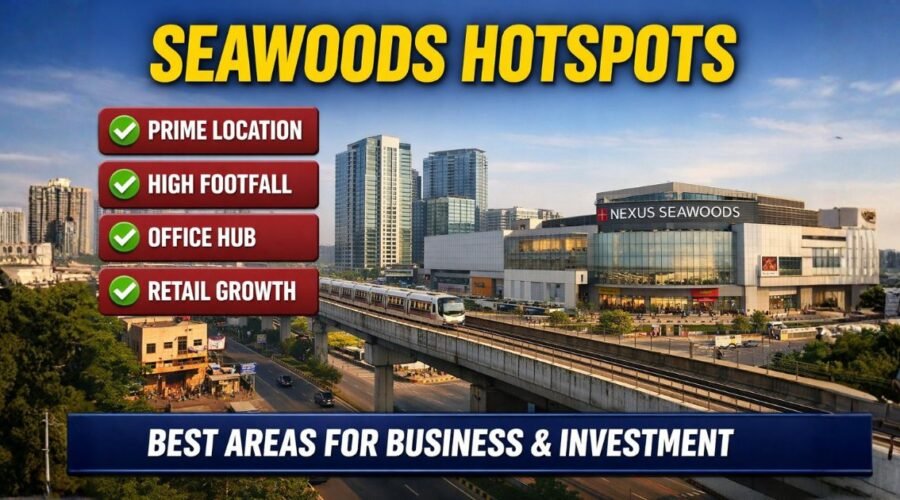
Best Office and Retail Pockets in Seawoods: Where Businesses and Investors Should Focus
If you want the direct answer, start here: the strongest office pocket in Seawoods is usually the station-integrated Seawoods Grand Central zone because it offers the best mix of rail access, recognisable commercial identity, and premium office environment. But retail is different. In Seawoods, the best retail pockets are split across station-linked destination retail, Palm Beach Road visibility-led stretches, and inner sector convenience pockets. The right choice depends on whether you need commuter capture, neighbourhood repeat business, or brand-led visibility.
Seawoods is not one single commercial market. That is the first thing most buyers, tenants, and even brokers oversimplify. A unit near the station, a main-road shop in Sector 44, a healthcare-facing space in Sector 42, and a utility-led shop in Sector 48 may all be in “Seawoods,” but they do not behave the same way in the real market.
The reason is simple. Office demand and retail demand follow different rules. Office users care about daily access, professional image, building quality, and ease of commute for staff and clients. Retail depends more on real walking movement, frontage, stopping convenience, repeat need, and whether footfall actually converts into paying customers. That difference matters a lot in Seawoods.
Seawoods also has one major structural advantage that most Navi Mumbai nodes do not have at this scale: a station-integrated transit-oriented commercial ecosystem. The Seawoods station-commercial zone, shaped by the Seawoods Grand Central development, combines large-format office stock with a major retail destination. In practical terms, that creates a premium commercial gravity inside the node. But it also creates traps for buyers who assume all nearby commercial space benefits equally.
For a broader local view before comparing specific pockets, Seawoods Commercial Property Guide is worth reading first.
Which parts of Seawoods are actually the strongest for office and retail space?
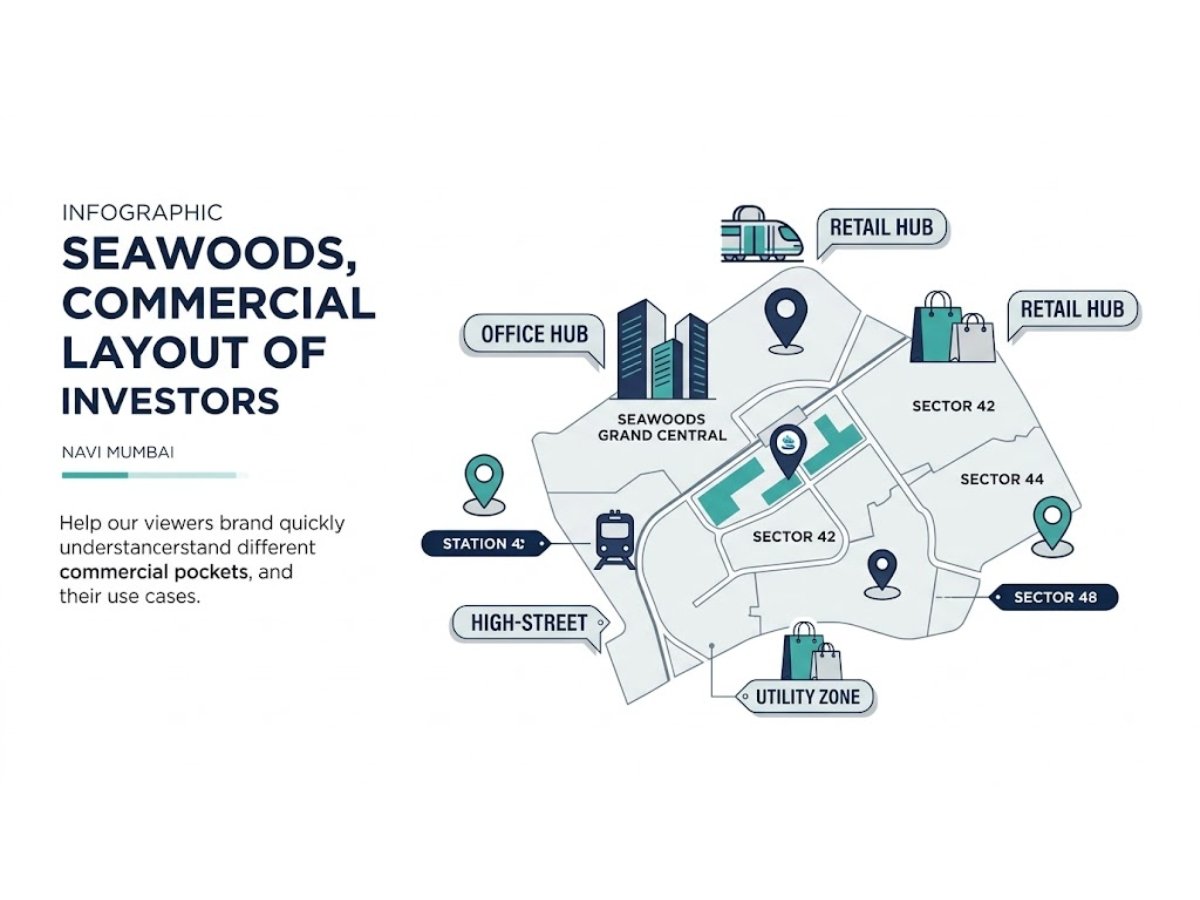
The strongest office and retail pockets in Seawoods are not identical. For office use, the best pocket is usually the station-linked Seawoods Grand Central and immediate Sector 40 belt. For retail, the answer splits into three different formats: destination retail inside the station-mall ecosystem, high-visibility retail on strong road-facing stretches, and neighbourhood retail inside inner sectors.
Here is the simplest way to read the market.
| Best Use | Why It Works | Main Caution | |
|---|---|---|---|
| Seawoods Grand Central / Sector 40 station zone | Premium office, branded service businesses, selective destination retail | Best access, strong commercial identity, Grade A environment | Expensive entry, not every nearby street-level unit gets real footfall |
| Sector 42 / 42A | Healthcare, daily-needs retail, essential services | D-Mart-led footfall, strong residential support, repeat local demand | Not the best fit for prestige-led office buying |
| Sector 44 / 44A | High-street retail, banks, service brands, selective professional offices | Strong local visibility, affluent catchment, recognisable road-level activity | Internal pocket underperformance despite premium pin code |
| Sector 48 and Seawoods East utility belt | Budget-led service retail, repair, hardware, medical support, local trade | Lower entry cost, practical demand, stable utility-driven catchment | Lower address recall, weaker premium office appeal |
So the first practical verdict is this: if your priority is office quality and commuter convenience, focus on the station-linked zone. If your priority is retail, do not just say “Seawoods is premium.” You need to decide whether your business needs destination pull, main-road visibility, or local repeat dependency.
Why the station-integrated Seawoods Grand Central zone is usually the strongest office pocket
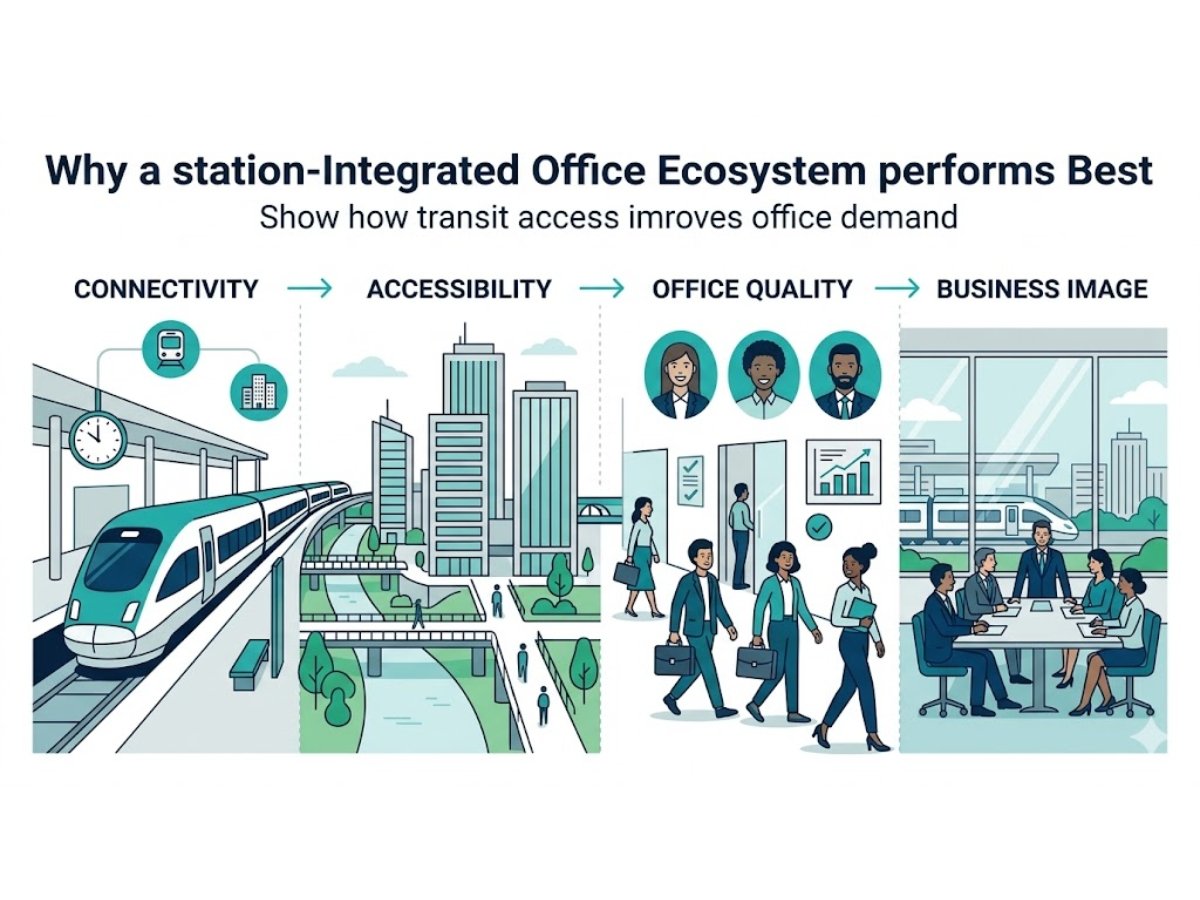
For office demand, this is the clearest winner in Seawoods. The station-linked Seawoods Grand Central ecosystem is not just “near the station.” It is built around the station. That difference matters.
What makes this pocket stronger for office demand
This pocket works because it reduces friction. A business located in a recognisable, transit-integrated office environment is easier for employees to reach, easier for clients to locate, and easier to position as a serious professional setup. In a node like Seawoods, that matters more than generic road visibility.
The Seawoods-Darave rail connection supports access from the Harbour Line side and broader Trans-Harbour movement logic. In real life, that means better commuter convenience from large parts of Navi Mumbai and better linkage for Thane-side users as well. Compared with many standalone commercial buildings in other nodes, the last-mile problem is much lower here.
There is also a quality gap. The Grade A office environment in the station-linked zone is not comparable to random small commercial units marketed as “office space” elsewhere. Large floor plates, better lobby experience, structured operations, backup systems, and corporate-grade maintenance all improve tenant quality. That is why professional occupiers usually read this zone differently from the rest of Seawoods.
Which kinds of office users fit here best
This pocket suits businesses that benefit from a polished address and dependable access.
The best fit usually includes:
- CA firms and consultancy offices
- corporate back-end or satellite offices
- legal and advisory setups
- premium clinics and wellness brands with appointment-led traffic
- managed office operators
- boutique finance, insurance, or corporate services firms
A small consultancy that meets clients regularly may do better here than in a cheaper but less credible inner-sector building. A managed office operator also benefits because Seawoods office demand is easier to package when the location already solves transit and image in one shot.
Where buyers and small investors should still be careful
This is also where many people overpay.
A premium address does not automatically mean every office-sized unit in or around the zone is a good investment. Some smaller commercial units look attractive during a site visit but do not enjoy the same ecosystem strength as the real Grade A office towers. The buyer ends up paying station-zone pricing for a unit that lacks true office depth.
Another issue is cost structure. Premium commercial ecosystems often come with higher maintenance burden, parking constraints for some users, and tighter building rules. A small occupier must calculate the full operational cost, not just the purchase price or headline rent.
> Caution: In Seawoods, “near Seawoods Grand Central” and “inside the real office ecosystem” are not the same thing. For office buying, verify building quality, access pattern, parking practicality, and actual tenant profile before paying a premium.
Which retail formats work best inside or around the Seawoods station-commercial ecosystem?
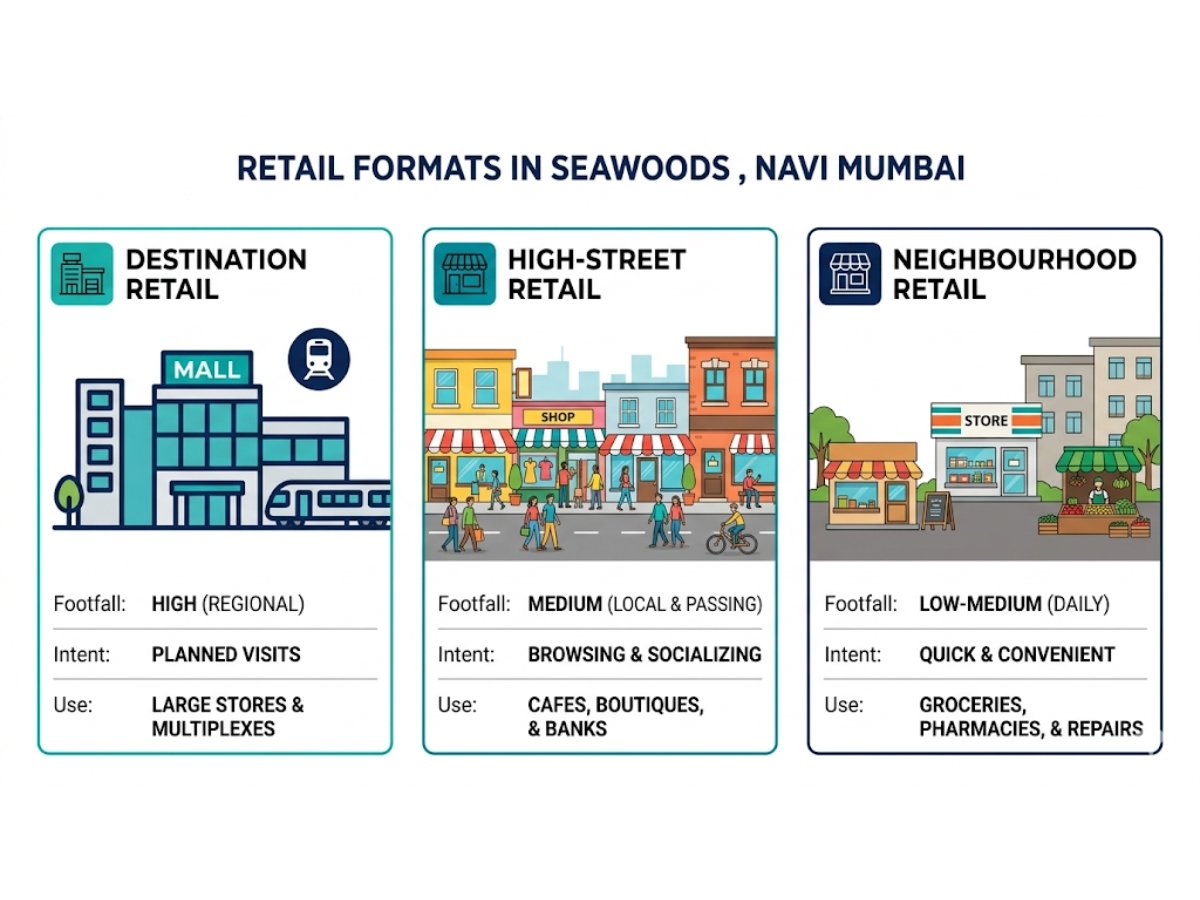
The biggest retail mistake in Seawoods is assuming all retail near the station works equally well. It does not. The station-commercial ecosystem supports some retail formats very strongly, but it can be harsh on the wrong format.
Destination retail
Destination retail works when the customer is willing to come specifically for the experience, brand, or category. Inside a major mall-led ecosystem, this usually includes branded fashion, F&B, entertainment, gifting, beauty, lifestyle, and organised category-led retail.
This is where the Seawoods Grand Central and Nexus Seawoods ecosystem has a genuine edge. Large leasable area, strong occupancy, brand clustering, and heavy shopper volumes make it a destination environment rather than just a passing location. That is fundamentally different from a neighbourhood shop line.
Food, café, lifestyle, and brand-led retail
Seawoods works well for retail formats that benefit from aspirational catchment and organised consumption patterns. A café, boutique food concept, premium salon, brand outlet, or organised services format can perform better in a station-linked destination ecosystem than in a basic local market because the consumer is already in “spend mode.”
This is also why many businesses are drawn to the Seawoods mall-station ecosystem instead of older, more fragmented high streets elsewhere in Navi Mumbai. The environment supports brand presentation better.
Retail formats that may struggle despite premium surroundings
This is where reality becomes important. A shop may be close to the station or mall and still underperform if consumer movement never naturally reaches it. Seawoods has what can be called an adjacency trap. A unit may sit near a major landmark, but if the internal flow of commuters is channelled into the mall or office core, the street-facing spillover may be weaker than expected.
That makes some “premium-looking” units commercially weak for retail. A shop that depends on random passerby footfall can struggle if the actual movement is vertically separated, redirected, or concentrated elsewhere.
> Example: A branded dessert kiosk inside a strong destination circuit may do well. A generic street-facing retail unit 100 metres away, but outside the real movement path, may not.
Are Palm Beach Road-facing and high-visibility stretches better for office branding or for retail frontage?
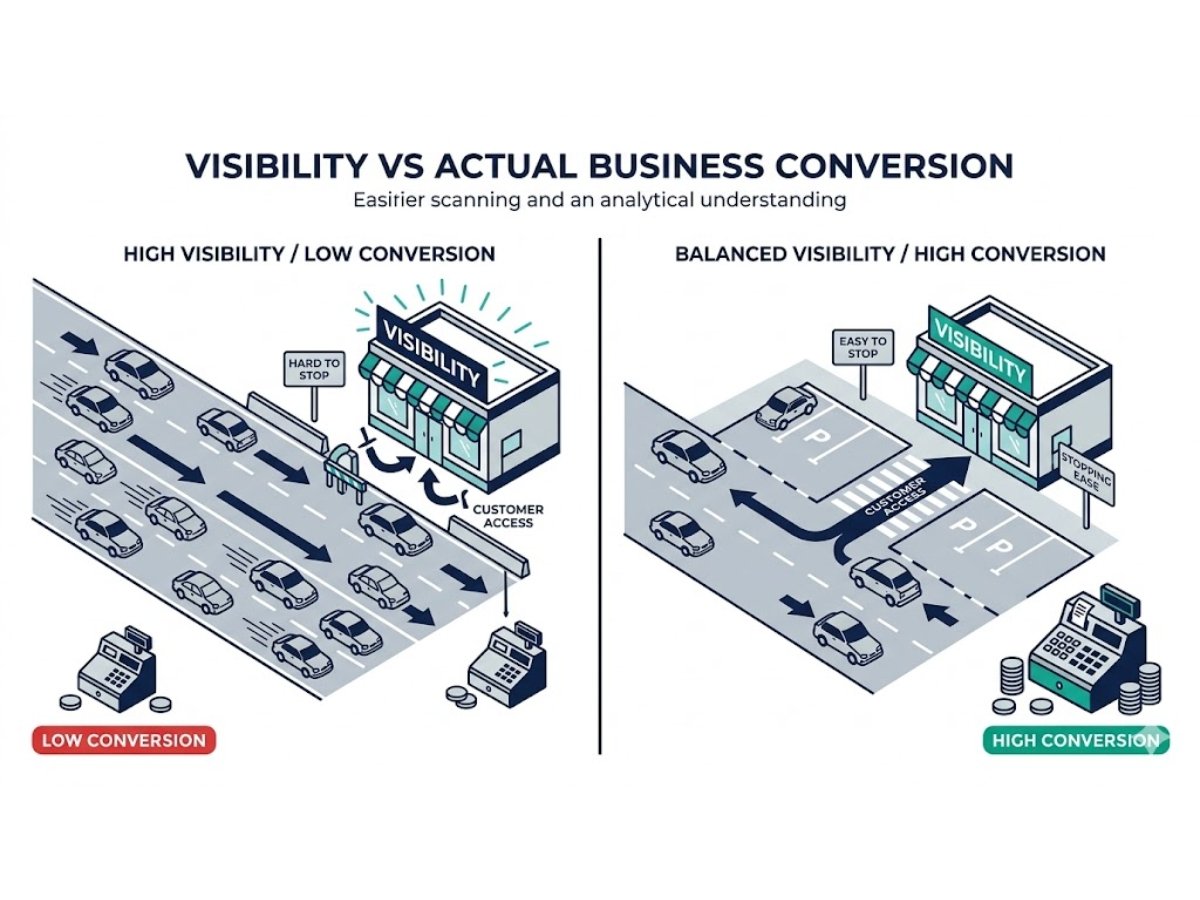
High visibility helps, but only when visibility converts into access, stopping convenience, and commercial use fit. That is why some Palm Beach Road-facing or major-road stretches work better for branding-led office users and some work better for retail, while others are expensive but inefficient.
When visibility adds real value
Visibility adds real value when the business depends on recall, signage, and easy physical recognition. This helps:
- clinics
- premium salons
- financial services offices
- banks
- branded service retail
- selective showrooms
- destination-led food outlets with known demand
A main-road-facing unit that people can actually see, stop at, and enter without friction can justify a premium. In Seawoods, this is more meaningful on genuine access roads and active local stretches, not just on paper-visible frontage.
When visibility is expensive but commercially weak
A road-facing unit can still be a weak buy if parking is poor, stopping is inconvenient, frontage is shallow, or movement speed is too high for impulse conversion. This happens more often than investors admit.
The same principle applies to some office units too. A visible address may help a small business with branding, but if the building does not offer the right office ecosystem, staff convenience, or client comfort, it becomes a vanity purchase rather than a durable office location.
| Situation | Better for Office Branding | Better for Retail Frontage | Can Underperform |
|---|---|---|---|
| Recognisable road-facing address with easy entry | Yes | Yes | Less likely |
| Visible but fast-moving road with poor stopping ease | Sometimes | Often no | Yes |
| Premium-looking internal frontage with weak walk-by movement | Limited | No | Yes |
| Main-road local high-street with repeat catchment | Selective | Yes | Less likely |
The key point is this: visibility is not enough. In Seawoods, you must judge frontage with real movement logic, not brochure language.
Which inner Seawoods sector pockets work better for neighbourhood retail than for premium office use?
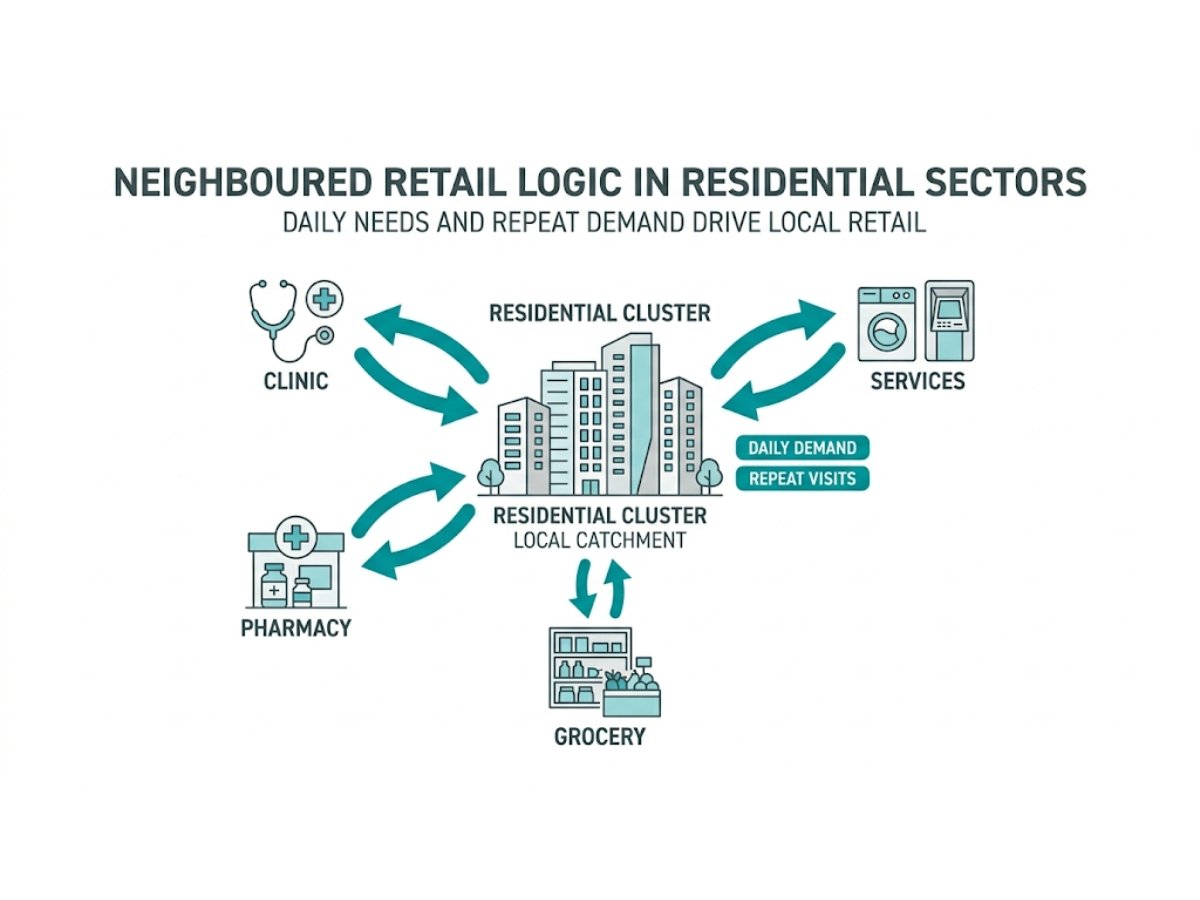
Inner Seawoods sectors matter because not every business needs station-linked prestige. Many businesses need daily repeat demand, local trust, and lower occupancy cost. That is where neighbourhood retail pockets become more relevant than premium office space.
Convenience-led retail
Sector 42 and 42A are especially important here. D-Mart-led movement creates repeat local activity, and the surrounding residential catchment supports grocery-adjacent, pharmacy, clinic, wellness, and essential-led formats. These are not glamorous retail stories, but they are commercially practical.
For many shop investors, this kind of demand is easier to understand than mall adjacency. Repeat need is stronger. Customer dependence is more local. Rent sustainability can be more practical for the right business category.
Service retail and daily-needs businesses
Sector 44 and parts of the inner Seawoods West side work well for service retail and recognisable high-street formats. Banking presence, established food spots, and premium residential catchment improve footfall quality. This is often a better fit for salons, clinics, diagnostic support, financial services, bakery, café, and service-led brands than for deep corporate office demand.
Sector 48 and Seawoods East play a different role. This is the more utility-driven, budget-sensitive, practical trade belt. Medical-support retail, stationery, electronics repair, hardware, local services, and other necessity-driven formats can work better here because the entry economics are more forgiving and the customer need is less image-dependent.
What usually does not work well here
Premium office buying is usually not the strongest play in these inner sector pockets unless the exact building, parking support, and professional ecosystem are unusually strong. A business that wants a clear premium office identity may find these locations commercially weaker than the station-linked zone.
Likewise, high-rent aspirational retail without repeat local fit can struggle. Seawoods residents may have spending power, but that does not mean every fashionable retail category will work in every sector pocket.
Quick local checklist for inner-sector retail fit
- Is demand daily or weekly, not just occasional?
- Can residents reach the unit easily without parking stress?
- Is the frontage visible from natural movement flow?
- Does the category solve a repeat need?
- Is the rent or EMI low enough for realistic local conversion?
If the answer to most of these is yes, inner-sector Seawoods may be stronger than a more expensive prestige pocket.
What kind of businesses fit each Seawoods pocket best?
This is where pocket selection becomes practical.
| Business Type | Best Seawoods Pocket | Why |
|---|---|---|
| CA / consultancy / legal office | Station-linked Sector 40 / SGC office zone | Better client access, better business image, stronger office ecosystem |
| Managed office / coworking | Station-linked office towers | Transit-led demand and scalable corporate environment |
| Premium clinic / wellness brand | Sector 40 or strong main-road stretches in 42/44 | Depends on whether image or local visibility matters more |
| Bank / finance / insurance office | Sector 44 or station-linked zone | Good mix of visibility, trust, and practical access |
| Café / organised food brand | Station-commercial ecosystem or active high-street | Destination demand or quality local catchment |
| Salon / beauty / boutique service brand | Sector 42 / 44 / visible West-side retail pockets | Residential spending power plus repeat service demand |
| Pharmacy / diagnostic support / essential retail | Sector 42 / 42A / Sector 48 | Healthcare and daily-needs support |
| Hardware / repair / utility-led trade | Sector 48 and East-side local markets | Lower cost and stronger utility catchment |
| Boutique retail / gifting / lifestyle | Destination-led mall ecosystem or selected high-street | Needs the right customer mood and visibility |
| Tuition / training / service-led local setup | Budget-conscious local pockets with steady catchment | Lower occupancy cost and practical access |
Three broad rules emerge from this: 1. Premium office users should usually stay close to the station-office ecosystem. 2. Repeat-needs retail should usually follow residential and healthcare catchment, not prestige branding. 3. Retail that depends on aspiration or impulse must be judged by actual customer flow, not just by address.
Should an investor buy office or retail in Seawoods in 2026-style market conditions?
In Seawoods, office is usually the more readable investment. Retail can give sharper upside, but only if the unit is in a truly proven pocket. That makes office safer for many investors and retail more selective.
You should also read Seawoods Commercial Rates and Market Trend to understand how pricing and demand are moving here.
Rental stability
Office space in the station-linked ecosystem is easier to underwrite because tenant logic is clearer. Transit access, Grade A environment, and professional use support steadier demand. For an investor who wants relative predictability, that matters.
Retail is more volatile. A well-bought prime retail unit can outperform, but the wrong retail unit can remain vacant or need rent cuts. In Seawoods, the difference between strong and weak retail can be just one flawed frontage decision.
Tenant replacement risk
Office tenant replacement is usually more manageable in a recognised office ecosystem. Retail tenant replacement is harsher because every category has different frontage and footfall needs. A shop that suits one business may not suit the next.
Ticket size and exit depth
Office investment in Seawoods often has high entry cost but better logic for users and professional investors. Retail varies far more by unit position, frontage, and format. That makes exit depth less uniform.
The cautious investor should think like this:
- choose office if you want a more institutionally understandable asset
- choose retail only if the unit has proven commercial logic, not just landmark adjacency
- choose budget-led local retail if you want yield logic over prestige
Which Seawoods commercial spaces look attractive on site visit but can underperform later?
This is the section many buyers need most.
A commercial unit can look impressive in Seawoods and still fail later because the business logic was weak from day one.
Weak frontage
A shop hidden behind parking, corner cuts, level differences, or awkward access may not capture enough movement even in a premium neighbourhood.
Poor visibility from actual movement flow
A unit may be geographically near the station, mall, or main road but still sit outside the natural pedestrian path. In Seawoods, this is a serious trap because the station-commercial ecosystem channels movement efficiently inside itself.
Footfall mismatch
High footfall is useless if it is the wrong kind. Commuters rushing to trains are not the same as shoppers browsing. Residents driving back home are not the same as patients looking for a clinic. Business fit matters more than raw numbers.
Office stock without true office ecosystem
Some small commercial buildings are sold with an “office space” story, but they do not offer the environment serious occupiers actually want. Weak parking, poor maintenance, low address credibility, and limited building services can reduce long-term tenantability.
> Caution: In Seawoods, do not buy based on map distance alone. Buy based on frontage, movement pattern, entry ease, parking reality, and real category fit.
What should you verify before buying or leasing office or retail space in Seawoods?
Before you commit, verify the commercial reality, not just the sales pitch. This is especially important in a node where premium pricing can hide practical flaws.
Title, sanction, use permission, and authority-side clarity
Check whether the space is genuinely sanctioned for the intended commercial use. Do not rely only on verbal descriptions like “commercial,” “office allowed,” or “retail possible.” In Navi Mumbai, authority-side clarity matters. CIDCO, NMMC, society rules, and project-level permissions can all affect actual usability.
If the asset is part of a project where project documents are relevant, verify the approvals properly. Where applicable, MahaRERA can help with project-level documentation, but it should not be forced into every resale situation. Use IGR Maharashtra only as a rough value reference, not as proof of real live market pricing.
Society, maintenance, parking, signage, and access
This is where many commercial deals become painful later.
Check:
- whether the building or society allows your business category
- whether signage rights are restricted
- whether customer and visitor parking is practically usable
- whether maintenance charges are reasonable for your business size
- whether entry and exit work smoothly during active hours
The NMMC environment has also become stricter around parking compliance and signboard enforcement. For some businesses, especially clinics, salons, and appointment-led services, parking friction can directly reduce customer retention. Signage compliance also matters more than many small operators assume.
Actual tenantability, not brochure positioning
Ask the practical questions:
- Who would realistically rent this after me?
- Would a business actually choose this over nearby alternatives?
- Does this unit solve a known local demand?
- Is the commercial story dependent on assumption or on proven movement?
If you cannot answer these clearly, the asset may be weaker than it looks.
Due diligence checklist before buying or leasing
- sanctioned commercial use confirmed
- building operations and occupancy reality checked
- society by-laws reviewed
- parking and visitor access assessed on-site
- signage restrictions understood
- maintenance burden calculated
- frontage and natural movement flow observed at real business hours
- future tenant profile realistically identified
So, which is the best Seawoods pocket for you?
There is no one universal best pocket. There is only the best pocket for your business type, risk appetite, and budget.
If you want the cleanest answer by user type, use this:
- Best for premium office use: Seawoods Grand Central and the station-linked Sector 40 office ecosystem
- Best for destination retail: inside the strong station-commercial retail environment
- Best for road-level service and branded retail: strong visible stretches in Sector 44 and selective West-side belts
- Best for healthcare and daily-needs retail: Sector 42 and 42A
- Best for budget-led utility and yield-focused local trade: Sector 48 and Seawoods East
- Best for cautious investors who want readable demand: office in the real station-linked ecosystem or practical retail in proven repeat-need pockets
- Most common mistake: paying premium money for a unit that is near the landmark but outside the real commercial flow
Seawoods works best when you respect pocket logic. Office demand here is strongest in recognisable Grade A environments, not in every small commercial unit. Retail demand is strongest when the format matches actual behaviour, whether that is destination shopping, local repeat need, or visibility-led service use. That is why Seawoods can be one of Navi Mumbai’s strongest commercial nodes and still punish the wrong buy.
concluaion
The best office pocket in Seawoods is usually the station-linked Seawoods Grand Central zone because it gives the strongest mix of access, office quality, and commercial identity. The best retail pockets are more fragmented: destination retail belongs to the station-commercial ecosystem, service and high-street retail fit better in visible pockets like Sector 44, healthcare and convenience retail do better in Sector 42, and utility-led local trade is stronger in Sector 48. If you are buying in Seawoods, do not buy the address alone. Buy the right pocket for the right commercial behaviour.
FAQs
Frequently Asked Questions