
How Station Access, Palm Beach Road and Event Economy Affect Nerul Business Demand
Nerul business demand does rise because of station access, Palm Beach Road, and the event ecosystem around the stadium belt, but these three drivers do not help every business in the same way. Station access mainly supports daily-use retail, staff-heavy offices, clinics, and coaching formats. Palm Beach Road supports visibility-led and car-dependent businesses. Event activity helps food, hospitality, and selective short-duration demand, but by itself it is not a complete business foundation.
To understand how these demand drivers affect the node overall, Nerul Commercial Property Guide is worth reading too.
What is the real answer: do station access, Palm Beach Road and event activity genuinely increase Nerul business demand?
Yes, they do. But the real answer is more specific than the usual “good connectivity” line.
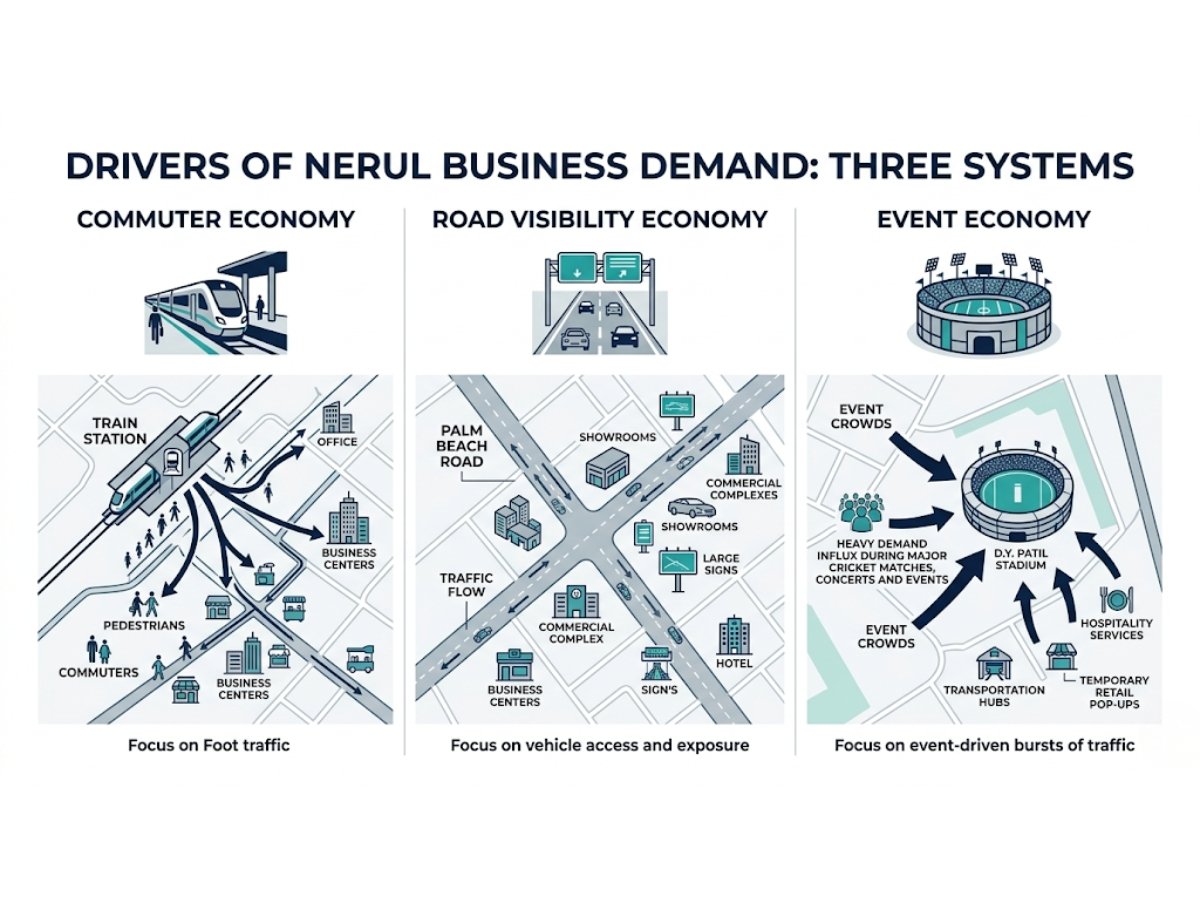
Nerul does not operate as one single commercial market. On ground, it behaves like three separate demand systems working inside the same node. One is the commuter economy around the station. The second is the arterial road economy around Palm Beach Road. The third is the event economy influenced by DY Patil Stadium, the university belt, hospitality demand, and surrounding institutional activity.
That distinction matters because business demand in Nerul is not just about being in a known location. It is about being in the right pocket for the right operational model. A shop that works near the station may fail on Palm Beach Road. A premium destination business that looks right on Palm Beach Road may struggle inside the station-side sectors. And a stadium-facing business may look exciting on event weekends but remain weak on ordinary weekdays.
Quick summary: how the three drivers affect Nerul business demand
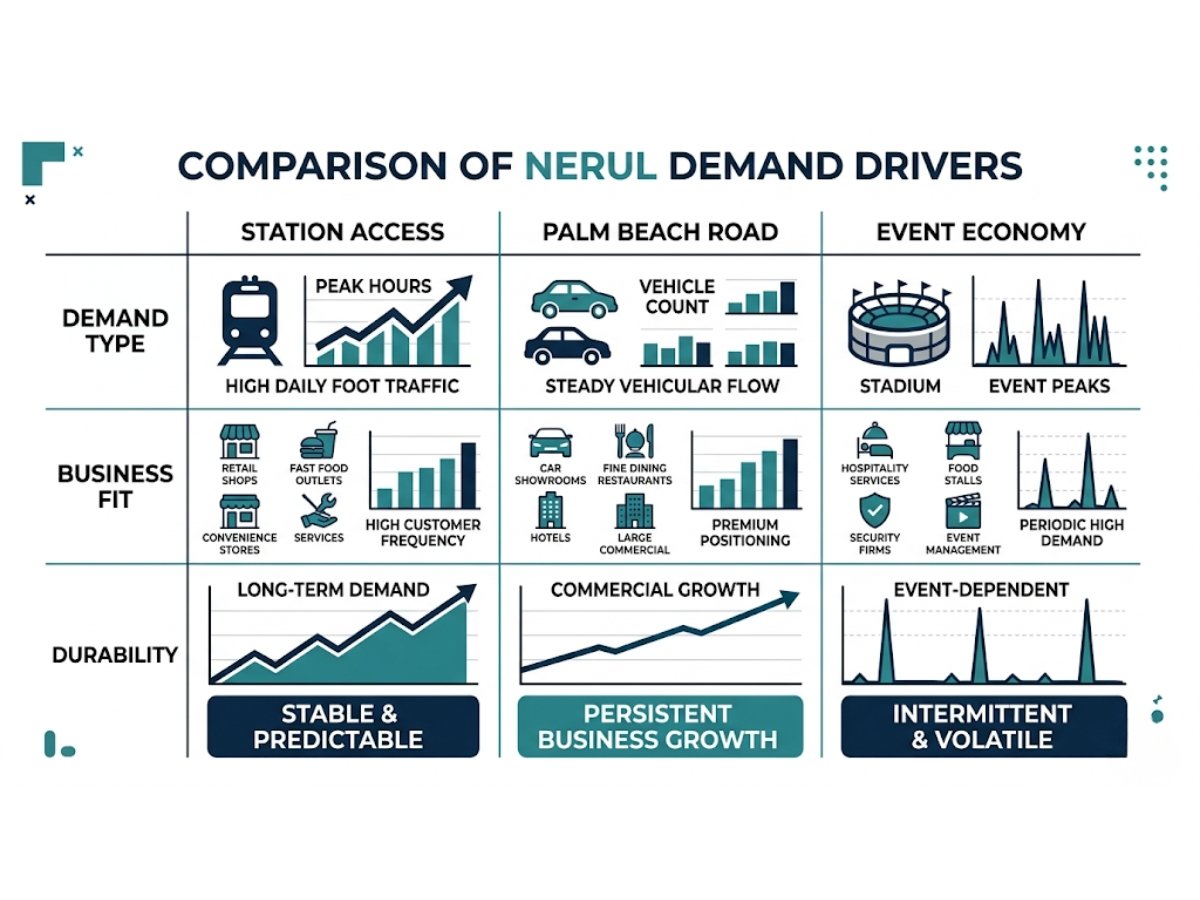
| Demand driver | What it really creates | Best-suited business types | Demand durability | Where it matters most |
|---|---|---|---|---|
| Station access | Daily recurring footfall, staff convenience, repeat usability | Clinics, coaching, pharmacies, QSRs, SME offices, convenience retail | High and stable | Sectors 15, 21, 23 and station-linked pockets |
| Palm Beach Road | Visibility, smoother car access, premium perception, planned destination visits | Showrooms, fine dining, premium studios, designer retail, financial branches | Stable but category-dependent | Sectors 4, 6, 8 and connector-side zones |
| Event economy | Short bursts of heavy spending, hospitality demand, brand exposure | Hotels, cafes, bars, event-friendly food outlets, selective retail | Cyclical, spike-based | Sectors 7, 9, 11 and the stadium-university belt |
The practical lesson is simple. Nerul business demand is real, but it is fragmented. The reader should not ask, “Is Nerul good?” The right question is, “Which Nerul demand engine matches my business?”
Why is station access still one of the strongest business demand drivers in Nerul?
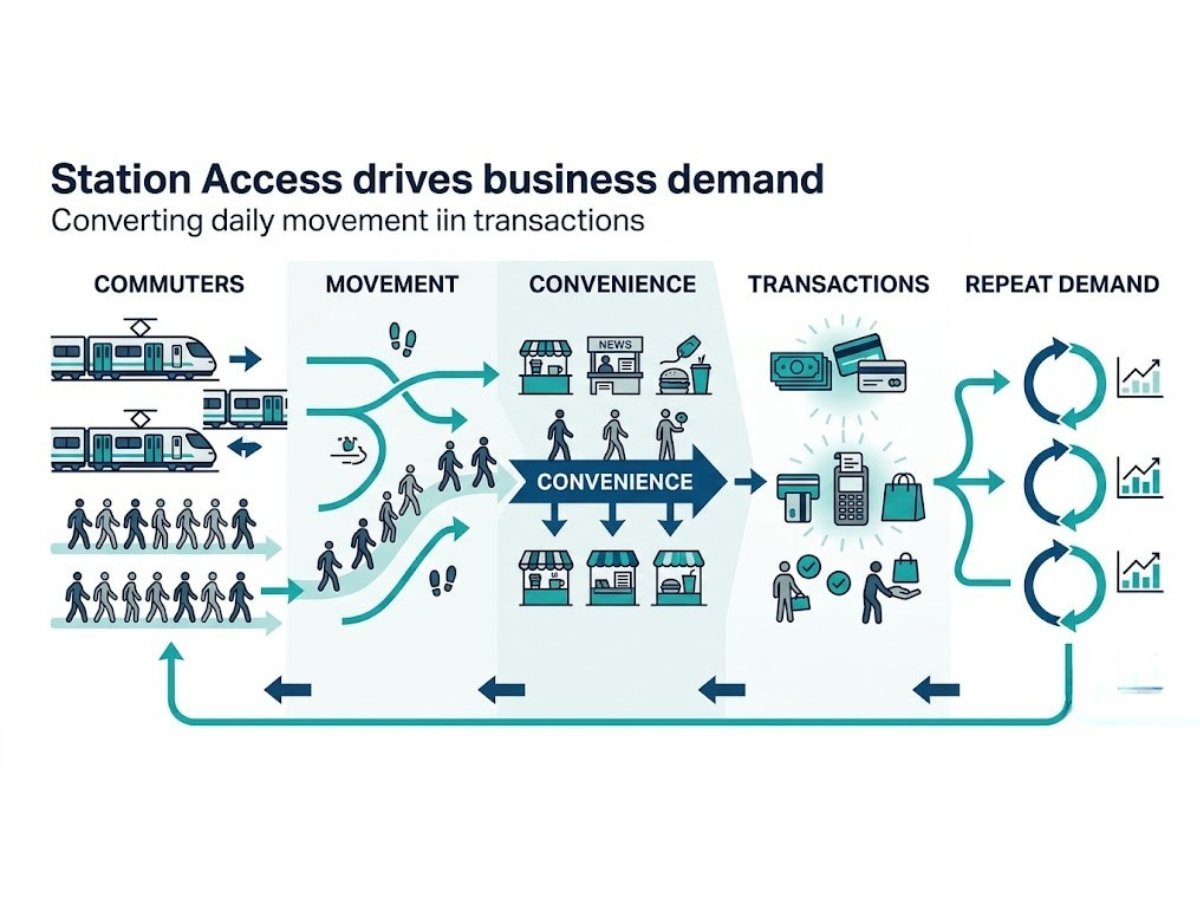
Station access remains one of the strongest commercial demand drivers because it supports routine. And in business, routine usually matters more than hype.
In Navi Mumbai, railway access still shapes how people move for work, study, errands, and daily purchases. Nerul benefits from that pattern because its station-side ecosystem does not just serve train users. It also connects with bus movement, autorickshaw circulation, and nearby residential sectors. That means the station area is not only a transport point. It is also a transaction zone.
The business value here comes from convenience. A customer buys because the shop is on the way. A patient chooses a clinic because it is easy to reach without depending on a car. A coaching class fills seats because students from other nodes can arrive without friction. A small office runs better because staff attendance is more reliable.
Which business types benefit most from walk-in commuter access?
The strongest beneficiaries are businesses that depend on high-frequency, low-friction decisions.
In Nerul, that usually includes pharmacies, bakeries, fast-food counters, tea and snack points, mobile repair shops, small grocery formats, pathology-linked healthcare, and daily service retail. These businesses do not need a grand arrival experience. They need flow. They need the customer to say, “I’ll just stop here on the way.”
This is why sectors close to the station, especially around Sectors 15, 21, and 23, tend to hold commercial relevance even when more glamorous pockets get more attention. Their demand is tied to habit, not novelty.
A coaching centre is another good example. It may not need branding prestige. It needs easy access for students from Panvel, Uran, Belapur, or Vashi. In that case, being within a practical walking radius from Nerul station is more valuable than being on a visually premium road.
Which business types need staff convenience more than customer footfall?
Some businesses do not depend mainly on walk-ins. They depend on staff stability, operational punctuality, and low-friction commuting.
That includes SME offices, back-office teams, boutique consultants, administrative firms, training centres, and educational setups. For them, the station is not just a customer magnet. It is a talent and attendance tool.
A self-use office in Nerul often makes sense when the team is coming from multiple parts of Navi Mumbai or even from the Mumbai side. In such cases, the business is not paying for glamour. It is paying for daily usability.
This is one of the more under-discussed truths about Nerul office demand. Many office users do not need the image profile of a Palm Beach-facing address. They need a location where employees can actually reach the office without daily travel friction.
When station proximity is overrated
Station access becomes overrated when buyers assume all commercial categories need the same thing.
Luxury retail, premium salons, designer boutiques, fine dining, and businesses serving mostly car-driving clients may not benefit much from being too close to a noisy, high-friction transit pocket. In fact, the station environment can work against them. Parking stress, messy frontage, rushed pedestrian behaviour, and limited arrival comfort reduce the value of the location for such formats.
That problem becomes more serious when a building lacks proper paper-backed parking support. A premium business cannot run on “visible but inconvenient” access forever. If customers struggle to arrive, the location stops being premium in practical terms.
Example box
A pharmacy near the station can perform strongly because people buy medicine during routine movement. A diagnostic clinic can do well because patients and staff can reach it easily. But a high-end lifestyle store in the same environment may struggle because its customer expects parking, slower browsing, and a cleaner arrival experience.
How does Palm Beach Road change business demand differently from station-led demand?
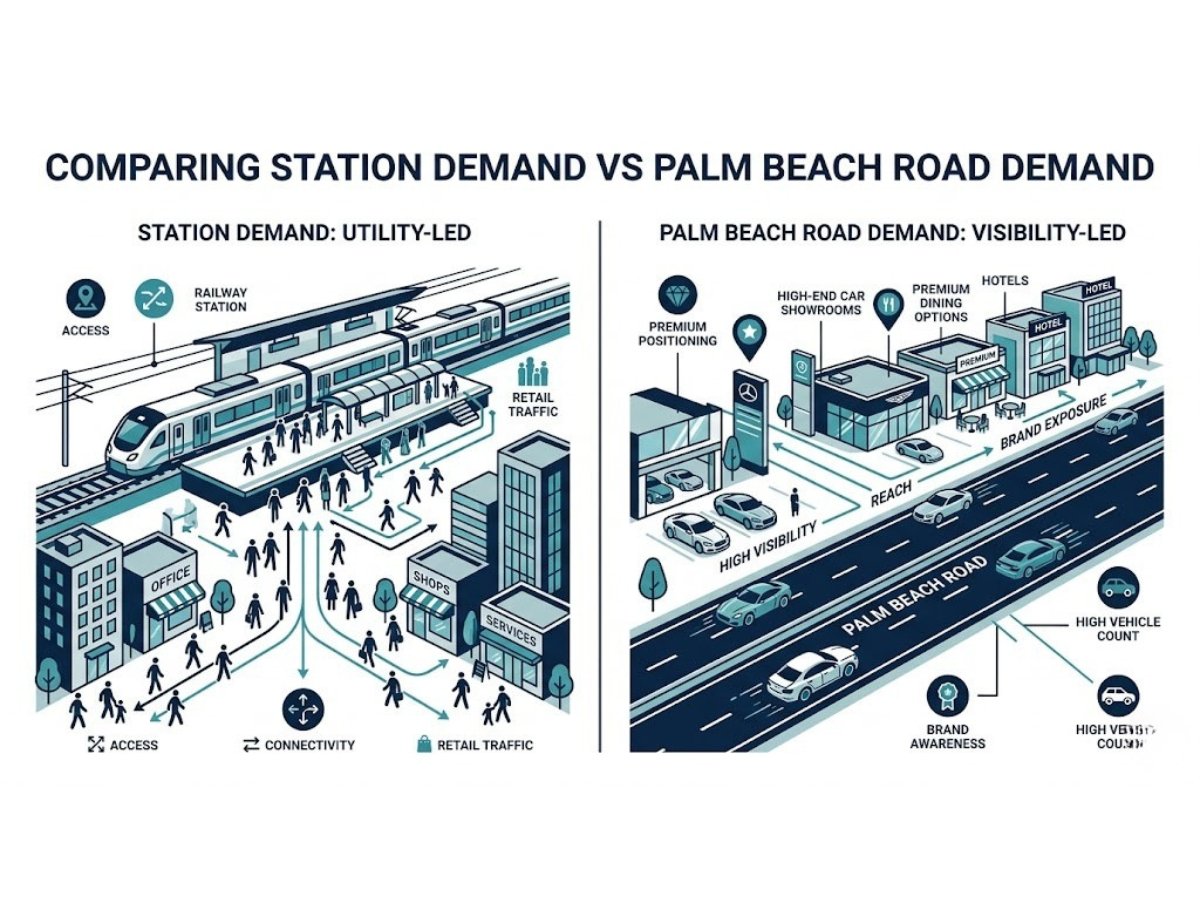
Palm Beach Road does not create the same kind of business demand as the station. It creates a different kind.
Station-led demand is about recurring utility. Palm Beach Road demand is about visibility, smoother arrival, wider-city access, and perception. One supports everyday frictionless use. The other supports destination-led consumption and premium positioning.
That is why it is wrong to treat both as “connectivity benefits.” They are not interchangeable.
Palm Beach Road helps visibility, car access, and premium perception
Palm Beach Road changes business demand by improving how a place looks, how it is approached, and which customer segment it attracts.
Road-facing pockets in and around Sectors 4, 6, and 8 benefit from a stronger arrival experience, better private-vehicle access, and a more polished market image. This makes them more suitable for businesses where the visit is planned and the purchase value is relatively high.
Automotive showrooms, premium interior brands, designer studios, upscale cafes, fine dining concepts, and premium financial or advisory branches are stronger fits here than daily convenience businesses. Their customers do not need random walk-ins. They need confidence, comfort, and smooth access.
Why road-facing visibility is not the same as recurring customer demand
This is where many commercial buyers make mistakes.
A unit can be highly visible from the road and still have weak daily business performance. Why? Because a passing car is not the same as a walking customer. Visibility creates awareness. It does not automatically create conversion.
Palm Beach Road is not a high-volume pedestrian street. It is a movement corridor. Businesses that rely on impulse footfall, repeated daily transactions, or neighbourhood convenience do not automatically gain from that environment. They may actually lose margin because the rent or capital value is higher while the transaction pattern does not improve enough.
A standard pharmacy, low-ticket stationery outlet, routine salon, or budget coaching format usually does not become stronger just because it is visible from a fast road.
Which businesses gain more from Palm Beach Road than from station adjacency?
Businesses that benefit more from Palm Beach Road usually share three qualities. They serve customers who arrive intentionally, they operate with higher average transaction value, and they depend on image as much as location.
That includes:
- showrooms
- fine dining and premium café formats
- luxury or designer retail
- automotive and home-interior categories
- premium professional branches serving appointment-based clients
For these formats, Palm Beach Road commercial demand is not about walk-ins. It is about status, convenience for car users, and city-wide recognizability.
Does Nerul’s event economy create real long-term business demand or only temporary footfall?
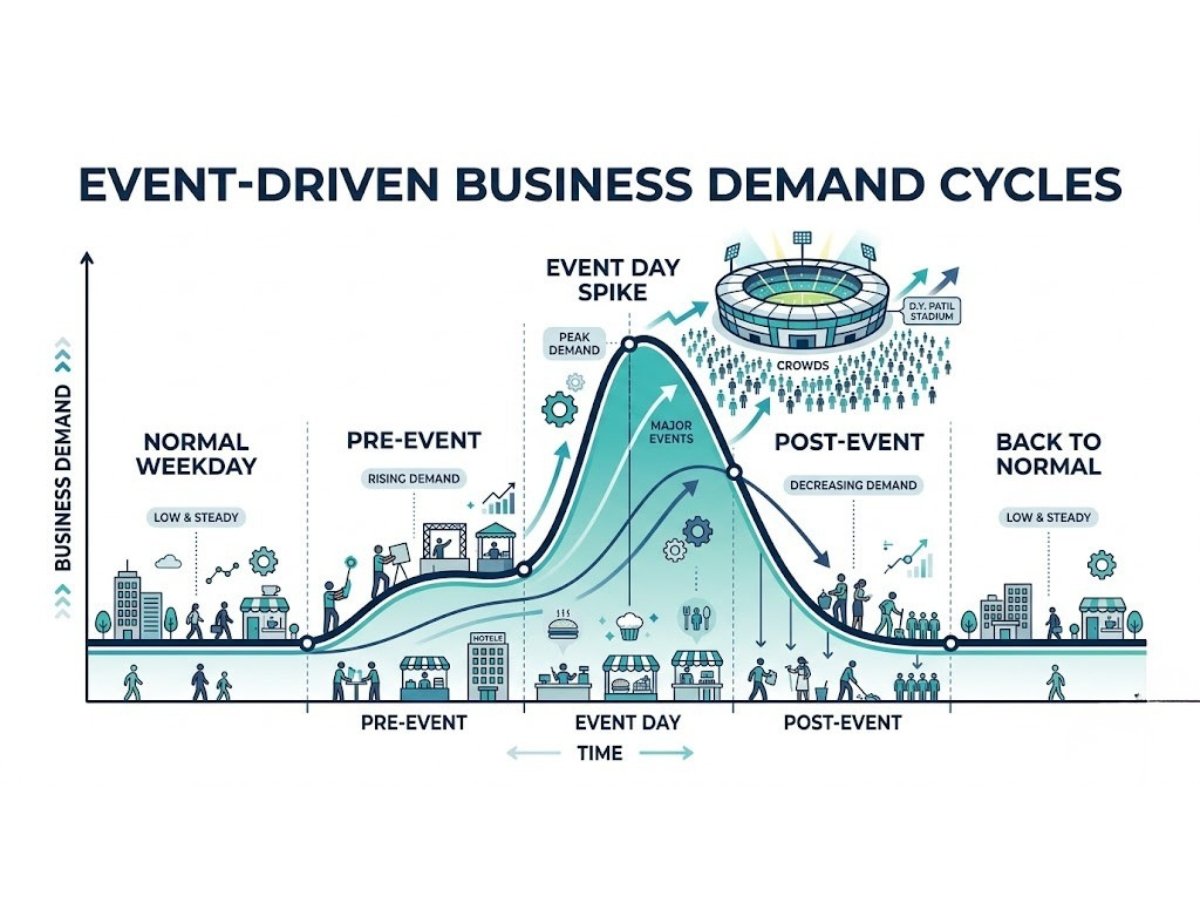
The honest answer is this: it creates real business opportunity, but mostly in bursts, not as an all-day, all-week commercial base.
The DY Patil Stadium belt, along with the university and hospitality influence zone, clearly changes Nerul’s visibility and spending pattern. During major concerts, cricket fixtures, and large events, the area gets an intense spike in occupancy, F&B activity, and short-duration commercial movement.
But event demand should be understood carefully. It is powerful, but uneven.
What event-led demand actually helps
Event-led demand mainly helps hospitality, food, beverage, and selective experience-led businesses.
Hotels and short-stay accommodation benefit directly when event visitors need rooms. Restaurants, cafes, pubs, and fast-moving food formats see strong pre-event and post-event spending. Event-friendly retail, merchandise, and quick-service formats can also get a temporary lift.
This kind of demand can be commercially meaningful. It also improves the wider branding profile of the belt. Over time, the area becomes more recognized, more discussed, and more visible in the city’s mental map.
Which businesses can convert event crowds into repeat revenue
Only a few businesses can use event crowds intelligently enough to build repeat value.
The best examples are food and hospitality operators who already have a decent local base and use event days as customer acquisition moments. A café or restaurant can get exposed to a much wider Navi Mumbai audience during major events. If the experience is good, some visitors may return later even without an event.
The student and institutional base around the DY Patil ecosystem also helps. Businesses that can serve both the everyday student and local audience and also scale up during event weekends are in the strongest position.
That mixed strategy matters. Depending only on event spikes is risky. Using event days to strengthen an already functional weekday model is smarter.
Why many investors overestimate event-driven demand
Because event footfall looks bigger than it really is in commercial terms.
A packed concert or stadium event creates excitement, traffic, and temporary spending. But that does not mean the surrounding area has stable daily demand for every category. In fact, major event days can hurt regular businesses that need smooth access. Road closures, traffic pressure, delivery delays, and client inconvenience can turn those days into an operating problem instead of an opportunity.
A dental clinic, a back-office unit, a diagnostic lab, or a dispatch-based business may not benefit at all from being too close to the event zone. On some event days, normal operations can become harder.
Caution box
Do not price commercial property near the stadium based on one sold-out concert weekend. The real test is simple: how does that business perform on a normal weekday afternoon? If the answer is weak, event hype is not enough to support the investment thesis.
Which parts of Nerul benefit most from these three demand drivers?
Not all of Nerul benefits equally. Different pockets respond to different demand engines.
Station-side practical business pockets
Sectors 15, 21, and 23 are among the strongest station-led pockets. These areas suit convenience retail, coaching, service businesses, clinics, and smaller offices that benefit from walkability and repeat local usage.
Their strength is not aesthetics. Their strength is utility.
Palm Beach Road and connector-side business pockets
Sectors 4, 6, and 8 are stronger for visibility-led and destination businesses. They offer a different value proposition: better vehicle-based arrival, stronger frontage appeal, and more premium business positioning.
These pockets are more suitable when customer type matters more than raw volume.
Stadium-university-hospitality influence zones
Sectors 7, 9, and 11, along with adjoining influence areas near the stadium-university belt, are more event-sensitive and transformation-oriented. They can suit hospitality, food, flexible commercial formats, and future-facing office demand where the surrounding ecosystem is changing.
But this zone requires sharper category selection. It is not automatically right for every business.
Micro-location summary
| Nerul pocket type | Main strength | Best use cases | Main caution |
|---|---|---|---|
| Station-side sectors | Daily volume and access | Clinics, coaching, QSRs, convenience retail, SME offices | Parking and premium-image limitations |
| Palm Beach-linked pockets | Brand visibility and car access | Showrooms, fine dining, premium studios, destination retail | Weak pedestrian conversion for routine retail |
| Stadium-university belt | Event spillover and evolving commercial profile | Hospitality, cafés, flexible office formats, selective service brands | Demand can be cyclical and access can get disrupted on event days |
Which businesses usually make the most sense in Nerul because of this demand mix?
Nerul works best for businesses that value a mix of access, catchment depth, and flexible positioning.
Offices and professional spaces
Nerul is a practical fit for SMEs, consultants, boutique professional firms, coaching offices, and service-led back-office operations. It offers stronger capital efficiency than more prestige-heavy nodes while still giving good connectivity and employee access.
This is why Nerul office demand is not just about glass towers. It is also about functional, well-connected workspaces.
Food, café, and hospitality-led formats
Nerul supports multiple food formats, but not in the same pocket. Quick-service formats are better closer to commuter and student flow. Premium dining works better where arrival comfort and destination choice matter more. Event-facing hospitality can work if the operator has the ability to manage demand spikes without depending only on them.
Clinics, education, coaching, and service-led businesses
These are among the most durable categories in Nerul. The combination of residential depth, public transport usability, and repeat local need makes such formats naturally stronger than trend-led speculative businesses.
Retail categories that need recurring local catchment, not just visibility
Supermarkets, daily-use stores, pharmacies, hardware, stationery, and routine apparel or service formats need recurring neighbourhood demand more than image. In Nerul, they usually make more sense in station-adjacent or internally connected sectors than on high-visibility prestige roads.
Which businesses should be careful before paying a Nerul premium?
Nerul is not the right answer for every operator. Some businesses should be cautious before paying for the node’s reputation.
Businesses that depend on very cheap rent
If the business model works only when rent stays very low, Nerul can become uncomfortable quickly, especially in better-connected or more visible pockets. A location premium without corresponding revenue strength becomes a drag very fast.
Businesses that need heavy cargo movement or industrial-style access
Cargo-heavy operations, warehouse-style movement, and businesses needing consistent truck access should think carefully. Nerul is increasingly mixed-use and urbanized. That makes it stronger for service-led and office-led commercial demand, not for logistics-heavy functions.
Businesses that mistake event spikes for stable demand
This is probably the most common mistake. Event days create noise, not necessarily durable tenant economics. If the business needs stable Tuesday-to-Friday revenue, it should be judged on that basis.
Is Nerul stronger for office demand, retail demand, or mixed-use business demand?
Nerul is strongest as a mixed-use business node.
It is not the pure office heavyweight that CBD Belapur can be in administrative and institutional terms. It is not the deeply established wholesale-retail ecosystem that Vashi can represent. It is also not a pure premium retail destination in the way some Seawoods pockets are perceived.
Its real advantage is balance.
Nerul can support offices, clinics, coaching, service retail, food formats, and selective premium commercial uses, but only when they are matched to the correct micro-location. That makes it especially useful for self-users and investors who want multiple exit routes instead of depending on a single tenant category.
What should an investor or self-user actually check before buying commercial space in Nerul on this thesis?
A strong location story is not enough. The property itself has to work.
You should also read Best Commercial Pockets in Nerul to see where this demand shows up most clearly.
Access quality versus map-level closeness
Do not confuse map proximity with operational ease. A unit may look close to the station, Palm Beach Road, or stadium on a map and still be awkward to reach. Check the actual approach road, walkability, turning comfort, and entry-exit experience.
Parking, frontage, and arrival experience
This matters even more for premium or appointment-led businesses. If the customer struggles to park or arrive comfortably, a supposed premium location loses value very quickly.
Building quality, sanction status, and use suitability
Check Occupancy Certificate status, use suitability, and whether the building actually fits the intended commercial purpose. If the purchase involves under-construction or evolving supply, verification should be stricter, not looser.
Whether demand is daily, weekend, or event-linked
This is the most important decision filter. The buyer should ask one simple question: what kind of demand is actually supporting this asset? Daily recurring demand is not the same as weekend demand. Weekend demand is not the same as event-day demand.
Practical buyer checklist
Before buying commercial space in Nerul on a station-access, Palm Beach Road, or event-economy thesis, check:
- actual walking and driving access, not just map distance
- legal parking support and realistic arrival comfort
- building sanction and occupancy comfort
- whether the business type matches the local demand driver
- whether demand is daily, destination-led, or only event-driven
- whether the unit works on an ordinary weekday, not just during a major event
When does the “station + Palm Beach + event economy” combination become a strong reason to choose Nerul?
It becomes a strong reason to choose Nerul when the buyer understands that these are not three equal benefits for one unit, but three separate strengths spread across one node.
Nerul makes the most sense when the business needs some combination of recurring accessibility, decent city-facing visibility, and selective destination upside, while still staying in a commercially flexible environment. That is the real advantage of Nerul. It is not one-dimensional.
For a self-user, this means choosing the exact pocket that matches how customers and staff actually move. For an investor, it means avoiding lazy “prime area” thinking and focusing on category fit, demand durability, and real operational comfort.
If that matching is done properly, Nerul can be one of the more practical mixed-use commercial choices in Navi Mumbai. If that matching is ignored, even a good-looking location can become an expensive mistake.
Conclusion
Station access, Palm Beach Road, and the event ecosystem do increase Nerul business demand, but they do so in very different ways. Station access builds daily reliability. Palm Beach Road builds visibility and premium positioning. Event activity creates selective spikes and branding spillover, not universal commercial stability. The right way to choose Nerul is not to chase the loudest story. It is to match the business model with the correct demand engine and the correct pocket inside the node.
FAQs
Frequently Asked Questions