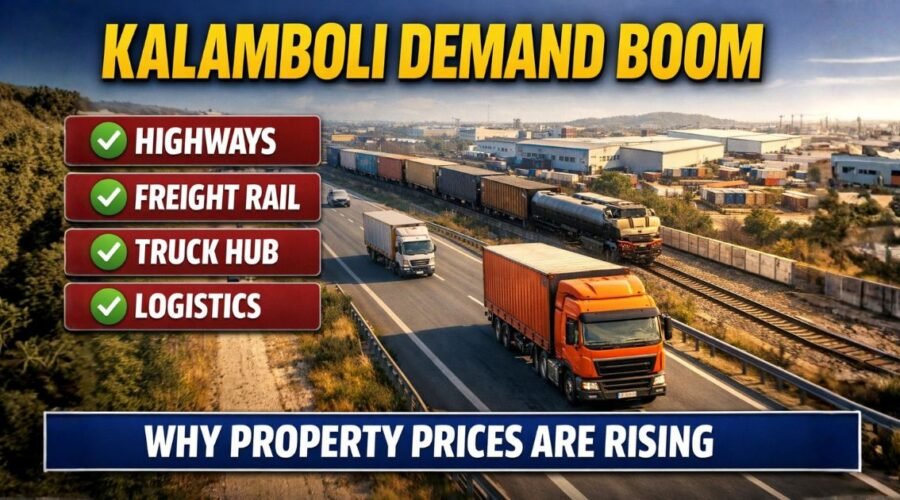
How Highways, Freight Rail and Truck Ecosystem Affect Kalamboli Demand
Kalamboli demand is rising mainly because it works as a freight movement node, not because it simply looks well connected on a map. Highways help daily cargo movement, freight rail strengthens the larger port-region logistics belt, and the truck ecosystem keeps operations moving on the ground. But this demand is uneven. Some pockets gain from faster dispatch and access, while others suffer from congestion, queue spillover, pollution, and entry-exit friction.
Kalamboli is often described in one lazy sentence: “good connectivity.” That sentence is not wrong, but it is incomplete. The real story is more practical. In Kalamboli, demand becomes strong only when transport infrastructure improves throughput in actual business use. A site near a major road is not automatically a high-demand site. If trucks struggle to enter, wait, load, turn, or exit, the location loses real value no matter how impressive the highway map looks.
That is why Kalamboli keeps coming up in logistics, industrial, and warehouse conversations across Navi Mumbai. It sits at a working junction between the Sion-Panvel side, NH-48, NH-66, Mumbai-Pune movement, Panvel-side cargo logic, and the wider JNPA freight system. Historically, it also developed around the shift of the steel trade out of South Mumbai, which is why the steel market still matters so much to the local ecosystem today.
What is actually driving Kalamboli demand today: highways, freight rail, or the truck ecosystem?
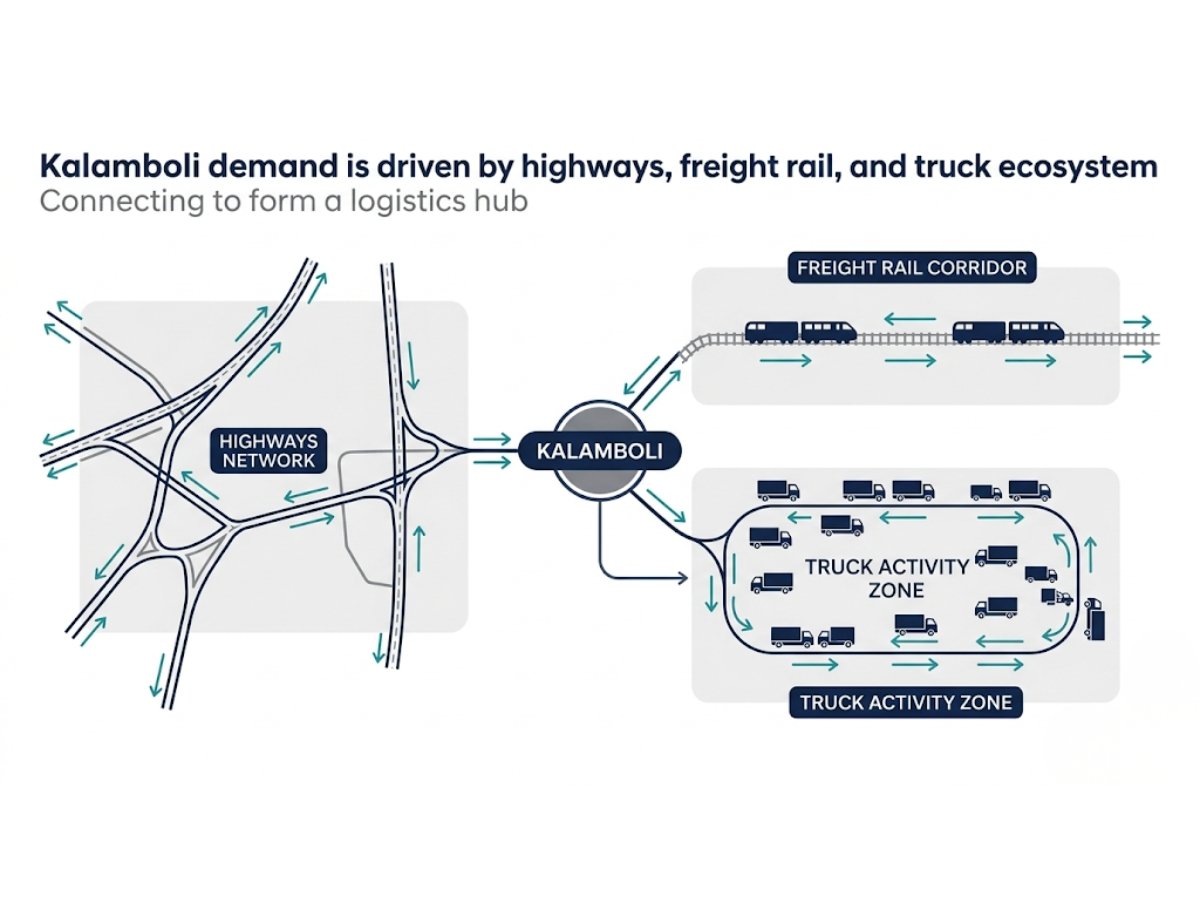
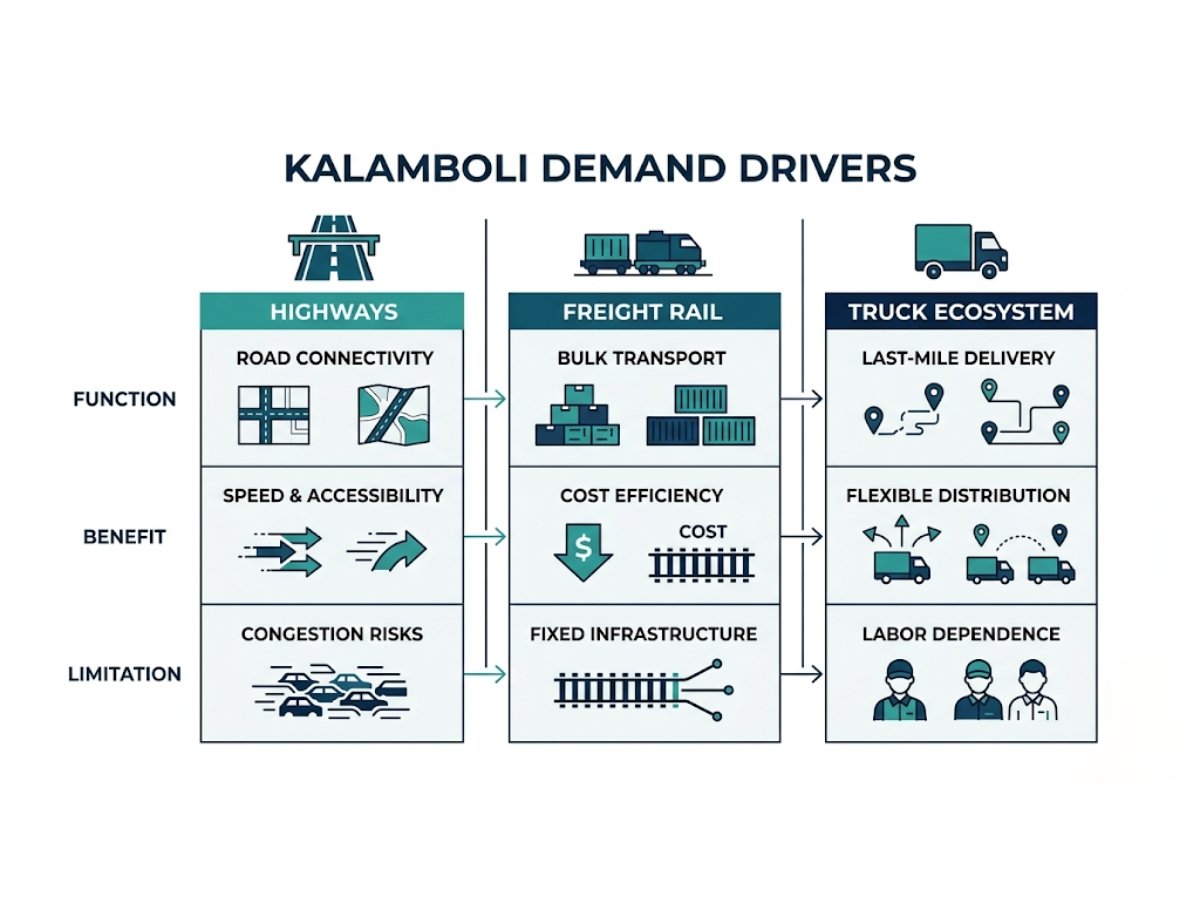
All three matter, but they are not relevant in the same way. Highways create immediate movement value. Freight rail strengthens the larger cargo economy around Kalamboli. The truck ecosystem converts connectivity into day-to-day usable business activity.
| Demand driver | What it actually does | Who benefits most | Where people misunderstand it |
|---|---|---|---|
| Highways | Improves regional road access, dispatch flexibility, and connection to Pune, Mumbai, Panvel, and port-facing corridors | Warehouse users, distributors, transport-heavy traders, industrial occupiers | People think “near highway” automatically means easy daily operations |
| Freight rail | Improves cargo-region efficiency, especially port-linked movement and backend logistics economics | Container-linked users, larger warehousing chains, port-connected supply chains | People overstate rail benefits for every plot, office, or small commercial asset |
| Truck ecosystem | Supports loading, parking, repair, maintenance, turnaround, and fleet continuity | Truck-cycle dependent businesses, steel-linked users, transport operators, goods handlers | People ignore that the same ecosystem can create congestion and livability discount |
So the short answer is this: Kalamboli demand is still road-led in daily practical terms, but it becomes more durable because rail and truck support systems sit behind that road network. That combination is what gives Kalamboli its throughput-market character.
Why do highways matter so much in Kalamboli beyond simple map connectivity?
Highways matter in Kalamboli because this is not just a commuter location. It is a movement location. Businesses choose Kalamboli when they need goods to move across regions with reasonable speed and repeatability.
How the Sion-Panvel Highway, Mumbai-Pune side access, and JNPA-facing road links shape movement
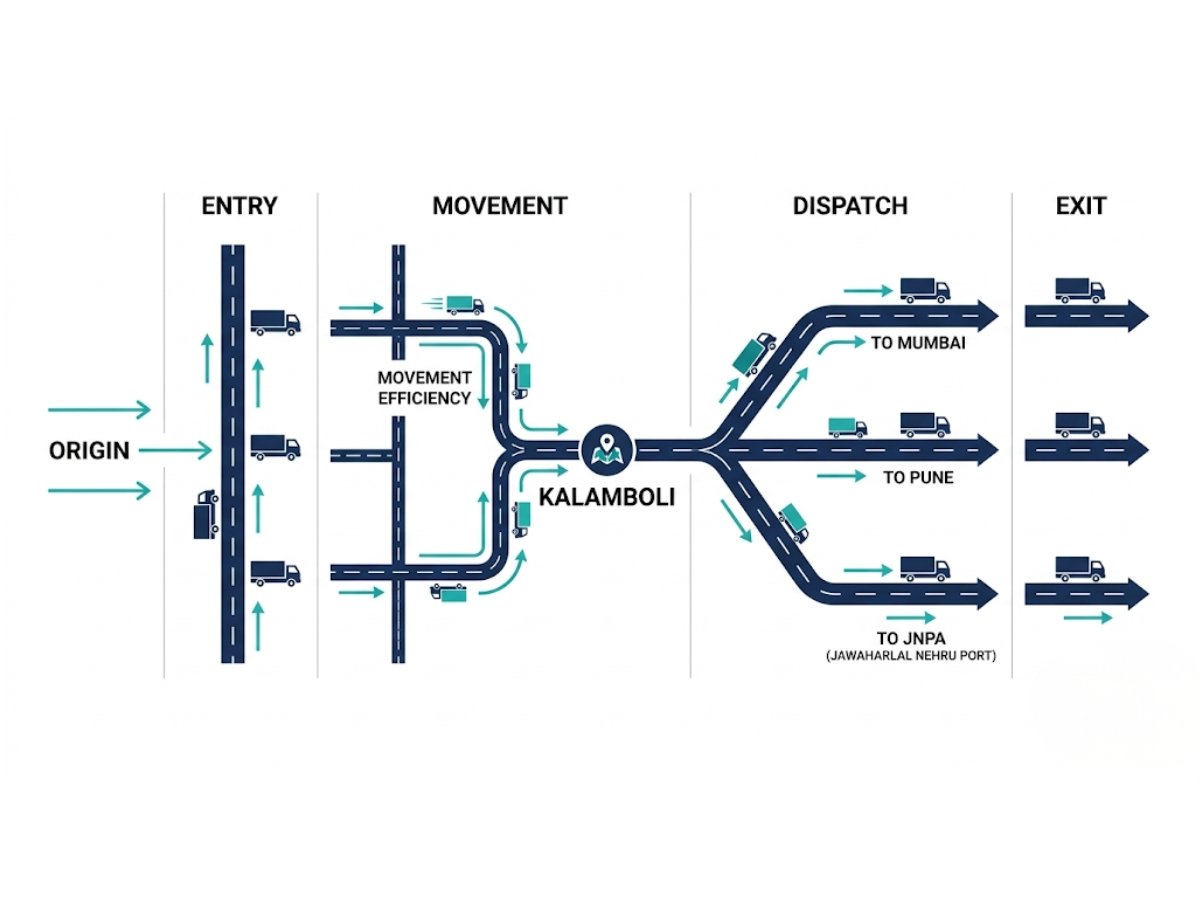
Kalamboli sits at one of the most important road intersections in this part of Western India. The Sion-Panvel Highway, NH-48, NH-66, and Mumbai-Pune Expressway-side movement all influence the node. That matters because road freight here is not abstract. It directly affects dispatch timing, receiving efficiency, fleet scheduling, and the cost of delay.
A warehouse or industrial user in Kalamboli benefits when one location can serve multiple directions without pushing every truck through a long urban detour. That is a major reason why occupiers keep considering the Panvel-Kalamboli belt for logistics and backend industrial use.
Kalamboli also gains because it sits within the operational gravity of JNPA. For import-driven businesses, especially bulky materials like steel and scrap, the ability to receive, store, and re-dispatch goods inland matters more than lifestyle appeal or city branding.
Why Kalamboli gains from regional access but also suffers from junction pressure
The same regional strength has also created Kalamboli’s biggest weakness: junction stress. For years, the central junction has struggled under the load of heavy commercial vehicles and mixed traffic. This is why the major multi-level interchange upgrade matters so much. It is not just a road beautification project. It is an attempt to remove one of the biggest friction points in the node’s operating model.
That is the key local truth. In Kalamboli, highway access creates demand only when junction handling improves. If a truck spends too much time queuing near a stressed connector, the benefit of being “well connected” reduces sharply.
A practical example helps here. A distributor dispatching to Pune, Navi Mumbai, and Mumbai in the same operating cycle may still prefer Kalamboli because the larger network reach is strong. But if the site sits in a pocket where entry-exit delays regularly eat into dispatch windows, the same occupier may pay less rent or choose a better-positioned micro-location nearby.
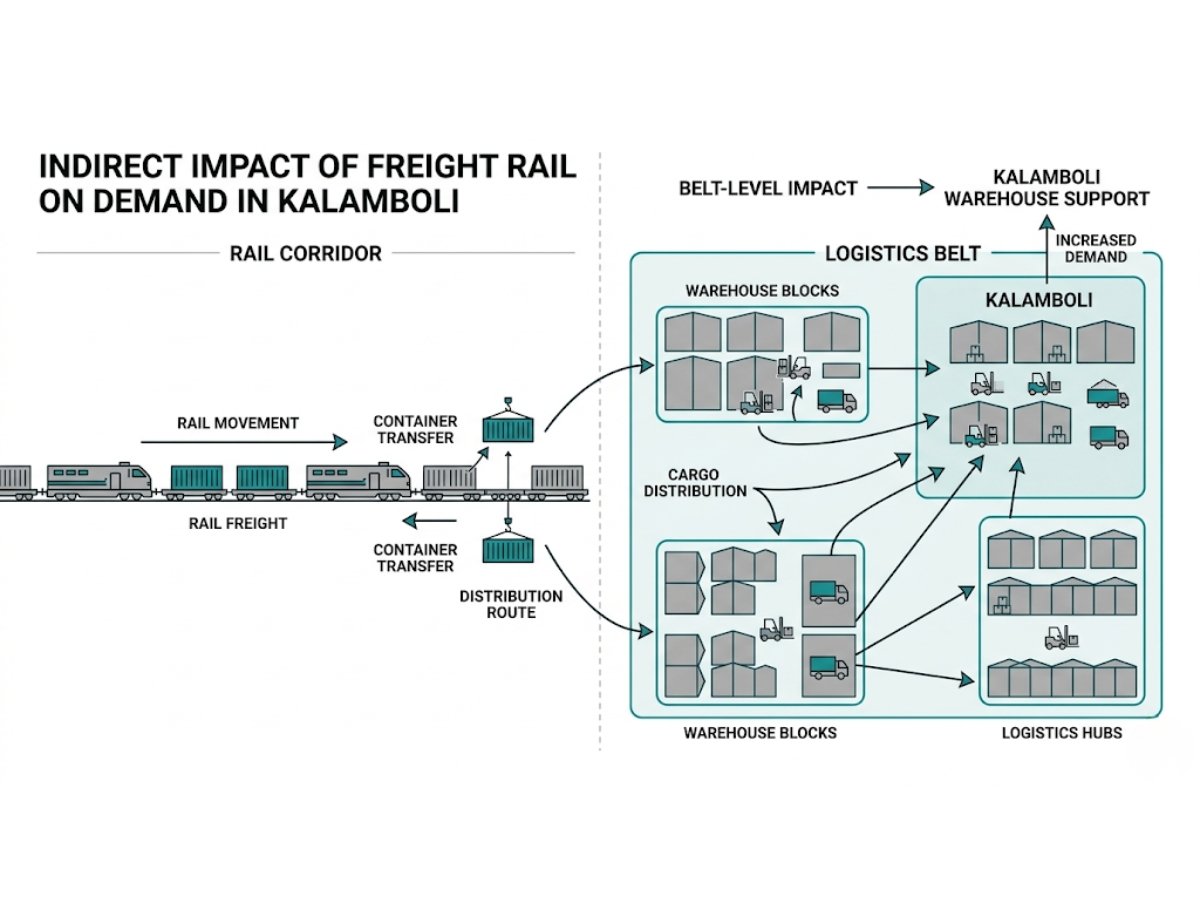
Does freight rail improve Kalamboli demand directly, or does it strengthen the larger cargo belt around it?
Freight rail improves Kalamboli demand more at the belt level than at the individual property level. That distinction is important.
What freight rail changes for port-linked logistics, container evacuation, and backend warehousing
The Western Dedicated Freight Corridor changes the logic of cargo movement because it is built for freight, not shared passenger priority. That means faster movement, greater train length capacity, heavier axle support, and far better predictability than the old mixed-use rail model. In practical terms, this helps the JNPA-linked cargo region move higher volumes more efficiently.
Kalamboli benefits because it sits within this larger inland logistics chain. The advantage is not that every property suddenly becomes premium due to rail. The real advantage is that the wider cargo ecosystem becomes stronger, faster, and more dependable. That supports backend warehousing, container handling, and bulk movement demand in and around the node.
The Kalamboli Goods Shed and GatewayRail Terminal matter here. When road and rail work together efficiently, secondary handling costs can reduce and warehousing logic becomes stronger. Businesses that want to keep drayage and inland movement practical start valuing such locations more.
Why rail strength does not benefit every property type equally
This is where many articles go wrong. Freight rail is not a magic value booster for everything nearby. It does not help every shop, office space, or mixed-use asset in the same way.
For example, a container-linked warehouse operator may benefit from stronger rail-backed cargo flows in the region. But a front-facing commercial user who depends on clean access, lighter vehicle flow, and a better walk-in environment may see little direct benefit.
> Caution: Freight rail strengthens Kalamboli’s role inside a larger cargo system. It does not automatically make every nearby property more usable, more premium, or easier to lease.
So yes, rail matters. But it matters through mechanism, not slogan.
How does the truck ecosystem create real demand on the ground?
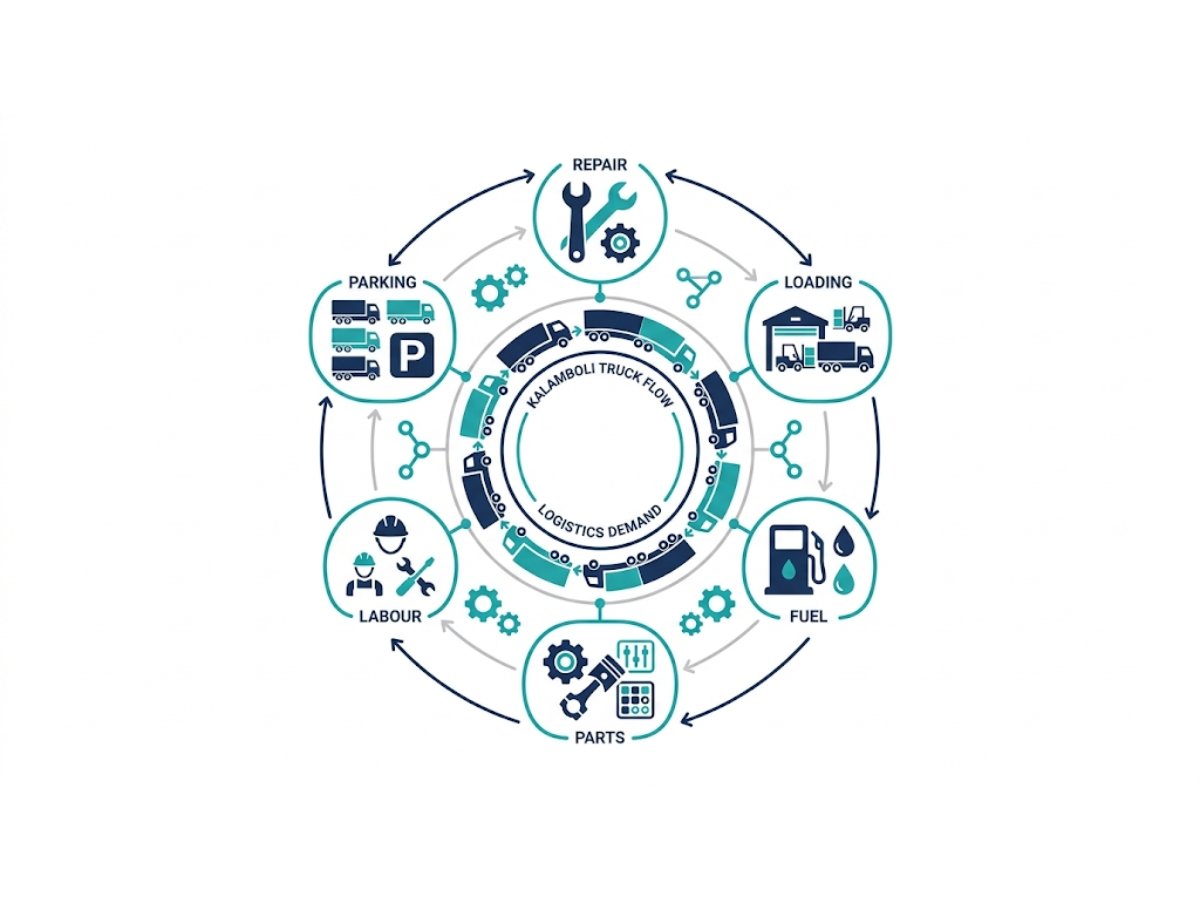
This is where Kalamboli becomes much more than a “connected node.” The truck ecosystem makes the node sticky.
Truck parking, driver movement, loading-unloading support, repair ecosystems, and B2B service clustering
A place handling thousands of heavy vehicles daily develops its own support economy. In Kalamboli, that includes truck parking zones, spare parts sellers, repair workshops, battery and electrical support, glass and body work services, diesel-related suppliers, and authorized service points. These businesses may look secondary, but they are actually part of the demand engine.
Why? Because logistics firms and transport-linked occupiers do not choose a node only for distance to port or highway. They also choose it for operating continuity. If breakdown support, parts, maintenance, and fleet services are available within a few kilometres, downtime reduces. That improves asset utilization.
The steel market also strengthens this logic. Over time, traders, transporters, handlers, processors, and support vendors create a clustered ecosystem that makes the node harder to replace.
Why businesses that depend on frequent truck cycles value Kalamboli differently
A truck-heavy occupier values Kalamboli very differently from a normal investor reading only property brochures. For a warehouse operator, what matters is not just land rate or highway mention. What matters is whether trucks can arrive, queue without chaos, load quickly, and leave on time.
Take a steel-linked user or industrial trader handling bulky material. For such a business, Kalamboli’s truck ecosystem is a major advantage because the entire operating environment is built around heavy goods movement. On the other hand, a premium office-led business that wants cleaner frontage, smoother staff access, and lower noise tolerance may see the same environment as a negative.
Quick practical checklist: when the truck ecosystem is actually a strength
Use this before calling a Kalamboli site “logistics-friendly”:
- Is there enough road width for truck entry and exit?
- Can a larger vehicle turn without difficult reversing?
- Is loading-unloading practical without blocking the frontage?
- Does queue spillover affect neighbours or main-road access?
- Are repair, fleet support, and labour availability nearby?
- Does the site support repeat dispatch cycles, not just occasional truck visits?
If the answer to most of these is no, then the truck ecosystem may exist in the area, but your specific property is not fully benefiting from it.
Which kinds of occupiers benefit the most from Kalamboli’s transport ecosystem?
Not every user should choose Kalamboli. The best fit is operational, not emotional.
Who gains most: distributors, industrial traders, steel-linked users, warehouse operators, port-linked cargo users
Kalamboli works best for occupiers who need regular goods movement and can actually use its freight-heavy ecosystem. That includes:
- distributors serving multiple regions by road
- warehouse operators with frequent dispatch cycles
- steel and heavy-material traders
- port-linked cargo users who need inland staging logic
- businesses that value truck repair, fleet support, and loading ecosystems nearby
For such users, Kalamboli’s appeal is practical. It offers regional reach, cargo clustering, and an established heavy-movement environment.
Who should be cautious: office-heavy users, premium front-end businesses, low-tolerance residential investors
Kalamboli is less ideal for users who need a cleaner business environment, softer commercial frontage, quieter access, or less truck interference. That includes:
- office-heavy operations with large daily staff movement
- premium customer-facing businesses
- investors assuming every transport-linked property will appreciate equally
- residential buyers or investors who are highly sensitive to noise, air quality, and truck traffic
This is where many people misread demand. High logistics demand in a belt does not automatically create premium demand across all asset types.
| User type | Fit with Kalamboli demand | Why |
|---|---|---|
| Warehouse operator | Strong | Benefits from road access, truck cycles, cargo region logic |
| Steel/material trader | Very strong | Gains from existing market ecosystem and heavy vehicle support |
| Port-linked backend logistics user | Strong | Benefits from JNPA-linked movement and freight-region integration |
| Generic office occupier | Weak to selective | Truck-heavy surroundings may reduce usability |
| Premium front-end commercial user | Weak | Congestion, pollution, and frontage stress can hurt business image |
| Residential investor | Selective | Belt-level growth may exist, but livability and micro-location matter greatly |
Why do some pockets in and around Kalamboli benefit more than others from the same connectivity story?
Because connectivity does not work evenly at plot level. Micro-location changes everything.
Main-road visibility vs inner-pocket usability
A main-road site may look more valuable because it has visibility and easier regional recognition. But if that frontage is constantly affected by truck congestion, difficult stopping, or chaotic loading conditions, visibility alone is not enough.
Similarly, an inner-pocket site may initially look inferior, but if it offers better turning radius, smoother loading, and less spillback from a stressed junction, it may be more useful for the right occupier.
Access width, turning radius, queue spillover, and local entry-exit friction
This is where real demand is decided. In Kalamboli, the winner is often not the site closest to a major road. It is the site that handles daily movement with less friction.
A property can underperform even inside a strong belt if:
- approach roads are too narrow
- trucks cannot turn comfortably
- loading has to happen in an awkward or obstructive way
- queue spillover blocks entry
- local traffic conflict reduces dispatch efficiency
A very honest line needs to be said here: demand can rise across Kalamboli as a logistics belt while individual properties still remain weak because their access geometry is poor.
> Micro-location reality: Near a major road is not the same as easy for daily truck movement.
Can the same freight and truck ecosystem reduce demand for some users?
Yes, absolutely. The same strength that attracts logistics demand can create discounts for the wrong user type.
Congestion, pollution, delayed access, frontage stress, and liveability trade-offs
Truck-led ecosystems create side effects. They bring noise, emissions, road stress, frontage blockage, and sometimes slower local movement. That is manageable for transport-linked businesses, but not for everyone else.
This is especially important in mixed parts of Kalamboli where residential towers, transport corridors, industrial uses, and truck-heavy movement sit close to each other. For some residents and investors, affordability may look attractive, but livability can become the trade-off.
When logistics strength becomes a discount factor
A frontage-dependent office or showroom may not enjoy the same benefits as a warehouse just because both are in Kalamboli. The warehouse may thrive on truck access. The office may struggle with staff experience, cluttered movement, and a less premium business environment.
So when people say “Kalamboli demand is high,” the right reply is: demand for what, and for whom?
How should investors read Kalamboli demand differently from occupiers?
Investors should be more careful than occupiers, not less. Occupiers can directly measure operational fit. Investors often rely on transport stories that sound bigger than they actually are.
Occupier demand vs speculative demand
Occupier demand is grounded in dispatch, truck suitability, cargo flow, and location usability. Speculative demand is often driven by future stories: junction upgrades, corridor talk, airport spillover, and general “growth” language.
Infrastructure does matter. The interchange upgrade, freight corridor progress, and wider multimodal logic are real positives. But investors should still separate current usability from expected future efficiency.
What signals suggest durable demand instead of temporary transport hype
Look for signals such as:
- repeat occupier demand from logistics or industrial users
- stronger leasing resilience in functionally usable properties
- properties with truck-friendly geometry, not just map proximity
- cluster advantage near established trade and support ecosystems
- fit between property type and actual transport-led demand
A site tied to genuine goods movement logic has a stronger base than a site being sold only through future infrastructure marketing.
What local checks should you do before calling any Kalamboli property “high-demand”?
Before buying, leasing, or marketing a property in Kalamboli as high-demand, verify the basics properly.
Sanctioned use, access reality, truck suitability, loading practicality, and documentation checks
Check the sanctioned use first. A property may sit in a logistics-influenced belt but still not be legally or physically suited for your intended use. Also inspect whether loading and truck entry are genuinely workable in real operating conditions.
Do not judge a property only through a daytime broker visit. Observe turning space, queueing behaviour, frontage blockage, internal road condition, and actual truck movement practicality.
Where CIDCO, MahaRERA, local authority records, and on-ground inspection matter
Use authority records where relevant. CIDCO and planning context matter for land-use and development logic. MahaRERA matters where the property is part of a project or development that falls under that framework. If you are checking pricing context, ready reckoner reference can help as a benchmark, but it should not be treated as the final truth of deal quality.
A practical due-diligence list should include:
- sanctioned use and approvals
- road width and access pattern
- loading-unloading feasibility
- turning radius for the expected vehicle type
- monsoon or waterlogging sensitivity where relevant
- actual distance and travel friction to key corridors
- project or asset documentation validity
- maintenance and local infrastructure condition
So, how exactly do highways, freight rail and truck ecosystem affect Kalamboli demand?
They affect Kalamboli demand by making it a throughput-driven logistics market rather than a simple connected suburb. Highways create immediate freight value. Freight rail strengthens the wider cargo region and improves backend logistics economics. The truck ecosystem converts that infrastructure into usable daily business performance.
But the benefit is not universal. Demand is strongest where goods can move, queue, load, turn, and exit with less friction. It is weaker where the same logistics intensity creates congestion without operational gain.
That is why Kalamboli remains important in Navi Mumbai’s industrial and logistics story. It is not just close to many corridors. It actually sits inside a working cargo system. And in this kind of market, the best-performing properties are usually not the ones with the best brochure line. They are the ones that handle movement best on the ground.
Conclusion
Kalamboli demand is real, but it is not a blanket connectivity premium. It is a logistics-efficiency premium. Highways matter because they improve movement. Freight rail matters because it strengthens the larger cargo belt. The truck ecosystem matters because it keeps real operations running.
For warehouse users, distributors, steel-linked occupiers, and freight-dependent businesses, that combination can make Kalamboli highly practical. For office-led, frontage-sensitive, or low-tolerance users, the same ecosystem can become a drawback. So the smartest way to read Kalamboli is simple: do not ask whether it is connected. Ask whether your goods, vehicles, and daily operations can move through it efficiently.
FAQs
Frequently Asked Questions