
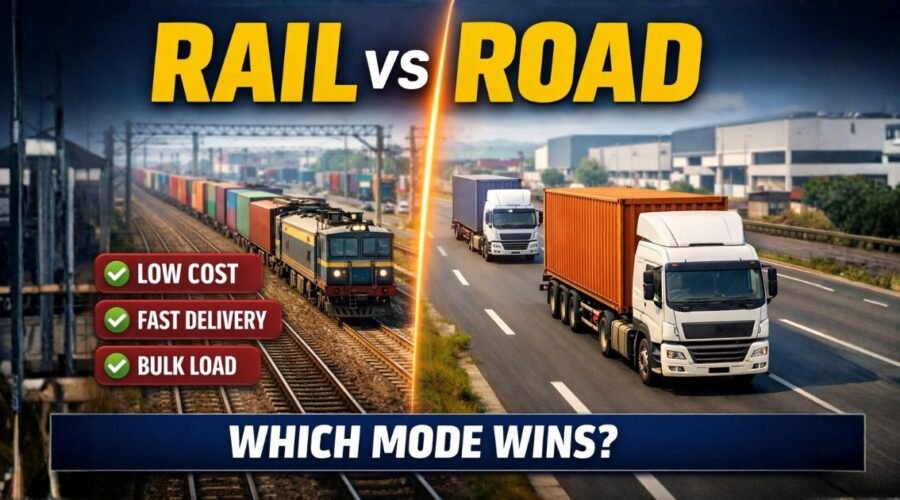
Rail Freight vs Road Freight Advantage in Kalamboli
In Kalamboli, rail freight usually makes more sense for containerised, bulk, repeat-volume, port-linked, and longer-haul movement, while road freight still wins for urgent, short-haul, fragmented, multi-stop, and last-mile delivery. That is the real answer. Kalamboli’s strength is not that rail replaces road. Its strength is that it sits inside a serious multimodal logistics ecosystem, with rail-linked terminal infrastructure, JNPA port connectivity, and direct highway dispersal all working together.
If you are choosing a mode from Kalamboli, do not ask only, “Which is cheaper?” Ask, “What is my cargo pattern, what is my route length, how much first-mile and last-mile friction do I have, and how much delay can my business actually tolerate?” That is where the answer changes.
| Shipment situation | Likely better mode | Why | What to verify before deciding |
|---|---|---|---|
| Bulk steel, heavy machinery, dense industrial cargo | Rail | Better linehaul economics, scale, and axle-load advantage on longer routes | Terminal access, rake availability, loading schedule |
| EXIM containers to NCR or North India, usually 700 km+ | Rail | Post-WDFC, rail has become much more viable for long-haul port-linked movement | Train frequency, cut-off times, first-mile drayage cost |
| FMCG, retail replenishment, local regional delivery within Maharashtra | Road | Door-to-door flexibility and no terminal double-handling | Peak-hour truck restrictions, tolls, unloading time |
| Partial-load, urgent dispatch, multi-stop route | Road | Rail does not fit fragmented distribution well | Route timing, delivery windows, detention risk |
| Warehouse deep inside inner Kalamboli without siding access | Mixed or Road | First-mile cost to rail terminal can kill rail savings | Local trailer cost, handling charges, Warai charges |
Rail or road: which one actually has the advantage in Kalamboli?
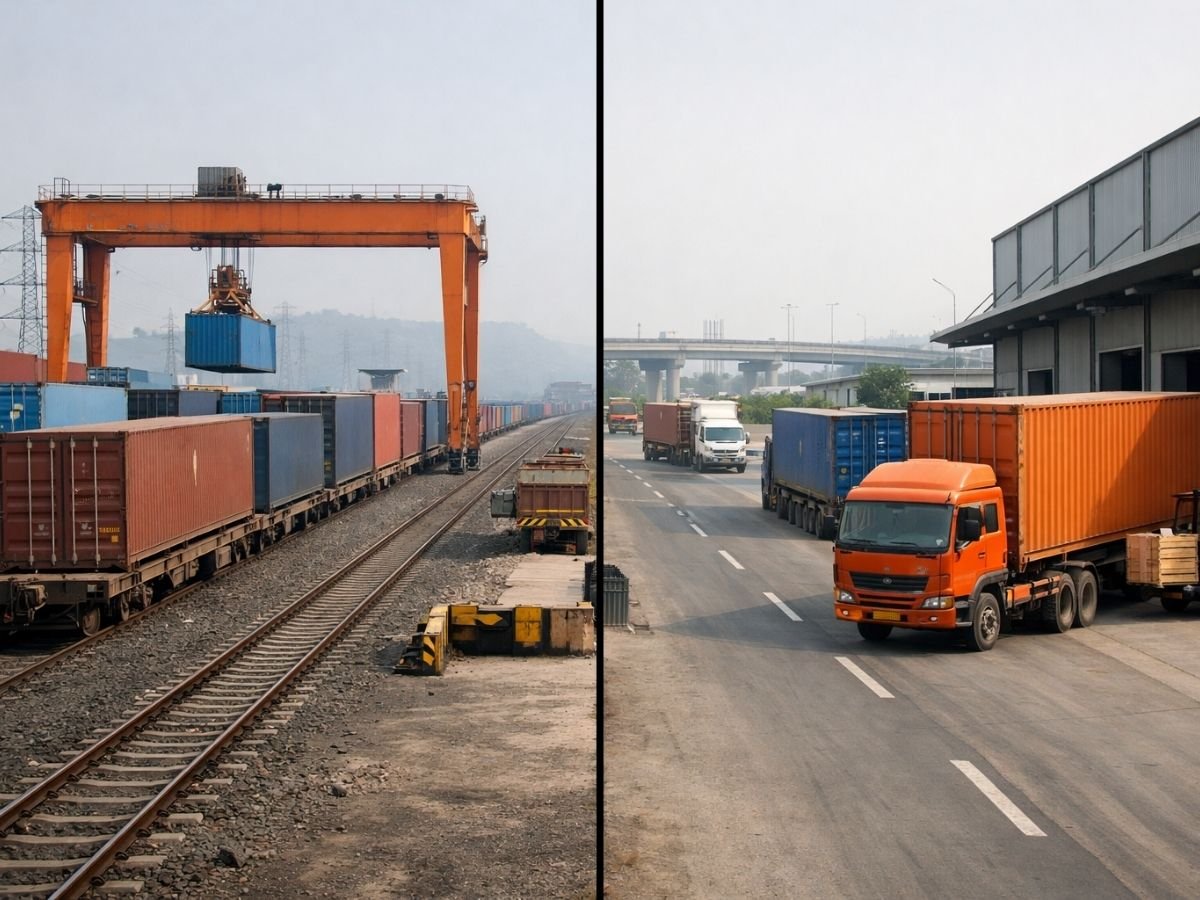
The practical answer is simple: rail has the advantage when distance, volume, and cargo type support scale; road has the advantage when flexibility, speed of dispatch, and direct delivery matter more.
This is why generic articles fail. They say rail is cheap and road is flexible. That is not enough for Kalamboli. Here, the real question is whether your shipment is strong enough to absorb terminal processes and still come out ahead.
India’s freight-cost logic supports this. Rail linehaul is usually lower per tonne-km than standard road movement, but multimodal transport becomes economically stronger only after the distance is long enough to absorb drayage, terminal handling, and transfer costs. The break-even band commonly used in policy and logistics studies is roughly 600 km to 1000 km. In plain language, a Pune dispatch is usually a truck decision. A Delhi, NCR, Haryana, Jaipur, Ludhiana, or North India linehaul is where rail becomes seriously worth studying.
> Practical answer: > In Kalamboli, rail is usually the smarter choice for long-haul, planned, heavy, and port-linked cargo. Road is usually the smarter choice for short-haul, urgent, fragmented, and direct-delivery cargo. The winner is decided by Total Landed Cost, not by linehaul rate alone.
Kalamboli is also not a “rail-only” logistics story. JNPA itself highlights rail access and the DFC linkage as a major freight advantage, while the node also remains deeply road-connected to the wider port and highway system.
When rail freight becomes the smarter choice from Kalamboli
Rail becomes attractive in Kalamboli when your business can use scale, predictability, and longer distance. The biggest recent change is the completion of the Western Dedicated Freight Corridor’s final JNPT-New Saphale section on 31 March 2026, which materially improves the long-haul rail logic from the JNPA side of the system.
Port-linked container movement with predictable volume
If your cargo is containerised and tied to the JNPA ecosystem, rail can become a very strong option, especially on longer corridors to North and Northwest India. JNPA itself positions DFC-linked rail connectivity as a port advantage, and GatewayRail’s Kalamboli domestic terminal adds real local terminal capacity to support this kind of movement.
This matters because Kalamboli is not just a warehouse zone. It is one of those locations where a business can actually switch from local road collection to rail linehaul without moving too far away from the freight ecosystem.
Bulk or heavy cargo where linehaul efficiency matters
Kalamboli’s old steel-market identity is still important. Heavy cargo like steel coils, TMT, industrial raw material, and machinery usually behaves better on rail when the route is long enough and the dispatch is large enough. That is not theory. It is simple freight mathematics.
CJ Darcl has publicly highlighted its rail-linked Kalamboli yard and full-length rail-line capability at the KTIG siding, which is exactly the kind of local infrastructure that makes rail more than a paper advantage.
Longer-haul lanes where repeat dispatch beats urgency
A business sending regular loads to NCR, Haryana, Rajasthan, Punjab, or other long-haul corridors should not compare rail and road like one-time spot transport. It should compare them as a recurring operating model.
That is where the post-March 2026 WDFC reality changes the conversation. A route that earlier looked slow or operationally uncertain on legacy rail assumptions can now look much stronger for stable, repeat-volume movements.
Businesses that can plan around terminal processes
Rail rewards planning. It does not reward chaos.
If your team can manage cut-off times, loading windows, documentation, and terminal coordination properly, rail can deliver very good linehaul economics. If your dispatch pattern changes every few hours, the road network will usually remain the more forgiving choice.
Example 1: A Kalamboli steel trader sending heavy material to North India every week may find rail clearly superior once shipment size, distance, and loading discipline are aligned.
Example 2: An EXIM user moving containers through the JNPA ecosystem toward inland North India may benefit from Kalamboli’s local terminal access and the now-completed WDFC linkage, provided first-mile and terminal costs stay controlled.
When road freight still wins from Kalamboli
Road freight is still the king of agility in Kalamboli. That has not changed.
Short-haul and regional dispatch
If your cargo is moving within the Mumbai Metropolitan Region, Pune belt, Nashik side, or other shorter routes, road is usually the better answer. Why? Because you skip drayage to the terminal, lift-on/lift-off handling, documentation friction, and fixed rail-side charges that can wipe out the linehaul saving.
This is one of the biggest mistakes people make when reading freight-cost comparisons. They compare a rail rate with a truck rate as if the freight starts from the same point and ends with the same handling pattern. It does not.
Urgent loads, partial loads, and multi-stop delivery
Rail is not designed for the everyday flexibility that many businesses need. If you are doing urgent replenishment, LTL-type fragmented movement, dealer delivery, retail stock push, or multi-stop dispatch, road remains far more practical.
Kalamboli’s highway location supports this. It connects naturally into the Sion-Panvel side, NH-48, Mumbai-Pune side movement, and wider regional truck distribution logic. The road mode remains the operating backbone for these use cases.
Cargo that cannot afford extra handling or waiting time
Some cargo loses money when it gets handled too many times. Some cargo loses money when it waits. Some cargo loses money when a missed cut-off pushes delivery out by a day.
For such movements, the truck often wins even if the linehaul rate looks higher on paper.
Local distribution where flexibility matters more than rail economics
A distributor serving MMR, Navi Mumbai retail points, or time-sensitive regional clients usually needs road, not rail. The ability to load, route, divert, stop, re-route, and deliver directly is still a huge advantage.
Fast dispatch vs cheaper linehaul: If your business makes money through responsiveness, road usually wins. If your business makes money through scale, rail may win. That is the cleanest way to think about it.
Why Kalamboli works best as a rail-plus-road node, not a rail-only story
This is the real information-gain point of the whole topic: Kalamboli works best when rail and road are used together, not when one tries to eliminate the other.
JNPA’s own connectivity planning shows why. The port system is built around stronger rail linkage and long-haul movement, but it still depends heavily on road integration. Kalamboli sits in the middle of that logic. It receives cargo by truck, consolidates it, and can push longer-haul movement through rail when the pattern fits.
The upcoming Morbe-Kalamboli link road, reported at around 14 km and about ₹100 crore, also reinforces this multimodal role by improving freight movement from the Vadodara-Mumbai Expressway side toward Kalamboli and JNPA-facing corridors.
So no, this is not a simple “rail beats road” article. Kalamboli’s competitive advantage is optionality. A good occupier here uses road for pickup, transfer, and last-mile flexibility, and rail for long-haul efficiency where the lane justifies it.
Which cargo types fit rail, road, or a mixed model in Kalamboli?
This is where the decision gets easier. Most readers do not think in mode theory. They think in cargo type. That is the right way to decide.
| Cargo type | Rail fit | Road fit | Mixed-mode fit | Local note for Kalamboli |
|---|---|---|---|---|
| EXIM containers | Excellent for long-haul inland corridors | Weak for long-haul if rail option is efficient | Excellent | GatewayRail's Kalamboli terminal is a real local rail-linked asset with quoted 17-acre footprint and 75,000 TEU capacity. |
| Steel, coils, heavy industrial material | Excellent | Moderate | Good | Kalamboli's steel-market legacy makes this one of the most natural rail-fit cargo groups. |
| Heavy machinery / project cargo | Strong in the right setup | Strong for specialised direct movement | Good | Choice depends on route, handling risk, and special equipment. |
| FMCG / retail / dealer supply | Weak | Excellent | Moderate | Road wins because of direct, flexible, multi-stop distribution. |
| E-commerce / urgent replenishment | Weak | Excellent | Weak | Schedule rigidity makes rail a poor fit. |
| Partial-load / fragmented shipments | Weak | Excellent | Limited | Rail usually needs more consolidation before it becomes viable. |
What cost comparison should businesses actually do before choosing rail over road?
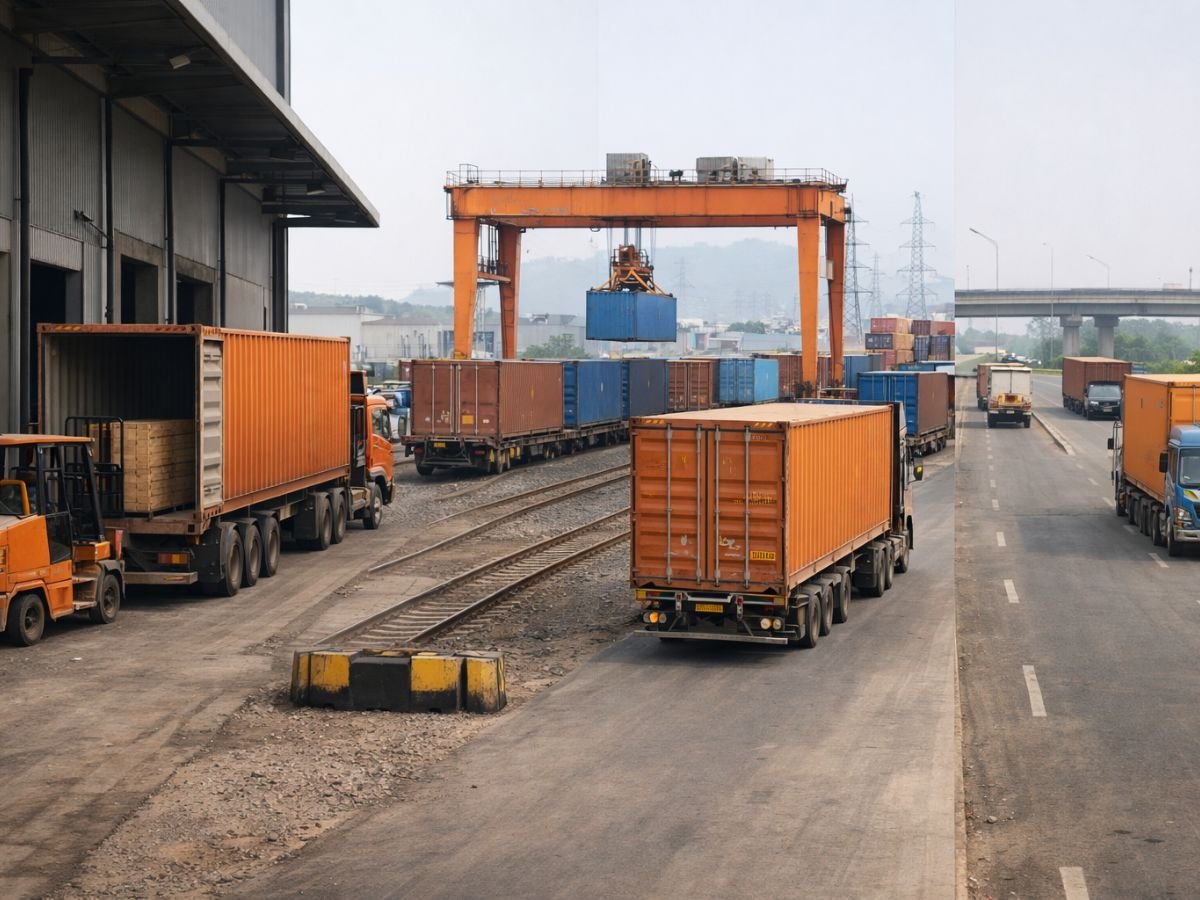
This is the most important financial section in the article.
Do not compare only quoted freight rates. Compare Total Landed Cost:
Base freight + first-mile drayage + last-mile drayage + terminal handling charges + loading/lift charges + tolls + detention + possible local labour union charges + inventory cost
That is the real number.
A rail quote can look far lower than a road quote. But if you need a local trailer just to move the container from an inner Kalamboli warehouse to the rail terminal, then pay lift-on/lift-off charges, then manage terminal handling, then again pay delivery drayage at the destination, the “cheap rail” story can shrink very quickly.
This is also where local Kalamboli realities matter. Businesses operating out of private warehouses in the region often face Warai charges or local handling-related labour charges, which can be quoted in different ways depending on the site and operation pattern. These costs vary, but they are real enough that any serious comparison should budget for them rather than pretending they do not exist.
Caution: A lower per tonne-km number does not automatically mean lower total logistics cost. Rail usually needs the right route length, the right cargo density, and controlled first-mile and last-mile friction.
A simple way to think about it:
- Within Maharashtra or nearby short-haul belts: road usually stays stronger
- Cross-state long-haul to the north with stable volume: rail becomes much more credible
- Inner Kalamboli warehouse without clean terminal access: rail advantage gets weaker
- Rail-linked yard with direct handling discipline: rail advantage gets stronger
Does your exact location inside Kalamboli change the freight advantage?
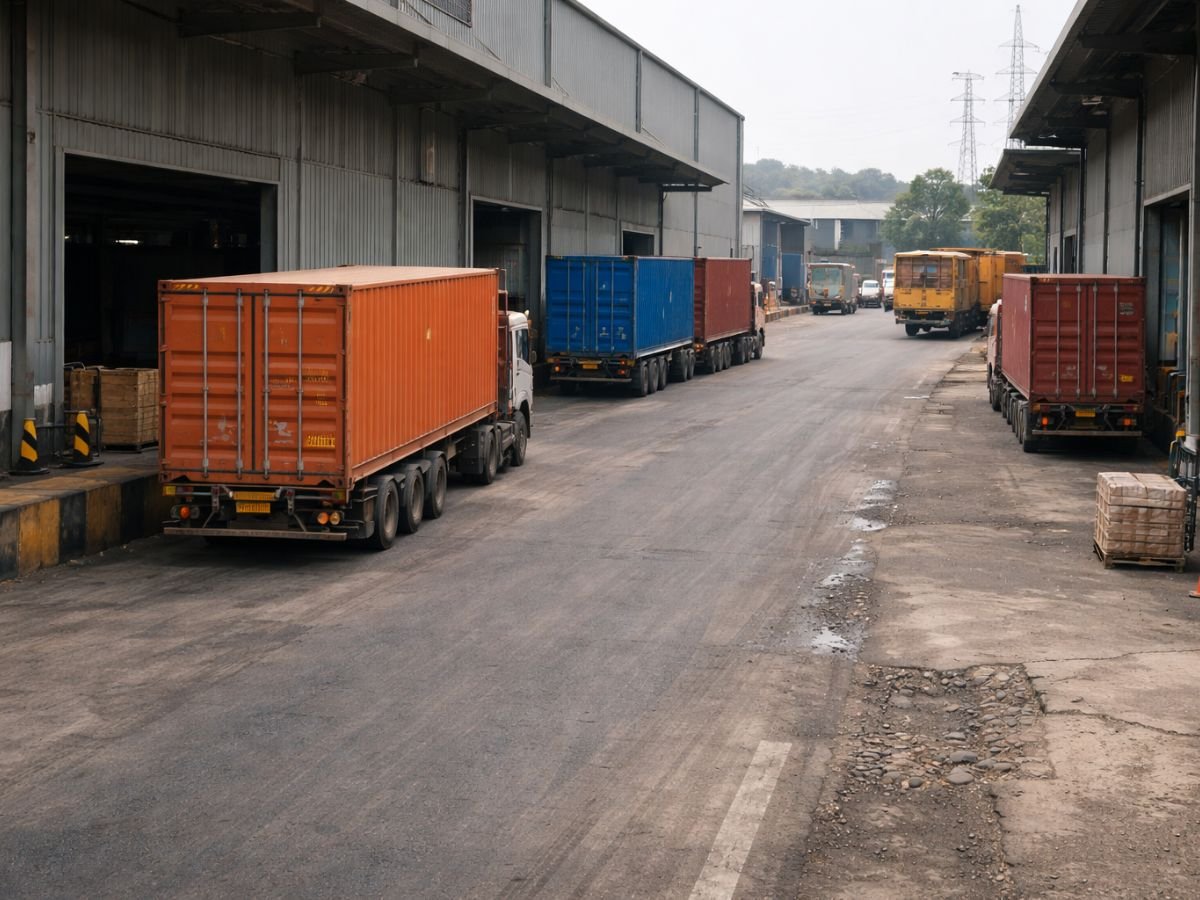
Yes, very much. In Kalamboli, micro-location can change macro-economics.
A cheap warehouse deep inside an older inner sector may look fine on rent, but if trailers struggle to enter, turn, wait, and exit, you start paying through lost time. CIDCO-linked planning rules also matter here because industrial and storage buildings are supposed to provide designated loading and unloading space. In commonly referenced GDCR text, loading space is specified at 3.75 m x 10.0 m, with quantity linked to floor area. A warehouse that does not handle large-vehicle movement properly becomes an operational problem even if the rent looks attractive.
The February 2026 heavy-vehicle restrictions also make internal access more important. Reports on the updated Mumbai-region traffic rules state that heavy vehicles face movement restrictions during 8 AM to 11 AM and 5 PM to 9 PM, which means dispatch planning is now more vulnerable to delay if the site already suffers from access friction.
The Kalamboli Junction upgrade, with broader sanction reported at about ₹770.49 crore, is intended to improve this overall traffic condition, but during project periods and diversions, some local movement friction can remain a real issue.
One more practical mistake: some people confuse KLMC, the passenger station identity, with KLMG, the goods-yard freight identity. For cargo planning, that distinction matters.
Is a rail-linked warehouse in Kalamboli worth paying extra for?
Sometimes yes, sometimes absolutely not.
A rail-linked warehouse or rail-linked domestic yard is worth paying extra for when the business has:
- long-haul repeat movement
- bulk or container-heavy dispatch
- disciplined scheduling
- real benefit from reduced double-handling
- dependence on JNPA-linked freight corridors
That is why operators like GatewayRail and CJ Darcl matter in this discussion. They represent actual local rail-linked infrastructure, not brochure-level logistics language.
But if your business is mainly doing short-haul movement, city or regional distribution, urgent replenishment, or fragmented dispatch, paying a premium for rail linkage may be wasteful. In that case, a highway-first warehouse with easier truck movement can be the smarter operational asset.
So the right question is not, “Is rail-linked better?” The right question is, “Will this rail-linked premium save me more than it costs?”
What mistakes make businesses misread rail and road advantage in Kalamboli?
Most costly mistakes in Kalamboli come from wrong assumptions, not bad rates.
Mistake 1: Assuming rail is always cheaper It is not. Rail usually needs distance and volume.
Mistake 2: Assuming road is always faster On a short direct route, often yes. On a long congested corridor, not necessarily, especially after the latest freight-corridor upgrades.
Mistake 3: Ignoring first-mile and last-mile costs This is where many “savings” disappear.
Mistake 4: Ignoring local handling and Warai charges Even if rates vary by site, they belong in the budget.
Mistake 5: Confusing KLMG freight relevance with the passenger-station identity A mapping mistake can become an operations mistake.
Mistake 6: Choosing warehouse rent without checking truck practicality Cheap rent can become expensive logistics.
Mistake 7: Using old assumptions about rail speed Post-March 2026, the WDFC conversation is not the same as it was earlier.
Conclusion
If the cargo is heavy, containerised, long-haul, repeat-volume, and linked to JNPA-side freight corridors, rail usually deserves serious preference in Kalamboli, especially after the WDFC’s final completion in March 2026. If the cargo is urgent, short-haul, fragmented, multi-stop, or locally distributed, road still remains the better working mode.
So the real winner is not rail or road alone. The real winner in Kalamboli is the business that uses the node properly.
Choose rail for scale. Choose road for agility. Choose Kalamboli for multimodal flexibility.
FAQs
Frequently Asked Questions