
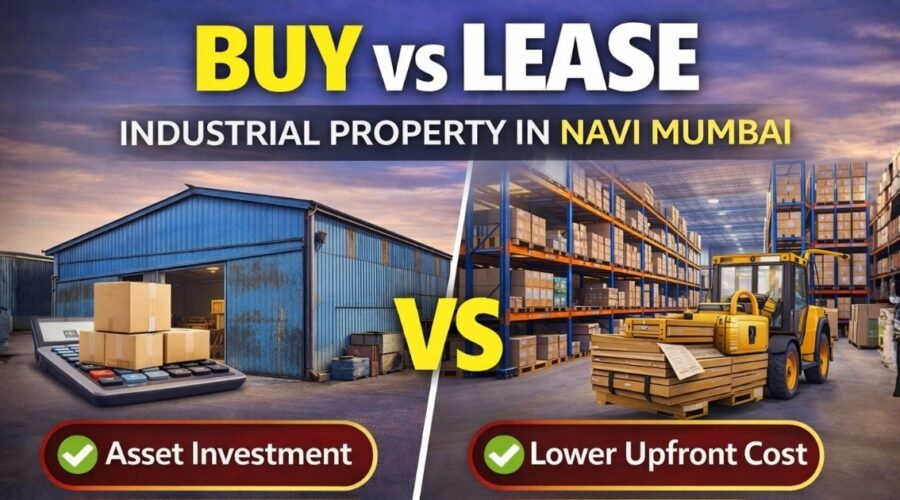
Buy vs Lease Industrial Property in Navi Mumbai
For most occupiers, buying industrial property in Navi Mumbai makes sense only when the business is stable, the exact belt is already proven, and long-term control matters more than flexibility. Leasing industrial property in Navi Mumbai is usually the smarter move when capital needs to stay free, the size requirement may change, or the business is still testing which industrial pocket actually works.
For investors, the answer is different again. Industrial property investment in Navi Mumbai works when the asset is legally understandable, operationally usable, and located in a belt with durable tenant demand. Buying just because prices are moving up is not enough. In this market, the right decision depends on use case, not emotion.
Quick Summary
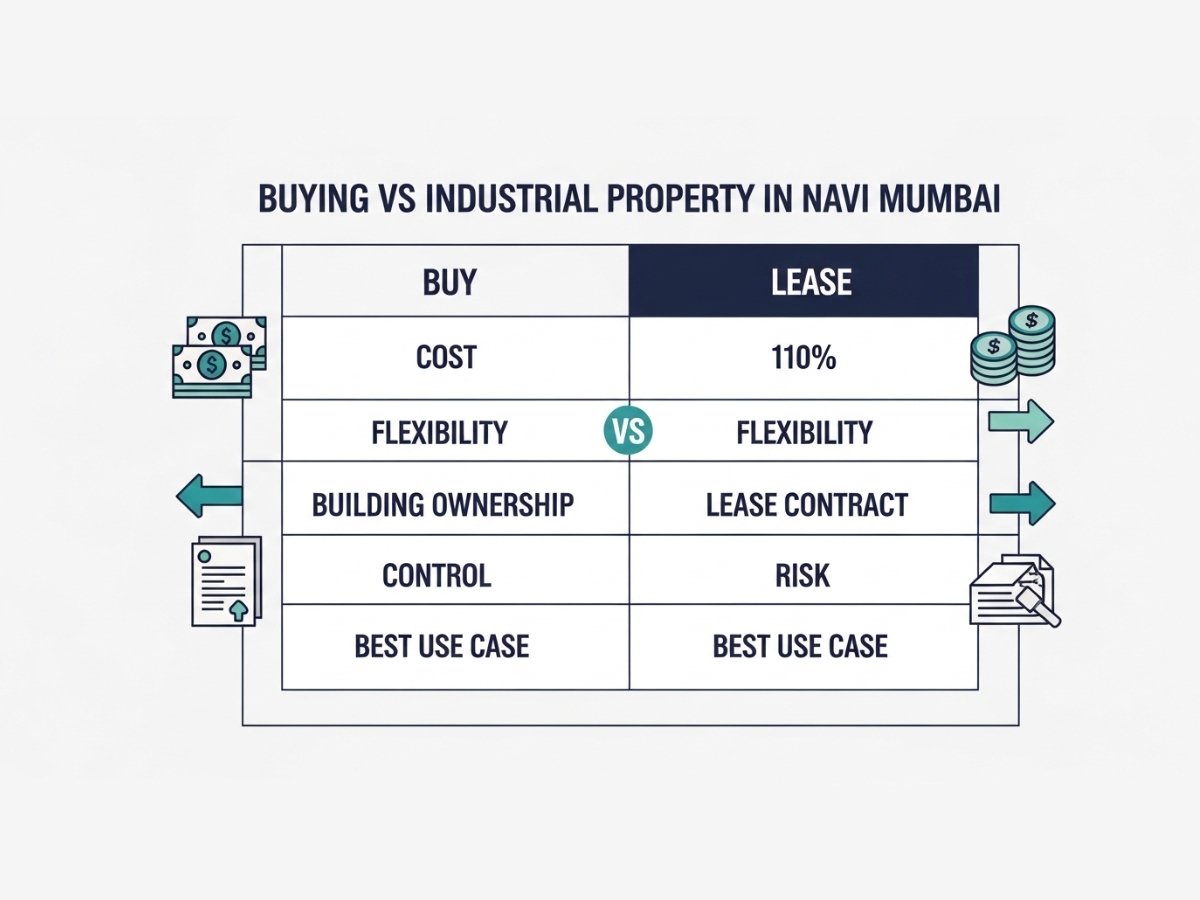
| Factor | Buy Industrial Property Navi Mumbai | Lease Industrial Property Navi Mumbai |
|---|---|---|
| Best for | Stable end-users, long-term operators, selected investors | Growing businesses, flexible occupiers, capital-conscious operators |
| Upfront cost | High | Lower |
| Control over layout and use | Stronger | Limited by lease and landlord conditions |
| Flexibility | Lower | Higher |
| Location risk | Higher if the wrong belt is chosen | Lower because the decision is reversible |
| Fit-out confidence | Better for long-term heavy customization | Better only if tenure and renewal comfort are strong |
| Balance-sheet effect | Ownership asset is created | Capital remains available for operations |
| Investor angle | Relevant | Not relevant, because there is no ownership |
| Exit challenge | Resale, liquidity, tenantability matter later | Renewal, escalation, and relocation matter later |
| Best use case | Proven long-term operating base | Testing, scaling, shifting, or uncertain demand |
What Buying Industrial Property in Navi Mumbai Actually Means
Buying industrial property in Navi Mumbai is not just a property decision. It is a decision to lock your business into one belt, one access pattern, one approval trail, and one long-term operating geography.
That matters because industrial real estate behaves very differently from residential or even normal office property. In industrial property for sale in Navi Mumbai, the real question is not only whether the title looks acceptable or whether the rate sounds fair. The real question is whether the property will remain commercially usable every day for years. Truck entry. Loading rhythm. turning radius. labour access. internal movement. utility practicality. These small-looking details decide whether ownership becomes a strength or a burden.
Buying usually makes sense when a business already understands its own operations deeply. It knows the space requirement, loading pattern, machinery logic, staff dependence, and customer geography. At that point, buying industrial property for business use can reduce future uncertainty.
What Leasing Industrial Property in Navi Mumbai Actually Means
Leasing industrial property in Navi Mumbai is often treated as a compromise. In practice, it is often the more disciplined choice.
A lease allows a business to enter a belt without making a permanent capital commitment. It preserves cash, reduces early lock-in, and gives management time to see whether the location works in real operating conditions. That matters because industrial property for rent in Navi Mumbai can look impressive on a listing but behave very differently once trucks, workers, dispatch, vendors, and daily operations actually begin.
Leasing industrial property for operations is especially sensible when the business is scaling, when order flow is still evolving, or when the management team is still deciding between TTC-side urban-industrial convenience, Taloja-style deeper industrial land logic, or Panvel-Kalamboli-side logistics movement advantages.
Buy vs Lease Industrial Property in Navi Mumbai: The Core Difference
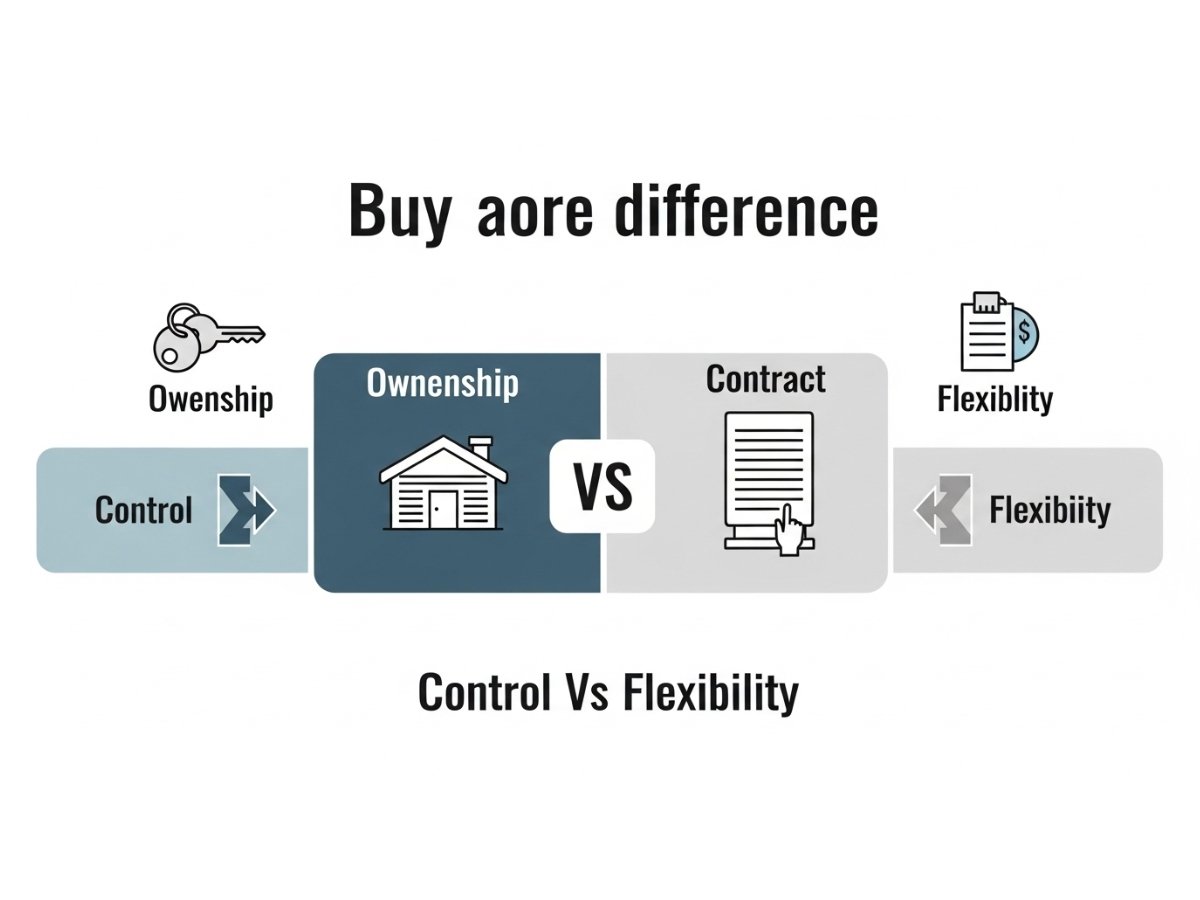
The simplest version is this:
Buying is a decision for control.
Leasing is a decision for flexibility.
Everything else sits underneath that.
An end-user buying industrial property in Navi Mumbai is usually prioritizing permanence. That business wants to control layout, circulation, machinery placement, storage design, branding, and future changes without depending too much on a landlord.
A tenant looking to rent industrial property in Navi Mumbai is solving a different problem. That business wants speed, optionality, lower upfront pressure, and the ability to shift if the current pocket turns out to be less useful than expected.
An investor looking at industrial property investment in Navi Mumbai is solving a third problem altogether. The investor must think about tenant demand, vacancy periods, rent depth, resale ease, legal comfort, and whether the belt will still make sense after the current infrastructure story cools down.
That is why the same asset can make sense for one buyer and make no sense for another.
Why This Is Not Just a Rent vs EMI Calculation
Many people reduce this decision to a simple line: “Why pay rent when I can pay EMI?” That sounds neat. It is also incomplete.
Buy vs lease industrial property is not a rent-versus-EMI question. It is a capital allocation question.
When you buy, you are not only paying acquisition cost. You are also locking money into stamp duty, registration, legal review, possible repair or upgrade costs, fit-out adjustments, maintenance burden, and long-term location exposure. If the property later proves operationally weak, the damage is not monthly. It is structural.
When you lease, you are not only paying rent. You are paying for reversibility. That reversibility can be extremely valuable in industrial real estate Navi Mumbai, where one wrong location decision can quietly hurt efficiency for years.
A lease may look expensive on a monthly spreadsheet. A wrong purchase can be far more expensive over five years.
The Two Big Questions That Should Drive the Decision First
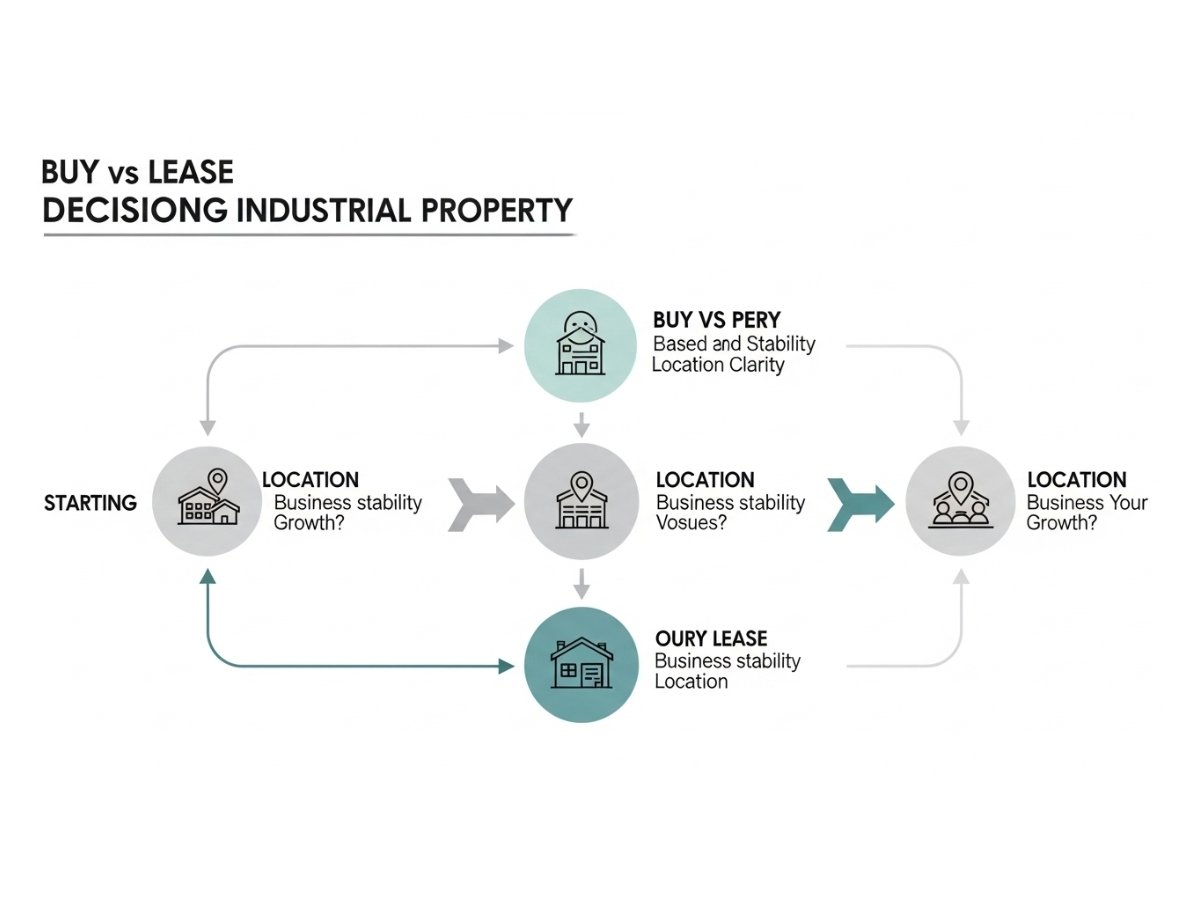
Before discussing price, ask two harder questions.
1. Is the business stable enough to stay in the same industrial geography for years?
If yes, buying becomes more logical.
If no, leasing is usually safer. A company that is still discovering its space pattern, dispatch rhythm, vendor network, or customer base should be very careful before making a permanent industrial purchase.
2. Is the belt proven for your exact use case?
This question matters more than most people think.
A manufacturing user, a warehouse operator, a light engineering unit, a service-industrial occupier, and a logistics player are not solving the same problem. Some need stronger highway and truck flow. Some need workforce convenience. Some need industrial depth. Some need urban adjacency. Some need better clear movement more than bigger land.
If the belt is proven for the exact business model, buying gets stronger. If not, leasing first is often the smarter industrial property decision guide.
When Buying Industrial Property Makes More Sense
Buying industrial property Navi Mumbai makes more sense in these situations.
When the business is a serious end-user
If the facility is core to operations and not temporary overflow space, ownership becomes more defensible. This is especially true where relocation later would disrupt clients, machinery, dispatch, or staffing.
When layout control matters
Some businesses cannot function well inside a generic leased industrial shed. They need customized internal flow, special loading design, dedicated service areas, permanent machinery base, or long-term operational fit-outs. In such cases, ownership brings clarity.
When the exact location is already proven
A business that has already tested a micro-market and knows the access road, transport logic, worker movement, and local operating pattern is in a better position to buy industrial property in Navi Mumbai.
When the business can afford patient ownership
Buying works better when the company is financially strong enough to absorb upfront costs without starving the core business.
When the buy decision is based on current usability, not only future hype
This is the real filter. Good industrial ownership is built on present functionality plus future durability, not just upcoming-infrastructure excitement.
When Leasing Industrial Property Makes More Sense
Lease industrial property Navi Mumbai when the business needs room to adjust.
When the business is still scaling
If the next two to three years may change your size requirement, staff pattern, or dispatch model, leasing protects you from locking into the wrong asset.
When capital has better use elsewhere
A business may earn more by deploying money into inventory, machinery, technology, hiring, or sales than by parking it in an industrial unit.
When the belt is promising but not fully validated
This is common in fast-changing pockets. The map story may be strong, but the operating story may still be incomplete. Leasing lets the business test before it commits.
When speed matters
Industrial property for rent in Navi Mumbai often allows quicker operational start than a full acquisition cycle involving diligence, structuring, documentation, and funding.
When management wants optionality
A lease gives the business a future exit route. That is not weakness. That is strategic caution.
What Actually Changes Industrial Property Value in Navi Mumbai
Industrial property value in Navi Mumbai does not move only because the city is growing. It moves because of a smaller set of harder variables.
Belt relevance
A belt that remains useful to real occupiers holds value better than a belt driven mainly by investor chatter.
Access quality
Approach road width, turning comfort, junction pressure, truck waiting practicality, and route reliability matter heavily. In industrial property, road usability is value.
Demand depth by use case
Warehouse demand, manufacturing demand, logistics demand, and service-industrial demand do not behave the same way. A belt can be fashionable and still have weak actual occupier depth for your asset type.
Asset usability
Loading comfort, frontage, internal circulation, clear movement, and operational efficiency often matter more than the brochure category label.
Legal clarity
Even a physically decent asset underperforms when buyers or tenants feel uncertain about title chain, possession status, OC position where relevant, or approval trail.
Exit integrity
Industrial property investment Navi Mumbai becomes much stronger when the asset is not only buyable, but also leaseable, financeable, and resellable.
How to Read Price Signals Without Misreading the Market
Rising prices alone do not automatically mean buying is smarter. That is one of the biggest mistakes in industrial property investment vs leasing.
A higher sale rate can mean genuine end-user demand. It can also mean investor anticipation, infrastructure-led speculation, shallow supply, or simple market excitement. Those are not the same thing.
The better way to read the market is this:
Rising prices plus rising occupier confidence is stronger
If businesses are actively using the belt, renewing, expanding, and transacting with operational conviction, price growth carries more meaning.
Rising prices without strong ground usability is weaker
This usually happens when narrative runs ahead of function. The market talks about future potential, but daily industrial performance still feels uneven.
Flat prices in a mature belt are not automatically negative
A stable industrial zone with real tenant demand and dependable operations can still be a stronger buy than a fashionable corridor with weaker ground proof.
Rent depth matters
If industrial property for sale Navi Mumbai is becoming expensive but tenant demand is still shallow, the ownership case needs closer scrutiny. Strong sale rate without strong rental depth is not always healthy.
Which Navi Mumbai Industrial Belts Suit Buying Better and Which Suit Leasing Better
This is where local judgment matters. Navi Mumbai industrial real estate is not one market.
TTC belt: Mahape, Rabale, Airoli side
TTC-side logic usually suits businesses that value a more established industrial ecosystem with better urban integration, stronger staff accessibility, and a more settled working environment. MIDC’s own ecosystem pages list TTC among the state’s chemical zones, MIDC runs a Mahape regional office, and MIDC maintains fire-station infrastructure in TTC blocks, all of which point to how institutionalized this belt already is.
Buying can make more sense here when the business already knows it needs a long-term base with reliable urban-industrial connectivity. Leasing still works well for companies that want TTC-side access without immediately locking premium capital into ownership.
Taloja industrial area
Taloja generally fits a different logic. It is more industrial in feel, often more relevant for users who prioritize industrial depth over urban polish. MIDC also lists Taloja as one of Maharashtra’s chemical zones, and CIDCO’s own metro material places Taloja MIDC directly within the broader Belapur-Kharghar-Taloja-Kalamboli-Khandeshwar corridor.
Buying in Taloja can make sense for end-users who genuinely fit the belt and have already tested how the specific pocket behaves. Leasing makes more sense when the company still needs to validate exact access, staff movement, or long-term suitability.
Panvel-Kalamboli side
Panvel-Kalamboli logic is often more movement-led. This side becomes relevant when logistics flow, regional connectivity, and corridor positioning matter more. CIDCO states that the NMIA-connected corridor links Belapur, Kharghar, Taloja MIDC, Kalamboli, and Khandeshwar, while the airport itself is planned at a large eventual scale of at least 60 million passengers and 1.5 million tonnes of cargo annually. Central Railway also says Kalamboli Goods Shed was notified as a Container Rake Terminal in January 2025. Those are not reasons to buy blindly, but they do explain why this side draws logistics and distribution attention.
Buying can work here when the asset sits on a genuinely usable route and the business is confident the corridor fits its long-term model. Leasing is often the better first step when the company is still testing whether the movement advantage is real in practice.
The JNPA effect
Any serious discussion of Panvel-Kalamboli-Uran-side industrial logic must also recognize JNPA’s scale. JNPA reports handling 7.30 million TEUs in FY 2024-25, about 53.93% of total container traffic handled by India’s major ports. That matters because port-linked freight intensity shapes how occupiers think about warehousing, yard logic, and corridor value. It still does not make every nearby industrial asset a smart buy. But it does explain why some logistics-aligned occupiers and investors view this side differently from TTC-side urban-industrial demand.
MahaRERA, approvals, possession status, title clarity, and practical checks buyers and tenants should not ignore
This section is where many industrial decisions go wrong.
Where a project or unit falls within the MahaRERA framework, buyers should use the project search page and verify what is actually uploaded there. MahaRERA’s own buyer guidance tells users to search the project on the website and check uploaded Occupancy Certificate status at possession stage.
But industrial diligence should not stop there.
For buyers, the practical checks include:
- title chain comfort
- approved use and actual use alignment
- possession status
- OC or equivalent completion comfort where relevant
- dues, transfer conditions, and maintenance burden
- whether the property is commercially usable in the way it is being marketed
For tenants, the filters change slightly:
- can the business legally operate there
- does the lease tenure justify fit-out cost
- are lock-in and escalation realistic
- who handles repairs and infrastructure failures
- can trucks, staff, and vendors actually function from that site every day
This is why industrial property Navi Mumbai requires deeper diligence than a normal brochure reading.
Common Mistakes Businesses, Investors, and First-Time Industrial Buyers Make
Mistake 1: buying because rent feels wasted
Rent is not wasted if it protects the business from a bad long-term purchase.
Mistake 2: treating all industrial property in Navi Mumbai as one market
TTC, Taloja, and Panvel-Kalamboli are not interchangeable. Their logic is different.
Mistake 3: confusing investor logic with occupier logic
An investor may buy where an end-user should hesitate. An end-user may buy where an investor sees weak tenant depth.
Mistake 4: over-trusting future infrastructure stories
Airport, metro, rail, and corridor improvements matter. But they do not automatically fix a weak asset, weak approach road, or weak usability.
Mistake 5: ignoring truck movement and access friction
In industrial real estate, daily friction compounds. A route problem is not a small problem.
Mistake 6: buying before the business understands its own space pattern
A company that is still evolving should be cautious about permanent ownership too early.
Mistake 7: looking only at entry price
Cheap entry does not help if resale, leasing, financing, or operations become difficult later.
Practical Decision Checklist Before Finalizing Buy or Lease
Use this before making the final call.
| Question | If Yes | Lean |
|---|---|---|
| Is the business stable enough to stay in the same geography for 5 to 10 years? | The commitment risk is lower | Buy |
| Is the exact industrial pocket already tested for your use case? | Location mismatch risk falls | Buy |
| Will the unit need serious long-term customization? | Ownership value rises | Buy |
| Would blocking capital hurt business growth? | Real estate may become a drag | Lease |
| Is the size requirement likely to change soon? | Flexibility matters more | Lease |
| Are you still comparing belts and not yet fully sure? | Reversible decision is safer | Lease |
| Are sale prices rising faster than true occupier comfort? | Buying may be premature | Lease or wait |
| Is the asset legally understandable and operationally clear? | Ownership risk reduces | Buy |
| Would shifting later be expensive and disruptive? | Long-term control becomes valuable | Buy |
| Are you drawn mainly by “future growth” and not current usability? | That is a warning sign | Re-evaluate |
Conclusion
If your business is stable, the exact belt is already proven, the unit is operationally right, and long-term control genuinely matters, buying industrial property in Navi Mumbai can be the better decision.
If your business is still growing, capital needs to stay productive, or you are still learning whether TTC, Taloja, or Panvel-Kalamboli actually fits your model, leasing industrial property in Navi Mumbai is usually the smarter move.
For investors, the standard should be even stricter. Buy only when the asset is understandable legally, usable commercially, and durable beyond the current market narrative. In this market, the best decision is not the one that feels bigger. It is the one that remains workable on the ground every day.
FAQs
Frequently Asked Questions