
Best Industrial Belt in Navi Mumbai for First-Time Investors
For most first-time investors, Taloja usually makes the most practical starting belt in Navi Mumbai. It offers a lower entry barrier, deeper small-unit demand, and more room for mistakes than the TTC belt. TTC is stronger, more mature, and more premium, but it is also costlier and less forgiving for beginners. Panvel-side industrial exposure can work, but mostly in specific long-horizon cases rather than as a safe first industrial buy.
Industrial property is very different from buying a flat, a small office, or even a retail shop. Here, your return is not decided only by location or appreciation. It is shaped by leasehold rules, municipal charges, compliance burden, tenant fit, and exit ease. That is why the best industrial belt in Navi Mumbai for a first-time investor is not the one with the highest status. It is the one where capital is less likely to get stuck.
Best Industrial Belt in Navi Mumbai for First-Time Investors: The Short Answer
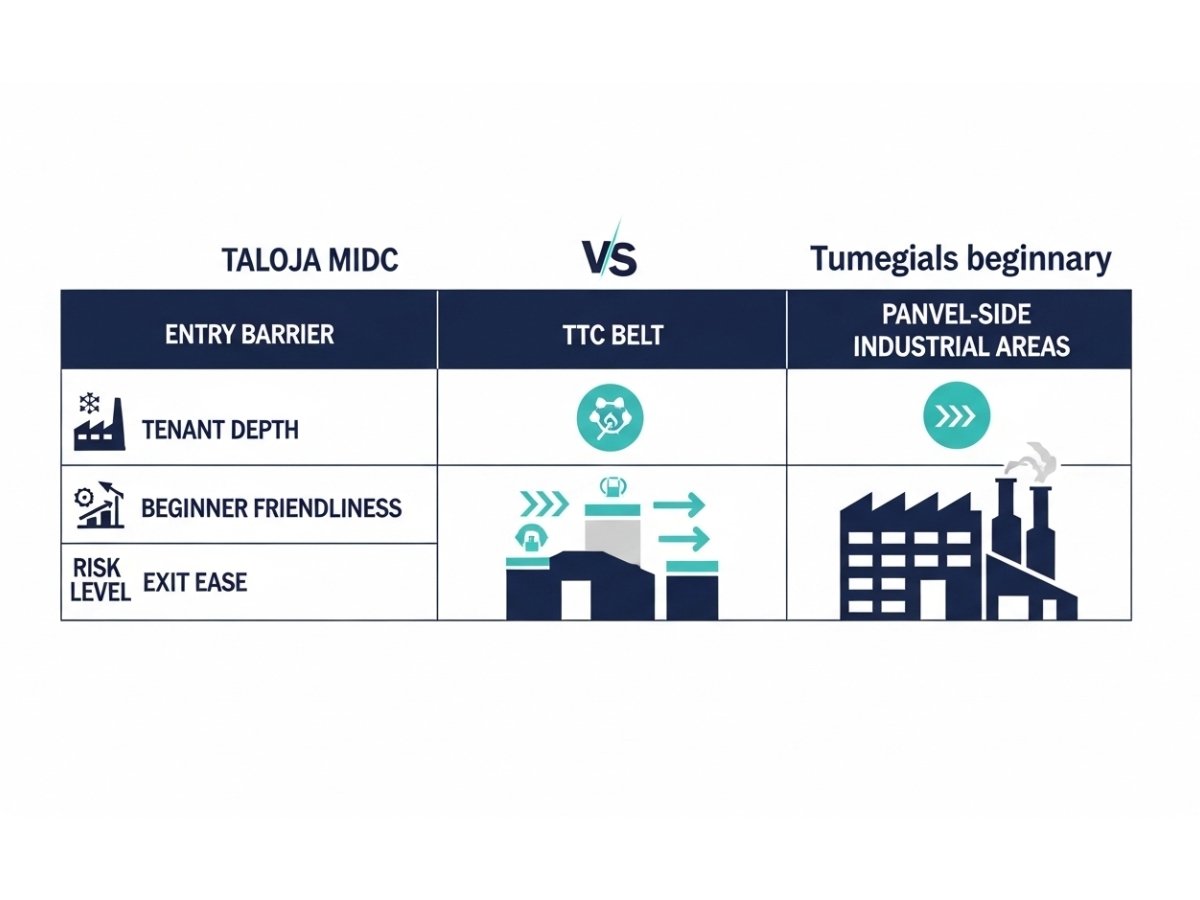
If the question is simple, the answer should also be simple. For most first-time investors, Taloja MIDC is usually the best starting point. It is not perfect, and it is not automatically safe everywhere, but it gives better beginner economics than TTC and better immediate practicality than Panvel-side speculative belts.
TTC, covering belts like Mahape, Rabale, Turbhe, and Pawane, is the stronger premium industrial ecosystem. But many beginners overestimate its rental comfort and underestimate its holding pressure. Panvel-side industrial exposure, including Patalganga-linked logic and airport-led narratives, can work more as a long-term thesis than a safe first-yield market.
Quick Summary Table
| Belt | Beginner Verdict | Why It Works | Main Problem | Best Fit |
|---|---|---|---|---|
| Taloja MIDC | Best practical starter for most first-time investors | Lower entry barrier, broader small-unit demand, more flexible entry formats | Belt quality varies sharply by block and activity type | Small-ticket investors, MSME-linked buyers, self-use plus rent fallback |
| TTC Belt | Best premium belt, but not the easiest first buy | Mature ecosystem, strong connectivity, better corporate pull | High holding costs, tighter pricing, NMMC tax burden, less forgiving vacancy cycle | Well-capitalized buyers targeting stronger tenants |
| Panvel-side / Patalganga exposure | Not ideal as a default first industrial investment | Infrastructure-led upside, lower official land rate base, future logistics thesis | More speculative, longer holding horizon, slower income certainty | Thesis-led investors with patience and construction clarity |
What Does “Best” Actually Mean for a First-Time Industrial Investor?
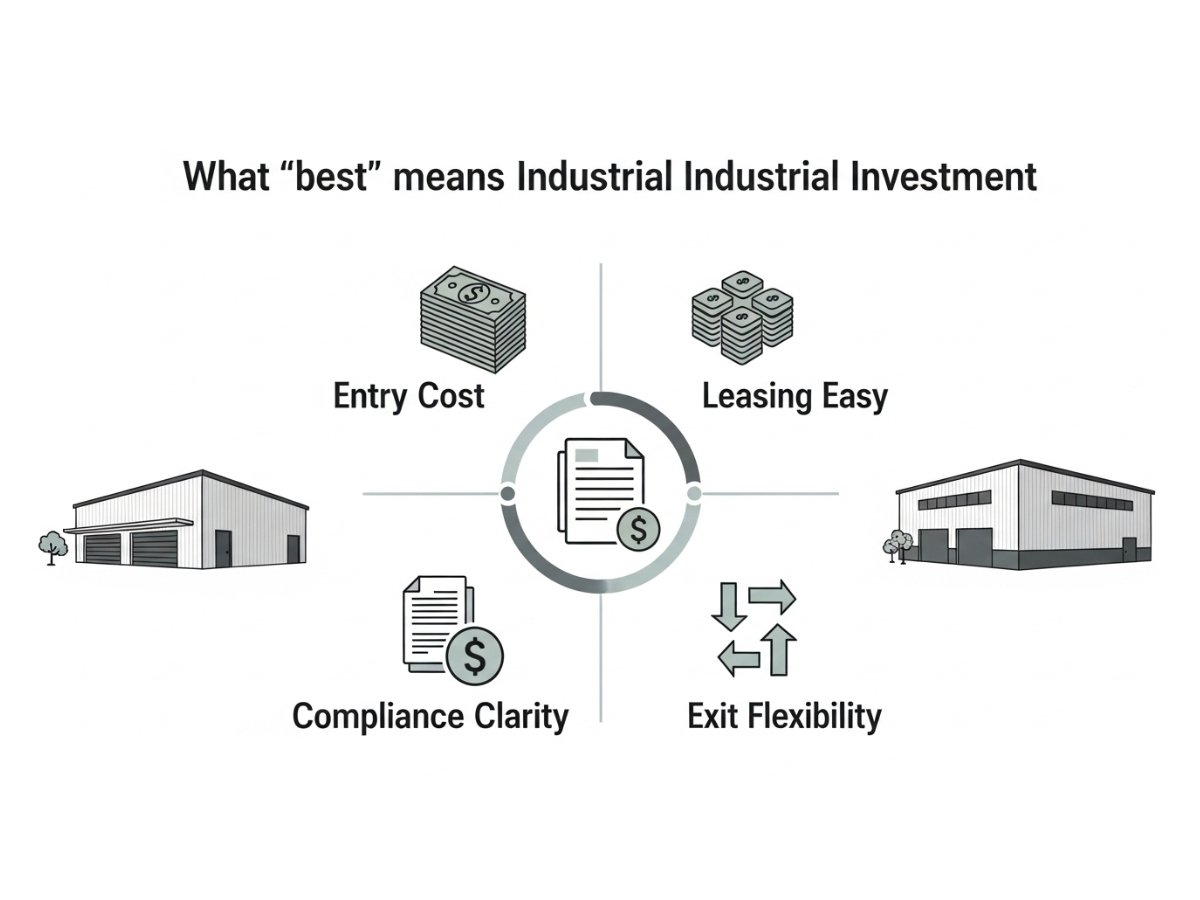
The word “best” creates confusion because many people use it loosely. In industrial real estate, the best belt is not the one with the most expensive land, the widest highway, or the strongest broker pitch. For a first-time investor, the best belt is the one that is easier to enter, easier to lease, easier to understand, and easier to exit.
That difference matters a lot in Navi Mumbai. A premium unit in a prestigious belt can still become a bad first investment if the vacancy period hurts cash flow, the municipal burden reduces net yield, or the tenant pool is too narrow for your ticket size.
Entry budget matters more than prestige
This is the first big truth beginners usually learn late. Prestige feels attractive, but budget flexibility protects capital.
The official MIDC base rate itself shows the difference in entry logic. TTC base land rates sit roughly in the ₹25,108 to ₹31,390 per sq.m. band, while Taloja sits around ₹12,100 to ₹15,460 per sq.m. That does not mean actual resale or asking prices are equal to those numbers. They are not. But it does show why TTC starts from a much tighter base and why many charges linked to official rates hit differently across belts.
A beginner usually needs flexibility more than image. That is why Taloja often wins the first comparison.
Leasing ease matters more than brochure appeal
A first-time industrial investor is not buying a showpiece. The real question is this: how easily will this space find the right tenant without destroying my holding power?
That answer depends on the local tenant ecosystem. Taloja works better for many first-time investors because it has wider MSME-style demand for practical industrial units. TTC can attract stronger tenants, but it also demands stronger asset quality, stronger positioning, and stronger patience.
Exit flexibility matters if this is your first industrial buy
In industrial property, exit is not just about appreciation. It is about whether another buyer or occupier can understand and reuse the asset quickly.
A smaller, functional industrial unit in the right Taloja belt may exit faster than an overcapitalized premium unit in TTC that needs a very specific buyer. For beginners, that flexibility matters more than theoretical upside.
A simple beginner safety lens
Before choosing a belt, ask these four questions:
- Can I afford not just the purchase, but also the holding period?
- Is the likely tenant pool broad enough for my unit type?
- Can I understand the compliance and leasehold rules properly?
- If I need to exit in 2 to 5 years, will this asset still be liquid?
If the answer is weak on two or more of these, it is probably not the right first belt.
Is Taloja Usually the Best Starting Belt for Most First-Time Investors?
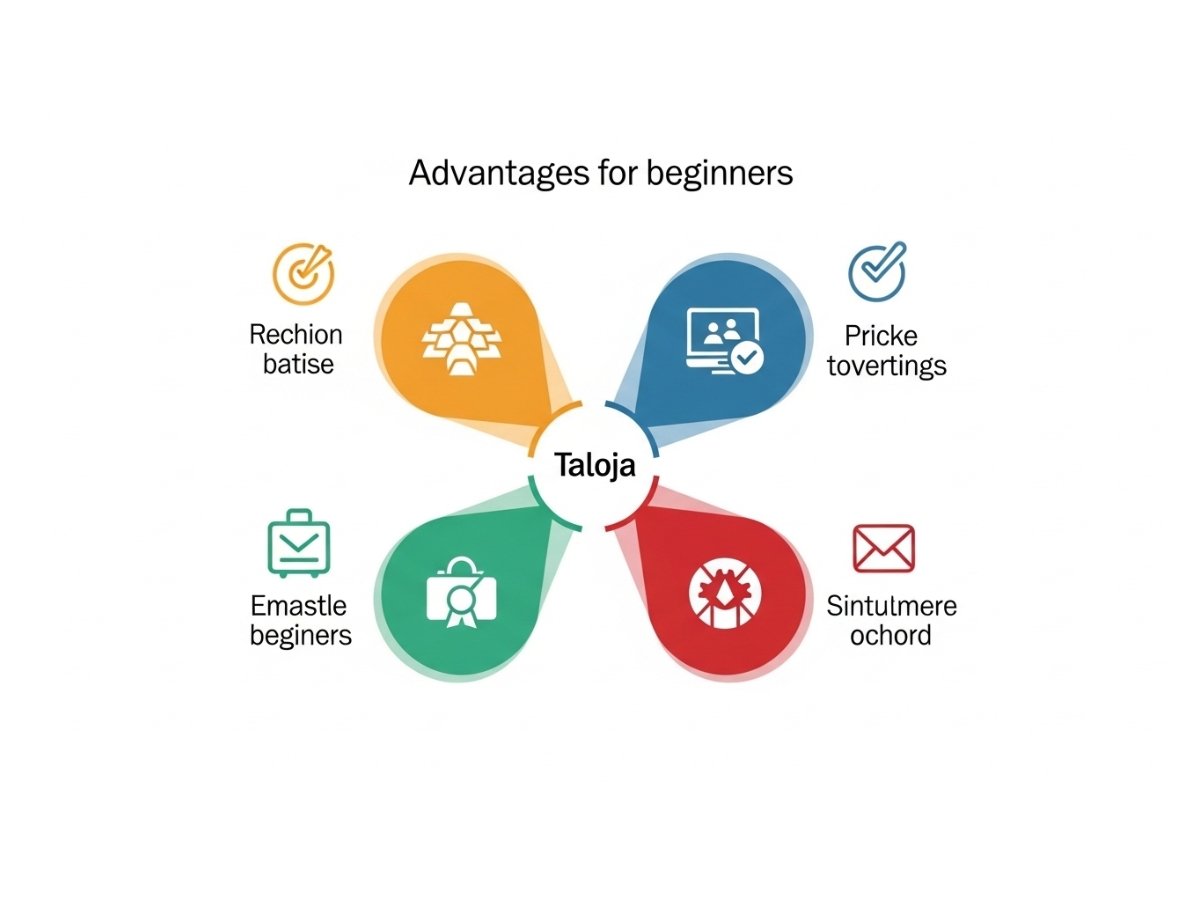
Yes, for most first-time investors, Taloja is usually the strongest practical starting belt. Not because it is glamorous. Because it is functional, flexible, and more forgiving.
Taloja works when the investor needs a market with a lower entry barrier, a broader range of industrial unit formats, and deeper MSME-style demand. It is especially useful for investors who want optionality: self-use now, lease later, or lease first and exit later.
Why Taloja feels more accessible at entry level
Taloja’s appeal starts with cost structure. Its official MIDC base rate band is much lower than TTC. Again, that does not equal open-market transaction reality, but it shapes the broader economics around entry, extensions, and other MIDC-linked calculations.
More importantly, Taloja usually offers a wider range of inventory types. A first-time investor is more likely to find practical small and mid-sized industrial units, galas, or buildable formats that align with real MSME demand. That is a big advantage over belts where the ticket size becomes premium before the investor has even understood the market.
Where Taloja works well for MSME-style demand
This is where Taloja becomes truly useful. Many small and medium occupiers do not need prestige. They need workable industrial logic: usable roads, practical loading, enough power, reasonable access, and acceptable industrial surroundings.
That is why Taloja has stronger beginner appeal than many people expect. It can serve engineering, fabrication, light manufacturing, industrial support activities, and practical production-linked users who care more about operational fit than about being in the most premium industrial corridor.
The upcoming and ongoing access improvements also matter. Taloja has historically felt more distant to some buyers. But metro access and the Kharghar–Turbhe Link Road logic change that long-term perception. That does not automatically make every property a winner. It simply means Taloja’s earlier isolation argument is weaker than before.
Where a beginner can still go wrong in Taloja
This is the part many generic articles miss. Taloja is not one uniform market.
Some blocks are more chemical and process heavy. Others are more suitable for engineering and cleaner industrial use. This distinction is critical. A first-time investor who buys in a discounted heavy-chemical pocket without understanding MPCB sensitivity or surrounding activity fit can make a very expensive mistake.
In practical terms, beginners usually need to be careful around Taloja’s more compliance-heavy chemical blocks. The dossier specifically flags V, T, J, and K-side chemical pockets as environments with stronger compliance burden and stricter operational logic. A beginner who wants a broad tenant pool should usually be far more comfortable in the engineering and lighter-use blocks such as C and L-type logic, where the tenant base is more practical and the environmental fit is easier for ordinary industrial users.
Example: how a first-time buyer should think in Taloja
Imagine two first-time investors with similar budgets.
The first buys a unit in a highly compliance-sensitive chemical pocket because the rate looks attractive. Later, he tries to lease it to a cleaner industrial or logistics-style occupier and faces poor fit from day one.
The second buys a simpler functional unit in an engineering-friendly Taloja pocket. The unit may not sound exciting, but the tenant pool is broader, the operational logic is cleaner, and the exit base is larger.
The second buyer usually has the smarter first investment.
When Does TTC Make More Sense Even if It Is Harder for Beginners?
TTC makes more sense when the investor is not just buying industrial real estate, but buying into a premium industrial ecosystem with stronger maturity, better connectivity, and stronger corporate-grade pull.
That includes belts such as Mahape, Rabale, Turbhe, and Pawane. These locations benefit from far better regional linkage to Mumbai-facing movement, stronger industrial-commercial overlap in some parts, and more mature location perception.
So yes, TTC is a stronger belt in many ways. But strength and beginner suitability are not the same thing.
Why TTC feels stronger on maturity and ecosystem depth
TTC is one of the most established industrial corridors in the Navi Mumbai side of the region. Occupiers value it for route logic, staff accessibility, and a more mature industrial ecosystem. In some pockets, the location carries stronger corporate comfort than Taloja.
For well-capitalized investors, this can be attractive. A better-quality asset in the right TTC location can have strong tenant appeal, especially where access and ecosystem maturity support stable use.
Why TTC can still be the wrong first buy for some investors
The problem is not TTC itself. The problem is beginners misreading TTC.
First, the entry base is far higher. Second, its holding environment is tougher. The dossier flags a major local issue here: TTC units are exposed to NMMC industrial/commercial property taxation, with a cited burden around 68.45% of rateable value, while also sitting inside a broader MIDC environment with its own charges and rules. For a beginner, this is where gross yield stories can collapse into much thinner net yield reality.
Then comes the subletting issue. MIDC subletting charges for industrial/commercial use are cited at 3% of prevailing MIDC land rate annually. This is not a small detail. It is one of the most important reality checks in industrial investing. A beginner who looks only at rent and ignores recurring statutory leakage can badly misjudge the real return.
So TTC is not wrong. It is just less forgiving. A vacancy cycle in TTC hurts more. A pricing mistake hurts more. A wrong tenant assumption hurts more.
TTC in plain language
If Taloja is the practical starter market, TTC is the premium market that expects you to already know what you are doing.
Should a First-Time Investor Look at Panvel-Side Industrial Exposure at All?
Yes, but only carefully. Panvel-side industrial exposure is usually not the best default first buy if your main aim is immediate safe industrial income.
That geography works more as a thesis-driven bet. Investors are drawn by airport logic, future logistics demand, infrastructure improvement, and broader growth narratives around Panvel-side development. Those narratives are real enough to study. But they do not automatically create a safe first industrial investment.
Where Panvel-side logic works
Panvel-side industrial exposure can work for buyers who:
- are comfortable with a longer holding period
- are not depending on immediate stable rent
- understand greenfield or emerging industrial logic
- are willing to build or wait rather than simply buy and relax
The official MIDC base rate reference in the dossier places Patalganga around ₹10,590 per sq.m., which makes it look attractive from a base-rate perspective. But low official base rate alone does not make a belt beginner-friendly.
Where it becomes too thesis-heavy for a fresher
This is the risk. A first-time investor may hear “airport”, “future freight”, “growth corridor”, and assume that immediate industrial income will follow quickly. That is not how these zones always behave.
Panvel-side exposure often needs patience, local route understanding, and construction clarity. If the investment is really a land-bank or future-format warehouse thesis, then fine. But that is different from buying a practical starter industrial asset.
Caution box: do not confuse future story with present usability
A first industrial investment should usually be built on current usability first and future upside second. If the order is reversed, risk rises sharply.
Taloja vs TTC vs Panvel-Side: Which Belt Wins on the Things Beginners Actually Need?
This is the comparison that matters most.
| Factor | Taloja MIDC | TTC Belt | Panvel-side / Patalganga exposure |
|---|---|---|---|
| Entry affordability | Best among the three for most first-time buyers | Weakest for beginners due to premium pricing environment | Official base entry may look lower, but practical development thesis can require more capital |
| Tenant depth for small and mid units | Strong, especially where MSME and practical industrial demand is broad | Strong in the right pockets, but tenant expectations can be higher | More selective and more dependent on exact location and future development logic |
| Compliance burden | Moderate overall, but sharply higher in chemical pockets | High due to overlapping practical burden and tighter holding logic | Variable and highly location-specific |
| Leasehold and process complexity | Manageable if the buyer understands MIDC rules and chooses the right block | Harder for beginners because cost of process mistakes is higher | Can become confusing when development thesis, zoning, and execution differ |
| Beginner friendliness | Best overall | Lower | Lower unless the investor has a clear long-horizon strategy |
| Exit ease | Usually strongest for functional smaller units | Can be good, but ticket-size and pricing can narrow the buyer pool | More dependent on future infrastructure and market maturity |
| Best fit | Small-ticket first investor, self-use plus rent fallback, MSME-facing logic | Premium buyer, experienced investor, better-capitalized operator | Long-horizon, thesis-led investor |
| Main risk | Buying in the wrong block or wrong activity environment | Yield compression and holding pressure | Waiting too long for the thesis to convert into practical return |
If the ranking is only from a beginner safety lens, the order is usually:
1. Taloja 2. TTC 3. Panvel-side exposure
If the ranking is from premium ecosystem quality alone, TTC would often rank first. But that is not the question this article is solving.
Which Belt Fits Your Budget and Investor Type Best?
This is where the answer becomes more personal. The right belt depends on who you are, not just on where the map points.
Small-ticket first investor
If this is your first industrial buy and your budget is limited, Taloja usually makes the most sense. The lower entry logic, broader demand, and better chance of finding practical smaller units make it a more stable starting belt.
The key is to stay in functional, cleaner-use, engineering-friendly areas rather than blindly buying the cheapest available unit.
Investor wanting self-use plus rental fallback
This buyer profile also tilts toward Taloja. The belt gives more flexibility if the investor wants to use the premises for business today but still wants rental or resale fallback later.
That flexibility matters a lot in first investments because plans change. Industrial belts that offer only one perfect use-case are riskier for beginners.
Premium buyer seeking stronger belt quality
This is where TTC starts becoming more compelling. If the investor is financially stronger, comfortable with a more expensive holding environment, and wants access to a more mature belt, TTC can make sense.
But this is not a beginner shortcut. TTC is best treated as a premium asset environment, not as an easy first experiment.
Investor chasing land-bank upside
Panvel-side or Patalganga-linked exposure is the natural candidate here. But that is only suitable for investors who know they are making a future-oriented bet.
This is not the right lane for someone who is entering industrial property mainly because they want safe, immediate, understandable income.
What First-Time Investors Misread Before Buying in an Industrial Belt
This is where many first industrial investments go wrong. Not because the belt was bad, but because the buyer misunderstood how industrial property actually behaves.
Confusing industrial approval with future usability
A unit can be industrial on paper and still be wrong for the tenant or activity the investor has in mind. This is especially risky in Taloja if the surrounding zone is compliance-heavy or environmentally mismatched.
Cheap entry is not useful if the future occupier pool becomes too narrow.
Buying only on road frontage or broker pitch
A wide road, nice frontage, or strong broker language can create false confidence. But industrial users care about many things beyond frontage: loading, truck turning radius, power, floor load, compliance environment, and tenant ecosystem.
Frontage does not rescue a wrong-use location.
Ignoring leasehold transfer and post-buy process realities
A large part of Navi Mumbai industrial stock operates on MIDC leasehold, typically on long-duration lease terms rather than casual freehold ownership. This changes how transfer, subletting, construction timelines, and compliance should be understood.
Beginners often behave as if industrial land can be bought and held like an ordinary open plot. That is dangerous thinking.
Assuming every industrial unit is equally easy to lease
This is one of the biggest mistakes. A practical industrial unit in the right block can move faster than a more expensive but narrower-use unit in a premium corridor.
Industrial leasing is about fit. Not just brand value.
Red-flag checklist for first-time buyers
- Do not buy an industrial plot only because land seems cheap
- Do not assume all Taloja blocks suit all activities
- Do not ignore annual subletting cost impact on real yield
- Do not calculate returns without holding-cost pressure
- Do not treat MIDC leasehold like casual freehold ownership
- Do not assume a premium corridor is automatically safer for a first investment
What Should You Check Before Deciding the Belt, Not Just the Unit?
This is the due-diligence part that makes the article practical. A lot of first-time buyers inspect the unit and forget to inspect the belt. That is backwards.
Belt-level tenant profile
Who actually operates in that belt? Engineering? Heavy chemicals? Light manufacturing? Warehousing? Industrial support? If the belt’s tenant logic does not match your future leasing plan, the investment can stall.
Truck movement and operational practicality
This is not a small detail. Industrial users care deeply about internal road movement, loading efficiency, turning comfort for larger vehicles, and surrounding road usability.
A location that looks strong on paper can fail in daily operations if truck movement is painful.
Compliance environment and activity fit
In industrial property, the surrounding compliance climate matters. Some pockets are more sensitive from an MPCB standpoint. Some carry a heavier operational environment. Some are far easier for ordinary engineering and light industrial use.
This is why Taloja block selection matters so much for beginners.
Age, maintenance and surrounding stock quality
A functional belt is not enough if the surrounding stock is poor, the road condition is weak, or the built environment signals long-term tenant discomfort.
The investor is not just buying the inside of the unit. The belt outside it is part of the asset.
Pre-site-visit checklist
Before finalizing the belt, check these basics:
- exact MIDC block and use environment
- likely tenant profile in that pocket
- whether the asset is land, gala, shed, or under-construction format
- whether under-construction inventory crosses the 500 sq.m. / 8-unit threshold where MahaRERA registration becomes relevant
- whether the investor can handle leasehold process realities
- whether the local road geometry is suitable for the intended industrial use
- whether the expected rent still makes sense after statutory leakages
One cost reality many beginners ignore: subletting can cut real yield
Industrial investing looks very different after this line item is understood properly.
The dossier notes MIDC subletting charges of 3% of prevailing MIDC land rate annually for industrial and commercial use. That means an investor chasing rent cannot look only at gross rental inflow and call it profit. The real yield becomes thinner after subletting charges and other local cost burdens are factored in.
Simple example
Suppose a 1,000 sq.m. industrial holding is benchmarked on a Taloja-side base rate of ₹15,460 per sq.m. The notional land-rate base comes to ₹1,54,60,000. A 3% annual subletting charge on that base works out to roughly ₹4,63,800 per year.
That does not mean every deal should be rejected. It simply means the investor must stop behaving as if gross rent is net return. In premium belts where other burdens are heavier, this gap can become even more important.
The empty-plot trap: why beginners should be careful with industrial land
This is one of the most important warnings in the entire article.
A first-time buyer coming from residential thinking may assume that buying an empty industrial plot and simply waiting is a smart strategy. Under MIDC logic, that can be dangerous. The dossier flags the 40% FSI utilization requirement linked to Building Completion Certificate expectations, along with the risk of significant penalties for delay and non-development.
In plain language, an industrial plot is not always a passive parking slot for capital. If you buy vacant industrial land, you should already have strong clarity on construction budget, build timeline, and actual use strategy.
For many first-time investors, this is exactly why a functional existing unit in the right belt is safer than vacant land bought on hope.
So Which Industrial Belt Should Most First-Time Investors Choose?
For most first-time investors, the answer remains Taloja MIDC, especially the practical engineering and lighter industrial pockets rather than the compliance-heavy chemical-facing zones.
That does not mean Taloja is automatically easy. It means it is the most balanced starting point when you compare:
- entry affordability
- tenant depth
- flexibility of unit formats
- beginner friendliness
- exit practicality
Conclusion
The practical starter: Taloja MIDC is the best choice for most first-time investors. It is not the most premium belt, but it is usually the most usable first belt.
The premium but harder belt: TTC is the stronger premium industrial corridor, but it is better for buyers who already understand holding pressure, yield compression, and sharper tenant expectations.
The thesis-led long hold: Panvel-side / Patalganga-linked exposure is not the best default first investment unless the investor is clearly entering with a long-horizon infrastructure thesis.
So if the goal is simple, the answer is also simple: start with the belt that protects beginner capital, not the belt that impresses on paper. In Navi Mumbai, that is usually Taloja.
Conclusion
If you are entering industrial real estate for the first time and want the safest practical answer, Taloja is usually the best industrial belt in Navi Mumbai to start with. It gives a more manageable entry point, a broader occupier base, and better beginner flexibility than TTC. TTC is stronger in maturity and premium positioning, but it punishes shallow planning. Panvel-side industrial exposure has future logic, but it is usually too speculative to be the default first move.
The smartest first industrial investment is not the one with the strongest sales story. It is the one you can understand, hold, lease, and exit without learning the hard way. In Navi Mumbai, that usually points back to Taloja.
FAQs
Frequently Asked Questions