

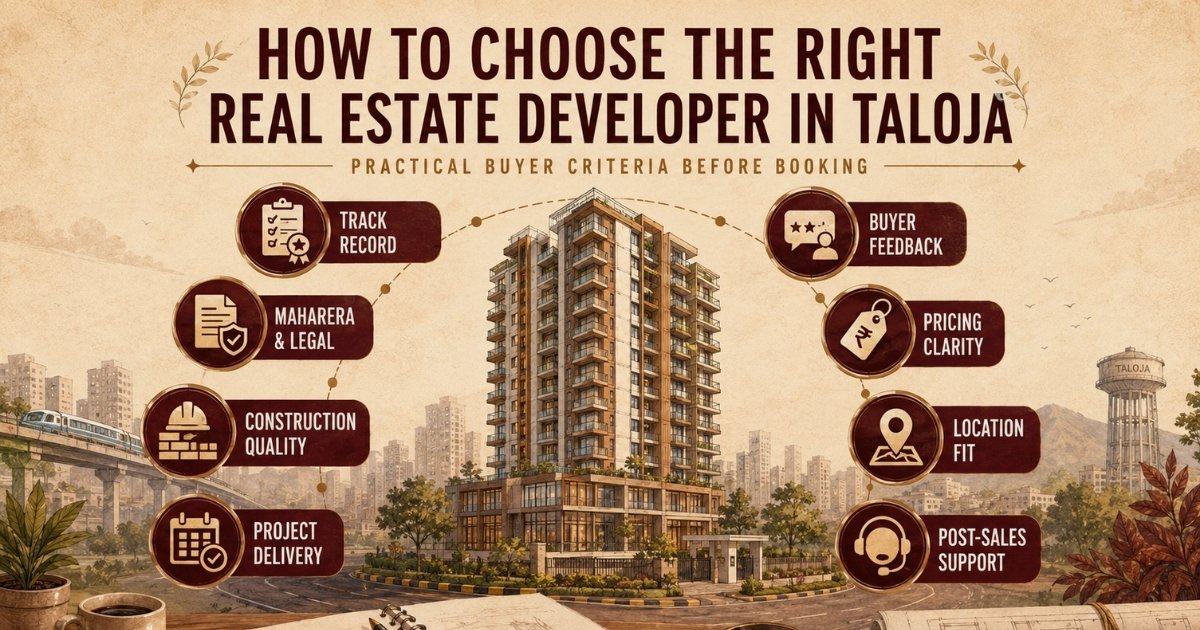
To choose the right real estate developer in Taloja, buyers should verify the developer’s past delivery record, MahaRERA details, CIDCO land documents, legal approvals, construction quality, pricing clarity, water planning, buyer feedback and OC-based possession before paying token money. In Taloja, this due diligence is especially important because the area has strong growth potential, but also real challenges such as water dependency, MIDC pollution influence, leasehold land complexity and under-construction project risk.
Quick Summary: How to Choose the Right Real Estate Developer in Taloja
Taloja is one of Navi Mumbai’s most affordable growth locations, especially for first-time homebuyers looking for 1 BHK and 2 BHK flats below the price levels of Kharghar, Nerul, Seawoods or Vashi. The operational Navi Mumbai Metro Line 1, airport-led growth expectations and improving connectivity have increased buyer interest in Taloja Phase 1, Taloja Phase 2, Ghot, Petali, Roadpali and nearby pockets.
But affordability should not make buyers careless. A cheap flat in the wrong project can become expensive later through delay, leakage, tanker water cost, hidden charges, weak society handover or unclear CIDCO documentation.
| What to Check | Why It Matters in Taloja | Good Sign | Red Flag |
|---|---|---|---|
| MahaRERA details | Confirms project registration, timelines and disclosures | Clear registration, updated progress, no major litigation pattern | Repeated extensions, poor disclosure, pending complaints |
| CIDCO / land title | Taloja has CIDCO leasehold and PAP / 12.5% plot-related risks | Clear allotment, transfer and title documents | Builder avoids sharing documents before token |
| OC and CC | Protects buyer from illegal possession and approval mismatch | CC and OC status clearly explained in writing | “Fit-out possession” offered without OC |
| Water planning | Taloja has known water supply stress in several societies | Adequate storage, legal water connection, resident satisfaction | Permanent tanker dependency in older projects |
| Construction quality | Monsoon leakage and maintenance issues can reduce livability | Older buildings show good upkeep and no major seepage | Damp walls, basement flooding, poor lift condition |
| Pricing clarity | Advertised base rates often exclude many charges | All-inclusive cost sheet on letterhead | Verbal discounts, hidden PLC, parking and maintenance charges |
| Location fit | Taloja Phase 1, Phase 2 and MIDC-side pockets differ | Project suits daily commute, air quality and budget | Good builder but weak micro-location |
The safest way to choose a real estate developer in Taloja is to verify legal documents, completed projects, pricing clarity and buyer feedback before paying token money. MahaRERA registration is important, but it should not be treated as the only proof of developer quality.
Why Choosing the Right Real Estate Developer Matters in Taloja
Choosing the right builder matters in every real estate market, but in Taloja it matters more because the buyer is not only buying a flat. The buyer is also accepting the developer’s ability to handle local approvals, CIDCO land conditions, water planning, construction quality, environmental realities and society handover.
Taloja is no longer just an industrial periphery. It is now a metro-linked residential growth corridor with strong interest from first-time buyers, MIDC employees, investors and families priced out of Kharghar or Panvel. However, rapid development has also brought uneven project quality. Some developers have managed to deliver usable, well-planned homes, while others have struggled with delays, poor construction quality, weak maintenance planning or legal complications.
A wrong developer choice in Taloja can create problems such as:
- EMI and rent burden due to delayed possession
- No proper OC at handover
- High monthly maintenance due to tanker water
- Leakage during monsoon
- Poor society formation and conveyance delays
- Hidden charges after booking
- Difficulty in resale because of weak project reputation
This article is for general buyer awareness. Before booking or signing an agreement, buyers should verify documents with a qualified legal professional.
Understand the Developer’s Past Track Record
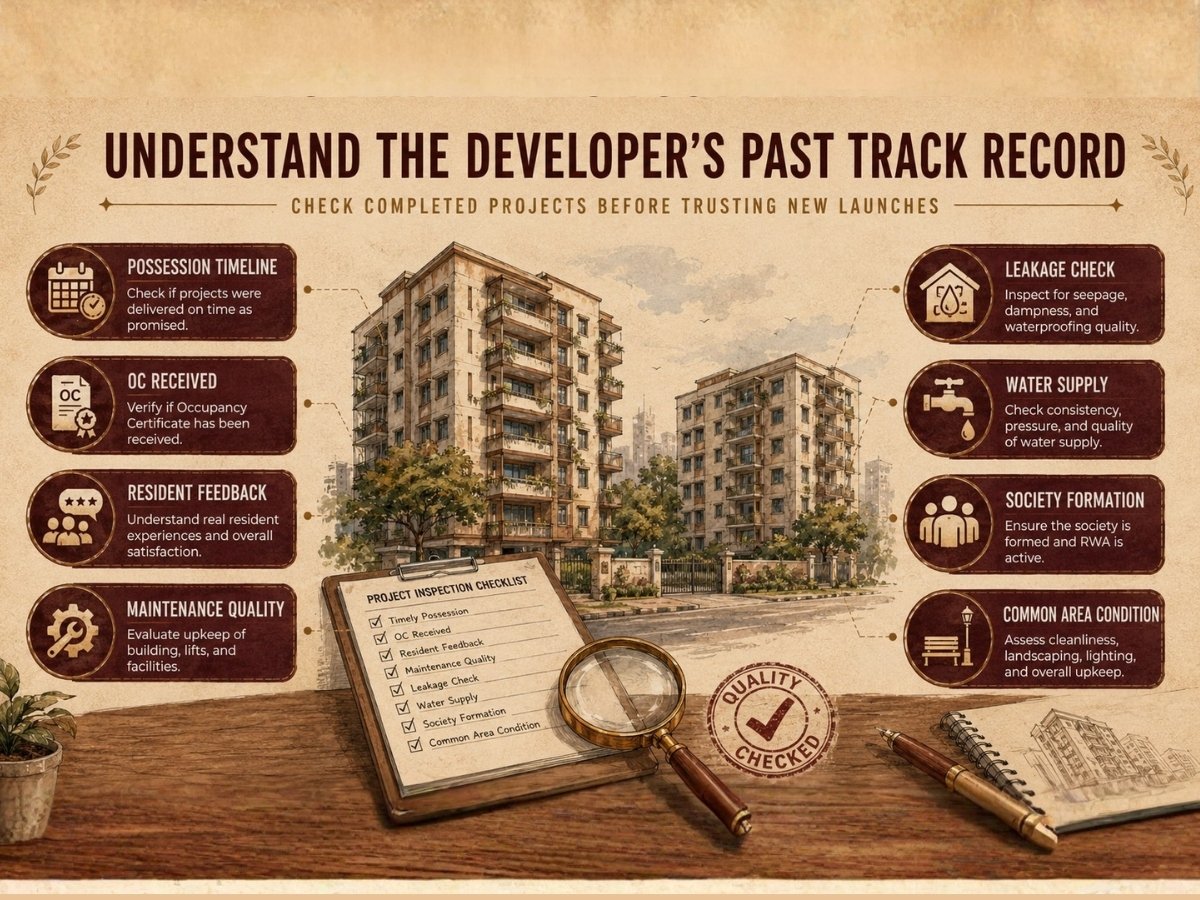
A developer’s past record is often more reliable than their sales presentation. In Taloja, where many buyers are attracted by affordable pricing and future appreciation hopes, checking older projects is one of the most practical ways to avoid a poor decision.
A builder may show impressive brochures, sample flats and 3D renders, but the real test is how their completed buildings look after five to ten years.
Check Completed Projects Before Trusting New Launches
Before trusting a new launch in Taloja, ask the developer for a list of completed projects. Do not only ask for names. Ask for addresses, possession dates and whether the projects received OC.
A completed project helps you check:
- Whether the developer delivered close to the promised timeline
- Whether the project received Occupancy Certificate
- Whether the society was formed properly
- Whether residents are satisfied with maintenance
- Whether there are leakage, lift or water issues
If a developer has many under-construction projects but very few completed projects, buyers should be careful. It does not automatically mean the developer is bad, but it increases the need for stricter verification.
Visit Older Buildings Developed by the Same Builder
A five-year-old building tells the truth better than a new sales office. In Taloja, this is especially important because monsoon seepage, humidity, industrial dust and water stress can expose weak construction quickly.
When visiting an older building by the same developer, check the basement, external walls, lobby, staircase, lift area, terrace and parking. Look for damp patches, peeling plaster, cracked tiles, rusted railings, poor drainage and waterlogging marks.
Also observe whether the building feels properly maintained or abandoned after handover. A good developer does not disappear immediately after possession.
Speak to Existing Residents and Buyers
Existing residents can tell you what the sales team will not say clearly. Ask simple, direct questions:
- Was possession delayed?
- Was the final cost the same as promised?
- Is water supply regular?
- Does the building depend heavily on tankers?
- Was society formation completed smoothly?
- Are there leakage problems during monsoon?
- Does the builder respond after possession?
In Taloja, buyers should specifically ask about water supply timing and tanker dependency. Some societies in the wider Taloja belt have faced very short municipal water windows and have relied on private tankers. If the developer’s older projects are still struggling badly for basic water, treat it as a serious warning sign.
Check MahaRERA Registration and Project Transparency
MahaRERA is a basic starting point for buyer safety. It helps buyers check project registration, promoter details, declared possession timeline, project progress, litigation disclosures and extension history.
But MahaRERA should not be treated as a full guarantee. A project can be registered and still face delay, cash-flow problems, weak construction quality or local infrastructure challenges.
Why MahaRERA Is Important for Taloja Buyers
Taloja has a large under-construction market. Many buyers book flats before the building is complete because prices are lower than ready-to-move homes. In such cases, MahaRERA becomes important because it gives buyers a formal way to verify the project.
Buyers should check the project on the MahaRERA website before paying token money. The project name, promoter name, completion date and uploaded documents should match what the sales team is claiming.
A reputed developer is not always the right developer if the project has unclear approvals, delayed possession, hidden charges or weak after-sales support.
What to Verify on the MahaRERA Website
On the MahaRERA portal, buyers should check:
- Project registration number
- Promoter name
- Declared possession date
- Project status
- Uploaded approvals and documents
- Litigation details, if any
- Extension history
- Percentage of work completed
- Financial progress compared with physical progress
A serious red flag is when a project shows heavy fund withdrawal but weak physical progress. This can indicate possible cash-flow stress or poor project discipline.
For a detailed guide, you can internally link to [MahaRERA verification process](ADD INTERNAL LINK HERE).
Why MahaRERA Alone Is Not Enough
MahaRERA registration confirms that the project is legally registered with the regulator. It does not automatically guarantee good construction, timely possession, strong water planning, proper society handover or clean CIDCO title.
In Taloja, buyers must combine MahaRERA checking with ground-level verification. A buyer should still visit the site, inspect completed projects, check CIDCO documents, review the Agreement for Sale and confirm OC-based possession.
MahaRERA is a safety tool. It is not a replacement for due diligence.
Check Legal Documents Before Booking a Flat
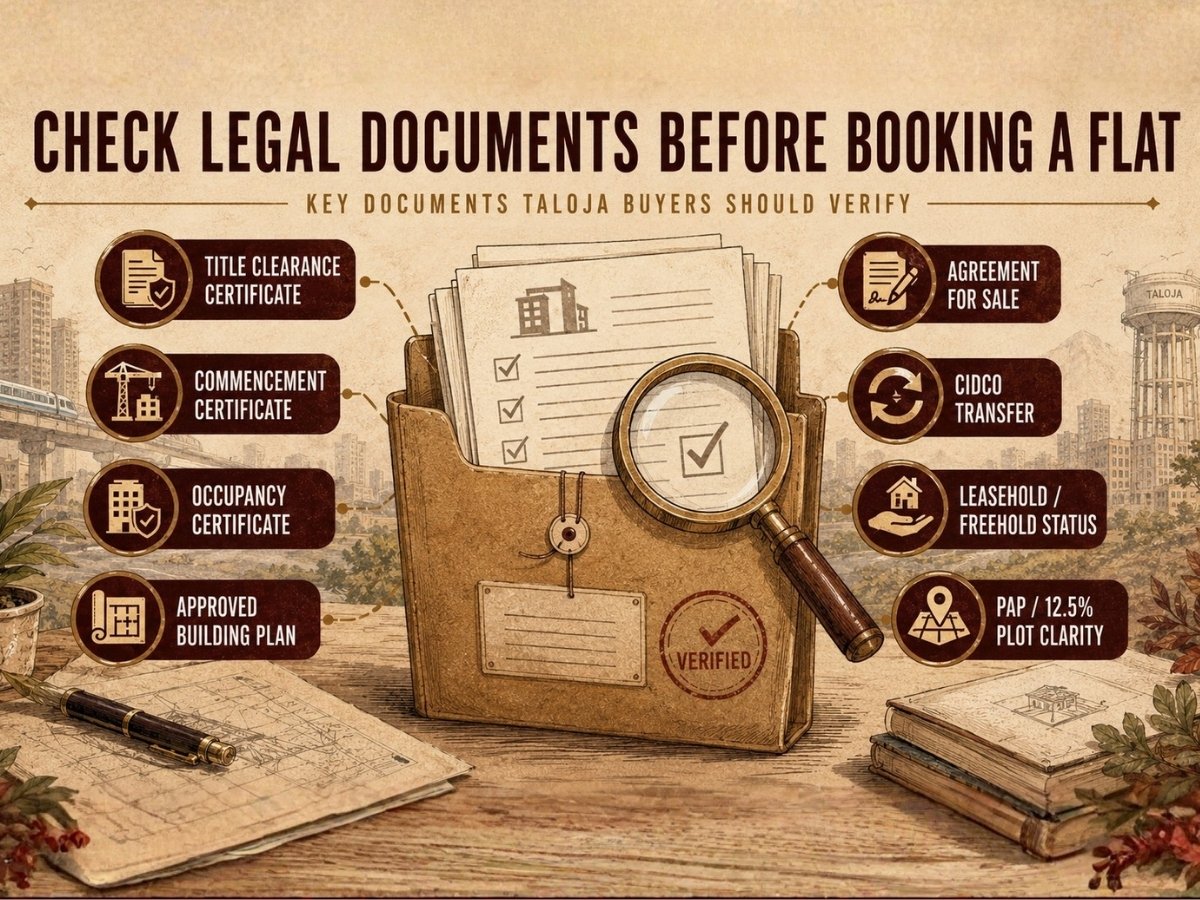
Legal document checking is one of the most important parts of choosing a real estate developer in Taloja. Many buyers focus only on price, carpet area and amenities, but the documents decide whether the purchase is safe.
Before booking a flat, ask for document access. A transparent developer will not hesitate to share basic legal documents for review by your lawyer.
| Document | Why It Matters | What Buyer Should Check |
|---|---|---|
| Title Clearance Certificate | Shows whether the land has clean ownership and no major dispute | Preferably 30-year title search reviewed by independent lawyer |
| Commencement Certificate | Confirms permission to start construction up to approved level | Check authority, floor approval and date |
| Occupancy Certificate | Confirms the building is legally fit for occupation | Do not accept final possession without OC |
| Approved Building Plan | Shows approved layout, floors, flats and common areas | Compare with what is being sold |
| Agreement for Sale | Legally binds possession, price and specifications | Review before signing, not after token pressure |
| CIDCO Transfer / Lease Documents | Important for CIDCO-origin land and leasehold properties | Clarify transfer charges and title flow |
For more clarity, add an internal link to [agreement to sale vs sale deed](ADD INTERNAL LINK HERE).
Title Clearance Certificate
The Title Clearance Certificate helps verify whether the land title is clean. In Taloja, this is crucial because many projects are connected to CIDCO leasehold systems, PAP plots or transfer histories.
Do not rely only on the builder’s statement that “bank loan is approved.” Bank approval is useful, but it does not replace independent title verification.
Commencement Certificate
The Commencement Certificate proves that the builder has permission to start construction. Buyers should verify whether the CC covers the floor being sold.
For example, if a developer has approval only up to a certain floor but is selling flats above that level, it is a serious risk. Buyers should ask for the stamped CC copy and cross-check approval status where possible through the relevant authority process.
Occupancy Certificate
The Occupancy Certificate is one of the most important documents for ready or nearing-possession flats. It confirms that the building has received required completion and safety approvals for occupation.
Buyers should avoid taking possession without OC. In many Navi Mumbai and MMR projects, “fit-out possession” is offered to reduce buyer pressure and delay penalty exposure. But for buyers, possession without OC can create major problems with municipal services, legal safety, insurance and future resale.
Approved Building Plan
The approved plan should match what the buyer is being promised. Check flat layout, carpet area, parking, amenity areas, building height and common spaces.
Do not assume the sample flat is the same as the final flat. Always compare the actual unit and Agreement for Sale specifications with the approved plan.
Agreement for Sale
The Agreement for Sale should clearly mention the price, carpet area, possession timeline, payment schedule, delay terms, specifications and parking details.
Do not sign in a hurry. Do not accept verbal promises about possession, free parking, GST waiver, floor-rise waiver or maintenance discount unless they are written properly.
CIDCO Transfer and Leasehold Clarity
Many Navi Mumbai properties are connected to CIDCO leasehold systems. In Taloja, buyers should ask whether the plot is leasehold, freehold-converted or under any special allotment structure.
CIDCO transfer charges, freehold conversion status and allotment documents can affect future resale and ownership clarity. With the July 2025 CIDCO freehold conversion scheme mentioned in the research context, buyers should confirm whether a particular project or plot is still leasehold or has gone through eligible conversion. This varies by plot and must be verified before booking.
Taloja-Specific Documents Buyers Should Check Before Booking
Taloja requires more careful legal checking than a simple “flat booking” mindset. The area has a mix of CIDCO-planned development, leasehold properties, growth pockets, PAP-related land histories and jurisdictional overlaps.
CIDCO Allotment and Transfer Documents
Ask whether the land was allotted by CIDCO and whether transfer permissions are complete. If the developer is building on CIDCO-origin land, the title flow must be clear.
Buyers should ask:
- Who is the original allottee?
- Has transfer permission been taken?
- Are any CIDCO charges pending?
- Is there any NOC required?
- Who will bear transfer-related cost?
PAP Plot or 12.5% Scheme Plot Clarity
Some Navi Mumbai plots are connected to the 12.5% Project Affected Persons scheme. Such plots can be legally valid, but the document chain must be clean.
For PAP or 12.5% scheme plots, buyers should verify allotment, tripartite agreement, transfer permissions and title search carefully. If multiple heirs, old disputes or incomplete transfers exist, future resale can become difficult.
For detailed internal support, link to [12.5% PAP scheme plots](ADD INTERNAL LINK HERE).
NMMC, PMC or CIDCO Approval Relevance
Taloja has areas where authority responsibility can feel confusing for normal buyers. Depending on the exact location, CIDCO, PMC or other authority-related matters may become relevant for approvals, services, water, waste management or taxation.
Buyers should not assume all Taloja projects follow the same authority structure. Ask the developer to clearly state the planning authority, municipal responsibility and approval route.
Society Formation and Conveyance Status
A developer’s responsibility does not end at possession. Society formation, conveyance and proper handover of maintenance funds are also important.
Ask residents of the developer’s completed projects whether society formation was delayed. If the builder kept control for too long, did not hand over accounts or demanded arbitrary fees, that is a strong warning sign.
Compare Construction Quality and Actual Site Progress
Construction quality in Taloja should be checked more seriously because the area faces heavy monsoon conditions, humidity, industrial dust and in some pockets, infrastructure stress.
A flat may look good during possession but start showing problems after the first monsoon if waterproofing, plastering, plumbing and drainage are weak.
Visit the Actual Construction Site
Do not depend only on the sales office or sample flat. Visit the actual construction site.
Check:
- Number of workers on site
- Pace of work
- Quality of material storage
- Site cleanliness
- Safety practices
- Basement and podium waterproofing
- Drainage planning
- Actual tower progress against promised timeline
If possible, visit at different times of the day. For location-level comfort, buyers may also visit late evening or night to understand road access, lighting, industrial smell and overall surroundings.
Compare Sample Flat and Real Flat Specifications
Sample flats are designed to impress. They may use special lighting, smaller furniture, glass partitions, open layouts and decorative finishes that are not part of the actual agreement.
Ask for the official specification sheet. Compare flooring, doors, windows, bathroom fittings, electrical points, kitchen platform, wall finish and balcony details.
The real question is not “Does the sample flat look good?” The real question is “Will the actual flat be delivered with the same usable quality?”
Check Lift, Lobby, Parking and Common Area Quality
A developer’s quality is visible in common areas. Lifts, lobby, parking, staircase, fire systems, drainage and security areas show whether the builder is cutting corners.
In Taloja, also check whether there is sufficient parking planning. Some projects attract buyers with low pricing but later create parking and internal road congestion issues.
Check Monsoon Performance and Leakage Issues
Monsoon is the real test of construction in Navi Mumbai. If the developer has older projects in Taloja, Kharghar, Kalamboli, Kamothe or Panvel, visit them during or just after the monsoon.
Look for seepage near windows, terrace leakage, basement waterlogging, wall dampness and smell inside corridors. Leakage is not a small cosmetic issue. Repeated seepage can reduce building life and increase society repair costs.
Understand Pricing, Hidden Charges and Payment Terms
Taloja attracts buyers because of affordability. But the advertised price is often not the final price. The base rate may look comfortable, but floor rise, PLC, parking, GST, stamp duty, registration, maintenance, clubhouse fees and transfer charges can change the actual budget.
Ask for an All-Inclusive Cost Sheet
Always demand a written all-inclusive cost sheet on company letterhead. It should show:
- Carpet area as per RERA
- Base price
- Floor-rise charges
- PLC charges
- Parking cost or allocation terms
- Clubhouse or amenity charges
- Infrastructure charges
- GST
- Stamp duty and registration estimate
- Advance maintenance
- Corpus fund
- Any CIDCO-related transfer or documentation charge, if applicable
For calculation support, internally link to [stamp duty calculator](ADD INTERNAL LINK HERE).
Check Parking, Floor-Rise, PLC and Maintenance Charges
A lower base price can become expensive after charges are added. In the research context, floor-rise charges may be quoted in the range of ₹50 to ₹100 per sq.ft. per floor, and PLC charges may vary depending on view, corner unit, garden or other preferences.
These charges vary by project. The buyer should verify the exact written amount before booking.
Understand GST, Stamp Duty and Registration Cost
GST, stamp duty and registration can materially affect the final cost. GST treatment may differ depending on whether the property is under construction, affordable housing category or ready with OC.
Do not depend on verbal tax estimates. Ask the developer and your legal or financial advisor to show the actual calculation before payment.
Avoid Verbal Price Commitments
Verbal commitments are one of the biggest traps in property buying. If the salesperson says parking is free, GST will be adjusted, floor rise is waived or maintenance is included, ask them to write it in the official cost sheet or Agreement for Sale.
If it is not written, do not treat it as real.
Check Developer Reputation Beyond Online Reviews
Online reviews are useful, but they are not enough. Real estate reviews can be managed, influenced or written emotionally. Buyers must look for repeated patterns, not isolated comments.
Read Google Reviews Carefully
Read positive and negative reviews. A few complaints are normal in any large project, but repeated complaints about the same issue are important.
Look for words such as:
- Possession delay
- OC issue
- Water problem
- Seepage
- Maintenance dispute
- No society handover
- Hidden charges
- Poor response after possession
Look for Repeated Complaint Patterns
One angry review may not prove anything. But if many people mention the same problem, take it seriously.
For example, twenty complaints about water dependency, leakage or delayed possession should not be ignored.
Speak to Local Brokers and Residents
Local brokers often know which buildings are easy to resell and which ones remain stuck in the market. Speak to two or three brokers who handle resale and rental in Taloja.
Also speak to residents directly. Residents usually know whether the builder provided promised amenities, completed handover and handled maintenance properly.
For support, link naturally to [real estate agents in Taloja](ADD INTERNAL LINK HERE).
Check Litigation or Delay History Where Possible
Search the builder’s name on MahaRERA and check other projects by the same promoter. If the same developer has repeated delay extensions, unresolved complaints or abandoned projects, be cautious.
A single delayed project may have a reason. A pattern of delay is a risk.
Big Builder vs Local Builder: Which Is Better in Taloja?
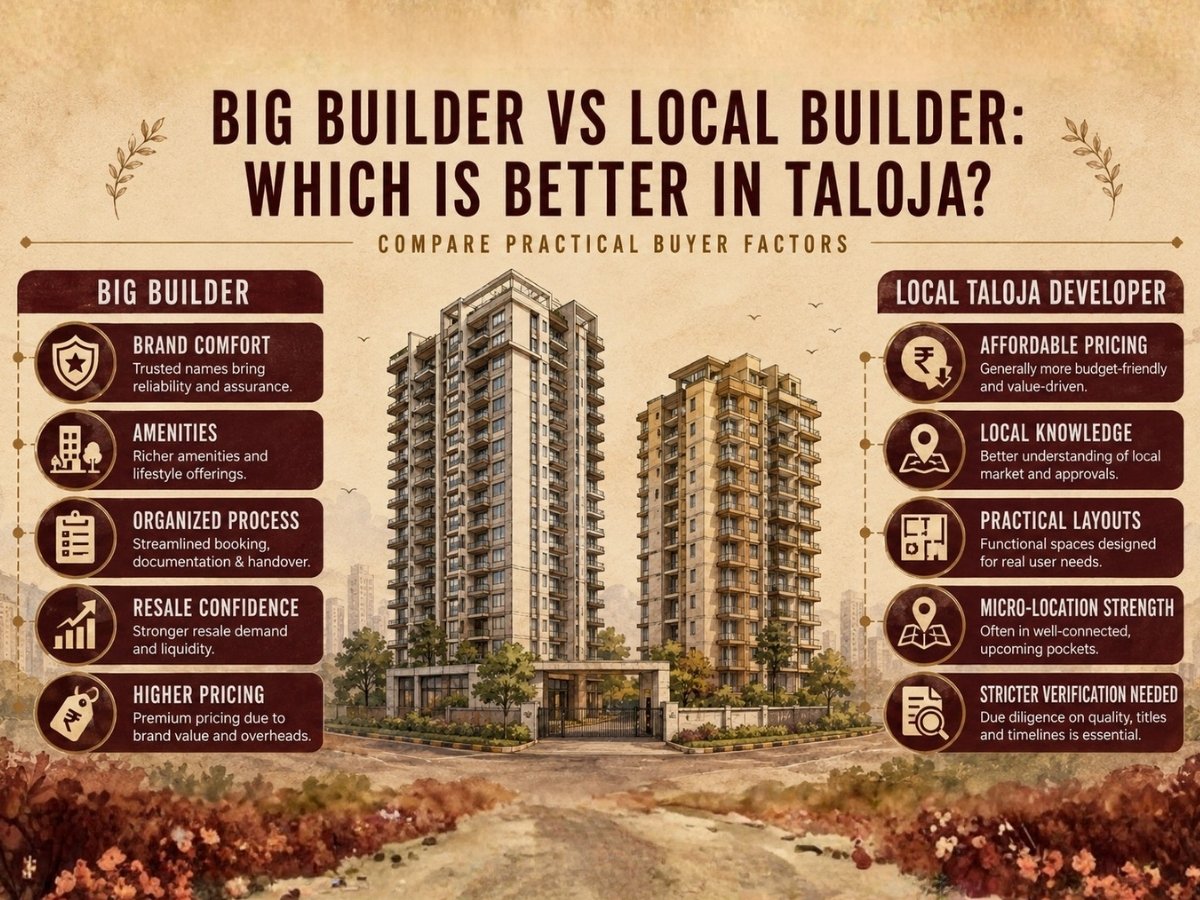
There is no single answer. A big builder is not always better, and a local builder is not always risky. The right choice depends on legal clarity, project location, delivery record, construction quality, pricing and your purpose of buying.
| Factor | Big Builder | Local Taloja Developer | What Buyer Should Do |
|---|---|---|---|
| Brand comfort | Higher recognition and stronger market confidence | May be lesser known outside local market | Do not choose only by name; verify documents |
| Pricing | Usually higher due to brand premium and amenities | Often more affordable | Compare final all-inclusive cost, not base price |
| Amenities | Larger clubhouses, security, landscaping and lifestyle facilities | Basic amenities, practical layouts | Pay for amenities only if you will actually use them |
| Legal systems | Usually more organized | Can vary widely | Check CIDCO title, MahaRERA and Agreement carefully in both cases |
| Execution risk | Generally lower, but not zero | Depends on funding and track record | Check past delivery and financial progress |
| Maintenance | Can be higher | Usually lower | Ask for written maintenance estimate |
| Location | Large parcels may be away from core convenience | Some local builders may have better metro-side plots | Check micro-location, not just builder name |
Advantages of Big Real Estate Developers
Big developers usually offer better organized sales processes, stronger funding access, larger amenities, better brand recall and more structured documentation. For end users who want township-style living, a big developer can be suitable.
But buyers should still check location, water planning, OC timeline, project-specific approvals and final price.
Advantages of Local Taloja Developers
A good local developer may offer practical flat layouts, lower pricing, better local land understanding and projects closer to daily-use roads or metro influence zones.
For first-time buyers with a strict budget, a well-vetted local builder can be a sensible choice. But legal and financial verification must be stricter.
When a Smaller Developer Can Be a Better Choice
A smaller developer may be a better choice when:
- Their completed projects are well maintained
- Residents give positive feedback
- Legal documents are clean
- The project has clear CIDCO approval
- Pricing is transparent
- Location is practical for daily commute
- There is no pattern of delay
When a Big Brand May Still Be Safer
A big brand may be safer when the buyer wants lower execution risk, better resale comfort, stronger amenities and higher confidence in project completion.
However, a big brand cannot solve every Taloja issue automatically. Water supply, MIDC-side air quality and micro-location must still be checked.
Check Location Fit Before Choosing the Developer
A good developer in a weak micro-location may still create a poor living experience. In Taloja, location fit is as important as builder quality.
Mature Nearby Nodes Like Kharghar, Kalamboli, Kamothe and Panvel
Taloja buyers often compare prices with nearby nodes such as Kharghar, Kalamboli, Kamothe and Panvel. Kharghar offers better maturity and social infrastructure but at a higher price. Panvel has stronger municipal maturity in many pockets but can face traffic and distance concerns. Kalamboli and Kamothe offer practical connectivity but vary by project and locality.
Taloja’s advantage is affordability, metro connectivity and growth potential. Its weakness is uneven infrastructure.
Growth Pockets Like Taloja Phase 1, Taloja Phase 2, Taloja MIDC, Roadpali and Pushpak Nagar
Taloja Phase 1, Phase 2, Ghot, Petali, Taloja MIDC-side areas, Roadpali and Pushpak Nagar should not be judged as one single market.
Phase 1 can offer better access in some pockets but may have stronger industrial influence depending on location. Phase 2 and Ghot-side areas may feel more residential in some parts, but water and infrastructure must be checked carefully. Pushpak Nagar has airport-led growth interest but still needs social infrastructure maturity.
Why Location Quality and Developer Quality Must Be Checked Together
A strong developer in a poor location can still be a bad decision. A local developer in a good location can also be risky if legal documents are weak.
Before choosing, check:
- Daily commute route
- Metro access
- Road condition
- Water supply reputation
- MIDC smell or pollution influence
- Nearby waste or industrial activity
- School, clinic and market access
- Street lighting and safety
- Resale demand
Visit the site in the morning, evening and late night if possible. Taloja’s livability can change by time of day, wind direction and traffic pattern.
Questions to Ask a Developer Before Paying Token Money
Token money should not be paid emotionally. Once token money is paid, many buyers feel locked in even if they later find a legal or pricing problem.
Ask these questions first and demand written proof.
| Question | Why It Matters | Proof to Ask For |
|---|---|---|
| Is the project registered on MahaRERA? | Confirms formal registration and timeline | MahaRERA certificate and project number |
| Can you share the approved plan, CC and legal documents? | Confirms approval and title clarity | CC, approved plan, title report |
| Is the quoted price fully all-inclusive? | Prevents hidden cost shock | Written cost sheet on letterhead |
| What is the written possession timeline? | Must match MahaRERA and agreement | Draft Agreement for Sale |
| What happens if possession is delayed? | Protects buyer rights | Delay clause in agreement |
| Is the OC already received or expected later? | Prevents illegal possession risk | OC copy or written OC timeline |
Is the Project Registered on MahaRERA?
Ask for the exact MahaRERA project number. Search it yourself. Do not accept only a brochure mention.
Can You Share the Approved Plan, CC and Legal Documents?
A serious buyer has the right to review documents before booking. A developer who refuses to share basic documents before token money should be treated carefully.
Is the Quoted Price Fully All-Inclusive?
Ask whether the price includes GST, stamp duty, registration, parking, PLC, floor rise, maintenance, corpus and CIDCO-related charges, if applicable.
What Is the Written Possession Timeline?
The possession date must be in writing and should match the MahaRERA timeline. If the sales team says “possession in 12 months” but MahaRERA shows a much later date, trust the official written record.
What Happens If Possession Is Delayed?
Ask how delay compensation is handled. Do not accept vague answers. The Agreement for Sale should clearly define rights and responsibilities.
Is the OC Already Received or Expected Later?
If the building is ready or near-ready, ask whether OC has been received. Do not accept “OC applied” as equal to “OC received.”
Red Flags When Choosing a Real Estate Developer in Taloja
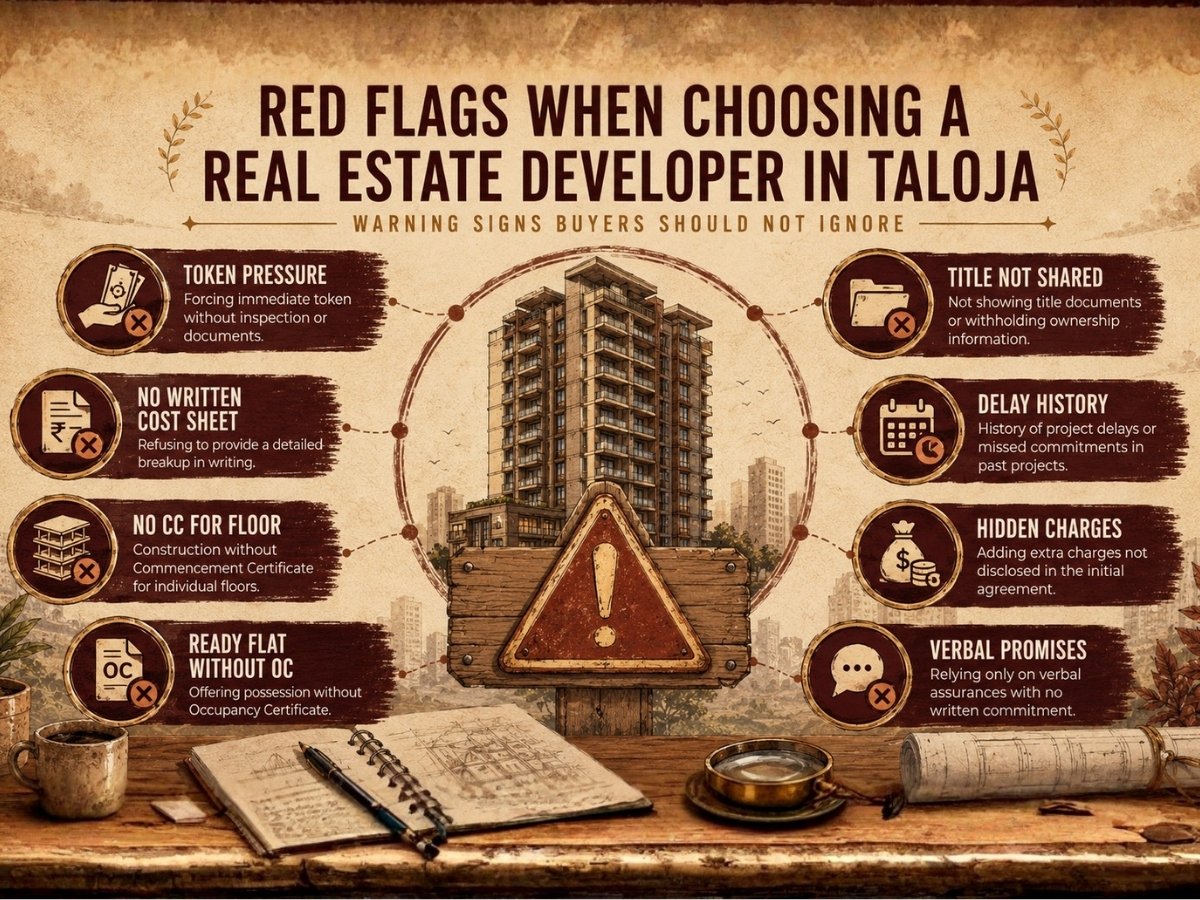
Some red flags should make buyers pause immediately. If two or more serious red flags appear, walking away may be wiser than trying to negotiate a small discount.
| Red Flag | What It May Mean | Buyer Action |
|---|---|---|
| Pressure to pay token money quickly | Sales team wants to block due diligence | Slow down or walk away |
| No written clarity on charges | Hidden cost risk | Demand official cost sheet |
| Delayed older projects | Poor execution history | Check MahaRERA pattern |
| Poor maintenance in completed buildings | Weak post-possession responsibility | Speak to residents before deciding |
| Weak legal transparency | Possible title or approval issue | Do not pay before lawyer review |
| Too many verbal promises | Future dispute risk | Ask for written confirmation |
| Fit-out possession without OC | Legal and civic service risk | Refuse possession without OC |
| Heavy tanker dependency in older projects | Poor utility planning | Factor long-term maintenance burden |
Pressure to Pay Token Money Quickly
Artificial urgency is a common tactic. A good project can wait for proper verification. A serious buyer should not be forced into a same-day decision.
No Written Clarity on Charges
If parking, maintenance, PLC or GST clarity is missing, do not pay token money. Most budget shocks happen after the buyer has already emotionally committed.
Delayed Older Projects
Check whether the developer’s previous projects faced long delays. A developer who repeatedly delays projects may repeat the same pattern.
Poor Maintenance in Completed Buildings
Poorly maintained completed buildings reveal weak after-sales culture. This affects resale, rental value and daily living.
Weak Legal Transparency
If the developer says documents will be shared only after token payment, treat it as a warning sign. Legal review should happen before financial commitment.
Too Many Verbal Promises
In real estate, verbal promises are almost useless during a dispute. Written clauses protect buyers. Casual assurances do not.
Real Estate Developer Shortlisting Scorecard
Use this scorecard to compare two or three developers before deciding.
| Factor | What to Check | Good Sign | Red Flag |
|---|---|---|---|
| Past Delivery Record | Completed projects and timelines | On-time or near on-time delivery | Repeated extensions |
| Legal Transparency | CC, title, agreement, CIDCO documents | Documents shared before token | Refusal or delay in sharing |
| Construction Quality | Older buildings, monsoon performance | No major seepage, good common areas | Leakage, poor lifts, cracks |
| Pricing Clarity | Full cost sheet | All-inclusive written pricing | Verbal discounts, hidden charges |
| Location Suitability | Connectivity, water, pollution, resale | Practical daily living | Weak access or industrial discomfort |
| After-Sales Support | Society formation, maintenance handover | Smooth handover | Builder control continues |
| Buyer Feedback Pattern | Resident and broker feedback | Consistent positive feedback | Repeated same complaints |
A project should not be selected only because it is the cheapest. It should be selected because the legal, financial, construction and location risks are acceptable.
Common Mistakes Buyers Make While Choosing Builders in Taloja
Trusting Only Brand Name
A big name gives comfort, but it does not remove the need to check approvals, OC, location and water planning. Even reputed developers must be judged project by project.
Ignoring Legal Document Verification
Many buyers assume bank loan approval means the project is fully safe. Bank approval is helpful, but buyers still need independent legal review, especially for CIDCO leasehold or PAP plot-related matters.
Booking Only Because of Discount or Offer
Large discounts can be genuine, but they can also be used to sell less desirable inventory. Check ventilation, view, floor, road access, noise, industrial influence and legal clarity before accepting any offer.
Not Visiting Completed Projects
This is one of the biggest mistakes. Completed projects show actual construction quality, not brochure quality.
Depending Fully on Broker or Sales Team Promises
Brokers and sales teams may help with information, but the final responsibility is the buyer’s. Verify documents, visit sites and take legal advice before payment.
How to Verify a Real Estate Developer Before Final Decision
Step 1: Check MahaRERA Details
Search the project and promoter on the MahaRERA website. Check possession timeline, litigation, extension history and uploaded documents.
Step 2: Visit the Project Site
Visit the actual site, not only the sales office. Check progress, surroundings, road access, water situation and general livability.
Step 3: Visit Completed Projects
Inspect at least one older completed project by the same developer. Speak to residents.
Step 4: Review Legal Documents with an Expert
Ask a qualified property lawyer to review title, CC, approved plan, Agreement for Sale, CIDCO documents and OC status.
Step 5: Compare Total Cost with Other Projects
Compare all-inclusive cost, not base price. Include taxes, stamp duty, registration, parking, floor rise, PLC, maintenance and other charges.
Step 6: Take Final Decision Only After Written Clarity
Pay token money only when price, timeline, documents, possession conditions and refund terms are clear in writing.
Final Checklist Before Choosing a Real Estate Developer in Taloja
Use this checklist before making payment:
[ ] MahaRERA registration number checked on the official portal [ ] Promoter name and project details verified [ ] MahaRERA possession timeline checked [ ] Litigation or extension history checked where available [ ] Commencement Certificate reviewed [ ] Approved building plan reviewed [ ] OC checked for ready-to-move property [ ] CIDCO leasehold or freehold status understood [ ] CIDCO allotment and transfer documents checked where applicable [ ] PAP or 12.5% plot documents verified, if relevant [ ] Title Clearance Certificate reviewed by a lawyer [ ] Agreement for Sale reviewed before signing [ ] Written all-inclusive cost sheet received [ ] Parking allocation written clearly [ ] GST, stamp duty and registration costs calculated [ ] Completed project visited [ ] Existing residents or buyers spoken to [ ] Site progress physically checked [ ] Water supply and tanker dependency checked [ ] MIDC-side pollution or odor impact checked through physical visits [ ] No verbal promises accepted without written proof [ ] Final payment linked to legal possession and OC clarity
Conclusion
Choosing the right real estate developer in Taloja requires a balanced view. Taloja has real advantages: affordable pricing, metro connectivity, airport-linked growth expectations and strong demand from first-time buyers. But it also has real risks: water stress, MIDC influence, legal complexity around CIDCO-origin plots, under-construction project delays and hidden cost structures.
The best developer for a Taloja buyer is not automatically the biggest name or the lowest price. The right developer is the one with a clean delivery record, transparent legal documents, clear pricing, OC-based possession, strong construction quality, practical water planning and positive feedback from actual residents.
Before paying token money, verify everything in writing. A little extra due diligence before booking can save years of stress after possession.
FAQs
How do I choose the right real estate developer in Taloja?
Choose the right real estate developer in Taloja by checking MahaRERA details, completed projects, legal documents, construction quality, pricing clarity, water planning and buyer feedback before paying token money.
In Taloja, buyers should be more careful because the area has a mix of good growth potential and real infrastructure challenges. A reliable developer should have clear CIDCO-related documents, a good delivery record, proper CC and OC clarity, transparent cost sheets and completed buildings that are still well maintained.
What documents should I check before booking a flat in Taloja?
Before booking a flat in Taloja, check the MahaRERA registration certificate, Commencement Certificate, approved building plan, Title Clearance Certificate, draft Agreement for Sale, CIDCO allotment or transfer documents and OC status where applicable.
If the land is connected to a PAP or 12.5% scheme plot, buyers should get the document chain reviewed by an independent real estate lawyer. Do not depend only on verbal approval claims from the sales team.
Is MahaRERA registration enough to trust a builder?
No, MahaRERA registration is important but not enough to fully trust a builder. It confirms regulatory registration, but it does not guarantee construction quality, timely possession, strong water planning or clean after-sales support.
Buyers should use MahaRERA as the first checkpoint, then verify completed projects, legal documents, site progress, pricing clarity and resident feedback.
Should I visit completed projects before booking?
Yes, buyers should always visit completed projects before booking. A five-to-ten-year-old building developed by the same builder reveals the true quality of construction and maintenance.
In Taloja, this is especially useful for checking monsoon leakage, lift quality, water supply, tanker dependency, society formation and overall resident satisfaction.
Is a big builder always better than a local builder?
No, a big builder is not always better than a local builder. Big developers may offer better brand comfort, amenities and lower execution risk, but they may also charge higher prices and maintenance.
A local Taloja developer can be a good choice if their legal documents are clean, completed projects are well maintained, pricing is transparent and residents give positive feedback.
What are the red flags in a real estate developer?
Major red flags include pressure to pay token money quickly, refusal to share legal documents, unclear pricing, repeated project delays, poor maintenance in completed buildings, verbal promises, fit-out possession without OC and heavy tanker dependency in older projects.
If a developer shows two or more serious red flags, buyers should pause and verify everything before moving ahead.
What should I ask before paying token money?
Before paying token money, ask whether the project is MahaRERA registered, whether the developer can share the approved plan and CC, whether the quoted price is fully all-inclusive, what the written possession timeline is, what happens if possession is delayed and whether OC will be received before possession.
All answers should be supported by written documents, not only verbal promises.
Which Taloja areas need extra legal checking before buying property?
Properties on CIDCO leasehold land, PAP or 12.5% scheme plots and areas with jurisdictional overlap between CIDCO and PMC-related responsibilities need extra legal checking.
Buyers should also be careful in under-construction projects where the developer has not clearly explained land title, transfer charges, authority approvals or OC timeline.
How important is Occupancy Certificate before possession?
Occupancy Certificate is extremely important before possession. Without OC, the building may not be legally fit for occupation, and buyers may face problems with civic services, resale, insurance and legal protection.
Do not treat “OC applied” as equal to “OC received.” For ready or nearing-possession flats, ask for the OC copy before making final payment or taking possession.
Can a local Taloja developer be safer than a big brand?
Yes, a local Taloja developer can be safer than a big brand if they have clean legal documents, strong delivery history, good construction quality, transparent pricing and positive feedback from past buyers.
The buyer should not judge only by brand size. In Taloja, project-specific legal clarity, location quality, water planning and actual resident experience matter more than marketing reputation alone.