
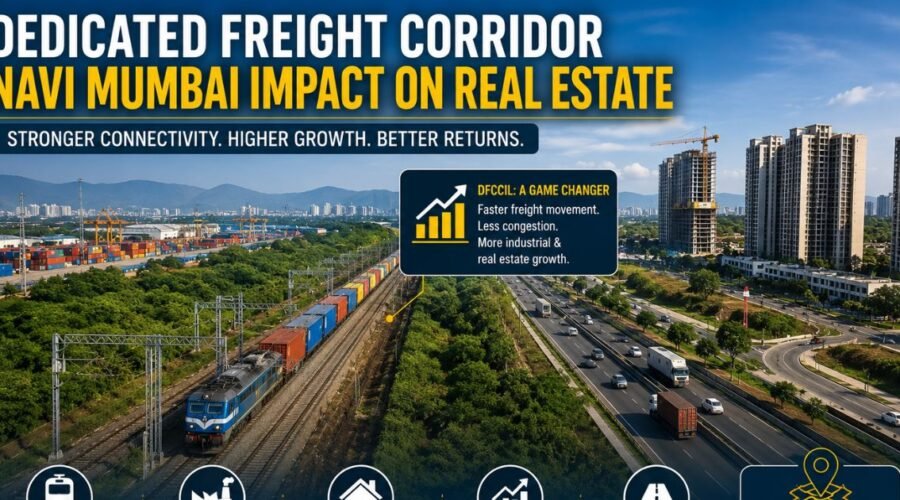
Dedicated Freight Corridor Navi Mumbai Impact on Real Estate
The Dedicated Freight Corridor Navi Mumbai impact will be strongest in logistics, warehousing, port-linked jobs, industrial land demand, and rental demand around JNPA, Uran, Dronagiri, Ulwe, Pushpak-Chirle, Panvel, and Taloja. But it does not make every nearby plot or flat a safe investment. Buyers must verify title, zoning, NA or development permission, road access, MahaRERA, CIDCO/NAINA status, and CRZ risk before paying token money.
What the Dedicated Freight Corridor Means for Navi Mumbai
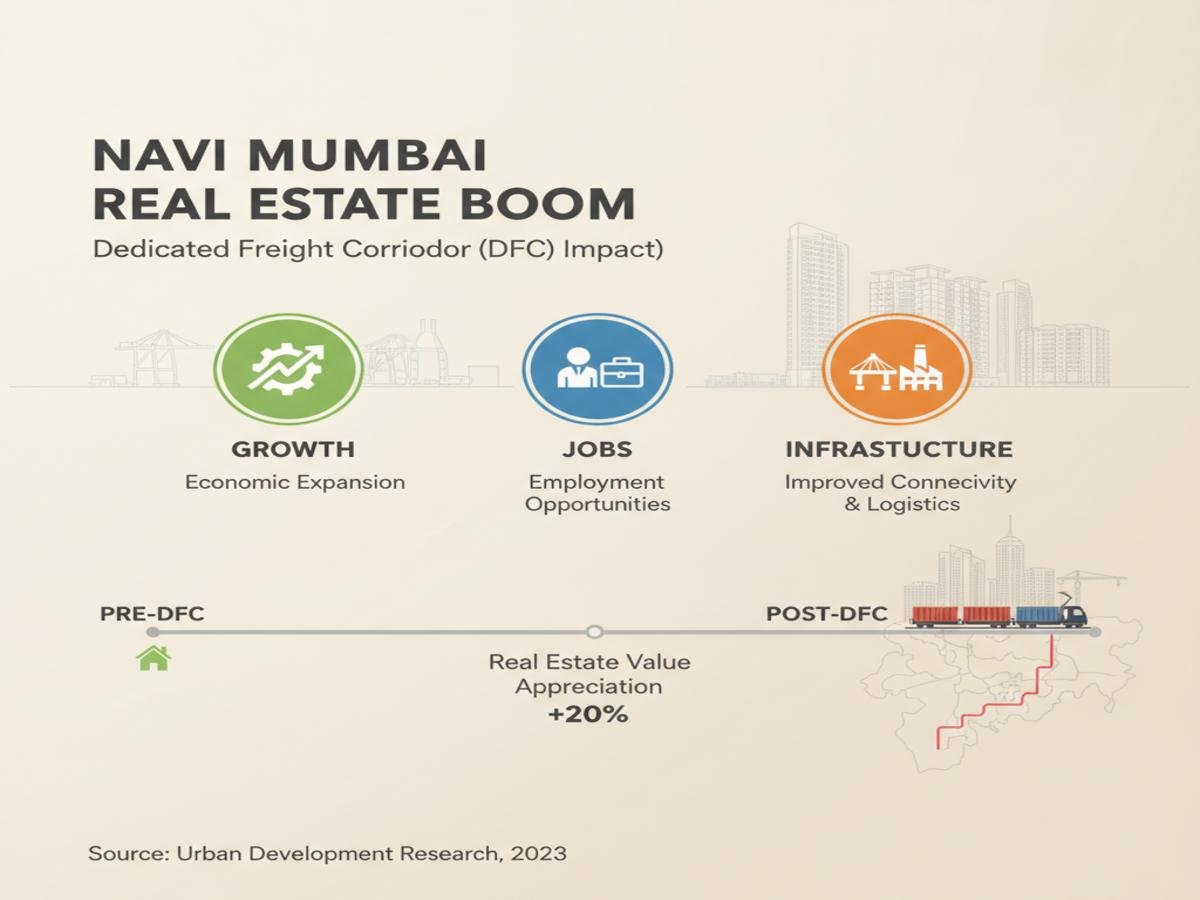
The Dedicated Freight Corridor, or DFC, is not a passenger metro line. It is a freight railway corridor built mainly for goods movement.
For Navi Mumbai, the important point is simple: the Western Dedicated Freight Corridor connects the north and western freight network with the JNPA/JNPT port side of Navi Mumbai. This improves the logistics value of the region.
That means the impact will not be limited to railway tracks. It can influence:
- Container movement
- Port-linked logistics
- Warehousing
- Industrial activity
- Trucking and transport businesses
- Rental housing for workers and managers
- Demand for commercial support services
This is why buyers are now hearing more about the Dedicated Freight Corridor impact in areas like Uran, Dronagiri, Ulwe, Pushpak Nagar, Chirle, Panvel, Taloja, and the larger NAINA belt.
But there is one important warning.
Infrastructure growth is not the same as legal clearance.
A property may be close to the DFC, port, airport, or logistics park. Still, it can have title issues, zoning restrictions, CRZ limitations, unclear road access, or missing permissions.
This is an educational guide. Verify the latest position with the relevant authority or a property lawyer before making a transaction.
For a broader understanding of job-led property growth, also read Navi Mumbai employment hubs real estate impact.
Why JNPA Makes This Corridor Important
JNPA, also known as JNPT, is one of India’s most important container ports. Its location near Uran and Navi Mumbai gives the Western Dedicated Freight Corridor a strong local real estate connection.
The DFC helps freight move more efficiently between the port and inland industrial markets. When port connectivity improves, the surrounding ecosystem usually becomes more active.
This can create demand for:
| Demand Type | How It May Grow |
|---|---|
| Logistics jobs | Warehouse staff, drivers, supervisors, operations teams |
| Industrial land | Warehousing, packaging, storage, light industrial use |
| Rental housing | Workers and mid-level professionals need nearby homes |
| Commercial spaces | Food outlets, repair shops, offices, transport services |
| Residential projects | Demand may rise in practical commuting zones |
This is why the DFC should be seen with other major Navi Mumbai infrastructure projects like NMIA, Atal Setu, JNPA expansion, Pushpak Node, CIDCO’s logistics plans, and the Panvel-Ulwe-Uran growth belt.
For related reading, connect this section with Navi Mumbai logistics hub real estate impact and JNPT real estate impact.
Area-Wise Dedicated Freight Corridor Navi Mumbai Impact
The DFC impact will not be equal everywhere. Some areas may benefit directly from logistics and industrial demand. Some may benefit indirectly through rental and residential demand.
| Area | Likely Impact | Buyer Caution |
|---|---|---|
| JNPA / Uran | Port-linked logistics, transport, warehousing, worker housing | Check CRZ, access road, title, authority permissions |
| Dronagiri | Residential demand from port, logistics, and future connectivity | Verify CIDCO leasehold, project completion, OC, and resale liquidity |
| Ulwe | Housing demand from airport, JNPA, Atal Setu, and logistics workers | Avoid overpaying only because of future claims |
| Pushpak / Chirle | Logistics park, airport-support economy, commercial activity | Verify CIDCO allotment, land-use, and approvals |
| Panvel | Wider housing base for workers, professionals, and investors | Check whether land falls under PMC, CIDCO, NAINA, or revenue jurisdiction |
| Taloja | MIDC, warehousing, industrial employment, affordable rentals | Consider pollution, commute, road condition, and MIDC proximity |
| NAINA villages | Long-term plotted development potential | Check zoning, TPS status, 7/12, 8A, mutation, road access, and CRZ risk where relevant |
The safest approach is not to ask, “Is this near DFC?”
The better question is:
Is this property legally usable, accessible, financeable, and suitable for the buyer’s purpose?
Impact by Property Type
Flats and Residential Projects
Flats may benefit from DFC-linked employment growth, but mostly in areas where people can actually live and commute comfortably.
For example, a logistics manager working around JNPA, Uran, Dronagiri, or Pushpak may prefer Ulwe, Dronagiri, Panvel, or Kharghar depending on budget and family needs.
A warehouse worker may prefer affordable rental pockets near Taloja, Panvel, Kalamboli, or nearby transport routes.
So rental demand can improve, but it depends on:
- Commute time
- Rent level
- Safety
- Road access
- Schools and daily markets
- Railway, bus, and highway connectivity
For residential comparisons, use employment impact on rental demand Navi Mumbai as a next supporting article.
Plots and Land
Plots carry the highest risk.
A broker may say, “DFC ke paas land hai, future logistics zone hai.” That statement alone means nothing unless documents support it.
For plots, the buyer must verify:
- 7/12 extract
- 8A extract
- Mutation entries
- Survey number and hissa number
- Title chain
- Index II
- Zoning certificate
- NA or development permission
- NAINA/CIDCO status
- Road access
- CRZ or mangrove restrictions where relevant
A 7/12 extract supports land-record verification, but it does not alone give complete ownership certainty. A lawyer must check the full title chain and registered documents.
Warehousing and Industrial Property
DFC has the most direct impact on logistics, warehousing, and industrial real estate.
But here also, location is not enough.
Before buying or leasing a warehouse, gala, shed, or industrial plot, check:
- Permitted land use
- Road width and truck access
- Fire access
- MIDC/CIDCO/NAINA permissions
- Power and water availability
- Environmental restrictions if applicable
- Leasehold conditions, if CIDCO or MIDC property
- Transfer permission requirements
For industrial-area decision-making, internally link to MIDC proximity pros and cons.
Retail and Commercial Property
Commercial property may benefit where workers, transporters, drivers, warehouse teams, and office staff create daily demand.
This may help:
- Food outlets
- Repair shops
- Logistics offices
- Packaging suppliers
- Labour contractor offices
- Small retail stores
- Vehicle service-related businesses
But commercial demand follows actual activity. It does not automatically rise because a corridor passes nearby.
Documents to Check Before Buying Near DFC-Influenced Areas
For Flats
Check these before paying token money:
| Document | Why It Matters |
|---|---|
| MahaRERA registration | Confirms project registration and basic public details |
| Commencement Certificate | Shows construction permission stage |
| Approved building plan | Helps verify what is officially approved |
| Agreement for Sale | Main buyer-builder contract |
| Occupancy Certificate | Important for legal occupation and resale confidence |
| Title report | Gives legal background of the project land |
| CIDCO lease documents | Important in CIDCO leasehold areas |
| Society registration and conveyance | Important for resale flats |
| Property tax and maintenance dues | Avoids inherited financial disputes |
MahaRERA should be checked for project status, promoter details, complaints, lapsed projects, revoked projects, and registered agent details.
For Land and Plots
For land, due diligence must be stricter.
| Document / Check | Plain English Meaning |
|---|---|
| 7/12 extract | Basic rural land record showing land details and holder name |
| 8A extract | Account-wise landholding record |
| Mutation entry | Record of changes like sale, inheritance, partition, or transfer |
| Index II | Summary of registered transaction from registration records |
| Title chain | Previous ownership history |
| Zoning certificate | Shows permitted use under planning authority |
| NA / development permission | Permission for non-agricultural or development use, where applicable |
| Road access proof | Confirms legal and physical approach road |
| CRZ/CZMP check | Needed near coastal, creek, mangrove, Uran, Dronagiri, and Raigad belts |
| Lawyer search report | Independent legal review before payment |
For foundational learning, link to 7/12 extract property verification Navi Mumbai and title search for property in Navi Mumbai.
How to Verify a DFC Property Claim

When someone says a property will benefit from DFC, ask for proof in three levels.
1. Location Proof
Ask for:
- Exact village name
- Survey number
- Gut number
- Hissa number
- Plot number, if applicable
- Google location only as supporting reference, not legal proof
2. Authority Proof
Check which authority controls the property:
- CIDCO
- NAINA
- PMC
- NMMC
- MIDC
- Revenue department
- Gram panchayat
- MCZMA, if coastal/CRZ-sensitive
A property near Panvel may fall under different rules depending on its exact village and planning status. This is common in NAINA and Raigad-side locations.
3. Permission Proof
Ask whether the property has:
- Residential permission
- Commercial permission
- Industrial permission
- Warehousing permission
- NA or development permission
- Approved layout
- Building permission
- RERA registration, if it is a real estate project
“Near DFC” is a marketing claim. It is not a legal permission.
Red Flags in DFC-Based Property Deals
Be careful if you hear these lines:
- “Token now, documents later.”
- “DFC touch property hai.”
- “Future logistics zone confirmed.”
- “NA plot hai, proof baad mein denge.”
- “RERA approved hai, but number abhi nahi hai.”
- “CIDCO/NAINA approved hai, but paper pending hai.”
- “Road aa jayega.”
- “CRZ issue nahi hai, tension mat lo.”
- “Builder bada hai, document check ki zarurat nahi.”
- “Investor inventory hai, fast decision lena padega.”
The biggest red flag is pressure.
A genuine seller or developer should not fear document verification.
Common Mistakes Buyers Make
Mistake 1: Treating DFC Like a Passenger Line
DFC is for freight. It will not work like Navi Mumbai Metro or local railway.
Its impact is mostly through logistics, jobs, industrial activity, and port connectivity.
Mistake 2: Buying Only Because of Future Infrastructure
Infrastructure can improve demand. But if land title is weak, zoning is wrong, or access road is missing, the investment can get stuck.
Mistake 3: Ignoring NAINA and CIDCO Rules
Many buyers do not check whether the land is in CIDCO, NAINA, PMC, or revenue jurisdiction. This creates confusion during permission, resale, development, and loan approval.
Mistake 4: Depending Only on 7/12
A 7/12 extract is important, but it is not a full legal title certificate. It must be read with mutation entries, registered deeds, Index II, and lawyer verification.
Mistake 5: Not Checking CRZ
In Uran, Dronagiri, Raigad-side villages, creek-side areas, and mangrove-sensitive locations, CRZ/CZMP checks are important. Do not rely only on verbal assurance.
Mistake 6: Assuming NA Rules Are Simple
Maharashtra has updated land conversion rules, including changes around separate NA permission in certain planning-permission cases. But buyers should not assume every agricultural land parcel is automatically safe for residential or commercial use.
Verify the latest position with the planning authority, revenue office, and property lawyer before transaction.
Navi Mumbai Example: Pushpak-Chirle Plot Near Logistics Growth
Suppose a broker shows a plot near Pushpak or Chirle and says:
“DFC, airport, logistics park, JNPT sab yahi aa raha hai. Rate double hoga.”
Before paying token, ask:
1. What is the exact survey number? 2. Is the seller’s name reflected in 7/12 and mutation records? 3. Is the plot inside CIDCO, NAINA, revenue village, or acquisition-affected land? 4. Is there official road access? 5. Is the land agricultural, residential, commercial, industrial, or reserved? 6. Is there NAINA ZCS or development permission? 7. Is there any CRZ, mangrove, green zone, or no-development zone issue? 8. Is the sale deed chain clear? 9. Is Index II available for earlier transactions? 10. Has a lawyer checked the title before token?
If the seller avoids these questions, do not rush.
What to Check Before Paying Token Money
Use this checklist before paying even a small token amount.
| Check | Status |
|---|---|
| Exact survey / plot number received | Pending / Done |
| 7/12 or property card checked | Pending / Done |
| 8A extract checked | Pending / Done |
| Mutation entries checked | Pending / Done |
| Registered deed and Index II checked | Pending / Done |
| Seller identity verified | Pending / Done |
| Authority jurisdiction confirmed | Pending / Done |
| Zoning checked | Pending / Done |
| NA / development permission checked | Pending / Done |
| Road access verified physically and legally | Pending / Done |
| CRZ/CZMP checked if applicable | Pending / Done |
| MahaRERA checked for project property | Pending / Done |
| Lawyer verification completed | Pending / Done |
| Token terms written clearly | Pending / Done |
Never pay token only on infrastructure promise. Pay only after document confidence.
FAQs
Frequently Asked Questions