

Risks of Buying Property with Litigation in Navi Mumbai
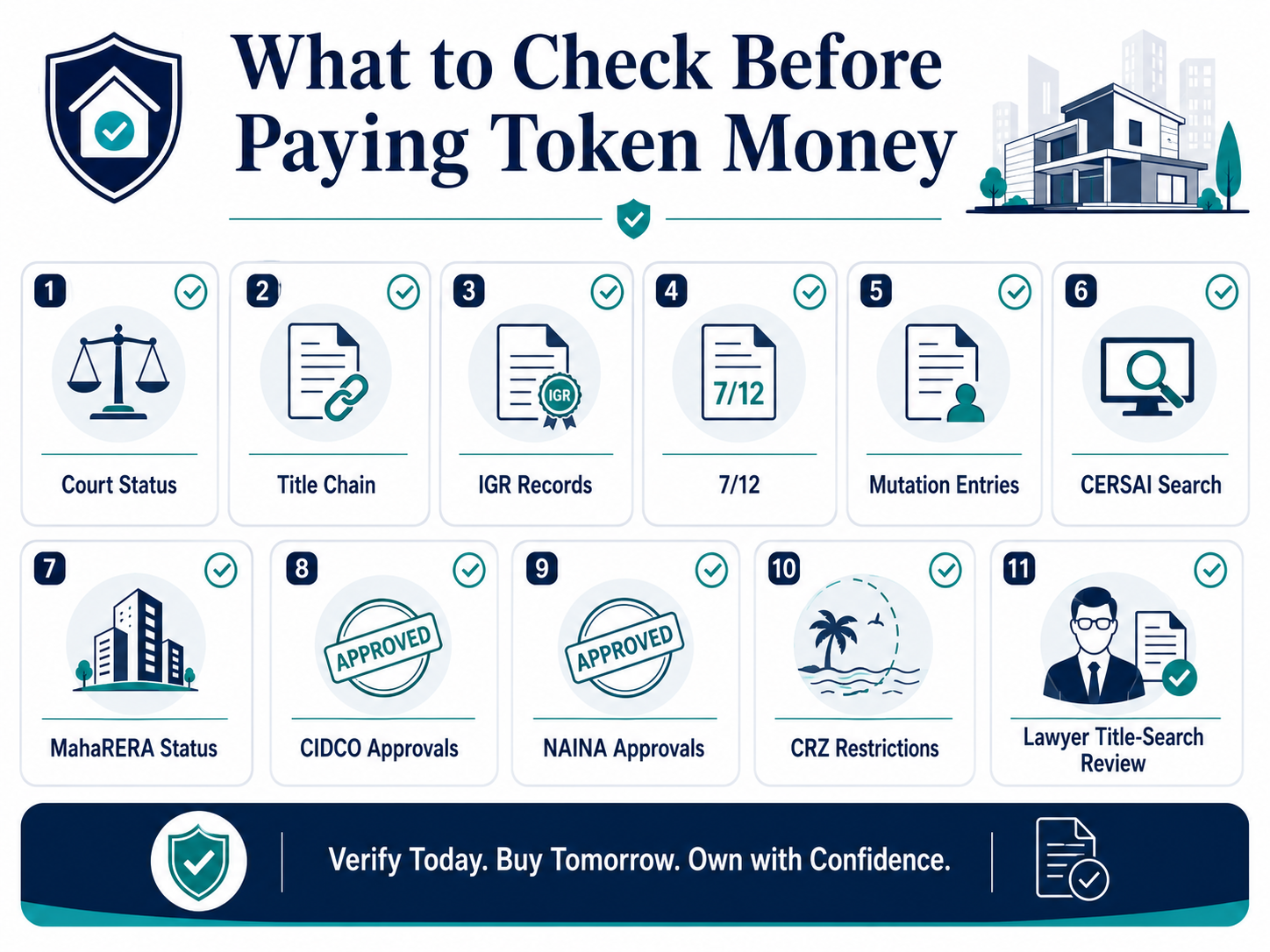
Buying property with litigation is risky. Do not pay token money until you verify the court case, title chain, IGR records, 7/12 or property card, mutation entries, RERA status, CIDCO/NAINA approvals, CRZ restrictions, loan/mortgage records, and a lawyer’s title-search report. Some minor disputes may be manageable, but ownership disputes, stay orders, fraud claims, and approval issues are serious red flags.
This is an educational guide. Verify the latest position with the relevant authority or a property lawyer before making a transaction.
What Does Property with Litigation Mean?
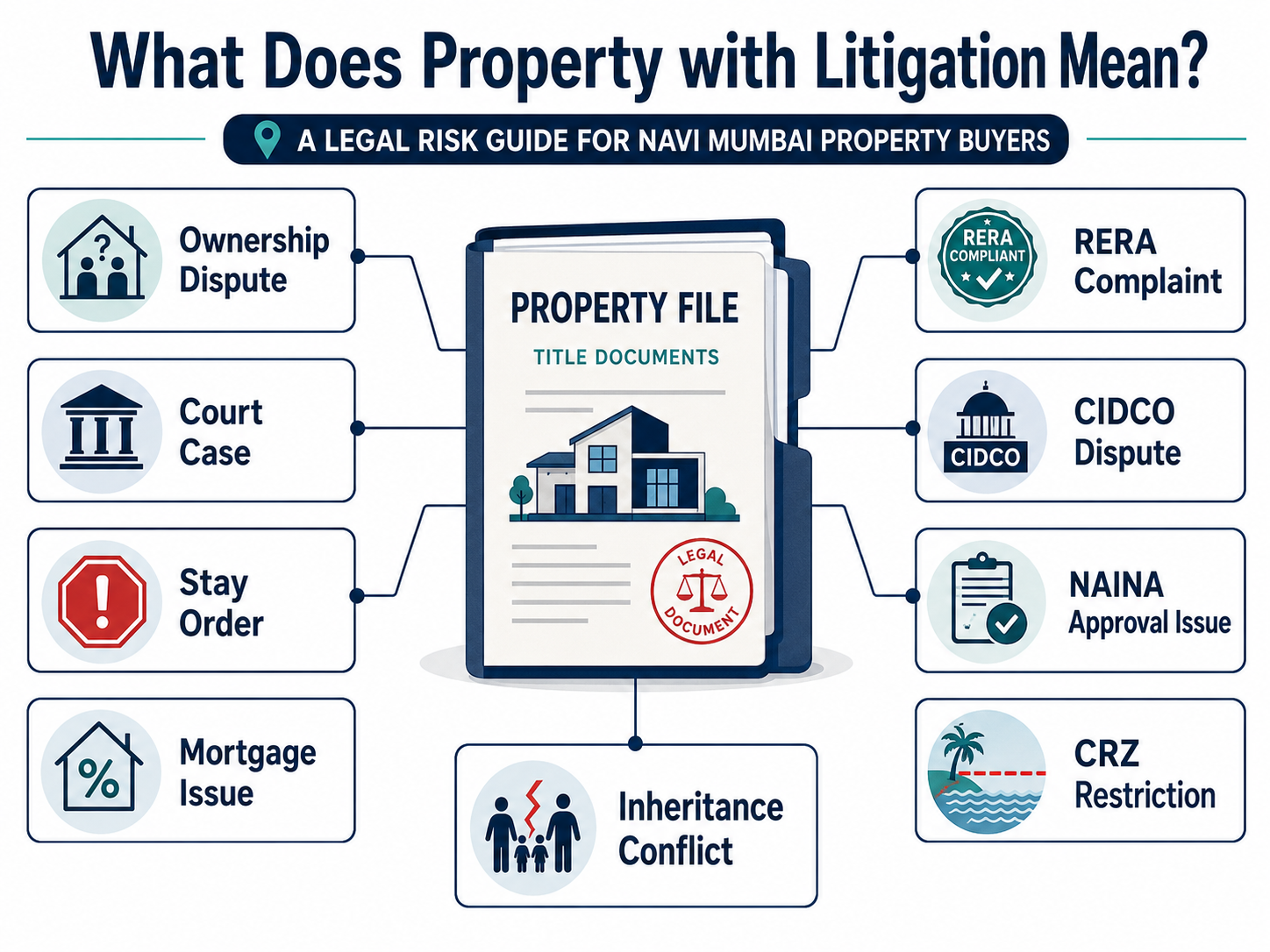
A property with litigation means there is some legal dispute, court case, revenue case, ownership claim, RERA complaint, bank recovery issue, or government-authority objection connected to the property.
It may involve:
- Ownership dispute between family members
- Pending civil suit
- Stay order or injunction
- Boundary or encroachment dispute
- Mutation dispute
- Unpaid loan or mortgage issue
- RERA complaint against builder
- CIDCO transfer or allotment dispute
- NAINA zoning or approval issue
- CRZ, mangrove, green zone, or no-development-zone restriction
In simple words, the seller may have a document, but the property may still not be clean enough for safe purchase.
A sale deed, tax bill, or broker assurance alone does not remove litigation risk.
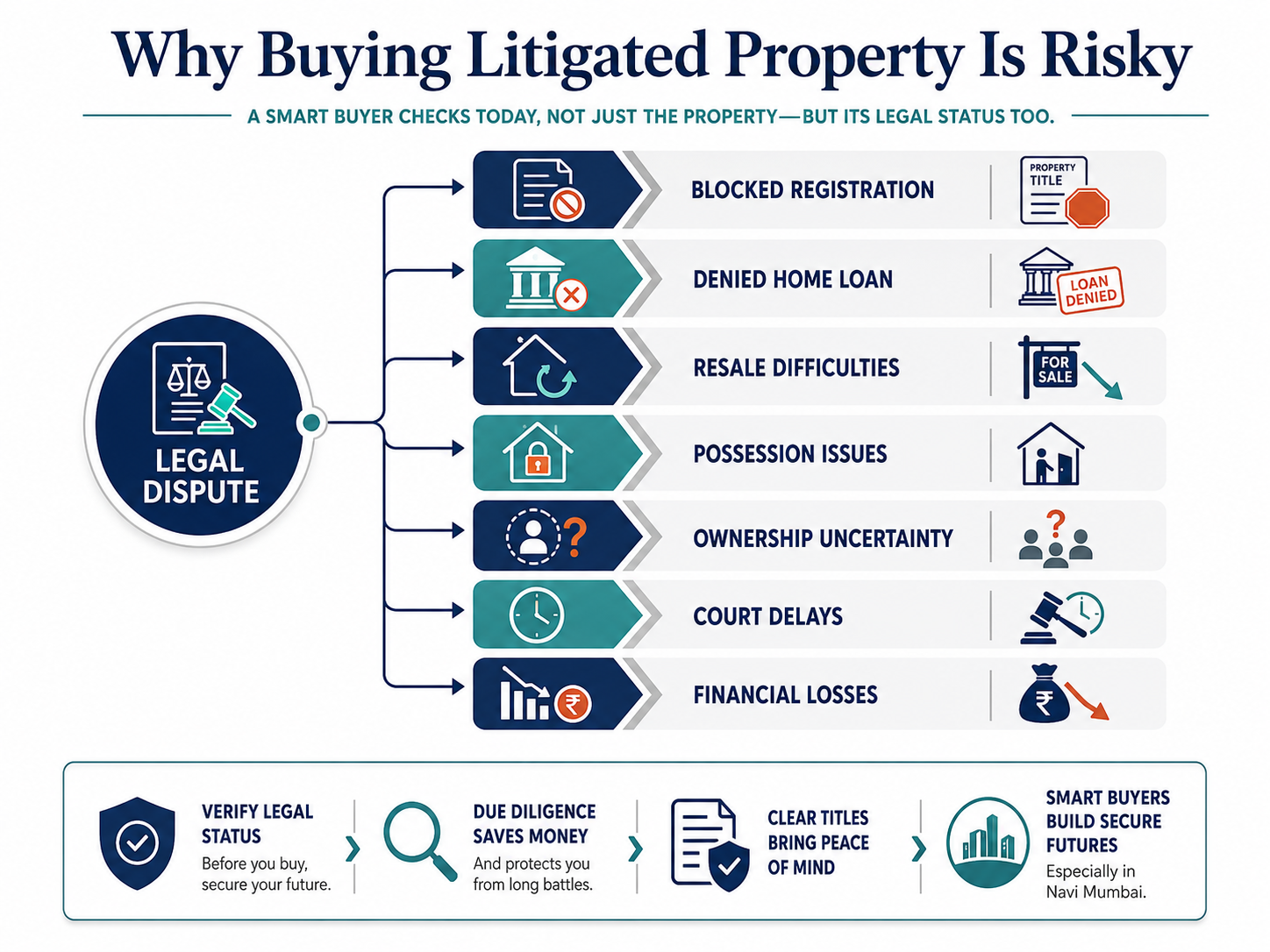
Why Buying Litigated Property Is Risky
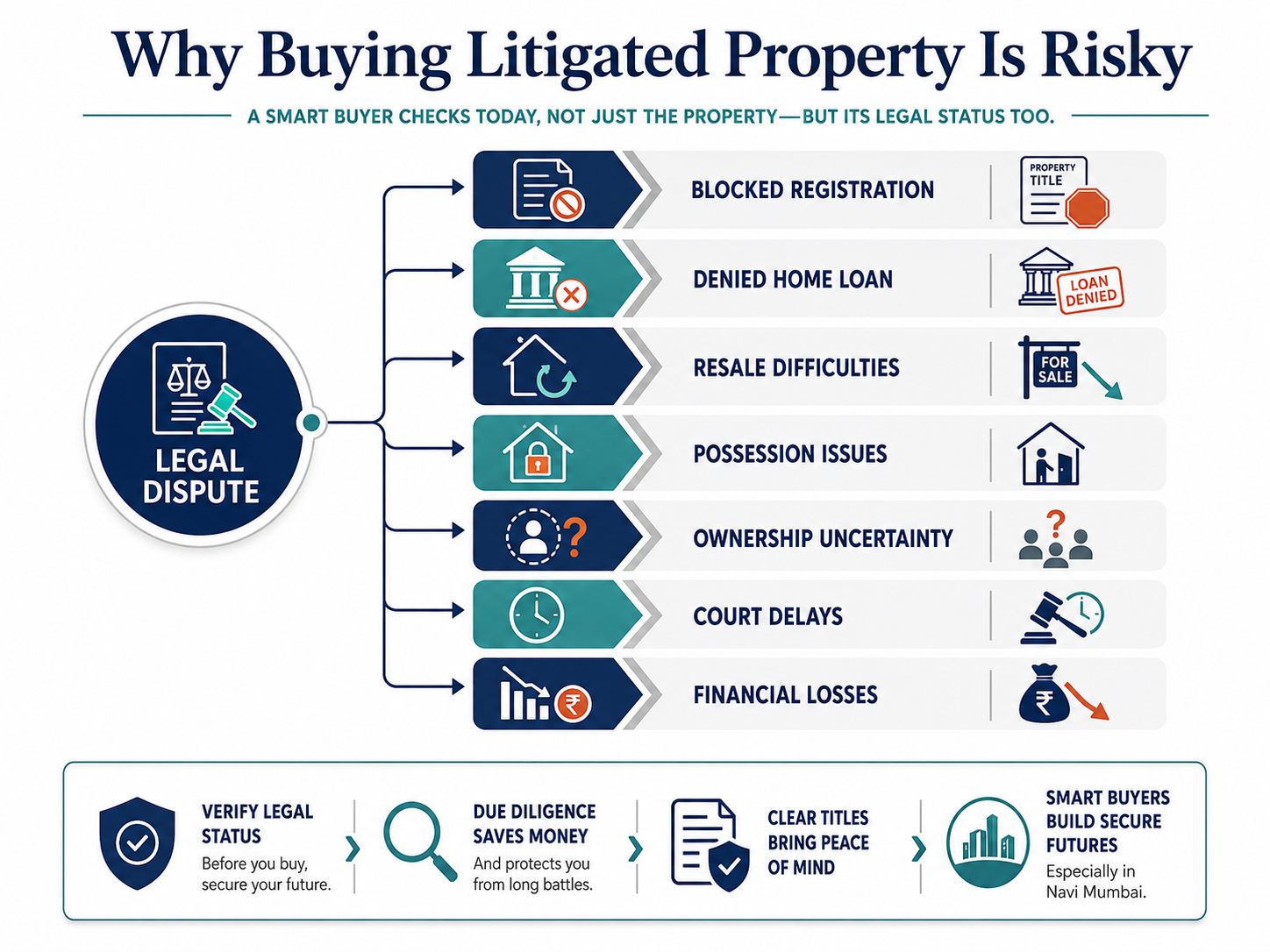
The biggest risk is not only losing money.
The bigger risk is getting stuck.
You may pay token money, sign an agreement, apply for a loan, or take possession and later discover that the seller’s right to sell was disputed.
For buyers in Navi Mumbai, Panvel, Ulwe, Kharghar, Taloja, Dronagiri, Uran, Raigad, Thane, CIDCO and NAINA areas, litigation risk can come from both legal and land-record issues.
| Risk | What it can affect |
|---|---|
| Title dispute | Ownership and resale |
| Stay order or injunction | Registration, construction, possession |
| Mutation dispute | Revenue record and transfer clarity |
| Loan or mortgage issue | Bank approval and future claims |
| CIDCO transfer issue | Leasehold transfer and permissions |
| NAINA zoning issue | Development potential |
| CRZ or mangrove issue | Construction permission |
| RERA complaint | Project delay, builder compliance, possession |
A cheap property with litigation can become expensive if the case blocks resale, loan approval, registration, or possession.
When Litigation May Be Manageable
Not every dispute means the property is impossible to buy.
Some issues may be manageable if they are minor, fully disclosed, documented, and cleared by a property lawyer.
Examples:
- Old society dues dispute already settled
- Minor boundary clarification with no stay order
- RERA complaint unrelated to title or possession
- Mutation delay where the registered title chain is otherwise clear
- Old objection closed by final written order
But do not decide this yourself.
Ask for the latest order, case papers, settlement documents, and lawyer’s written opinion.
When You Should Pause or Walk Away
You should pause immediately if the property has:
- Ownership dispute
- Pending title suit
- Stay order
- Injunction
- Attachment order
- Multiple heirs claiming rights
- Forged document allegation
- Power of attorney dispute
- CIDCO allotment or transfer dispute
- NAINA approval mismatch
- CRZ or mangrove restriction
- Government land or reservation issue
- Builder refusing to share RERA, CC, OC, or title documents
If the seller says, “case is only formal,” ask for proof.
If the broker says, “pay token first, documents later,” treat it as a warning sign.
Documents to Check Before Buying
The documents depend on the property type.
For Resale Flats in Navi Mumbai
Check:
- Registered sale deed chain
- Agreement for sale
- Index II
- Society share certificate
- Society NOC, if applicable
- Maintenance dues statement
- Property tax record
- Occupancy Certificate
- Building Completion Certificate
- Existing loan closure letter or bank NOC
- IGR Maharashtra eSearch record
- Court case search by owner, seller, builder, and society name
Property tax record is useful, but it should not be treated as ownership proof by itself.
For NAINA Plots and Land
Check:
- 7/12 extract
- 8A extract
- Mutation entries
- Survey number and village name
- Property card, if applicable
- Zone Confirmation Statement
- NAINA Development Plan status
- Town Planning Scheme status
- Development permission
- Commencement Certificate
- Occupancy Certificate, if construction exists
- IGR registration chain
- Court case status
- CERSAI mortgage/security-interest search
7/12 is called Satbara in Marathi. It records land details, occupant names, crop or land-use entries, and other revenue information. It supports verification, but buyers should not treat it as final ownership proof without title-chain review.
Mutation is called Ferfar in Marathi. It records changes in revenue records after sale, inheritance, partition, or other transfer. A mutation entry supports record updating, but it does not automatically cure a defective title.
For CIDCO Properties

Check:
- CIDCO allotment letter
- Lease deed
- Transfer permission
- Possession letter
- CIDCO NOC, if applicable
- Payment receipts
- Tripartite documents, if applicable
- Building permission
- OC
- Any CIDCO 12.5% or scheme-related documents
- Seller’s legal authority to transfer
CIDCO leasehold property has its own transfer and approval conditions. Do not rely only on seller-side documents.
For Gaothan Property
Check:
- Gaothan status
- Sanad, if applicable
- Property card or village records
- 7/12 and mutation entries, if applicable
- Heirship documents
- Construction permission
- Road access
- Encroachment risk
- Local authority confirmation
Gaothan properties can have older records, family claims, informal construction history, and unclear documentation. Use a local property lawyer before payment.
For CRZ, Creekside or Mangrove-Affected Property
Check:
- CZMP map
- MCZMA status
- Development permission conditions
- Distance from creek, mangroves, wetlands, and high tide line
- Environmental restrictions
- Whether construction is allowed
This is important in parts of Navi Mumbai, Panvel, Uran, Dronagiri, Kharghar, and coastal or creek-facing belts.
How to Verify Litigation Status
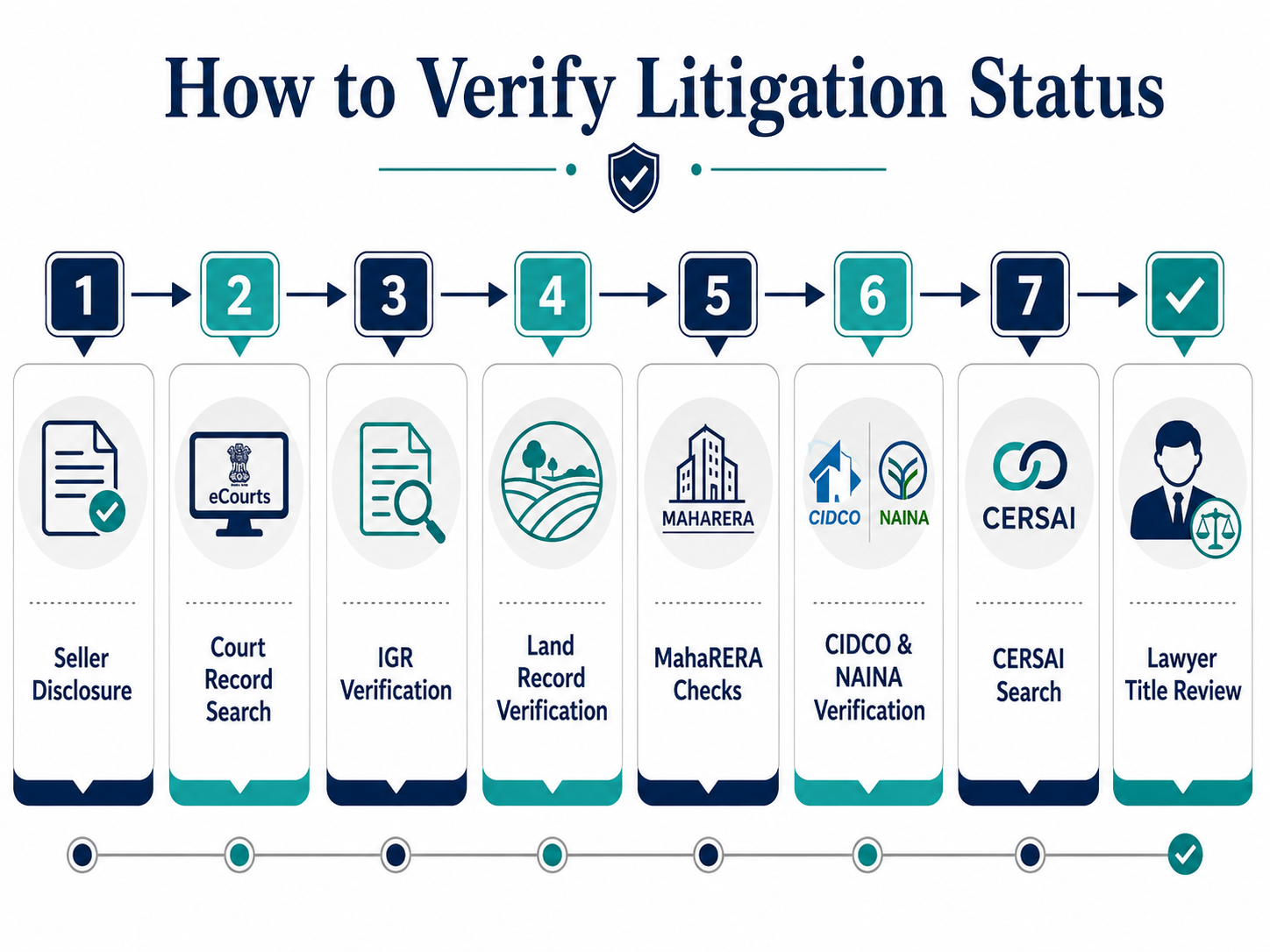
Use a step-by-step approach.
1. Ask for Written Disclosure
Ask the seller or builder for:
- Case number
- Court name
- Names of parties
- Latest order
- Copy of plaint or application
- Written statement or reply
- Stay or injunction order, if any
- Settlement documents, if they claim the case is settled
No document means no payment.
2. Search Court Records
Search the case on eCourts using:
- CNR number
- Case number
- Party name
- Advocate name
- Court name
Also search by seller name, builder name, project name, society name, and landowner name.
If the case is in the Bombay High Court or another forum, ask a lawyer to verify the latest status.
3. Check IGR Maharashtra eSearch
Use IGR eSearch to check registered transaction history.
Compare:
- Seller name
- Property description
- Document number
- Index II
- Survey number
- Flat number
- Building name
- Village name
- Registration dates
Check IGR close to the transaction date, not only once at the beginning.
4. Check Land Records
For land, plot, gaothan, NAINA, or village property, check:
- 7/12
- 8A
- Mutation
- Property card
- Survey map
- Record of Rights
- Civil court case notation, if shown
If names do not match across records, stop and verify.
5. Check MahaRERA
For under-construction projects, plotted developments where applicable, or registered projects, check the MahaRERA project page.
Look for:
- Project registration
- Promoter details
- Completion date
- Extension
- Lapsed or revoked status
- Abeyance status
- Complaints
- Orders
- Uploaded title report
- Encumbrance details
- Building plan approval
- Commencement Certificate
- CERSAI details
A MahaRERA number is not enough. Check the actual project record.
6. Check CIDCO and NAINA Records
For CIDCO or NAINA properties, verify:
- ZCS
- NAINA DP status
- TPS status
- CC list
- OC list
- Development permission
- Survey number
- Village name
- Whether the plot falls in any excluded, reserved, or restricted area
Do not buy NAINA land only because someone says “future airport area.”
7. Check CERSAI
CERSAI search helps identify whether a security interest, such as a mortgage, may be registered against the property.
This is useful for resale flats, plots, and builder projects.
Still, CERSAI should be one part of verification, not the only check.
Example: Cheap NAINA Plot Near Panvel
A buyer finds a discounted plot near Panvel-Taloja belt.
The broker says:
“Only a small family case is pending. Pay token today. The price will increase.”
The buyer checks documents and finds:
- 7/12 is still in the deceased owner’s name
- Mutation is pending
- Two heirs have not signed
- Civil suit is pending between family members
- No NAINA ZCS is available
- Survey number does not match the shown plot
- Development permission is not clear
This is not a small issue.
The buyer should not pay token until all heirs, mutation, title chain, court status, NAINA zoning, IGR records, and lawyer report are verified.
If there is a stay order, ownership suit, forged document claim, or government-land issue, the safer decision is usually to walk away unless a property lawyer gives a clear written opinion.
Red Flags in Litigated Property
Watch for these signs:
| Red flag | Why it matters |
|---|---|
| Seller says “minor case” but gives no papers | Case may be serious |
| Broker pushes token before documents | High pressure risk |
| Stay order or injunction exists | Transaction may be blocked |
| Seller name differs from land records | Title-chain issue |
| Heirs have not signed | Future ownership claim possible |
| Power of attorney is old or unclear | Authority to sell may be disputed |
| Property is very cheap | Hidden risk may be priced in |
| Builder avoids RERA or CC/OC questions | Approval or compliance issue |
| NAINA plot has no ZCS | Zoning risk |
| CIDCO property lacks transfer approval | Transfer may be defective |
| CRZ status is only verbally confirmed | Construction risk |
If the risk touches ownership, stay order, government land, CIDCO, NAINA, gaothan, CRZ, or inheritance, get professional verification before paying.
What to Check Before Paying Token Money
Before token payment, confirm:
- Latest court status is verified
- No stay order blocks sale or possession
- Seller has clear right to sell
- All owners and heirs are signing
- IGR search matches seller claim
- 7/12, property card, and mutation are checked
- CERSAI search is done
- MahaRERA status is checked, if applicable
- CIDCO/NAINA permissions are checked, if applicable
- CRZ/CZMP is checked, if relevant
- Lawyer has reviewed the title chain
- Token receipt says refund is allowed if title is not clear
Do not pay cash token.
Do not sign a non-refundable token receipt before document verification.
What to Put in the Token Receipt or MOU
Use a lawyer-drafted document, especially if any litigation exists.
Basic points to include:
- Token is refundable if title is defective
- Payment is subject to lawyer title-search approval
- Seller must disclose all litigation, notices, loans, claims, and restrictions
- Seller must provide latest court orders
- Seller must provide all title documents
- Sale is subject to authority approvals, if applicable
- No hidden encumbrance should exist
- Refund timeline must be written
- Broker statements should not replace seller’s written disclosure
Common Mistakes Buyers Make
Avoid these mistakes:
- Trusting broker screenshots
- Checking only one sale deed
- Ignoring old title-chain gaps
- Paying token before original documents
- Not checking eCourts
- Not checking IGR near the payment date
- Assuming property tax record proves ownership
- Assuming MahaRERA registration means title is clean
- Ignoring CC and OC
- Buying inherited property without all heirs
- Ignoring NAINA ZCS
- Ignoring CRZ or mangrove restrictions
- Not checking CERSAI
- Using a generic opinion instead of a proper title-search report
When to Consult a Professional
Consult a property lawyer or title-search professional when:
- Any court case exists
- Seller mentions litigation
- Property is inherited
- Power of attorney is used
- Property is gaothan, NAINA, CIDCO, or agricultural land
- Plot is near creek, mangroves, CRZ, or green zone
- Builder cannot show approval documents
- Bank raises a title objection
- Buyer is an NRI
- Token amount is high
- Seller wants quick payment
For NAINA, CRZ, CIDCO, gaothan, NA, land-conversion, and zoning matters, also verify with the relevant planning or revenue authority.
Conclusion
Before buying a flat, plot, CIDCO property, NAINA plot, or gaothan property with litigation, do not rush into token payment. First verify the title, court case, land records, approvals, mortgage status, and authority records.
Your next step: read verify property documents before token and prepare a document checklist before speaking to the seller or broker.
FAQs
Frequently Asked Questions