
Fake Possession Letter in Property Deals Navi Mumbai Buyer Checklist
A possession letter alone does not prove safe ownership, legal construction, or clear title. Before trusting it, verify the OC, MahaRERA details, registered agreement or sale deed, IGR records, dues, and authority approvals. For CIDCO, NAINA, gaothan, plot, or land deals in Navi Mumbai and nearby areas, verify the exact property with official records before paying token money or taking possession.
Disclaimer: This is an educational guide. Verify the latest position with the relevant authority or a property lawyer before making a transaction.
What Is a Possession Letter?
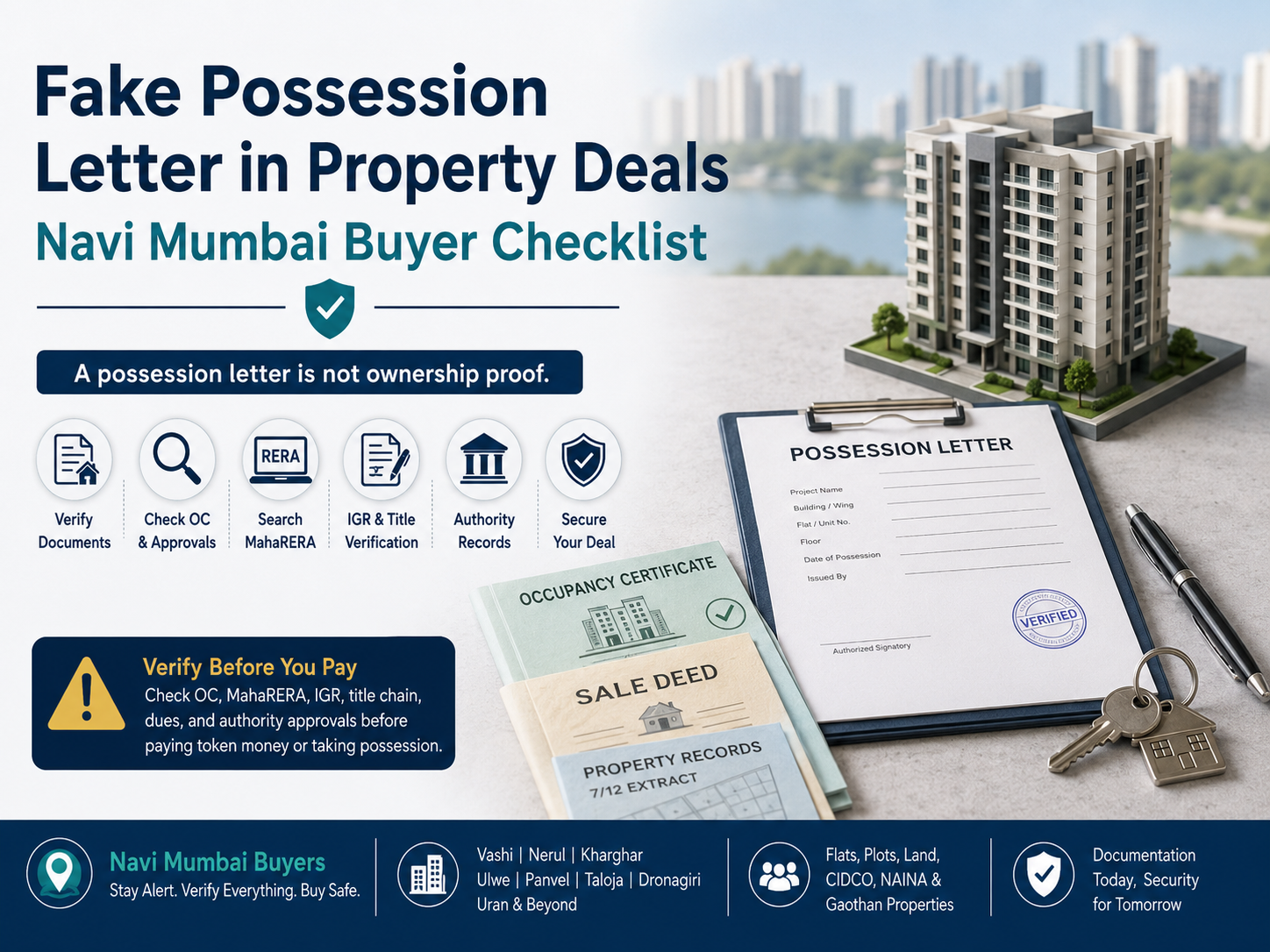
A possession letter is a document that says possession of a flat, shop, unit, plot, or property has been offered or handed over.
It may be issued by:
- A builder or promoter
- A society
- CIDCO or another authority
- A seller in a resale transaction
- A landowner
- A power of attorney holder
But here is the important point:
A possession letter is not the same as ownership proof.
It may support the handover history of a property. But it does not automatically prove that title is clear, construction is legal, OC is issued, dues are paid, or the seller has the right to sell.
For Navi Mumbai buyers, this matters because property types are different across Vashi, Nerul, Kharghar, Ulwe, Panvel, Taloja, Dronagiri, Uran, CIDCO areas, NAINA villages, and gaothan pockets.
A flat possession letter and a land possession letter are not the same risk.
Why Fake Possession Letters Are Risky
A fake or misleading possession letter can make a buyer believe the property is safe when it is not.
It can be used to:
- Push the buyer to pay token money
- Demand balance payment before proper verification
- Hide missing OC or part OC issues
- Sell a resale flat without complete title chain
- Mislead buyers in CIDCO or NAINA property deals
- Show “possession” of land where title, boundary, zoning, or access is disputed
- Create confidence when the seller does not have authority
MahaRERA’s possession-stage guidance tells homebuyers to ensure documents are in place before taking possession and to check OC status issued by the civic authority. This is important because possession should not be treated as a casual handover step.
Possession Letter vs OC vs Sale Deed
Use this table before trusting any property document.
| Document | What it means | What it does not prove |
|---|---|---|
| Possession letter | Handover or possession is being claimed | Does not by itself prove ownership, OC, clean title, or legal construction |
| Occupancy Certificate (OC) | Authority indicates building/unit is fit for occupation as per approval status | Does not prove the buyer’s title chain is clean |
| Completion Certificate (CC) | Development completion is certified as per sanctioned plan, where applicable | Does not replace registered transfer documents |
| Registered agreement / sale deed | Records the legal transaction between parties | Still needs title-chain and encumbrance verification |
| Index II | Summary of a registered document | Not a full title report |
| 7/12 extract | Rural land record showing survey, holder, area, and remarks | Supports land verification but is not a full legal title certificate |
| Property card | Urban property record | Supports verification but must be checked with title documents |
Plain English meaning:
- 7/12 extract: A Maharashtra land record showing land details, survey number, area, landholder details, and remarks.
- 8A extract: A village-form record showing a person’s landholding details.
- Mutation / Ferfar: A record entry showing change due to sale, inheritance, partition, court order, or another event.
- Property card: Urban property record used in city survey areas.
These records help verification. They should not be treated as final proof without legal review.
How to Verify a Possession Letter
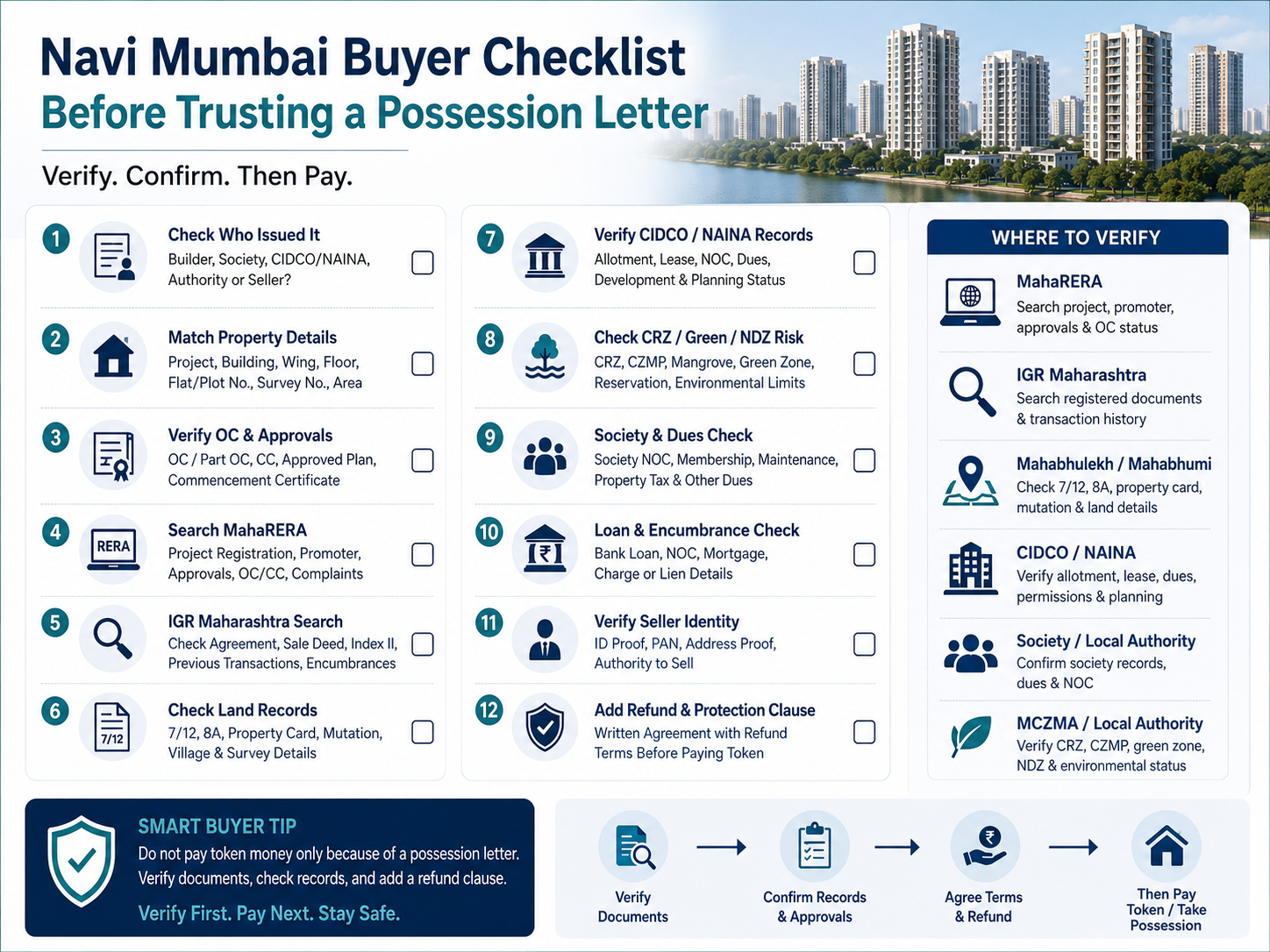
1. Check Who Issued It
Ask one question first:
Who has issued this possession letter?
If it is issued by a builder, check the builder’s name with MahaRERA and the agreement.
If it is issued by CIDCO or another authority, verify it directly with the authority record.
If it is issued by a society, check whether the society has authority to confirm possession history, not ownership title.
If it is issued by a broker, be careful. A broker’s letter is not a substitute for builder, authority, society, or registered records.
2. Match Property Details
Check whether the possession letter correctly mentions:
- Project name
- Building name
- Wing
- Floor
- Flat or unit number
- Carpet area
- Plot number
- Survey number
- Village name
- Date of possession
- Issuer name
- Signature
- Seal or reference number
Small mismatches can create big problems later.
For land and plots, survey number and village name are critical. A wrong survey number can mean a completely different property.
3. Verify OC or Completion Status
Do not accept “possession offered” as equal to OC.
Ask for:
- Full OC or part OC
- Completion Certificate, if applicable
- Approved plan
- Commencement Certificate
- Authority-issued approval reference
- Whether your exact building, wing, floor, or unit is covered
A part OC may apply only to a specific building, wing, or floor. Do not assume your flat is covered.
4. Search MahaRERA
For under-construction or recently completed projects, check MahaRERA.
Verify:
- Project registration number
- Project name
- Phase
- Promoter name
- Completion date
- Uploaded approvals
- Uploaded OC or CC, if available
- Agreement for sale
- Deviation report
- Complaints or non-compliance details, if visible
If the possession letter says one thing and MahaRERA records say something else, pause the deal.
5. Search IGR Maharashtra
IGR Maharashtra e-Search helps citizens search property transactions online.
Use it to check:
- Registered agreement
- Sale deed
- Index II
- Previous sale history
- Mortgage entries
- Release deed
- Gift deed
- Development agreement
- Whether names and property details match
This is important for resale flats in Navi Mumbai.
A possession letter from the old builder does not replace the registered chain of agreements.
6. Check Mahabhulekh or Digital Land Records
For plots, gaothan property, NAINA land, agricultural land, or village-area property, check land records.
Use Mahabhulekh / Mahabhumi to view:
- 7/12 extract
- 8A extract
- Property card, where applicable
Use digitally signed records where required.
But remember: land records support verification. They do not remove the need for title search, boundary verification, zoning check, and legal opinion.
7. Verify CIDCO / NAINA Records
For CIDCO or NAINA property, do not rely only on PDF copies.
Check:
- CIDCO allotment letter
- Possession letter
- Lease deed
- Transfer permission or NOC, if applicable
- CIDCO dues
- Plot/unit details
- Development permission
- NAINA planning status
- Town Planning Scheme impact, if relevant
In NAINA, CIDCO acts as the planning authority for notified areas. So plot buyers must verify the exact land parcel with CIDCO/NAINA records before relying on possession claims.
8. Check CRZ, Green Zone, or No-Development Risk
For Uran, Dronagiri, Panvel belt, creek-side locations, Raigad, Thane, and some coastal or sensitive pockets, check whether the property is affected by:
- CRZ
- CZMP
- Mangrove buffer
- Green zone
- No-development zone
- Reservation
- Environmental restriction
MCZMA hosts approved CZMP resources for Maharashtra coastal districts. But interpretation should be done carefully with professional help.
If land is near creek, coast, mangroves, wetlands, or low-lying areas, verify before paying.
What to Check Before Paying Token Money
A fake possession letter is often used before asking for token.
Use this checklist before paying:
| Check | Why it matters |
|---|---|
| Original possession letter | Confirms whether the document exists beyond a screenshot |
| OC / part OC | Confirms occupation approval status |
| MahaRERA record | Checks project and promoter details |
| Registered agreement / sale deed | Checks legal transaction history |
| IGR search | Helps verify registered documents |
| Seller identity | Avoids fake seller or wrong authority |
| Society records | Confirms transfer, dues, and membership details |
| Loan NOC | Important if property is mortgaged |
| CIDCO / NAINA record | Critical for authority-controlled property |
| 7/12 / property card | Important for plots, gaothan, and land |
| Refund clause | Protects buyer if verification fails |
Do not pay token money only because someone shows a possession letter.
Ask for documents first. Pay only after minimum verification and written refund conditions.
Red Flags of a Fake Possession Letter
Stop and verify if you see these signs:
- Letter is shared only on WhatsApp.
- No original or certified copy is shown.
- Builder name does not match MahaRERA.
- Project phase does not match the possession letter.
- No OC is available.
- Only part OC exists, but your unit is not clearly covered.
- Flat number, wing, floor, plot number, or survey number is wrong.
- Signature looks scanned or copied.
- No reference number or inward number.
- Seller cannot show registered agreement or sale deed.
- Society refuses to confirm records.
- CIDCO document cannot be verified with CIDCO.
- Broker says, “No need for OC.”
- Token is demanded in cash.
- Seller avoids lawyer verification.
- Land possession is claimed but 7/12, mutation, or boundary records do not support it.
- Plot is near CRZ, green zone, reservation, or creek area but seller avoids zoning discussion.
One red flag may not always mean fraud.
But it means you should not rush.
Common Mistakes Buyers Make
Mistake 1: Treating Possession Letter as Ownership Proof
Possession and ownership are different.
A person may have physical possession but not clean title. A possession letter may support handover history, but ownership must be checked through registered documents and title records.
Mistake 2: Accepting Possession Without OC
Possession without OC can create future resale, loan, safety, municipal, and legality problems.
Before accepting possession, check whether the OC covers your exact building, wing, floor, and unit.
Mistake 3: Trusting Broker Screenshots
Screenshots can be edited.
Ask for original documents and verify directly from official sources.
Mistake 4: Ignoring Old Chain Documents
In resale property, the first possession letter from the builder is not enough.
You still need the complete chain of registered documents from the first buyer to the current seller.
Mistake 5: Skipping CIDCO / NAINA Verification
CIDCO and NAINA properties may involve allotment, lease, transfer permission, development permission, TPS, or planning restrictions.
Verify with the relevant authority before relying on possession claims.
Mistake 6: Ignoring Land Records for Plots
For plots and land, possession must be checked with survey number, 7/12, mutation, boundary, access road, title chain, and zoning.
Do not buy land only because someone says, “Possession is clear.”
Navi Mumbai Example
A buyer in Ulwe is shown a resale flat.
The broker shares a builder possession letter and says:
“This proves everything is clear. Pay token today.”
The buyer should not rely only on that letter.
They should check:
- Is OC issued for that building or wing?
- Does the possession letter match the exact flat?
- Is the sale deed registered?
- Does IGR show the transaction chain?
- Is the society share certificate available?
- Are maintenance and property tax dues clear?
- Is there any bank loan?
- Does the seller name match all documents?
If the seller cannot provide these, the buyer should pause.
The correct response is:
“I will pay token only after document verification and written refund terms.”
When to Consult a Professional
Speak to a property lawyer or document-verification expert if:
- Possession is offered without OC
- Builder is pressuring for payment
- Project is delayed
- MahaRERA record does not match the letter
- Seller has only old possession documents
- Property is CIDCO, NAINA, gaothan, inherited, POA-based, or mortgaged
- Plot is near CRZ, green zone, NDZ, or reservation
- Survey number or boundary is unclear
- Seller is an NRI
- You are buying remotely
Do not depend only on broker confidence.
For high-value property, one legal review can prevent a major loss.
What to Do If You Suspect a Fake Possession Letter
Take these steps:
1. Stop further payment. 2. Ask for original or verifiable documents. 3. Send written email asking for OC, registered documents, and authority proof. 4. Verify MahaRERA, IGR, Mahabhulekh, CIDCO/NAINA, and local authority records. 5. Preserve WhatsApp chats, payment receipts, emails, and demand letters. 6. Ask a lawyer whether the issue is civil, criminal, RERA, consumer, or title-related. 7. If forgery or cheating is suspected, take legal advice before filing a complaint. 8. If a bank loan is involved, inform the bank before disbursement.
Do not threaten blindly. Document everything.
Conclusion
A possession letter can be useful.
But it should never be the only reason to pay token money, accept possession, or buy a resale property.
Before you move ahead, verify the OC, MahaRERA record, IGR documents, title chain, dues, and authority approvals.
For the next step, use verify property documents before possession or token payment.
A genuine seller will allow verification.
A risky deal will pressure you to skip it. “`
FAQs
Frequently Asked Questions