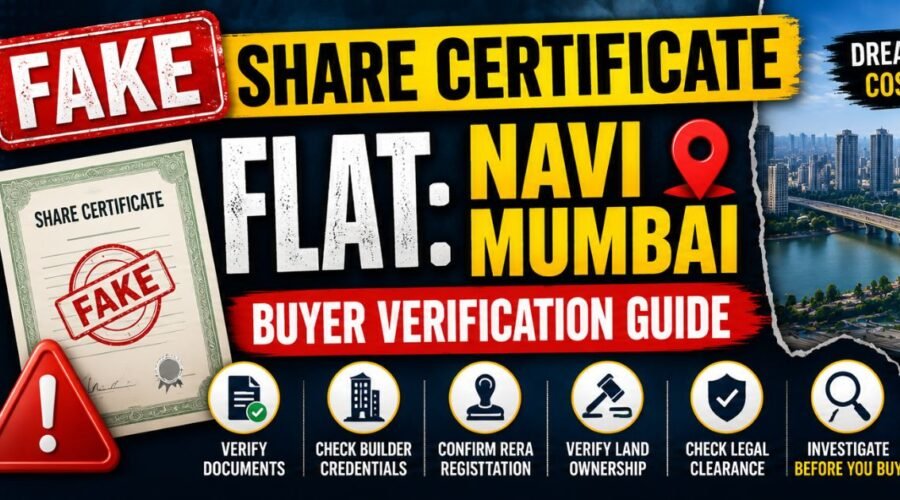
Fake Share Certificate Flat in Navi Mumbai: Buyer Verification Guide
Fake Share Certificate for Flat: Navi Mumbai Buyer Checklist
A share certificate alone does not prove safe ownership of a flat. Before trusting it, verify the original certificate with the housing society, seller’s registered sale deed or agreement, Index II, IGR Maharashtra records, society register, share ledger, dues, loan status, and seller identity. In Navi Mumbai resale deals, never pay token money only because a broker shows a share certificate.
Disclaimer: This is an educational guide. Verify the latest position with the relevant authority or a property lawyer before making a transaction.
What Is a Society Share Certificate?
A society share certificate is issued by a co-operative housing society to a member who holds shares in that society.
In simple words, it shows that the person is recorded as a member/shareholder in the housing society.
It usually includes details like:
- Member name
- Share certificate number
- Distinctive share numbers
- Number of shares
- Value of shares
- Society seal
- Authorised signatures
In Maharashtra, model bye-laws for co-operative housing societies describe the share certificate as a society-issued document for shares held by a member.
But here is the important point:
A share certificate supports society membership. It should not be treated as complete title proof by itself.
For a resale flat in Navi Mumbai, you still need to check registered documents, title chain, society records, dues, loan status, and seller authority.
Why Fake Share Certificates Are Risky
A fake share certificate can make a buyer believe that the seller is the legal owner.
That is where many resale flat risks begin.
A fake, altered, old, or wrongly transferred certificate may be used to:
- Push the buyer to pay token money
- Hide incomplete title chain
- Sell a flat where society records are not updated
- Hide a family or inheritance dispute
- Hide a mortgage or pending loan
- Show an old owner’s certificate as the current seller’s proof
- Create false confidence in a broker-led deal
- Support fake no-dues or transfer documents
This risk is common in resale flats because buyers often ask only one question:
“Is the share certificate available?”
The better question is:
“Does the share certificate match the society records, registered title chain, IGR records, dues, loan status, and seller identity?”
Share Certificate vs Sale Deed vs Index II
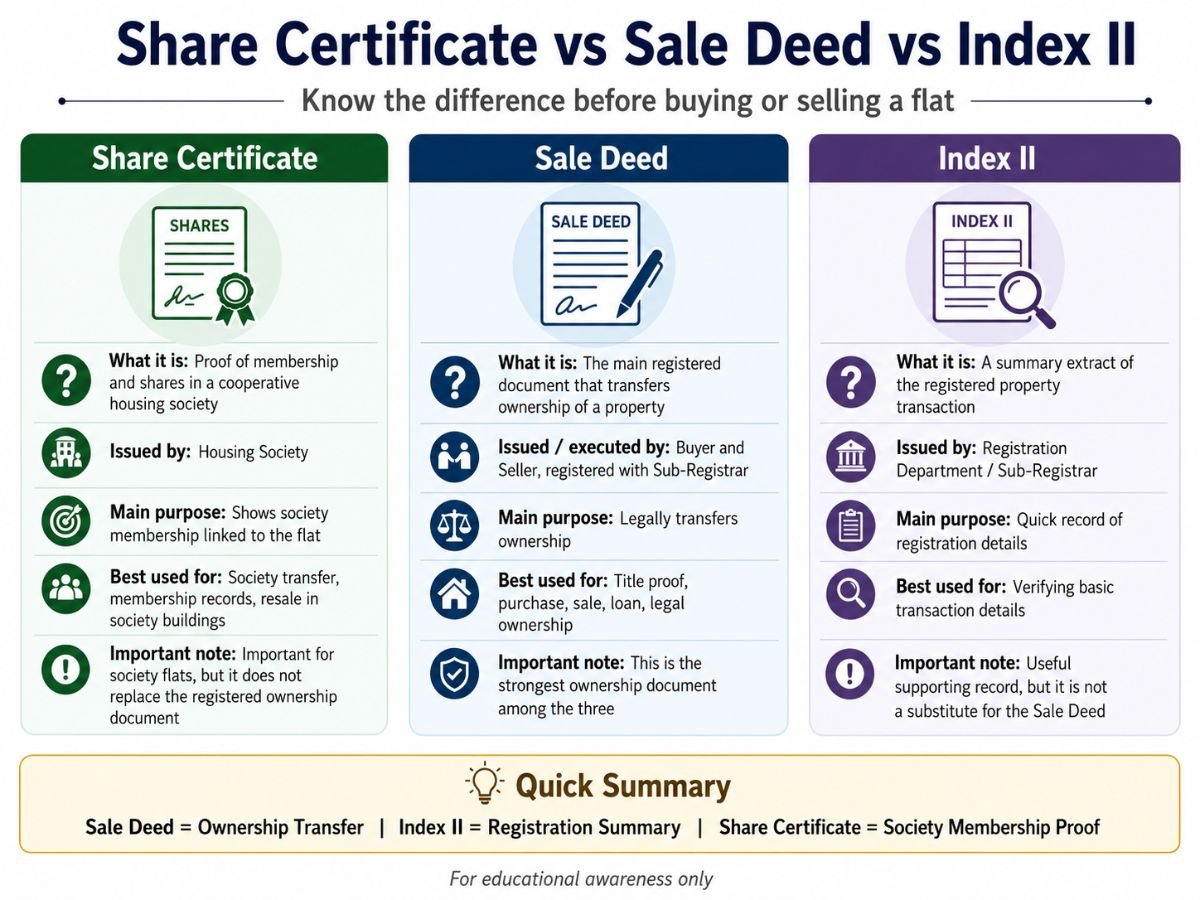
Do not confuse these documents. Each has a different purpose.
| Document | What it supports | What it does not confirm |
|---|---|---|
| Share certificate | Society membership and shareholding | Complete legal title, no loan, no dispute, no fraud |
| Registered sale deed / agreement | Registered transaction between buyer and seller | Society records are updated or title is risk-free |
| Index II | Summary of registered document | Full title chain or legal opinion |
| Society no-dues certificate | Pending society dues status | Ownership or title by itself |
| IGR search result | Registered document history | Society membership or physical possession |
| Title search report | Lawyer’s review of title chain and risk | A government guarantee of title |
A share certificate can be genuine, but the flat can still have a title issue.
A sale deed can be registered, but society records may still be pending.
A no-dues certificate can confirm dues, but it does not prove title.
So the buyer must verify all key records together.
Documents to Check Before Trusting a Share Certificate
Before accepting a share certificate as part of your resale flat due diligence, ask for three sets of documents.
Seller-Side Documents
Ask the seller for:
- Original share certificate
- Registered sale deed or agreement
- Previous chain documents
- Index II
- Seller PAN and Aadhaar
- Name-change proof, if names differ
- Power of Attorney, if seller is not signing directly
- Heirship, succession, probate, or family documents if inherited
- Bank loan closure letter or NOC if mortgaged
If the seller says “documents will come after token,” pause the deal.
Society-Side Documents
Ask the society office or managing committee to confirm:
- Membership register entry
- Share ledger entry
- Transfer form records
- Committee approval or transfer resolution
- No-dues certificate
- Maintenance payment history
- Parking allotment, if relevant
- Any pending dispute, redevelopment notice, or lien information
Do not rely only on broker confirmation.
Speak to the society office directly.
Property-Side Documents
For a resale flat in Navi Mumbai, also check:
- Occupancy Certificate, where applicable
- Completion-related records, where applicable
- Property tax receipt
- Electricity bill
- Water bill, if separately billed
- Existing loan or mortgage status
- Possession letter, if relevant
- Approved plan or building records, where available
For CIDCO flats or old leasehold properties, ask for CIDCO-related documents such as allotment letter, lease deed, transfer permission or NOC where applicable, and dues confirmation.
How to Verify a Share Certificate
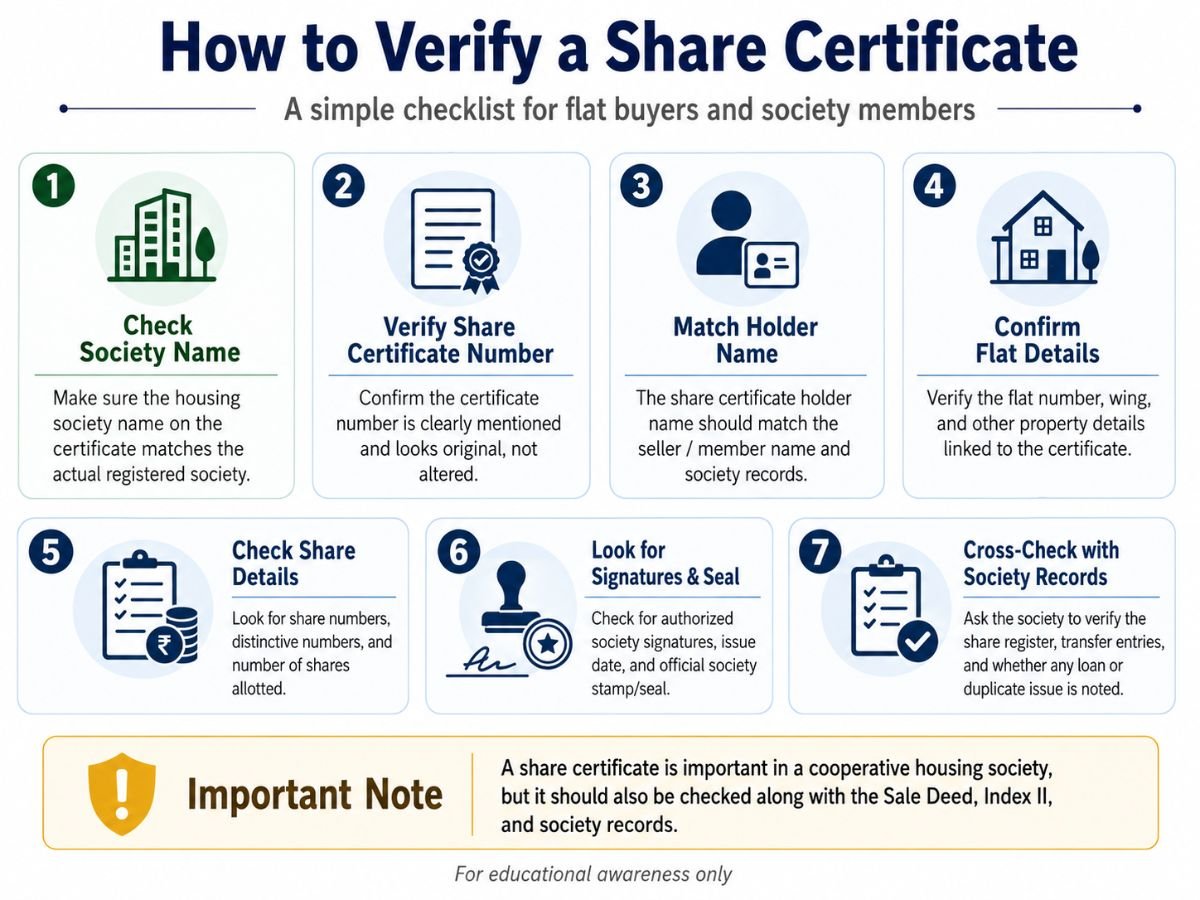
Step 1: Ask for the Original
Do not rely on a WhatsApp photo, scanned PDF, or photocopy.
Ask to see the original certificate.
Check whether it has:
- Society name
- Registration number
- Certificate number
- Member name
- Share numbers
- Seal
- Signatures
- Date of issue
- Any overwriting or correction
If the certificate is laminated, damaged, overwritten, or unclear, ask for society verification in writing.
Step 2: Match the Seller’s Name
The seller’s name should match across:
- Share certificate
- Registered sale deed or agreement
- Index II
- Society register
- Maintenance bill
- Seller ID proof
- Loan NOC, if any
If there is a mismatch, do not ignore it.
There may be a valid reason, such as marriage, name change, inheritance, or transfer delay. But it must be supported by proper documents.
Step 3: Verify with the Society
Ask the society secretary or managing committee:
- Is this certificate number genuine?
- Is the seller the current member?
- Are the share numbers correct?
- Was transfer approved?
- Are any dues pending?
- Was any duplicate certificate issued?
- Is there any objection, dispute, lien, or court notice?
The society’s answer matters because a fake certificate may look convincing on paper.
Step 4: Check IGR Maharashtra Records
Use IGR Maharashtra e-Search to check registered transaction history.
Search by:
- Document number
- Property details
- Seller/buyer name, where possible
- Registration year
- Village or area details, if applicable
Check whether the seller’s registered document exists and whether property details match the flat being sold.
This step helps detect gaps in the title chain.
Step 5: Verify the Title Chain
A title chain shows how the flat moved from the first owner to the current seller.
For a resale flat, check:
- First allotment or builder agreement
- First sale document
- Each resale agreement
- Current seller’s document
- Index II for each registered transaction
- Loan release documents, where applicable
A share certificate without a clean title chain is not enough.
Step 6: Check Loan or Mortgage Status
A flat can have a share certificate and still be mortgaged.
Ask for:
- Bank NOC
- Loan closure letter
- List of original documents held by bank
- Release deed or satisfaction document, if applicable
- Written confirmation before final payment
If original documents are with the bank, coordinate payment only after legal and bank process review.
What to Check Before Paying Token Money
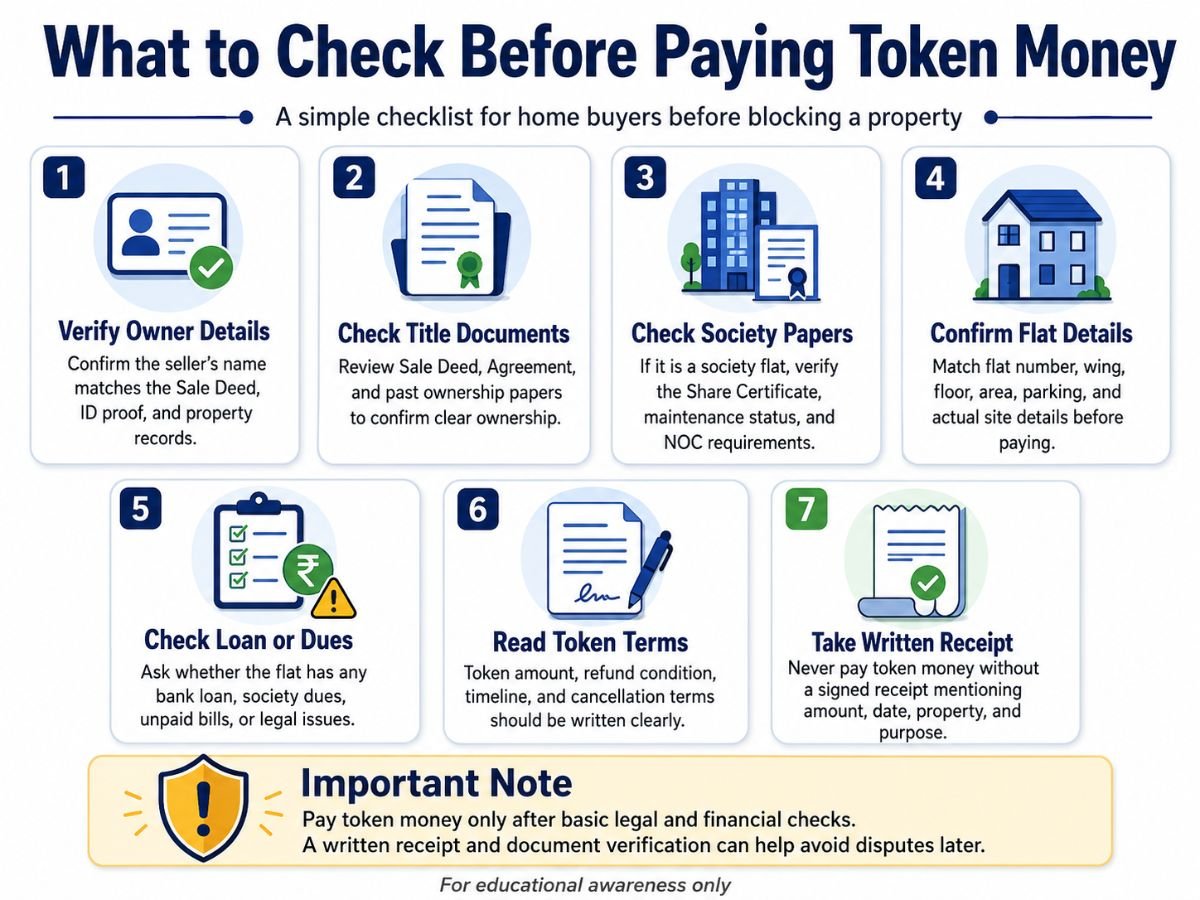
This is the most important section for buyers.
Before paying token money for a resale flat in Navi Mumbai, verify these items:
| Check | Why it matters |
|---|---|
| Original share certificate | Confirms certificate exists beyond a screenshot |
| Society register entry | Confirms seller is recorded as member |
| Share ledger | Confirms share numbers and transfer history |
| Registered sale deed/agreement | Confirms seller’s registered transaction |
| Index II | Confirms registration summary |
| IGR search | Checks registered document history |
| No-dues certificate | Checks maintenance dues |
| Loan NOC | Checks mortgage risk |
| Seller KYC | Confirms seller identity |
| Refund clause | Protects buyer if verification fails |
Do not pay token money just because the share certificate looks genuine.
Pay only after basic verification and written refund terms.
A simple token clause should say that the payment is subject to satisfactory verification of title, society records, dues, loan status, and seller authority.
Ask a lawyer to draft or review it.
Red Flags of a Fake Share Certificate
Stop and verify if you see any of these signs:
- Seller has only a photocopy.
- Broker refuses to show the original.
- Society seal is missing or unclear.
- Certificate number is not found in the society register.
- Share numbers do not match the share ledger.
- Seller name differs from the registered sale deed.
- Old owner’s name is still on the certificate.
- Certificate has overwriting or correction marks.
- Signature looks scanned or pasted.
- Society secretary refuses to confirm authenticity.
- Duplicate certificate was issued but no proper explanation is given.
- Seller says, “Society transfer will happen after full payment.”
- No-dues certificate looks unofficial.
- Maintenance bill is in another person’s name.
- Flat is mortgaged but seller hides loan details.
- Property is inherited but family consent or heirship papers are missing.
- Token money is demanded before society verification.
- Broker says, “Share certificate is enough. No need for title search.”
One red flag does not always prove fraud.
But it means you should slow down.
Common Mistakes Buyers Make
Mistake 1: Treating Share Certificate as Ownership Proof
This is the biggest mistake.
A share certificate supports society membership. Ownership and title need registered documents, title-chain verification, IGR search, and legal review.
Mistake 2: Not Checking IGR Records
A seller may show society documents, but the registered document chain may still have gaps.
Always check IGR Maharashtra records for registered transaction history.
Mistake 3: Ignoring Society Records
The share certificate must match the society membership register, share ledger, transfer records, and maintenance records.
If society records do not match, do not proceed casually.
Mistake 4: Paying Token Too Early
Many resale disputes start because the buyer pays first and verifies later.
In a strong transaction, documents come before token.
Mistake 5: Not Checking Mortgage Status
A flat may have a valid share certificate and still be under bank loan.
Ask for bank NOC and original document status before finalising payment.
Mistake 6: Ignoring Inheritance Risk
If the flat came through death of a member, nomination alone may not remove every title-risk question.
Ask a lawyer to verify succession, heirship, family consent, and transfer history.
Navi Mumbai Resale Flat Example
A buyer is shown a resale flat in Kharghar.
The broker shares a society share certificate on WhatsApp and says:
“Owner name is on the certificate. Pay ₹1 lakh token today.”
The buyer should ask:
- Can I see the original share certificate?
- Does the society register show the same member?
- Does the share number match the share ledger?
- Does IGR show the seller’s registered agreement?
- Is the previous title chain complete?
- Are society dues clear?
- Is there any bank loan?
- Is the flat under redevelopment or dispute?
- Is the seller available for direct KYC verification?
If the broker or seller avoids these checks, the buyer should not pay token.
The correct response is:
“I will pay token only after society verification, IGR check, title-chain review, and written refund terms.”
When to Consult a Professional
Consult a property lawyer, society consultant, or document-verification expert if:
- Original share certificate is missing
- Duplicate share certificate is involved
- Seller is acting through Power of Attorney
- Seller is an NRI
- Flat is inherited
- Society is under redevelopment
- Society does not cooperate
- Registered chain documents are incomplete
- There is a name mismatch
- Flat is mortgaged
- Property is CIDCO-allotted or old leasehold property
- Token amount is high
- You are buying remotely
For high-value resale flats in Vashi, Nerul, Kharghar, Ulwe, Panvel, CBD Belapur, Taloja, or Dronagiri, one professional review can prevent a costly mistake.
What to Do If You Suspect a Fake Share Certificate
Take safe steps:
1. Stop further payment. 2. Do not sign a token receipt without refund terms. 3. Ask for original documents. 4. Verify with the society office in writing. 5. Search IGR Maharashtra records. 6. Ask for the seller’s complete title chain. 7. Preserve WhatsApp chats, emails, receipts, and payment requests. 8. Get legal review. 9. If forgery is suspected, take legal advice before filing a complaint.
Whether the issue is civil, criminal, co-operative society, title, or consumer-related depends on facts.
Do not guess. Verify.
Conclusion
A share certificate is useful.
But it should never be the only document you trust before buying a resale flat.
Before paying token money, verify the society records, IGR documents, title chain, dues, loan status, and seller identity.
For the next step, use verify flat documents before token payment.
A genuine seller will allow verification.
A risky deal will pressure you to skip it.
FAQs
Frequently Asked Questions