
NAINA FSI Rules: What Buyers Must Verify Before Buying Land or Property
Direct Answer
NAINA FSI rules decide how much construction may be allowed on land within the NAINA planning area, but FSI is not the same for every plot. It depends on the latest NAINA DCPR, zone, road width, plot size, reservations, Town Planning Scheme, development permission, CRZ or greenzone restrictions, and final authority approval.
> Disclaimer: This is an educational guide. Verify the latest position with the relevant authority or a property lawyer before making a transaction.
Last Reviewed: June 2026
Table of Contents
What are NAINA FSI rules? What is FSI in simple words? Why NAINA FSI matters for buyers What decides FSI in NAINA? FSI vs actual buildable area How to verify NAINA FSI Documents to check Red flags Common mistakes Token money checklist FAQs Internal links External sources Schema recommendations Final CTA
What Are NAINA FSI Rules?

NAINA FSI rules are planning rules that decide how much construction may be allowed on a plot or land parcel within the Navi Mumbai Airport Influence Notified Area.
NAINA is linked with planned development around Navi Mumbai International Airport and nearby areas such as Panvel, Uran, Dronagiri and parts of Raigad.
But buyers must understand one thing clearly.
There is no single FSI number that applies blindly to every NAINA plot.
FSI depends on the plot, zone, road width, applicable DCPR, Development Plan, Town Planning Scheme, restrictions and approvals.
Before buying land, first understand the broader planning framework in NAINA Real Estate Guide.
What Is FSI in Simple Words?
FSI means Floor Space Index.
It tells how much builtup area may be permitted on a plot, subject to rules and approvals.
Example:
If a plot area is 1,000 sq.m. and permissible FSI is 1.0, then the basic possible builtup area may be 1,000 sq.m., subject to other planning rules.
If FSI is 1.5, the basic possible builtup area may be 1,500 sq.m., again subject to approvals.
But this is only a simple example.
Actual construction may change because of:
Road width Setbacks Open space requirements Parking rules Height restrictions Fire norms Reservation CRZ or greenzone restrictions Development permission conditions
So do not calculate investment value only from a rough FSI number.
Why NAINA FSI Matters for Buyers
FSI affects land value.
A plot with higher verified development potential may have better commercial value than a plot with restrictions.
But this also creates risk.
Sellers and brokers may use lines like:
“High FSI available.” “Future FSI milega.” “NAINA plot hai, development pakka hai.” “Airport ke baad FSI badhega.”
These claims should not be accepted without documents.
For a buyer, FSI matters because it affects:
How much can be constructed Whether the price is justified Whether a developer can build the promised project Whether resale value may be affected Whether the land is suitable for your purpose
Claimed FSI is not verified FSI.
What Decides FSI in NAINA?
FSI in NAINA can depend on multiple planning and land factors.
| Factor | Why It Matters |
|---|---|
| NAINA DCPR | Main development control rules for planning and construction |
| Zone | Residential, commercial, industrial, green or other zone can affect use |
| Road Width | Wider roads may affect development potential under rules |
| Plot Size | Very small or irregular plots may not achieve full theoretical FSI |
| Plot Shape | Narrow or oddshaped plots can reduce practical construction |
| Reservation | Road, public utility or openspace reservation can reduce usable land |
| Town Planning Scheme | Final plot and development rights may change under TPS |
| CRZ / Green Zone / NDZ | Restrictions can reduce or block construction |
| Development Permission | Final authority approval is required for actual development |
| Approved Plan / CC | Shows what has actually been sanctioned |
This is why buyers should avoid articles, videos or brokers giving one fixed FSI number for all NAINA land.
NAINA FSI vs Actual Buildable Area
FSI and buildable area are related, but they are not the same.
FSI tells possible floor area as per rules.
Buildable area is what can practically be built after applying all conditions.
For example, a land parcel may look good on paper, but actual development may reduce because of:
Required front setback Side margin Parking requirement Access road issue Drainage or utility reservation Shape of plot Greenzone restriction CRZ issue Pending development permission
A buyer should ask an architect or planning consultant to calculate realistic buildable potential.
Do not pay premium price only because someone says “FSI is high.”
How to Verify NAINA FSI Before Buying
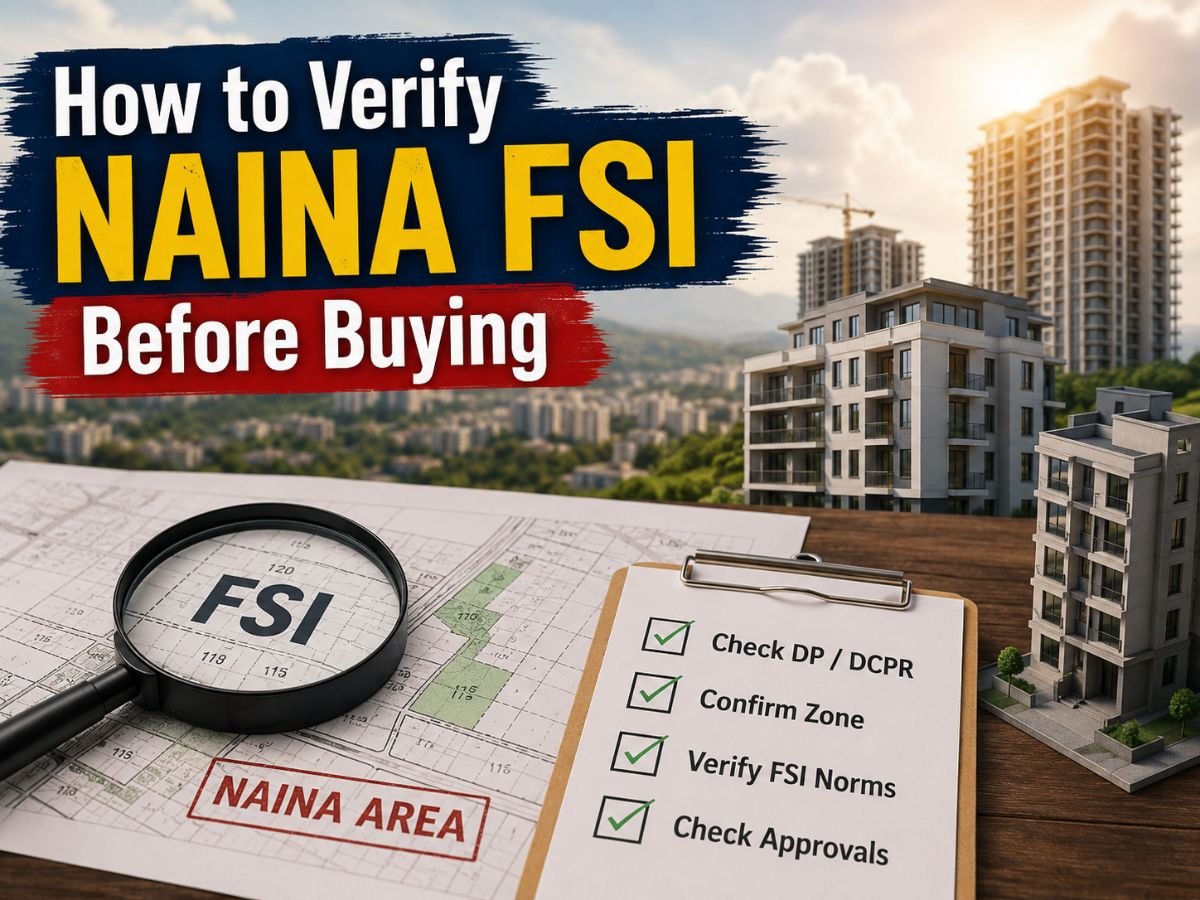
Step 1: Confirm Survey Number and Village
Start with the exact land identity.
Ask for:
Village name Survey number Hissa number Taluka District Plot number if applicable
Without the correct survey number, FSI verification can go wrong.
Step 2: Check Latest Land Records
Verify:
7/12 extract 8A extract Mutation entries
The 7/12 extract is a rural land record that helps identify land details and recorded holder information.
The 8A extract shows landholding reference.
Mutation means a landrecord entry showing change due to sale, inheritance, partition or other transaction.
These documents support verification, but they do not alone confirm development rights.
Step 3: Check NAINA Zone Through ZCS
A Zone Confirmation Statement helps identify the planning zone applicable to the land.
This is important because FSI depends on the applicable zone and planning rules.
Read NAINA ZCS Guide before assuming the land can be developed.
Step 4: Read Applicable NAINA DCPR
DCPR means Development Control and Promotion Regulations.
These rules decide how land can be developed, what conditions apply, and how construction permission may be evaluated.
For FSI, the DCPR is one of the most important references.
A buyer should not depend on broker calculations.
Read NAINA DCPR Explained to understand how rules affect land potential.
Step 5: Check Development Plan and TPS Impact
The Development Plan may show:
Roads Reservations Open spaces Public utilities Zone classification Future planning proposals
Town Planning Scheme can also affect final plot size, road access and usable land.
So before buying, check NAINA Development Plan Guide and NAINA Town Planning Scheme.
Step 6: Verify Road Width and Access
Road width can affect development potential.
Also, legal access road is essential.
A plot without proper road access may face practical and approval problems.
Ask for proof of access, not only a site visit.
Step 7: Check CRZ, Green Zone and NoDevelopment Risk
Some areas near creek, coastal belts, mangroves or environmentally sensitive zones may have restrictions.
If land is near Uran, Dronagiri, creekside pockets or coastal influence areas, CRZ and related checks become important.
If a plot falls in green zone or nodevelopment zone, claimed FSI may not be usable.
Step 8: Ask for Development Permission, Approved Plan or CC
If a project already exists or construction is being sold, ask for:
Development permission Approved layout Approved building plan Commencement Certificate MahaRERA registration if applicable
Read NAINA Commencement Certificate if the seller or builder is claiming construction approval.
Step 9: Get Architect and Lawyer Review
FSI is technical.
Title is legal.
You usually need both reviews.
An architect or planning consultant can check development potential.
A lawyer can verify ownership chain, agreement risk and title documents.
Before token payment, also read property title search in Navi Mumbai.
Documents to Check for NAINA FSI
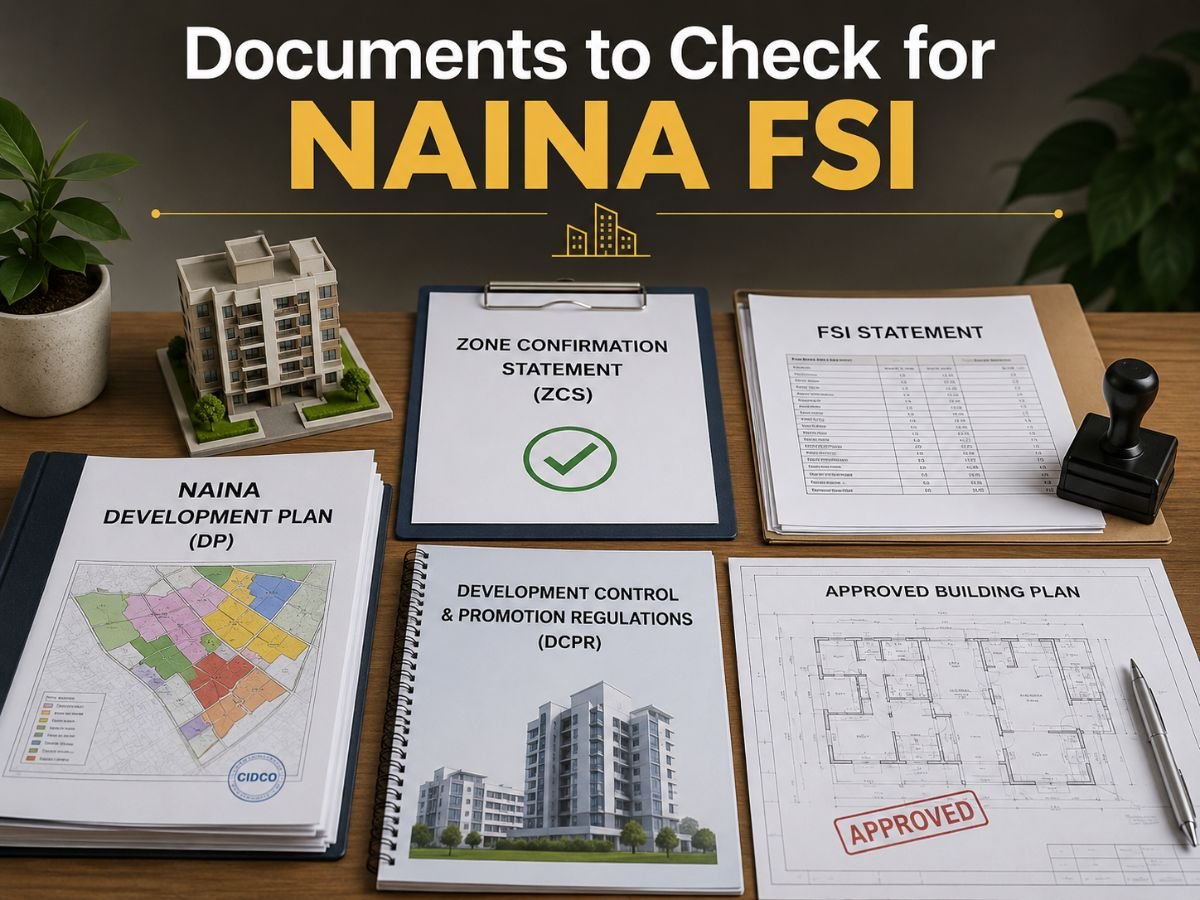
| Document | What It Helps Verify |
|---|---|
| 7/12 Extract | Land identity and recorded holder |
| 8A Extract | Landholding reference |
| Mutation Entry | Landrecord change history |
| ZCS | Planning zone |
| NAINA DCPR | Applicable development rules |
| Development Plan | Roads, reservations and zone impact |
| TPS Records | Final plot and scheme impact |
| Development Permission | Approved development use |
| Approved Plan | Actual sanctioned layout/building |
| Commencement Certificate | Construction approval status |
| MahaRERA / MahaCRITI | Projectlevel verification if applicable |
| CRZ / CZMP | Coastal restriction check |
| Title Search Report | Ownership and legal chain |
What FSI Claims Do NOT Prove
FSI claims can be misleading.
A claimed FSI does not prove:
Clear title Ownership Development permission Approved floors Construction permission RERA compliance CRZ clearance Greenzone clearance Future appreciation Safe token payment
FSI is only one part of the buying decision.
Example: Panvel Land Buyer Checking FSI
A buyer finds land near Panvel.
The broker says:
> “2 FSI possible hai. Airport ke baad value double hogi.”
The buyer asks for documents.
After checking ZCS, DCPR, road width and Development Plan, the buyer finds that part of the land is affected by a proposed road and the usable development potential is lower than expected.
The buyer avoids overpaying.
This is the correct approach.
Do not buy based on future FSI promises.
Verify plotspecific FSI before paying.
Red Flags in NAINA FSI Deals
| Red Flag | Why It Is Risky |
|---|---|
| Seller promises fixed FSI without document | Claim may be false or incomplete |
| “Future FSI guaranteed” | Future planning changes are not guaranteed |
| No ZCS | Zone is not verified |
| No DCPR reference | Rule basis is unclear |
| No roadwidth proof | Development potential may be affected |
| No approved plan | Proposed construction may not be sanctioned |
| Plot in CRZ / green zone / NDZ | Construction may be restricted |
| CC approves less than brochure | Builder may be overselling |
| MahaRERA details mismatch | Project information conflict |
| Token demanded before verification | Buyer loses protection |
Common Mistakes Buyers Make
Believing One FSI Applies to All NAINA Plots
This is wrong.
FSI can change based on zone, plot conditions and approval rules.
Ignoring Road Width
Road width may affect what can be developed.
Always verify road access and width with documents.
Checking Only 7/12
7/12 is important, but it is not enough.
You also need zoning, DCPR, DP, title and permission checks.
Confusing Proposed Plan With Approved Plan
A proposed plan is not approval.
Ask for sanctioned plan and authority permission.
Paying Extra for Unverified FSI
Some buyers pay a higher rate because the seller claims high FSI.
Do not pay premium without technical verification.
Ignoring Professional Review
FSI calculation is not just simple maths.
A planning consultant or architect should review it.
What to Check Before Paying Token Money
Use this checklist before making any financial commitment.
| Checkpoint | Buyer Action |
|---|---|
| Survey Number | Confirm exact land identity |
| Latest Land Records | Check 7/12, 8A and mutation |
| ZCS | Confirm planning zone |
| DCPR | Check applicable FSI rules |
| Development Plan | Check roads and reservations |
| TPS | Check final plot impact |
| Road Width | Verify access and width |
| CRZ / Green Zone | Check restrictions where applicable |
| Approved Plan | Verify if project exists |
| Commencement Certificate | Check construction approval |
| MahaRERA / MahaCRITI | Verify project if applicable |
| Architect Review | Get practical FSI calculation |
| Lawyer Review | Check title and agreement |
| Token Terms | Put refund terms in writing |
Do not pay token money only on FSI promises.
Schema Recommendations
Article Schema Fields
Use Article schema with:
headline: NAINA FSI Rules: What Buyers Must Verify Before Buying Land or Property description: Learn how NAINA FSI rules work, what affects FSI, how to verify FSI claims and what buyers must check before buying land or property in NAINA areas. author: I Love Navi Mumbai publisher: I Love Navi Mumbai datePublished: Add publishing date dateModified: Add latest updated date mainEntityOfPage: Article URL image: Add featured image URL
BreadcrumbList Schema Path
Home → Real Estate Guides → NAINA, Town Planning & Land Development → NAINA FSI Rules
FAQ schema is optional. Do not depend on FAQ schema as the primary SEO tactic.
conclusion
NAINA FSI rules can affect land value, project viability and buyer risk.
But FSI should never be accepted only from a broker, brochure or WhatsApp message.
Before paying token money, verify the survey number, ZCS, DCPR, Development Plan, TPS, road width, restrictions, approved plan, MahaRERA details and title documents.
Your next step should be Property Verification Before Token Payment so you can complete full due diligence before making a financial commitment. “`
FAQs
Frequently Asked Questions