
Best Areas to Invest in Shops and Showrooms in Navi Mumbai
There is no single best area for every shop and showroom investment in Navi Mumbai. For safer rental stability and easier reletting, Vashi and CBD Belapur usually come first. For selective premium branding and stronger showroom visibility, Sanpada, Nerul, and Seawoods can work better. Kharghar and Panvel are growth bets, not blind buys. Airoli and Mahape suit specific employee-driven formats, not all retail businesses.
That is the practical answer most buyers actually need.
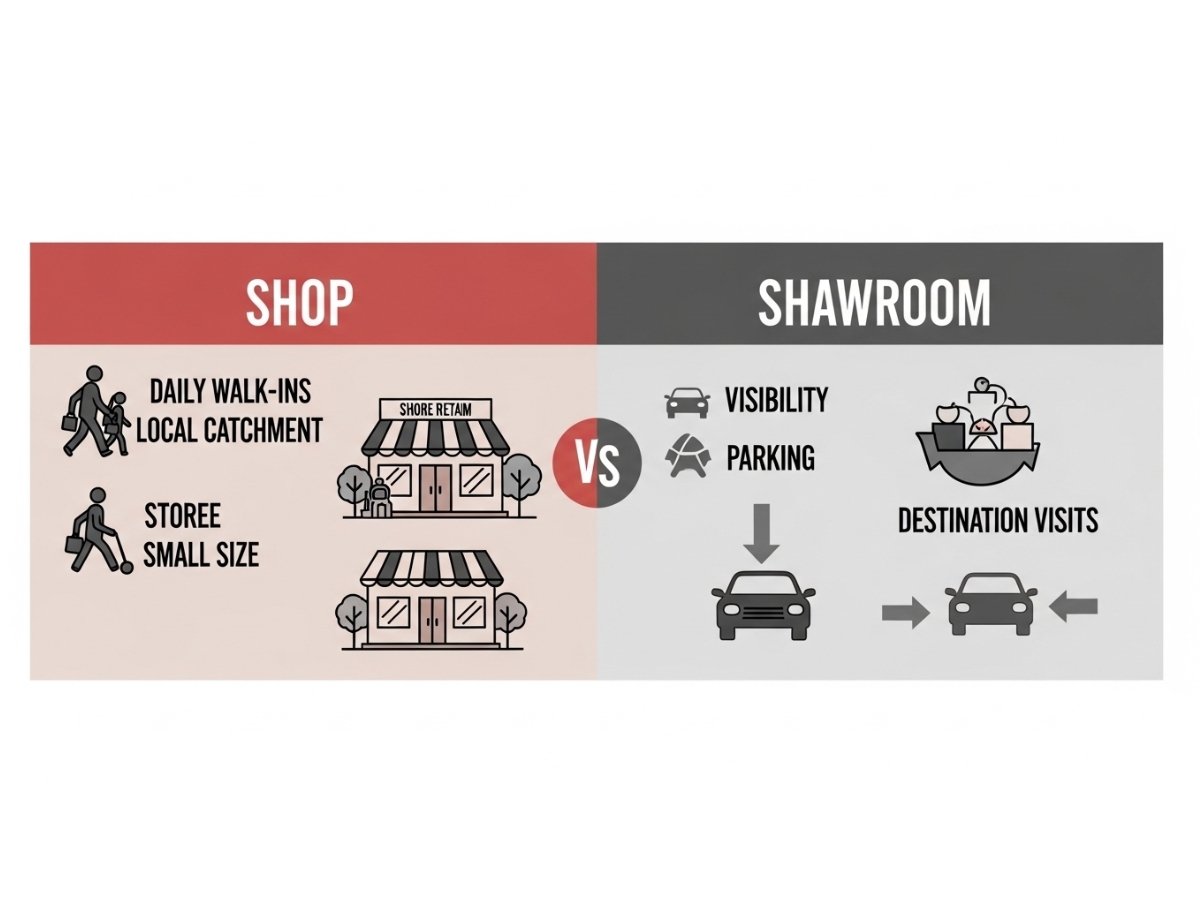
A lot of commercial property content becomes useless because it mixes shops, showrooms, offices, and warehouses into one basket. In real life, a 300 sq. ft. daily-needs shop below a housing cluster and a 2,000 sq. ft. branded showroom on a major road do not work on the same logic. One depends on repeat local walk-ins. The other depends on frontage, signage, parking, and the willingness of customers to make a planned visit.
So if you are trying to shortlist the best areas to invest in shops and showrooms in Navi Mumbai, do not start with the node name alone. Start with the business format, catchment quality, access, parking, sanctioned use, and holding period. In this market, a loud location can underperform a quieter but better-matched one.
Quick Summary
Here is the shortest useful version before we go deeper.
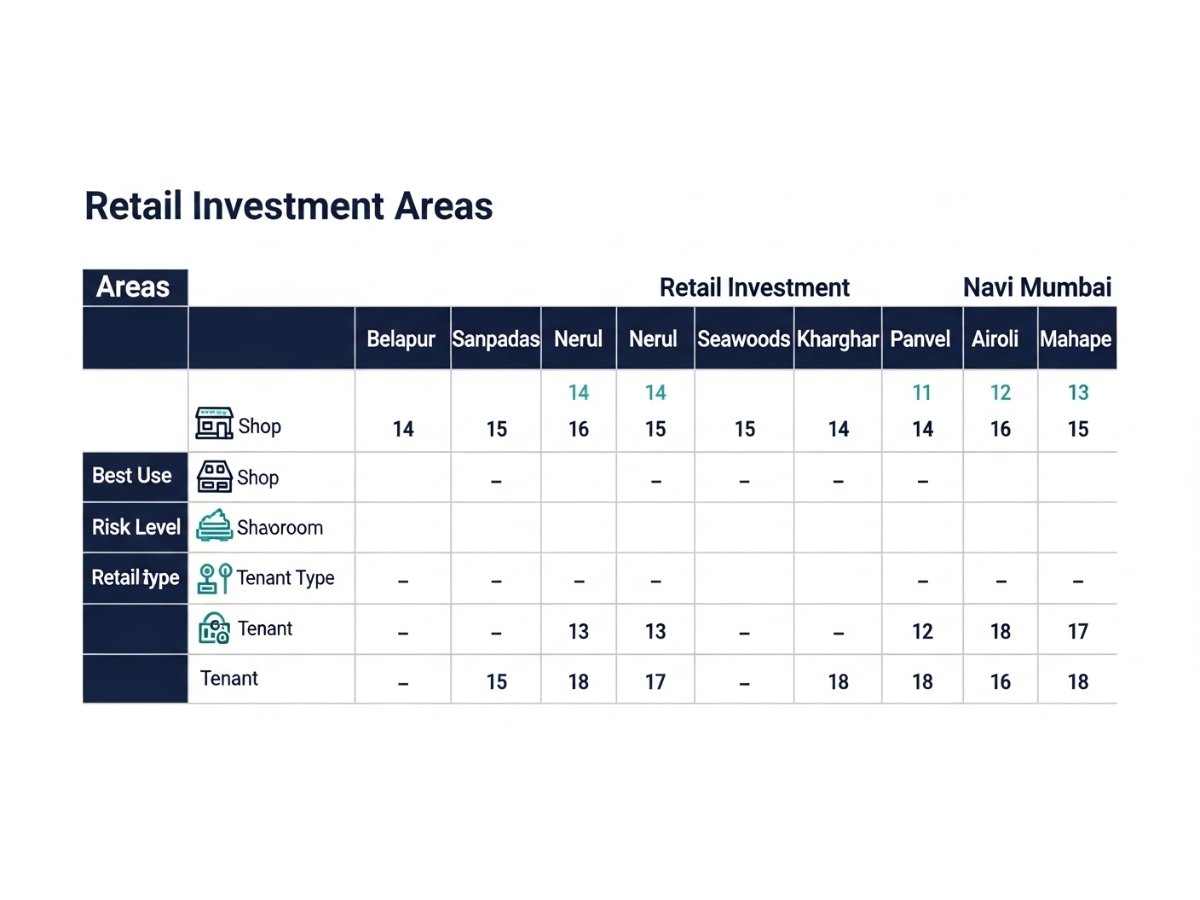
| Investor goal | Best-fit areas | Why they work | What to watch |
|---|---|---|---|
| Safer rent and easier reletting | Vashi, CBD Belapur | Mature commercial base, stronger tenant depth, lower vacancy stress | High entry price, easy to overpay |
| Daily-needs or residential spillover retail | Sanpada, selected Kharghar sectors | Captive local catchment, repeat-use retail, smaller ticket size possible | Internal lane quality matters a lot |
| Premium showroom or selective lifestyle retail | Nerul, Seawoods, select Sanpada stretches | Better branding value, stronger profile, better for destination formats | Yield can be lower, CAM and carrying cost matter |
| Growth-oriented longer hold | Kharghar, Panvel | Metro, airport, corridor growth narratives can improve future demand | Micro-location risk is high |
| Employee-driven or service-led weekday business | Airoli, Mahape | Corporate crowd, office-linked demand, niche F&B and services | Weak weekend family retail pattern |
| Budget-led higher-yield risk appetite | Taloja-type industrial fringe logic, not mainstream family retail | Lower entry point, stronger yield bands in some cases | Tenant quality, churn, and vacancy can be rough |
The biggest mistake is assuming that the “best commercial area” is the best for every business type. It never is.
What Makes a Good Shop Location in Navi Mumbai, and What Makes a Good Showroom Location Different?
A good shop location and a good showroom location are often two different things.
What small daily-use shops need
Small shops usually survive on frequency, not glamour. Pharmacies, snacks, bakeries, salons, mobile repair, small clinics, laundry pickup, and grocery-support retail do best where people pass daily and stop easily. That usually means internal sector markets, station approach zones, or ground-floor units under residential buildings with real local movement.
For these formats, the most important questions are simple. Do people already live or work nearby? Can they stop quickly? Is the frontage visible from the natural walking line? Will the shop still work on ordinary weekdays, not just festive rush?
This is why some quieter residential pockets in Sanpada or Kharghar can outperform louder roads for daily-use retail.
What destination showrooms need
A showroom is different. A customer is not always buying on impulse. They may compare, park, enter, spend time, and then decide. That means road visibility, vehicle access, signage width, setback, and legal parking become far more important.
A showroom on a congested internal lane may look cheap compared to a highway-facing or arterial-road unit, but cheap can become costly if customers cannot stop, notice the brand, or enter comfortably. In Navi Mumbai, that problem becomes sharper for larger units because parking and compliance matter more once the size increases.
> Simple rule: > If your business needs repeat daily walk-ins, prioritise catchment and stoppage. > If your business needs brand display and planned visits, prioritise frontage and vehicle access.
Which Navi Mumbai Areas Are Safest for Rental Stability, and Which Are Better as Growth Bets?
In commercial property, higher yield does not always mean better investment. Quite often, it means higher risk.
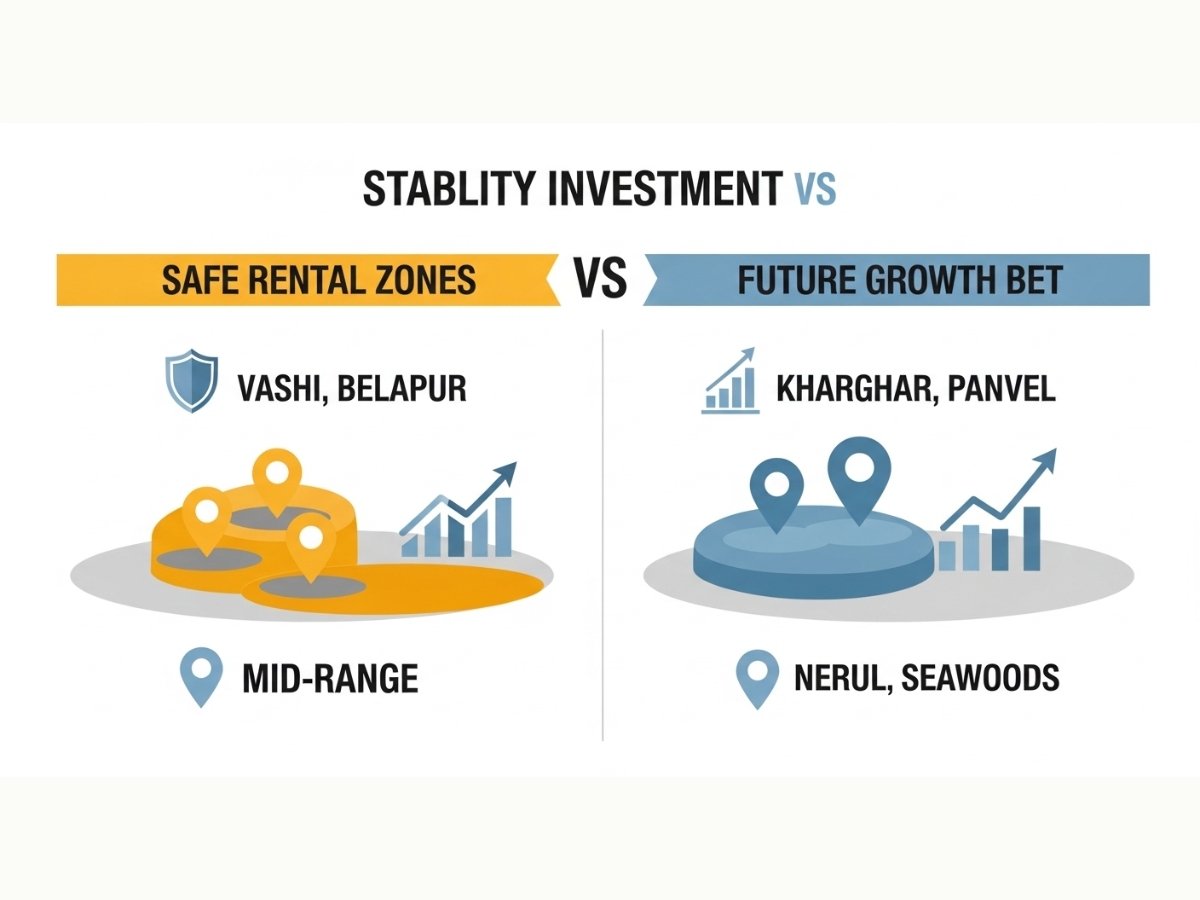
The safest shop investment Navi Mumbai usually offers is in mature nodes where reletting is easier and tenant demand is broad. Vashi and CBD Belapur sit higher on that safety ladder because they already have stronger commercial ecosystems. Prices are steeper, so yields may not look exciting on paper, but the chances of long vacancy are usually lower.
Growth bets are a different category. Kharghar and Panvel can look more attractive to investors who want future appreciation and can tolerate more uncertainty. Some sectors are already usable today. Others are still being sold on what may happen around future infrastructure, approach roads, or nearby development.
Seawoods and Nerul sit in between in an interesting way. They are not the cheapest, and they are not always the highest-yield retail locations in Navi Mumbai, but they can make sense for selective showroom formats and premium profile-based businesses.
Is Vashi Still the Safest Bet for Shop and Showroom Investment?
Yes, in many cases Vashi is still the safest benchmark for retail and showroom investment in Navi Mumbai. But that does not mean every Vashi property is worth buying.
Vashi works because it has depth. The node has a long-established business ecosystem, older commercial habit, stronger corporate presence, medical and banking demand, and a wider tenant pool than most other locations. If you want a property that is easier to explain to lenders, tenants, and buyers, Vashi still carries weight.
Where Vashi works best
Vashi suits investors looking for mature high-street retail, service businesses, clinics, finance-linked occupiers, branded smaller showrooms, and pre-leased assets with stronger covenant quality. It is especially useful for investors who value liquidity and lower vacancy stress more than dramatic upside stories.
For showrooms, the logic improves further when the unit has clear visibility and actual customer stopping ability. Main road and better-planned commercial stretches do far better than cramped internal spots.
Where Vashi gets overpriced or overestimated
The danger in Vashi is lazy buying. Buyers often pay “Vashi rates” for units that do not have “Vashi performance.” Internal lanes without strong footfall, awkward frontage, poor parking, or limited display potential can be sold at unjustified premiums simply because the node name sounds safe.
> Caution: > Do not buy a Vashi unit just because the seller says “Vashi mein kuch bhi chalta hai.” > In commercial property, micro-location still decides everything.
Should You Pick CBD Belapur or Sanpada for Cleaner Business Catchment and Better Long-Term Hold?
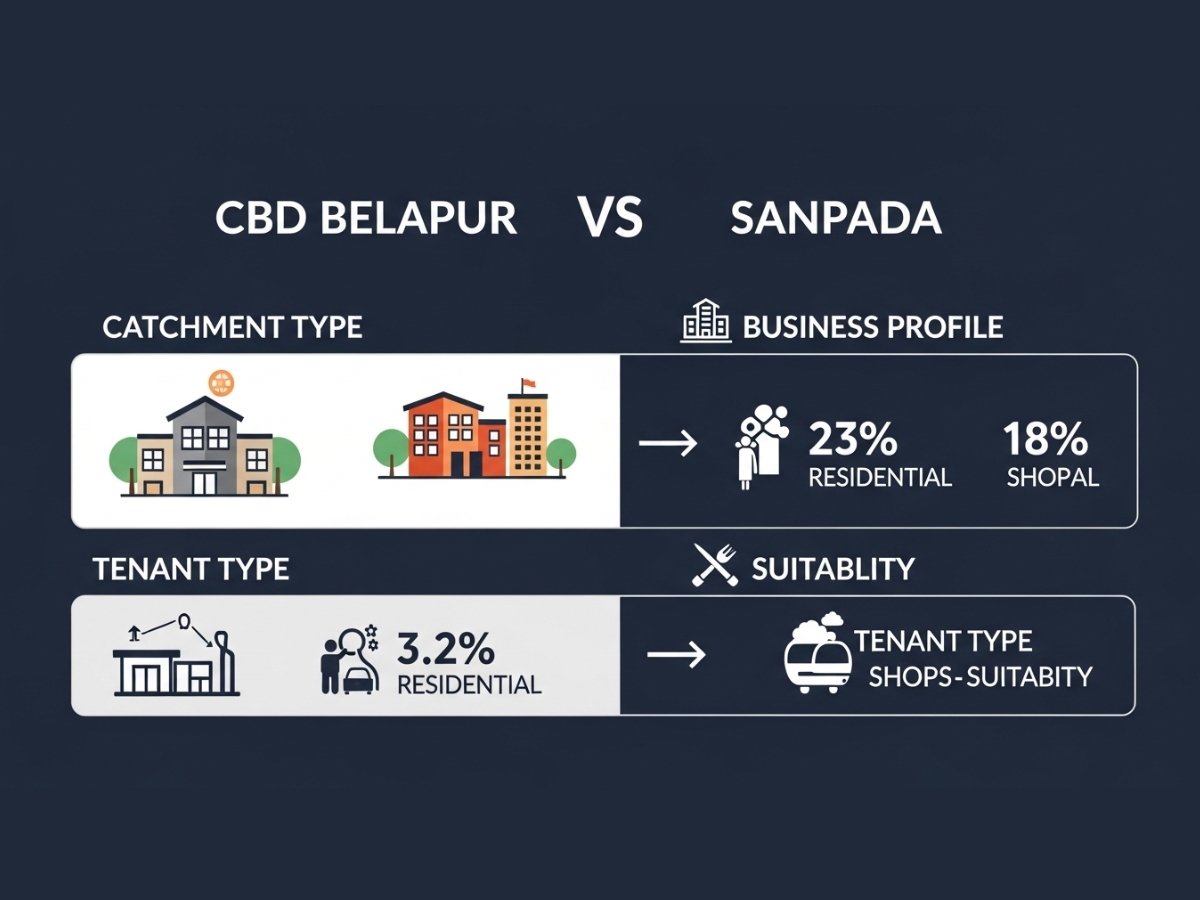
This comparison is more useful than many buyers realise.
CBD Belapur works more like an administrative and business-services node. Sanpada works more like a residential-commercial spillover market that has become stronger over time.
Where Belapur works best
CBD Belapur showroom investment or shop investment makes most sense when the tenant profile is service-led, professional, white-collar, or business-dependent. Think consultancies, finance-linked occupiers, clinics, offices with public interaction, and selective retail that benefits from a cleaner business catchment.
Belapur is not always the loudest node, but it often feels more stable and more orderly for the right format. That matters.
Where Sanpada works better than people expect
Sanpada is often treated like a side note to Vashi. That is a mistake. For daily-needs retail, neighbourhood-facing shops, food, grooming, pharmacy, small format franchise retail, and selective local showrooms, Sanpada commercial shops can be surprisingly practical because the residential catchment is real and recurring.
If Vashi feels too expensive and you still want a fairly mature node, Sanpada becomes a very sensible middle path.
Are Nerul and Seawoods Better for Premium Retail and Selective Showrooms Than for Mass-Market Shops?
In many cases, yes.
Nerul and Seawoods are more selective retail environments. They are not the first answer for every low-ticket, mass-market shop. But they can make much more sense for premium retail property investment, brand-facing formats, dining, lifestyle businesses, and showrooms that benefit from stronger profile, better roads, and aspirational catchment.
Where premium catchment helps
Seawoods showroom location logic improves when the brand needs better surroundings, stronger visual profile, and a customer base that is more willing to travel for a targeted purchase. Nerul retail property investment can also work well for selective lifestyle and service formats where quality of catchment matters more than raw volume.
Palm Beach Road visibility, station linkage, and the broader Seawoods-Nerul positioning all help. But they help different business types in different ways.
What investors misread near Palm Beach, station belts, or mall influence
This is where many people get trapped.
High-speed road visibility is not the same as retail conversion. If vehicles are moving fast and customers cannot easily stop, park, and enter, the showroom value falls sharply. The same goes for the mall halo effect. A unit near a large mall does not automatically get the mall’s customer spending. Sometimes the mall absorbs the demand instead of sharing it.
So yes, Nerul and Seawoods can be excellent. But they are better for selective showrooms and selective premium retail than for generic mass-market shop buying.
Are Kharghar and Panvel the Best Growth-Bet Areas for Retail Buying, or Still Too Micro-Location Dependent?
They are strong growth-bet locations, but only if you respect micro-location.
Kharghar commercial shop investment is already workable in selected sectors with established housing, student movement, cafes, and regular neighbourhood use. Panvel showroom investment and retail buying have long-term promise, especially where approach roads, transport, hospitality, and airport-linked growth may strengthen commercial demand over time.
But neither location should be bought blindly just because the future story sounds big.
Kharghar: where resident-led retail can work
Kharghar works best where residential occupancy is already real, not just promised. Selected sectors with stronger settlement, recurring daily movement, and better street-level usability are better for cafes, boutiques, clinics, convenience retail, and neighbourhood-facing commercial units.
For many buyers, Kharghar is attractive because it still offers better growth upside than the older mature nodes while already having some present-day retail life.
Panvel: where transport-led and growth-led retail can work
Panvel is more sensitive to approach roads, large-format logic, and holding period. It can work for bigger-format retail, hospitality-linked commercial use, and future-facing bets where the buyer is comfortable waiting.
The problem starts when buyers purchase deep internal units based only on the airport narrative. That is where Panvel becomes risky. Future upside is possible, but present usability still matters.
Do Airoli and Mahape Work for Shop and Showroom Investment, or Mainly for Employee-Driven Demand?
Mostly for employee-driven demand.
That does not mean they are bad. It means they are not universal retail winners.
Airoli retail investment and Mahape commercial retail demand work best when the business format matches weekday office life. Quick-service food, office support services, pickup-drop formats, professional kiosks, certain business utilities, and selective B2B-oriented retail can perform well because the corporate base is strong.
But many investors make the mistake of treating these nodes like family retail zones. They are not.
Weekday lunch and evening movement can look impressive. Weekend family walk-ins can be weak. A showroom that depends on leisurely consumer visits may struggle if the location is built around office-time demand rather than seven-day household demand.
> Caution: > If your retail model needs steady family traffic across the week, Airoli and Mahape are usually not the safest passive bets.
Should You Buy Near a Station, on a Main Road, Inside a Sector Market, or on a Highway Edge?
This is one of the most important decisions in the entire purchase.
A station-edge property gives movement, but also chaos. A main road gives visibility, but only if customers can actually stop. An internal sector market gives stable residential catchment. A highway-edge or major-arterial site gives showroom branding value, but only if the service road and access are practical.
So do not ask only, “Which node?” Also ask, “Which street type?”
Station-edge property is usually better for small-ticket, fast-turnover retail. Main road and highway-edge property are usually better for furniture, electronics, automotive, and larger showroom formats. Internal sector markets are often better for grocery-linked daily needs, salons, clinics, pharmacies, and neighbourhood retail.
This is why two units in the same node can perform completely differently.
Which Areas Fit Your Budget, Tenant Target, and Holding Period Best?
The best retail locations in Navi Mumbai change based on the buyer profile.
If you are a safer investor with a higher budget, Vashi and CBD Belapur usually make more sense. If you want a more selective premium profile, Seawoods and Nerul become relevant. If you are okay with growth risk and want future upside, Kharghar and Panvel enter the shortlist. If your budget is tighter and you can actively manage churn and location risk, more fringe or employee-led locations may come into play.
A useful way to think about it is this:
- Beginner investor wanting fewer surprises: Vashi, Belapur, selected Sanpada
- Self-use local business owner: Sanpada, selected Kharghar, selected Nerul pockets
- Brand-oriented showroom buyer: Seawoods, Nerul, selected Vashi frontages, selected Panvel arterial stretches
- Growth-led long holder: Kharghar, Panvel
- Weekday service or office-linked business: Airoli, Mahape
- Pure yield chaser with higher risk appetite: industrial-fringe logic, not mainstream premium retail
If you are buying a pre-leased shop in Navi Mumbai, do not get carried away by the headline rent. Check tenant quality, lease term, lock-in, fit-out dependence, and whether the business can actually survive in that specific micro-market.
What Legal and Authority Checks Matter Before Buying a Shop or Showroom in Navi Mumbai?

This section is not optional. It is where many commercial buyers lose money.
Commercial property in Navi Mumbai is heavily shaped by CIDCO, local municipal rules, project-stage approvals, and the actual sanctioned use of the unit. A retail-looking unit is not enough. It must also be legally usable for that retail purpose.
Here is the practical screening checklist.
| Check before token money | Why it matters |
|---|---|
| Confirm sanctioned commercial use and category | A beautiful unit is useless if the permitted use does not match your business |
| Check whether the project is under MahaRERA, and verify registered details if applicable | For newer projects, marketing claims should not be trusted blindly |
| Understand whether the property is on CIDCO leasehold land | Commercial leasehold transfer friction can materially affect total cost |
| Ask for exact transfer, NOC, and society-related cost position | Hidden authority-side charges can damage returns |
| Review parking reality, especially for larger showroom-size units | Parking is not just convenience, it can affect usability and compliance |
| Check municipal tax and maintenance burden | NMMC-side and Panvel-side carrying costs can differ in method and impact |
| Verify frontage, access, and loading practicality in person | A site visit often exposes what the brochure hides |
CIDCO leasehold, transfer, NOC, and society-side friction
This is one of the biggest local realities. Many commercial properties across Navi Mumbai still sit within the CIDCO-led leasehold framework. That matters because transfer charges and permissions can significantly change the economics of resale and acquisition, especially for bigger assets.
A buyer who ignores this may think only in terms of agreement value and rent. That is not enough. Authority-side friction can be substantial.
MahaRERA and project-stage checks for newer developments
If you are buying in a newer development or under-construction commercial project, do not rely on brochure language. Check the project registration, sanctioned details, and the commercial portion properly. Carpet area, approved use, and timeline clarity matter more than sales presentation.
eASR, tax, CAM, sanctioned use, and documentation reality
IGR Maharashtra e-ASR can help as a guidance reference, but it is not the final truth of market value. The actual deal logic must also include maintenance, CAM, local tax burden, frontage quality, and vacancy risk.
That is why commercial buying cannot be reduced to one number per square foot.
Which Attractive Retail Locations in Navi Mumbai Are Easiest to Misread Before You Buy?
Some commercial locations look stronger than they really are.
The first trap is the station proximity illusion. Heavy movement near stations can look exciting, but the same location may be terrible for a premium showroom because parking, dwell time, and customer comfort are missing.
The second trap is the Palm Beach visibility illusion. Fast-moving visibility without easy stopping power may help branding, but not conversion.
The third trap is the mall halo illusion. A unit near a major mall may not receive spillover benefits automatically. Sometimes the mall captures the customer journey completely.
The fourth trap is the future-story trap. Buyers in Panvel or outer-growth pockets sometimes purchase internal or weakly planned units assuming infrastructure alone will rescue the location. It may not.
The fifth trap is the Vashi badge trap. Not every Vashi property deserves premium pricing. The same is true for every “famous” node in Navi Mumbai.
Conclusion
If your goal is safer commercial buying, start with Vashi and CBD Belapur. If your goal is selective premium showroom exposure, look seriously at Nerul, Seawoods, and parts of Sanpada. If your goal is future upside and you can tolerate more uncertainty, Kharghar and Panvel deserve attention, but only with strict micro-location filtering. If your business depends mainly on office workers, Airoli and Mahape can work. If it depends on seven-day family retail, they usually should not be your first choice.
The real winner in Navi Mumbai is rarely the node with the loudest pitch. It is the unit where catchment, frontage, access, parking, sanctioned use, and holding period all match the business properly. If this article helps you remove even two wrong areas from your shortlist, it has done its job.
FAQs
Frequently Asked Questions