
Best Commercial Sectors in Kharghar: Where Shops, Offices and Investors Make More Sense
If you are searching for the best commercial sectors in Kharghar, the honest answer is this: there is no single best sector for every business. Station-side sectors make more sense for commuter-heavy retail and compact offices, Central Park-side sectors suit premium destination businesses, mature residential sectors work better for clinics, coaching, and daily-needs shops, and outer growth sectors are mainly for patient investors, not for immediate business performance.
For a broader local view before comparing specific pockets, Kharghar Commercial Property Guide is worth reading first.
Which commercial sectors in Kharghar usually make the most practical sense?
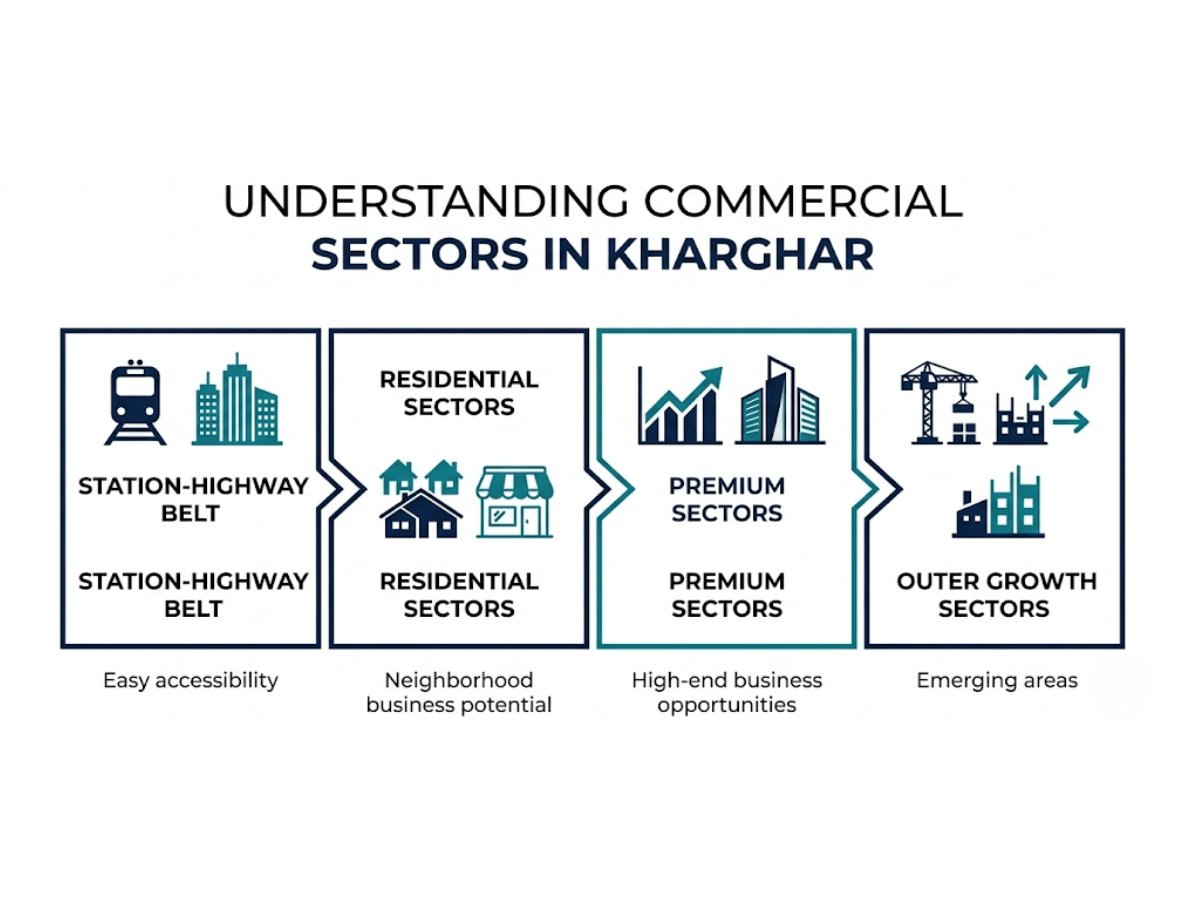
The most practical commercial sectors in Kharghar usually fall into four different buckets, and each bucket suits a different type of buyer or business.
Sector 2 and the highway-station belt are stronger for businesses that need movement, visibility, and quick customer access. Sectors 7, 10, 12, 15, and 17 are usually better for repeat-demand businesses that depend on residents, students, families, and regular visits. Sectors 20 and 21 fit more premium, destination-led businesses. Sectors 34, 35, and 36 are not the first choice for most owner-users today, but they do attract long-term investors who are betting on future development around Metro connectivity and the planned corporate park zone.
Quick sector summary
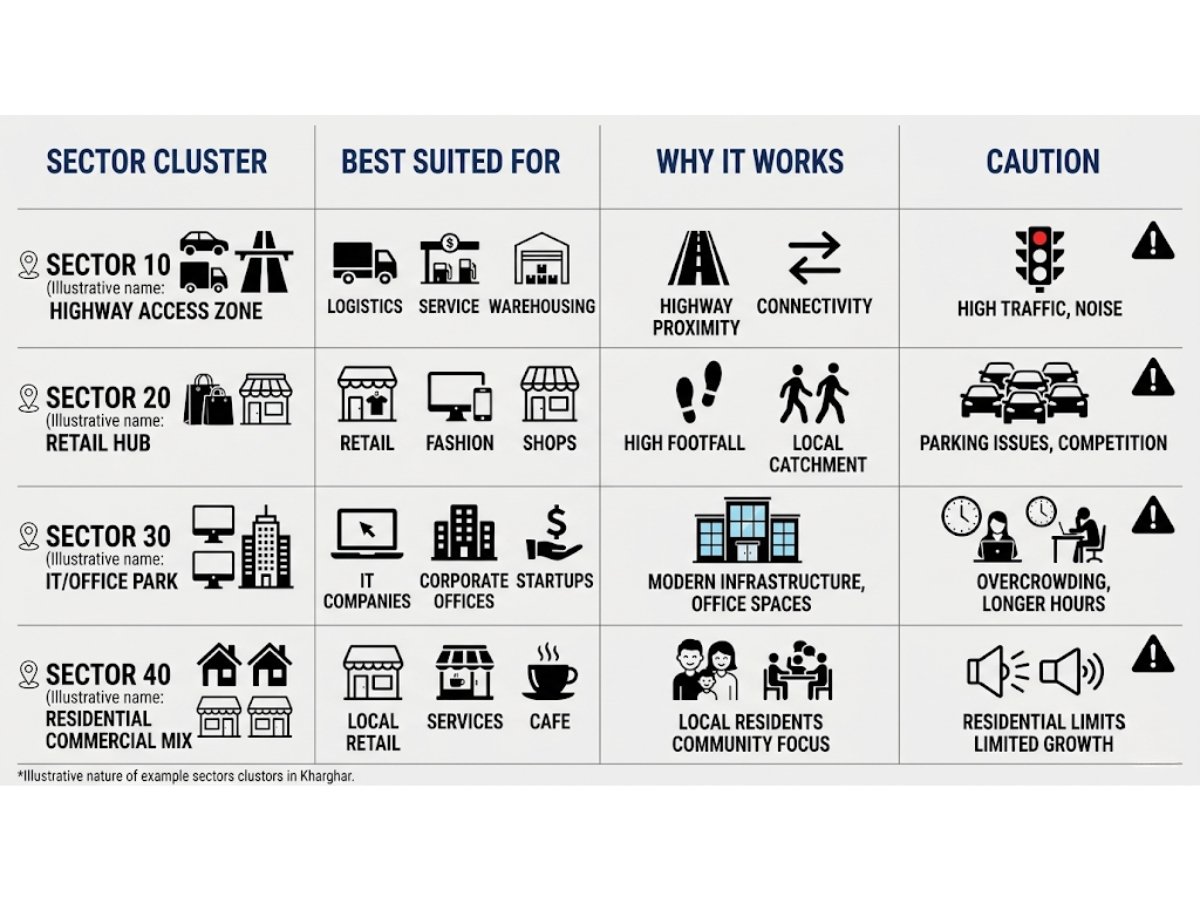
| Sector cluster | Best suited for | Why it works | Main caution |
|---|---|---|---|
| Sector 2 and station-highway belt | QSR, commuter retail, compact offices, service counters | Transit movement, station convenience, highway access | High entry cost, parking friction, not easy for low-margin businesses |
| Sectors 7, 10, 12 | Daily-needs retail, clinics, family services, formal offices | Mature residential catchment, stable repeat demand | Not every building has equal frontage |
| Sectors 15, 17 | Coaching, pathology, dental, pharmacy, student services | Education hub, family base, repeat visits | Upper-floor retail still needs strong purpose |
| Sectors 20, 21 | Premium cafes, salons, aesthetic clinics, boutique brands | Central Park and golf-course side image, destination pull | Prestige does not guarantee daily footfall |
| Sectors 34, 35, 36 | Long-term investors, selective future-facing commercial holds | Lower entry point, future infrastructure story | Weak immediate rentability, vacancy risk, environmental exposure in some pockets |
The biggest mistake in Kharghar is treating every famous sector as commercially equal. It is not.
What actually makes one Kharghar sector commercially stronger than another?
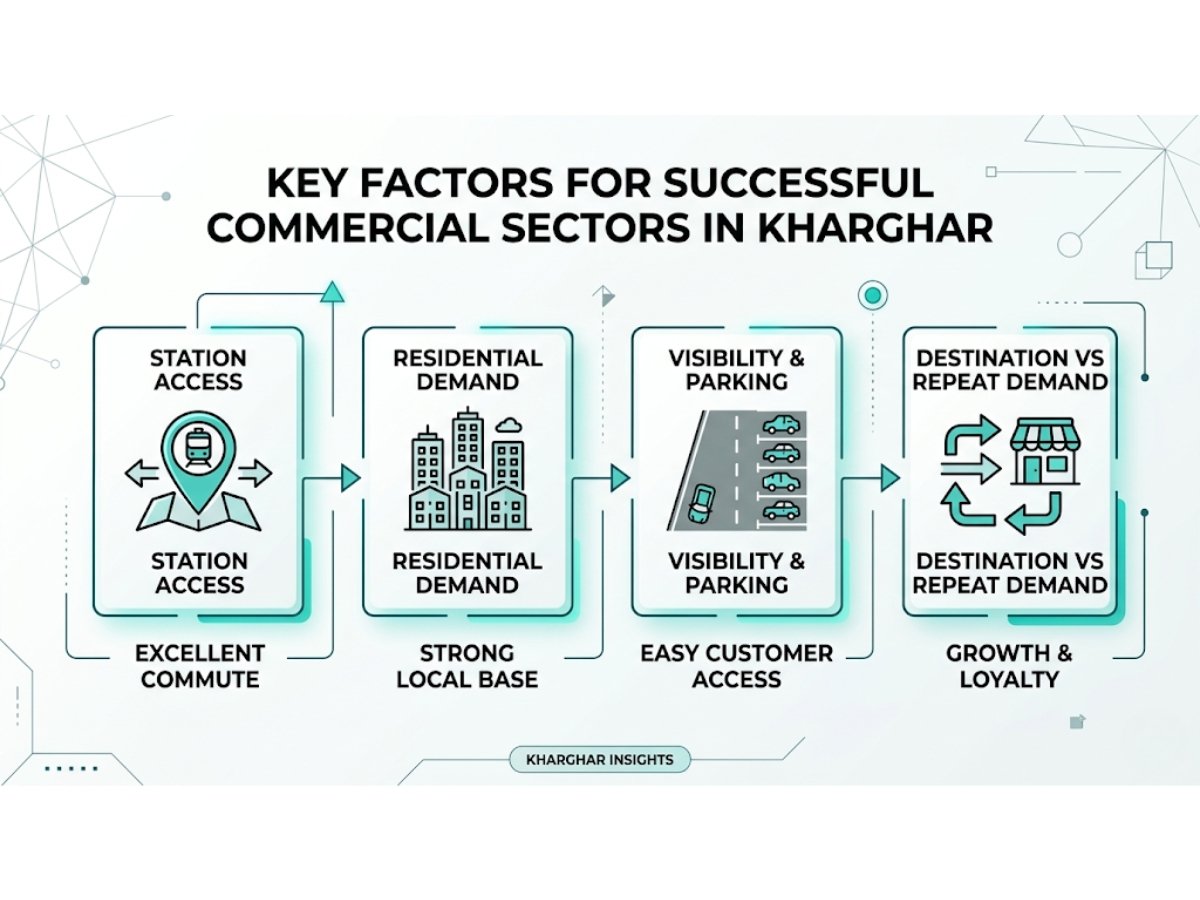
A Kharghar commercial sector becomes stronger not because it sounds premium, but because the business can survive there on real daily behaviour.
Station access and last-mile convenience
If customers, staff, or visiting clients need easy rail access, then station-side sectors have a major advantage. This matters more for offices, small service centers, banks, fast food, and businesses that depend on quick visits.
A unit that is technically near Kharghar station but awkward to reach, poorly connected, or painful for parking will not behave like a true station-led commercial asset. In Kharghar, minutes of walking distance and ease of approach matter a lot.
Residential catchment and repeat local demand
For clinics, coaching, pathology labs, pharmacies, salons, convenience retail, and family services, repeat demand matters more than brand image. This is where mature residential sectors often beat glamorous sectors.
A boring unit inside a strong residential catchment can outperform a prettier unit in a premium corridor because families keep coming back. That is the real commercial engine for many businesses.
Main-road visibility, frontage, and parking friction
Visibility helps, but visibility without stopping power is weak. If customers cannot park, cannot turn in easily, or feel they may get challaned, the road frontage loses real value.
This is one of the most ignored filters in Kharghar commercial buying. Many businesses do not fail because of the area. They fail because the building layout, frontage depth, or parking situation never supported actual customer behaviour.
Destination appeal vs daily-needs demand
Some businesses need high frequency. Others need the right customer once in a while. A grocery, lab, tuition center, or pharmacy needs repeat-use logic. A boutique salon, premium cafe, or aesthetic clinic can survive on destination-led visits.
That is why one sector cannot be best for all businesses.
Which sectors near Kharghar station work best for business and why?
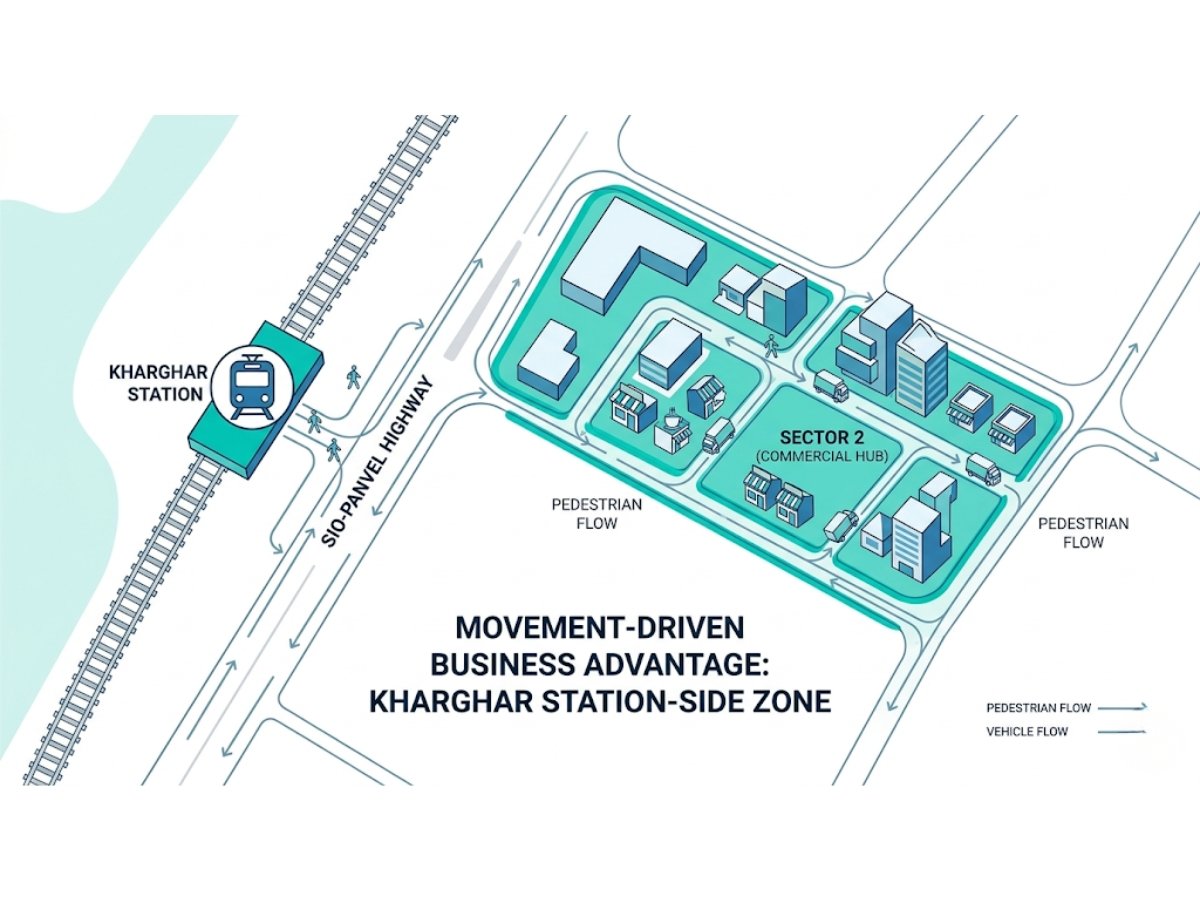
The station-side answer begins with Sector 2.
Sector 2 has a practical commercial advantage because it sits closer to the railway movement zone and the highway-side access pattern. It benefits from commuter traffic, quick-stop behaviour, and easier staff access. This makes it more suitable for quick-service food, banking, pickup-drop businesses, compact professional offices, and service retail that depends on movement more than leisurely browsing.
This belt also gains from the wider commercial energy created by established anchors like mall-side activity and transit-linked movement. For office buyers, this matters because employee commute becomes easier. For small retail, it matters because daily footfall is less dependent on one residential pocket alone.
But there is a clear caution here.
Low-margin businesses can struggle in station-side locations if acquisition cost or rent is too high. Just because a sector is commercially active does not mean every tenant profile will succeed there. If the math only works in a perfect scenario, it is not a safe commercial decision.
Are Central Park and golf course side sectors better for premium commercial use?
Yes, but only for the right category of business.
Sectors 20 and 21 carry stronger premium perception because of their link to Central Park, the golf-course side image, and a more aspirational residential environment. This makes them more attractive for businesses that benefit from lifestyle branding, experience value, and a destination-led customer.
These sectors usually make more sense for:
- premium cafes
- boutique salons
- wellness and aesthetic services
- specialty clinics
- interior or design-led studios
- selective upscale food concepts
However, these sectors are often overestimated by buyers who assume expensive surroundings automatically create strong business demand for everything.
Caution
A premium address is not the same as strong daily conversion.
If your business depends on high-volume repeat local footfall, such as a budget tuition center, standard pharmacy, basic daily-needs retail, or value-led service shop, then paying a prestige premium in this belt may reduce returns instead of improving them. Wealthy residential surroundings do not always create frequent localized transactions.
Which Kharghar sectors are better for daily-needs retail, clinics, coaching, and service businesses?
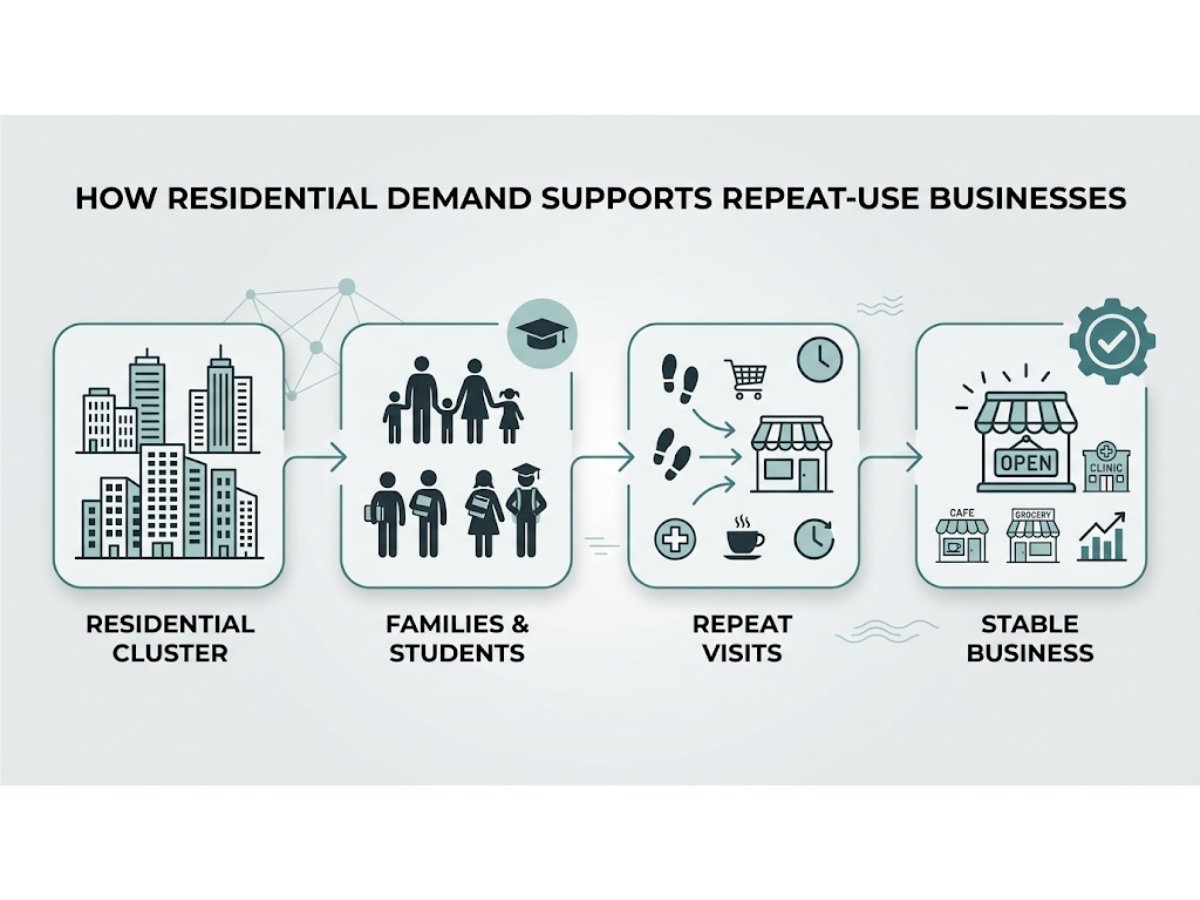
For practical, repeat-use businesses, the stronger Kharghar sectors are usually the mature central residential sectors, especially 7, 10, 12, 15, and 17.
These sectors have something more important than image: they have habit-based demand. Families live here. Students move here. Parents come back here. That makes a huge difference for businesses built on recurring visits.
Sector 10 works well for structured family-oriented services and more formal neighborhood commercial setups. Sector 12 fits many repeat-visit uses. Sectors 15 and 17 have strong educational pull and support coaching classes, student services, medical support, and pharmacy demand because of nearby institutional presence and student housing dynamics.
Where repeat-demand businesses usually fit best
| Business type | Better sector fit | Why |
|---|---|---|
| Pharmacy, pathology, dental, clinic | 10, 12, 15, 17 | Family repeat visits and practical access |
| Coaching, tuition, student services | 15, 17 | Education ecosystem and student density |
| Daily-needs shop, salon, convenience retail | 7, 10, 12 | Established residential catchment |
| Premium cafe or boutique salon | 20, 21 | Better aspiration and destination appeal |
| Commuter-led food or quick service | 2 | Transit flow and movement-driven demand |
This is where many buyers misread Kharghar. They chase the most talked-about sector instead of the most usable sector.
Which sectors make more sense for office buyers than for shop buyers?
Office logic is very different from shop logic.
A shop often lives or dies by ground-floor visibility, frontage, and instant footfall. An office does not always need that. Offices need access, building profile, ease of client visit, staff commute, lifts, signability, and practical environment.
Because of that, sectors like 10 and 11 usually make more sense for office buyers than for pure retail buyers. These sectors can support consultants, CAs, agencies, back-office setups, small corporate branches, diagnostic consulting, and professional services without needing high-street retail energy.
Sector 2 also works for certain office users, especially those who value fast access and transit convenience. But for some professional offices, being slightly away from station chaos can actually be better.
Office-buyer checklist
A Kharghar office sector usually becomes more practical when it offers:
- easy commute for staff
- decent client approach
- formal building environment
- usable upper-floor inventory
- manageable parking or visitor drop-off
- lower dependence on impulse walk-ins
This is also why upper-floor office units can still work, while upper-floor retail units often struggle badly.
Which commercial sectors in Kharghar are better for investors, and which are better for owner-users?
Owner-users and investors should not be shopping with the same logic.
Investor-friendly sectors
If someone is buying purely for long-term appreciation and can absorb vacancy, sectors 34, 35, and 36 may enter the conversation. These sectors are tied to future-facing narratives such as Metro-led deep-sector access and the planned International Corporate Park influence across the wider 28-34 belt.
Entry pricing is usually lower than the mature core. That makes them interesting for patient capital. But this is not passive easy money. Immediate rental performance is weaker, current yields are lower, and the hold period may need to be long.
Owner-user-friendly sectors
Owner-users need working demand now. Not after eight years. Not after the next big promise.
For self-use businesses, the practical choices remain sectors with proven catchment, current visibility, actual movement, and operating convenience. That usually means Sector 2 for movement-heavy uses, 7 to 17 for repeat-demand uses, and 20 to 21 for selected premium destination-led concepts.
Where rental promise is often overstated
The most overstated rental stories in Kharghar are usually attached to outer growth sectors and upper-floor retail units. A future infrastructure story can support long-term valuation interest, but it does not automatically create a tenant today.
That difference matters a lot.
Which sectors are often overhyped for commercial buying in Kharghar?
The overhyped zones are usually the ones sold on future narrative without enough present commercial proof.
Sectors 34, 35, and 36 are the obvious example. They are often marketed through the upcoming corporate park story and wider growth corridor expectations. That long-term theme is real, but it has a long execution horizon. It is not a shortcut to immediate business success or smooth rental income.
Another overhyped category is upper-floor retail in multi-level plazas without strong anchors. The price may look attractive, but in Kharghar, a cheap upper-floor shop is often cheap for a reason. Without exceptional vertical circulation, destination power, or a committed tenant type like coaching or clinic use, these spaces can remain dead.
There is one more local caution that serious buyers should not ignore. Some outer belts, especially around the Taloja-facing side, can face seasonal air-quality discomfort and odor issues depending on wind patterns. That does not make entire sectors unusable, but it does affect the suitability of open-air hospitality, premium lifestyle concepts, and certain medical uses in exposed micro-pockets.
How should you choose the right commercial sector in Kharghar based on your exact business type?
The cleanest way to choose is to match business model to sector behaviour.
For small retail shops
Choose mature residential sectors or strong transit-led zones. If you need daily repeat purchases, go where people live and return. If you need movement and quick buying, Sector 2 makes more sense.
For cafes, food counters, and destination-led concepts
Choose based on customer intent, not just visibility. Premium cafes and lifestyle-led food concepts fit better in Sectors 20 and 21. Quick-service and transit-driven formats can work better in Sector 2.
For offices and professional services
Look at Sectors 10 and 11 first, then selective station-linked options if commute is a major advantage. Professional services do not need to overpay for retail-style frontage.
For clinics, tuition, and repeat-visit businesses
Sectors 12, 15, and 17 are stronger because the business model depends on repeat visits from families and students. This is where practical catchment often beats flashy address value.
For pure rental investors
If you want current rent stability, lean toward mature sectors. If you want future appreciation and can tolerate uncertainty, outer sectors may fit. But the holding power must be real.
What should you verify before buying commercial property in a Kharghar sector?
Before buying any commercial unit in Kharghar, verify the asset first and the sector second. A good sector cannot save a flawed asset.
Due-diligence checklist
- Confirm sanctioned commercial use
- Check Occupancy Certificate status where relevant
- Verify MahaRERA details for under-construction or recently delivered stock
- Understand whether the property remains leasehold and what CIDCO transfer implications apply
- Factor in the revised commercial transfer charges before negotiating resale deals
- Confirm whether the intended business can get the required PMC trade license
- Check actual parking availability, not just brochure claims
- Ask about signage restrictions, society conditions, and operating-hour limitations
- Calculate net yield after CAM charges, not just gross promised rent
- Inspect frontage, access, lift quality, and real customer movement at peak hours
This is especially important in Kharghar because the planning side and the operating side are not the same. CIDCO shapes the node, but daily business permissions and civic enforcement sit with Panvel Municipal Corporation. That gap creates confusion for first-time commercial buyers.
Which commercial sectors in Kharghar suit which buyer best?
The best commercial sectors in Kharghar depend entirely on what you are trying to do.
If you want commuter-facing retail, compact office demand, and quick-stop business movement, Sector 2 is one of the strongest practical bets.
If you want stable daily-needs business, family services, clinics, coaching, or repeat local demand, the mature residential belt of Sectors 7, 10, 12, 15, and 17 makes more sense.
If you want premium lifestyle positioning for cafes, salons, wellness, or selective destination businesses, Sectors 20 and 21 are better suited.
If you are a long-hold investor who can wait through vacancy and market cycles, Sectors 34, 35, and 36 may justify attention, but only as patient speculative plays, not easy rental stories.
The real answer is simple: in Kharghar, the best commercial sector is not the most famous one. It is the one whose daily behaviour matches your business model, your customer movement, your holding period, and your tolerance for operational friction.
You should also read Kharghar Commercial Rates and Rent Trend to understand how pricing and demand are moving here.
FAQs
Frequently Asked Questions