
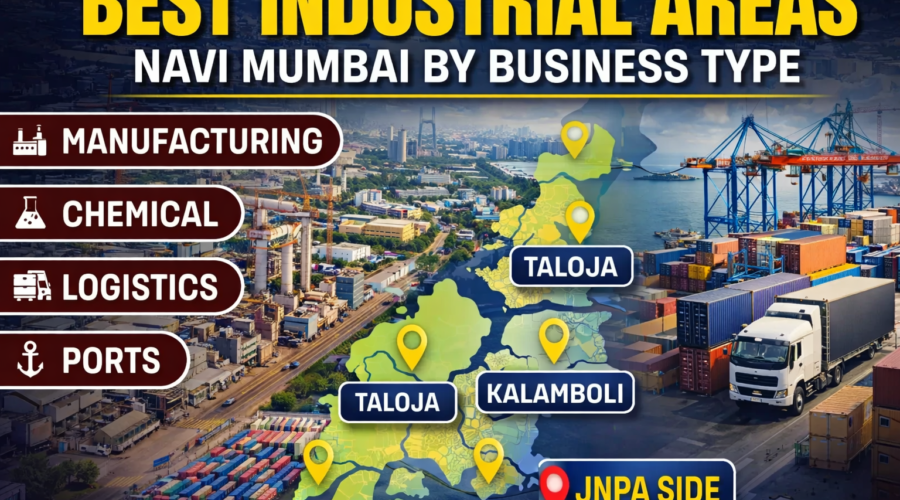
Best Industrial Areas in Navi Mumbai by Business Type: TTC, Taloja, Kalamboli, Panvel and JNPA Side
There is no single best industrial area in Navi Mumbai. The right answer depends on what your business actually does, how much truck movement you need, what compliance load you carry, how staff will reach daily, and whether you need a gala, shed, warehouse, or land parcel. In simple terms, TTC usually suits cleaner mixed industrial and tech-linked users better, Taloja suits heavier or process-oriented logic better, and Kalamboli, Panvel-side, and JNPA-linked belts usually suit warehousing and movement-heavy businesses better.
That is the real shortlist logic.
A lot of businesses lose money not because Navi Mumbai is wrong, but because they choose the wrong part of Navi Mumbai. A company that needs easy staff access and a smaller operational setup may struggle in a belt built around heavier truck logic. A warehouse user may overpay in a premium mixed-use belt that looks impressive but does not improve movement. And a buyer may pick a property only because it is called “industrial” without checking whether the exact unit, sanctioned use, and access conditions actually fit the business.
That is the core truth of this market: area name alone is not the answer; business type plus property reality is the answer.
Best industrial areas in Navi Mumbai by business type: the quick answer
| Business Type | Best Starting Areas | Why These Areas Fit | Verification Checklist |
|---|---|---|---|
| IT hardware, electronics, backend operations | Mahape, Airoli, Ghansoli | Cleaner mixed-use logic, stronger power, office-industrial environment | Building type, sanctioned use, parking, loading practicality |
| Light engineering, fabrication, vendor-based | Rabale, Pawane, Turbhe, TTC belt | Practical industrial ecosystem, vendor presence, mixed unit formats | Truck turning, floor load, mezzanine legality, utility connections |
| Heavy manufacturing, chemicals, pharma | Taloja MIDC | Process-heavy compliance, heavy industrial logic, CETP-linked | MPCB category, CETP linkage, power load, internal road access |
| Warehousing, 3PL, regional distribution | Kalamboli, Panvel belts, Taloja | Large movement logic, warehouse clustering, expressway advantages | Docking, clear height, floor load, 24-hour movement |
| Port-linked logistics, EXIM, export mfg | JNPA side, JNPA SEZ, Dronagiri | Port adjacency, growing sea-road-rail logistics advantage | Exact port relevance, lease structure, container access |
| Small MSME (Fast Start) | MIDC sheds, TTC/Taloja galas | Faster startup if unit type matches business | Sanctioned use, OC, shared building restrictions, fire compliance |
| Investor Buying for Leasing | TTC (mixed), Taloja (industrial), Panvel (logistics) | Depends on target tenant type, not headline popularity | Tenant profile, building usability, real rental demand |
Which businesses should start with the TTC belt first?
The TTC belt is usually the first answer for businesses that need a more urban-industrial environment, better staff access, mixed office plus operations use, and smaller to mid-sized industrial setups. But TTC is not one uniform market. Mahape is not the same as Pawane. Airoli is not the same as Turbhe. That difference matters.
Airoli, Ghansoli and Mahape for tech-linked, cleaner mixed-use and backend-heavy operations
If your business sits between industrial and office logic, TTC becomes very relevant. Mahape and Airoli especially work better for businesses that need reliable urban linkages, cleaner building stock in selected pockets, stronger digital infrastructure, and day-to-day staff convenience.
This is why tech-linked support businesses, electronics assembly, R&D-type functions, backend support centres, data-linked operations, and certain cleaner industrial users often begin with Mahape, Airoli, or selected Ghansoli pockets. In practical terms, these belts feel closer to a working business district with industrial roots than to a heavy factory zone.
They are also better suited when the team includes office staff, engineers, service technicians, and vendor movement rather than only full-scale trailer-based logistics. For many businesses, that daily operating rhythm matters more than raw industrial image.
Rabale, Pawane and Turbhe for practical mixed industrial use, vendor bases and smaller operational setups
Rabale, Pawane, and Turbhe usually make more sense when the business is more hands-on, more vendor-driven, and more operationally gritty. These pockets suit light engineering, practical fabrication support, food-related processing in suitable setups, smaller warehouses, trading support, and businesses that do not need the polished profile of a Mahape-type address.
They often work well for owners who want function first. Vendor ecosystem, familiarity with industrial activity, repair and service support, and smaller usable units can all matter here.
But this is also where people make a mistake. They assume every TTC property will work for all industrial users. It will not. Some older internal roads, building formats, and access points can become difficult if your actual movement depends on large trailers or heavy docking patterns.
Best fit inside TTC
- Cleaner mixed industrial users
- Electronics and engineering support
- Smaller backend-heavy operations
- Light assembly
- Vendor-linked operational businesses
- Users who need staff convenience along with industrial utility
Not automatically best for
- Red-category heavy process industry
- Very large container-dependent movement
- Businesses needing heavy yard-style operations
- Users who need broad internal road geometry at every step
When Taloja MIDC is the better answer than TTC
Taloja is the stronger answer when your business is industrial in the real sense, not just in the property brochure sense. If the business has process load, heavier utilities, bigger movement needs, or stricter environmental handling, Taloja often makes more sense than TTC.
Best fit businesses in Taloja
Taloja MIDC is usually the natural shortlist for chemical processing, bulk pharma-linked activity, heavy engineering, selected food processing, larger sheds, and industrial operations that need a more traditional heavy-industry setting. It also matters for warehousing, especially where the user wants larger industrial formats rather than smaller mixed urban units.
One practical reason is compliance fit. Businesses that fall into stronger MPCB scrutiny or need environmental infrastructure may find Taloja more realistic than belts that are better suited to cleaner operations. This does not mean every Taloja property is automatically compliant. It means the belt is structurally more aligned to such uses.
The other reason is built form. Taloja has stronger logic for larger industrial sheds, broader movement patterns in suitable zones, higher power requirements, and heavy-use industrial activity. If you are choosing between TTC and Taloja for a genuinely process-oriented business, Taloja often wins on industrial suitability.
When Taloja becomes the wrong recommendation
Taloja becomes the wrong answer when the business is lighter, faster, more staff-sensitive, or more office-linked than the owner first assumes. A small electronics unit, a backend-heavy operations company, a service-led industrial user, or a business where daily staff convenience matters more than industrial scale may find Taloja inconvenient.
It can also be the wrong answer when the buyer sees lower price levels compared to TTC and assumes that means better value. Lower entry cost does not help if the business later struggles with commute friction, wrong building type, wrong unit format, or unnecessary compliance complexity.
Important caution: popularity does not make an area suitable. Taloja is often recommended too loosely. It suits a particular industrial logic. It is not the automatic answer for every manufacturing or MSME setup.
Where warehousing, transport and large vehicle movement usually work better
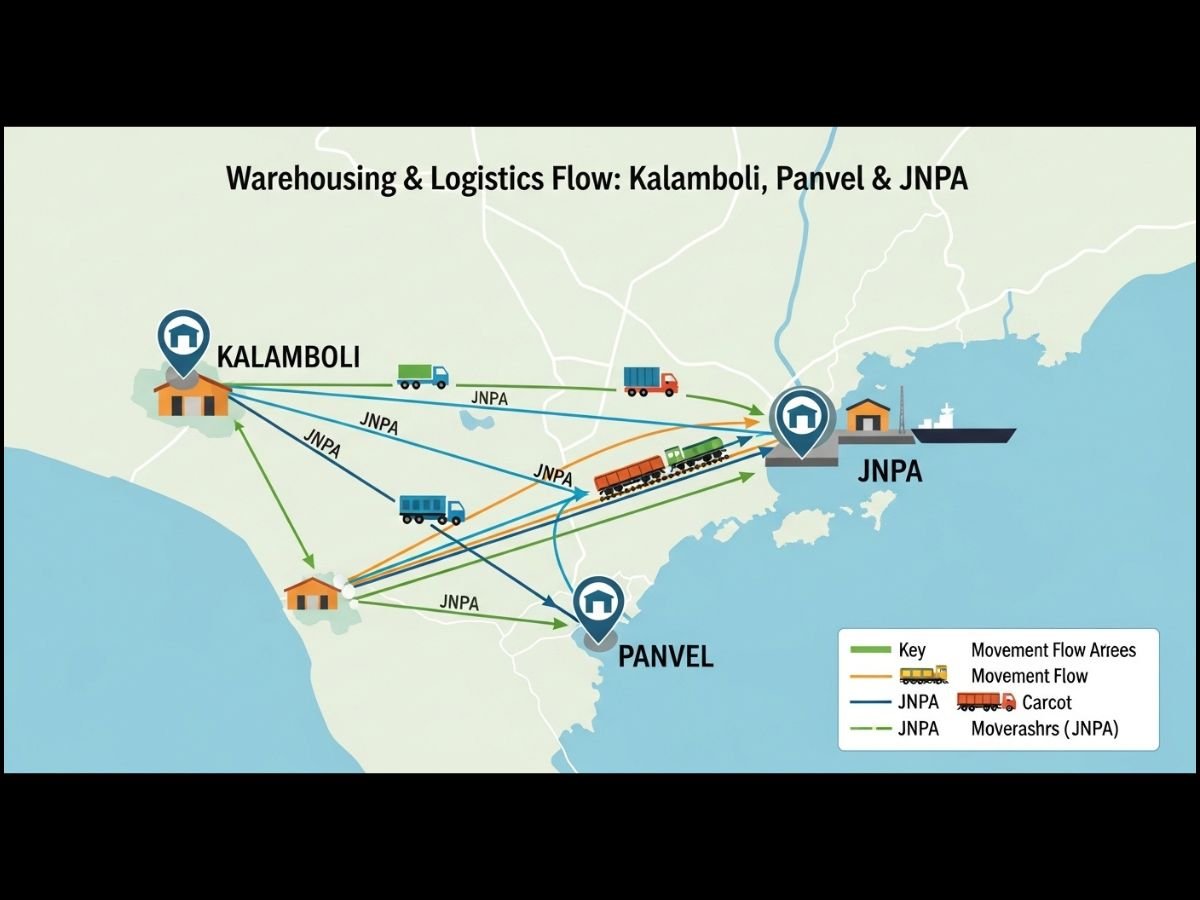
For logistics-heavy users, the question is not “Which industrial area is famous?” The question is “Which belt reduces movement friction?” For that, Kalamboli, Panvel-side belts, selected Taloja logistics stock, and JNPA-side logic usually become stronger than core TTC.
Why Kalamboli works well for warehouse and transport-heavy operations
Kalamboli is one of the clearest answers for warehousing and transport-heavy logic because the ecosystem itself supports movement, storage, and distribution. It is not just about location on the map. It is about how the area behaves operationally.
Warehouse concentration, truck-oriented movement logic, and access toward larger regional routes give Kalamboli a natural advantage for 3PL, transport yards, distribution, steel and commodity movement, and warehousing users who value practical throughput more than urban polish.
That said, even in Kalamboli, not every property is equal. One warehouse may work smoothly because the approach road, turning radius, and loading bay design are right. Another may sit in the same broad belt but still fail operationally because access is weak.
When Panvel-side belts make more sense than core Navi Mumbai belts
Panvel-side logic becomes stronger when the user is thinking regionally rather than only within core Navi Mumbai. This usually applies to larger warehousing, regional distribution, highway-linked logistics, and businesses that need to connect toward Pune-side, Raigad-side, or wider movement corridors.
Panvel also sits in an area where the infrastructure story has grown stronger in recent years. That makes it attractive for logistics, large movement users, and industrial occupiers who want a gateway-style location rather than a denser urban-industrial one.
This does not mean every Panvel-side plot is a warehouse winner. It means the corridor often fits regional movement logic better than premium mixed-use industrial belts.
Where JNPA-side and Dronagiri logic becomes relevant
JNPA-side and Dronagiri become relevant when the business is genuinely port-linked, export-import dependent, or tied to container logistics and maritime trade. This is where many businesses make another expensive mistake: they hear “near port” and assume automatic advantage.
Port-side logic only works when the business model actually benefits from port adjacency. If your business is domestic light assembly with no real EXIM dependence, you may be paying for a story you do not use.
Where it does fit, though, the fit is strong. JNPA-linked warehousing, export-support logistics, FTWZ-style activity, port-linked manufacturing support, and high-movement EXIM operations can benefit from the belt around JNPA, JNPA SEZ, and Dronagiri.
If you need a smaller gala, ready shed or faster start, where should you look first?
Small-unit users should usually begin with unit type, not area glamour. A well-fitted gala or ready shed in the correct belt can be far better than a bigger but mismatched property in a more famous industrial location.
How MIDC sheds and galas change the search
MIDC-oriented industrial stock matters because many small and mid-sized occupiers do not need land-play logic at all. They need a usable unit that allows quicker startup. In those cases, galas and ready sheds can change the decision completely.
A small packaging unit, light assembly user, repair-linked business, service-support operator, or non-heavy MSME may be better off looking at suitable flatted factories or smaller industrial sheds instead of dreaming about a standalone plot. That is cheaper, faster, and often more realistic.
But the unit must match the activity. A gala works for some businesses and fails for others. Shared access, service lift dependence, floor loading, fire norms, parking, and mezzanine legality all matter.
Why small-unit buyers should worry about legal fit before price
This is where many small buyers go wrong. They compare only ticket size. They do not check whether the unit is legally and physically suitable.
Before buying a small gala or shed, check:
- Sanctioned industrial use
- Occupancy Certificate where applicable
- Whether the physical unit matches approved plans
- Whether mezzanine or loft additions are authorized
- Power load suitability
- Loading and unloading practicality
- Fire and access norms
- Transfer and authority permissions where relevant
A cheap industrial unit is expensive if the business cannot legally or practically run inside it.
MIDC area, CIDCO node or private industrial estate: why this changes the deal
The same business can feel completely different depending on whether the property sits in a MIDC area, a CIDCO-planned node, or a private industrial estate. This is not technical background. This changes real money, documentation, transfer friction, and daily operations.
In broad terms, MIDC areas are more production-oriented. TTC and Taloja fit that pattern. CIDCO nodes such as Kalamboli and Dronagiri sit inside a more urban-planned framework where transfer permissions, node-level development rules, and authority-side handling often matter more directly.
Private industrial estates introduce another layer altogether. The building may look usable, but the land title chain, sanction position, common-area control, transfer process, and utility reality may be very different from a direct MIDC or CIDCO context.
For buyers and tenants, this changes:
- transfer permissions and charges
- documentary comfort
- development norms
- utility handling
- road and service management expectations
- mortgage and transaction ease in some cases
This is why two similar-looking properties can behave very differently after purchase.
Practical rule: do not compare only square feet, price, and location pin. Compare authority structure as well.
What to check before believing a property is truly right for your business
This is the most important section in the article because this is where real mistakes are prevented. The exact plot, sanctioned use, unit type, and access conditions matter more than the broker’s area label.
Sanctioned use and planning reality
First check whether the property is actually permitted for your use. “Industrial” is too broad. A warehouse user, a chemical processor, a food unit, and a light assembly business do not carry the same use logic.
Also check whether the physical structure matches the approved plan. Unauthorized mezzanines, expanded lofts, altered layouts, and missing OC can create serious problems later.
Building type, loading, movement and utility practicality
The building format must suit the business. A gala, shed, standalone RCC building, and warehouse shell are not interchangeable. Check:
- floor loading
- clear height
- crane provision if needed
- dock height
- parking and circulation
- gate width
- internal movement path
- utility readiness
A property can be in the right area and still be the wrong unit.
MPCB and other compliance load where relevant
Do not flatten all industrial users into one compliance bucket. Some users have minimal pollution load. Others face full environmental scrutiny. If the business falls into stronger MPCB categories, location choice becomes far more sensitive.
For such users, the area must support the compliance reality. That is why Taloja may be stronger for some operations than TTC. But this must be matched to the exact process, not guessed from the company name.
Staff access, truck access and daily operational friction
Some businesses fail not because the rent is high but because daily movement is badly designed. Staff cannot reach easily. Trucks struggle to turn. Loading happens on a narrow internal road. Parking spills outside. Night movement becomes painful.
This is why site visits matter. A map pin is not enough. Watch the actual road width, truck turning behaviour, internal congestion, and surrounding activity.
Which area usually fits better if you are buying for own use, leasing, or investing?
| Buyer Type | Better Starting Logic | Why It Matters |
|---|---|---|
| End-user occupier | Choose by exact operational fit first | Daily business efficiency matters more than broad market story |
| Lease-first operator | Choose by startup speed, flexibility, and usability | The business needs workable space, not long-term capital lock-in |
| Investor buying for rental | Choose by actual tenant depth in that micro-market | A popular area is useless if the unit type does not match tenant demand |
End-user occupier
If you are buying for your own business, the best area is the one that reduces friction for ten years, not the one that sounds strongest in conversation. A light engineering user may benefit from TTC-side practical belts. A chemical user may need Taloja. A logistics operator may need Kalamboli or Panvel-side logic.
Lease-first operator
Tenants should be even more practical. Time to start, deposit burden, fit-out requirement, loading setup, utilities, and access often matter more than prestige. Many lease-first operators are better off in an operationally correct second-choice area than in a premium but inconvenient first-choice area.
Investor buying for rental demand
Investors should think like future occupiers. Do not buy industrial property by headline only. Ask who the likely tenant is. A smaller mixed-use industrial tenant may prefer TTC-side logic. A warehouse operator may prefer Kalamboli or Panvel-side practicality. A port-linked user may only value JNPA-side logic if the business truly needs it.
Common business-type mismatch mistakes people make in Navi Mumbai
These mistakes are extremely common:
- Taking a TTC unit for a business that actually needs larger truck movement, broad loading space, and warehouse-style operations
- Taking Taloja for a lighter staff-heavy operation just because the entry pricing looks easier than TTC
- Buying a “cheap industrial gala” without checking sanctioned use, floor loading, or mezzanine legality
- Assuming Kalamboli and Panvel mean the same thing for every logistics user
- Paying a premium for JNPA-side land without real export-import dependence
- Treating every industrial-looking plot as safe for industrial activity
These errors usually come from one habit: choosing by area reputation instead of business fit.
Conclusion
The best industrial area in Navi Mumbai depends on business type, not popularity. TTC usually fits cleaner mixed industrial, smaller operational, and tech-linked users better. Taloja usually fits heavier manufacturing and process-oriented industrial logic better. Kalamboli and Panvel-side belts usually work better for warehousing, transport, and regional movement. JNPA-side and Dronagiri matter most when the business is genuinely port-linked.
Use the area name only as a starting filter. The real decision should be made after checking the exact unit type, sanctioned use, authority structure, truck and staff movement, and compliance load. In this market, the winning choice is rarely the most famous belt. It is the belt that matches how the business will actually run every day.