
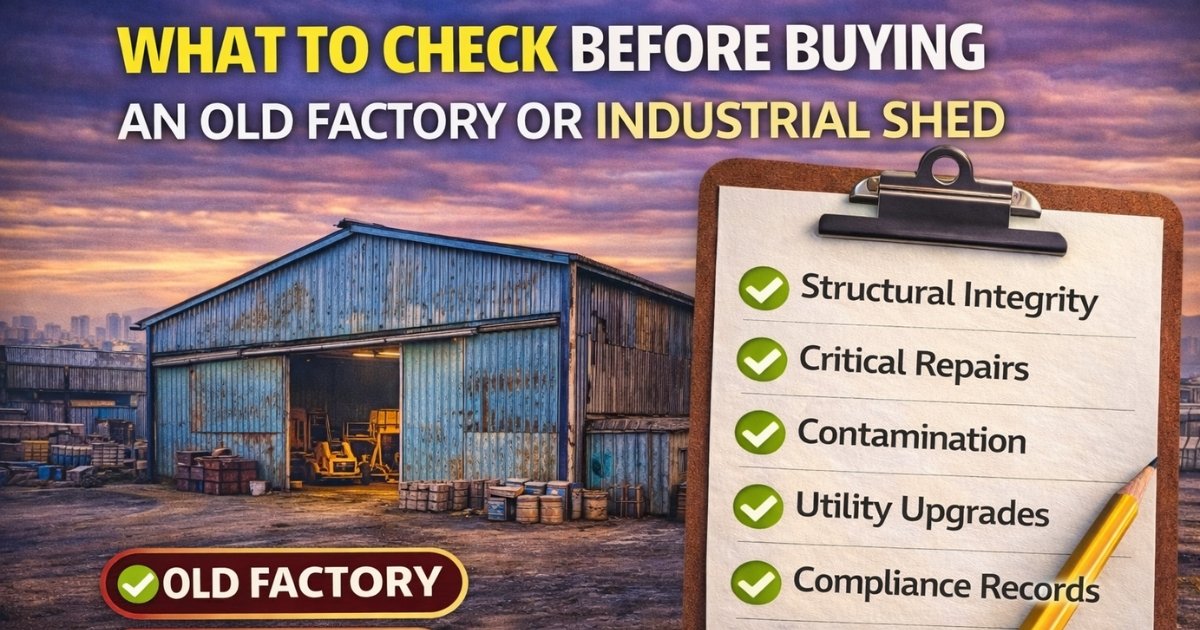
What to Check Before Buying an Old Factory or Industrial Shed in Navi Mumbai
Buying an old factory or industrial shed can make sense, but only if the file, structure, access, utilities, approvals, and transfer conditions are still workable. Age by itself is not the real problem. The real risk is buying a unit that looks cheap but later demands heavy repair money, carries old dues, has transfer restrictions, or simply does not suit modern industrial use. That is what you need to check before token, agreement, and final payment. In Navi Mumbai and nearby industrial belts, this matters even more because older stock is common in places like the TTC belt and Taloja. Many of these units were built for a very different era of trucks, machinery, pollution control, and building compliance. So the right question is not “Is the shed old?” The right question is “How much usable life, legal clarity, and operational value is still left in it?” Should you even consider buying an old factory or industrial shed? Yes, sometimes you should. An old industrial property is not automatically a bad deal. In fact, in established belts, an older unit can still be a smart buy if the location is strong, the file is clean, and the building can still support your use without massive hidden capex. The mistake is assuming that old means cheap value. Sometimes it means cheap trouble. A 25-year-old shed with intact structure, good truck movement, valid approvals trail, and clean transferability can be safer than a newer-looking property with unauthorized changes or weak paperwork. Quick summary Check area Good sign Bad sign Why it matters Title and transfer Clear ownership and transferable rights Past transfers done informally or without authority approval Registration alone does not always make the transfer clean Structure Repairable ageing, manageable leakage, usable floor Major corrosion, settlement, structural distress A cheap structure can become a rebuilding project Access and loading Trucks can enter, turn, load, and exit practically Blind reverse, narrow gate, weak loading geometry Poor movement kills daily operations Approvals and utility Valid or renewable compliance trail Expired consents, missing plans, unclear power/water status Old papers do not automatically protect present use Hidden costs Repair budget still lower than value gain Roof, fire, drainage, electrical, and regularisation costs too high Cheap purchase price is not the real entry cost A simple rule helps here: do not buy age; buy remaining utility. What should you check first before even visiting the site? Before you spend time on a physical visit, ask for the basic file first. Many industrial deals collapse on paper long before a site inspection becomes relevant. In practical terms, the seller should be able to share a preliminary document set: allotment-related papers if authority land is involved, ownership proof, latest tax receipt, current approval status, utility snapshot, and photographs that match the sanctioned structure. If the file already looks confused, the site visit is just a distraction. Start with the property file, not the building The first check is simple: who owns what, and under which rights? In industrial belts around Navi Mumbai, many buyers assume they are buying land ownership when they are actually buying leasehold rights subject to authority conditions. That difference changes valuation, transfer cost, and future control. Also confirm whether the seller is offering only the built structure, the leasehold interest, an occupied running setup, or some bundled business transfer story. These are not the same transaction. Confirm what exactly is being sold This is where many first-time buyers make a costly mistake. A broker may say “factory available” as if it is one simple asset. But you need to know whether you are buying: leasehold rights in authority-governed land an old structure sitting on that land a tenanted or occupied unit machinery and business setup along with premises a property that has been altered beyond approved plans If this is not clearly defined, stop and clarify it before moving forward. > Caution: If the sanctioned building record shows a smaller or different structure than what is standing on site, that is not a minor paperwork issue. It can affect transfer, compliance, finance, and even future demolition or regularisation options. Which documents matter most before you pay token? Token payment is the stage where many buyers lose leverage. Once money is paid, even a “small token” becomes a negotiating trap. So before token, document checking must be serious. Broadly, you should verify four pillars: ownership, transferability, building legality, and dues. Title chain and present ownership proof The seller must prove a clean title history and present authority to sell. In industrial property, this is not just about the latest name on paper. You need to understand the chain, past transfers, and whether any encumbrance, mortgage, or unresolved claim exists. A current encumbrance check and a properly reviewed title chain are basic. They do not guarantee perfection, but they are the minimum starting point before your legal team proceeds further. Transfer permission, authority conditions, and pending restrictions This becomes critical in Navi Mumbai because industrial assets may sit under MIDC or CIDCO-type authority frameworks, not a simple freehold setup. A transfer recorded with the sub-registrar does not automatically mean the lessor authority has approved it. That is a major distinction. Also check whether there are lock-in conditions, mortgage NOCs, transfer premiums, or usage-related restrictions. In some cases, authority charges and transfer economics can materially change the transaction math. Step 2 research also highlights that CIDCO transfer charges rose sharply in 2025, making authority identification a serious financial issue, not a minor clerical detail. Sanctioned plans, approvals, and completion-related records Ask for the sanctioned plan and compare it with the actual structure. This matters more than many buyers realize. An unauthorized mezzanine, extended shed portion, extra floor, or altered footprint can later block approvals, transfer, finance, or operational licensing. If BPAMS-style digital approval systems or formal occupancy/completion-related records apply, they should align with the physical structure. Old photocopies alone are not enough. Tax, utility, and authority dues Do not inherit old defaults by accident. In Navi
Read More