Blogs

Everything about Navi Mumbai

Navi Mumbai Airport Real Estate Impact: Which Areas Are Rising and by How Much

The Navi Mumbai International Airport (NMIA) has already triggered one of the most significant real estate surges in the Mumbai Metropolitan Region. Since NMIA began commercial operations in December 2025, apartment prices in key surrounding zones have risen 74% compared to 2021, with residential plots in some pockets appreciating by as much as 93%. For buyers and investors tracking the Navi Mumbai airport real estate impact, the data is now clear: the airport effect is not speculative anymore. It is measurable, on-ground, and still unfolding. What Is the Navi Mumbai Airport and Why Does It Matter for Real Estate? The Navi Mumbai International Airport (NMIA), developed by Adani Airports (74%) and CIDCO (26%), is built across 1,160 hectares in Ulwe. The total project investment stands at approximately Rs 16,700 crore. Phase 1 is designed to handle 20 million passengers annually, with a long-term capacity target of 90 million passengers. NMIA was inaugurated by Prime Minister Narendra Modi on October 8, 2025. Commercial flights commenced on December 25, 2025, with the first IndiGo flight arriving from Bengaluru. According to CIDCO, the airport was decades in planning and is now India’s most significant greenfield airport in terms of scale. Its impact on surrounding land values is being compared to how Hyderabad’s Rajiv Gandhi International Airport transformed the Shamshabad corridor. The “airport effect” in real estate is well-documented globally: when a major transit hub opens, surrounding land sees strong appreciation driven by employment generation, commercial activity, and improved connectivity. In Navi Mumbai, all three are now active simultaneously. Key Micro-Markets Seeing the Highest Appreciation Ulwe: The Closest Bet to the Runway Ulwe sits directly adjacent to NMIA and has emerged as the highest-appreciation zone. Properties here have seen 40-80% appreciation over the past five years, depending on location and project quality. Current apartment rates are in the range of Rs 12,000 to Rs 18,000 per square foot. Ulwe was considered an overlooked micro-market as recently as 2020. Post-airport, it has become one of Navi Mumbai’s most sought-after investment destinations, attracting both end-users and high-net-worth investors. For investors with a 3 to 5-year horizon, Ulwe offers the strongest correlation between infrastructure and appreciation. The risk is that much of the speculative price movement has already occurred in the most premium projects. Panvel: Infrastructure Depth, Not Just Airport Adjacency Panvel’s strength is not just its proximity to NMIA. It is the convergence of multiple infrastructure projects: the Mumbai-Pune Expressway, Atal Setu (MTHL), metro line expansion, and the airport itself. Between 2021 and 2025, apartment prices in Panvel climbed to Rs 10,000 to Rs 12,000 per square foot, representing a 74% increase in capital value. Residential plot prices have surged 93%, currently trading at Rs 80,000 to Rs 85,000 per square yard. Panvel is increasingly being positioned as a transport and logistics hub for the broader MMR. With the airport operational and the Atal Setu reducing travel time to South Mumbai to 20-45 minutes, Panvel has effectively shed its satellite-city status. Kharghar: Established Demand Meeting Fresh Momentum Kharghar was already one of Navi Mumbai’s most developed residential zones before the airport boom. Appreciation here has been steadier rather than explosive. Some projects have reported 20% gains over 18 months. Current rates in Kharghar range from Rs 12,000 to Rs 15,000+ per square foot depending on the project. The arrival of CIDCO’s 375-acre International Corporate Park and the airport’s employment ecosystem are expected to deepen commercial demand in Kharghar through 2027. For buyers seeking livability alongside investment value, Kharghar remains one of the most balanced options in the airport influence zone. Dronagiri: The Affordable Entry Point Dronagiri is positioned as a future growth corridor. It offers relatively affordable entry points at Rs 6,500 to Rs 9,000 per square foot, making it the go-to zone for first-time buyers and long-horizon investors. The trade-off is infrastructure maturity. Dronagiri still requires time for on-ground amenities, connectivity, and commercial activity to fully develop. Buyers entering here should plan for a minimum 5-year hold period. Taloja: Metro-Driven Growth Taloja is benefiting more from Metro Line 1 (Belapur-Pendhar) than directly from the airport. With the metro fully operational, Taloja is seeing 11-16% annual appreciation forecasts. Current rates are among the more affordable in the Navi Mumbai corridor at around Rs 8,700 per square foot, making it viable for mid-income buyers. Property Price Data: What Numbers Actually Look Like The table below summarizes current price benchmarks across key airport-influence zones as of 2026: Area Approx. Rate (Per Sq Ft) Appreciation (2021-2026) Investor Profile Ulwe Rs 12,000 – Rs 18,000 40-80% High-risk, high-return Panvel Rs 10,000 – Rs 12,000 74% Balanced Kharghar Rs 12,000 – Rs 15,000+ Steady 15-20% Livability + growth Dronagiri Rs 6,500 – Rs 9,000 Early appreciation Long-horizon investors Taloja Rs 8,700 11-16% annually Mid-income buyers Figures sourced from market reports and property consultants. Verify current rates directly with developers or [MahaRERA](https://maharera.maharegistration.gov.in) registered projects before transacting. What Is Driving the Appreciation Beyond the Airport? The NMIA’s impact is amplified by three parallel infrastructure developments that have matured simultaneously. Atal Setu (MTHL): India’s longest sea bridge, inaugurated in January 2024, cut travel time between South Mumbai and Navi Mumbai from two hours to 20-25 minutes. Areas like Ulwe and Panvel, previously considered remote, are now viable daily commute zones for Mumbai’s business districts. Navi Mumbai Metro Line 1: Fully operational on the Belapur-Pendhar corridor, the metro has opened up Kharghar and Taloja to a wider base of daily commuters. The planned extension connecting the airport to BKC (Bandra-Kurla Complex) is under development and will further reshape the southern corridor’s investment profile. NAINA (Navi Mumbai Airport Influence Notified Area): CIDCO is implementing a planned urban development framework across 94 villages surrounding the airport. Infrastructure projects worth Rs 2,550 crore are underway, including roads, utilities, and civic amenities. NAINA is designed to function as an aerotropolis over the long term, ensuring that the growth around NMIA is structured rather than speculative sprawl. Aerocity Development: The Maharashtra government has accelerated plans for a 667-acre Aerocity

Read More

Navi Mumbai Airport Impact on Pushpak Nagar: Property Prices, Growth & Investment Guide

Pushpak Nagar is the closest CIDCO-planned residential node to the Navi Mumbai International Airport sitting just 1.5 to 3 kilometres from the terminal and is currently in the earliest stages of what analysts describe as an airport-driven growth cycle. Property prices here have moved from ₹6,000 to ₹7,000 per sq ft a few years ago to ₹9,000 to ₹11,000 per sq ft today, with experts projecting 30% to 50% appreciation over the next three to five years as airport operations, metro connectivity, and the logistics hub development mature. What Is Pushpak Nagar? Pushpak Nagar is a planned residential node developed by CIDCO, located in the Dapoli area of Navi Mumbai. It sits within the cluster formed by Ulwe, Dronagiri, and Uran all of which fall inside CIDCO’s airport influence planning zone. Unlike most of the other nodes discussed in Navi Mumbai’s airport story, Pushpak Nagar is not an established city district. It is a purpose-built node positioned to serve as a residential and commercial base for the airport economy. That distinction is both its risk and its upside. The proximity is not metaphorical. Areas around Bamandongri, which falls within the Pushpak Nagar development zone, are just 2 to 3 kilometres from the NMIA terminal. Central sectors of Pushpak Nagar fall within a 5-kilometre radius. No other planned residential node in Navi Mumbai sits this close to the airport. The Airport Opens and Pushpak Nagar’s Clock Starts The Navi Mumbai International Airport was inaugurated by Prime Minister Narendra Modi on October 8, 2025. Commercial flight operations began on December 25, 2025, with the first IndiGo flight from Bengaluru landing at 8:00 AM. The airport is now fully operational with Phase 1 capacity of 20 million passengers annually, scaling toward 90 million passengers across its full multi-phase build-out. The inauguration activated a dynamic that Pushpak Nagar investors had been positioning for: the transition from speculative demand to actual economic activity. Jobs in aviation, ground handling, hospitality, logistics, retail, and services are being created within minutes of Pushpak Nagar. Local businesses hotels, restaurants, logistics providers, service companies are establishing operations in the node to serve both airport employees and passengers. This wave of commercial activity is what turns a planned node into a functioning economic cluster. For reference, a comparable dynamic played out in Ulwe over the years preceding the airport’s inauguration. Pushpak Nagar is now entering the early phase of that same cycle but with the airport already operational rather than years away. Property Prices in Pushpak Nagar: Where Things Stand The most important thing to understand about Pushpak Nagar’s price story is that it is in the early growth phase, not the mature phase. That means prices have moved but have not yet reflected the full value of what is being built around them. Current Price Range Residential apartments in Pushpak Nagar currently range from ₹9,000 to ₹11,000 per sq ft for standard configurations. Some projects closer to the airport boundary and main access roads quote a slight premium. A more granular view from 2026 data puts most active projects between ₹7,000 and ₹8,500 per sq ft depending on construction stage, sector, and builder. Premium projects with better finishes and airport-facing positions are closer to ₹10,000 to ₹15,000 per sq ft. The weighted average price on platforms like 99acres shows approximately ₹10,750 per sq ft across active listings. How Prices Have Moved Plots and apartments that were transacting at ₹6,000 to ₹7,000 per sq ft a few years ago are now in the ₹10,000 plus range a 40% to 65% increase from early baseline levels. The airport’s inauguraton in October 2025 accelerated the pace of enquiries and transactions noticeably. For context, areas immediately adjacent to NMIA’s influence zone have appreciated 40% to 80% over the past five years depending on location and project quality. Pushpak Nagar sits at the lower end of that range historically, which is precisely what makes it attractive to buyers entering now. Price Comparison With Adjacent Nodes Node Current Residential Range Proximity to NMIA Development Stage Pushpak Nagar ₹7,000 – ₹11,000/sq ft 1.5 – 5 km Early growth Ulwe ₹14,500 – ₹16,600/sq ft 3 – 7 km Mid-stage, active Panvel ₹10,000 – ₹12,000/sq ft 12 km Established Dronagiri ₹6,500 – ₹9,000/sq ft 5 – 9 km Very early stage Kharghar ₹12,000 – ₹18,000/sq ft 10 – 15 km Mature, established Pushpak Nagar currently occupies the gap between Dronagiri’s raw, very early stage and Ulwe’s more established mid-stage pricing. It offers airport proximity closer than Ulwe at prices still below Ulwe’s current levels. That gap is expected to narrow as infrastructure matures. The Infrastructure Building Around Pushpak Nagar Pushpak Nagar’s growth story is not just about the airport terminal nearby. It is about everything being built around and between the airport and this node. CIDCO’s 925-Acre Integrated Logistics Park (ILP) at Pushpak Node This is one of the most significant commercial developments directly tied to Pushpak Nagar’s future. CIDCO has launched the bidding process for the first phase of a 925-acre Integrated Logistics Park at the Pushpak Node. This is expected to be one of the largest logistics infrastructure projects in the Mumbai Metropolitan Region. The ILP will attract warehousing, cold chain, freight forwarding, and e-commerce fulfilment operations that need airport and port adjacency. JNPT, India’s largest container port, is also nearby. Together, NMIA and JNPT make the Pushpak Node one of the most strategically located logistics corridors in India. The employment that flows from this logistics park direct and indirect will create structured housing demand within Pushpak Nagar for years. Ulwe Coastal Road This ₹1,590 crore project is a 6.7-kilometre six-lane elevated road connecting the Atal Setu junction at Shivajinagar directly into the airport terminal via an elevated link. Construction is progressing. When complete, this road will make Pushpak Nagar one of the most airport-accessible nodes in the entire MMR not just in straight-line distance but in actual drive time. Mumbai Trans Harbour Link (Atal Setu) The MTHL, India’s longest sea bridge at 21.8 kilometres, connects

Read More

Atal Setu vs Airport Real Estate Impact: Which One Is Doing More for Navi Mumbai Property Prices?

Both the Atal Setu (Mumbai Trans Harbour Link) and the Navi Mumbai International Airport (NMIA) have driven real estate appreciation in the same corridors. But they work differently, affect different buyer profiles, and have played out across different timelines. Atal Setu, inaugurated in January 2024, delivered an immediate connectivity jolt. NMIA, operational from December 2025, is an employment and commercial ecosystem that will take years to fully mature. For buyers trying to understand which infrastructure project carries more weight for their specific decision, here is a direct comparison. The Core Difference: What Each Project Actually Does The starting point is understanding what each project is, at its core. Atal Setu (MTHL) is a connectivity infrastructure project. India’s longest sea bridge at 21.8 km, it connects Sewri in Mumbai to Nhava Sheva in Navi Mumbai. Its direct output is reduced travel time: the journey between South Mumbai and Navi Mumbai dropped from two hours to 20-25 minutes from the day it opened. That is its real estate value proposition in a single sentence. Properties near MTHL exit points became viable primary residences for professionals working in Mumbai’s traditional business districts. NMIA is an economic infrastructure project. Its real estate impact comes not from cutting commute times but from generating employment, triggering commercial development, attracting logistics hubs, and establishing a new economic center. The airport effect on real estate is broader but slower. It operates over a 5-10 year horizon rather than an immediate post-opening surge. Neither is simply “better.” They are different types of catalysts. Timeline: Which Came First and Why It Matters Atal Setu opened on January 12, 2024. Its impact on real estate was visible almost immediately. Areas like Ulwe, Nhava Sheva, and Panvel saw 10-15% appreciation within six months of the MTHL’s inauguration. NMIA’s commercial operations began December 25, 2025. However, much of NMIA’s real estate impact was priced in earlier. The announcement effect, land acquisition, and construction activity had been pushing prices in airport-adjacent zones upward since 2019-2020. The 74% appreciation in Panvel between 2021 and 2025 reflects both the airport anticipation and the Atal Setu opening rather than either in isolation. This sequencing matters for investors. If you bought in Ulwe or Panvel before 2022, you benefited from both announcement effects. If you are entering now, the post-announcement appreciation has already occurred. The remaining upside comes from operational scale-up, NAINA development, and the airport’s employment ecosystem maturing. Geographic Impact Zones: Where Each Project Hits Hardest Atal Setu’s impact is concentrated along the Sewri-to-Nhava Sheva corridor. The areas that benefit most are those near MTHL entry and exit points: Nhava Sheva, Ulwe, and Panvel on the Navi Mumbai side. The bridge effectively merged these nodes with South Mumbai for daily commuters. NMIA’s impact zone is broader and airport-centric. The primary beneficiaries are Ulwe (closest to the runway), Panvel, Dronagiri, and Pushpak Nagar. The secondary impact zone extends to Kharghar, Taloja, and Karanjade as employment-driven rental demand spreads outward. There is significant geographic overlap. Ulwe and Panvel benefit from both. However, the mechanism is different even in overlapping zones. MTHL made these areas commutable to Mumbai. NMIA is making them self-sufficient economic hubs. Together, this dual positioning is rare in the MMR: a location that is both well-connected to existing business districts and developing its own economic gravity. Appreciation Numbers: Breaking Down the Contribution Separating MTHL’s contribution from NMIA’s in the same zone is difficult because they operate simultaneously. But data points allow rough attribution. Immediately after MTHL’s opening (January 2024 to mid-2024), areas in the direct connectivity corridor saw 10-15% appreciation. This is largely attributable to Atal Setu, as NMIA had not yet opened. In Kharghar, which benefits significantly from MTHL and metro connectivity but is slightly further from the airport, 5-year appreciation is tracked at around 24%, with 15-20% recorded over the past two years. The airport spillover effect on Kharghar is visible but measured: the primary driver here has been connectivity (MTHL + Metro), not airport adjacency. In Ulwe, where both infrastructure projects converge most directly, appreciation has been in the 40-80% range over five years. Here, both MTHL and NMIA contributed. MTHL enabled the commuter use case. NMIA created the employment and commercial demand use case. Neither alone would have produced this scale of appreciation. The current rate benchmarks as of 2026 tell the story: Area Primary Driver Current Rate (Per Sq Ft) Ulwe NMIA + MTHL Rs 14,500 – Rs 16,600 Panvel NMIA + MTHL + Highways Rs 13,350 – Rs 15,000 Kharghar MTHL + Metro + ICP Rs 11,000 – Rs 18,000 Nhava Sheva MTHL dominant Moderate appreciation Dronagiri NMIA future-focused Rs 6,500 – Rs 9,000 Source: Market reports and property consultants. Verify current rates with [MahaRERA](https://maharera.maharegistration.gov.in) registered projects. Buyer Profile: Who Benefits More from Each? MTHL is more immediately useful for end-users who work in Mumbai. If you work in South Mumbai, BKC, or Nariman Point and want to live in Navi Mumbai, Atal Setu is the direct enabler. What was previously a 2-hour commute is now under 30 minutes with the bridge. This is a permanent lifestyle upgrade that justifies immediate action. For this buyer, the MTHL’s impact is already locked in and not speculative. NMIA is more relevant for investors with a longer horizon and employment-driven tenants. If your investment thesis is rental yield from airport-linked professionals, or capital appreciation as the employment ecosystem builds, NMIA is the primary driver. The airport is expected to generate over 1 lakh direct and indirect jobs. Add the 667-acre Aerocity under development by CIDCO and the NAINA infrastructure buildout, and the employment-driven demand is a 7-10 year story. The overlap zone (Ulwe, Panvel) suits buyers who want both. These are the locations where a working professional can live, commute to Mumbai via MTHL, and also be positioned to benefit from rental demand generated by airport employment. This is why these two nodes have seen the highest combined appreciation. Infrastructure Maturity: Where Each Project Stands in 2026 Atal Setu is fully operational.

Read More

Atal Setu Impact on Dronagiri: Property Prices, CRZ Risks & What to Verify Before Buying

Quick Summary The Atal Setu (Mumbai Trans Harbour Link) opened on January 12, 2024, placing Dronagiri within 2–3 km of the bridge exit and cutting travel to South Mumbai from 90+ minutes to under 20. Property prices in Dronagiri have risen 40–55% since 2020 (source: ghar.tv, December 2025). But Dronagiri also has CRZ-restricted coastal land, CIDCO leasehold plots, and gaothan pockets with unclear titles. The opportunity is real. So are the risks. Here’s how to separate them. What Atal Setu Actually Changed for Dronagiri The Atal Setu (officially: Atal Bihari Vajpayee Sewri–Nhava Sheva Atal Setu) is India’s longest sea bridge at 21.8 km, connecting Sewri in central Mumbai to Chirle near Panvel. Before it opened, reaching South Mumbai from Dronagiri meant navigating Vashi, Sion, and the Eastern Express Highway a 90-minute commute on a good day. Now it’s a 20-minute drive. The Chirle exit puts Dronagiri 2–3 km from the bridge. That’s not “near Atal Setu” in the vague developer-brochure sense. It’s the first major node you hit on the Navi Mumbai side. This is the single biggest connectivity upgrade Dronagiri has received in its history. For end-users working in South Mumbai or Bandra-Kurla Complex, Dronagiri has gone from being impractical to genuinely viable. The Convergence: Atal Setu + Airport + JNPA + Reliance Atal Setu is just one of four simultaneous tailwinds hitting Dronagiri. No other Navi Mumbai node has all four at once. 1. Navi Mumbai International Airport (NMIA) The airport was inaugurated on October 8, 2025, with commercial flights beginning December 25, 2025. Phase 1 capacity: 2 crore passengers annually. Dronagiri is within a 15-minute drive of the terminal. 2. JNPA SEZ The Jawaharlal Nehru Port Authority’s Special Economic Zone is operational. It spans 277 hectares (685 acres) and is positioned as a port-based manufacturing hub directly tied to Dronagiri’s industrial economy. From JNPA’s own portal: the SEZ’s attractiveness is bolstered by proximity to the MTHL, suburban rail to Uran, the Dedicated Freight Corridor, and NMIA. 3. Reliance Industries’ IIA Acquisition In December 2024, Reliance Industries acquired a 74% stake in Navi Mumbai IIA Pvt. Ltd. (Dronagiri Infrastructure Pvt. Ltd.) for ₹1,628 crore valuing the entity at ₹2,200 crore. Navi Mumbai IIA has been appointed the Special Planning Authority for the notified areas of Dronagiri, Kalamboli, and Ulwe (Waterfront and Airport nodes) under the Maharashtra Regional and Town Planning Act, 1966. This isn’t speculative land buying. It is a corporate infrastructure mandate on one of the largest industrial land parcels in Maharashtra. 4. CIDCO Resuming Land Allotments After an 18-year gap, CIDCO issued intent letters to 319 beneficiaries for land allotments in Dronagiri in 2025. For buyers waiting on CIDCO schemes or 12.5% gaothan expansion plots, this matters directly. The combination of all four is what makes Dronagiri different from other “emerging” nodes. Each factor would be meaningful on its own. Together, they’re significant. What the Price Data Shows Area Current Rate (2025–26) Appreciation Since 2020 Risk Level Dronagiri ₹6,500–₹9,000/sq. ft 40–55% High (CRZ, leasehold, gaothan) Ulwe ₹8,500–₹10,500/sq. ft ~17% YoY (2024) Medium Panvel ₹7,500–₹11,000/sq. ft ~74% (5 years) Low–Medium Kharghar ₹12,000–₹18,000/sq. ft 35–45% Low Sources: ghar.tv (Dec 2025), housivity.com (Jan 2026), navimumbai.com (2026). Rates vary by project, sector, and exact location. Dronagiri is the most affordable of the four. That discount is partly because it’s early-stage. But it’s also partly because of the land complexity we’ll cover next. Don’t assume the cheaper price is purely opportunity. Some of it is the market pricing in risk. The Risks Nobody Mentions in the Sales Pitch CRZ Restrictions Dronagiri is a coastal node. That means parts of it fall under the Coastal Regulation Zone (CRZ) a legal framework under the Environment Protection Act, 1986 that restricts what can be built near the coastline. What CRZ means in plain language: If your plot is within 500 metres of the High Tide Line, it falls under CRZ rules. Within that zone, there are four sub-categories: CRZ-I: Ecologically sensitive areas (mangroves, tidal zones). Construction is almost entirely prohibited. CRZ-II: Developed urban frontages. Limited construction allowed. CRZ-III: Relatively undisturbed rural/urban coastal areas. Only specified activities permitted. CRZ-IV: Aquatic regions. No solid waste discharge allowed. Maharashtra’s Coastal Zone Management Plan (CZMP) for Mumbai and Mumbai Suburban districts was published in September 2021 and is in effect. The CZMP for Raigad district (under which Dronagiri falls) verify current status with MCZMA before relying on CRZ zone claims in any sales pitch. > If a seller or developer tells you “CRZ doesn’t apply here” ask them to show you the CZMP map and a CRZ clearance certificate. If they can’t produce either, stop the transaction. CIDCO Leasehold Land Not Freehold Most land in Dronagiri (like most of CIDCO-developed Navi Mumbai) is leasehold not freehold. This means you’re buying a 60-year lease, not absolute ownership of the land. Key implications: Resale requires NOC from CIDCO. Banks have stricter lending criteria for leasehold plots. Lease renewals and transfer charges apply. Do not assume a CIDCO flat or plot is freehold. Check the allotment letter and lease deed explicitly. Gaothan Land and Title Risk Gaothan (from Marathi: gaon = village, than = site) refers to original village settlement land. In Dronagiri and nearby Uran area, pockets of gaothan land exist within what otherwise looks like a planned development zone. These properties can have: Unclear or disputed ownership chains No proper revenue documents (7/12 extract missing or incomplete) No NA (Non-Agricultural) permission for construction No MahaRERA registration if a builder is selling from such land Banks like HDFC and SBI have occasionally lent against gaothan properties but that does not mean the property is legal or clear. Bank loan approval is not a substitute for title verification. > A bank home loan on a gaothan property does not certify its legality. Do your own due diligence. 7/12 Extract The Document That Cannot Be Missing The 7/12 extract (saat-baara utara in Marathi) is a land record document maintained by the state revenue department. It shows: Land ownership history Tenancy details

Read More

Navi Mumbai Parks and Open Spaces: A Practical Guide for Home Buyers

Quick Answer Navi Mumbai has better planned parks and open spaces than many older parts of Mumbai, but every node is not equal. Kharghar, Nerul, Seawoods, Vashi, Belapur, Airoli, Ulwe, and Panvel offer different open-space advantages. Before paying extra for a “garden-facing” or “open-view” property, verify whether the space is public, maintained, legally reserved, accessible, and safe. Why Navi Mumbai Parks and Open Spaces Matter for Property Buyers Open space is not just a lifestyle feature. It affects daily comfort, senior citizen mobility, children’s outdoor activity, pet walking, morning walks, mental health, and long-term resale perception. This is why many buyers prefer homes near gardens, playgrounds, walking tracks, creek-side promenades, hills, or lower-density sectors. But there is one problem. A green view is not always a permanent open space. A vacant plot can become a building. A nullah-side view can create smell and mosquito issues. A creek-side property may involve CRZ or mangrove restrictions. A society garden may look attractive, but it does not improve the whole locality in the same way a public park does. So the right question is not only: “Is there a park nearby?” The better question is: “Is this open space usable, legal, maintained, accessible, and likely to remain open?” This is where a smart buyer gets an advantage. For broader locality comparison, also read is Navi Mumbai good for living. Best Navi Mumbai Areas for Parks and Open Spaces Area Open-space advantage Best for Buyer caution Kharghar Central Park, hills, sector gardens, wider planning in many pockets Families, walkers, long-term end users Check sector-level access and hill-slope restrictions Nerul Mature gardens, grounds, institutional pockets, access toward Seawoods and Belapur Families, senior citizens, established living Check building age, parking, and road congestion Seawoods Walkable pockets, lifestyle convenience, premium residential feel End users wanting convenience plus greenery Check density and actual public open-space access Vashi / Sanpada Older planned gardens, walkable roads, civic maturity Senior citizens, office-goers, families Check traffic, old building condition, and redevelopment impact CBD Belapur Hillside feel, institutional areas, open pockets Buyers wanting central connectivity with calmer surroundings Check slope, access road, and project approvals Airoli / Ghansoli Good for working professionals, some garden access IT/MIDC workforce, rental demand Check traffic, MIDC proximity, and air/noise exposure Ulwe / Pushpak Nagar Emerging layouts, planned roads, future development potential Airport-linked buyers and investors Verify DP/TPS reservation before trusting open views Panvel / NAINA Long-term planned growth and larger land parcels in some pockets Plot buyers and long-term investors Check NAINA status, land records, and development permission Kharghar: Strongest Open-Space Identity in Navi Mumbai Kharghar is often the first name buyers think of when they discuss Navi Mumbai parks and open spaces. The reason is simple. Kharghar has Central Park, hill views, wide internal roads in many sectors, and a more spacious feel compared to dense commercial nodes. For families, walkers, and senior citizens, this matters. Central Park is a CIDCO-developed large-scale open-space project rather than simply a small neighbourhood garden. CIDCO records show that its development covered Sector 23 in the first phase and Sectors 24 and 25 in the second phase. This makes the exact sector and walking distance important when comparing properties in Kharghar. For a buyer, “near Central Park” should therefore be checked against the actual project location rather than treated as a generic Kharghar benefit. But buyers should not assume every Kharghar property gets the same benefit. A flat near Central Park is different from a flat in a far sector with poor footpaths or limited garden access. A hill-view property may look attractive, but hill-slope development, access roads, and environmental restrictions should be checked carefully. For a deeper locality-specific angle, link this article to Kharghar Central Park property impact. Nerul, Seawoods, Vashi, and Sanpada: Mature Open-Space Living Nerul, Seawoods, Vashi, and Sanpada are mature Navi Mumbai nodes. Their advantage is not only big parks. It is the combination of gardens, schools, railway access, markets, footpaths, older trees, and established social infrastructure. For senior citizens, this can be more useful than a large but distant park. A small maintained garden within walking distance is often more valuable than a large open space that needs a car ride. NMMC’s Development Plan documentation provides useful context for the scale of civic recreational infrastructure in its jurisdiction. The document records 232 gardens and 91 playgrounds across the NMMC area in the planning data cited in the report, with gardens and playgrounds distributed across nodes including Belapur, Nerul, Sanpada, Vashi, Koparkhairane, Ghansoli and Airoli. These figures should be treated as planning-document data rather than a promise that every listed space is equally maintained or equally accessible today. For a home buyer, the practical check is still the specific garden, its maintenance, walking access and current condition. Buyers should check: Is the garden open to the public? Is it safe in the evening? Are walking paths maintained? Are there benches and lighting? Is the area too crowded during peak hours? Is the building old and due for redevelopment? For walkability-focused comparisons, internally link to Best Navi Mumbai Areas for Walkability. Ulwe, Pushpak Nagar, Panvel, and NAINA: Do Not Trust Empty Land Blindly In emerging areas like Ulwe, Pushpak Nagar, Panvel, and NAINA-side locations, buyers often see open plots around a project and assume the view will remain open. This is risky. An empty plot may be: A future residential plot A road reservation An amenity plot A garden reservation A school or public-use plot A commercial plot Land under a town planning scheme Land with pending ownership or approval issues In NAINA and CIDCO-influenced areas, buyers should check the Town Planning Scheme, final plot status, sanctioned layout, and development permission. If the seller or broker says “open view forever,” ask for official proof. Do not pay a premium only because the surrounding land is currently vacant. For related due diligence, internally link to Navi Mumbai CRZ property guide and Navi Mumbai flood risk property guide where relevant. Park, Open Space, Society Garden, or Empty Plot?

Read More

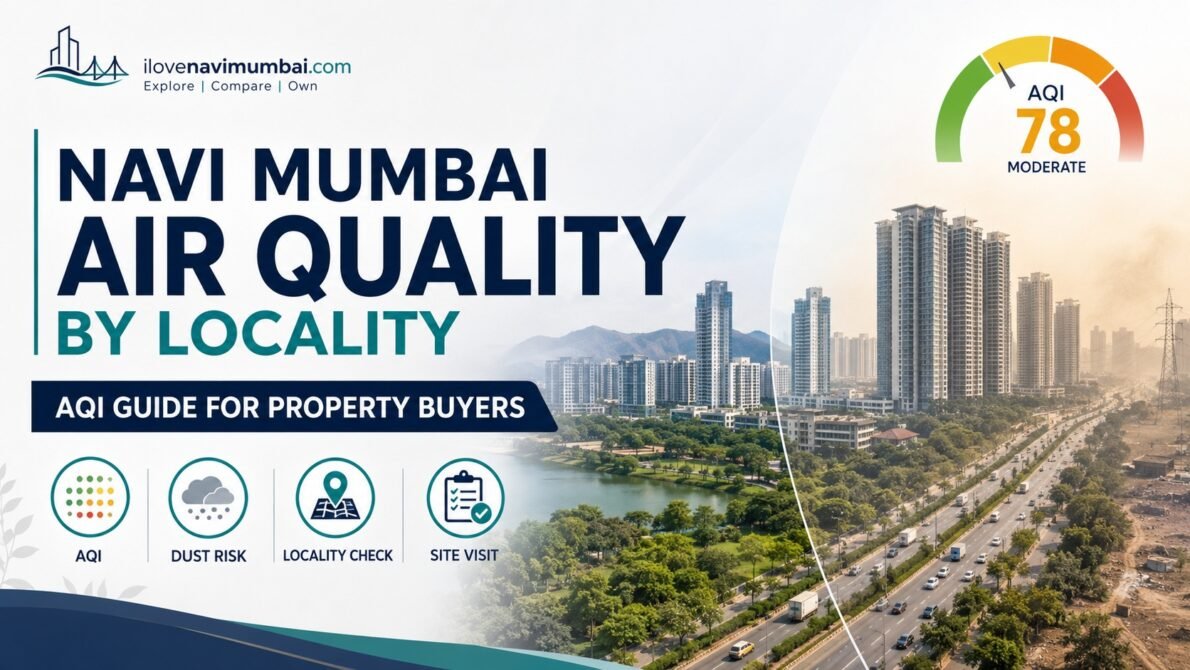
Navi Mumbai Air Quality by Locality: AQI Guide for Property Buyers

Quick Summary Navi Mumbai air quality is not the same in every locality. Areas near heavy construction, MIDC belts, major roads, truck routes, redevelopment pockets, and infrastructure work may face higher dust and pollution exposure. Before buying or renting, check CPCB/SAMEER AQI data, visit the site at different times, inspect nearby dust sources, and speak to residents. Why Air Quality Matters Before Buying Property in Navi Mumbai Buying a home is not only about carpet area, price, amenities, and connectivity. Air quality also affects daily comfort. A flat may look premium on paper. But if it faces a dusty road, construction site, RMC plant, highway, or industrial belt, daily living can become uncomfortable. This matters more for: Senior citizens Children People with asthma or allergies Work-from-home families Buyers planning long-term residence NRIs buying without visiting the site often Navi Mumbai has some excellent residential pockets with open spaces, creeks, hills, and planned infrastructure. But it also has industrial belts, port-linked roads, construction-heavy zones, and fast-growing nodes. So the real question is not only, “Is Navi Mumbai good for living?” The better question is: “Is this exact micro-location good for daily living?” For a wider environmental-risk understanding, connect this article with Navi Mumbai Pollution Guide. How AQI Works in India AQI means Air Quality Index. It converts pollution data into a simple category so normal users can understand air quality quickly. In India, CPCB uses AQI categories such as: AQI Category General Meaning for Buyers Good Usually comfortable for most people Satisfactory Acceptable, but sensitive people may still notice discomfort Moderate Children, elderly people, and people with breathing issues should be cautious Poor Long exposure may create discomfort, especially for sensitive groups Very Poor Outdoor exposure should be reduced Severe Serious health concern; avoid unnecessary outdoor activity AQI includes pollutants such as PM2.5, PM10, NO2, SO2, CO, O3, NH3, and Pb as per CPCB’s AQI framework. For property buyers, two terms matter the most: PM2.5 PM2.5 means very fine particles that can enter deep into the lungs. It is usually linked with combustion, traffic, industrial emissions, and fine suspended pollution. PM10 PM10 includes larger dust particles. In Navi Mumbai, this can be connected with road dust, construction dust, uncovered soil, debris movement, and infrastructure work. A locality may have decent city-level AQI, but one building can still feel dusty because of its immediate surroundings. That is why micro-location checking is important. Navi Mumbai Air Quality by Locality Do not treat this table as a fixed AQI ranking. AQI changes by season, wind, rain, construction work, traffic, and monitoring location. Use this as a practical buyer-risk guide. Locality / Belt What Buyers Should Check Practical Property View Vashi Traffic, commercial density, redevelopment dust, main-road exposure Strong convenience, but road-facing flats need closer inspection Sanpada Construction activity, traffic, dust, seasonal AQI spikes Good connectivity, but check site surroundings carefully Nerul Road dust, redevelopment, traffic, construction pockets Strong residential node, but avoid assuming every pocket has clean air Seawoods Road exposure, construction pockets, creek-side variation Some pockets feel more open, but micro-location matters Kharghar Construction dust, hill-side dust, highway-linked movement, quarry influence in some pockets Good open-space advantage in some sectors, but inspect active construction nearby Taloja MIDC influence, truck movement, industrial smell, road dust Affordable and growing, but buyers must verify pollution exposure carefully Mahape / Rabale / Ghansoli MIDC belt, traffic, industrial-commercial movement Better for work access; residential buyers should inspect air and smell at different times Airoli Office traffic, Thane-Belapur Road exposure, industrial-side pockets Good connectivity, but main-road-facing units need caution Ulwe / Pushpak Nagar Airport-linked development, construction dust, road work Strong growth market, but check dust, future traffic, and airport-related liveability Panvel / NAINA Belt Construction, road expansion, logistics movement, developing infrastructure Good long-term potential, but project-level and locality-level checks are essential Dronagiri / Uran Belt Port-linked traffic, JNPT/JNPA road movement, industrial/logistics exposure Useful for investment and logistics-linked growth, but residential comfort should be checked carefully The takeaway is simple: Do not buy only because the locality name is popular. Buy after checking the exact road, surroundings, wind direction, construction activity, and daily dust level. Main Pollution Sources Buyers Should Check 1. Construction Dust This is one of the biggest practical issues in fast-growing Navi Mumbai nodes. Dust can come from: Excavation Road cutting Cement mixing Debris movement Uncovered construction material Poor barricading Unpaved internal roads If there are multiple under-construction towers near the project, visit the site during working hours. A project that looks peaceful on Sunday may feel completely different on a weekday afternoon. 2. Traffic and Main-Road Exposure Properties near major roads may face more dust and emissions. Check exposure near: Sion-Panvel Highway Palm Beach Road Thane-Belapur Road JNPT/JNPA Road Uran-Dronagiri logistics routes Internal high-traffic node roads A flat inside the same locality can feel cleaner if it faces a garden, internal lane, or open side. A road-facing flat may get more dust, noise, and heat. For road-linked living concerns, connect this with Living Near JNPT Road and Navi Mumbai Traffic Guide. 3. MIDC and Industrial Belts Navi Mumbai has important industrial zones. Buyers should be more careful near: Taloja MIDC Mahape MIDC Rabale TTC Industrial Area Turbhe Pawne Kopar Khairane industrial-side pockets Ghansoli industrial-side pockets This does not mean every property near these belts is bad. But it means you should check: Smell in the evening and early morning Truck movement Dust on windows and balconies Nearby factories or warehouses Distance from industrial roads Resident complaints For deeper due diligence, link this section to Living Near MIDC Navi Mumbai, Living Near Taloja MIDC, and Living Near Mahape MIDC. 4. RMC Plants, Debris Routes, and Open Soil Ready-mix concrete plants, debris dumping points, and uncovered soil can create heavy local dust. This can affect even a good project. Before buying, check what is located within a 500-metre to 1-km radius. Look for: RMC plants Stone-crushing activity Large excavation Dumped construction debris Open plots used for material storage Unpaved access roads 5. Airport and Infrastructure Construction Ulwe,

Read More

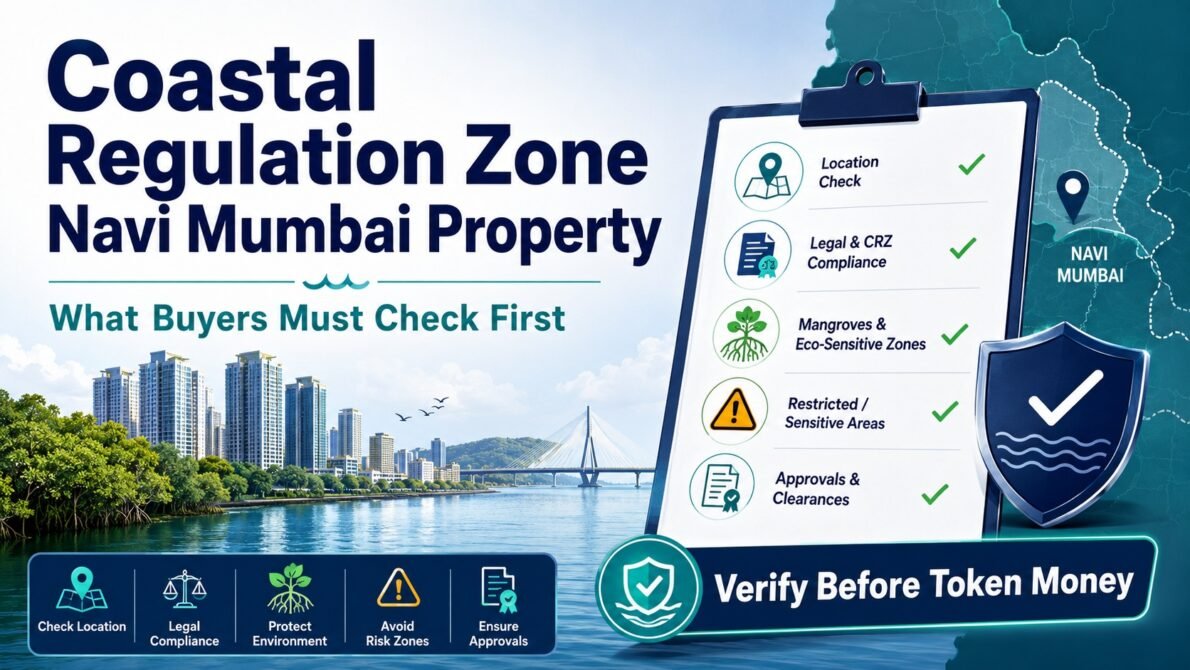
Coastal Regulation Zone Navi Mumbai Property: What Buyers Must Check First

Quick Summary Coastal Regulation Zone Navi Mumbai property risk applies mainly to land or projects near creeks, mangroves, mudflats, and tidal water bodies. A CRZ-affected property is not automatically illegal, but buyers must verify CZMP status, MCZMA clearance where applicable, MahaRERA details, sanctioned layout, OC/CC, land records, IGR history, and planning authority approvals before paying token money. What CRZ Means for Navi Mumbai Property Buyers CRZ means Coastal Regulation Zone. In simple language, it is a regulatory framework for coastal areas, creeks, tidal water bodies, mangroves, mudflats, and other environmentally sensitive locations. For a Navi Mumbai buyer, CRZ matters because many premium and emerging property locations are close to water bodies or creek-side land. This includes parts of: Nerul Palm Beach Road Seawoods Vashi Koparkhairane Airoli Ghansoli Kharghar Ulwe Dronagiri Uran Panvel and NAINA-side areas CRZ does not mean every nearby project is illegal. It means the location, land use, permissions, layout, and environmental restrictions must be checked carefully. For the main parent guide, internally link this article to Navi Mumbai CRZ property guide. Why CRZ Matters Before Buying Property A property near a creek or mangrove belt can look premium. The view is open. The balcony feels better. The area may look less crowded. Brokers may describe it as “creek view,” “waterfront,” “nature-facing,” or “open view forever.” But this is where buyers must slow down. A good view does not remove legal, environmental, or civic risk. Approval Risk If a project falls inside or near a CRZ-marked area, it may need specific permissions or authority-level clearance. The buyer should check whether the project has obtained the required approvals. Do not accept only verbal answers. Layout Restriction Risk Sometimes only part of a plot is affected. This can change the number of towers, open spaces, compound wall, podium, basement, amenity area, or usable land inside the project. So the sanctioned layout matters. Mangrove and Buffer Risk Mangroves are common around several creek-side areas in Navi Mumbai. If mangroves exist near the site, the buyer should not assume the land is freely developable. A mangrove-side view can look peaceful, but it may also bring development restrictions, environmental scrutiny, and resale concerns. For deeper checking, use property near mangroves in Navi Mumbai as a supporting internal link. Flood and Drainage Risk CRZ is not only a legal issue. It is also a practical living issue. Creek-side and low-lying locations can face problems during heavy rain, high tide, poor stormwater drainage, and blocked outfalls. The flat may be safe on the upper floor, but the approach road, basement, parking, and society compound may still suffer. Add a related internal link to Navi Mumbai flood risk property guide. Resale and Bank Loan Risk If CRZ status, OC, title, or layout approval is unclear, future buyers may hesitate. Banks may also ask for stronger documentation. A premium view can help resale only when approvals are clean and the location is livable. Navi Mumbai Locations Where CRZ Checks Are Important Location Why buyers like it What to check Nerul / Palm Beach Road Premium projects, creek-side appeal, strong connectivity CZMP, MCZMA clearance, mangrove distance, OC/CC Seawoods / NRI Complex side Lifestyle value and open pockets Creek proximity, drainage, sanctioned layout Vashi / Koparkhairane Mature location and commercial access Old buildings, nullah links, flood history Airoli / Ghansoli Work-location convenience Creek-side pockets, drainage, MIDC impact Kharghar / Mansarovar side Growth, hills, open surroundings Mangrove/wetland sensitivity, land-use approvals Ulwe / Dronagiri / Uran Airport and port-led growth CIDCO approval, CRZ/CZMP, access road, title Panvel / NAINA belt Land and plotted development potential TPS, 7/12, NA status, development permission, CRZ Do not judge risk only by node name. A safe project in one sector and a risky plot in another sector can exist in the same broad locality. The exact plot location matters. Documents to Check Before Buying CRZ-Affected Property This is an educational guide. Verify the latest position with the relevant authority or a property lawyer before making a transaction. 1. CZMP Map CZMP means Coastal Zone Management Plan. This is one of the most important checks for CRZ-related property. The buyer should check whether the exact plot or project falls inside, near, or outside a CRZ-marked area. Do not rely only on Google Maps, broker maps, or brochure graphics. 2. MCZMA Recommendation or Clearance MCZMA means Maharashtra Coastal Zone Management Authority. If the property or project needs CRZ-related recommendation or clearance, ask for written documents. The builder or seller should be able to explain: Whether CRZ applies Which part of the plot is affected Whether MCZMA recommendation was required Whether approval was obtained Whether the sanctioned layout reflects CRZ conditions If they cannot explain this clearly, treat it as a red flag. 3. MahaRERA Project Page For under-construction or ongoing projects, check MahaRERA. Look for: Project registration number Developer name Project status Approved layout uploads Completion timeline Extensions Plan changes Revoked or lapsed status, if any Complaints or orders, where available MahaRERA is important, but it is not the only check. A buyer should still verify CRZ/CZMP, sanctioned layout, OC/CC, land records, and title documents. 4. Sanctioned Layout and Building Plan The brochure may show open views and green spaces. The sanctioned layout shows what is actually approved. Compare both. Check whether the following are properly approved: Tower location Basement Podium Clubhouse Compound wall Amenity area Garden Internal road Creek-facing side If the brochure and sanctioned plan do not match, pause the deal. 5. Commencement Certificate and Occupancy Certificate The Commencement Certificate allows construction to start as per approval. The Occupancy Certificate allows occupation after completion checks. For ready or resale property, ask whether there is: Full OC Part OC Wing-wise OC No OC OC applied but not received Fit-out possession is not the same as legally safe possession with proper OC. 6. 7/12 Extract, 8A, and Property Card For land, plot, gaothan, village, NAINA, or peripheral areas, land records become important. Simple meaning: 7/12 extract: A rural land record showing survey number, area, holder details,

Read More

NAINA FSI Rules: What Buyers Must Verify Before Buying Land or Property

Direct Answer NAINA FSI rules decide how much construction may be allowed on land within the NAINA planning area, but FSI is not the same for every plot. It depends on the latest NAINA DCPR, zone, road width, plot size, reservations, Town Planning Scheme, development permission, CRZ or greenzone restrictions, and final authority approval. > Disclaimer: This is an educational guide. Verify the latest position with the relevant authority or a property lawyer before making a transaction. Last Reviewed: June 2026 Table of Contents What are NAINA FSI rules? What is FSI in simple words? Why NAINA FSI matters for buyers What decides FSI in NAINA? FSI vs actual buildable area How to verify NAINA FSI Documents to check Red flags Common mistakes Token money checklist FAQs Internal links External sources Schema recommendations Final CTA What Are NAINA FSI Rules? NAINA FSI rules are planning rules that decide how much construction may be allowed on a plot or land parcel within the Navi Mumbai Airport Influence Notified Area. NAINA is linked with planned development around Navi Mumbai International Airport and nearby areas such as Panvel, Uran, Dronagiri and parts of Raigad. But buyers must understand one thing clearly. There is no single FSI number that applies blindly to every NAINA plot. FSI depends on the plot, zone, road width, applicable DCPR, Development Plan, Town Planning Scheme, restrictions and approvals. Before buying land, first understand the broader planning framework in NAINA Real Estate Guide. What Is FSI in Simple Words? FSI means Floor Space Index. It tells how much builtup area may be permitted on a plot, subject to rules and approvals. Example: If a plot area is 1,000 sq.m. and permissible FSI is 1.0, then the basic possible builtup area may be 1,000 sq.m., subject to other planning rules. If FSI is 1.5, the basic possible builtup area may be 1,500 sq.m., again subject to approvals. But this is only a simple example. Actual construction may change because of: Road width Setbacks Open space requirements Parking rules Height restrictions Fire norms Reservation CRZ or greenzone restrictions Development permission conditions So do not calculate investment value only from a rough FSI number. Why NAINA FSI Matters for Buyers FSI affects land value. A plot with higher verified development potential may have better commercial value than a plot with restrictions. But this also creates risk. Sellers and brokers may use lines like: “High FSI available.” “Future FSI milega.” “NAINA plot hai, development pakka hai.” “Airport ke baad FSI badhega.” These claims should not be accepted without documents. For a buyer, FSI matters because it affects: How much can be constructed Whether the price is justified Whether a developer can build the promised project Whether resale value may be affected Whether the land is suitable for your purpose Claimed FSI is not verified FSI. What Decides FSI in NAINA? FSI in NAINA can depend on multiple planning and land factors. Factor Why It Matters NAINA DCPR Main development control rules for planning and construction Zone Residential, commercial, industrial, green or other zone can affect use Road Width Wider roads may affect development potential under rules Plot Size Very small or irregular plots may not achieve full theoretical FSI Plot Shape Narrow or oddshaped plots can reduce practical construction Reservation Road, public utility or openspace reservation can reduce usable land Town Planning Scheme Final plot and development rights may change under TPS CRZ / Green Zone / NDZ Restrictions can reduce or block construction Development Permission Final authority approval is required for actual development Approved Plan / CC Shows what has actually been sanctioned This is why buyers should avoid articles, videos or brokers giving one fixed FSI number for all NAINA land. NAINA FSI vs Actual Buildable Area FSI and buildable area are related, but they are not the same. FSI tells possible floor area as per rules. Buildable area is what can practically be built after applying all conditions. For example, a land parcel may look good on paper, but actual development may reduce because of: Required front setback Side margin Parking requirement Access road issue Drainage or utility reservation Shape of plot Greenzone restriction CRZ issue Pending development permission A buyer should ask an architect or planning consultant to calculate realistic buildable potential. Do not pay premium price only because someone says “FSI is high.” How to Verify NAINA FSI Before Buying Step 1: Confirm Survey Number and Village Start with the exact land identity. Ask for: Village name Survey number Hissa number Taluka District Plot number if applicable Without the correct survey number, FSI verification can go wrong. Step 2: Check Latest Land Records Verify: 7/12 extract 8A extract Mutation entries The 7/12 extract is a rural land record that helps identify land details and recorded holder information. The 8A extract shows landholding reference. Mutation means a landrecord entry showing change due to sale, inheritance, partition or other transaction. These documents support verification, but they do not alone confirm development rights. Step 3: Check NAINA Zone Through ZCS A Zone Confirmation Statement helps identify the planning zone applicable to the land. This is important because FSI depends on the applicable zone and planning rules. Read NAINA ZCS Guide before assuming the land can be developed. Step 4: Read Applicable NAINA DCPR DCPR means Development Control and Promotion Regulations. These rules decide how land can be developed, what conditions apply, and how construction permission may be evaluated. For FSI, the DCPR is one of the most important references. A buyer should not depend on broker calculations. Read NAINA DCPR Explained to understand how rules affect land potential. Step 5: Check Development Plan and TPS Impact The Development Plan may show: Roads Reservations Open spaces Public utilities Zone classification Future planning proposals Town Planning Scheme can also affect final plot size, road access and usable land. So before buying, check NAINA Development Plan Guide and NAINA Town Planning Scheme. Step 6: Verify Road Width and Access Road width can affect development

Read More

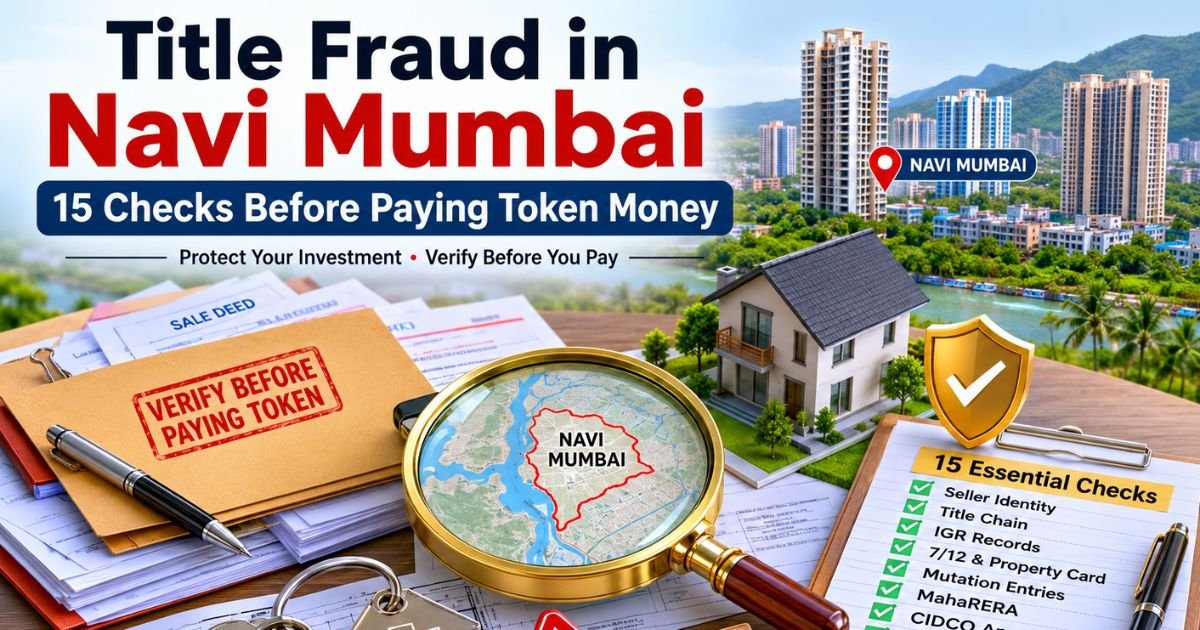
Title Fraud Property Navi Mumbai: 15 Checks Before Paying Token Money

Title fraud in Navi Mumbai property happens when the seller does not have a clean, transferable title or hides ownership, loan, litigation, zoning, CIDCO, NAINA or land-record problems. Before paying token money, verify: Seller identity Registered title chain IGR records 7/12 extract or Property Card Mutation entries MahaRERA details CIDCO approvals NAINA approvals CRZ and zoning restrictions > This is an educational guide. Verify the latest position with the relevant authority or a property lawyer before making a transaction. — What Is Title Fraud in Navi Mumbai Property? Title fraud means the person selling the property may not have the legal right to sell it. This can happen in: Resale flats Builder projects CIDCO properties Gaothan houses NAINA plots Agricultural land Common fraud situations: Seller shows only photocopies Broker claims papers are clear Token payment demanded urgently Agreement postponed Price looks unusually attractive Never pay token money based only on verbal assurances. A buyer should verify: Ownership chain Seller identity Registered documents Land records Approvals Land use Transferability — Why Navi Mumbai Buyers Need Extra Checks Different property types require different verification. CIDCO Properties Check: Allotment letter Lease deed Transfer permission CIDCO dues Commencement Certificate (CC) Occupancy Certificate (OC) NAINA Plots Check: Zone Confirmation Statement (ZCS) Development Plan Interim Development Plan DCPR TPS status Sanctioned layout Gaothan Property Check: Property Card 7/12 Extract 8A Extract Mutation entries Heirship documents Construction permissions CRZ, Creek & Mangrove Areas Verify: CRZ classification CZMP status Development restrictions Mangrove buffer zones — Documents to Check Before Trusting the Title Property Type Documents Purpose Resale Flat Sale Deed, Index II, Share Certificate, Society NOC, OC Ownership & transfer verification Builder Project MahaRERA, Legal Title Certificate, Sanctioned Plan Project legality Plot/Land 7/12, 8A, Property Card, Mutation Land ownership verification CIDCO Property Allotment Letter, Lease Deed, Transfer Permission Transfer rights NAINA Plot ZCS, DP, TPS, Layout Approval Development eligibility Gaothan Property Property Card, Mutation, Heirship Documents Local ownership verification > Important: No single document guarantees complete legal safety. — Red Flags Before Paying Token Money Be cautious if: Seller refuses title chain documents Broker says “Token first, papers later” Names differ across records POA holder pressures urgent payment Property is suspiciously cheap NAINA plot lacks ZCS CIDCO transfer permission missing Family ownership disputes exist Seller demands cash Builder project missing on MahaRERA If someone rushes you, slow down. — How to Verify Title Step by Step Step 1: Verify Seller Identity Check: Aadhaar PAN Address Proof Photograph Ownership capacity For inherited property: Verify legal heirs Check succession documents — Step 2: Match the Title Chain Review: Sale deeds Gift deeds Release deeds Partition deeds Court orders Inheritance documents Ensure ownership transitions correctly. — Step 3: Verify IGR Maharashtra Records Check: Document number Registration year Seller details Buyer details Property description — Step 4: Verify Land Records Review: 7/12 Extract 8A Extract Property Card Mutation Entries Survey Number Village Records — Step 5: Check MahaRERA Verify: Project registration Legal title certificate Encumbrances Litigation details Sanctioned plans CC & OC — Step 6: Verify CIDCO / NAINA Approvals CIDCO Check: Allotment Lease Transfer permissions Dues NAINA Check: ZCS DP TPS DCPR Layout approval — Step 7: Check CRZ / Green Zone Restrictions Verify: CRZ classification Green zone status Road reservation DP reservations No-development zones — Step 8: Obtain Written Title Search Report Recommended for: NAINA plots CIDCO properties Inherited properties POA sales CRZ-risk land High-value transactions — Navi Mumbai Example: NAINA Plot Before Token Situation A broker shows a Panvel-area plot and requests ₹2 lakh token immediately. Issues: Only photocopies available Multiple names on 7/12 No ZCS No layout approval No title report Correct Action Do not pay token Verify 7/12 Verify 8A Check mutation entries Confirm legal heirs Search IGR records Verify ZCS Check TPS impact Obtain legal opinion — Common Mistakes Buyers Make Mistake 1: Paying Token Before Verification Biggest mistake. — Mistake 2: Trusting Screenshots Screenshots are not legal verification. — Mistake 3: Assuming Registered Means Safe Registration does not guarantee a clear title. — Mistake 4: Ignoring Name Mismatches Even small mismatches matter. — Mistake 5: Ignoring CIDCO / NAINA Rules Special planning areas require additional checks. — Mistake 6: Ignoring CRZ Restrictions Development restrictions may apply. — Mistake 7: Blind Trust in MahaRERA MahaRERA improves transparency but does not replace due diligence. — Token Money Checklist Check Done Seller identity verified ☐ Co-owners identified ☐ POA reviewed ☐ Title chain checked ☐ Sale deed reviewed ☐ Index II verified ☐ IGR search completed ☐ 7/12 checked ☐ Property card checked ☐ Mutation verified ☐ Litigation checked ☐ MahaRERA checked ☐ CIDCO approvals checked ☐ NAINA approvals checked ☐ CRZ restrictions checked ☐ Refund clause verified ☐ — Final CTA Before paying token money for any flat, plot, CIDCO property, NAINA plot or gaothan property in Navi Mumbai, verify the title first. If documents are incomplete, approvals are unclear, names do not match or the seller is creating urgency, pause the transaction and complete verification before making any payment. FAQs Frequently Asked Questions What is title fraud? Title fraud occurs when a seller does not have a clean legal right to transfer property. Is Index II enough? No. It should be verified with other ownership records. Is 7/12 proof of ownership? No. It supports verification but is not standalone proof. What should I check before buying a NAINA plot? 7/12 Mutation entries ZCS TPS Development permissions Legal opinion Can MahaRERA protect me from title fraud? It helps but does not replace legal verification. Should I use a lawyer? Yes, especially for plots, inherited properties, NAINA land and CIDCO transactions.

Read More

Token Amount Fraud in Property Navi Mumbai Buyer Checklist Before Paying

Token Amount Fraud in Property: What Navi Mumbai Buyers Must Check Before Paying Direct Answer Do not pay token money for any property in Navi Mumbai, Panvel, Ulwe, Kharghar, Taloja, Dronagiri, Uran, NAINA, CIDCO or Raigad before checking ownership, title chain, land records, approvals and refund terms. Pay only through bank transfer to the verified owner or promoter account. Never trust a verbal “refundable token” promise without written terms. — What Is Token Amount Fraud in Property? Token amount fraud happens when a buyer pays money to “block” a flat, plot, shop or land parcel, but later finds that the deal was unsafe, incomplete or misleading. The fraud can happen in many ways. The seller may not be the real owner. The broker may collect money without authority. The documents may be fake. The land may have zoning, CRZ, NAINA, CIDCO, mutation or title issues. Or the seller may simply refuse to refund the token amount because the refund terms were never written clearly. In Navi Mumbai and nearby areas, this risk is higher in fast-moving locations like Panvel, Ulwe, Dronagiri, Uran, Taloja, Kharghar, NAINA and gaothan belts because many buyers are attracted by airport growth, CIDCO plots, future development and “limited-time” land offers. The rule is simple: no verified documents, no verified seller, no written refund clause, no token money. — When Token Money Becomes Risky Token money is not automatically fraud. It becomes risky when it is paid before proper due diligence. Resale Flat In a resale flat, token money becomes risky when: The seller name does not match the agreement or share certificate. The chain of agreements is incomplete. Society dues are pending. The flat has a loan or lien. Occupancy Certificate or completion documents are unclear. Token is paid to the broker instead of the owner. For resale flats in Vashi, Nerul, Seawoods, Kharghar, Airoli, Ghansoli, Ulwe or Panvel, the buyer should verify the seller, society records, registered documents and pending liabilities before paying. Builder Flat For a builder flat, check MahaRERA before paying booking or token amount. Under RERA, a promoter cannot accept more than 10% of the cost of the apartment, plot or building as advance payment or application fee without first entering into a written and registered agreement for sale. This applies to promoter/builder transactions. It does not automatically solve every private resale dispute. Before paying a builder token, check: MahaRERA registration. Project status. Promoter name. Completion date. Complaints or orders, if any. Approved plans. Commencement Certificate. Occupancy Certificate or part OC, where applicable. Allotment and cancellation terms. MahaRERA registration is important, but it is not a replacement for legal due diligence. Plot, Land, NAINA or Gaothan Property Land and plot token payments are more dangerous than regular flat token payments. A 7/12 extract alone is not enough. A buyer must also check mutation entries, title chain, survey details, zoning, access road, development permission, NA status, NAINA/CIDCO permissions and CRZ risk where relevant. For gaothan property, also check property card, sanad and local authority records. For NAINA plots near Panvel, Uran, Dronagiri, Pushpak Nagar or airport-side areas, verify the planning status with CIDCO/NAINA or the relevant authority before paying. — What to Check Before Paying Token Money Use this table before making any payment. Property Type Documents / Checks Why It Matters Resale flat Sale deed, chain agreements, Index II, share certificate, society dues, property tax, loan NOC Helps verify seller rights, registered history and pending liabilities Builder flat MahaRERA registration, project status, CC, OC/part OC, allotment letter, payment schedule Helps check whether the project and promoter details match the promise Plot / land 7/12, 8A, mutation, survey map, title chain, access road, zoning, NA/development permission Helps identify land-use, ownership, access and approval risks CIDCO property Allotment letter, lease documents, transfer permission, CIDCO records Helps verify whether the seller can legally transfer the property NAINA property NAINA/CIDCO permission, land records, development permission, zoning Helps avoid buying land based only on future-development promises Gaothan property Property card, sanad, local body records, mutation, title chain Helps verify village-property records and occupancy details CRZ / creek-side property CZMP/CRZ status, MCZMA reference, local planning records Helps avoid coastal-zone and mangrove-side restrictions Important: These documents support verification. They should not be treated as final proof of clean ownership without title search and professional review. — Red Flags Before Paying Token Pause the deal if you hear any of these lines: “Pay token today, documents tomorrow.” “Owner is out of India, pay the broker now.” “Cash token is better.” “No need for lawyer.” “7/12 is enough.” “NA permission will come later.” “CIDCO transfer is pending but guaranteed.” “NAINA approval is confirmed, but papers are not ready.” “This is a 12.5% scheme plot, no need to verify.” “CRZ does not apply here.” “Refund is guaranteed, but we do not write it.” “Receipt on WhatsApp is enough.” “Many buyers are waiting, decide now.” Pressure is not proof. Documents are proof for verification. If the seller or broker refuses to share documents before token payment, treat it as a serious warning. — How to Verify Property Before Paying Token Step 1: Verify the Seller Check whether the seller’s name matches the property documents. For individuals, check PAN, Aadhaar, bank account name and document name. For companies, check board resolution, authorised signatory and company details. For POA cases, verify the Power of Attorney. If the seller is an NRI, legal heir or family representative, take legal advice before paying token. Step 2: Check Registered Documents on IGR Maharashtra Use IGR Maharashtra / eSearch to check registered document history, Index II and past transactions. Index II is a summary of a registered document. It can help you identify registered sale, transfer, mortgage or transaction details. But it is not a full title certificate. Check IGR records close to the transaction date because records can change. Step 3: Check Land Records on Mahabhumi / Bhumi Abhilekh For land, plot, gaothan and village properties, check: 7/12 extract, also called Satbara. 8A extract. Mutation entry, also

Read More
Digital To Infinity Academy - Build Skills. Build Projects. Build Your Future.