

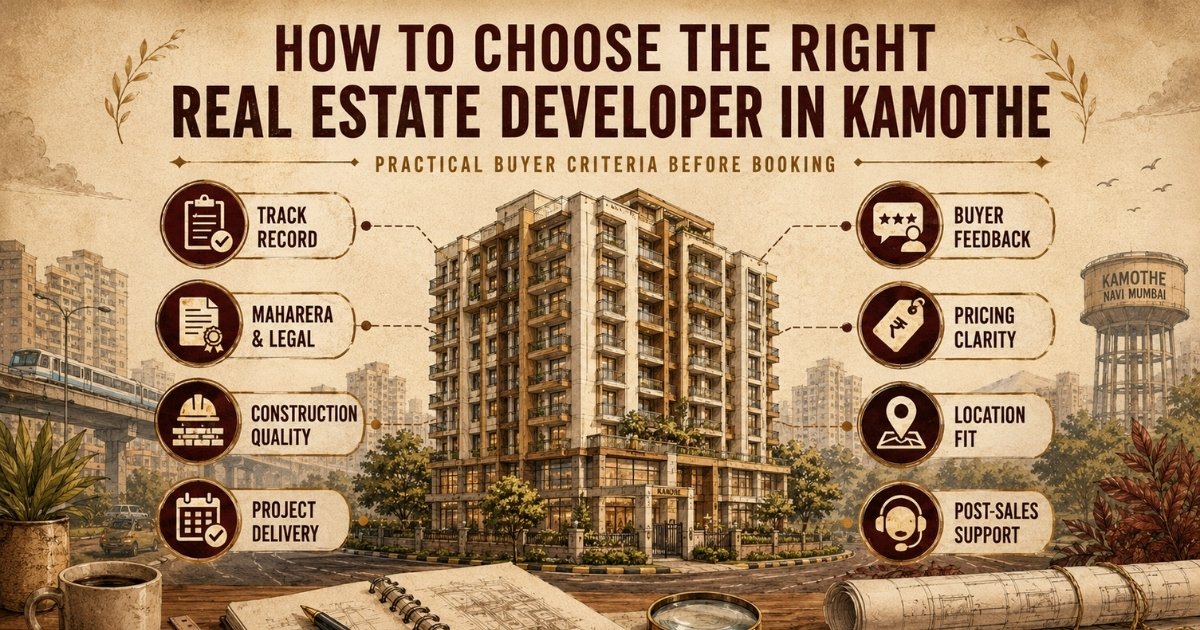
To choose the right real estate developer in Kamothe, buyers should check the developer’s past delivery record, MahaRERA details, legal documents, construction quality, pricing transparency, completed projects, buyer feedback and OC status before paying token money. In Kamothe, this is especially important because many projects involve CIDCO-origin land, PMC civic services, 12.5% PAP plot documentation, water supply concerns and sector-level drainage issues.
This article is for general buyer awareness. Before booking or signing an agreement, buyers should verify all documents with a qualified property lawyer or legal professional.
Quick Summary: How to Choose the Right Real Estate Developer in Kamothe
Kamothe is a mature, mid-budget residential node between Kharghar, Kalamboli and Panvel. It is practical for families because of its connectivity to Mansarovar railway station, Sion-Panvel Highway, schools, markets and daily-use services. But choosing a developer here should not be based only on brochure design, sample flat beauty or low per-square-foot rate.
A safer developer in Kamothe is one who can prove clear title, valid approvals, realistic possession timelines, good construction quality, transparent pricing and proper post-handover support.
| What to Check | Why It Matters in Kamothe | Good Sign | Red Flag |
|---|---|---|---|
| MahaRERA registration | Confirms regulatory registration and basic project transparency | Active RERA number with regular updates | Expired, lapsed or unclear project record |
| Legal documents | Kamothe has many CIDCO-origin and 12.5% PAP plot properties | Clear title chain, CC, approved plan and CIDCO documents | Builder avoids sharing legal file |
| Occupancy Certificate | OC proves legal occupation and safety compliance | Ready-to-move property has valid OC | “Fit-out possession” without OC |
| Construction quality | Monsoon leakage, parking and lift quality matter in daily life | Older projects are well maintained | Seepage, poor common areas, basement issues |
| Water and drainage | Kamothe has reported water and drainage stress in some pockets | Functional PMC water connection and proper drainage | Heavy tanker dependency or sewage overflow complaints |
| Pricing clarity | Final cost can be much higher than base rate | Written all-inclusive cost sheet | Verbal promises and hidden charges |
| Buyer feedback | Existing residents reveal real after-sales behaviour | Society formed, maintenance handed over | Complaints about delays, OC, water or maintenance |
The safest way to choose a real estate developer in Kamothe is to verify legal documents, completed projects, pricing clarity and buyer feedback before paying token money.
Why Choosing the Right Real Estate Developer Matters in Kamothe
Choosing the right developer in Kamothe is not only about getting possession on time. It affects your legal safety, monthly maintenance, water supply reliability, society handover, resale value and peace of mind after moving in.
Kamothe is not an undeveloped location, but it has its own local challenges. The land planning history is linked to CIDCO, while present civic administration, property tax and many utility-related matters come under Panvel Municipal Corporation. This means buyers must understand both CIDCO-related land documents and PMC-related civic approvals.
A weak developer can create problems long after possession, such as:
- No proper Occupancy Certificate
- Delay in society formation
- Unclear conveyance status
- Poor waterproofing and monsoon leakage
- Inadequate water storage or tanker dependency
- Pending municipal dues
- Parking disputes
- Hidden charges after token payment
In Kamothe, the developer’s quality directly affects the society’s long-term functioning. A well-built flat in a poorly managed project can still become stressful if water supply, drainage, legal title and maintenance handover are weak.
For broader comparison, buyers can also read [real estate developers in Navi Mumbai](ADD INTERNAL LINK HERE) and [Kamothe real estate guide](ADD INTERNAL LINK HERE).
Understand the Developer’s Past Track Record
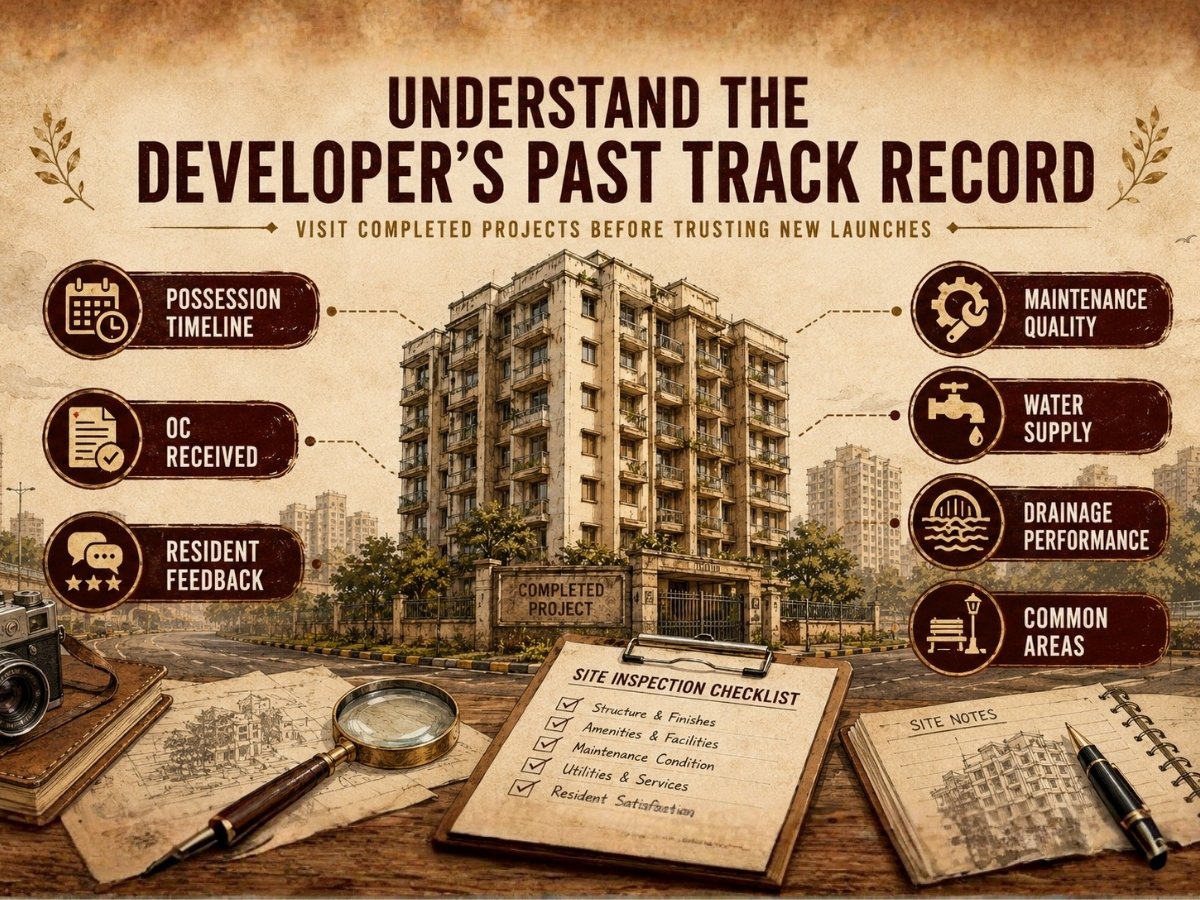
A developer’s past work is usually more reliable than their current sales pitch. Before trusting a new launch or under-construction project, check what the same developer has already delivered.
Check Completed Projects Before Trusting New Launches
Completed projects show the real ability of a developer. A new launch may have excellent renders, a polished sales office and attractive offers, but the real test is whether the builder has delivered earlier projects with OC, basic amenities and proper handover.
Check:
- How many projects the developer has completed
- Whether possession was given close to the promised timeline
- Whether completed buildings have OC
- Whether residents are satisfied with construction and maintenance
- Whether the developer has too many ongoing projects compared to completed projects
On the MahaRERA website, buyers should search the promoter name, not only the project name. Some developers may use different project entities or special purpose vehicles, so checking only one project may not show the full picture.
Visit Older Buildings Developed by the Same Builder
Do not judge a developer only by a sample flat. Visit one or two buildings completed by the same developer at least three to five years ago.
In Kamothe and nearby Navi Mumbai nodes, monsoon performance is a serious quality test. Poor construction usually starts showing through wall seepage, plaster cracks, basement dampness, lift issues and parking problems within a few years.
During your visit, observe:
- Exterior wall condition
- Leakage marks near windows and ceilings
- Basement or stilt parking condition
- Lift brand and lift maintenance
- Lobby and staircase condition
- Water tank and common area cleanliness
- Fire safety equipment condition
A building that looks stable and well maintained after multiple monsoons is a stronger sign than a beautiful sample flat.
Speak to Existing Residents and Buyers
Existing residents are one of the best sources of truth. They know whether the builder handled possession properly, whether the OC was received, whether water supply is regular and whether maintenance money was handed over properly.
Ask residents direct questions:
- Was possession given on time?
- Did the builder give OC before possession?
- Is there PMC water supply or regular tanker dependency?
- Was the society formed properly?
- Was the maintenance corpus handed over?
- Are lifts, pumps and common areas maintained well?
- Were there any hidden charges during possession?
Even a five-minute conversation with a resident or security staff can reveal more than a long sales presentation.
Check MahaRERA Registration and Project Transparency
MahaRERA registration is a basic requirement for eligible real estate projects. It gives buyers access to important project information, but it should not be treated as the final proof of safety.
Why MahaRERA Is Important for Kamothe Buyers
MahaRERA helps buyers check the registered project details, possession timeline, promoter information, approvals, litigation declarations and project updates. For Kamothe buyers, this is important because many projects involve complex land histories, CIDCO-origin plots and local approval dependencies.
MahaRERA registration is important, but it should not be treated as the only proof of developer quality. A RERA-registered project can still have poor construction quality, weak water planning, delayed OC or bad after-sales support.
What to Verify on the MahaRERA Website
Before paying token money, buyers should verify the project on the MahaRERA website. Do not depend only on a printed RERA number on the brochure.
Check:
- Project name and RERA registration number
- Promoter name and entity details
- Registered possession date
- Project status
- Uploaded approvals
- Litigation or encumbrance details, where available
- Quarterly progress updates
- Completion percentage
- Validity of registration
Compare what the sales team says with what is uploaded on MahaRERA. If the sales team says the project is nearly complete but the portal shows low progress, ask for a clear explanation in writing.
Why MahaRERA Alone Is Not Enough
MahaRERA can help with transparency, but it does not guarantee everything a buyer needs. It does not automatically prove that the building has good waterproofing, strong lifts, proper PMC water connection, smooth drainage or responsible society handover.
In Kamothe, buyers must combine MahaRERA checks with physical site visits, document verification and local infrastructure checks. For example, a legally registered project may still face water pressure issues or drainage problems if the surrounding infrastructure is weak.
Check Legal Documents Before Booking a Flat
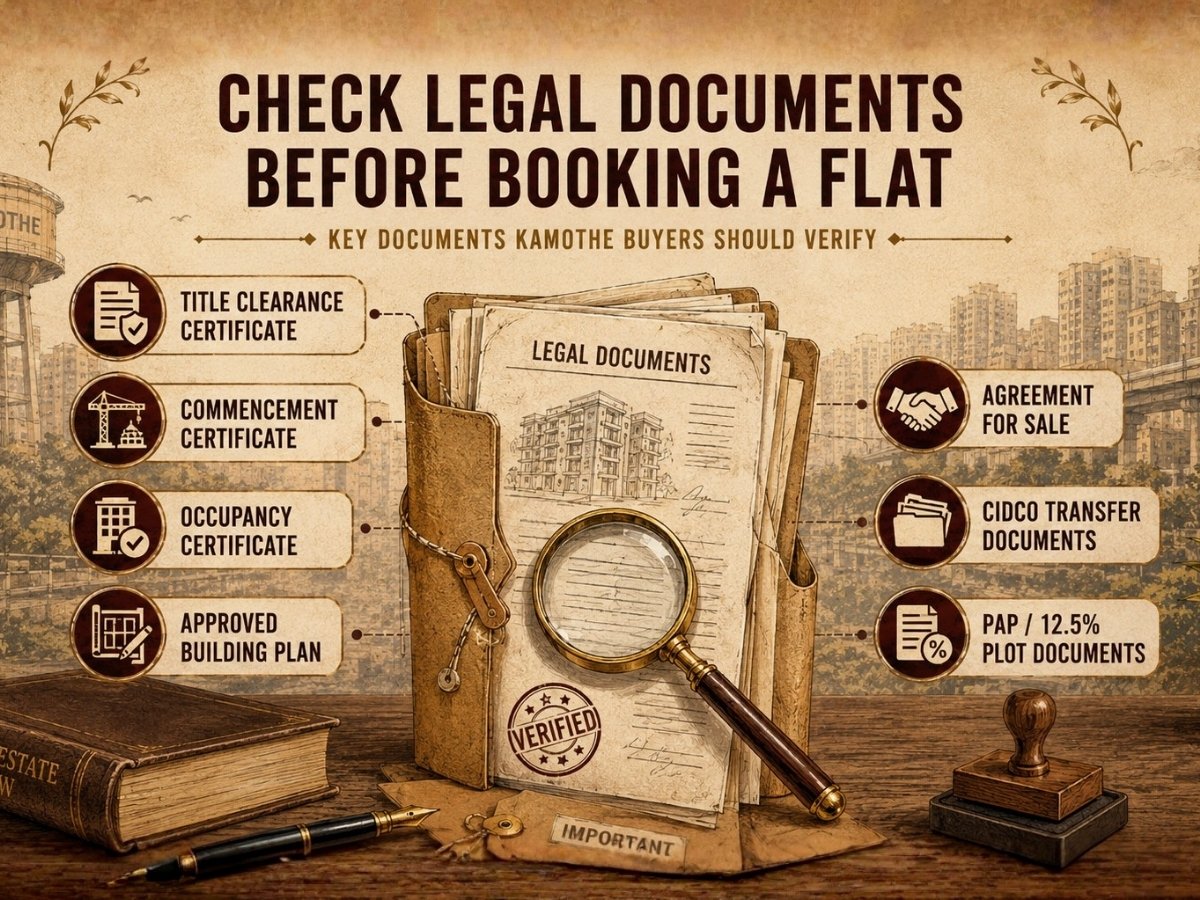
Legal document checking is one of the most important steps before choosing any builder in Kamothe. Since many properties in Navi Mumbai have CIDCO-origin land history, buyers should not treat legal verification casually.
| Document | What It Proves | Why It Matters in Kamothe | Buyer Action |
|---|---|---|---|
| Title Clearance Certificate | Developer’s legal right over the land | Important for CIDCO-origin and PAP plot properties | Get it reviewed by an independent lawyer |
| Commencement Certificate | Permission to start construction up to approved level | Prevents risk of unauthorized floors | Match flat floor with sanctioned floors |
| Occupancy Certificate | Building is fit for legal occupation | Critical for ready possession flats | Do not accept final possession without OC clarity |
| Approved Building Plan | Official sanctioned layout | Confirms flat layout, parking and common areas | Compare brochure plan with approved plan |
| Agreement for Sale | Legal contract between buyer and developer | Protects possession date, payment terms and penalties | Review before signing |
| CIDCO transfer documents | Leasehold or transfer clarity | Important in Kamothe’s CIDCO-planned background | Ask who pays transfer-related costs |
| PAP / 12.5% scheme documents | Title chain from original allottee | Many standalone projects may involve such plots | Verify LOI, award copy and title chain |
Title Clearance Certificate
A Title Clearance Certificate confirms whether the developer has a clear and marketable right to develop and sell the property. In Kamothe, title checking can be more detailed because many plots have CIDCO allotment history or PAP 12.5% scheme background.
Buyers should ask for a title search report from an independent advocate. A bank loan approval is useful, but it should not replace independent legal due diligence.
Commencement Certificate
A Commencement Certificate, or CC, proves that the competent authority has allowed construction as per approved plans. It may be issued for specific floors or stages.
Before booking, check whether the floor you are buying is covered under the valid CC. If the builder has permission only up to a certain floor and is selling above that, it becomes a serious warning sign.
Occupancy Certificate
An Occupancy Certificate, or OC, confirms that the building is completed as per approved plans and is legally fit for occupation. For ready-to-move flats, OC is extremely important.
Never treat “fit-out possession” as the same as legal possession. Without OC, buyers may face problems related to property tax, water connection, resale, home loan closure, society formation and long-term legality.
Approved Building Plan
The approved building plan shows the legally sanctioned layout of the project. It helps buyers verify flat dimensions, parking areas, open spaces, amenity areas, staircase, lift positions and common facilities.
Compare the approved plan with the brochure and sample flat layout. If the sales plan and approved plan do not match, ask for written clarification.
Agreement for Sale
The Agreement for Sale is the main legal document that records the payment schedule, possession date, flat details, carpet area, parking, delay penalty, taxes, charges and buyer-builder obligations.
Buyers should not sign it in a hurry. Read every clause, especially:
- Possession timeline
- Delay compensation
- Carpet area
- Parking rights
- Maintenance charges
- GST and taxes
- Cancellation terms
- Force majeure clauses
- Amenities promised
For legal clarity, buyers can also read [agreement to sale vs sale deed](ADD INTERNAL LINK HERE).
CIDCO Transfer and Leasehold Clarity
Kamothe has a CIDCO-planned background. In many Navi Mumbai properties, land may be leasehold and transfer-related procedures may involve CIDCO. Buyers should ask whether the property is leasehold or freehold, whether CIDCO transfer requirements apply and whether any dues or premiums are pending.
For resale flats, CIDCO transfer charges may become a major cost depending on the property and applicable rules. Always ask for written clarity before finalizing the deal.
Kamothe-Specific Documents Buyers Should Check Before Booking
Kamothe buyers should not use a generic Mumbai property checklist. The local context is different because CIDCO, PMC, PAP plots and leasehold history may all matter.
CIDCO Allotment and Transfer Documents
For CIDCO-origin plots, buyers should ask for the allotment letter, lease agreement, transfer documents and NOC-related papers where applicable. These documents help verify whether the developer or society has valid rights over the land.
If the property is in resale, check the previous chain of agreements and whether required CIDCO transfer procedures were completed properly.
PAP Plot or 12.5% Scheme Plot Clarity
Many standalone buildings in Kamothe and nearby Navi Mumbai areas may be developed on PAP or 12.5% scheme plots. These plots were allotted to Project Affected Persons as part of land acquisition compensation.
This does not automatically make the project unsafe. But the title chain must be clean. Buyers should verify:
- Original award copy
- CIDCO Letter of Intent, where applicable
- Development agreement
- Tripartite agreement
- 7/12 extract and mutation entries
- Title Clearance Certificate
If the developer cannot explain the PAP plot history clearly, do not proceed without a lawyer’s review.
NMMC, PMC or CIDCO Approval Relevance
Kamothe comes under Panvel Municipal Corporation for civic administration, property tax and many municipal services. It is not under NMMC. At the same time, its planning and land history are linked to CIDCO.
This matters because buyers often get confused about which authority controls what. For Kamothe properties, check PMC-related approval and civic documents where applicable, while also checking CIDCO-origin land documents if the plot has a CIDCO background.
Society Formation and Conveyance Status
A good developer does not disappear after possession. The builder should help form the cooperative housing society, hand over documents, transfer maintenance records and complete conveyance-related responsibilities as applicable.
For completed projects, ask residents:
- Was the society formed?
- Was conveyance completed or pending?
- Was the corpus handed over?
- Are municipal bills and common area dues clear?
- Does the builder still control maintenance or transfer permissions?
Delayed society formation and conveyance can create future problems during repairs, redevelopment and resale.
Compare Construction Quality and Actual Site Progress
Construction quality is not visible in glossy brochures. It must be checked physically.
Visit the Actual Construction Site
For under-construction projects, visit the actual site, not only the sales office. Observe whether the site is active and organized.
Check:
- Is actual construction happening?
- Are workers present in reasonable numbers?
- Are materials stored properly?
- Is the site safe and clean?
- Are there signs of long inactivity?
- Is monsoon water managed properly?
A project that looks active only during customer visits but remains slow otherwise needs careful checking.
Compare Sample Flat and Real Flat Specifications
Sample flats are designed to look bigger and better. They may use smart lighting, smaller furniture, fewer partitions and upgraded finishes.
Before booking, ask for written specifications for:
- Flooring
- Bathroom fittings
- Electrical switches
- Window quality
- Door material
- Wall finish
- Kitchen platform
- Sanitaryware
- Paint quality
The final delivered flat should match what is written in the agreement or annexure, not just what was verbally promised.
Check Lift, Lobby, Parking and Common Area Quality
In Kamothe, many buildings are standalone structures with limited plot sizes. This makes common area planning very important.
Check:
- Lift brand and service quality
- Lobby flooring and lighting
- Staircase width
- Fire safety systems
- Water pump room
- Parking layout
- Mechanical parking maintenance, if any
- Generator backup for common areas
Parking should be checked very carefully. Stilt parking, open parking, covered parking and mechanical parking have different legal and maintenance implications.
Check Monsoon Performance and Leakage Issues
Monsoon is a real test for construction quality in Navi Mumbai. In Kamothe, buyers should especially check leakage, drainage, basement dampness and external wall condition.
If possible, visit completed projects during or just after monsoon. Look for:
- Damp patches on walls
- Watermarks near windows
- Leakage from terrace or top floors
- Basement flooding
- Lift shutdown during rains
- Waterlogging near the building entrance
- Sewage or drainage overflow nearby
A developer’s older building will reveal whether waterproofing and structural quality are reliable.
Understand Pricing, Hidden Charges and Payment Terms
A low base rate does not mean the final cost is low. In Kamothe, the total cost can change significantly after adding parking, floor-rise, GST, stamp duty, registration, maintenance deposit, society charges and other items.
Ask for an All-Inclusive Cost Sheet
Before paying token money, ask for a written all-inclusive cost sheet. It should clearly mention:
- Basic flat cost
- Carpet area
- Floor-rise charges
- PLC charges, if any
- Parking charges
- GST, if applicable
- Stamp duty estimate
- Registration cost
- Maintenance deposit
- Society formation charges
- Legal charges
- Corpus fund
- Utility connection charges
- CIDCO transfer charges, if applicable
Do not negotiate only on per-square-foot rate. Compare the final all-inclusive cost.
For calculation support, buyers can use [stamp duty calculator](ADD INTERNAL LINK HERE) and [property tax calculator](ADD INTERNAL LINK HERE).
Check Parking, Floor-Rise, PLC and Maintenance Charges
Parking and floor-rise charges can add a significant amount to the total cost. Covered parking, mechanical parking and preferred location charges should be clearly written.
Also ask about advance maintenance. Some developers may demand 12 to 24 months of maintenance in advance. This should be recorded clearly, including what will be handed over to the society later.
Understand GST, Stamp Duty and Registration Cost
Under-construction properties usually attract GST, while ready-to-move properties with OC are treated differently. Stamp duty and registration are statutory costs and should be calculated separately.
For Maharashtra property purchases, stamp duty can vary depending on buyer profile and current government rules. Buyers should verify the latest applicable charges before booking.
Avoid Verbal Price Commitments
Verbal promises are one of the biggest traps in real estate buying. If the sales team says parking is free, club charges are waived or floor-rise is included, ask them to write it on official letterhead or include it in the agreement.
A reputed developer is not always the right developer if the project has unclear approvals, delayed possession, hidden charges or weak after-sales support.
Check Developer Reputation Beyond Online Reviews
Online reviews are useful, but they are not enough. Many reviews may be promotional, emotional or incomplete. Buyers must look for patterns.
Read Google Reviews Carefully
Do not rely only on the average star rating. Sort reviews by newest and lowest rating. Read detailed reviews from actual residents and buyers.
Look for words like:
- Delay
- OC
- Leakage
- Water
- Tanker
- Parking
- Maintenance
- Possession
- RERA
- Refund
- Legal issue
Repeated negative reviews are more important than one angry comment.
Look for Repeated Complaint Patterns
One complaint may be a personal issue. But repeated complaints usually show a system problem.
Be careful if many buyers mention:
- Possession delays
- Pending OC
- Water tanker dependency
- Poor lift maintenance
- Seepage
- Parking disputes
- Hidden charges
- Poor after-sales response
Speak to Local Brokers and Residents
Local brokers in Kamothe, especially those active around Mansarovar station, Sector 18, Sector 22 and nearby residential pockets, often know which developers have better reputations and which projects have problems.
But do not depend on one broker. Speak to two or three independent people. Cross-check what they say with MahaRERA, legal documents and residents.
Check Litigation or Delay History Where Possible
Search the developer’s legal entity name, project name and promoter name. Check MahaRERA orders where available. If there is a long history of complaints, delayed projects or unclear litigation, proceed carefully.
For serious investment decisions, ask your lawyer to check legal databases and public records.
Big Builder vs Local Builder: Which Is Better in Kamothe?
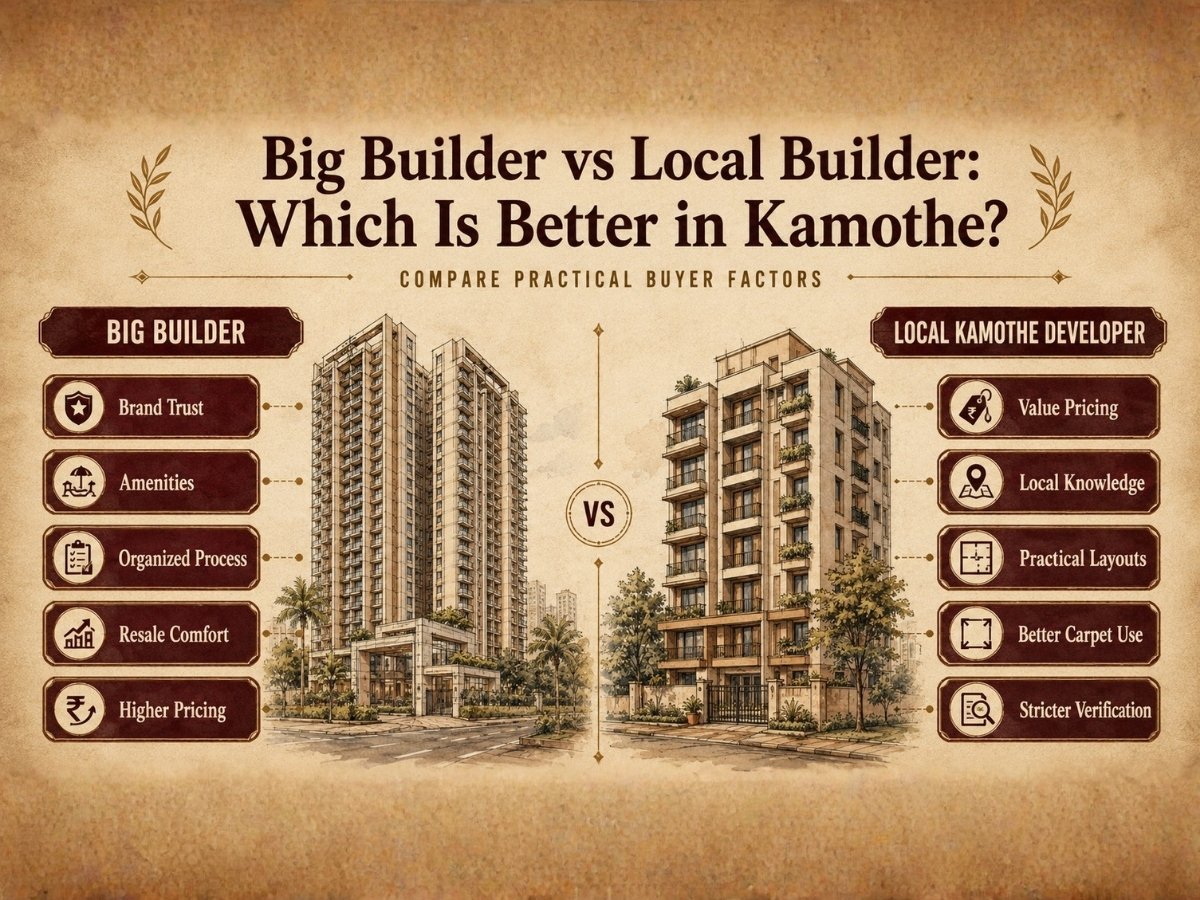
There is no single answer. In Kamothe, many projects are developed by local or regional builders rather than large national developers. The right choice depends on legal clarity, delivery record, construction quality and total cost.
| Factor | Big Builder | Local Kamothe Developer | What Buyer Should Check |
|---|---|---|---|
| Brand trust | Usually higher | Depends on local track record | Do not trust brand name blindly |
| Pricing | Often higher brand premium | Usually more value-driven | Compare carpet area and final cost |
| Amenities | More structured in larger projects | Limited in standalone buildings | Check whether amenities are actually useful |
| Local approval handling | May be stronger in systems | May understand CIDCO/PMC process better | Verify documents either way |
| Financial strength | Usually stronger | Varies widely | Check project funding and delivery history |
| Carpet area value | Sometimes smaller for price | Often better internal space | Compare usable area, not brochure size |
| Risk | Lower in some cases, not zero | Can be safe if track record is strong | Check OC, past projects and buyer feedback |
Advantages of Big Real Estate Developers
Big developers usually have better access to finance, standardized processes, established brands and stronger systems. They may be safer for large-format projects where internal infrastructure, amenities, STP, roads and utilities require heavy capital.
But in Kamothe, big-brand presence may be limited compared to Panvel, Kharghar or larger township corridors. Also, buyers may pay a higher price for smaller carpet area or amenities they may not use.
Advantages of Local Kamothe Developers
Local Kamothe developers may offer better internal carpet area, practical layouts and competitive pricing. Some local builders also understand CIDCO, PMC and 12.5% scheme paperwork better because they operate in this micro-market regularly.
However, not every local developer is safe. Check their completed projects, OC history, legal transparency and ability to finish construction without long delays.
When a Smaller Developer Can Be a Better Choice
A smaller developer can be a better choice if:
- The title is clear
- MahaRERA details are clean
- Completed projects are well maintained
- OC was received in earlier projects
- Pricing is transparent
- Construction quality is proven
- Residents give positive feedback
For end-users who need practical space at a reasonable cost, a strong local developer can sometimes offer better value than a brand-heavy project.
When a Big Brand May Still Be Safer
A big brand may be safer when the project is large, infrastructure-heavy or located in a less developed fringe area where the developer must create internal utilities, roads, amenities and services.
If a buyer is risk-averse and willing to pay a premium for stronger corporate systems, a reputed brand may be worth considering. Still, legal documents and OC checks should not be skipped.
Check Location Fit Before Choosing the Developer
A good developer in a weak micro-location can still create problems for buyers. In Kamothe, location fit must be checked along with developer quality.
Mature Nodes Like Kharghar, Kalamboli, Panvel and Kamothe
Kamothe is a practical mid-budget alternative to Kharghar and a more mature residential option compared to many emerging pockets. It benefits from access to Mansarovar station, Sion-Panvel Highway, markets, schools and nearby employment corridors.
Kharghar may command higher prices. Kalamboli is more transport and logistics-oriented in parts. Panvel has both mature and growth pockets. Kamothe sits in the middle as a largely end-user-driven residential market.
Growth Nodes Like New Panvel, Taloja, Pushpak Nagar and Ulwe
Growth nodes like New Panvel, Taloja, Pushpak Nagar and Ulwe may offer different investment logic. Some are linked to airport influence, future infrastructure and appreciation expectations. But they may also carry higher execution or livability risk depending on the exact pocket.
Kamothe buyers usually prioritize immediate livability more than pure speculation. If you are comparing Kamothe with these areas, compare:
- Daily commute
- Water supply
- School access
- Market access
- Railway station connectivity
- Legal clarity
- Resale liquidity
- Total cost
Why Location Quality and Developer Quality Must Be Checked Together
Do not choose a project only because the developer is reputed. Also check the 500-metre radius around the plot.
Look for:
- Road condition
- Waterlogging
- Drainage issues
- Nearby nallahs
- Sewage overflow complaints
- Access to main road
- Street lighting
- Parking pressure
- Distance from station or highway
- Nearby schools and markets
Some pockets in Kamothe, including areas mentioned in local discussions around Sector 6 and Sector 18, may require extra drainage and civic infrastructure checking. Buyers should verify the present ground condition before booking.
Questions to Ask a Developer Before Paying Token Money
Token money should be paid only after basic legal, financial and project clarity. Do not pay under pressure.
Is the Project Registered on MahaRERA?
Ask for the RERA number and verify it independently on the MahaRERA website. Check whether the registration is active and whether the promoter details match the sales documents.
Can You Share the Approved Plan, CC and Legal Documents?
A serious developer should be able to share the legal master file for your lawyer’s review. If the team refuses to share documents before token payment, treat it as a warning sign.
Is the Quoted Price Fully All-Inclusive?
Ask for a written cost sheet. It should include parking, floor-rise, PLC, taxes, maintenance, legal charges, society charges and any CIDCO-related costs if applicable.
What Is the Written Possession Timeline?
Do not accept verbal possession promises. Check the date mentioned in MahaRERA and the draft Agreement for Sale.
What Happens If Possession Is Delayed?
Ask how delay compensation is handled. The answer should be reflected in the agreement, not only explained verbally by the sales team.
Is the OC Already Received or Expected Later?
For ready possession, ask for the OC copy. For under-construction property, ask when the builder expects OC and what happens if it is delayed.
Red Flags When Choosing a Real Estate Developer in Kamothe
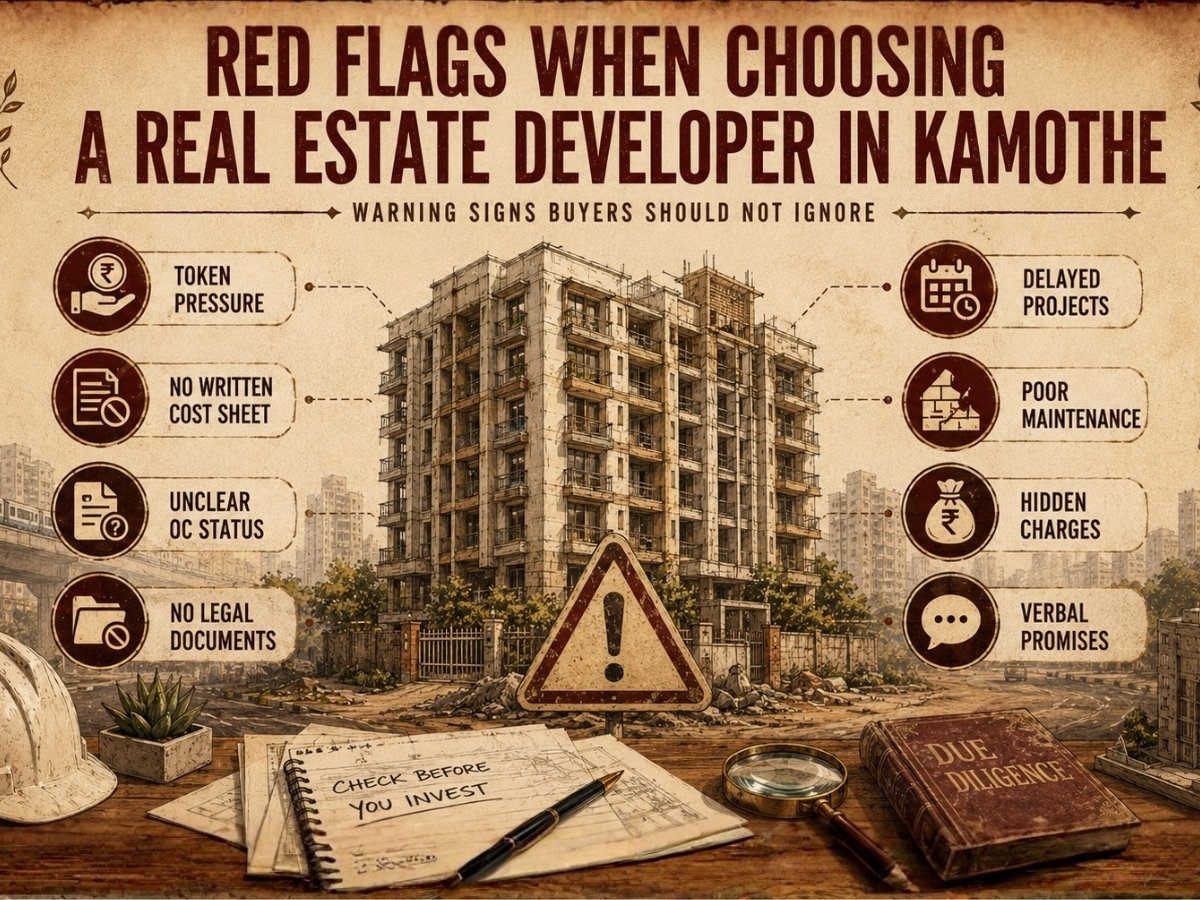
| Red Flag | What It May Mean | Buyer Action |
|---|---|---|
| Pressure to pay token quickly | Sales team wants to close before due diligence | Do not pay without refundable terms and document review |
| No written cost clarity | Hidden charges may appear later | Demand signed all-inclusive cost sheet |
| Unclear OC status | Building may not be legally ready for occupation | Refuse possession without OC clarity |
| Builder avoids legal documents | Title or approval issue may exist | Let your lawyer review before paying |
| Heavy tanker dependency in old projects | Poor utility planning | Speak to residents before booking |
| Poor maintenance in completed buildings | Weak after-sales support | Visit older projects physically |
| Too many verbal promises | Promises may not appear in agreement | Get everything written |
| Repeated delay complaints | Cash flow or approval problem | Check MahaRERA history carefully |
Pressure to Pay Token Money Quickly
If the sales team says the offer is valid only today, be careful. Good projects do not require blind payments without document checks.
Pay token money only if:
- Refund terms are written
- Legal review is allowed
- Cost sheet is clear
- Project documents are shared
- Booking form terms are readable
No Written Clarity on Charges
A developer who avoids giving a written cost sheet may later add charges for parking, floor-rise, utility connection, maintenance, legal fees or society formation.
This is a serious red flag in any under-construction or ready possession deal.
Delayed Older Projects
If the builder has delayed earlier projects by years, do not assume the new project will be different. Check whether the delay was due to genuine external reasons or repeated poor planning.
Poor Maintenance in Completed Buildings
Poorly maintained completed buildings show the developer’s real attitude after sale. Check lifts, lobby, parking, pumps, walls, terrace and society handover.
Weak Legal Transparency
If the developer hesitates to share title documents, CC, approved plan, CIDCO papers or draft agreement, stop the process until your lawyer reviews the matter.
Too Many Verbal Promises
Free parking, waived charges, upgraded fittings or early possession must be written. If it is not written, it should not be trusted.
Real Estate Developer Shortlisting Scorecard
Use this scorecard to compare two or three developers before making a final decision.
| Factor | What to Check | Good Sign | Red Flag |
|---|---|---|---|
| Past Delivery Record | Completed projects and timelines | Delivered close to promised date | Repeated extensions |
| Legal Transparency | Title, CC, OC, CIDCO documents | Documents shared before booking | Token demanded before document review |
| Construction Quality | Older buildings and monsoon performance | Dry walls, good lifts, clean common areas | Leakage, cracks, poor parking |
| Pricing Clarity | Written all-inclusive cost | Every charge listed | Vague verbal commitments |
| Location Suitability | Road, drainage, water, commute | Good access and low civic stress | Waterlogging or sewage complaints |
| After-Sales Support | Society formation and handover | Corpus and documents transferred | Builder still controls society matters |
| Buyer Feedback Pattern | Resident reviews and complaints | Consistent positive feedback | Repeated OC, water or delay complaints |
Past Delivery Record
Give higher weight to developers who have already delivered completed projects with OC and acceptable resident feedback.
Legal Transparency
A transparent developer will not hide documents from your lawyer. Legal clarity is more important than a discount.
Construction Quality
Check the building after monsoon, not just during the launch period. Construction quality is visible in older projects.
Pricing Clarity
A clear cost sheet prevents budget shock. Compare total cost, not base rate.
Location Suitability
A good project must also be in a livable pocket. Check water, drainage, road access and daily convenience.
After-Sales Support
After-sales support includes society formation, handover of maintenance corpus, warranty documents, AMC records and pending bill clearance.
Buyer Feedback Pattern
Repeated resident complaints are stronger evidence than promotional reviews. Look for patterns, not isolated comments.
Common Mistakes Buyers Make While Choosing Builders in Kamothe
Trusting Only Brand Name
A big name does not automatically mean the project is right for you. Check documents, cost, location and possession status.
Ignoring Legal Document Verification
Do not depend only on bank loan approval. Banks check loan safety, but buyers must check long-term ownership safety through an independent lawyer.
Booking Only Because of Discount or Offer
Discounts can be used to push weak inventory. Do not book only because of a festive offer, free gold, zero stamp duty claim or limited-period pricing.
Not Visiting Completed Projects
A sample flat tells you how the builder markets. A completed project tells you how the builder builds.
Depending Fully on Broker or Sales Team Promises
Brokers and sales teams may be useful, but their promises must be verified. Final decisions should be based on documents, site visits and written terms.
For more buyer preparation, read [questions to ask before buying a flat in Navi Mumbai](ADD INTERNAL LINK HERE).
How to Verify a Real Estate Developer Before Final Decision
Step 1: Check MahaRERA Details
Search the project and promoter on MahaRERA. Check registration validity, possession date, uploaded documents, progress updates and any available litigation or encumbrance information.
Step 2: Visit the Project Site
Visit the actual construction or completed building. Check access road, construction activity, material quality, drainage and surrounding infrastructure.
Step 3: Visit Completed Projects
Visit older projects by the same developer. Speak to residents and inspect construction quality, leakage, lifts, parking and water supply.
Step 4: Review Legal Documents with an Expert
Hire a property lawyer to review the Title Clearance Certificate, CC, approved plan, CIDCO documents, PAP plot documents if applicable and draft Agreement for Sale.
Step 5: Compare Total Cost with Other Projects
Compare the final all-inclusive cost with similar projects in Kamothe, Kharghar, Kalamboli and Panvel. Do not compare only base rate.
Step 6: Take Final Decision Only After Written Clarity
Proceed only when the developer has provided written clarity on cost, possession, documents, parking, maintenance, OC and all promised features.
Final Checklist Before Choosing a Real Estate Developer in Kamothe
Use this checklist before making payment:
- [ ] MahaRERA registration number checked on the official portal
- [ ] Promoter name and project details verified
- [ ] MahaRERA possession timeline checked
- [ ] Litigation or extension history checked where available
- [ ] Commencement Certificate reviewed
- [ ] Approved building plan reviewed
- [ ] OC checked for ready-to-move property
- [ ] CIDCO leasehold or freehold status understood
- [ ] CIDCO transfer documents checked where applicable
- [ ] PAP or 12.5% plot documents verified, if relevant
- [ ] Title Clearance Certificate reviewed by a lawyer
- [ ] Agreement for Sale reviewed before signing
- [ ] Written all-inclusive cost sheet received
- [ ] Parking allocation written clearly
- [ ] GST, stamp duty and registration costs calculated
- [ ] Completed project visited
- [ ] Existing residents or buyers spoken to
- [ ] Site progress physically checked
- [ ] Water supply and tanker dependency checked
- [ ] Drainage and monsoon condition checked around the project
- [ ] No verbal promises accepted without written proof
- [ ] Final payment linked to legal possession and OC clarity
Conclusion
Choosing the right real estate developer in Kamothe requires more than comparing price, floor plan and amenities. Buyers should check MahaRERA, legal documents, CIDCO and PAP plot clarity, PMC approval relevance, OC status, construction quality, water supply, drainage condition, pricing transparency and completed project feedback before paying token money.
Kamothe is a practical residential market for end-users, but it has local risks that must be checked carefully. A slightly cheaper flat can become costly if the building has unclear title, hidden charges, delayed OC, poor waterproofing or long-term water dependency. Similarly, a big brand is not automatically safer if the project location, legal paperwork or final cost does not match the buyer’s needs.
The best developer in Kamothe is not simply the most famous one. It is the one who gives clear documents, delivers what is promised, maintains construction quality, supports society handover and leaves the buyer with a legally safe, livable home.
FAQs
How do I choose the right real estate developer in Kamothe?
Choose a real estate developer in Kamothe by checking MahaRERA registration, completed projects, legal documents, OC status, construction quality, pricing clarity and resident feedback. Visit the builder’s older projects and speak to residents before paying token money.
What documents should I check before booking a flat in Kamothe?
Buyers should check the Title Clearance Certificate, Commencement Certificate, Occupancy Certificate, approved building plan, Agreement for Sale, CIDCO allotment or transfer documents and PAP or 12.5% scheme documents where applicable.
Is MahaRERA registration enough to trust a builder?
No. MahaRERA registration is important, but it is not enough. Buyers should also verify legal title, construction quality, OC, pricing, water supply, drainage condition and the developer’s completed project history.
Should I visit completed projects before booking?
Yes. Visiting completed projects is one of the most practical ways to judge a developer. It helps buyers check real construction quality, leakage issues, lift maintenance, parking condition, water supply and after-sales support.
Is a big builder always better than a local builder?
No. A big builder may offer stronger systems and brand comfort, but a good local Kamothe developer can offer better carpet area, practical pricing and strong local approval knowledge. The decision should be based on documents, delivery record and quality, not brand name alone.
What are the red flags in a real estate developer?
Major red flags include pressure to pay token money quickly, refusal to share documents, unclear OC status, hidden charges, delayed older projects, poor maintenance in completed buildings, repeated buyer complaints and too many verbal promises.
What should I ask before paying token money?
Ask whether the project is MahaRERA registered, whether approved plans and CC are available, whether the price is fully all-inclusive, what the written possession date is, what happens if possession is delayed and whether OC is received or expected later.
Which Kamothe areas need extra legal checking before buying property?
Properties near older sectors, village boundaries or plots with PAP or 12.5% scheme history need extra legal checking. Buyers should also check local drainage and civic conditions in pockets where waterlogging, sewage overflow or water supply complaints are reported.
How important is Occupancy Certificate before possession?
OC is extremely important. It confirms that the building is legally fit for occupation. Buyers should avoid accepting final possession without OC clarity, especially in ready-to-move projects.
Can a local Kamothe developer be safer than a big brand?
Yes, a local Kamothe developer can be safer if they have clear CIDCO and PMC paperwork, valid approvals, good construction quality, timely completed projects, OC history and positive resident feedback. The key is verification, not size.