

Choosing the right builder in Navi Mumbai is not only about brand name, brochure design, amenities, or the salesperson’s confidence. The safest way is to verify the exact project, exact promoter, exact phase or tower, MahaRERA status, possession timeline, approvals, construction quality, pricing clarity, and past delivery record before you pay token money.
A good builder is not just a famous builder. A good builder, for your specific purchase, is one whose project documents are clear, whose delivery record can be checked, whose cost sheet is transparent, and whose commitments are written properly in the agreement.
Navi Mumbai has many different property markets, from mature nodes like Vashi, Nerul, Seawoods, Airoli, and Belapur to growth-focused areas like Kharghar, Ulwe, Panvel, Taloja, Dronagiri, Pushpak Nagar, and Kamothe. The builder you choose should be suitable for that exact location, project type, and your purpose: end-use, investment, rental income, or long-term holding.
MahaRERA’s official website provides project search, promoter search, registered project information, complaint search, project-wise complaints, promoter-wise complaints, lapsed projects, and homebuyer resources, so it should be the starting point of your verification process.
Quick Summary
| Check | What to Verify | Why It Matters |
|---|---|---|
| MahaRERA registration | Exact project name, registration number, promoter name, status | Confirms basic regulatory visibility |
| Promoter name | Legal promoter name vs marketing brand name | The legal entity matters more than the brand used in ads |
| Project phase/tower | Exact wing, phase, tower, and registration details | Different phases can have different approvals and timelines |
| Possession date | Declared date on MahaRERA and agreement | Avoid relying only on verbal possession promises |
| Approvals | CC, approved plan, OC/Completion Certificate where applicable | Confirms whether construction and occupation claims are document-backed |
| Past projects | Completed buildings by the same promoter | Shows practical delivery and construction quality |
| Resident feedback | Existing residents’ experience | Helps check maintenance, leakage, handover, and after-sales support |
| Cost sheet | Base price, GST, stamp duty, parking, corpus, maintenance, legal charges | Prevents hidden-cost surprises |
| Agreement draft | Possession, payment schedule, carpet area, cancellation, delay terms | This is more important than the brochure |
| Legal review | Independent lawyer check before large payment | Reduces document and title risk |
Simple rule: do not judge a builder only by reputation. Judge the exact project with documents.
Step-by-Step Process to Verify a Builder in Navi Mumbai
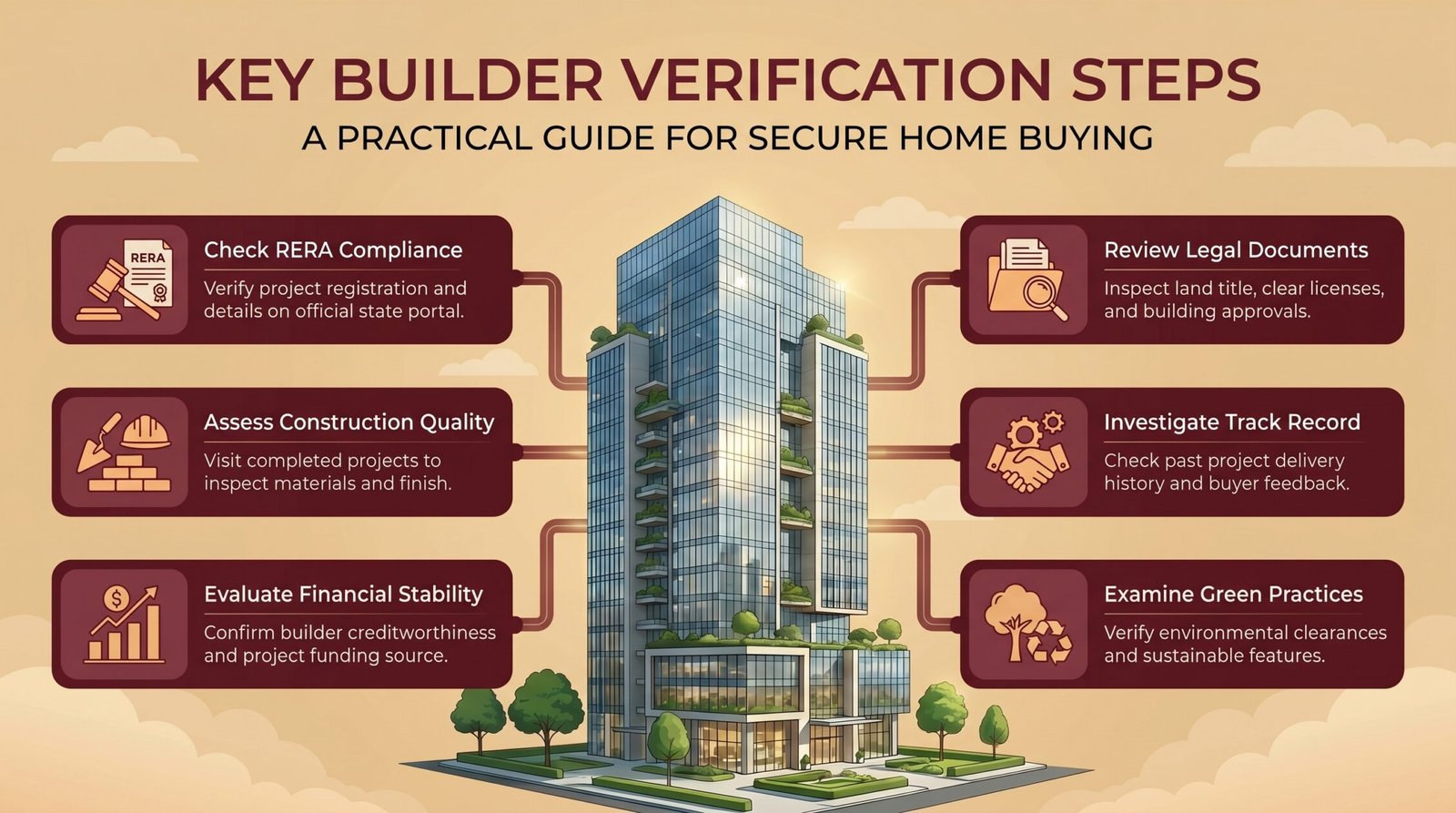
1. Search the Exact Project on MahaRERA
Start with the exact project name or registration number. Do not rely only on what is printed in a brochure or WhatsApp message. On the MahaRERA website, check whether the project appears under registered projects, whether the details match the sales material, and whether the promoter name is the same as what is shown in the draft documents.
2. Match the Promoter Name With the Builder Brand
Many buyers search for a popular builder brand, but the legal record may show a different promoter entity. This is not automatically a problem, but it must be understood clearly. Ask the sales team:
- What is the legal promoter name?
- Is this the same entity signing the agreement?
- Is this the same entity shown on MahaRERA?
- Is the project part of a joint venture, landowner arrangement, or special purpose company?
The RERA Act requires promoter/project registration details and disclosures, including promoter information and project documents.
3. Verify the Exact Phase, Tower, or Wing
This is one of the most common mistakes buyers make. A builder may have a large project name, but approvals, registration, possession dates, and construction progress may differ by phase or tower.
Under the RERA framework, if a project is developed in phases, each phase is treated as a standalone real estate project for registration purposes.
So do not ask only:
“Is this project RERA registered?”
Ask:
“Is this exact phase, tower, or wing RERA registered, and what is its official completion date?”
4. Check Possession Date and Delay Risk
The possession date in the advertisement is not enough. Check the declared date on MahaRERA and the possession clause in the Agreement for Sale.
If the builder gives a verbal answer like “possession soon” or “almost ready,” ask for the written date. If the date has changed, ask why. If there are extensions, ask for the official record.
Section 18 of the RERA Act deals with return of amount and compensation where a promoter fails to complete or give possession in accordance with the agreement or specified date, subject to legal facts and procedure.
5. Review Uploaded Documents and Disclosures
Look for documents and disclosures related to:
- approvals
- commencement certificate
- sanctioned plan
- layout plan
- title/encumbrance information
- agreement format
- allotment letter format
- carpet area
- garage/parking details
- project completion timeline
The RERA Act lists several project-registration disclosures, including approvals, commencement certificate, sanctioned plan, layout plan, agreement format, carpet area, garage details, title/encumbrance information, and completion timeline.
6. Check the Local Authority
In Navi Mumbai, the relevant approval authority can vary depending on the exact project location. For some projects, CIDCO records may matter. In Panvel, Panvel Municipal Corporation’s town planning department grants development permission and commencement certificate as per sanctioned development control regulations.
For projects under NMMC limits, occupancy and related municipal records should be checked through the appropriate NMMC systems or department. The NMMC online system references occupancy certificate services.
7. Visit Completed Projects
Do not judge construction quality only from the sample flat. Visit at least one completed project by the same promoter, preferably one that is a few years old.
Check:
- leakage marks
- lift maintenance
- parking condition
- lobby and staircase quality
- society handover
- security and common areas
- actual amenities delivered
- resident satisfaction
A new sample flat can look polished. An old completed project shows how the builder’s work ages.
8. Speak to Existing Residents
Online reviews help, but they are not enough. Speak to people who already live in the builder’s completed projects.
Ask them:
- Was possession delayed?
- Were amenities delivered as promised?
- Were there leakage or structural issues?
- How was after-sales support?
- Was society handover smooth?
- Were extra charges added later?
Online discussions among Navi Mumbai buyers show that people often feel confused about “trusted developers” and ask for real experiences from other buyers. Treat such forums as sentiment signals, not final proof, because anonymous comments can be incomplete, emotional, or unverified.
9. Check the Cost Sheet Carefully
The cost sheet should be written, complete, and easy to understand. Ask for a full breakup:
- basic price
- floor rise
- preferred location charge
- parking
- clubhouse or amenity charge
- GST, if applicable
- stamp duty and registration
- maintenance deposit
- society charges
- corpus fund
- legal charges
- other administrative charges
Do not compare two builders only by the headline price. Compare total cost and carpet area.
10. Review the Agreement Before Paying a Large Amount
Section 13 of the RERA Act says a promoter cannot accept more than 10% of the cost of the apartment, plot, or building as advance payment or application fee without first entering into a written and registered Agreement for Sale.
Before paying beyond a small initial amount, ask for the draft Agreement for Sale and get it reviewed. The agreement should clearly mention the unit, carpet area, payment schedule, possession date, delay terms, cancellation terms, parking, amenities, and other commitments.
Promoter Name vs Builder Brand: Why This Matters
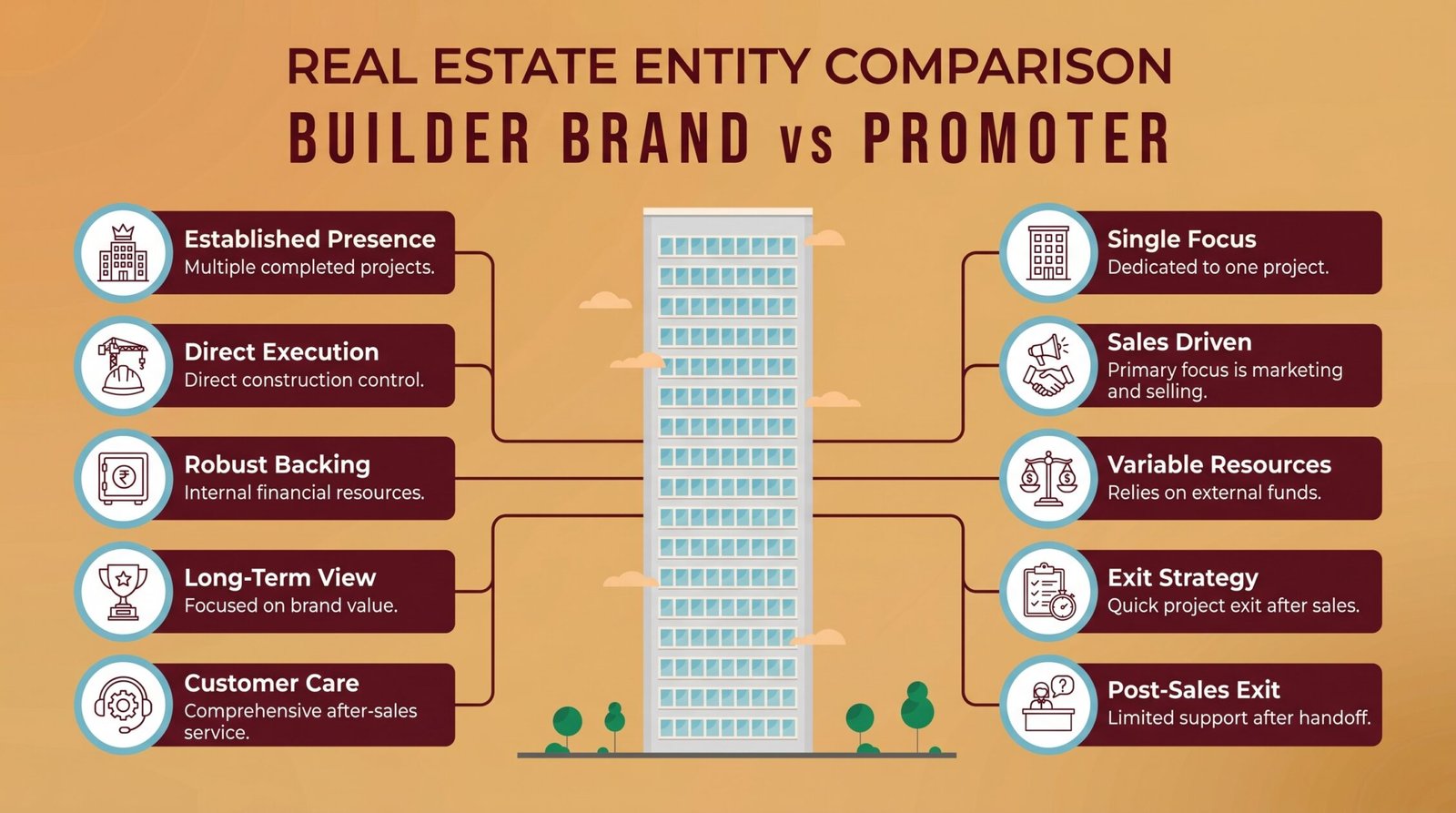
A buyer may say, “I am buying from XYZ Builder.” But the agreement may be signed by a different legal entity. Sometimes this is normal because projects are developed through group companies, joint ventures, LLPs, or special purpose entities. But it should never be unclear.
Before booking, match these four things:
- Brand name used in marketing
- Legal promoter name on MahaRERA
- Name on draft Agreement for Sale
- Name on payment receipt/account details
If these do not match, ask for a written explanation. Do not assume that a popular brand name automatically protects you.
Project-Level and Phase-Level Verification
The right way to choose a builder is to verify the project, not just the builder.
A builder may have delivered one project well and delayed another. A builder may be strong in one Navi Mumbai node but weak in another. A township may have one completed phase and another under-construction phase with a different timeline.
Check:
- exact project registration number
- phase or tower registration
- possession date for your phase
- construction status
- approvals for your building
- payment schedule linked to construction milestones
- whether amenities belong to your phase or future phases
This is especially important in larger developments where brochures show a full lifestyle image but the actual unit may belong to an early or later phase.
Documents to Check Before Booking a Flat in Navi Mumbai
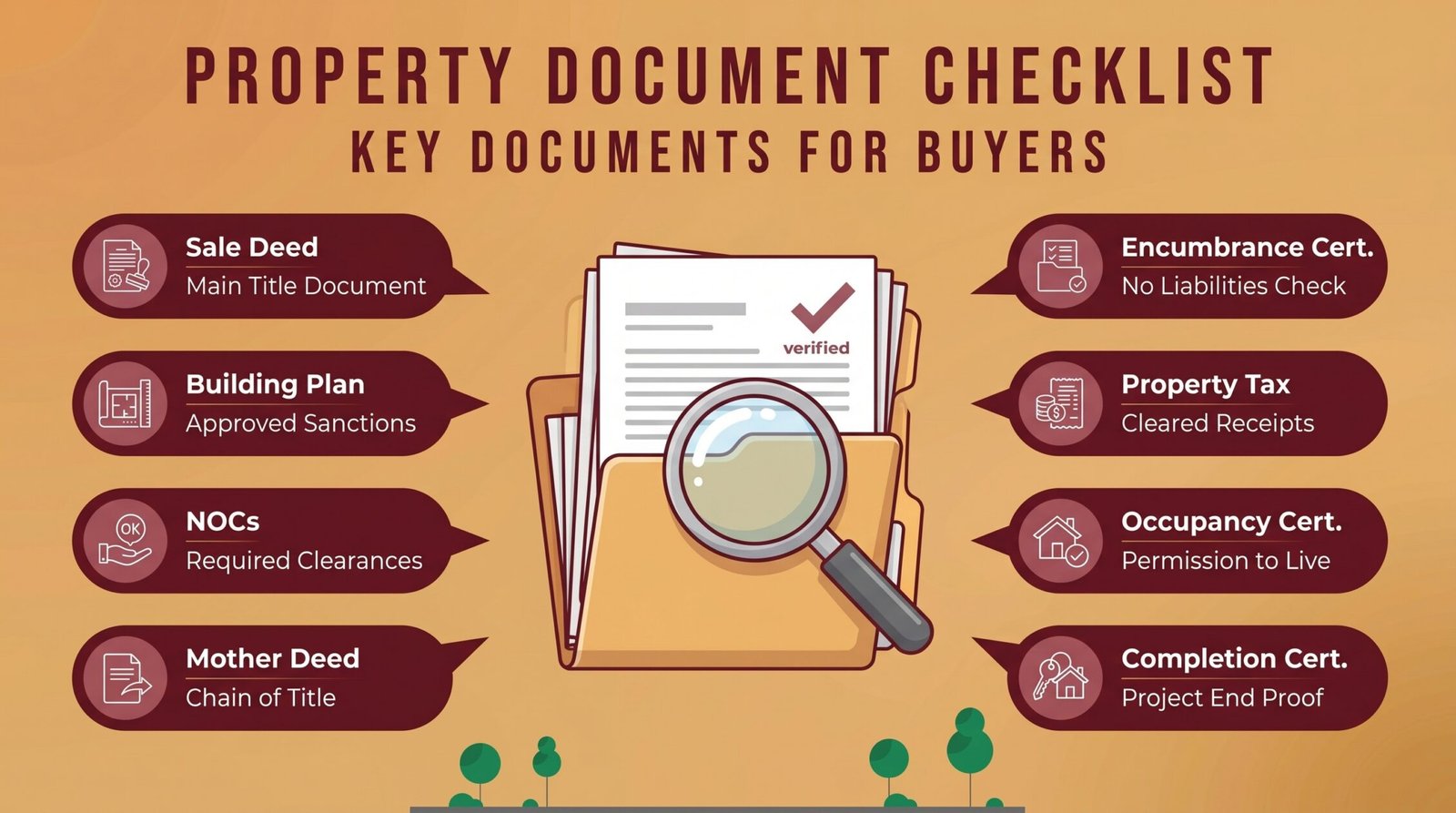
This is the minimum document checklist. For final purchase, get a property lawyer to review documents before signing or making a large payment.
| Document | Why It Matters |
|---|---|
| MahaRERA registration details | Confirms basic project and promoter visibility |
| Title documents/title report | Helps check legal ownership and development rights |
| Encumbrance details | Helps identify claims, charges, or rights over the land |
| Approved building plan | Confirms what is officially sanctioned |
| Commencement Certificate | Confirms permission to begin construction as per sanctioned plan |
| Occupancy Certificate / Completion Certificate | Important for ready-possession or completed-property claims |
| Draft Agreement for Sale | Controls the actual buyer-builder relationship |
| Allotment letter | Should match unit, floor, price, and terms |
| Cost sheet | Shows total payable amount and hidden charges |
| Carpet area statement | Helps compare usable area correctly |
| Parking terms | Avoids later confusion over parking type, allocation, and cost |
| Maintenance/corpus details | Shows future and possession-stage charges |
| Bank approval details | Useful, but not a substitute for legal due diligence |
The RERA Act defines “carpet area” as the net usable floor area of an apartment, excluding external walls, service shafts, exclusive balcony/verandah area, and exclusive open terrace area, while including internal partition walls. It also defines commencement certificate and completion/occupancy-related concepts under the Act.
Important: Bank approval does not mean the project is risk-free. It only means the bank has its own process for lending. Your legal check is still necessary.
CC, OC, Approved Plan, Title, Agreement and Cost Sheet: What Buyers Should Understand
Commencement Certificate
A Commencement Certificate means the competent authority has permitted construction to begin as per the sanctioned plan. For under-construction projects, this is a key document.
Occupancy Certificate
An Occupancy Certificate is important for ready-possession claims. The RERA Act describes occupancy certificate as a certificate issued by the competent authority permitting occupation of a building under local laws, with civic infrastructure such as water, sanitation, and electricity.
Approved Plan
The approved plan is more important than the brochure. A brochure can show attractive amenities, but the approved plan and agreement tell you what is officially committed.
Title
Title documents help show whether the promoter has proper legal rights over the land or development. This should be checked by a lawyer.
Agreement for Sale
This is the most important document for the buyer. It should clearly mention possession, payment schedule, unit details, carpet area, delay terms, cancellation terms, and amenities.
Cost Sheet
A good cost sheet should not hide major charges. Ask for everything in writing before paying token money.
Builder Scorecard for Navi Mumbai Buyers
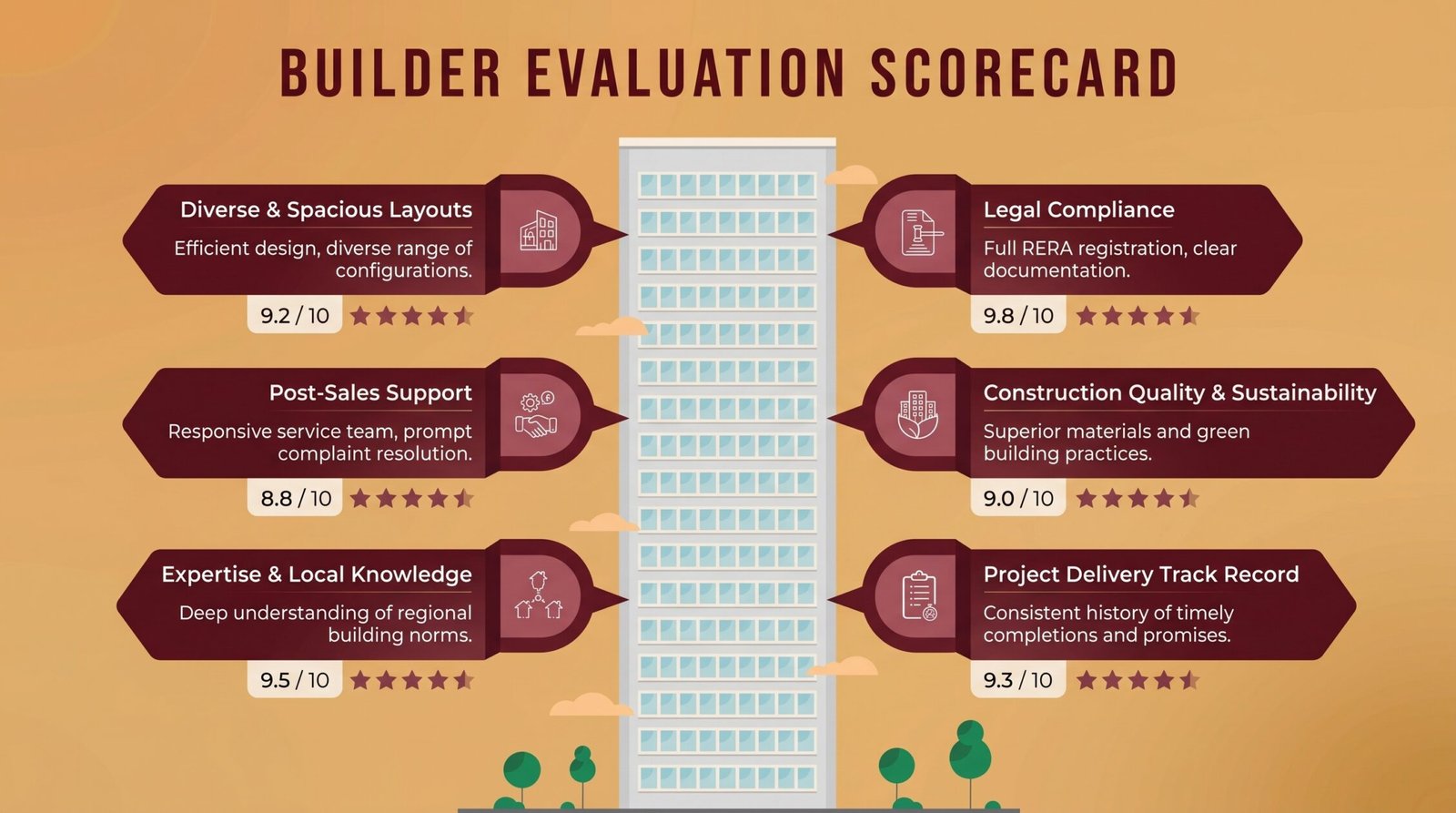
Use this scorecard before shortlisting any builder. This is not a public ranking system. It is a buyer decision tool.
| Criteria | Score 1–5 | What to Check |
|---|---|---|
| MahaRERA clarity | __ / 5 | Exact project, promoter, phase, documents |
| Delivery record | __ / 5 | Completed projects, delay history, resident feedback |
| Construction quality | __ / 5 | Site visit, leakage, common areas, finishing |
| Legal clarity | __ / 5 | Title, approvals, agreement, encumbrance |
| Pricing transparency | __ / 5 | Full cost sheet, no vague charges |
| Carpet area clarity | __ / 5 | RERA carpet area in writing |
| Possession confidence | __ / 5 | Official date, site progress, agreement date |
| After-sales support | __ / 5 | Resident feedback, complaint handling |
| Local node experience | __ / 5 | Experience in that Navi Mumbai area |
| Buyer fit | __ / 5 | End-use, investment, rental, budget, lifestyle |
Scoring guide:
- 5: Strong evidence
- 4: Mostly positive, small checks pending
- 3: Mixed; verify carefully
- 2: Weak evidence
- 1: Do not proceed until clarified
A builder scoring well on brand image but poorly on documents should not be treated as a safe choice.
Node-Wise Builder Checks in Navi Mumbai
The best builder for one area may not be the best choice for another. Navi Mumbai has mature nodes, growth nodes, airport-influence areas, and budget-sensitive areas. The verification style should change accordingly.
| Area | What Buyers Should Check |
|---|---|
| Kharghar | Exact phase, amenities, construction quality, metro/location claims, society handover |
| Ulwe | Airport-growth claims, possession timeline, authority records, actual livability |
| Panvel | Whether the project falls under PMC, CIDCO, NAINA, or another authority; approvals and CC/OC |
| Taloja | Construction progress, access, livability, possession realism, budget vs risk |
| Vashi | OC, society condition, parking, redevelopment clarity, structural upkeep |
| Nerul | Mature-building quality, OC, premium pricing justification, society management |
| Seawoods | Premium claims, OC, view/location claims, written amenity commitments |
| Airoli | Office-corridor relevance, rental demand, OC, building upkeep |
| Ghansoli | Commute claims, rental suitability, construction quality, maintenance |
| Kamothe | Authority clarity, connectivity claims, OC/CC chain |
| Dronagiri | Long-term infrastructure claims, possession timeline, project progress |
| Pushpak Nagar | Airport-related pricing claims, exact address, approval authority, phase status |
| Belapur | Mature-node quality, OC, parking, society and maintenance standards |
| Sanpada | Redevelopment clarity, OC, structural condition, parking |
| Juinagar/Kalamboli | Location-specific approval authority, access, livability, cost sheet clarity |
Do not buy only because a salesperson says an area will grow. Growth can help, but documents protect you first.
Common Experiences Navi Mumbai Buyers Often Face
Many buyers in Navi Mumbai go through the same pattern. They shortlist projects based on location, price, and builder name. Then they get confused because every salesperson says their project is “RERA approved,” “almost sold out,” “near possession,” or “best for investment.”
In online Navi Mumbai property discussions, buyers often ask which developers are trusted, which areas are better, whether a builder is reliable, and whether certain growth stories are being overhyped. These discussions are useful because they show real buyer concerns, but they should not be used as final proof against or in favour of any builder. Anonymous online comments can be biased, incomplete, or based on one project only.
The practical lesson is simple: listen to people, but verify documents.
Red Flags Before Choosing a Builder in Navi Mumbai
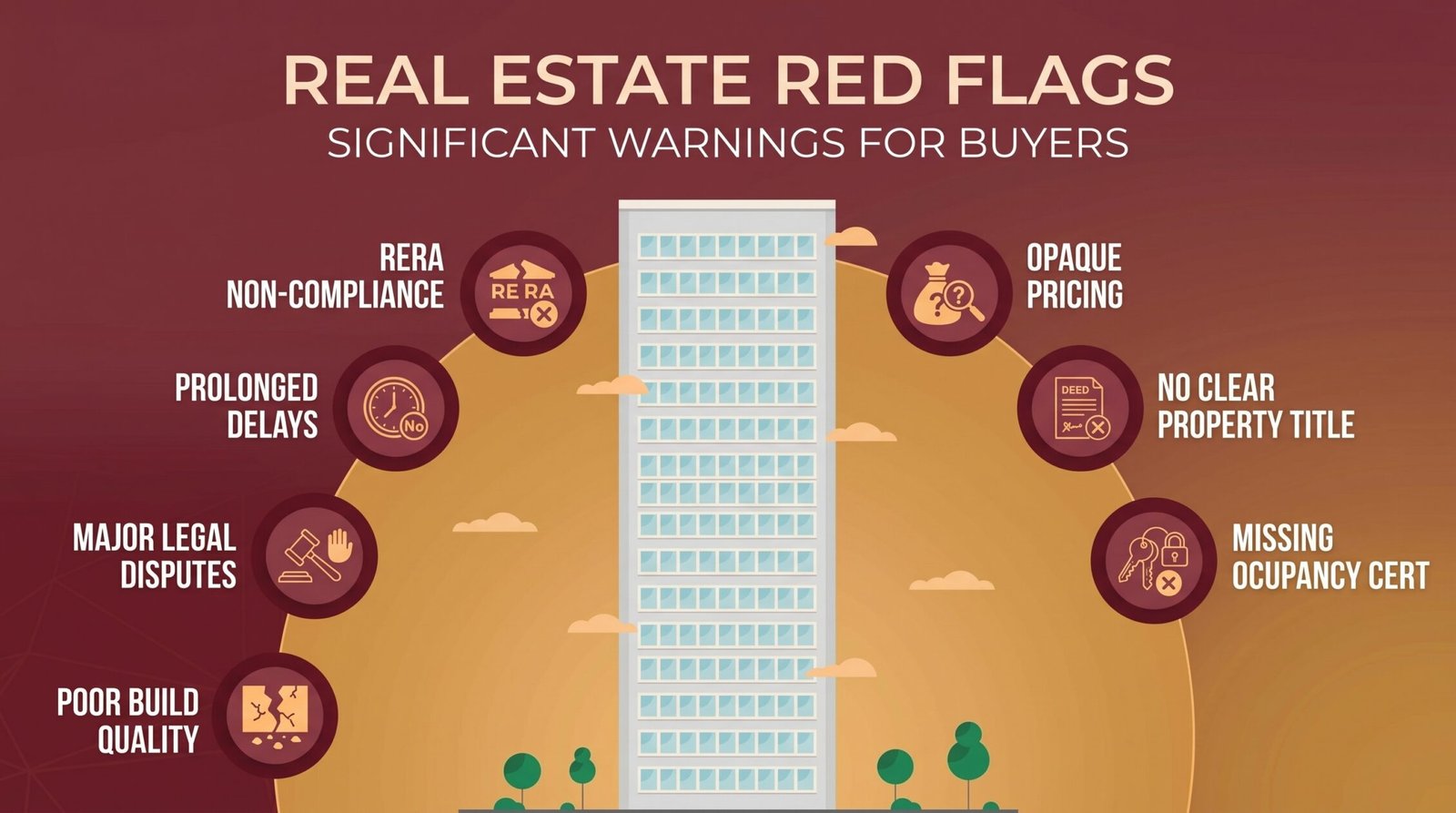
Be careful if you notice any of these signs:
- Project is not found on MahaRERA.
- Sales team avoids sharing the RERA number.
- Promoter name and brand name do not match, with no clear explanation.
- Possession date is only verbal.
- Builder says documents will be shared only after token payment.
- More than 10% is demanded before agreement.
- Cost sheet is incomplete or keeps changing.
- Carpet area is not clearly mentioned.
- Parking terms are vague.
- Amenities are promised verbally but not in writing.
- “Ready possession” is claimed but OC status is unclear.
- Completed projects are not available for inspection.
- Existing residents report repeated unresolved issues.
- Builder discourages lawyer review.
- Payment is requested in cash or unclear channels.
- Brochure and legal documents do not match.
- Bank approval is used as the only proof of safety.
- Local approval authority is not clear.
- Cancellation/refund policy is vague.
- Sales pressure is unusually high.
One red flag does not always mean the project is bad. But it means you should stop, ask written questions, and verify before paying.
Questions to Ask Before Paying Token Money
Before paying token money to any builder in Navi Mumbai, ask these questions:
RERA and Legal
- What is the exact MahaRERA registration number?
- What is the legal promoter name?
- Is this exact phase/tower registered?
- Can I see the project on MahaRERA?
- Are there any extensions, changes, or complaints I should know about?
Approvals and Documents
- Which authority approved the project?
- Can I see the approved plan?
- Can I see the Commencement Certificate?
- Is OC or Completion Certificate available, if the project is ready?
- Can I review the draft Agreement for Sale before paying a large amount?
Possession
- What is the possession date on MahaRERA?
- What is the possession date in the agreement?
- What happens if possession is delayed?
- Are amenities delivered at possession or later?
Pricing
- What is the full written cost sheet?
- Are parking, GST, stamp duty, registration, maintenance, corpus, and legal charges included?
- Are there any future charges not shown today?
- Is the payment schedule linked to construction progress?
Unit Details
- What is the RERA carpet area?
- What is the difference between carpet area and saleable area?
- Is the unit number, floor, view, and parking written clearly?
Practical Checks
- Can I visit a completed project by the same promoter?
- Can I speak to existing residents?
- Who handles after-sales complaints?
- What is the cancellation/refund policy if I do not proceed?
If the answers are mostly verbal, delay payment.
Final Decision Framework
Before choosing a builder, classify the project into one of these four categories.
Green Zone: Good to Shortlist
- Project is found on MahaRERA.
- Promoter name is clear.
- Phase/tower details match.
- Possession date is written.
- Key approvals are available.
- Cost sheet is clear.
- Agreement can be reviewed.
- Completed projects look acceptable.
- Resident feedback is mostly reasonable
Yellow Zone: Verify Carefully
- Project appears on MahaRERA, but some details need checking.
- Cost sheet has unclear items.
- Possession timeline needs more proof.
- Local authority records need verification.
- Resident feedback is mixed.
- Agreement has clauses that need legal review.
Orange Zone: Pause Before Paying
- Documents are delayed.
- Sales team pressures you for token.
- Possession language is vague.
- Promoter name is unclear.
- Cost sheet is incomplete.
- Parking or amenities are not written clearly.
Red Zone: Avoid Until Clarified
- Project cannot be found on MahaRERA.
- Builder refuses to share documents.
- Large payment is demanded before agreement.
- OC/CC status is misrepresented.
- Legal promoter identity is unclear.
- Payment route is not traceable.
- Brochure and agreement do not match.
The safest decision is not always the cheapest project or the biggest brand. The safest decision is the project where the documents, timeline, cost, and builder record all make sense together.
Conclusion
Choosing the right builder in Navi Mumbai is not about finding the most popular name. It is about reducing risk before you commit your money.
Start with MahaRERA. Match the promoter name. Verify the exact project phase. Check CC, OC, approved plan, title documents, agreement, cost sheet, and possession date. Visit completed projects. Speak to residents. Ask direct questions before paying token money.
A builder becomes trustworthy only when the documents, delivery record, construction quality, pricing, and buyer experience all support the claim.
Discussion
FAQs
Frequently Asked Questions
Which builder is best in Navi Mumbai?
There is no single best builder for every buyer. The right builder depends on your budget, location, project type, possession requirement, and risk comfort. A builder should be judged project by project, not only by brand name.
How do I check if a builder is RERA registered in Navi Mumbai?
Go to the MahaRERA website and search the exact project or promoter. Match the registration number, project name, promoter name, phase/tower, declared timeline, and uploaded documents with the builder’s brochure and agreement.
Is MahaRERA registration enough?
No. MahaRERA registration is a starting point, not the full due diligence. You should also check approvals, possession date, agreement terms, OC/CC status, cost sheet, title documents, completed projects, and resident feedback.
Should I choose a big builder or a local builder?
A big builder is not automatically safe, and a local builder is not automatically risky. Compare the exact project’s RERA status, approvals, construction quality, delivery record, pricing transparency, and agreement terms.
What documents should I check before booking a flat?
Check MahaRERA registration details, title documents, encumbrance details, approved plan, Commencement Certificate, OC/Completion Certificate where applicable, draft Agreement for Sale, cost sheet, carpet area, parking terms, and maintenance/corpus charges.
Can I pay token money before checking documents?
You should avoid paying token money before basic verification. At minimum, check MahaRERA details, promoter name, project phase, possession date, cost sheet, cancellation terms, and payment receipt format before paying.
What is the biggest red flag while choosing a builder?
The biggest red flag is refusal to share documents. A builder who expects payment but does not share RERA details, approvals, agreement draft, or cost sheet clearly is creating unnecessary risk for the buyer.
Is ready-possession always safer than under-construction?
Not always. Ready-possession can reduce construction-delay risk, but you still need to check OC, title, society condition, maintenance, parking, and actual building quality. Under-construction projects need stricter RERA, CC, possession, and payment-schedule checks.
Why is carpet area important?
Carpet area helps you compare the actual usable area of flats. The RERA Act defines carpet area as net usable floor area, excluding external walls, service shafts, exclusive balcony/verandah, and exclusive open terrace area, while including internal partition walls.
What should I do if the builder pressures me to book immediately?
Slow down. Ask for written documents, verify the project on MahaRERA, check the cost sheet, speak to residents, and review the agreement. A good project should survive basic due diligence.