

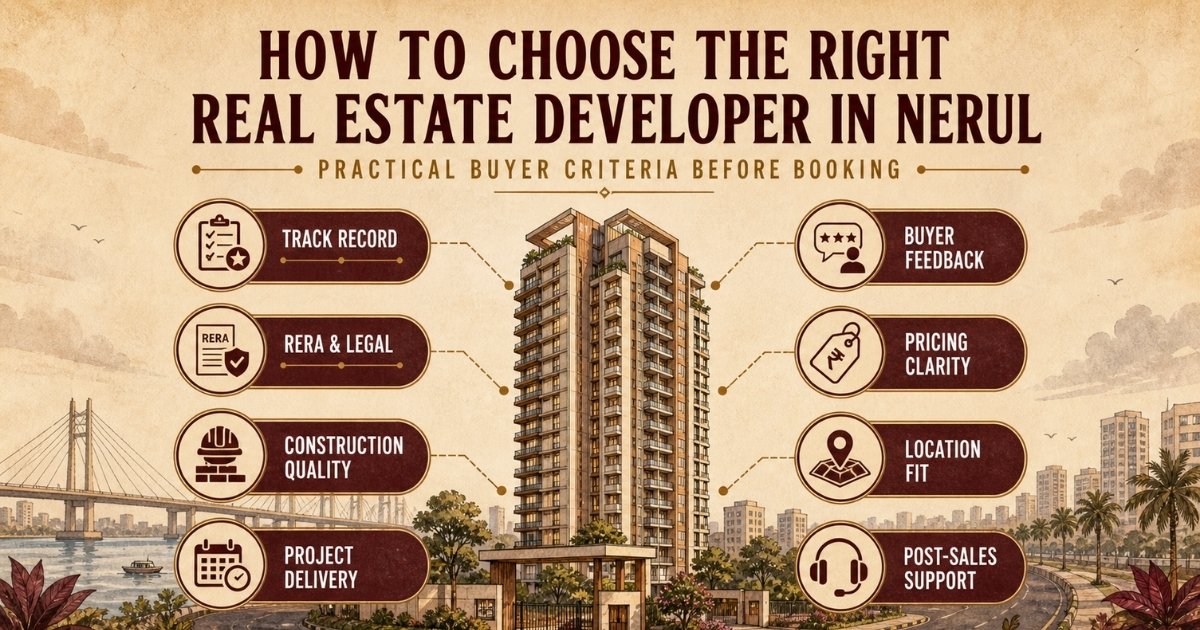
To choose the right real estate developer in Nerul, buyers should check the developer’s completed projects, MahaRERA details, legal documents, CIDCO/NMMC approvals, construction quality, pricing clarity, possession history, and existing buyer feedback before paying token money. In Nerul, this is especially important because property values are high, many projects involve redevelopment or CIDCO-origin land, and approval clarity can differ from sector to sector.
Nerul is one of Navi Mumbai’s mature and high-value residential nodes. It has established sectors, educational institutions, Palm Beach Road access, railway connectivity, and proximity to Seawoods, Belapur, Vashi, Juinagar, and future airport-linked growth corridors. But a good location alone does not make a project safe. The developer’s legal transparency, construction discipline, financial strength, and handover record matter just as much.
This guide is written for buyer awareness. Before booking a flat or signing an agreement, buyers should verify all documents with a qualified legal professional.
Quick Summary: How to Choose the Right Real Estate Developer in Nerul
The safest way to choose a real estate developer in Nerul is to verify legal documents, completed projects, pricing clarity, and buyer feedback before paying token money. A reputed developer is not always the right developer if the project has unclear approvals, delayed possession, hidden charges, or weak after-sales support.
| What to Check | Why It Matters in Nerul | Good Sign | Red Flag |
|---|---|---|---|
| MahaRERA registration | Confirms legal project registration and timeline disclosure | Active registration with uploaded documents | Missing, expired, or unclear project details |
| NMMC CC and OC | Confirms legal construction and possession status | CC covers your floor and OC is available before possession | Fit-out possession without OC |
| CIDCO title clarity | Important because Navi Mumbai land often has CIDCO-origin leasehold history | Clear allotment, transfer, or freehold documents | Vague answers on CIDCO transfer charges |
| Completed projects | Shows actual delivery and construction quality | Older buildings are well-maintained | Leakage, poor parking, bad upkeep |
| Pricing sheet | Prevents budget shocks | Written all-inclusive cost sheet | Verbal pricing and later extra charges |
| Resident feedback | Reveals after-sales reality | Residents confirm smooth handover | Complaints about delays, water, maintenance, or society issues |
For buyers comparing [real estate developers in Nerul](ADD INTERNAL LINK HERE), the first rule is simple: do not judge only by brochures, sample flats, or brand name. Check proof.
Why Choosing the Right Real Estate Developer Matters in Nerul
Nerul is not a new peripheral market where buyers only look at future promise. It is a mature Navi Mumbai node with high residential demand, strong end-user interest, and premium micro-markets near Palm Beach Road, Seawoods, Belapur, and key educational belts.
The local property market has different layers. Some sectors have older CIDCO-era societies and redevelopment activity. Some areas attract premium buyers because of Palm Beach Road and waterfront influence. Other pockets, including relatively newer or emerging sectors, may offer more accessible pricing compared to the most premium parts of Nerul.
This is why choosing the right developer matters. A poor developer can create problems such as delayed possession, unclear legal title, inflated charges, weak construction quality, OC delays, and society handover issues. In a high-value market like Nerul, even a small mistake can block large capital for years.
A reliable developer should not only build the flat. They should deliver a legally safe, structurally sound, financeable, and resale-friendly asset.
Understand the Developer’s Past Track Record
A developer’s past record is the strongest signal of future performance. New launch advertisements can look impressive, but older completed projects reveal the real truth.
Check how many projects the developer has completed, whether possession was given on time, whether Occupancy Certificates were received properly, and whether housing societies were formed without unnecessary delay.
A developer with many new launches but weak completed-project history should be checked more carefully.
Check Completed Projects Before Trusting New Launches
Before trusting a new project in Nerul, visit at least one completed project by the same developer. Ideally, check a building that is three to five years old.
Look for:
- External wall condition
- Water seepage marks
- Basement or stilt parking condition
- Lift performance
- Lobby maintenance
- Society board and handover status
- Resident complaints about water, maintenance, or delayed documents
A project can look excellent at launch. The real test is how it performs after a few monsoons.
Visit Older Buildings Developed by the Same Builder
In Navi Mumbai’s coastal environment, construction quality gets tested by heavy rains, humidity, and saline air. Nerul, Seawoods, and Palm Beach Road-side properties can face monsoon and waterproofing issues if construction quality is weak.
Do not only inspect the entrance lobby. Check staircases, terrace waterproofing, parking areas, mechanical parking systems, and common service areas. These places reveal whether the developer focused on long-term quality or only on first impressions.
Speak to Existing Residents and Buyers
Existing residents are often more useful than online reviews. They can tell you whether the builder actually delivered what was promised.
Ask residents:
- Was possession given on time?
- Was OC received before handover?
- Were extra maintenance charges demanded suddenly?
- Was the society formed properly?
- Did the builder cooperate after possession?
- Are there leakage, lift, parking, or water supply issues?
If multiple residents repeat the same complaint, treat it seriously.
Check MahaRERA Registration and Project Transparency
MahaRERA registration is a basic requirement for eligible real estate projects. Buyers should verify the project directly on the MahaRERA website before paying token money.
MahaRERA helps buyers check project registration, declared possession date, uploaded documents, litigation disclosures, and other important project details.
However, buyers should remember one thing clearly: MahaRERA registration is important, but it should not be treated as the only proof of developer quality.
Why MahaRERA Is Important for Nerul Buyers
MahaRERA gives buyers a formal platform to verify project details and timelines. It also gives buyers certain remedies if the developer fails to deliver possession as committed under the agreement.
For Nerul buyers, this is important because many transactions involve high-ticket properties, under-construction projects, redevelopment projects, and local approval dependencies.
A builder who avoids sharing MahaRERA details openly should not be trusted easily.
What to Verify on the MahaRERA Website
Do not only check whether the project has a registration number. Go deeper.
Check:
- Project registration status
- Registered project name
- Developer name
- Declared completion date
- Uploaded Commencement Certificate
- Litigation details, if any
- Approved plan-related uploads
- Project progress updates
- Any revised completion timelines
Sometimes the sales team may verbally promise early possession, while the RERA completion date may be much later. The written and registered timeline matters more than verbal claims.
Why MahaRERA Alone Is Not Enough
MahaRERA does not guarantee that the building will have excellent construction quality, good ventilation, smooth after-sales support, or low maintenance issues.
A RERA-registered project can still have poor waterproofing, bad parking planning, weak lobby quality, high maintenance costs, or society handover problems.
Treat MahaRERA as the legal baseline. After that, verify the project physically, legally, and financially.
For a separate step-by-step guide, you can internally link to [Navi Mumbai MahaRERA verification steps](ADD INTERNAL LINK HERE).
Check Legal Documents Before Booking a Flat
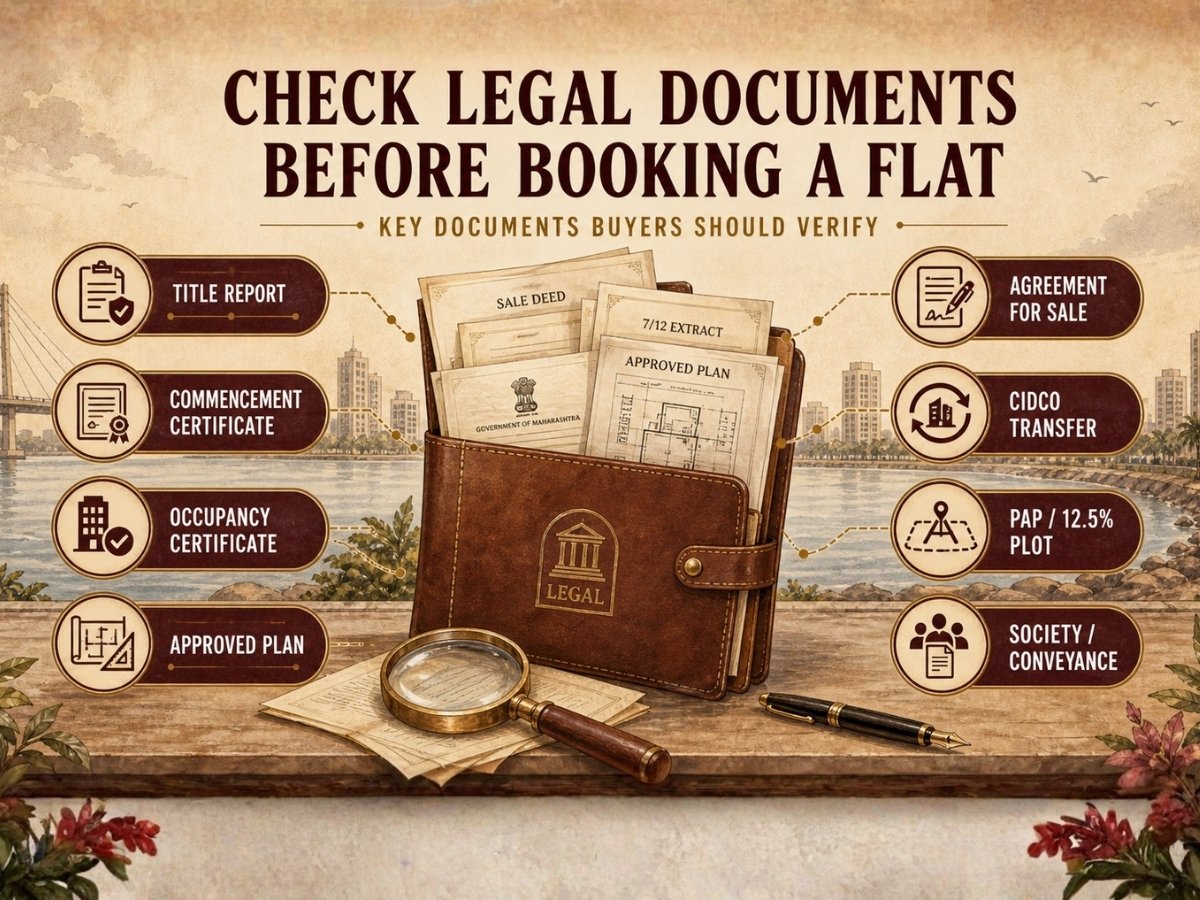
Legal document verification should happen before token payment, not after. Many buyers make the mistake of paying a “small” token first and then asking for documents. That weakens their negotiating position.
A transparent developer should be ready to share basic project documents before asking for serious financial commitment.
| Document | Why It Matters | What Buyer Should Verify |
|---|---|---|
| Title Clearance Certificate | Confirms the developer’s legal right over the land/project | Clear title chain, CIDCO allotment or redevelopment rights |
| Commencement Certificate | Confirms legal permission to construct | CC must cover the floor being booked |
| Occupancy Certificate | Confirms building is fit for legal possession | Do not accept possession without OC |
| Approved Building Plan | Confirms approved layout and area | Match plan with actual flat and RERA carpet area |
| Agreement for Sale | Main legal contract between buyer and developer | Cost, timeline, penalties, specifications, and promises |
| CIDCO documents | Important for Navi Mumbai land title | Leasehold/freehold status and transfer charge clarity |
Title Clearance Certificate
The Title Clearance Certificate shows whether the developer has a clear legal right to develop and sell the property.
In Nerul, buyers should check whether the land is CIDCO-allotted, society redevelopment land, PAP/12.5% scheme-related land, or otherwise transferred legally. For redevelopment projects, the title report should also support the developer’s right through proper society permissions and development agreements.
Commencement Certificate
The Commencement Certificate, or CC, is the official permission to begin construction. In Nerul, building permissions and civic approvals are generally connected with NMMC jurisdiction, while CIDCO may still be relevant for land title history.
Buyers should confirm that the CC covers the exact floor they are booking. If the builder has approval only up to a certain floor, booking above that level is risky.
Never treat an IOD or preliminary permission as equal to a valid CC.
Occupancy Certificate
The Occupancy Certificate, or OC, is one of the most important documents before possession. It confirms that the building has been completed as per approved norms and is fit for occupation.
Buyers should be extremely careful about “fit-out possession” or “soft possession” without OC. Taking keys before OC may expose buyers to legal, civic, utility, and resale complications.
In simple words: possession without OC is not safe possession.
For deeper explanation, add an internal link to [fit-out possession risks](ADD INTERNAL LINK HERE).
Approved Building Plan
The approved building plan confirms the official layout, floor structure, and approved areas. Buyers should compare the approved plan with the sales brochure and sample flat.
Do not rely only on super built-up area or marketing claims. Check RERA carpet area and the actual usable space.
Agreement for Sale
The Agreement for Sale is the binding legal document. It should clearly mention the flat details, carpet area, payment schedule, possession date, delay clauses, specifications, parking terms, taxes, and refund conditions.
Buyers should not sign an agreement that allows the developer to change major specifications, layouts, timelines, or charges without proper consent.
You can internally link to [agreement to sale vs sale deed](ADD INTERNAL LINK HERE) for readers who need legal clarity.
CIDCO Transfer and Leasehold Clarity
Navi Mumbai has a unique land history because many plots were originally allotted by CIDCO. Some properties may still have leasehold-related conditions, while some may have freehold conversion clarity.
Buyers should ask:
- Is the land leasehold or freehold?
- Are CIDCO transfer charges applicable?
- Who will pay transfer charges if applicable?
- Has freehold conversion been completed?
- Are there any pending CIDCO premiums, dues, or transfer permissions?
These answers should be in writing.
Nerul-Specific Documents Buyers Should Check Before Booking
Generic property checks are not enough in Nerul. Buyers must also understand the local authority structure. CIDCO, NMMC, MahaRERA, and society-related documents can all become relevant depending on the project.
CIDCO Allotment and Transfer Documents
If the project land has CIDCO-origin title, ask for allotment and transfer documents. If the property is leasehold, transfer permissions and applicable charges should be checked.
Do not accept vague statements like “CIDCO work is already handled.” Ask for documentary proof.
PAP Plot or 12.5% Scheme Plot Clarity
Some Navi Mumbai plots are linked to the 12.5% Gaothan Expansion Scheme or PAP allotments. If a project is on such land, buyers should verify documents such as the original allotment records, CIDCO Letter of Intent, tripartite agreement, and related title papers.
This is a technical area. A property lawyer familiar with Navi Mumbai land documents should review it before booking.
NMMC, PMC or CIDCO Approval Relevance
For Nerul, NMMC is highly relevant for civic approvals, property tax, CC, OC, and mutation-related processes. CIDCO may still matter for land title, leasehold, freehold, and transfer history.
Buyers should not confuse one authority’s role with another. A project can have marketing approval claims, but the buyer must verify the exact document from the relevant authority.
NMMC property tax and transfer-related costs should also be checked before final budgeting. Readers can use a [property tax calculator](ADD INTERNAL LINK HERE) where relevant.
Society Formation and Conveyance Status
For completed or redevelopment projects, check whether the society was formed and whether conveyance or deemed conveyance was completed.
A developer delaying society formation may retain control over maintenance, parking, common areas, or future development rights. This can create long-term disputes for residents.
Compare Construction Quality and Actual Site Progress
Document checks are important, but they do not replace site visits. A serious buyer should visit the actual project site, completed projects, and surrounding location before making a final decision.
Visit the Actual Construction Site
At the construction site, check whether work is actively progressing. A healthy site usually has visible labour activity, material movement, safety systems, and organized execution.
Red flags include:
- Very few workers during active construction phase
- Rusted exposed steel
- Poor site safety
- Long gaps in visible progress
- No clear project information displayed
- Repeated excuses about approvals or funding
Compare Sample Flat and Real Flat Specifications
Sample flats are made to impress. They often use special lighting, compact furniture, and interior design tricks.
When visiting, compare:
- Actual room dimensions
- Ceiling height
- Window size
- Beam placement
- Kitchen usability
- Bathroom ventilation
- Carpet area shown in legal documents
Carrying a measuring tape or laser measure is practical. Do not judge only by interior decoration.
Check Lift, Lobby, Parking and Common Area Quality
In Nerul’s mid-premium and premium projects, buyers pay a high price. That price should reflect in common areas too.
Check:
- Lift brand and capacity
- Lobby ventilation and finish
- Fire exits
- Basement/stilt parking design
- Mechanical parking quality
- Drainage and slope
- Security systems
- Common area maintenance planning
Mechanical parking in humid coastal locations needs special attention. Poor systems can become expensive for societies later.
Check Monsoon Performance and Leakage Issues
Nerul and nearby coastal nodes face strong monsoon conditions. Poor waterproofing can create repeated leakage issues.
The best time to inspect older projects is during or just after the monsoon. Check external walls, basement areas, terraces, lift shafts, and upper-floor seepage marks.
A building that handles monsoon well is a stronger proof of construction quality than a glossy brochure.
Understand Pricing, Hidden Charges and Payment Terms
The advertised per-square-foot rate is not the final cost. Buyers must understand the full cost before booking.
In many projects, the final payable amount may include parking, GST, stamp duty, registration, floor-rise, PLC, maintenance deposit, legal charges, infrastructure charges, and other project-specific items.
Ask for an All-Inclusive Cost Sheet
Ask the developer for a written all-inclusive cost sheet before token payment.
The cost sheet should include:
- Flat cost
- Floor rise
- PLC, if any
- Parking cost
- GST, if applicable
- Stamp duty
- Registration fee
- Maintenance deposit
- Society formation charges
- Legal charges
- Any CIDCO or NMMC-related charges, if applicable
If the sales team avoids giving this clearly, pause the decision.
Check Parking, Floor-Rise, PLC and Maintenance Charges
Parking charges, floor-rise premiums, and preferential location charges can materially change the final budget.
A flat that looks affordable at first may become expensive after all add-ons. In Nerul, where ticket sizes are already high, this can create serious loan and cash-flow stress.
Ask whether parking is included, optional, mechanical, covered, or separately chargeable.
Understand GST, Stamp Duty and Registration Cost
For under-construction property, GST may apply as per prevailing rules. Ready-to-move property with OC generally has different tax treatment compared to under-construction property.
Stamp duty and registration costs should be calculated before booking, not later. Buyers can internally use a [stamp duty calculator](ADD INTERNAL LINK HERE) for planning.
Costs can vary based on agreement value, registration type, ownership structure, government rules, and date of transaction. Always verify current charges before payment.
Avoid Verbal Price Commitments
A verbal promise has very little value in a property transaction.
If the developer or sales person promises free parking, waived charges, modular kitchen, early possession, sea view, or discount adjustment, ask them to put it in writing in the allotment letter or agreement.
If it is not written, assume it does not exist.
Check Developer Reputation Beyond Online Reviews
Online reviews are useful, but they are not enough. Some reviews may be promotional, emotional, incomplete, or outdated.
Use online reviews as a starting point, not the final decision.
Read Google Reviews Carefully
Look for specific complaint patterns, not only star ratings.
Useful reviews mention:
- OC delay
- Poor maintenance
- Water tanker dependence
- Lift problems
- Leakage
- Parking disputes
- Staff behaviour
- Society handover issues
- Extra charges
Generic five-star reviews with no detail should not influence your decision too much.
Look for Repeated Complaint Patterns
One negative review may be an individual issue. Repeated complaints are different.
If many buyers mention the same delay, same leakage issue, same maintenance dispute, or same legal problem, treat it as a serious warning.
Speak to Local Brokers and Residents
Experienced local brokers, residents, and housing society members often know which developers deliver properly and which ones create problems after possession.
However, do not depend fully on brokers because they may have sales incentives. Use their input, but verify it with documents.
You can also compare advice with trusted [real estate agents in Nerul](ADD INTERNAL LINK HERE).
Check Litigation or Delay History Where Possible
Search for the developer name, project name, and director names where possible. Check MahaRERA records, consumer complaint references, and legal history if available.
A single legal matter does not always mean the project is unsafe. But repeated delay complaints, non-compliance, or serious litigation should make buyers cautious.
Big Builder vs Local Builder: Which Is Better in Nerul?
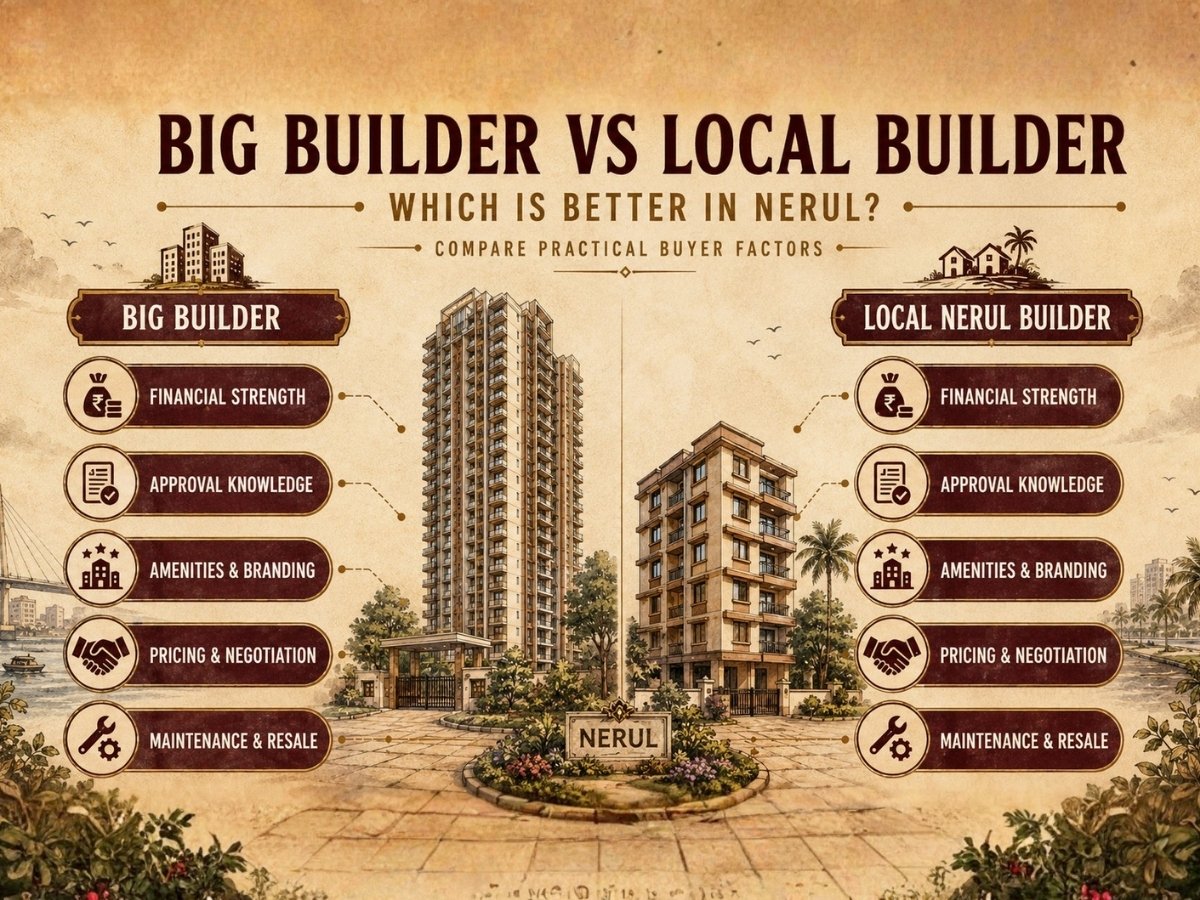
There is no one correct answer. In Nerul, both big developers and strong local developers can be suitable, depending on the project type.
| Factor | Big Builder | Local Nerul Developer | What Buyer Should Decide |
|---|---|---|---|
| Financial strength | Usually stronger capital base | May depend more on project sales and local funding | Prefer stronger balance sheet for large under-construction projects |
| Local approvals | May rely on teams and consultants | Often understands CIDCO/NMMC processes deeply | Local expertise matters in redevelopment and PAP/CIDCO cases |
| Pricing | Often carries brand premium | May offer better carpet area value | Compare total cost, not only brand name |
| Project type | Strong for large luxury or township-style projects | Strong for standalone towers and society redevelopment | Match developer strength with project complexity |
| Flexibility | Usually less flexible | May offer more local-level flexibility | Useful if layout or practical changes matter |
| Resale value | Brand may help resale perception | Depends on local reputation | Check completed project quality and buyer feedback |
Advantages of Big Real Estate Developers
Big developers may offer better financial security, stronger project systems, organized customer communication, and higher brand recall in resale.
They may be safer for large under-construction projects, premium towers, or complex multi-phase developments where capital strength matters.
Advantages of Local Nerul Developers
A strong local developer may understand Nerul’s sector-level realities better. This includes redevelopment negotiations, CIDCO-related title flows, NMMC approvals, parking constraints, local buyer expectations, and society-level coordination.
For older sectors and single-building redevelopment projects, an experienced local developer can sometimes execute faster and more practically than a large corporate developer.
When a Smaller Developer Can Be a Better Choice
A smaller or mid-sized developer can be a better choice when:
- The project is a single-building redevelopment
- The developer has completed similar projects nearby
- Legal documents are clean
- Existing residents speak positively
- Pricing is transparent
- Construction quality is visible in older projects
Do not reject a local developer only because the brand is not nationally famous. Judge by proof.
When a Big Brand May Still Be Safer
A big brand may be safer when the project is large, under-construction, premium-priced, or located in a high-value corridor. Capital strength matters when market conditions change or when project execution is complex.
But even big brands should be checked for legal documents, CC, OC, construction quality, and actual possession timelines.
Check Location Fit Before Choosing the Developer
A good developer in one location may not be equally suitable in another. Nerul has mature sectors, premium pockets, redevelopment zones, and connectivity-driven demand.
Mature Nodes Like Vashi, Nerul, Seawoods and Belapur
In mature nodes, buyers expect good construction quality, clear society handover, strong resale value, and proper civic services. Developers working here must manage limited space, older societies, parking pressure, redevelopment expectations, and premium buyer demands.
Growth Nodes Near Nerul Like Ulwe, Juinagar, Seawoods West and Kharghar
Nearby growth or transition areas may offer different risk-reward equations. Ulwe may attract airport-linked investors, Kharghar has a large residential and institutional base, Juinagar has connectivity advantages, and Seawoods West has a premium development character.
When comparing Nerul with growth nodes, check whether the developer’s experience fits that specific location. A project in a developing area needs strong infrastructure planning. A project in mature Nerul needs legal clarity, redevelopment handling, and quality execution.
For broader comparison, readers can refer to a [Navi Mumbai property investment guide](ADD INTERNAL LINK HERE).
Why Location Quality and Developer Quality Must Be Checked Together
A good location cannot fix a weak developer. A good developer cannot fully fix a poor civic location.
Before booking, check both:
- The project’s internal quality
- The surrounding roads, drainage, water supply, parking, and connectivity
- Future resale demand
- Nearby social infrastructure
- Legal clarity of the land
The right purchase happens when developer quality and location quality match.
Questions to Ask a Developer Before Paying Token Money
Before paying token money, ask direct questions. A serious developer will answer with documents, not only words.
| Question | Why It Matters | Proof to Ask For |
|---|---|---|
| Is the project registered on MahaRERA? | Confirms basic legal registration | MahaRERA number and project page |
| Do you have NMMC CC for my floor? | Prevents booking on unapproved floors | Copy of CC showing approved floors |
| Is the price fully all-inclusive? | Prevents hidden cost shock | Written itemized cost sheet |
| Will possession be given only after OC? | Protects against fit-out possession risk | Agreement clause and OC commitment |
| Is the land CIDCO leasehold or freehold? | Affects transfer and resale clarity | Title report, CIDCO/freehold documents |
| What is the written possession date? | Verbal timeline is not enough | RERA and Agreement for Sale date |
Is the Project Registered on MahaRERA?
Ask for the exact MahaRERA registration number. Search it yourself on the official website.
Can You Share the Approved Plan, CC and Legal Documents?
A transparent developer should share core documents for review. If the sales team refuses until token payment, treat it as a warning.
Is the Quoted Price Fully All-Inclusive?
Ask for the final amount, not only the base rate. Confirm parking, GST, stamp duty, registration, maintenance, floor-rise, PLC, legal charges, and any authority-related charges.
What Is the Written Possession Timeline?
The written timeline in MahaRERA and the Agreement for Sale matters. Sales-office promises do not protect the buyer.
What Happens If Possession Is Delayed?
Ask how delay compensation will work and whether the agreement follows MahaRERA requirements. Do not accept vague answers.
Is the OC Already Received or Expected Later?
For ready projects, ask for the OC before possession. For under-construction projects, ask when OC is expected and whether final possession depends on OC.
Red Flags When Choosing a Real Estate Developer in Nerul
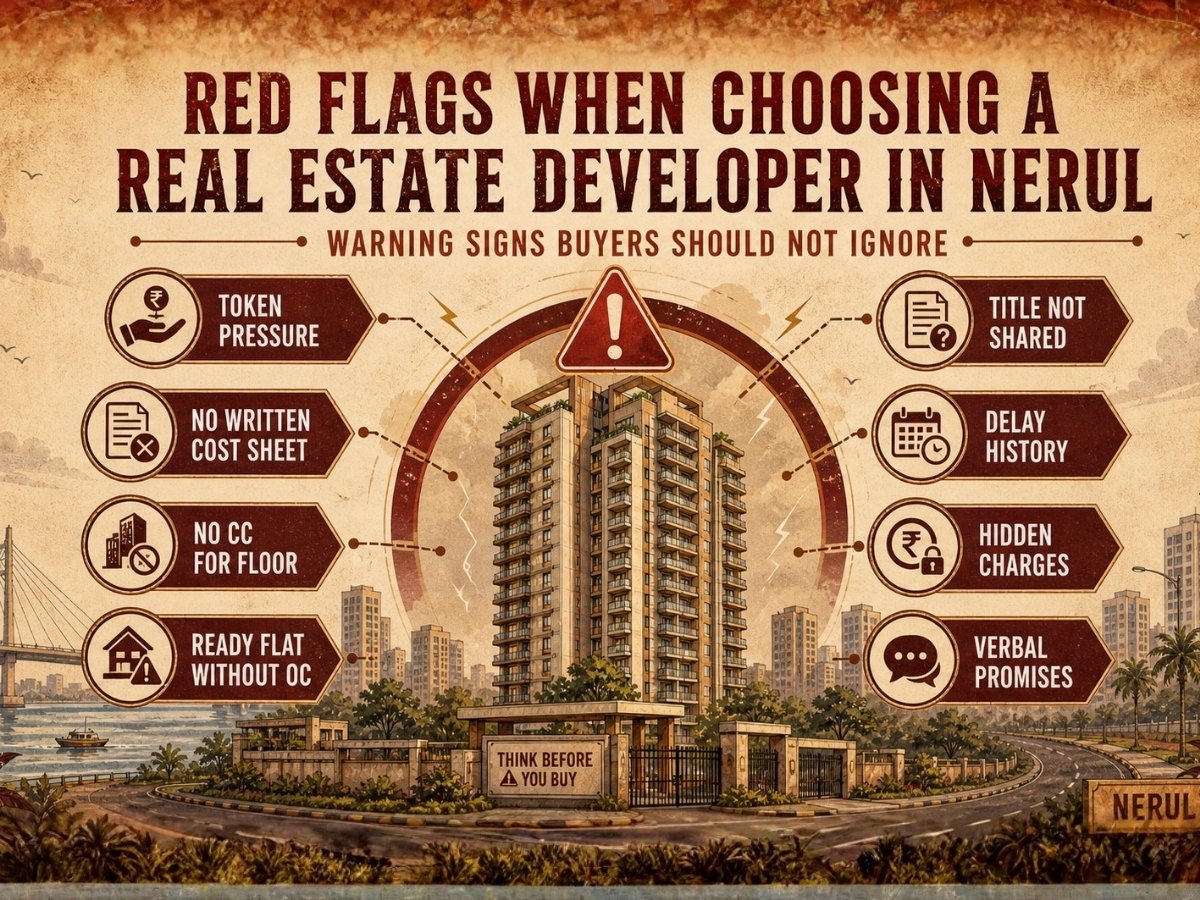
| Red Flag | What It May Indicate | Buyer Action |
|---|---|---|
| Pressure to pay token quickly | Sales urgency or hidden legal issue | Do not pay before document check |
| No written clarity on charges | Hidden cost risk | Ask for stamped cost sheet |
| Delayed older projects | Weak execution or funding stress | Check MahaRERA and resident feedback |
| Poor maintenance in completed buildings | Weak after-sales support | Visit older buildings before booking |
| Weak legal transparency | Title or approval concerns | Get lawyer review before proceeding |
| Too many verbal promises | Future dispute risk | Put every promise in writing |
| Fit-out possession without OC | Illegal or unsafe handover risk | Reject possession without OC |
Pressure to Pay Token Money Quickly
If the sales team says the offer will disappear today, pause. Good property decisions should not be made under pressure.
No Written Clarity on Charges
A developer who avoids written pricing may later add parking, floor-rise, PLC, legal, maintenance, or other charges.
Delayed Older Projects
Check whether the developer has a repeated pattern of revised completion dates. One delay may happen. A pattern is dangerous.
Poor Maintenance in Completed Buildings
If the builder’s older project looks much older than its actual age, that is a construction and after-sales warning.
Weak Legal Transparency
If documents are not shared, explanations keep changing, or staff avoid direct legal questions, do not proceed casually.
Too Many Verbal Promises
Verbal promises create future disappointment. Written terms create enforceability.
Real Estate Developer Shortlisting Scorecard
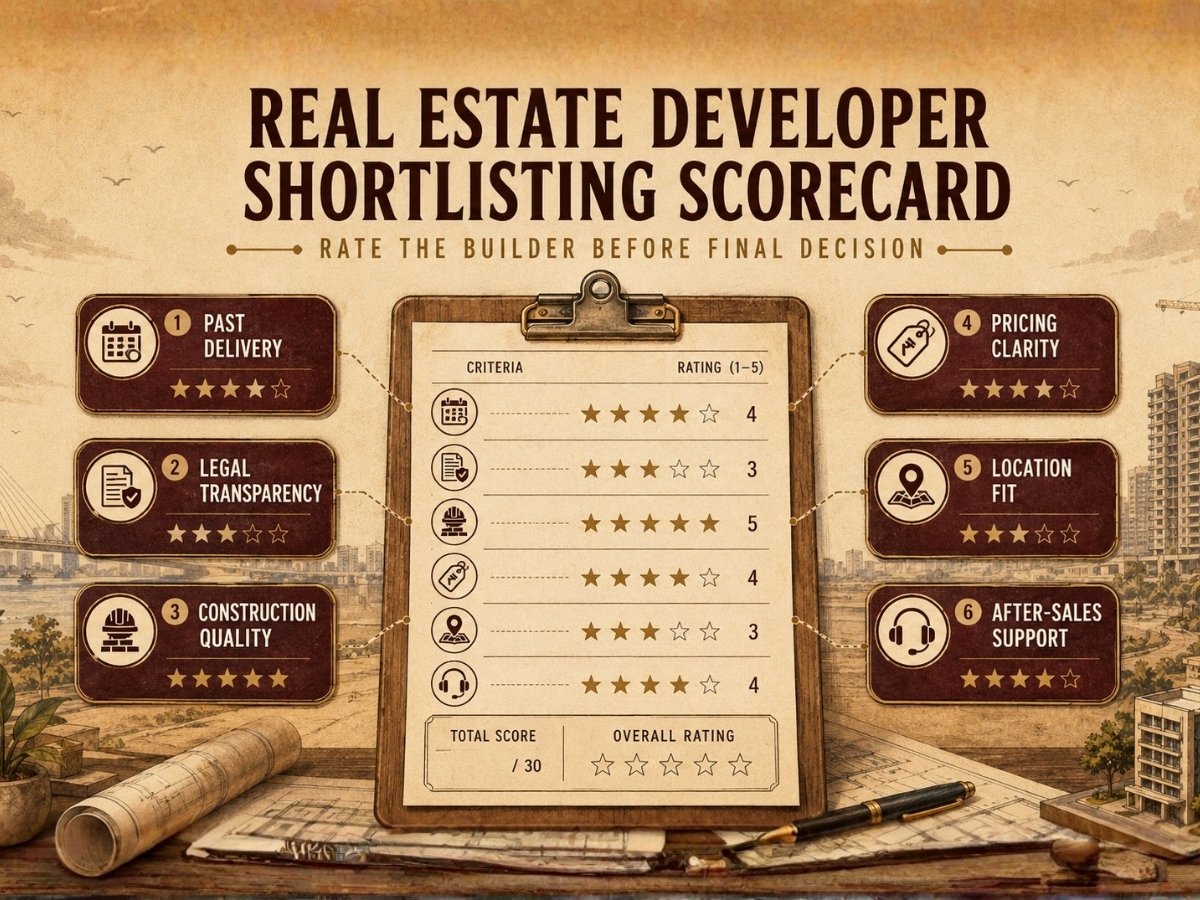
Use a simple scorecard before final decision. Rate each factor from 1 to 5.
| Factor | What to Check | Score |
|---|---|---|
| Past Delivery Record | Completed projects, OC history, delay pattern | /5 |
| Legal Transparency | MahaRERA, CC, OC, title, CIDCO clarity | /5 |
| Construction Quality | Older buildings, monsoon performance, parking, lifts | /5 |
| Pricing Clarity | All-inclusive cost sheet and written charges | /5 |
| Location Suitability | Sector quality, connectivity, civic services | /5 |
| After-Sales Support | Society formation, maintenance, resident response | /5 |
| Buyer Feedback Pattern | Reviews, residents, brokers, complaint history | /5 |
A project with weak scores in legal transparency, OC clarity, and past delivery should not be shortlisted only because the price is attractive.
Past Delivery Record
Choose developers who have actually delivered completed projects, not only announced upcoming launches.
Legal Transparency
Legal transparency is a non-negotiable factor in Nerul because CIDCO, NMMC, MahaRERA, and society documentation can all matter.
Construction Quality
Check real construction, not only marketing visuals.
Pricing Clarity
The best developer for a buyer is not always the cheapest. It is the one that gives complete cost clarity.
Location Suitability
The developer should understand the sector, buyer profile, parking needs, and infrastructure limitations of that exact pocket.
After-Sales Support
A project does not end after possession. Society formation, documents, maintenance, and defect handling matter.
Buyer Feedback Pattern
Repeated buyer feedback is more reliable than one-off reviews.
Common Mistakes Buyers Make While Choosing Builders in Nerul
Trusting Only Brand Name
A big name can reduce some risk, but it does not remove the need for due diligence. Always verify project-specific documents.
Ignoring Legal Document Verification
Do not assume that everything is clear because the sales office looks professional. Ask for documents and get them checked.
Booking Only Because of Discount or Offer
Discounts, subvention schemes, and limited-period offers should not become the main reason to buy. First check approvals, pricing, and possession clarity.
Not Visiting Completed Projects
This is one of the biggest mistakes. Completed projects reveal long-term quality, maintenance, leakage, and resident satisfaction.
Depending Fully on Broker or Sales Team Promises
Brokers and sales teams may help, but their claims must be verified. The buyer is responsible for final due diligence.
How to Verify a Real Estate Developer Before Final Decision
Step 1: Check MahaRERA Details
Search the project on MahaRERA and review registration status, completion date, uploaded documents, and litigation details.
Step 2: Visit the Project Site
Check actual work progress, safety, material quality, worker activity, and site organization.
Step 3: Visit Completed Projects
Visit at least one older completed building by the same developer. Speak to residents and inspect common areas.
Step 4: Review Legal Documents with an Expert
Ask a property lawyer to review the title report, CC, OC status, CIDCO documents, agreement draft, and cost-related clauses.
Step 5: Compare Total Cost with Other Projects
Compare the all-inclusive cost, not only the base rate. Include taxes, parking, maintenance, floor-rise, PLC, and authority charges.
Step 6: Take Final Decision Only After Written Clarity
Do not finalize based on trust, pressure, or verbal promises. Final decision should happen only after written clarity.
Final Checklist Before Choosing a Real Estate Developer in Nerul
Use this checklist before paying token money.
- [ ] MahaRERA registration number verified.
- [ ] RERA completion date checked.
- [ ] Uploaded documents reviewed.
- [ ] Title Clearance Certificate checked.
- [ ] CIDCO leasehold/freehold status understood.
- [ ] PAP/12.5% plot documents checked, if applicable.
- [ ] NMMC Commencement Certificate verified.
- [ ] CC covers the floor being booked.
- [ ] OC checked for ready possession project.
- [ ] Fit-out possession without OC rejected.
- [ ] Approved building plan matched with flat details.
- [ ] RERA carpet area verified.
- [ ] All-inclusive cost sheet received in writing.
- [ ] Parking, floor-rise, PLC, GST, stamp duty, registration, and maintenance charges checked.
- [ ] Completed project visited.
- [ ] Existing residents spoken to.
- [ ] Monsoon leakage and parking issues checked.
- [ ] Society formation and conveyance history reviewed.
- [ ] Agreement for Sale reviewed by a legal professional.
- [ ] Every verbal promise added in writing.
Conclusion
Choosing the right real estate developer in Nerul is not about selecting the biggest advertisement, the most attractive sample flat, or the most polished sales office. It is about checking whether the developer can legally, financially, and practically deliver what is promised.
Nerul is a strong residential market because of its mature infrastructure, Palm Beach Road access, educational ecosystem, railway connectivity, and proximity to Seawoods, Belapur, Vashi, and future growth corridors. But high location value also means buyers must be more careful, not less.
The right developer in Nerul should have clear MahaRERA records, proper NMMC approvals, transparent CIDCO/title documents, good completed projects, clean pricing, OC-based possession, and positive resident feedback. If any of these areas are weak, slow down and verify before committing money.
For broader comparison, buyers can also explore [real estate developers in Navi Mumbai](ADD INTERNAL LINK HERE), [questions to ask before buying a flat in Navi Mumbai](ADD INTERNAL LINK HERE), and the [Nerul real estate guide](ADD INTERNAL LINK HERE).
FAQs
How do I choose the right real estate developer in Nerul?
Choose the right real estate developer in Nerul by checking completed projects, MahaRERA registration, NMMC approvals, CIDCO title clarity, construction quality, pricing transparency, and existing buyer feedback before paying token money.
What documents should I check before booking a flat in Nerul?
Buyers should check the MahaRERA certificate, Title Clearance Certificate, NMMC Commencement Certificate, Occupancy Certificate if ready for possession, approved building plan, Agreement for Sale, and CIDCO allotment or transfer documents where applicable.
Is MahaRERA registration enough to trust a builder?
No. MahaRERA registration is important, but it is not enough. Buyers must also verify construction quality, legal title, CC, OC, pricing clarity, completed projects, and resident feedback.
Should I visit completed projects before booking?
Yes. Visiting completed projects is one of the best ways to check real construction quality. Older buildings reveal leakage issues, lift performance, parking quality, maintenance standards, and after-sales support.
Is a big builder always better than a local builder?
Not always. A big builder may offer stronger financial security, but a good local Nerul developer may understand CIDCO, NMMC, redevelopment, and local buyer needs better. The safer choice depends on documents, delivery record, and project type.
What are the red flags in a real estate developer?
Major red flags include pressure to pay token money quickly, refusal to share documents, unclear pricing, delayed older projects, poor maintenance in completed buildings, verbal promises, and fit-out possession without OC.
What should I ask before paying token money?
Ask for the MahaRERA number, NMMC CC, title documents, CIDCO/freehold clarity, all-inclusive cost sheet, written possession date, OC handover condition, and draft Agreement for Sale before paying token money.
Which Nerul areas need extra legal checking before buying property?
Projects on 12.5% PAP plots, CIDCO-origin leasehold land, and older society redevelopment projects in established Nerul sectors need extra legal checking. Buyers should verify title documents, CIDCO records, society permissions, and NMMC approvals.
How important is Occupancy Certificate before possession?
The Occupancy Certificate is extremely important. Buyers should not accept possession without OC because it can create legal, utility, resale, and safety-related risks.
Can a local Nerul developer be safer than a big brand?
Yes, a local Nerul developer can be safer if they have a strong delivery record, clean legal documents, good completed projects, transparent pricing, and positive resident feedback. The decision should be based on proof, not only brand size.