

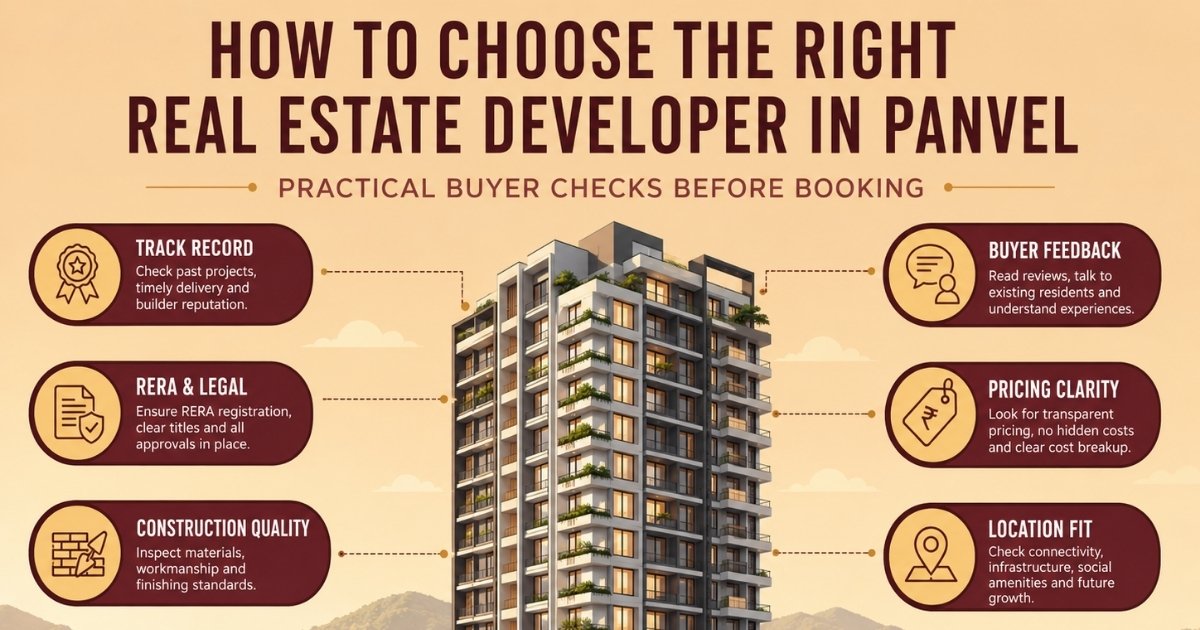
To choose the right real estate developer in Panvel, buyers should check the developer’s past delivery record, MahaRERA registration, legal documents, construction quality, pricing transparency, completed projects, buyer feedback, and OC possession history before paying token money. In Panvel, this is even more important because projects may fall under PMC, CIDCO, or NAINA influence, and each authority can affect approvals, water supply, land title, and long-term resale value.
Panvel is not a simple one-type real estate market. Old Panvel, New Panvel, Khandeshwar, Kamothe, Karanjade, Palaspe, Pushpak Nagar, and NAINA-side locations all have different buyer risks. Some areas offer mature railway connectivity and daily convenience, while others depend heavily on future airport-linked growth, internal roads, water lines, and infrastructure delivery. A good developer in one micro-market may not automatically be the right developer for another.
This article is for general buyer awareness. Before booking a flat or signing an agreement, buyers should verify all legal documents with a qualified property lawyer or legal professional.
Quick Summary: How to Choose the Right Real Estate Developer in Panvel
The safest way to choose a real estate developer in Panvel is to verify four things before payment: legal clarity, delivery track record, construction quality, and total cost transparency. Do not rely only on the project brochure, sample flat, airport proximity, or the developer’s brand name.
| What to Check | Why It Matters in Panvel | Good Sign | Red Flag |
|---|---|---|---|
| MahaRERA registration | Confirms project disclosure and legal visibility | Valid project number with updated details | No RERA number or expired registration |
| Legal documents | Protects from land title and approval issues | CC, title certificate, approved plan shared before token | Documents shown only after payment |
| OC status | Confirms legal possession and utility eligibility | OC received for ready property | “Fit-out possession” without OC |
| CIDCO / PMC / NAINA relevance | Approval rules differ by authority | Clear jurisdiction and authority documents | Confusion about who approved the project |
| Construction quality | Panvel’s monsoon and humidity test building durability | Older projects show low seepage and good upkeep | Leakage, cracks, poor basement condition |
| Pricing clarity | Hidden charges can increase budget sharply | Written all-inclusive cost sheet | Verbal quote with later additions |
| Buyer feedback | Shows real post-possession experience | Residents confirm good after-sales support | Repeated complaints about delay, leakage, water, or maintenance |
A reputed developer is not always the right developer if the project has unclear approvals, delayed possession, hidden charges, weak construction quality, or poor after-sales support.
Why Choosing the Right Real Estate Developer Matters in Panvel
Panvel has become one of the most watched real estate markets around Navi Mumbai because of its connection to the Mumbai Metropolitan Region, Pune, Konkan, Atal Setu, the upcoming airport influence zone, and developing rail and road corridors. This growth has attracted both large corporate developers and many smaller local builders.
That creates opportunity, but also risk.
A buyer may see a project near Pushpak Nagar, Palaspe, NAINA, Karanjade, or New Panvel and assume that location growth alone will protect the investment. That is a mistake. A good location cannot fully protect a buyer from a weak developer. If the builder delays possession, cuts construction quality, hides charges, avoids society handover, or gives possession without OC, the buyer may face years of stress.
In Panvel, developer selection matters because:
- Some projects fall under different planning and civic authorities.
- CIDCO leasehold and transfer issues may apply in some areas.
- PMC areas may have water supply and civic infrastructure concerns.
- NAINA-side projects can involve land-pooling, agricultural land conversion, and longer infrastructure timelines.
- Heavy monsoon conditions can expose weak waterproofing and poor construction.
- Under-construction projects can look attractive but may carry possession and hidden cost risks.
For readers comparing [real estate developers in Panvel](ADD INTERNAL LINK HERE), the right question is not only “Which builder is famous?” The better question is: “Which developer is legally clear, financially stable, construction-focused, transparent in pricing, and suitable for this exact Panvel location?”
Understand the Developer’s Past Track Record
A developer’s past record is the strongest clue about future delivery. Marketing teams can promise anything, but completed projects show the truth.
Before trusting a new launch, check whether the developer has delivered projects in Panvel, Navi Mumbai, or similar approval environments. A developer who has already handled CIDCO approvals, PMC clearances, society formation, and OC handover is usually easier to evaluate than a first-time builder with only a brochure and sample flat.
Check Completed Projects Before Trusting New Launches
Do not judge a developer only by the new project’s sales office. Visit at least one completed project by the same builder, preferably one that is three to five years old.
Check:
- Was possession given close to the promised timeline?
- Did the building receive OC?
- Are the amenities completed or still pending?
- Is the building maintained properly?
- Are residents satisfied with the developer’s response after possession?
In Panvel, completed projects in areas like New Panvel, Khandeshwar, Khanda Colony, Kamothe, or Karanjade can reveal how the developer performs after the launch excitement is over.
Visit Older Buildings Developed by the Same Builder
A five-year-old building often tells more truth than a new sample flat. Panvel’s monsoon, humidity, and coastal climate can expose poor construction quickly.
During the visit, observe:
- Damp patches on external walls
- Leakage in top-floor flats
- Basement or podium waterlogging
- Rust marks near beams or slabs
- Peeling paint
- Poor lift maintenance
- Cracked plaster or hollow tiles
A newly painted building can hide problems for a short time, but repeated seepage and poor common-area maintenance usually show up in older buildings.
Speak to Existing Residents and Buyers
Existing residents are usually the best source of practical information. The sales team will talk about amenities. Residents will talk about water supply, lift downtime, leakage, maintenance bills, parking disputes, and whether the builder actually responds.
Ask residents:
- Was the possession delayed?
- Did the builder provide OC before handover?
- Is there regular municipal water, or tanker dependency?
- Was the society formed properly?
- Were maintenance funds handed over transparently?
- Are promised amenities functional?
- Did the builder repair defects during the liability period?
This small step can save a buyer from a very costly mistake.
Check MahaRERA Registration and Project Transparency
MahaRERA registration is a basic filter for any serious buyer. In Maharashtra, registered real estate projects disclose important details such as promoter information, project timeline, approvals, litigation details where available, and progress updates.
MahaRERA registration is important, but it should not be treated as the only proof of developer quality. It gives transparency, not a guarantee of good construction or perfect delivery.
Why MahaRERA Is Important for Panvel Buyers
In Panvel, many buyers look at under-construction projects in growth corridors. MahaRERA helps them check whether the project is legally registered and whether the developer has declared a possession timeline.
For large township-style projects or multi-phase developments, buyers must verify the exact tower, wing, or phase they are booking. Do not assume the entire project is covered just because the sales team shows one registration number.
What to Verify on the MahaRERA Website
Before paying token money, buyers should verify:
- Project registration number
- Promoter name
- Project address and land details
- Proposed completion date
- Approved plans and uploaded documents
- Quarterly Progress Reports, where available
- Litigation or complaint details, where available
- Whether the registration is valid, expired, or extended
If the sales team promises possession in one year but MahaRERA shows a much later date, trust the official record, not the verbal promise.
Why MahaRERA Alone Is Not Enough
A MahaRERA-registered project can still have poor construction quality, delayed amenities, weak water supply, or local infrastructure issues. RERA is a verification tool, not a replacement for legal due diligence.
Buyers should also check:
- Title documents
- Commencement Certificate
- Approved building plan
- Occupancy Certificate for ready property
- CIDCO or PMC relevance
- Local water supply and road access
- Completed project quality
- Resident feedback
Check Legal Documents Before Booking a Flat
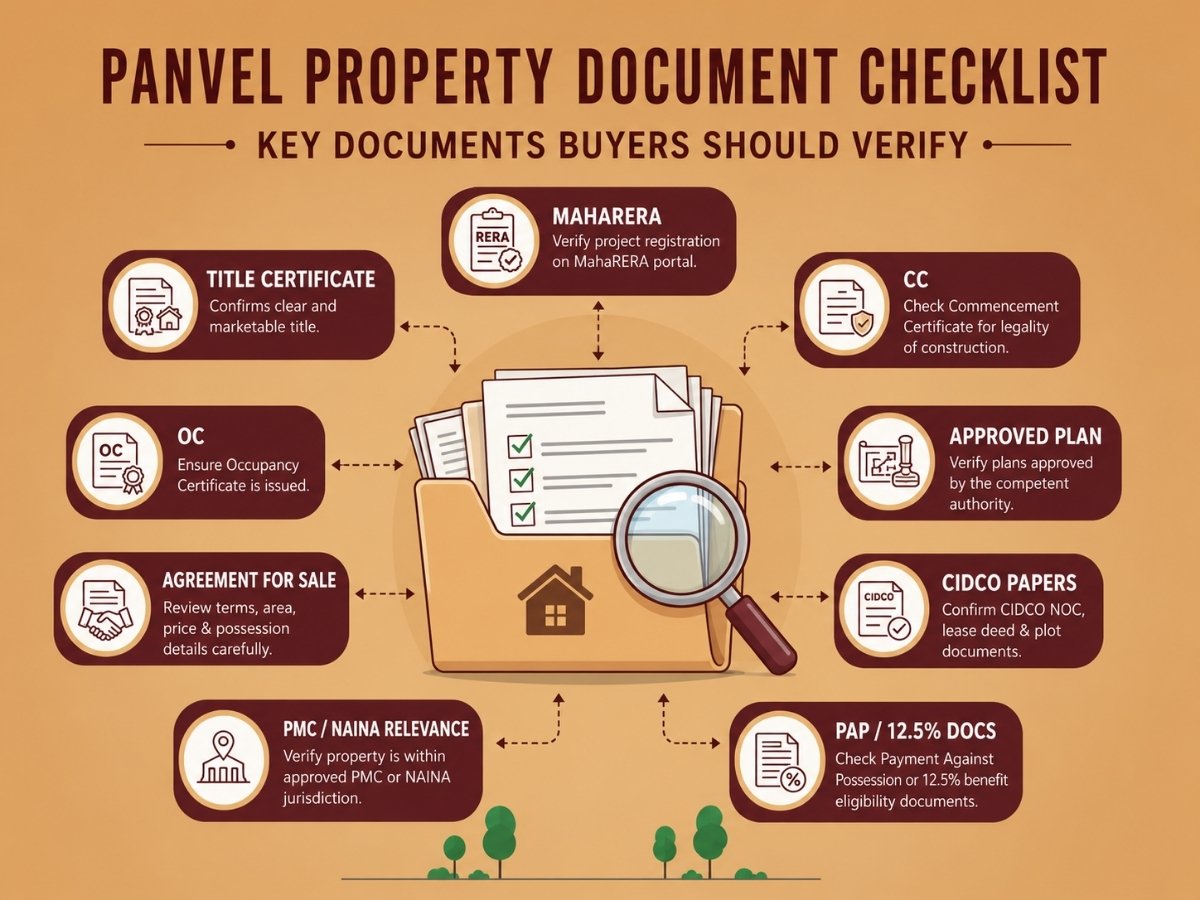
Legal documents should be checked before token payment, not after. Once the buyer pays a non-refundable token, negotiation power usually shifts to the developer.
A transparent developer should be willing to share the basic legal file for independent review.
Title Clearance Certificate
The Title Clearance Certificate confirms whether the developer has clear rights over the land. In Panvel, this is especially important because some lands may have agricultural history, conversion requirements, family ownership chains, CIDCO leasehold structure, or PAP plot origin.
Buyers should ask a property lawyer to check the title history, 7/12 extract where applicable, property card, encumbrances, and development rights.
Commencement Certificate
The Commencement Certificate, or CC, gives permission to start construction up to approved floors or phases. This is a critical document.
If the buyer is booking a flat on the 15th floor, but the CC is valid only up to the 10th floor, the buyer is taking a serious risk. Always check whether the CC covers the exact wing and floor being sold.
Occupancy Certificate
The Occupancy Certificate, or OC, confirms that the building is legally fit for occupation. For ready-to-move flats, the OC is one of the most important documents.
Buyers should be very careful about “fit-out possession.” Fit-out possession is not the same as legal possession. Moving into a building without OC can create issues with safety, insurance, resale, loan processing, and municipal utility connections.
Approved Building Plan
The approved building plan should match the flat layout, building height, parking arrangement, open space, and common areas shown to the buyer. Marketing floor plans are not enough.
Buyers should compare the municipal-stamped plan with the brochure and sample flat promise.
Agreement for Sale
The Agreement for Sale is the legal document that matters most after booking. It should clearly mention:
- Carpet area
- Payment schedule
- Possession timeline
- Delay compensation clauses
- Specifications and fittings
- Parking details
- Maintenance charges
- OC and final handover terms
- Any negotiated offers or waivers
For a deeper legal understanding, buyers can also read [Agreement to Sale vs Sale Deed](ADD INTERNAL LINK HERE).
CIDCO Transfer and Leasehold Clarity
Many Navi Mumbai and Panvel-side properties may involve CIDCO-origin leasehold land or CIDCO transfer rules. Buyers should verify whether the property is leasehold or freehold, whether any CIDCO dues are pending, and whether transfer permissions are clear.
Where CIDCO-origin documents apply, buyers should not depend on verbal explanations. Written documents are necessary.
Panvel-Specific Documents Buyers Should Check Before Booking
Panvel needs more careful legal checking than a generic city market because it includes mature municipal areas, CIDCO-planned nodes, airport-influence zones, NAINA-related pockets, and peripheral development belts.
| Document / Check | Why It Matters | Panvel Relevance | Buyer Action |
|---|---|---|---|
| MahaRERA registration | Confirms legal disclosure and project timeline | Important for under-construction and phased projects | Verify the exact project number online |
| Title Clearance Certificate | Confirms land ownership or development rights | Critical in land conversion and PAP-related areas | Get it reviewed by a lawyer |
| Commencement Certificate | Confirms construction approval | Must cover the booked floor and wing | Ask for copy before token |
| Occupancy Certificate | Confirms legal possession | Needed for ready flats and utility clarity | Do not accept possession without checking |
| Approved Building Plan | Confirms sanctioned layout | Prevents mismatch between brochure and approval | Compare with flat layout |
| CIDCO Allotment / Transfer Papers | Confirms CIDCO-origin land chain | Relevant in CIDCO-planned pockets | Check complete chain of documents |
| PAP / 12.5% Scheme Documents | Confirms clean transfer from original allottee | Important in Panvel, Ulwe, Karanjade and nearby belts | Verify award copy, tripartite agreement and family consent |
| NA Order / Land Conversion | Confirms land is legally usable for residential development | Important in peripheral and NAINA-side areas | Ask advocate to verify |
| Society Formation / Conveyance | Confirms long-term ownership handover | Important for resale and redevelopment | Check society records in resale cases |
CIDCO Allotment and Transfer Documents
For CIDCO-origin properties, buyers should check the original allotment letter, transfer documents, lease agreement, NOC, and chain of ownership. Missing links in the document chain can create resale and loan problems later.
PAP Plot or 12.5% Scheme Plot Clarity
In parts of Navi Mumbai and Panvel-side development, some projects may be built on PAP or 12.5% scheme plots. These require extra caution.
Buyers should verify documents such as the award copy, PAP certificate, tripartite agreement, allotment papers, 7/12 extract where applicable, and family tree or heir consent documents. If there is a dispute among original landowners or heirs, the project can face serious delays.
NMMC, PMC or CIDCO Approval Relevance
Panvel is not governed by one simple approval system. Buyers should clearly understand whether the project falls under PMC, CIDCO, NAINA, or another relevant planning framework.
This matters because approval authority affects:
- Building permission
- Water supply
- Drainage and road access
- Property tax structure
- Future infrastructure timelines
- Resale confidence
Society Formation and Conveyance Status
A developer’s duty does not end with handing over keys. Society formation, corpus handover, maintenance transfer, and conveyance are important for long-term ownership.
In resale flats, buyers should check whether the society is registered, share certificate is issued, conveyance status is clear, and maintenance accounts are properly handled.
Compare Construction Quality and Actual Site Progress
Construction quality is not judged by Italian-looking tiles in a sample flat. It is judged by structure, waterproofing, material quality, workmanship, and long-term maintenance performance.
In Panvel, this is very important because heavy monsoon conditions can expose weak construction quickly.
Visit the Actual Construction Site
A site visit shows how the developer actually works. Look for:
- Proper material storage
- Use of Ready-Mix Concrete where applicable
- Safety practices
- Clean site management
- Visible engineering supervision
- Waterproofing treatment
- Pace of actual construction
A developer who does not allow basic site inspection or avoids technical questions should be treated carefully.
Compare Sample Flat and Real Flat Specifications
Sample flats are designed for selling. They may use special lighting, smaller furniture, upgraded fittings, false ceiling design, or premium materials that may not be part of the final agreement.
Ask for a written specification list covering:
- Flooring
- Sanitaryware
- Electrical fittings
- Windows
- Doors
- Kitchen platform
- Bathroom fittings
- Wall finish
Only written specifications matter.
Check Lift, Lobby, Parking and Common Area Quality
Common areas affect daily life and resale value. A flat may look good, but poor lifts, unfinished lobbies, confusing parking, and weak fire systems can reduce living quality.
For ready projects, physically inspect lifts, lobby, basement, parking, fire-fighting systems, security areas, and amenity spaces.
For under-construction projects, check what MahaRERA and the agreement say about amenities and common area delivery.
Check Monsoon Performance and Leakage Issues
Panvel buyers should take monsoon performance seriously. Visit the developer’s older buildings during or after the rainy season if possible.
Look for:
- Terrace leakage
- External wall seepage
- Basement flooding
- Damp lift shafts
- Mold patches
- Water entering parking areas
- Poor drainage around the building
Monsoon issues are not small cosmetic problems. They often become society-level repair expenses.
Understand Pricing, Hidden Charges and Payment Terms
The base rate is not the final cost. Many buyers make the mistake of calculating affordability only on the quoted flat price. In reality, GST, stamp duty, registration, parking, floor-rise, PLC, legal charges, maintenance deposits, and utility charges can push the total cost much higher.
| Cost Component | What It Means | Buyer Caution |
|---|---|---|
| Base flat price | Main property value | Ask whether it is based on RERA carpet area |
| GST | Applicable mainly on under-construction property | Ready OC flats generally do not carry GST |
| Stamp duty | Government registration-related cost | Budget separately from loan amount |
| Registration fee | Paid during property registration | Confirm exact current amount before registration |
| Parking charges | May be charged separately | Ask for written clarity |
| Floor-rise charges | Extra amount for higher floors | Often negotiable in some projects |
| PLC | Preferential Location Charges | Check if view, corner, or facing charges are added |
| Maintenance deposit | Advance society or facility maintenance | Ask duration and handover process |
| Utility charges | Water, electricity, meter, legal or documentation charges | Must be written in the cost sheet |
Ask for an All-Inclusive Cost Sheet
Before paying token money, ask for a printed or emailed all-inclusive cost sheet. It should include every charge.
Do not accept statements like “Sir, roughly this much only” or “Later we will adjust.” In real estate, written cost clarity is financial protection.
Check Parking, Floor-Rise, PLC and Maintenance Charges
Parking, floor-rise, PLC, and maintenance deposits can materially affect the final budget. These charges vary by project and developer.
A buyer should compare the total cost of two or three similar projects, not just the base rate. A lower base rate with high hidden charges may become costlier than a transparent project.
Understand GST, Stamp Duty and Registration Cost
Under-construction flats usually attract GST as per applicable rules. Ready-to-move flats with OC generally do not attract GST. Stamp duty and registration costs are separate government charges and should be planned before booking.
For better calculation, buyers can use a [stamp duty calculator](ADD INTERNAL LINK HERE) before finalizing the budget.
Avoid Verbal Price Commitments
A verbal promise has no value if it is not written. If the sales team promises free parking, waived floor-rise, modular kitchen, GST support, or discount, ask for written confirmation in the official cost sheet or term sheet.
If it is not written, assume it does not exist.
Check Developer Reputation Beyond Online Reviews
Online reputation can be useful, but it can also be manipulated. A developer with many positive reviews may still have delayed projects, poor post-sales support, or weak maintenance.
Use online reviews as one input, not the final decision.
Read Google Reviews Carefully
Do not focus only on star ratings. Read the lowest reviews first. Look for detailed complaints about:
- Possession delay
- OC delay
- Seepage
- Lift problems
- Parking disputes
- Poor maintenance
- Water tanker dependency
- Builder not responding
- Society not formed
A review praising the sales office is less useful than a resident review discussing actual living conditions.
Look for Repeated Complaint Patterns
One complaint may be personal. Repeated complaints are data.
If several buyers across different projects mention leakage, delayed OC, poor maintenance, unresponsive CRM, or hidden charges, the pattern should not be ignored.
Speak to Local Brokers and Residents
Independent [real estate agents in Panvel](ADD INTERNAL LINK HERE) often know which buildings have resale demand and which projects buyers avoid. Speak to brokers who are not directly connected to the developer’s sales mandate.
Also speak to residents, shopkeepers near the project, security guards, and society members. Ground-level information often reveals more than a brochure.
Check Litigation or Delay History Where Possible
Buyers should check MahaRERA details, complaint history where visible, consumer disputes where relevant, and legal issues through a lawyer. Litigation related to land title, unauthorized construction, delayed possession, or OC can seriously affect the buyer.
Big Builder vs Local Builder: Which Is Better in Panvel?
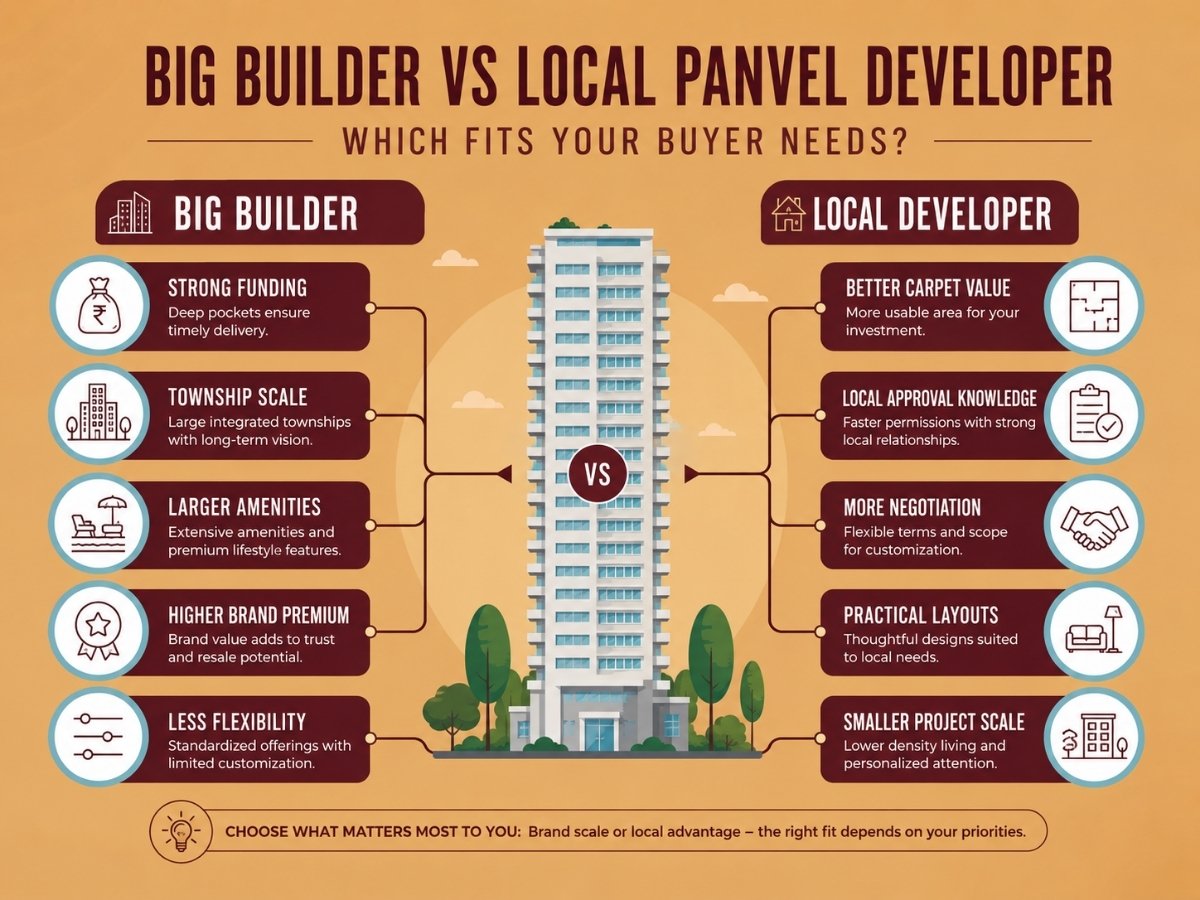
There is no single answer. A big builder is not automatically better. A local builder is not automatically risky. The right choice depends on the location, project size, budget, legal clarity, and buyer’s risk appetite.
| Factor | Big Builder | Local Panvel Developer | Better Choice For |
|---|---|---|---|
| Project scale | Large townships, multi-tower layouts, bigger amenities | Standalone or smaller multi-tower projects | Big builder for township living |
| Pricing | Usually higher brand premium | Often more affordable and negotiable | Local builder for value and carpet area |
| Location strategy | More active in growth corridors and large land parcels | Stronger in mature local pockets | Depends on micro-market |
| Legal systems | Usually stronger compliance teams | Varies widely by builder | Verify both independently |
| Amenities | Larger clubhouses and lifestyle features | Basic but functional amenities | Depends on lifestyle need |
| Flexibility | Less negotiation | More room for negotiation in some cases | Local builder for price flexibility |
| Delivery risk | Lower abandonment risk, but delays can still happen | Depends heavily on financial strength | Check past delivery record |
| Local bureaucracy | May rely on consultants | Established local builders may know local approvals well | Local names can be strong in mature zones |
Advantages of Big Real Estate Developers
Big developers may offer stronger financial capacity, better compliance systems, larger amenities, township-level planning, and stronger project management. In emerging areas like NAINA, Pushpak Nagar, Palaspe, or airport-influence locations, larger developers may be better placed to handle long infrastructure timelines and internal development costs.
Advantages of Local Panvel Developers
Established local developers may offer better carpet area, more practical layouts, lower ticket size, better negotiation, and stronger familiarity with local approvals. In mature pockets like Old Panvel, New Panvel, Khandeshwar, Khanda Colony, or Kamothe, a proven local developer can be a practical choice.
When a Smaller Developer Can Be a Better Choice
A smaller developer can be a better choice when:
- The location is already livable
- The project is not too large
- The builder has delivered multiple nearby projects
- Legal documents are transparent
- Construction quality is visible in older buildings
- Pricing is clear and reasonable
When a Big Brand May Still Be Safer
A big brand may be safer when the project is in a large growth corridor where internal roads, amenities, sewage, water systems, and long-term infrastructure patience are required.
In speculative locations, financial stamina matters. A small builder may complete the building but fail to support the larger ecosystem around it.
Check Location Fit Before Choosing the Developer
A good developer in a poor-fit location may still create daily inconvenience. A good location with a poor developer can become a legal or maintenance problem. Both must be checked together.
Mature Locations Like Old Panvel, New Panvel, Khandeshwar and Kamothe
These locations generally offer stronger daily convenience, railway access, schools, hospitals, markets, and established residential demand. They are useful for end-users who want livability now, not after five years.
However, buyers should check parking, water supply, building age, redevelopment potential, and congestion.
A local developer with strong past delivery can sometimes be more practical in these mature locations than a large township brand located far away.
Growth Locations Like Palaspe, Pushpak Nagar, NAINA, Ulwe and Dronagiri
Growth locations may offer future upside, but they require patience. Infrastructure, retail convenience, schools, internal roads, and public transport may take time to mature.
In these areas, buyers should be extra careful about:
- Land title
- NAINA or CIDCO approvals
- Internal infrastructure responsibility
- Water source
- Road access
- Developer funding strength
- Long possession timelines
Why Location Quality and Developer Quality Must Be Checked Together
The best decision combines both. A project should have a suitable location and a capable developer.
Before choosing, ask:
- Is this location livable today or future-dependent?
- Which authority governs this plot?
- Is the developer experienced in this type of location?
- Does the project depend on future infrastructure?
- Can the developer complete and maintain the project even if sales slow down?
For broader location planning, buyers can also read a [Panvel real estate guide](ADD INTERNAL LINK HERE) or [Navi Mumbai property investment guide](ADD INTERNAL LINK HERE).
Questions to Ask a Developer Before Paying Token Money
Token money should be paid only after basic verification. Before payment, the buyer has maximum negotiation power.
| Question | Why It Matters | Proof to Ask For |
|---|---|---|
| Is the project registered on MahaRERA? | Confirms legal disclosure | Exact MahaRERA number |
| Can you share the approved plan, CC and legal documents? | Confirms legal construction and title clarity | CC, title certificate, approved plan |
| Is the quoted price fully all-inclusive? | Avoids hidden charges | Written cost sheet |
| What is the written possession timeline? | Prevents verbal date confusion | MahaRERA timeline and agreement clause |
| What happens if possession is delayed? | Protects buyer rights | Delay compensation clause |
| Is the OC already received or expected later? | Confirms legal possession | OC copy or OC-linked payment clause |
| Is the land CIDCO, PMC, NAINA or PAP related? | Identifies local legal risk | Authority and land-origin documents |
Is the Project Registered on MahaRERA?
Ask for the exact MahaRERA registration number. Verify it yourself. Do not accept only a screenshot or logo in the brochure.
Can You Share the Approved Plan, CC and Legal Documents?
A serious developer should not hesitate to share legal documents for review. If the answer is “after token,” be careful.
Is the Quoted Price Fully All-Inclusive?
Ask this directly. Then ask for written proof.
The all-inclusive price should include GST if applicable, stamp duty estimate, registration, parking, floor-rise, PLC, maintenance, legal charges, and utility charges.
What Is the Written Possession Timeline?
The written possession timeline should match the MahaRERA record and Agreement for Sale. Do not trust festival-based verbal promises like “Diwali possession” unless they are legally supported.
What Happens If Possession Is Delayed?
The agreement should clearly mention delay-related buyer rights and compensation as per applicable law. Avoid signing one-sided extension clauses without legal review.
Is the OC Already Received or Expected Later?
For ready-to-move property, ask for the OC copy. For under-construction property, ensure final payment and possession are linked to OC clarity.
Red Flags When Choosing a Real Estate Developer in Panvel
| Red Flag | What It May Mean | Buyer Action |
|---|---|---|
| Pressure to pay token quickly | Sales urgency used to bypass due diligence | Do not pay before legal and cost checks |
| No written clarity on charges | Hidden cost risk | Demand itemized cost sheet |
| Delayed older projects | Weak execution or financial discipline | Check MahaRERA and resident feedback |
| Poor maintenance in completed buildings | Weak after-sales support | Visit older projects |
| Weak legal transparency | Title or approval risk | Walk away if documents are not shared |
| Too many verbal promises | Future dispute risk | Accept only written commitments |
| Fit-out possession without OC | Legal and safety risk | Do not accept possession without OC |
| Unclear water source | Daily living problem | Verify municipal supply or tanker dependency |
| PAP plot document gaps | Land dispute risk | Ask lawyer to verify complete chain |
| Sample flat mismatch | Specification risk | Demand written brand and material list |
Pressure to Pay Token Money Quickly
A genuine opportunity should survive basic due diligence. If the sales team is forcing immediate payment before sharing documents, treat it as a warning sign.
No Written Clarity on Charges
If the developer cannot provide a proper cost sheet, they are either unorganized or intentionally unclear. Both are bad signs.
Delayed Older Projects
A builder who delayed past projects may delay yours too. Check older project timelines before trusting the new launch.
Poor Maintenance in Completed Buildings
Poorly maintained old buildings show how the developer behaves after collecting money. This matters more than the sample flat.
Weak Legal Transparency
A developer who hides documents is hiding risk. Do not pay token money until legal documents are available for review.
Too Many Verbal Promises
Verbal promises about metro, airport appreciation, free parking, modular kitchen, or future amenities should not influence your decision unless they are written and legally included.
Real Estate Developer Shortlisting Scorecard
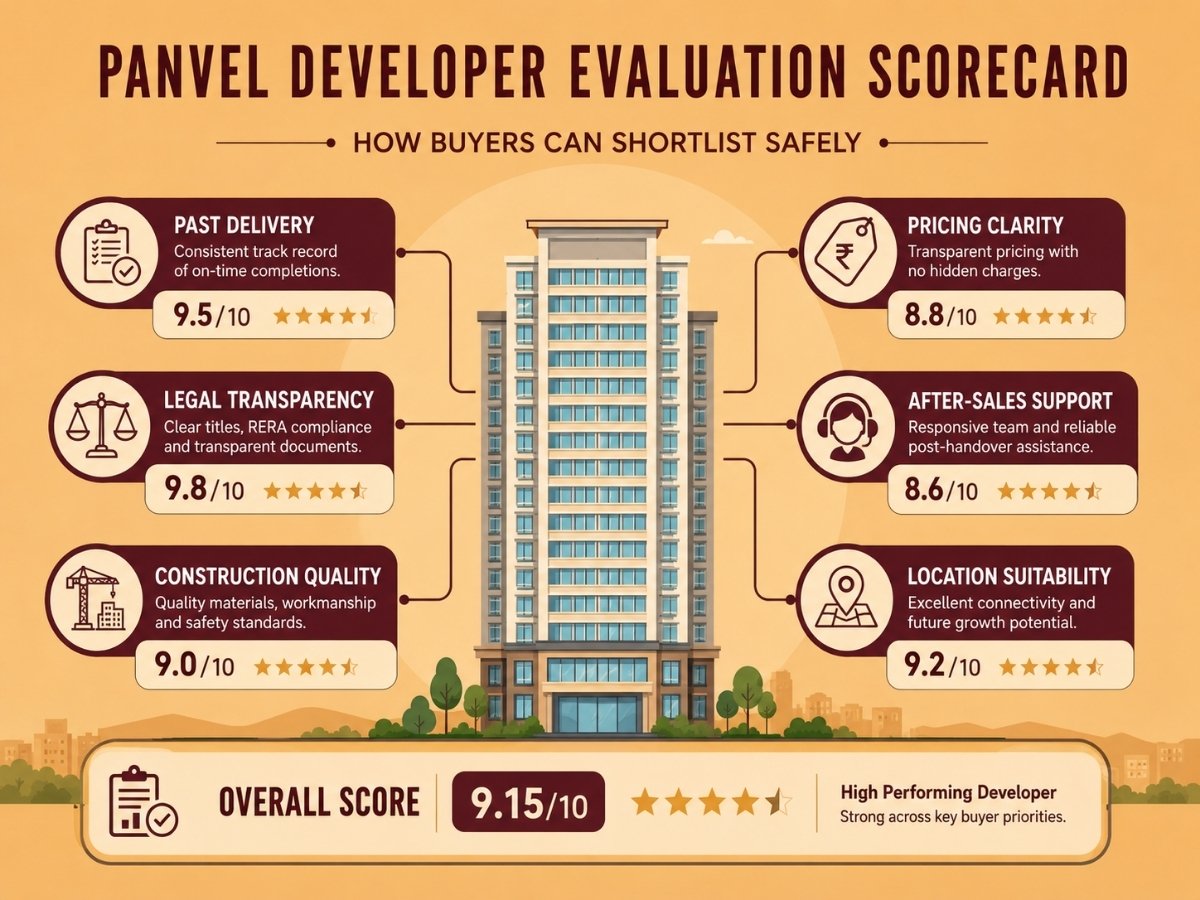
Use this scorecard to compare two or three developers before deciding.
| Factor | What to Check | Good Sign | Red Flag |
|---|---|---|---|
| Past Delivery Record | Completed projects and timelines | On-time or near on-time delivery | Repeated extensions |
| Legal Transparency | CC, title certificate, approved plan | Documents shared before token | Evasive answers |
| Construction Quality | Older buildings, monsoon performance | Low leakage, good upkeep | Cracks, seepage, poor waterproofing |
| Pricing Clarity | All-inclusive cost sheet | Written full cost | Verbal quote only |
| Location Suitability | Developer fit for micro-market | Experience in similar area | Wrong builder type for location |
| After-Sales Support | Society, maintenance, defect repair | Good resident feedback | Poor response after handover |
| Buyer Feedback Pattern | Reviews and resident opinions | Consistent positive ground feedback | Repeated complaints |
Past Delivery Record
Give maximum weight to past delivery. A developer who regularly misses deadlines should not be trusted only because the current sales pitch sounds confident.
Legal Transparency
A good developer shares documents without drama. Legal clarity before token payment is a strong positive sign.
Construction Quality
Check structure, waterproofing, common areas, and older buildings. Panvel’s monsoon conditions make construction quality a serious decision factor.
Pricing Clarity
A proper developer will explain the full price in writing. Avoid builders who keep adding charges after emotional commitment.
Location Suitability
A developer must be suitable for the location. A township developer may be better for a raw growth zone, while a strong local builder may be better in an established residential pocket.
After-Sales Support
The buyer’s real experience begins after possession. Check whether the builder repairs defects, completes amenities, forms the society, and hands over accounts properly.
Buyer Feedback Pattern
Repeated complaints matter. If many residents report the same issue, do not ignore it.
Common Mistakes Buyers Make While Choosing Builders in Panvel
Trusting Only Brand Name
A famous brand can reduce some risk, but it does not remove the need for checking RERA details, legal documents, construction progress, and possession terms.
Ignoring Legal Document Verification
This is one of the biggest mistakes. In Panvel, legal checking can involve title certificate, CC, OC, CIDCO documents, NAINA relevance, NA order, and PAP-related documents where applicable.
Booking Only Because of Discount or Offer
Discounts, free parking, GST offers, or festive schemes should never be the main reason to book. First check whether the base price was inflated before the offer.
Not Visiting Completed Projects
A completed building shows the truth. Buyers who skip this step rely too much on brochures and sample flats.
Depending Fully on Broker or Sales Team Promises
Brokers and sales teams are useful, but their promises must be verified. Infrastructure claims should be checked through official source types such as MahaRERA, CIDCO, PMC, or planning authority documents where applicable.
For a wider buyer checklist, readers can also refer to [questions to ask before buying a flat in Navi Mumbai](ADD INTERNAL LINK HERE).
How to Verify a Real Estate Developer Before Final Decision
Step 1: Check MahaRERA Details
Search the project on the MahaRERA website. Confirm registration status, promoter name, completion date, progress updates, and uploaded documents.
Step 2: Visit the Project Site
Do not finalize only from the sales office. Visit the site and observe real work quality, material storage, safety, and construction progress.
Step 3: Visit Completed Projects
Visit a building completed by the same developer at least three years ago. Check leakage, lifts, lobby, parking, paint, cracks, and resident feedback.
Step 4: Review Legal Documents with an Expert
Hire a local property lawyer to review the title certificate, CC, approved plan, agreement draft, CIDCO documents, PAP documents, or NAINA-related documents where applicable.
Step 5: Compare Total Cost with Other Projects
Compare total landed cost, not only base rate. Include GST, stamp duty, registration, parking, maintenance, PLC, floor-rise, and utility charges.
Step 6: Take Final Decision Only After Written Clarity
Pay token only after you have:
- Verified RERA details
- Reviewed legal documents
- Seen written price breakup
- Checked possession timeline
- Understood OC status
- Visited completed projects
- Spoken to residents or local market people
Final Checklist Before Choosing a Real Estate Developer in Panvel
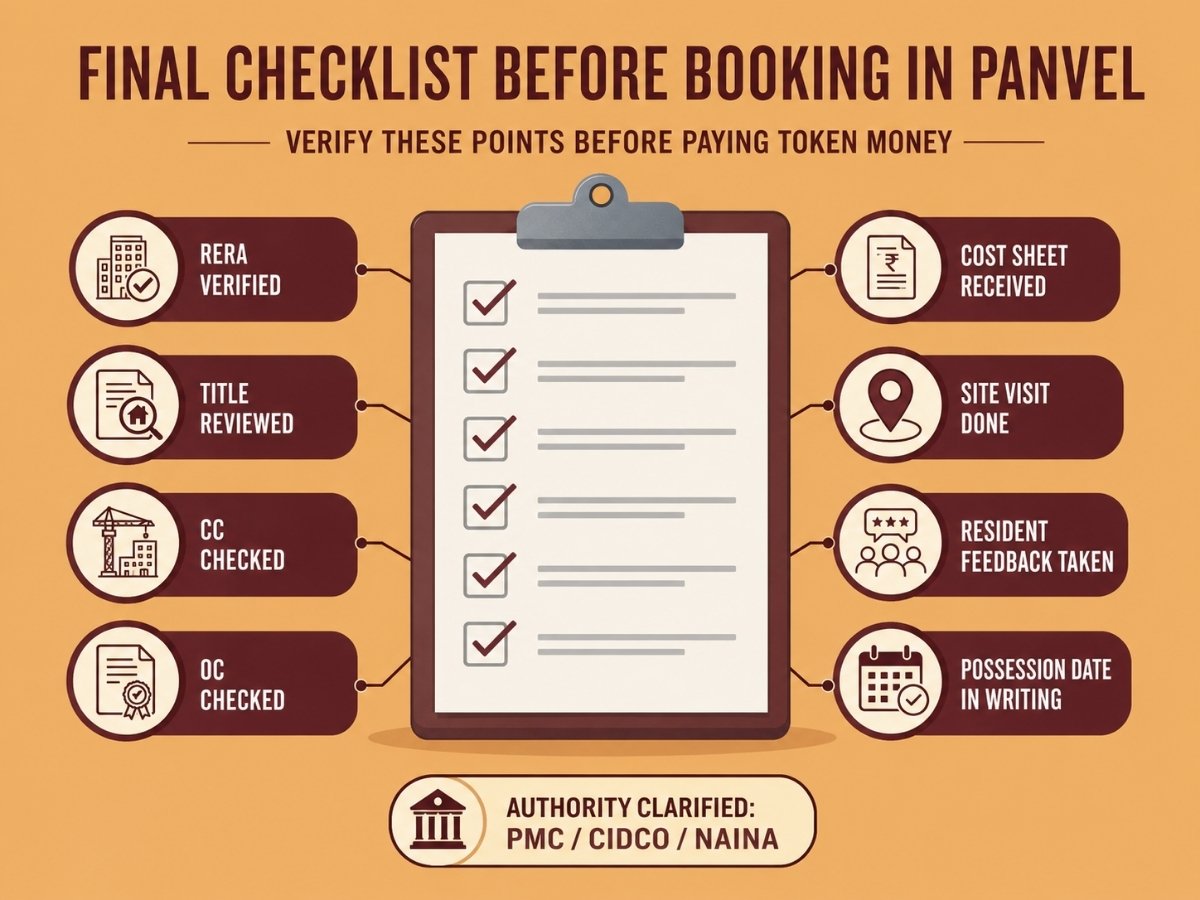
Use this checklist before making payment:
- [ ] MahaRERA registration number checked on the official portal
- [ ] Promoter name and project details verified
- [ ] MahaRERA possession timeline checked
- [ ] Litigation or extension history checked where available
- [ ] Commencement Certificate reviewed
- [ ] Approved building plan reviewed
- [ ] OC checked for ready-to-move property
- [ ] CIDCO leasehold or freehold status understood
- [ ] CIDCO transfer documents checked where applicable
- [ ] PAP or 12.5% plot documents verified, if relevant
- [ ] Title Clearance Certificate reviewed by a lawyer
- [ ] Agreement for Sale reviewed before signing
- [ ] Written all-inclusive cost sheet received
- [ ] Parking allocation written clearly
- [ ] GST, stamp duty and registration costs calculated
- [ ] Completed project visited
- [ ] Existing residents or buyers spoken to
- [ ] Site progress physically checked
- [ ] Water supply source verified
- [ ] No verbal promises accepted without written proof
- [ ] Final payment linked to legal possession and OC clarity
Conclusion
Choosing the right real estate developer in Panvel is not about selecting the biggest name or the most attractive sample flat. It is about checking whether the developer can legally, financially, and practically deliver what is promised.
Panvel has strong long-term importance because of its location, connectivity, and airport-linked growth. But this same growth has also brought more aggressive selling, under-construction inventory, complex land structures, and mixed-quality developers. Buyers must be more careful, not less careful.
The final decision should be based on evidence: MahaRERA details, legal documents, completed projects, construction quality, all-inclusive pricing, OC clarity, local authority relevance, and real buyer feedback. A good developer will not fear these checks. A weak developer will avoid them.
For buyers comparing [real estate developers in Navi Mumbai](ADD INTERNAL LINK HERE) or shortlisting [builder profile pages](ADD INTERNAL LINK HERE), the safest rule is simple: verify first, pay later.
FAQs
How do I choose the right real estate developer in Panvel?
Choose a real estate developer in Panvel by checking MahaRERA details, completed projects, legal documents, construction quality, pricing clarity, OC status, and real buyer feedback before paying token money. In Panvel, also verify whether the project falls under PMC, CIDCO, NAINA, or a PAP-related land structure.
What documents should I check before booking a flat in Panvel?
You should check the MahaRERA registration, Title Clearance Certificate, Commencement Certificate, approved building plan, draft Agreement for Sale, and Occupancy Certificate for ready flats. Where applicable, also check CIDCO allotment, transfer documents, PAP or 12.5% scheme papers, NA conversion, and society-related documents.
Is MahaRERA registration enough to trust a builder?
No. MahaRERA registration is important, but it is not enough to trust a builder completely. Buyers should also verify legal title, construction quality, completed projects, OC status, pricing transparency, and resident feedback.
Should I visit completed projects before booking?
Yes. Visiting completed projects is one of the best ways to judge a developer’s real quality. In Panvel, older buildings reveal leakage, poor maintenance, lift issues, water problems, and whether the builder handled society handover properly.
Is a big builder always better than a local builder?
No. A big builder may offer stronger financial capacity and larger amenities, but a reputed local Panvel developer may offer better carpet area, better pricing, and stronger local approval knowledge in mature locations. The better choice depends on the project, location, documents, and buyer priority.
What are the red flags in a real estate developer?
Major red flags include pressure to pay token quickly, refusal to share legal documents, unclear OC status, hidden charges, delayed past projects, poor maintenance in completed buildings, repeated leakage complaints, and too many verbal promises.
What should I ask before paying token money?
Before paying token money, ask for the MahaRERA number, Commencement Certificate, approved plan, Title Clearance Certificate, all-inclusive cost sheet, written possession timeline, OC status, and clarity on CIDCO, PMC, NAINA, or PAP-related land documents.
Which Panvel areas need extra legal checking before buying property?
Growth and peripheral locations such as NAINA, Palaspe, Pushpak Nagar, Karanjade, and airport-influence areas usually need extra legal checking because land conversion, authority approvals, infrastructure timelines, and PAP or CIDCO documentation may be more complex.
How important is Occupancy Certificate before possession?
The Occupancy Certificate is extremely important. It confirms that the building is legally fit for occupation. Buyers should avoid moving in or accepting possession without OC because it can affect safety, utility connections, resale, insurance, and legal rights.
Can a local Panvel developer be safer than a big brand?
Yes. A local Panvel developer can be safer if they have a strong delivery record, clear legal documents, good construction quality, OC-completed projects, and positive resident feedback. In mature areas like Old Panvel, New Panvel, Khandeshwar, or Kamothe, a proven local developer can be a practical and reliable choice.