

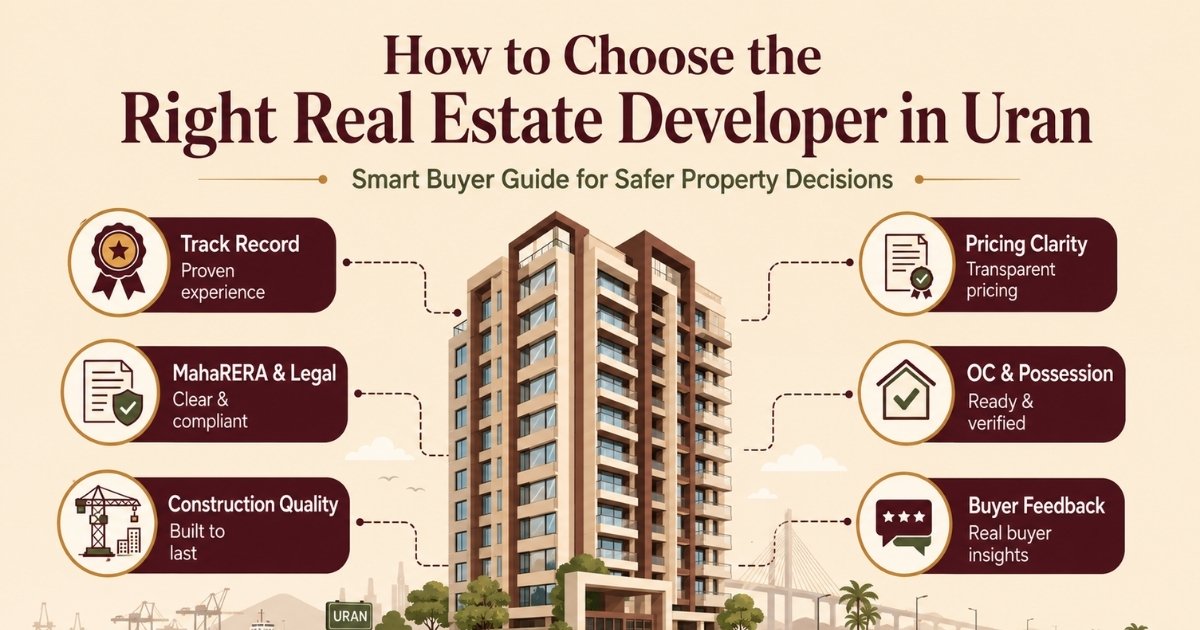
To choose the right real estate developer in Uran, buyers should check the developer’s past delivery record, MahaRERA registration, legal documents, CIDCO or Uran Council approvals, construction quality, pricing transparency, completed projects, and buyer feedback before paying token money. In Uran, this is especially important because land type, approval authority, PAP plots, Dronagiri’s CIDCO planning, and coastal construction conditions can differ sharply from one project to another.
Uran and nearby Dronagiri are attracting more attention because of Atal Setu, JNPT, the Navi Mumbai International Airport influence, port-led employment, and improving road connectivity. But higher attention also means more aggressive selling, more under-construction inventory, and more confusion for first-time buyers. A good developer can protect your money, timeline, and long-term peace of mind. A weak developer can create years of legal, financial, and maintenance stress.
This guide is written as a practical buyer-decision checklist for Uran homebuyers, investors, NRIs, and local families comparing developers before booking a flat.
This article is for general buyer awareness. Before booking or signing any agreement, buyers should verify all property documents with a qualified legal professional.
Quick Summary: How to Choose the Right Real Estate Developer in Uran
The safest way to choose a real estate developer in Uran is to verify legal documents, completed projects, pricing clarity, construction quality, and buyer feedback before paying token money.
| What to Check | Why It Matters in Uran | Good Sign | Red Flag |
|---|---|---|---|
| MahaRERA registration | Confirms basic project registration and declared timeline | Project details match the sales brochure | “RERA applied” but no valid registration |
| Land and title documents | Uran has CIDCO, municipal, Gaothan and PAP-related land complexity | Clear title report and authority documents shared | Builder avoids document sharing |
| CC and OC | Shows construction permission and legal possession status | CC covers the floor being sold; OC available for ready flat | Fit-out possession without OC |
| Completed projects | Shows actual delivery and quality record | Older buildings are maintained well | Leakage, poor lifts, delayed society handover |
| Pricing clarity | Prevents hidden cost shock | Written all-inclusive cost sheet | Verbal offers and unclear extra charges |
| Local reputation | Online reviews alone can mislead | Residents confirm delivery and support | Repeated complaints about delays or charges |
If you are comparing multiple [real estate developers in Uran](ADD INTERNAL LINK HERE), shortlist only those who are transparent with documents, have completed projects, and are willing to let your advocate review the legal file.
Why Choosing the Right Real Estate Developer Matters in Uran
Choosing the right developer in Uran matters because the area is not a simple, fully matured residential market. Uran has older town areas, port-linked pockets, CIDCO-planned Dronagiri sectors, PAP or 12.5% scheme land, and growth villages such as Chirle, Jasai, Bokadvira, Nagaon and Karanja. Each micro-location can have a different approval path and risk profile.
A developer in Uran is not only selling a flat. The developer is responsible for:
- Clear land title
- Valid project approvals
- Quality construction suitable for coastal weather
- Timely possession
- OC and society handover
- Transparent charges
- After-sales support
Uran’s coastal environment also matters. Buildings near creek, port and sea-influenced zones must handle monsoon exposure, humidity, seepage risk, and long-term maintenance pressure. Imported tiles and a good-looking lobby mean very little if the terrace leaks, basement floods, or external walls start peeling after two monsoons.
A reputed developer is not always the right developer if the project has unclear approvals, delayed possession, hidden charges, or weak after-sales support.
Understand the Developer’s Past Track Record
A developer’s past record is the strongest clue about future performance. Do not judge a builder only by hoardings, sales office design, brochure quality, or social media ads. In Uran and Dronagiri, many buyers are attracted by lower entry prices and future infrastructure potential, but the developer’s delivery history must come first.
Check whether the developer has delivered projects in Uran, Dronagiri, Panvel, Ulwe, Kharghar, Nerul, Vashi or other Navi Mumbai nodes. If the builder is new to Uran, their broader Navi Mumbai track record becomes even more important.
Check Completed Projects Before Trusting New Launches
Under-construction and pre-launch projects carry more risk than ready or near-completion projects. A new launch may look attractive because of lower pricing, but buyers should first ask one simple question:
Has this developer successfully completed similar projects before?
A good developer should have at least a few completed projects where buyers received possession, OC, and society handover without major disputes. If the builder has only new launches and no proven delivery record, treat the project as higher risk.
For buyers looking at Dronagiri sectors such as 47, 50, or 51, completed project checks become even more important because many projects in these pockets are still under construction or recently delivered.
Visit Older Buildings Developed by the Same Builder
Do not stop at the sample flat. Visit older buildings developed by the same builder, ideally 3 to 5 years old. This is one of the most practical checks a buyer can do.
During the visit, observe:
- Exterior paint and plaster condition
- Leakage marks on walls and ceilings
- Basement waterlogging
- Lift condition
- Lobby maintenance
- Parking usability
- Terrace waterproofing
- Drainage around the building
- Society cleanliness and security
A newly painted sample flat can hide many things. An older completed building shows the real construction quality after monsoon, daily use, and maintenance pressure.
Speak to Existing Residents and Buyers
Existing residents can tell you what no brochure will say. Speak to people living in the builder’s completed projects. If possible, speak to the society chairman, secretary, or long-term residents.
Ask practical questions:
- Was possession given on time?
- Was OC received before possession?
- Were hidden charges demanded later?
- Were amenities delivered as promised?
- Did the builder respond to leakage or defect complaints?
- Was the maintenance corpus properly handed over?
- Was the society formed on time?
- Is water supply stable?
- Are lifts and common areas maintained properly?
In Uran and Dronagiri, also ask about water supply, monsoon leakage, parking, and access roads. These are not small issues. They affect daily life.
Check MahaRERA Registration and Project Transparency
MahaRERA registration is an important first filter, but it is not the final proof of developer quality. It gives buyers access to project details, declared possession timelines, promoter information, approved plans, legal documents, and complaint-related information where available.
MahaRERA registration is important, but it should not be treated as the only proof of developer quality.
Why MahaRERA Is Important for Uran Buyers
MahaRERA helps Uran buyers because it creates a formal regulatory record of the project. It also requires developers to declare timelines, upload key documents, and follow buyer protection rules.
For under-construction projects, buyers should never accept vague answers such as “RERA process is going on” or “registration will come soon.” If a project is being marketed and sold, the buyer should verify the actual registration status on the MahaRERA website.
MahaRERA also matters because delay-related compensation provisions exist under the RERA framework. But buyers should not depend only on later legal recovery. Prevention is better than fighting for years after booking.
What to Verify on the MahaRERA Website
Before paying token money, check the project on the MahaRERA website and verify:
| MahaRERA Check | What Buyer Should Verify |
|---|---|
| Project name | It should match the project being sold |
| Promoter name | It should match the developer entity |
| Registration status | It should be active and valid |
| Project phase | Tower or phase details should match your booking |
| Declared possession date | It should match the sales team’s written promise |
| Uploaded documents | Title, plan, approvals and other documents should be reviewed |
| Litigation details | Check if disputes are disclosed |
| Extension history | Repeated extensions are a warning sign |
| Registered broker details | The broker involved should ideally be registered |
Always search using the exact project name and promoter name. Large projects may have multiple phases, so do not assume one RERA number covers every tower.
Why MahaRERA Alone Is Not Enough
MahaRERA is a strong tool, but it does not replace legal due diligence, site inspection, and financial judgment. A project can be registered and still face delays, quality issues, litigation, or buyer complaints.
Use MahaRERA as a diagnostic tool. Then verify:
- Land title
- CC
- OC
- Approved plan
- CIDCO or Uran Council documents
- Cost sheet
- Builder history
- Site progress
- Completed project quality
A buyer who checks only the RERA number but ignores land documents, possession status, and construction quality is still taking an unnecessary risk.
Check Legal Documents Before Booking a Flat
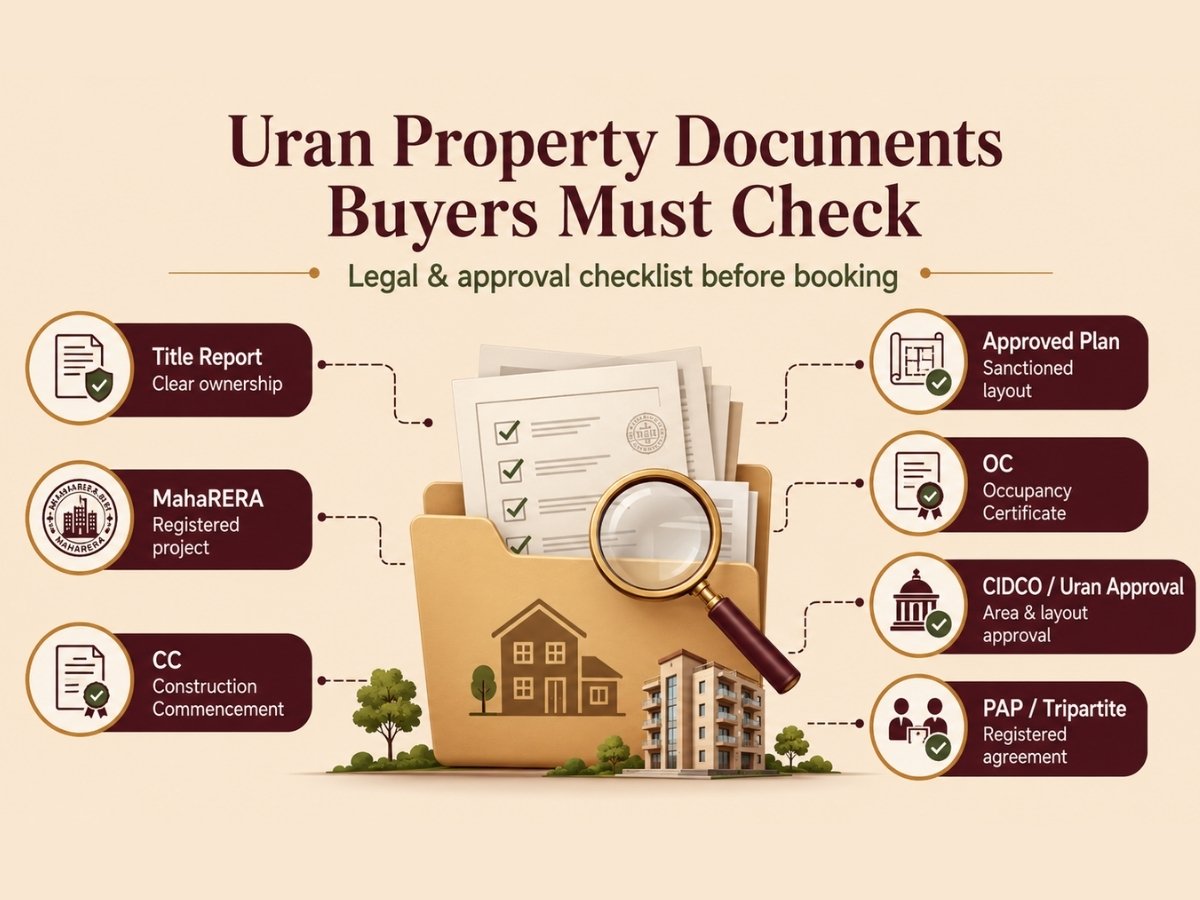
Legal document verification is non-negotiable in Uran because the land structure can be complex. Uran Town, Dronagiri, Gaothan land, CIDCO leasehold plots, PAP or 12.5% scheme plots, and NAINA-influenced areas may involve different documents and approvals.
Before paying a token amount, ask for the legal file and get it reviewed by a property advocate familiar with Navi Mumbai, CIDCO and Raigad-side property documentation.
| Document | Why It Matters | What to Check |
|---|---|---|
| Title Clearance Certificate | Confirms clear ownership history | 30-year title search, no major disputes or claims |
| Commencement Certificate | Confirms permission to start construction | CC should cover the floor being sold |
| Occupancy Certificate | Confirms building is approved for occupation | Must be available before legal possession of ready flat |
| Approved Building Plan | Confirms sanctioned layout and construction plan | Flat, floor, parking and common areas should match |
| Agreement for Sale | Defines buyer-builder legal terms | Carpet area, possession date, charges and penalties |
| CIDCO documents | Important for leasehold and Dronagiri plots | Allotment, transfer, NOC, lease and premium clarity |
| PAP / 12.5% documents | Critical for development rights on PAP plots | Tripartite Agreement and original allotment trail |
Title Clearance Certificate
The Title Clearance Certificate should show that the land has a clean ownership chain and is not trapped in active disputes, mortgages, family claims, or ownership confusion.
In Uran, this is especially important for Gaothan or older land parcels where ownership history may involve multiple heirs, agricultural conversion, or development rights. A proper advocate should check the title history, not just the builder’s summary.
Commencement Certificate
The Commencement Certificate, or CC, confirms that the planning authority has permitted construction. For Uran Town, the authority may differ from CIDCO-planned Dronagiri. Buyers should check who issued the CC and whether it covers the floor they are buying.
A serious red flag is when a builder sells a flat on a higher floor but the CC is approved only up to a lower floor. Never rely on verbal assurances that “permission will come later.”
Occupancy Certificate
The Occupancy Certificate, or OC, is one of the most important documents for ready-to-move flats. It confirms that the building has been completed according to approved plans and is fit for occupation.
Avoid taking possession only for “fit-out” if the OC is not received. Without OC, buyers may face problems with legal possession, utilities, resale, home loans, and society formation.
Approved Building Plan
The approved building plan should match the actual construction. Check whether the flat layout, floor, parking, open spaces, staircase, lifts, fire safety provisions and common areas match what is being sold.
Do not accept only a brochure layout. A sales brochure is marketing material. The approved plan is the document that matters.
Agreement for Sale
The Agreement for Sale must clearly mention:
- Exact carpet area
- Flat number and floor
- Possession date
- Total consideration
- Payment schedule
- Parking clarity
- Default clauses
- Delay compensation terms
- Specifications and fittings
- Maintenance and handover terms
For further legal understanding, buyers can internally link to [Agreement to Sale vs Sale Deed](ADD INTERNAL LINK HERE).
CIDCO Transfer and Leasehold Clarity
Many properties in Navi Mumbai’s planned nodes are on CIDCO leasehold land rather than freehold land. This is normal in CIDCO-planned areas, but buyers must understand the cost and legal process.
For Dronagiri and CIDCO-origin plots, check:
- Original CIDCO allotment letter
- Lease deed
- Transfer permissions
- Paid transfer charges
- CIDCO NOC where applicable
- Any pending premium or dues
- Future freehold conversion relevance, if applicable
In resale transactions, CIDCO transfer charges can affect the total cost. Buyers should clearly ask who will pay these charges before finalizing the deal.
Uran-Specific Documents Buyers Should Check Before Booking
Uran has a mixed approval environment. Dronagiri is CIDCO-planned, while Uran Town has municipal relevance. Some surrounding growth areas may have NAINA or land pooling influence. So buyers must first identify the project’s exact jurisdiction.
Do not assume that every Uran project follows the same approval path.
CIDCO Allotment and Transfer Documents
If the project is on CIDCO-allotted or transferred land, ask for the allotment and transfer trail. These documents help establish that the developer has proper rights to develop and sell flats.
For a resale flat in Dronagiri, also check whether previous CIDCO transfer formalities and dues are cleared.
PAP Plot or 12.5% Scheme Plot Clarity
PAP or 12.5% scheme plots are common in parts of Navi Mumbai and surrounding development areas. Under this system, landowners affected by acquisition may receive developed land compensation. Developers may later enter into arrangements to develop these plots.
For such plots, buyers should verify:
- Original allotment details
- 7/12 extract where relevant
- Development rights agreement
- Tripartite Agreement between CIDCO, original allottee and developer or society
- Any pending notices or disputes
- Whether the developer has clear authority to sell flats
This is one area where casual checking is not enough. Use a qualified local property advocate.
NMMC, PMC or CIDCO Approval Relevance
A common confusion is treating the whole region as one single authority area. Uran and Dronagiri should not be blindly treated like NMMC areas such as Vashi or Nerul, or PMC areas such as parts of Panvel.
Buyers should verify the exact approving authority for the project. In Dronagiri, CIDCO documents are usually central. In Uran Town, Uran Municipal Council-related documentation may be relevant. In nearby growth villages, additional planning framework checks may be needed.
Society Formation and Conveyance Status
A good developer should not disappear after possession. Society formation, maintenance handover and conveyance are important parts of the buyer’s long-term safety.
Ask the developer:
- When will the society be formed?
- When will accounts and maintenance corpus be handed over?
- Has the builder completed conveyance in older projects?
- Are there pending dues or disputes with residents?
- Is the builder retaining control over future FSI or common areas?
A builder who delays society formation repeatedly may not be buyer-friendly after possession.
Compare Construction Quality and Actual Site Progress
In Uran and Dronagiri, construction quality must be checked seriously because the area faces coastal humidity, strong monsoons, drainage pressure, and long-term maintenance challenges. A beautiful sales office cannot prove structural quality.
Visit the Actual Construction Site
Visit the site yourself. Do not rely only on WhatsApp photos, drone videos or 3D renders.
At the site, observe:
- Construction activity level
- Labour presence
- Material storage
- Site cleanliness
- Safety practices
- Progress against promised timeline
- Quality of concrete work
- Drainage and surrounding road condition
- Whether the site looks active or abandoned
If the project claims fast progress but the site looks inactive for weeks, ask direct questions.
Compare Sample Flat and Real Flat Specifications
Sample flats are designed to impress. They often use better lighting, better furniture, upgraded fittings, and smart visual tricks to make the space look larger.
Before booking, compare the sample flat with the actual agreement specifications. Ask for exact brands and specifications for:
- Flooring
- Tiles
- Sanitary fittings
- Electrical switches
- Doors
- Windows
- Kitchen platform
- Paint
- Bathroom fittings
- Safety features
If the sales team says “similar quality,” ask them to write it clearly in the agreement annexure.
Check Lift, Lobby, Parking and Common Area Quality
A good flat inside a badly designed building is not a good purchase. Common areas affect daily comfort and resale value.
Check:
- Lift brand and capacity
- Lobby ventilation
- Corridor width
- Staircase quality
- Parking entry and turning radius
- Fire exit access
- Security cabin
- Rainwater drainage
- Basement or stilt waterlogging risk
Narrow parking, poorly ventilated corridors, and low-quality lift systems can become daily irritations after possession.
Check Monsoon Performance and Leakage Issues
Monsoon performance is one of the most important practical checks in Uran. Ask existing residents about:
- Terrace leakage
- Wall seepage
- Basement flooding
- Lift shutdown during rains
- Dampness in common areas
- Waterlogging near the gate
- Drainage blockage
- Exterior paint peeling
Under RERA, developers have defect liability obligations for structural defects for a defined period after possession. But fighting for repairs can be stressful. It is better to choose a builder who has already shown quality in older projects.
Understand Pricing, Hidden Charges and Payment Terms
The base price is not the final cost. Buyers must calculate the total outflow before booking. In Uran and Dronagiri, hidden or unclear charges can affect affordability and loan planning.
Use tools like [stamp duty calculator](ADD INTERNAL LINK HERE) and [property tax calculator](ADD INTERNAL LINK HERE) where useful for planning.
Ask for an All-Inclusive Cost Sheet
Ask for a written all-inclusive cost sheet on the developer’s official letterhead.
It should include:
- Base flat cost
- Floor-rise charges
- Preferential location charges
- Parking charges
- GST, if applicable
- Stamp duty
- Registration charges
- Legal charges
- Maintenance deposit
- Society formation charges
- Clubhouse or amenity charges
- Utility connection charges
- CIDCO transfer or related charges, if applicable
Do not rely on “approximate” numbers if you are close to paying token money.
Check Parking, Floor-Rise, PLC and Maintenance Charges
Many buyers focus only on per sq ft rate and later get surprised by add-ons. Parking charges, floor-rise charges, PLC, club charges and advance maintenance can significantly change the final budget.
Ask clearly:
- Is parking included?
- Is parking open, stilt or basement?
- Is floor-rise charged separately?
- Is PLC applicable?
- What is the maintenance rate?
- For how many months is advance maintenance collected?
- Who will manage maintenance before society formation?
If the answer keeps changing between sales staff and agreement draft, be careful.
Understand GST, Stamp Duty and Registration Cost
In general, under-construction properties attract GST, while ready-to-move properties with OC are treated differently. Stamp duty and registration charges also need to be calculated separately.
These costs vary by transaction type, property value, legal status, government rules and timing. Buyers should confirm current costs with the registration office, advocate, bank or relevant official source before booking.
Avoid Verbal Price Commitments
A verbal promise has almost no practical value in a property transaction. If the sales team says parking is free, GST is included, maintenance is waived, or modular kitchen is complimentary, ask for it in writing.
The rule is simple: if it is not in the registered Agreement for Sale or signed cost sheet, do not treat it as final.
Check Developer Reputation Beyond Online Reviews
Online reviews are useful, but they are not enough. Some reviews may be promotional, outdated, emotional, incomplete or manipulated. Use online reviews only as a starting point.
Read Google Reviews Carefully
Check reviews by:
- Lowest rating
- Newest reviews
- Long detailed reviews
- Reviews with photos
- Resident comments
- Repeated complaints
Ignore vague reviews like “good project” or “nice builder” unless they provide real detail. A useful review mentions possession, leakage, charges, staff behaviour, maintenance, OC, or amenities.
Look for Repeated Complaint Patterns
One complaint does not prove the builder is bad. But repeated complaints across projects matter.
Watch for patterns such as:
- Delayed possession
- No OC clarity
- Hidden charges
- Poor maintenance
- Leakage
- Poor lift quality
- Builder not responding after possession
- Society handover delays
- Legal disputes
Patterns reveal builder behaviour better than isolated reviews.
Speak to Local Brokers and Residents
Local brokers, residents and society members often know the ground reality. In Uran, where many projects are tied to local land and approval dynamics, offline reputation matters.
Ask neutral brokers, not only the project’s official channel partner. If local brokers avoid recommending a particular builder despite high commission, there may be a reason.
You can also refer readers to [real estate agents in Uran](ADD INTERNAL LINK HERE) for local transaction guidance.
Check Litigation or Delay History Where Possible
Check the promoter name on MahaRERA and look for delay history or complaints where available. Buyers can also use relevant legal portals or ask their advocate to check civil dispute history.
Do not finalize a project if the developer refuses to disclose litigation, mortgages, encumbrances or project-related disputes.
Big Builder vs Local Builder: Which Is Better in Uran?
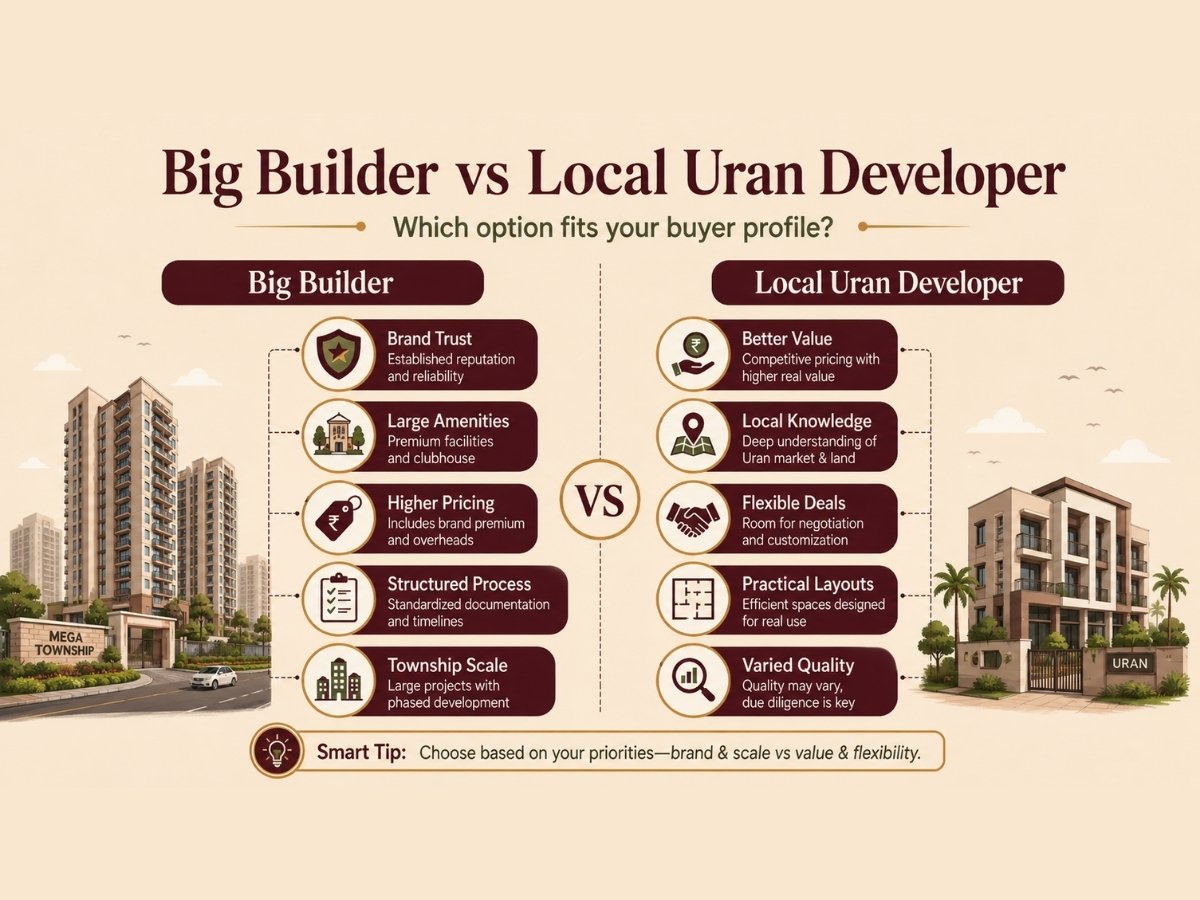
There is no one-size-fits-all answer. A big builder is not automatically better, and a local builder is not automatically risky. The right choice depends on legal clarity, project quality, location, pricing, and your buyer profile.
| Factor | Big Real Estate Developer | Local Uran Developer | What Buyer Should Decide |
|---|---|---|---|
| Brand trust | Usually higher public recognition | Depends on local reputation | Do not rely only on name |
| Project scale | Larger projects, more amenities | Smaller buildings, practical layouts | Choose based on lifestyle and budget |
| Location | Often larger peripheral land parcels | May have central or transit-friendly plots | Check daily convenience |
| Pricing | Usually higher brand premium | Often more competitive | Compare carpet area and total cost |
| Legal systems | More structured processes | Varies widely | Legal review is required for both |
| Maintenance | Higher amenity maintenance possible | Lower monthly maintenance possible | Check long-term affordability |
| Buyer type | NRIs, investors, lifestyle buyers | End-users, local families, budget-conscious buyers | Match builder to your actual need |
Advantages of Big Real Estate Developers
Big developers may offer:
- Stronger brand recognition
- Better formal processes
- Larger amenities
- Easier resale perception
- Institutional funding comfort
- More standardized documentation
For NRIs or outstation buyers who cannot visit the site often, a known brand may feel safer. Still, legal and project-specific checks are necessary.
Advantages of Local Uran Developers
Local Uran or Navi Mumbai developers may offer:
- Better pricing
- Practical flat sizes
- Lower maintenance burden
- Familiarity with CIDCO and local authority processes
- Centrally located smaller plots
- Faster decision-making in some cases
A good local developer with clean documents and a strong delivery record can be a sensible choice for end-users.
When a Smaller Developer Can Be a Better Choice
A smaller developer can be better when:
- The project has clear approvals
- The land title is clean
- The builder has delivered similar buildings
- The project location is convenient
- Maintenance cost is reasonable
- The flat offers better carpet area value
- Residents of older projects give good feedback
For a family seeking practical housing near Uran Town or Dronagiri station access, a well-executed local building may be more useful than a far-off amenity-heavy project.
When a Big Brand May Still Be Safer
A big brand may be safer when:
- The buyer wants large gated amenities
- The buyer is an NRI or outstation investor
- The buyer wants brand-led resale comfort
- The project has strong legal clarity
- The buyer can afford higher maintenance
- The developer has proven local execution experience
Even with big brands, buyers must check OC, CC, RERA, possession timeline, and cost sheet.
Check Location Fit Before Choosing the Developer
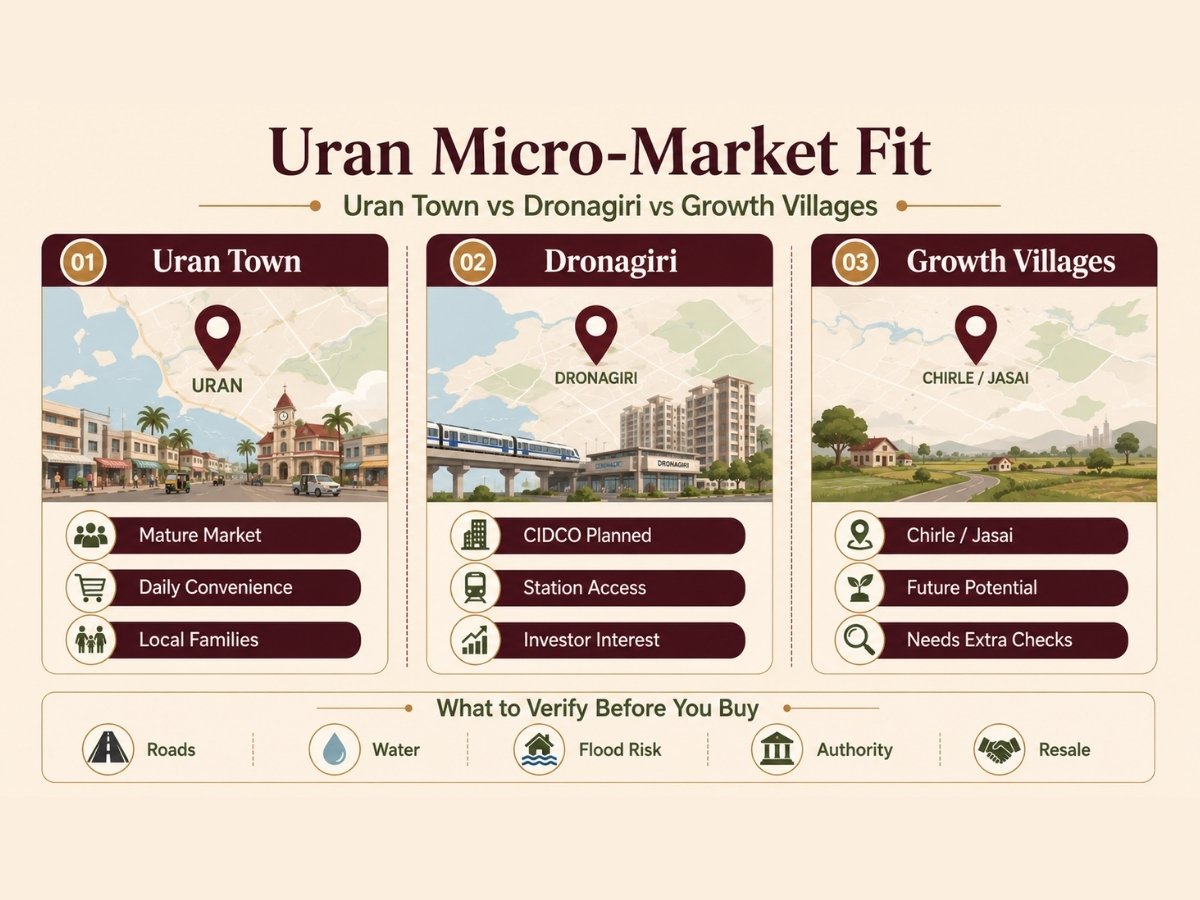
Developer quality and location quality must be checked together. A good builder cannot fully fix a poor location, and a good location cannot fully protect you from a weak builder.
Mature Areas Like Uran Town, JNPT, Nhava Sheva and Dronagiri
Uran Town, JNPT, Nhava Sheva and Dronagiri have stronger functional relevance because of port activity, existing movement, road connectivity and growing residential demand.
Dronagiri is important because it is CIDCO-planned and has developing residential sectors. It may appeal to port professionals, investors, and buyers looking for relatively affordable entry compared to mature Navi Mumbai nodes.
Before choosing a developer in these areas, check:
- Distance to railway station or main road
- Daily access to markets
- Hospital and school availability
- Road condition
- Water supply
- Flooding or waterlogging risk
- Port traffic impact
- Noise and industrial movement
- Long-term resale demand
Growth Areas Like Chirle, Jasai, Bokadvira, Nagaon and Karanja
Growth areas such as Chirle, Jasai, Bokadvira, Nagaon and Karanja are often discussed in connection with long-term infrastructure and land value expectations. But buyers should be more careful here.
These areas may involve land pooling, NAINA influence, former agricultural land, or future development assumptions. They may suit long-term investors more than buyers who need immediate livability.
Before buying, verify:
- Exact land status
- Approval authority
- Road access
- Future development plan
- Current social infrastructure
- Water and electricity availability
- Legal conversion and title clarity
- Whether the project is truly residential and approved
Do not buy only because someone says “airport impact” or “future growth.” Verify the documents and ground reality.
Why Location Quality and Developer Quality Must Be Checked Together
A Grade-A developer in a weak, isolated, low-lying location can still create a poor buyer experience. Similarly, a local developer in a strong location may be worth considering if legal documents and construction quality are solid.
Check both:
1. Is the developer trustworthy? 2. Is the location practical for living or resale?
Only when both answers are positive should you move forward.
Questions to Ask a Developer Before Paying Token Money
Token money should be paid only after basic legal, financial and project checks. Do not pay simply because the sales team says the price will increase.
| Question | Why You Should Ask | Proof to Request |
|---|---|---|
| Is the project registered on MahaRERA? | Confirms basic legal registration | MahaRERA number and portal verification |
| Can you share the approved plan, CC and legal documents? | Tests transparency | Hard copies or digital copies for advocate review |
| Is the quoted price fully all-inclusive? | Prevents hidden cost shock | Signed cost sheet on letterhead |
| What is the written possession timeline? | Avoids verbal date confusion | Agreement and RERA timeline match |
| What happens if possession is delayed? | Checks builder accountability | Delay clause in Agreement for Sale |
| Is the OC already received or expected later? | Critical for ready possession | Actual OC document, not application receipt |
Is the Project Registered on MahaRERA?
Ask for the MahaRERA registration number and verify it yourself. Do not accept only a brochure mention.
Can You Share the Approved Plan, CC and Legal Documents?
A transparent developer should allow legal review before booking. If the builder refuses or delays document sharing, treat it as a serious concern.
Is the Quoted Price Fully All-Inclusive?
Ask for the total cost, not only the base rate. Include GST, stamp duty, registration, parking, maintenance, legal charges and any CIDCO-related costs where applicable.
What Is the Written Possession Timeline?
The promised date by the sales team should match the RERA declaration and agreement draft. If different dates are given in different places, pause the transaction.
What Happens If Possession Is Delayed?
Ask how the builder handles delay compensation and buyer rights. A professional developer should not avoid this question.
Is the OC Already Received or Expected Later?
For ready-to-move flats, ask to see the actual Occupancy Certificate. An OC application receipt is not the same as OC approval.
Red Flags When Choosing a Real Estate Developer in Uran
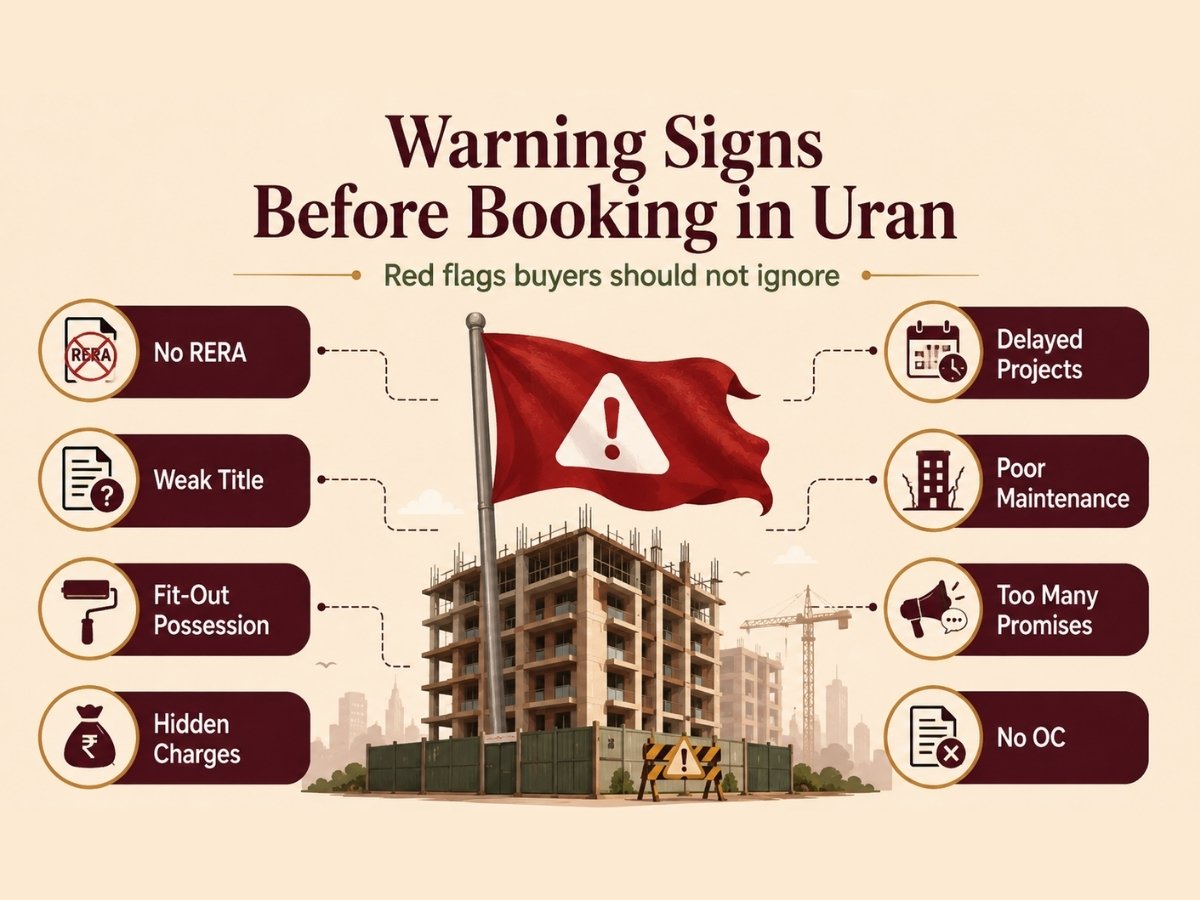
| Red Flag | What It May Mean | What Buyer Should Do |
|---|---|---|
| Pressure to pay token quickly | Sales urgency may be hiding approval or demand weakness | Do not pay before verification |
| No written clarity on charges | Hidden costs may appear later | Demand signed all-inclusive cost sheet |
| Delayed older projects | Possible cash flow or execution problem | Check MahaRERA and resident feedback |
| Poor maintenance in completed buildings | Weak after-sales support | Visit older projects before booking |
| Weak legal transparency | Title or approval issue may exist | Get documents reviewed by advocate |
| Too many verbal promises | Builder may deny later | Put everything in writing |
| No OC for ready flat | Possession may not be legally safe | Do not take possession without checking OC |
| Sample flat mismatch | Actual flat may have lower specifications | Check agreement annexure |
Pressure to Pay Token Money Quickly
Phrases like “last unit,” “price increases tomorrow,” or “only today’s offer” are common sales tactics. A genuine project should survive basic due diligence.
No Written Clarity on Charges
If the builder avoids giving a written cost sheet, there may be hidden charges. Do not move forward without written clarity.
Delayed Older Projects
If the same developer has delayed older projects, the new project may also face issues. Check actual possession records, not just promises.
Poor Maintenance in Completed Buildings
Poorly maintained completed projects show the builder’s attitude after collecting money. If older buildings are already leaking, badly painted, or poorly managed, be careful.
Weak Legal Transparency
A builder who says “documents are confidential” before booking is not giving enough confidence. Your advocate must be allowed to review the legal file.
Too Many Verbal Promises
Free parking, waived charges, early possession, special discount, modular kitchen, sea view, future metro, new road accessnothing matters unless written.
Real Estate Developer Shortlisting Scorecard
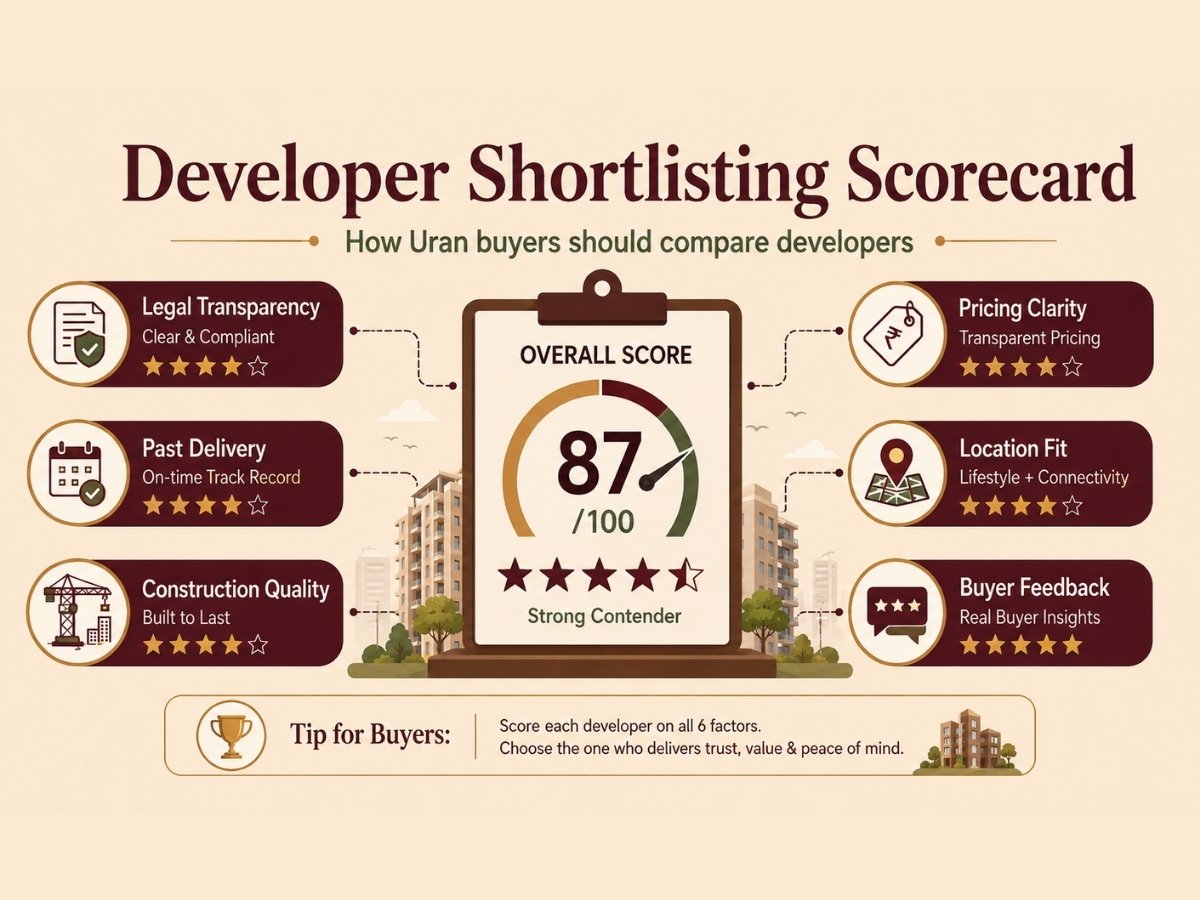
Use this scorecard to compare two or three developers before deciding.
| Factor | Weight | What to Check | Score 1-5 |
|---|---|---|---|
| Legal Transparency | 30% | Title, CC, OC, CIDCO documents, RERA uploads | |
| Past Delivery Record | 20% | Completed projects, possession history, delays | |
| Construction Quality | 20% | Older building condition, leakage, lifts, parking | |
| Pricing Clarity | 10% | All-inclusive cost sheet and no hidden charges | |
| Location Suitability | 10% | Connectivity, daily needs, flood risk, resale demand | |
| After-Sales Support | 5% | Defect handling, maintenance, society formation | |
| Buyer Feedback Pattern | 5% | Resident reviews and repeated complaint patterns |
A developer with weak legal transparency should not be shortlisted even if pricing looks attractive.
Past Delivery Record
Give higher scores to builders who have delivered projects on time or with minor delays and have no major unresolved buyer complaints.
Legal Transparency
This is the most important factor. If documents are unclear, every other advantage becomes secondary.
Construction Quality
Check older buildings. Good construction quality should survive regular use and monsoon exposure.
Pricing Clarity
Choose the builder who gives written total cost clarity before token payment.
Location Suitability
A good project should fit your daily life, not only your investment hopes.
After-Sales Support
A developer who helps after possession is more valuable than one who disappears after registration.
Buyer Feedback Pattern
Look for patterns, not one-off comments. Repeated complaints should influence your decision.
Common Mistakes Buyers Make While Choosing Builders in Uran
Trusting Only Brand Name
Brand name helps, but it does not replace project-level verification. Even a known developer must show proper documents, approvals and site progress.
Ignoring Legal Document Verification
Skipping legal review to save time or money can become the costliest mistake. In Uran, CIDCO, PAP, leasehold, municipal and Gaothan-related documents must be checked carefully.
Booking Only Because of Discount or Offer
A discount is useful only if the project is legally clear and deliverable. A cheap flat in a disputed or delayed project is not a good deal.
Not Visiting Completed Projects
Many buyers visit the sample flat but never inspect completed projects. This hides the builder’s real construction quality and after-sales behaviour.
Depending Fully on Broker or Sales Team Promises
Brokers and sales teams may not carry legal responsibility for every statement. Verify independently, especially before token payment.
How to Verify a Real Estate Developer Before Final Decision
Follow this simple step-by-step process before choosing a developer in Uran.
Step 1: Check MahaRERA Details
Search the exact project and promoter name on the MahaRERA website. Verify project status, possession date, documents, extensions and litigation details where available.
Step 2: Visit the Project Site
Check actual progress, labour activity, material quality, safety, surrounding roads, drainage and accessibility.
Step 3: Visit Completed Projects
Visit at least one older project by the same developer. Speak to residents about possession, maintenance, leakage and builder response.
Step 4: Review Legal Documents with an Expert
Hire a qualified advocate familiar with Navi Mumbai, CIDCO and Uran-side property documents. This is especially important for CIDCO leasehold land, PAP or 12.5% scheme plots, and NAINA-influenced areas.
Step 5: Compare Total Cost with Other Projects
Compare the all-inclusive cost, not just the base rate. Include GST, stamp duty, registration, parking, maintenance deposit and transfer-related charges where applicable.
Step 6: Take Final Decision Only After Written Clarity
Move ahead only when the builder provides written clarity on price, possession date, carpet area, parking, specifications, charges and legal documents.
Final Checklist Before Choosing a Real Estate Developer in Uran
Use this checklist before making payment:
- [ ] MahaRERA registration number checked on the official portal
- [ ] Promoter name and project details verified
- [ ] MahaRERA possession timeline checked
- [ ] Litigation or extension history checked where available
- [ ] Commencement Certificate reviewed
- [ ] Approved building plan reviewed
- [ ] OC checked for ready-to-move property
- [ ] CIDCO leasehold or municipal land status understood
- [ ] CIDCO allotment and transfer documents checked where applicable
- [ ] PAP or 12.5% plot documents verified, if relevant
- [ ] Tripartite Agreement checked for PAP/CIDCO-origin plots
- [ ] Title Clearance Certificate reviewed by a lawyer
- [ ] Agreement for Sale reviewed before signing
- [ ] Written all-inclusive cost sheet received
- [ ] Parking allocation written clearly
- [ ] GST, stamp duty and registration costs calculated
- [ ] Completed project visited
- [ ] Existing residents or buyers spoken to
- [ ] Monsoon leakage and maintenance feedback checked
- [ ] Site progress physically checked
- [ ] No verbal promises accepted without written proof
- [ ] Final payment linked to legal possession and OC clarity
Conclusion
Choosing the right real estate developer in Uran is not about selecting the most attractive brochure or the biggest discount. It is about protecting your money, possession timeline, legal ownership, and future resale value.
Uran and Dronagiri have strong long-term interest because of Atal Setu, JNPT, NMIA influence, CIDCO planning and improving connectivity. But the same growth story also brings risk. Under-construction projects, PAP land, leasehold documentation, hidden charges, monsoon leakage, and unclear approvals can create serious problems if buyers do not verify properly.
The final verdict is simple: choose a developer only after checking MahaRERA details, legal documents, completed projects, construction quality, pricing clarity, and resident feedback. A good developer will not hide documents, rush you into token payment, or depend only on verbal promises.
For broader comparison, readers can also explore [real estate developers in Navi Mumbai](ADD INTERNAL LINK HERE), [questions to ask before buying a flat in Navi Mumbai](ADD INTERNAL LINK HERE), and the [Navi Mumbai property investment guide](ADD INTERNAL LINK HERE).
FAQs
How do I choose the right real estate developer in Uran?
Choose a developer in Uran by checking MahaRERA registration, completed projects, legal documents, construction quality, pricing clarity, and existing buyer feedback. Also verify whether the project falls under CIDCO, Uran Municipal Council or another relevant planning framework before paying token money.
What documents should I check before booking a flat in Uran?
Check the Title Clearance Certificate, Commencement Certificate, approved building plan, MahaRERA registration, Agreement for Sale, and Occupancy Certificate for ready flats. For CIDCO or PAP plots, also check allotment, transfer, leasehold and Tripartite Agreement documents.
Is MahaRERA registration enough to trust a builder?
No. MahaRERA registration is important, but it is only the starting point. Buyers should also verify land title, CC, OC, approved plan, construction quality, pricing clarity, delay history and completed project feedback before trusting a builder.
Should I visit completed projects before booking?
Yes. Visiting completed projects is one of the best ways to judge real construction quality. It helps buyers check leakage, lift quality, parking, maintenance, society handover, resident satisfaction and the builder’s after-sales support.
Is a big builder always better than a local builder?
No. A big builder may offer brand trust and amenities, but a good local Uran developer can offer better pricing, practical layouts and stronger local authority experience. The safer choice depends on documents, delivery record, quality and location.
What are the red flags in a real estate developer?
Major red flags include pressure to pay token money quickly, refusal to share legal documents, unclear OC, delayed older projects, hidden charges, poor maintenance in completed buildings, and too many verbal promises not mentioned in the agreement.
What should I ask before paying token money?
Ask for the MahaRERA number, approved plan, CC, title documents, all-inclusive cost sheet, written possession date, OC status, parking clarity, and exact carpet area. Do not pay token money until the documents are checked.
Which Uran areas need extra legal checking before buying property?
Areas involving Gaothan expansion, PAP or 12.5% scheme plots, CIDCO leasehold land, NAINA influence, or growth villages such as Chirle, Jasai and Bokadvira need extra legal checking. Buyers should verify land title and authority approvals carefully.
How important is Occupancy Certificate before possession?
Occupancy Certificate is very important. It confirms that the building is approved for legal occupation. Buyers should avoid taking possession of a ready flat without checking the actual OC document, not just an application or verbal assurance.
Can a local Uran developer be safer than a big brand?
Yes, a local Uran developer can be safer if they have clean title documents, valid approvals, completed projects, good resident feedback, transparent pricing and strong local execution history. Judge every developer on proof, not only brand size.