
CIDCO’s Role in Navi Mumbai: From Planning to Execution
The Institution Behind Navi Mumbai
Navi Mumbai does not announce itself loudly. It does not overwhelm you the way older Indian cities do. Instead, it settles into your routine quietly. Wide roads that don’t suddenly disappear. Sectors that feel numbered for a reason. Nodes that somehow manage to function independently yet feel connected. You notice this difference slowly, usually after living here for a while, when you realize how much chaos you are not dealing with.
This is exactly why Navi Mumbai feels different from organically grown cities. It was not shaped by accidents, migration pressure, or desperate adjustments. It was shaped by intent. Someone planned it before people arrived in large numbers. Someone decided where roads would go, where industries would sit, how residential pockets would breathe, and how the city would expand decades later.
CIDCO’s role has always been invisible but decisive. It does not run daily civic operations like garbage collection or streetlights. It does not feature in everyday complaints the way municipal bodies do. Yet it quietly controls the skeleton of the city. Land use. Zoning. Infrastructure sequencing. Even today, as older nodes are handed over to municipal corporations like NMMC and PMC, the foundational decisions still belong to CIDCO. Ironically, this “handover phase” is where many residents feel the most friction, with overlapping jurisdictions, dual taxes, and occasional maintenance gaps exposing the invisible seam between planning authority and civic governance.
What Is CIDCO and Why Was It Created?
CIDCO, or the City and Industrial Development Corporation of Maharashtra, was created at a time when Mumbai was heading toward a breaking point. By the late 1960s, the city had run out of physical space and emotional patience. Housing shortages were severe. Commutes were exhausting. Infrastructure was strained beyond its limits.
The background of CIDCO’s formation lies in this moment of realization. The state government understood that Mumbai could not keep absorbing population endlessly. Something radical had to be done. The mandate given to CIDCO was not modest. It was asked to create a counter-magnet city across the harbour. A city that would absorb growth instead of feeding congestion.
CIDCO was granted extraordinary powers for this purpose. It could acquire land, plan development, build infrastructure, allocate plots, and regulate growth. This combination of roles is rare, and it explains why Navi Mumbai looks the way it does today. CIDCO was not reacting to development. It was orchestrating it.
The Original Vision of Navi Mumbai

The original vision of Navi Mumbai was ambitious and, at that time, deeply idealistic. The goal was simple in theory and complex in execution. Decongest Mumbai through planned urbanization. Shift population, jobs, and industries away from the island city into a new, self-sufficient urban region.
This was never meant to be a satellite town where people sleep and travel back to Mumbai every morning. Navi Mumbai was envisioned as a full-fledged city with its own economic engines. Offices. Industrial zones. Residential areas. Social infrastructure. Everything planned together instead of stitched together later.
That vision explains why CIDCO focused so heavily on land control and zoning. Without controlling land, no planning vision survives market pressure. CIDCO understood this early, even if it earned criticism for being slow or rigid.
How CIDCO-Led Cities Differ From Organic Growth
Organic cities grow because people arrive first and infrastructure chases them later. Shops open where footfall exists. Roads are widened after congestion appears. Utilities are upgraded only when breakdowns become routine. This demand-first model creates energy, but it also creates permanent inefficiencies.
CIDCO-led development works in reverse. Planning comes first. Demand follows later. Roads exist before traffic. Utilities are laid before buildings rise. This planning-first approach often feels frustrating in the short term. Empty roads look wasteful. Unused plots look like lost opportunity.
But over time, the difference becomes obvious. Planned cities age better. They break less often. They recover faster from pressure. Navi Mumbai’s structure today reflects decades of anticipation rather than reaction.
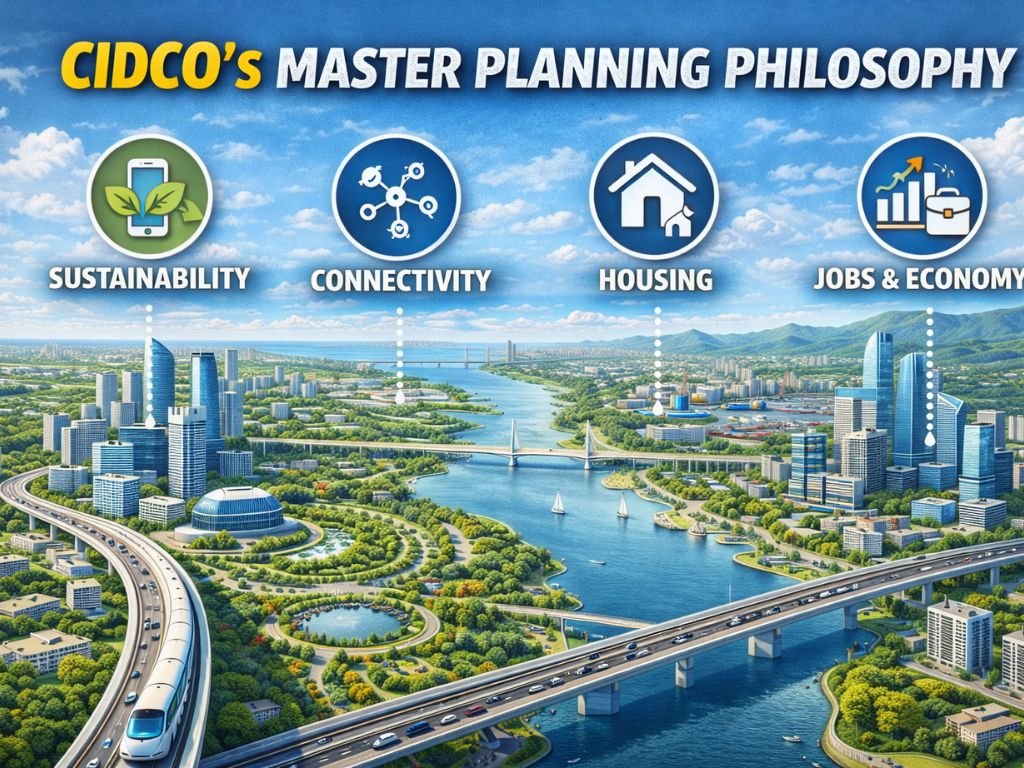
CIDCO’s Master Planning Philosophy
How CIDCO-Led Cities Differ From Organic Growth
| Feature | Metro Line 8 | MTHL |
|---|---|---|
| Travel Time | Predictable, fixed | Fast during non-peak hours, variable in peak traffic |
| Best For | Daily commuters, airport staff | Business travelers, occasional flyers |
| Reliability | High | Variable |
| Frequency | Regular intervals | Depends on vehicle availability |
| Cost | Low (fare-based) | High (toll + fuel) |
Metro Line 8 may not always be the fastest, but it guarantees on-time arrival. MTHL can be quicker, but only when traffic conditions allow.
Cost Comparison for Different Users
Metro Line 8 is designed for daily affordability. Commuters benefit from low travel costs without worrying about fuel charges, tolls, or vehicle maintenance. It is ideal for airport employees or residents traveling regularly to work. On the other hand, MTHL involves tolls, fuel expenses, and vehicle wear and tear, which makes it suitable for occasional flyers or business travelers who prioritize speed and comfort. For daily use, however, MTHL can become quite expensive.
Which Option Is Better for Whom?
Daily commuters and airport staff benefit more from Metro Line 8 because of its low cost, reliability, and predictable travel schedule. Business travelers or occasional flyers generally prefer MTHL for speed and flexibility. Logistics and cargo operators depend heavily on MTHL due to its suitability for rapid, high-volume transport.
Side-by-Side Snapshot
| Feature | Metro Line 8 | MTHL (Atal Setu) |
|---|---|---|
| Cost | Budget-friendly | High (Toll + Fuel) |
| Speed | Consistent / Fixed | Fast (Traffic dependent) |
| Reliability | High | Variable |
| Best For | Employees & Students | Tourists & Business Travelers |
Conclusion
Both Metro Line 8 and MTHL address different layers of airport connectivity. Metro Line 8 focuses on mass movement and daily predictability, while MTHL provides speed, flexibility, and regional integration. Together, they make NMIA accessible from multiple directions for different types of users.
Pro-Tip: If you’re traveling with heavy luggage, MTHL is the more convenient choice. If you’re commuting daily or alone, Metro Line 8 is the best option for cost and reliability.
FAQ's
Frequently Asked Questions