
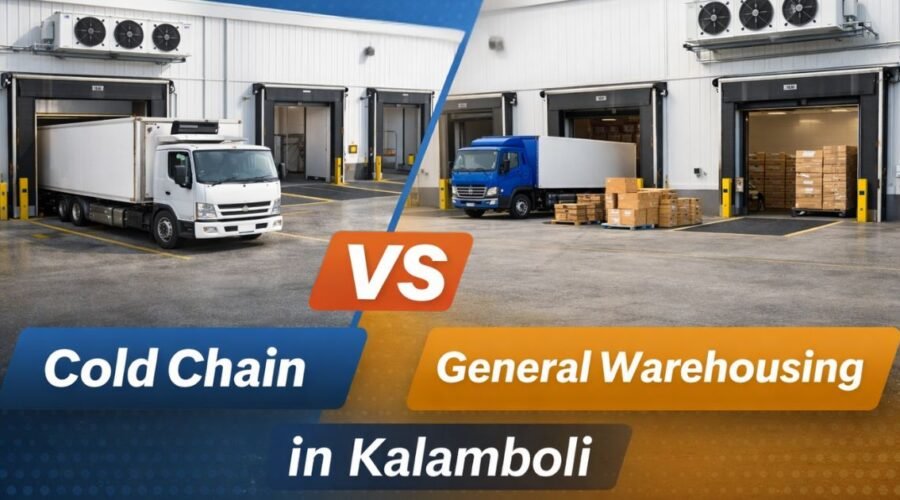
Cold Chain vs General Warehousing in Kalamboli
General warehousing usually makes more sense for most occupiers and investors in Kalamboli because it is cheaper, simpler, easier to lease, and more flexible across cargo types. Cold chain works only when the product, client contract, or compliance requirement genuinely demands temperature control. That is the practical answer. In Kalamboli, both formats can work, but not every plot, shed, or operator is suitable for cold storage.
Kalamboli is not a place where cold chain automatically becomes the better option just because rents look higher. This is a logistics-led market where highway access, JNPA linkage, truck movement, power reliability, and building quality matter more than buzzwords. For most dry cargo businesses, a standard warehouse is still the smarter format. For frozen food, dairy, pharma, export seafood, or other temperature-sensitive supply chains, the answer changes fast.
Quick summary
| Factor | General Warehousing in Kalamboli | Cold Chain in Kalamboli |
|---|---|---|
| Best fit | FMCG, e-commerce staging, auto parts, hardware, paper, steel-linked stock, mixed cargo | Dairy, frozen foods, seafood exports, pharma, biologics, floriculture, processed foods |
| Setup cost | Usually around ₹900 to ₹1,800 per sq. ft. | Usually around ₹4,500 to ₹8,500 per sq. ft., and more for deeper freeze formats |
| Typical rent | Often around ₹20 to ₹32 per sq. ft. depending on quality and access | Often around ₹40 to ₹50+ per sq. ft., depending on temperature zones and systems |
| OPEX profile | Lower and easier to manage | Much higher due to continuous refrigeration and backup requirements |
| Power dependence | Important, but manageable | Critical; power failure can destroy inventory |
| Tenant pool | Broad | Narrow and specialized |
| Reuse / reletting | Easy | Difficult if built too specifically |
| Best for investors | Safer, more liquid, easier exit | Better only with a strong tenant story or built-to-suit case |
So the real question is not “Which is better?” The real question is: Does your cargo truly need cold chain, and can the property support it properly?
Which businesses in Kalamboli usually need cold chain and which do not?
The answer depends more on the cargo than on the building. Many businesses say they need “better storage,” but that does not automatically mean cold chain.
Business types that genuinely need temperature-controlled warehousing
Cold chain usually becomes necessary when product damage, compliance failure, or shelf-life loss can create serious financial damage.
This usually applies to:
- dairy distribution needing chilled zones
- frozen food and processed meat
- export-grade seafood
- certain pharma and biologics
- vaccines and sensitive healthcare products
- floriculture and highly time-sensitive perishables
- some specialty chemicals or ingredients where temperature stability matters
In these cases, temperature is not a comfort feature. It is part of the product itself. One power failure, one badly sealed dock, or one long loading delay can ruin stock worth lakhs.
Kalamboli becomes relevant here because it sits in a freight-sensitive belt. JNPA access matters for export cargo. The upcoming Navi Mumbai International Airport can matter for high-value, time-sensitive movement. But this location advantage helps only when the warehouse itself is technically right.
Business types that are better off in general warehousing
A large share of occupiers in Kalamboli are still better served by normal dry warehousing.
That usually includes:
- auto components
- hardware and industrial supplies
- paper and packaging
- steel and allied trading stock
- consumer durables
- electronics that do not require controlled-temperature storage
- e-commerce staging inventory
- mixed trading and distribution cargo
- spare parts and machinery-related stock
These businesses usually care more about clear height, loading efficiency, truck turnaround, floor capacity, and access to highways than about refrigeration.
Business-fit comparison
| Business type | Better fit in Kalamboli | Why |
|---|---|---|
| E-commerce staging | General warehousing | Needs throughput, flexibility, and easy movement |
| Automotive parts | General warehousing | Dry storage is sufficient; easy rack and dispatch use |
| Steel / hardware trading | General warehousing | Heavy-load practicality matters more than temperature |
| FMCG ambient stock | General warehousing | Broad distribution logic, no strict thermal need |
| Frozen foods | Cold chain | Product loss risk is too high without temperature control |
| Dairy | Cold chain | Chilled handling is operationally necessary |
| Seafood exports | Cold chain | Export quality and spoilage risk require cold chain |
| Pharma / biologics | Cold chain in the right cases | Compliance and temperature logging can be non-negotiable |
One important point here: an air-conditioned warehouse is not the same as a true cold chain facility. Real cold storage means controlled zones, temperature integrity, dock discipline, insulation, and uninterrupted monitoring.
Why general warehousing usually works for more occupiers in Kalamboli
General warehousing is usually the stronger default because it matches the broadest set of real occupier needs in this belt.
Lower cost and faster operational setup
A normal warehouse is far cheaper to build, fit out, and start using. Current market benchmarks suggest general warehousing may often be built in the range of roughly ₹900 to ₹1,800 per sq. ft., depending on clear height, steel quality, loading design, and specification level.
That matters in Kalamboli because land and logistics-linked asset values have already been rising. When the land itself is becoming expensive, most investors and occupiers want the format that reaches operational stability faster.
A dry shed also has a lower break-even threshold. It does not need heavy refrigeration machinery, insulated chambers, advanced dock shelters, or continuous backup planning in the same way.
Wider tenant demand and easier reuse
This is one of the biggest reasons general warehousing remains safer.
If one dry warehouse tenant leaves, another can often move in with limited changes. A unit used by an electronics distributor can be adapted for packaging stock, auto parts, FMCG, or industrial supplies without major reconstruction.
That flexibility matters in any market, but especially in a belt like Kalamboli where a lot of demand is movement-led rather than highly specialized.
Better fit for mixed cargo, trading, staging and distribution
Kalamboli has long had trading and transport-oriented logistics DNA. The area’s traditional warehousing and industrial activity, including steel-linked movement and general goods flow, naturally favors unspecialized storage.
For many occupiers, the priority is:
- truck access
- dispatch speed
- cross-docking
- loading area efficiency
- floor-load practicality
- easy expansion or exit
General warehousing handles these needs well without the operating burden of refrigeration.
When cold chain becomes worth the extra cost in Kalamboli
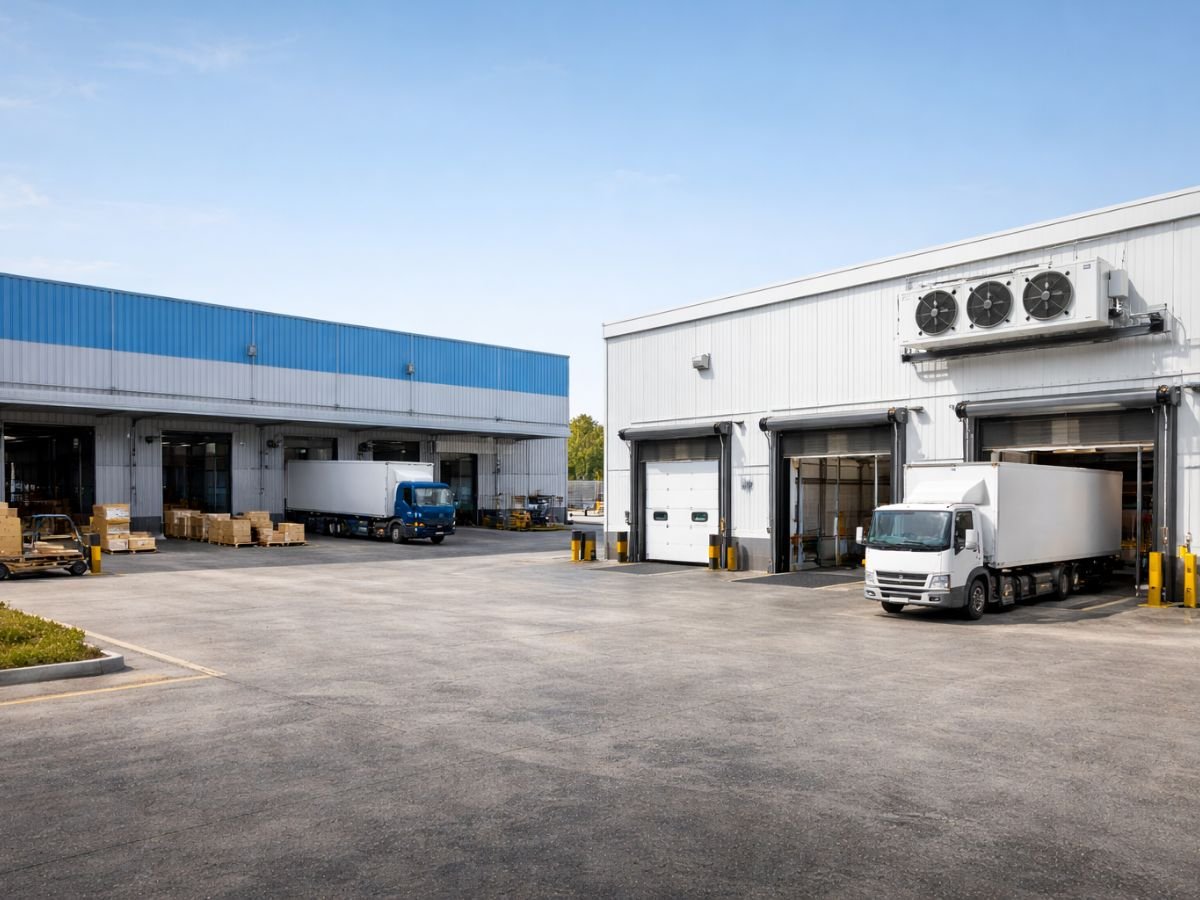
Cold chain becomes worth it only when the cost of not having it is even higher.
Product spoilage risk and shelf-life sensitivity
If your cargo can degrade, expire, or get rejected because of temperature variation, cold chain stops being optional.
That is the clearest case. A frozen food operator or seafood exporter cannot treat refrigeration as a premium extra. It is the base condition of doing business.
In that situation, paying a much higher setup cost can still make sense because one serious spoilage event can wipe out months of savings.
Client contracts, compliance, and service-level requirements
Some occupiers need cold chain not because they personally prefer it, but because their clients or regulations leave no choice.
This is especially relevant in pharma and export-linked supply chains. Temperature logs, controlled handling, and documented movement standards can be critical. If a shipment is rejected at the port or by a buyer because the cold chain was broken, the loss is not just inventory loss. It can also damage the business relationship itself.
Stable volume versus irregular demand
Cold chain works best when volume is stable and predictable. That is because its cost structure is heavy.
Industry benchmarks in the dossier suggest cold chain setup costs can start around ₹4,500 per sq. ft. and go much higher depending on temperature level and compliance design. OPEX is also sharply higher, with electricity alone often taking 25% to 30% of total operating costs.
So if the cargo need is irregular, seasonal, or too small, cold chain can quickly become an expensive mistake.
Practical example
A frozen foods operator dispatching daily to retail chains or export channels may justify a Kalamboli cold chain base because spoilage risk, dispatch discipline, and port connectivity all matter.
But a trader handling mostly ambient packaged goods with only occasional chilled cargo may be better off taking a dry warehouse and outsourcing the cold portion through third-party cold logistics. For that business, owning or leasing a full cold facility may simply be overkill.
Does Kalamboli actually support cold chain operations well, or only selective ones?
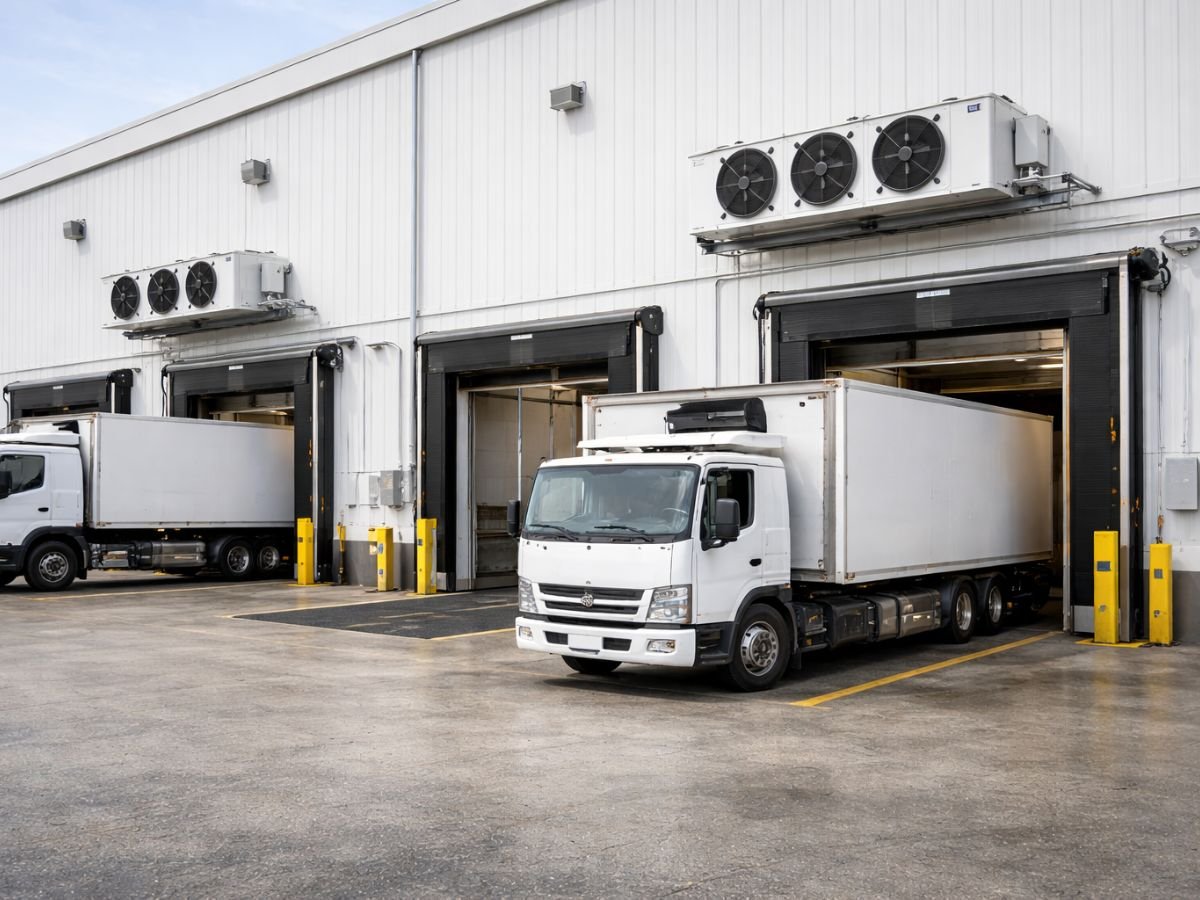
Kalamboli supports cold chain selectively, not universally.
The macro-location is strong. The micro-conditions vary a lot.
Highway and truck movement logic
Kalamboli benefits from major logistics connectivity through the Mumbai-Pune Expressway side, NH routes, and the larger Panvel movement network. The Kalamboli Junction upgrade and the Morbe-Kalamboli link road are important because they improve freight movement and reduce avoidable delays.
This matters even more for reefer transport. Less stoppage and smoother port connectivity can improve delivery timing and reduce operational strain during transit.
Port, Mumbai, Panvel and regional distribution relevance
For JNPA-linked cargo, Kalamboli’s location is practical. For regional distribution across Navi Mumbai, Mumbai entry points, Panvel, and beyond, it also has a strong case.
That is why the node can support both dry and temperature-sensitive warehousing. But the mere fact that it is strategically located does not mean every part of Kalamboli is equally fit for cold chain.
Why building quality and utilities matter more here than location hype
This is where many people get the decision wrong.
Older internal belts, especially where roads are narrow, rough, or movement is less efficient, are not ideal for modern reefer operations. A highway-facing or better-planned peripheral position is far more useful than an interior legacy shed with poor access.
Power is another major divider. A general warehouse can survive moderate utility disruption far better than a cold chain facility. A cold storage operator must think about high-amperage power, backup systems, diesel generator redundancy, and downtime risk from day one.
So yes, Kalamboli supports cold chain. But it supports it best in the right plots, the right buildings, and the right operating setup. Not everywhere.
What changes in the property itself when you move from general warehousing to cold chain?
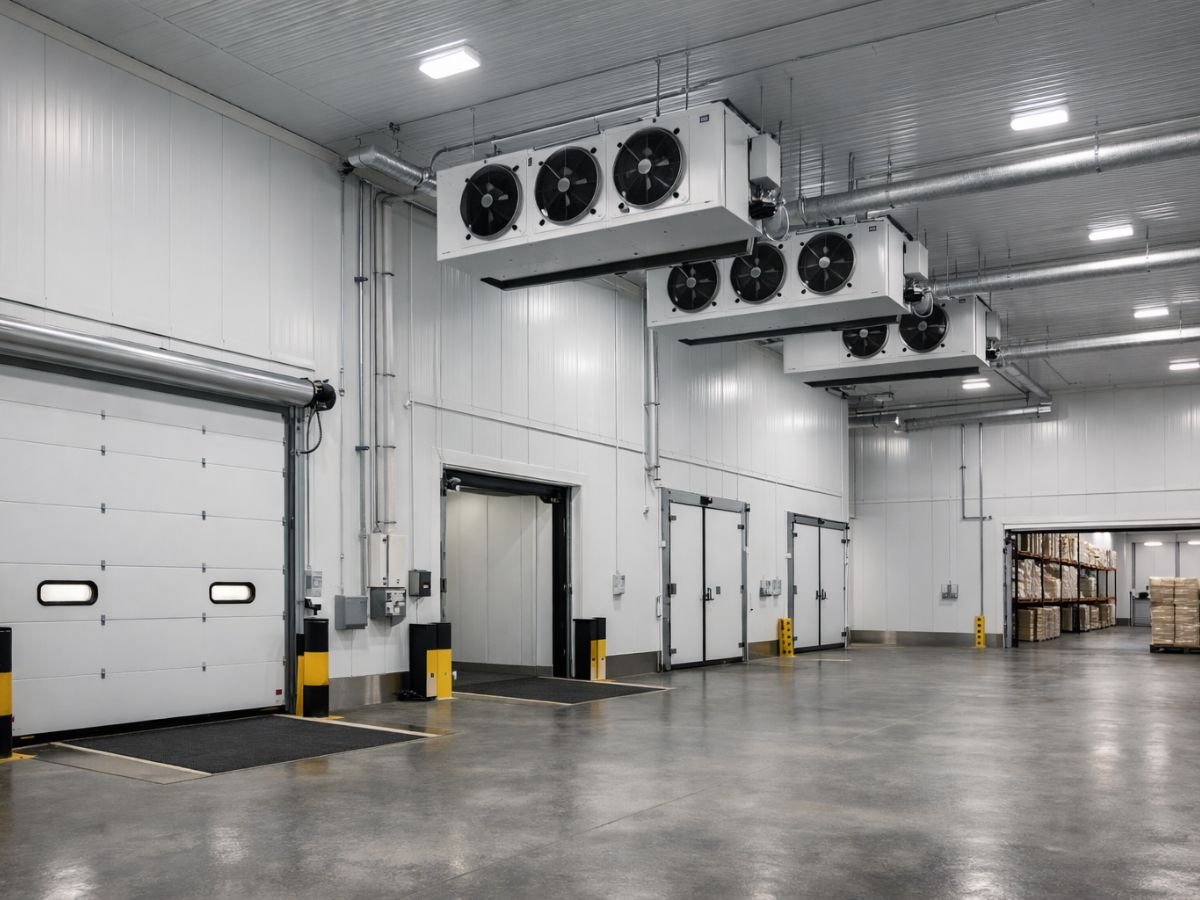
The building changes completely. Cold chain is not just a better warehouse. It is a different kind of asset.
Insulation, flooring, dock planning, and chamber layout
A cold storage facility typically needs:
- insulated PUF panel systems
- strong vapor barriers
- controlled chamber zoning
- sealed dock systems
- loading arrangements that reduce temperature loss
- floor systems designed for freezer environments
This is far beyond ordinary shed construction.
One of the biggest technical issues is frost heave. In deep-freeze environments, the ground below the slab can freeze and expand if the building is not properly designed. That can damage the floor itself. In a place like Navi Mumbai, where humidity and monsoon conditions add extra pressure on sealing performance, poor design gets exposed quickly.
Power load, refrigeration systems, and backup needs
A normal warehouse uses power. A cold chain facility depends on power for survival.
Dual compressors, refrigeration plants, control systems, and backup infrastructure all push up both capex and risk. If power supply is interrupted and backup fails, the problem is not inconvenience. It can become full stock damage.
This is why MSEDCL connection quality, tariff category, and backup planning matter so much more in cold chain than in general warehousing.
Maintenance intensity and downtime risk
Cold chain is a high-maintenance format. Equipment failure is not just a repair issue. It can shut down the business.
This is also why comparing only rent is dangerous. A cold storage unit may earn much more rent than a dry shed, but the maintenance load, technical dependency, and business interruption risk are also much higher.
Is cold chain a better investment than general warehousing in Kalamboli?
Usually, no. Not by default.
Cold chain can be a better investment in the right hands and with the right tenant story. But for most investors, general warehousing is still the safer and more liquid option in Kalamboli.
Higher rent potential versus narrower tenant pool
The attraction is obvious. The dossier indicates cold chain rents can often sit around ₹40 to ₹50+ per sq. ft., compared with roughly ₹20 to ₹32 per sq. ft. for dry warehousing.
That looks attractive. But the higher rent comes with a narrower tenant base. If a specialized cold tenant exits, reletting can take longer and may require more changes than many investors expect.
Capex burden versus long-term yield logic
Cold chain assets can fetch yield premiums in the right market. The dossier notes that the spread may sometimes be around 50 to 100 basis points higher than standard logistics assets.
But the initial capital burden is also much heavier. That changes the real return math.
If an investor is entering Kalamboli mainly for stable rentability, broad demand, and easier exit, general warehousing usually fits better. If the investor already has a long lease discussion with a serious cold chain occupier, the answer can shift.
Exit, reletting, and conversion risk
General warehousing is easier to sell, easier to lease, and easier to reposition.
Cold chain is more like a specialized industrial machine inside a building. If the original tenant’s exact use case disappears, the next tenant may not want the same configuration. Retrofitting a frozen-food setup for another temperature band or reverting to standard warehousing is not always simple.
That is why cold chain looks stronger on paper than it often feels in real asset management.
Should you convert an existing Kalamboli warehouse into a cold chain facility?
In most cases, no. Conversion is usually riskier and more expensive than people first assume.
When conversion can make sense
Conversion can make sense only if all of the following are already true:
- the building has strong clear height and structural capacity
- the power infrastructure can support refrigeration load
- access is suitable for reefer movement
- slab and engineering modifications are feasible
- a confirmed tenant or business case already exists
- the expected lease term or use period is long enough to recover the retrofit cost
Without that combination, conversion becomes weak very quickly.
When conversion usually becomes a costly mistake
This is where many landlords go wrong. They see higher cold storage rents and assume an old shed can be upgraded cheaply.
But retrofitting vapor barriers, insulated panels, docks, suspended loads, refrigeration systems, and specialized floors into a legacy structure is expensive and messy. In older belts around Kalamboli, many sheds were built for steel trading, engineering use, or general storage, not for thermally controlled environments.
A badly done conversion may lead to:
- inefficient cooling
- high power bills
- moisture problems
- ice formation and corrosion
- compressor failures
- floor damage
- fire compliance issues
- tenant dissatisfaction
Caution checklist before considering conversion
Before converting a dry warehouse into cold chain, check these first:
- Is there a real tenant or contract need, not just a rent assumption?
- Can the structure handle suspended refrigeration systems and insulated build-out?
- Can the slab and floor system be redesigned if needed?
- Is reliable high-load power actually available?
- Is full backup planning financially possible?
- Is the location suitable for reefer movement even in monsoon conditions?
- Does the asset still make financial sense after retrofit, downtime, and compliance cost?
If the answer is unclear on multiple points, conversion should usually be avoided.
Which one should tenants, owner-occupiers, and investors choose in Kalamboli?
The right answer changes by stakeholder type.
| Reader type | Usually better choice | Why |
|---|---|---|
| Tenant | General warehousing unless strict cold control is essential | Lower lock-in risk, lower operating burden, easier flexibility |
| Owner-occupier | Cold chain only if it is core to the business | Makes sense only when product and operations truly depend on it |
| Investor | General warehousing in most cases | Broader demand, easier exit, lower capex risk |
| Investor with anchor tenant | Cold chain can work | Built-to-suit logic reduces vacancy and configuration risk |
Best fit for tenants
Tenants should usually stay flexible. If only part of the operation needs temperature control, outsourcing that portion may be smarter than taking on the full complexity of a cold plant.
Best fit for owner-occupiers
Owner-occupiers can justify cold chain when the business cannot function without it. An ice cream distributor, dairy operator, frozen food player, or certain pharma chain may have no real alternative.
But for many businesses, capital is better used in operations, market expansion, or transport systems than in building a technically demanding cold facility.
Best fit for investors
For most investors entering the Kalamboli market, Grade-A general warehousing remains the safer play.
Cold chain usually makes the most sense when the investor already has an anchor tenant, built-to-suit commitment, or very strong confidence in long-term specialized demand.
Common mistakes people make when comparing cold chain and general warehousing in Kalamboli
The biggest mistake is assuming cold chain is simply “premium warehousing.” It is not. It is specialized warehousing with much heavier dependency on engineering, utilities, and process discipline.
Other common mistakes include:
- comparing rent without comparing capex and OPEX
- assuming any shed can be converted
- ignoring backup dependence and diesel exposure
- focusing on location while ignoring power and building readiness
- mixing up air-conditioned storage with real cold chain
- assuming a narrow tenant pool is not a serious investor risk
- treating all Kalamboli pockets as equally suitable
- overlooking local labor and mechanization realities
One local nuance also matters here. The 2025 amendment to the Maharashtra Mathadi law created a more favorable framework for fully mechanized or automated facilities. That can benefit modern, automated operations. But this does not mean every warehouse automatically escapes on-ground labor friction. In practice, mechanization has to be real, not cosmetic.
That is important because older manual setups and newer automated facilities do not operate under the same practical reality.
Conclusion
If you are comparing cold chain vs general warehousing in Kalamboli, the safe practical answer is this: general warehousing fits most businesses, most investors, and most properties better. It is cheaper to build, easier to lease, more reusable, and better matched to the broad demand base that drives this belt.
Cold chain should be chosen only when the cargo, contract, or compliance need makes temperature control non-negotiable. In that case, Kalamboli can work very well, especially for port-linked, regional, and future airport-influenced movement. But the building, power setup, access quality, and operating model must all be right. In this market, cold chain is not a fashionable upgrade. It is a serious infrastructure decision.
FAQs
Frequently Asked Questions