

Commercial Stamp Duty and Registration Costs in Navi Mumbai: Full Buyer Guide
If you are buying a shop, office, showroom, or gala in Navi Mumbai, budget commercial stamp duty at 7% and registration at 1%, with registration effectively capped at ₹30,000 once the value crosses ₹30 lakh. But that is only the statutory layer. Your real cost changes depending on whether the deal is under-construction, ready resale, or a CIDCO-linked leasehold transfer. GST, CIDCO transfer premium, mutation fee, society transfer, legal fees, parking, and maintenance are separate buckets.
This is why many commercial buyers in Navi Mumbai get trapped. They see a base price, calculate one rough percentage, and assume the rest is minor. It is not. In this market, the smartest way to think is in three layers: statutory charges, valuation basis, and separate transaction-side costs.
For a normal commercial purchase in Navi Mumbai, the baseline is simple: 7% stamp duty plus registration charges. Registration is charged on an ad valorem basis, but the fee table caps it at ₹30,000 once the value goes above ₹30 lakh. That means on larger commercial deals, the real statutory hit is usually best understood as roughly 7% + ₹30,000, before you add anything else.
Quick summary

| Cost bucket | Usually part of stamp duty/registration? | What buyers should assume |
|---|---|---|
| Stamp duty | Yes | Core state-level statutory cost |
| Registration fee | Yes | Separate from stamp duty, but still statutory |
| GST on under-construction commercial property | No | Separate tax layer |
| CIDCO transfer premium / NOC-linked transfer cost | No | Separate authority-side cost |
| NMMC mutation / transfer fee | No | Post-registration local civic cost |
| Society transfer premium | No | Separate society-level cost |
| Brokerage, legal fees, parking, fit-out, deposits | No | Separate transaction cost |
What is included in stamp duty and registration, and what is not?
This is the first place where confusion starts. Stamp duty and registration are paid to legalise the document and validate the transfer under the state registration-and-stamps system. They are not a master charge covering everything connected to the deal.
So what is included? Only the stamp duty payable on the instrument and the registration fee for registering that instrument. That is the statutory side.
What is not included? A lot:
- GST on eligible under-construction deals
- CIDCO transfer premium or authority-side transfer approval costs
- municipal mutation costs
- society transfer premium
- brokerage
- lawyer’s due diligence fee
- separately billed parking, PLC, deposits, maintenance advances, or fit-out-linked charges
This distinction matters a lot in Navi Mumbai because many commercial transactions are not plain freehold sales. They may involve CIDCO leasehold rights, transfer permissions, society paperwork, and local body follow-up after registration. A buyer who hears “7% plus registration” and stops there is often budgeting only the first layer, not the full acquisition cost.
Is commercial stamp duty calculated on deal value or government value?

Commercial stamp duty is not simply based on whatever price you negotiated. In Maharashtra, the valuation system runs through the Annual Statement of Rates (ASR), also called the Ready Reckoner, and these rates are used for assessing true market value for stamp-duty purposes. In practice, buyers should budget on the higher of the agreement value and the government valuation benchmark.
That becomes very important in commercial property because commercial ASR logic can differ sharply by use, floor, frontage, and micro-location. A ground-floor shop in a strong retail belt like Vashi Sector 17 or near a station-facing market pocket can sit on a very different valuation logic from an internal upper-floor office in a slower building. The city is not one flat pricing sheet. Even within the same node, the government benchmark can vary materially.
So if a broker tells you, “You got a distress deal, so your duty will also be lower,” do not accept that blindly. If the official benchmark is higher, the software-driven valuation framework may still pull the duty upward. This is one of the most common reasons buyers feel shocked just before execution.
How do costs differ for builder sale, resale, and CIDCO-linked transfer cases?
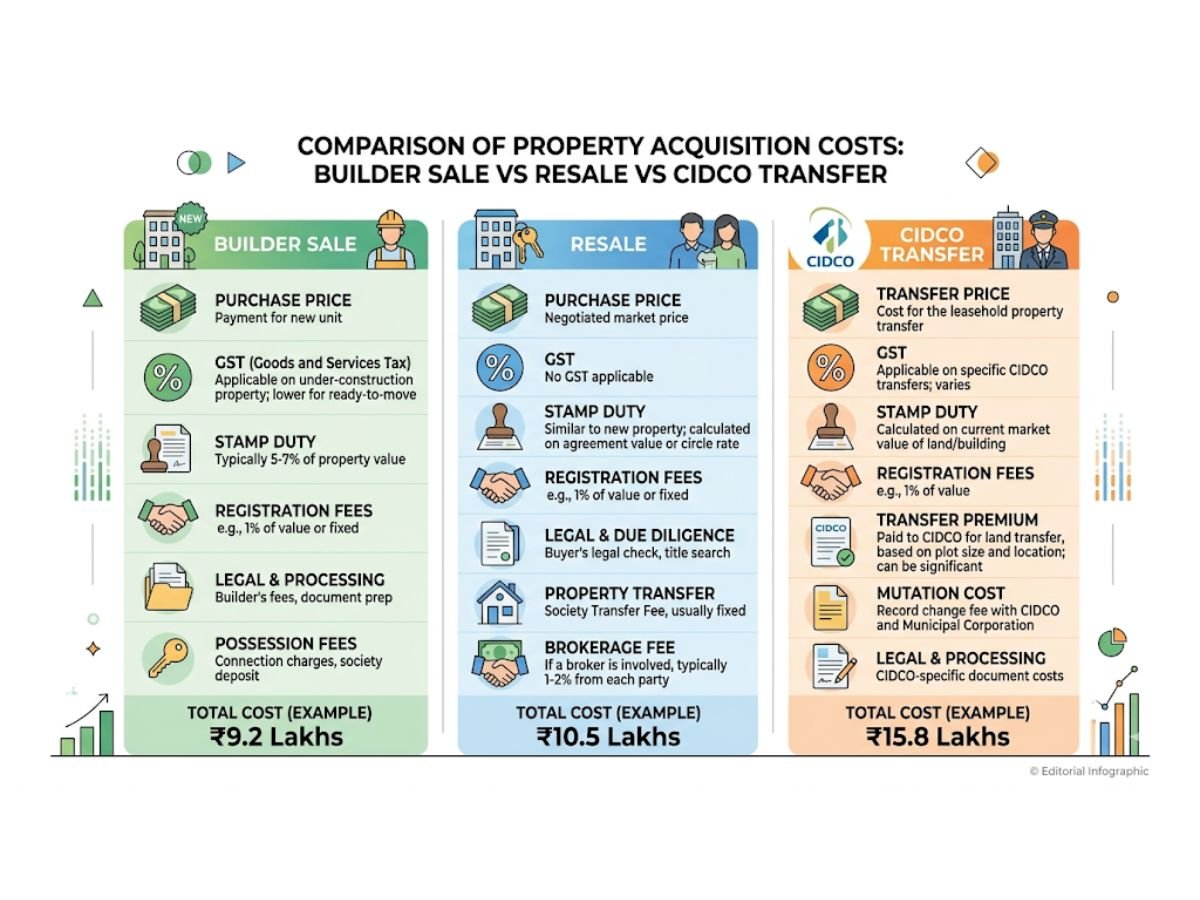
This is the most important practical section in the whole article. In Navi Mumbai commercial property, deal type changes cost structure more than most buyers realise.
New commercial unit from builder
If the commercial unit is under construction, GST becomes the big extra cost. For many standard commercial builder-sale cases, buyers budget 12% GST on the under-construction sale. But there is an important nuance here: the GST Council’s real-estate FAQ shows that commercial apartments inside an RREP can fall under a different 5% structure, while commercial apartments in a non-RREP / old-rate context can be 12% with ITC. So do not assume one universal GST number without checking the project classification.
The practical buyer takeaway is simple: if you are buying a typical standalone commercial office or shop from a builder before OC/CC, GST can materially raise your upfront outflow, even if CIDCO transfer exposure is not immediately hitting you in the same way as a secondary-market leasehold transfer.
Ready or resale commercial property
If the property is ready and the deal is being done after OC / completion, GST usually falls away from the property sale itself. That is why many resale buyers feel more comfortable with ready commercial units. The headline tax looks lighter.
But this is exactly where Navi Mumbai-specific reality kicks in. A resale deal can still carry CIDCO transfer premium, society transfer costs, mutation costs, legal rectification work, and other local compliance costs. So “no GST” does not automatically mean “cheap transaction.”
CIDCO leasehold / transfer / assignment style cases
This is the local differentiator that generic pages usually miss.
Large parts of Navi Mumbai still sit in a CIDCO-shaped ownership and transfer environment, and when a resale commercial property is tied to leasehold transfer logic, the buyer may need to factor in a CIDCO transfer premium. After CIDCO’s April 2025 revision, reported commercial transfer charges in some categories became very steep, with figures going up to ₹5,84,600 per sq m for certain commercial properties over 200 sq m.
That does not mean every resale commercial unit will attract that exact number. It does mean this: you should never treat CIDCO transfer charges as a small clerical fee. They can materially change whether a resale deal is actually attractive. Always ask for the latest official calculation applicable to the exact unit, area, node, and transfer category.
There is one more critical local check now. Buyers should ask whether the property has already been converted under CIDCO’s freehold conversion policy. If it has, future transfer-cost exposure may change significantly compared with a standard leasehold transfer case. Do not assume freehold. Ask for proof.
Does the location within Navi Mumbai change the answer?
The short answer is: the statutory rate does not change the way many buyers think it does, but the practical outflow still changes by location and authority framework.
Across Navi Mumbai’s main belts, the core commercial stamp-duty logic remains the same. Whether the unit is in Vashi, Nerul, Belapur, Kharghar, Kamothe, Kalamboli, Ulwe, or Panvel-side growth belts, your main questions are still: 1. what document is being registered, 2. what value base applies, 3. whether the deal triggers GST, 4. whether there is a CIDCO-linked transfer burden, 5. and which local body will handle mutation after registration.
Where location matters is in the ASR benchmark and authority-side follow-up. NMMC and Panvel-side areas do not necessarily create a different stamp-duty percentage for this query, but their market values, civic records, and post-registration handling can still change your total cost and paperwork trail. NMMC, for example, revised its property transfer policy and applies a 0.20% transfer/mutation fee on the consideration value or Ready Reckoner value, whichever is higher.
So no, you do not need a different stamp-duty formula for every node. But yes, you absolutely need the exact sector-level valuation and title/authority context for the property you are buying.
Which extra commercial-property charges are most often confused with stamp duty?

The biggest confusion is not between two taxes. It is between taxes and everything else.
The first major confusion is GST. Buyers often hear that ready property has no GST and assume the whole deal is “GST-free.” That is too simplistic. The property sale may be GST-exempt after completion, but separately billed construction-stage or service-linked components can still have their own GST treatment. That is why the cost sheet has to be read line by line, not only headline by headline.
The second confusion is CIDCO transfer premium. In Navi Mumbai, many people casually speak about “government charges” as if stamp duty, registration, and CIDCO transfer are all one bucket. They are not. Stamp duty goes through the registration-and-stamps system. CIDCO transfer cost, where applicable, is a planning-authority-side burden linked to transfer of rights in a leasehold environment. Treating them as the same thing is one of the costliest mistakes in this market.
The third confusion is post-registration and society-level cost. A cooperative society’s transfer premium in Maharashtra cannot be pushed endlessly; public legal guidance and reporting consistently point to a ₹25,000 cap in the normal framework. NMMC mutation cost is again separate. So when a broker says, “Just pay stamp duty and registration, the rest is routine,” that sentence needs to be unpacked immediately.
What should a buyer check before paying token money on a commercial deal?
Before you pay token money, do four checks.
First, ask for the full cost sheet. Not a verbal estimate. Not a WhatsApp total. Ask for a line-by-line sheet showing base value, stamp duty, registration, GST if any, CIDCO transfer if any, society transfer, mutation, parking, maintenance deposit, legal fee, and brokerage.
Second, verify the project stage. If it is under construction, GST may apply. If it is claimed to be ready and GST-free, ask for the OC / CC proof.
Third, confirm title framework. Is this freehold, leasehold, society-held, or CIDCO-linked? In Navi Mumbai, this one answer changes the cost map more than many first-time buyers realise.
Fourth, run an ASR check on the official e-ASR system. Do not budget only on the negotiated number if the government valuation may sit higher.
If even one of these four checks is vague, your budget is still incomplete.
A simple way to estimate total acquisition cost before you commit

The easiest way to think about total cost is this:
Base deal value + stamp duty + registration + GST if applicable + CIDCO / authority transfer cost if applicable + mutation / society / legal / brokerage / separately billed extras
That formula is far more useful than asking, “What is the stamp duty percentage?” because buyers do not lose deals over stamp duty alone. They lose deals when the second and third cost layers appear late.
Worked comparison: two ₹1 crore-style commercial scenarios
| Scenario | Under-construction office from builder | Ready resale shop in leasehold-style transfer environment |
|---|---|---|
| Agreement value used here | ₹1,00,00,000 | ₹1,00,00,000 |
| Stamp duty | ₹7,00,000 | ₹7,00,000 |
| Registration | ₹30,000 | ₹30,000 |
| GST on property sale | Often budgeted at 12% in standard commercial builder-sale cases, but project classification must be checked | Nil on completed / ready resale sale of property |
| CIDCO transfer premium | Often not the immediate buyer-side issue in the same way as resale transfer | May apply and can materially change total outflow |
| NMMC mutation / society transfer / legal extras | Still possible separately | Commonly relevant separately |
The most common budgeting mistakes commercial buyers make in Navi Mumbai
The first mistake is using residential rules for commercial property. This happens all the time with the women’s concession. Maharashtra’s 1% stamp-duty reduction is specifically tied to certain residential documents. It does not extend to commercial purchases just because the buyer is female or the company is trying to structure the asset that way. For commercial property, budget the full commercial rate.
The second mistake is calculating duty only on the negotiated price and ignoring ASR. The third is assuming resale means “no extra taxes.” The fourth is treating CIDCO transfer burden like a routine stamp-paper expense. The fifth is paying token before getting a real cost sheet. None of these mistakes are rare. In Navi Mumbai commercial property, they are normal enough to be dangerous.
Conclusion
For most buyers, the right way to budget commercial stamp duty and registration costs in Navi Mumbai is not to ask only, “What percentage will I pay?” The right question is: What is my full acquisition cost after valuation rules, GST status, CIDCO transfer exposure, and local post-registration charges?
That is the real difference between a smooth commercial purchase and a last-minute budget shock.
So keep this framework simple:
- Statutory baseline: 7% stamp duty + registration cap logic
- Valuation check: higher-value risk through ASR
- Deal-type filter: under-construction, ready resale, or CIDCO-linked transfer
- Local reality: mutation, society, legal, and authority-side charges are separate
If you do those checks before token payment, you will already be ahead of most commercial buyers in Navi Mumbai.
FAQs
Frequently Asked Questions