Deemed Conveyance in Navi Mumbai: Eligibility, Documents & Process
Many housing societies in Navi Mumbai manage their buildings but do not legally own the land beneath them. This usually happens when the builder fails to transfer ownership to the society even after the building is complete.
Deemed conveyance is a legal solution for this problem.
It allows a housing society to obtain ownership of the land and building through the competent authority even if the builder refuses or delays the transfer. This process exists under the Maharashtra Ownership Flats Act (MOFA) and is handled by the competent authority appointed by the state government, usually an officer from the Cooperative Societies department.
For many societies in Navi Mumbai, getting deemed conveyance is not just a legal formality. It is the key to redevelopment, legal ownership, and financial security.
Quick Summary: What Deemed Conveyance Means for a Housing Society
| Aspect | Explanation |
|---|---|
| Meaning | Legal transfer of land and building ownership to a housing society when the builder fails to execute the conveyance deed |
| Applicable Law | Maharashtra Ownership Flats Act (MOFA) |
| Authority | Competent Authority appointed by the state government, usually from the Cooperative Societies department |
| Who Applies | Cooperative housing society or association of apartment owners |
| Why It Matters | Gives the society legal ownership of the land and building |
| When Used | When the builder refuses or delays conveyance |
What Is Deemed Conveyance and Why Housing Societies Need It

In a normal situation, once a building is completed and the housing society is formed, the builder must transfer the ownership of the land and structure to that society.
This transfer is done through a legal document called a conveyance deed.
But in many cases across Navi Mumbai, builders do not complete this step. Sometimes they delay it because they want to keep control over future development rights such as unused FSI or additional phases of construction.
That is where deemed conveyance comes in.
It allows the government authority to step in and legally transfer the ownership to the society even without the builder’s cooperation.
What “Conveyance” Means in a Housing Society
A conveyance deed is the legal document that transfers the ownership of land and the building from the developer to the housing society.
Once conveyance happens:
- The society becomes the legal owner of the land
- Property records are updated in the society’s name
- The society can take decisions about redevelopment
Without conveyance, the builder technically remains the owner on paper.
What Happens When the Builder Does Not Transfer the Land

When conveyance is not executed:
- The society manages the building but does not own the land
- The builder may still control development rights
- Redevelopment becomes legally difficult
- Property ownership records remain incomplete
In such cases, societies apply for deemed conveyance through the competent authority.
Who Can Apply for Deemed Conveyance in Navi MAumbai

In most cases, the applicant is a registered cooperative housing society.
This applies to many residential buildings across Navi Mumbai nodes such as Vashi, Nerul, Belapur, Kharghar, Kamothe, Ulwe, and Kalamboli.
Eligibility Conditions for a Housing Society
A society can apply for deemed conveyance if the following conditions are met:
- The housing society is legally registered
- The builder has not executed the conveyance deed
- At least four months have passed since the society’s registration
- A general body resolution is passed by the society to apply for deemed conveyance
These rules exist under MOFA, which requires the builder to transfer the property within a specific time period after the society is formed.
Who Can Apply for Deemed Conveyance in Navi MAumbai

Common situations include:
- Builder disappears or shuts down the company
- Builder delays conveyance to retain development rights
- Builder demands extra money for transferring ownership
- Society wants to start redevelopment but ownership is not transferred
Many older societies in Vashi, Nerul, and Belapur face this issue today because their buildings are over 25 to 30 years old.
Documents Required for Deemed Conveyance Application
The application requires several legal and property documents. These help the authority verify the ownership chain, construction approvals, and sale agreements.
Documents Needed for Deemed Conveyance
| Document | Purpose |
|---|---|
| Society Registration Certificate | Proves the legal existence of the housing society |
| List of Society Members | Shows who owns the flats |
| General Body Resolution | Confirms society approval for applying |
| Sale Agreements of Members | Shows flats were legally sold |
| Index II Documents | Confirms registration of sale agreements |
| Approved Building Plans | Confirms the building was approved |
| Commencement Certificate | Shows construction permission |
| Completion Certificate or Occupation Certificate | Confirms building completion |
| Property Card or 7/12 Extract | Shows land ownership records |
| Development Agreement | Shows relationship between builder and landowner |
In Navi Mumbai, societies may also need documents related to CIDCO land allotment or lease agreements, because many plots are leasehold rather than freehold.
Step-by-Step Process to Get Deemed Conveyance in Maharashtra
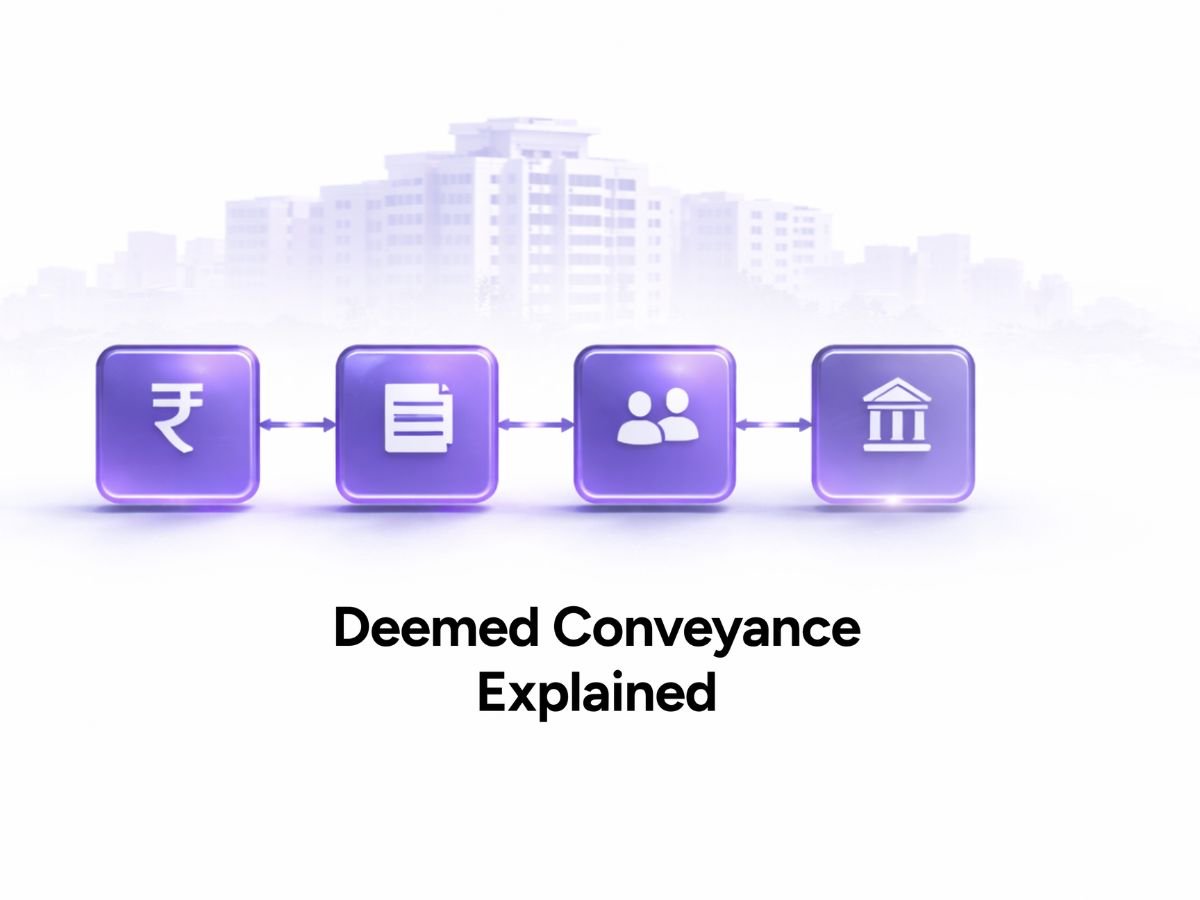
The process is structured but usually takes time because it involves legal verification and hearings.
Step 1 – Society Passes a Resolution
The housing society holds a general body meeting and passes a resolution to apply for deemed conveyance.
The society also appoints an authorized representative such as the secretary or chairman.
Step 2 – Application to the Competent Authority
The society files an application with the competent authority.
This is usually done through the prescribed form along with the required documents and fees.
Step 3 – Notice Issued to the Builder and Landowner
The authority issues notices to the builder and the original landowner.
They are asked to appear for a hearing and respond to the society’s application.
Step 4 – Hearing and Document Verification
The authority reviews:
- land documents
- sale agreements
- building approvals
- society records
If the builder does not appear or cannot justify the delay, the authority proceeds with the case.
Step 5 – Order for Deemed Conveyance
If the authority is satisfied with the documents, it issues an order granting deemed conveyance.
The conveyance deed is then registered with the Sub Registrar even without the builder’s signature.
How Long the Deemed Conveyance Process Usually Takes

The timeline depends on document clarity and builder cooperation.
| Stage | Typical Time |
|---|---|
| Document collection | 1 to 3 months |
| Application and scrutiny | 1 month |
| Hearings | 3 to 6 months |
| Final order and registration | 1 to 2 months |
In practice, the entire process may take 6 months to 1 year.
Delays usually happen because of missing documents or builder objections.
Benefits of Deemed Conveyance for Housing Societies
Once the society gets deemed conveyance, several major advantages follow.
Key Benefits
- Legal ownership of land transferred to society
- Property records updated in society’s name
- Better position to start redevelopment
- Protection from builder disputes
- Easier access to bank loans for redevelopment
For older buildings in Navi Mumbai, deemed conveyance is often the first major step before redevelopment discussions begin.
Common Challenges Societies Face During Deemed Conveyance

Even though the process exists, societies often face practical difficulties.
Missing Land Documents
Builders sometimes do not provide original land documents.
Societies then need to obtain certified copies from government departments.
Builder Objections
Builders may argue about unused development rights or pending project phases.
Even then, a builder cannot keep delaying conveyance forever just because of these issues.
Incomplete Property Records
Old buildings may lack proper approvals or completion certificates.
In such cases, societies may need legal help to sort out documents.
Member Coordination
Collecting documents from every flat owner can take time.
Many societies delay the process simply because records are scattered.
Why Deemed Conveyance Is Important for Redevelopment

Many buildings in Navi Mumbai are now over 25 to 30 years old.
Redevelopment becomes necessary for structural safety and modern amenities.
In most cases, redevelopment becomes very difficult without a conveyance deed or clear land ownership.
Developers usually prefer to deal with societies that legally own their land.
Deemed conveyance solves this problem by transferring ownership to the society.
Final Verdict
Deemed conveyance is one of the most important legal tools available to housing societies in Navi Mumbai.
Without it, a society may manage the building but still lack ownership of the land. That creates legal risks, blocks redevelopment opportunities, and keeps the builder in control of the property.
The process may take time and documentation effort, but once completed, it gives the society clear legal ownership and long-term control over its property.
For many Navi Mumbai societies today, especially older ones in Vashi, Nerul, and Belapur, starting the deemed conveyance process is not just paperwork.
It is the step that finally gives residents ownership of the land they have lived on for decades.
FAQs
Frequently Asked Questions