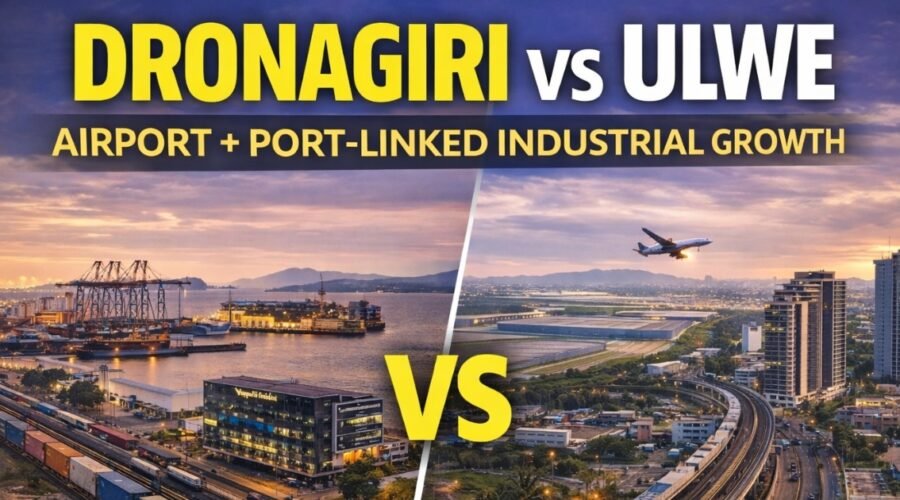
Dronagiri vs Ulwe for Airport and Port-Linked Industrial Growth
Dronagiri usually makes more practical sense for port-linked industrial growth, logistics-led investment, and export-import chain logic. Ulwe usually makes more sense for airport-led visibility, urban-commercial spillover, and long-term land appreciation narratives. That is the clean answer. The confusion starts when buyers treat both as the same “future growth belt” simply because both sit in the southern Navi Mumbai side. CIDCO’s own planning framework places Ulwe and Dronagiri as separate southern nodes, while the hard infrastructure story around them is different: JNPA is already a functioning container and trade ecosystem, whereas NMIA is a major airport-led growth catalyst that changes land perception, mobility, and future demand patterns in a different way.
Dronagiri vs Ulwe at a glance
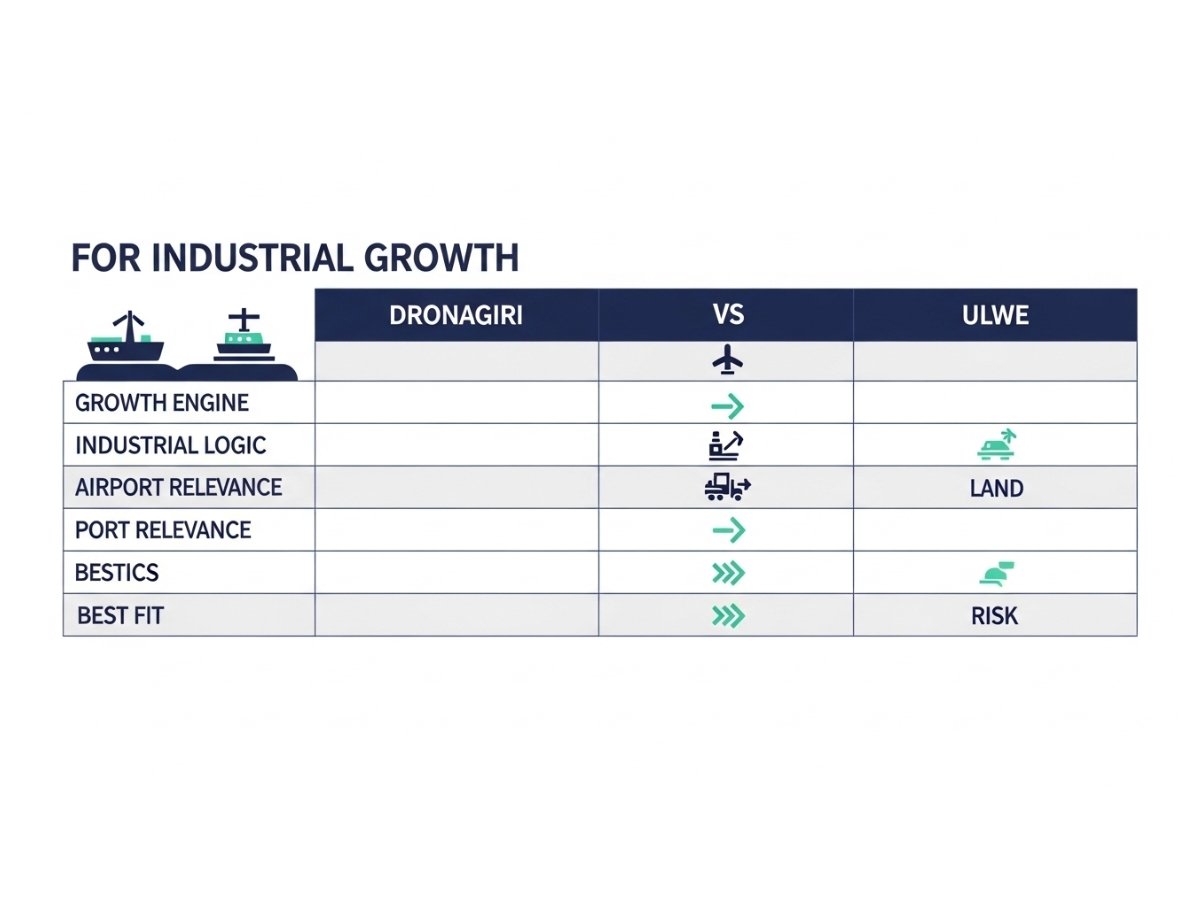
Before going deeper, this is the comparison most buyers actually need.
| Factor | Dronagiri | Ulwe | Practical reading |
|---|---|---|---|
| Core growth engine | Port ecosystem, logistics chain, freight relevance | Airport adjacency, urban growth, commercial spillover | These are not the same thesis |
| Industrial logic today | Stronger | Selective and weaker | Dronagiri is usually ahead for industrial-use reasoning |
| Airport relevance | Indirect but meaningful through broader regional connectivity | Direct and identity-defining | Ulwe gains more from NMIA visibility |
| Port relevance | Much stronger | Limited compared with Dronagiri | Port-led investors usually lean Dronagiri |
| Best fit | EXIM, logistics, industrial-chain, long-horizon port thesis | Land holders, airport-growth believers, future mixed-use/commercial thesis | Use case decides the answer |
| Main risk | Buying weak land just because the macro story is strong | Paying industrial prices for a mostly narrative-led land story | In both nodes, ground reality beats map theory |
This comparison is grounded in the official regional infrastructure picture: JNPA remains India’s largest container port among major ports and continues to handle very large container volumes, while NMIA is being positioned as a major greenfield airport in a multi-airport metro system with substantial passenger and cargo planning.
Why Dronagiri and Ulwe should not be treated as the same growth story
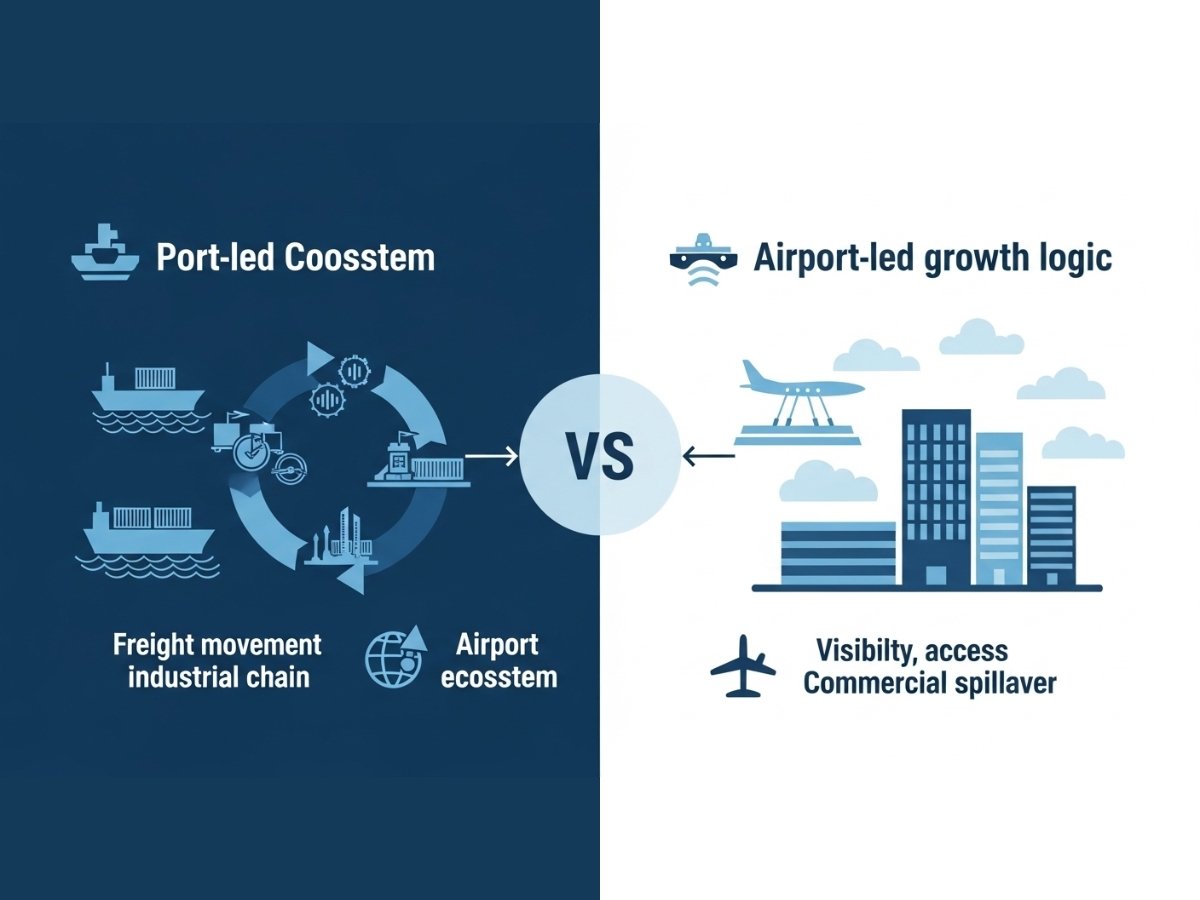
They may look close on a map, but they are not driven by the same market force.
Dronagiri’s case is tied more directly to movement of goods. Ulwe’s case is tied more directly to movement of people, capital, and urban demand. That single distinction changes almost everything: pricing logic, absorption pattern, buyer profile, exit route, and the gap between expectation and reality. A port ecosystem creates value when cargo, terminals, warehousing, customs-linked movement, and industrial support activity reinforce each other. An airport ecosystem creates value faster in access, hospitality, services, offices, retail, and premium urban perception, while industrial benefit can come later and more selectively.
CIDCO’s own development framework also matters here. Official planning material places both Ulwe and Dronagiri among the southern Navi Mumbai nodes, but that does not mean the two nodes carry identical land-use logic or identical investment timing. Buyers often miss that difference and pay for a headline instead of a thesis.
Which node has the stronger direct industrial logic today?
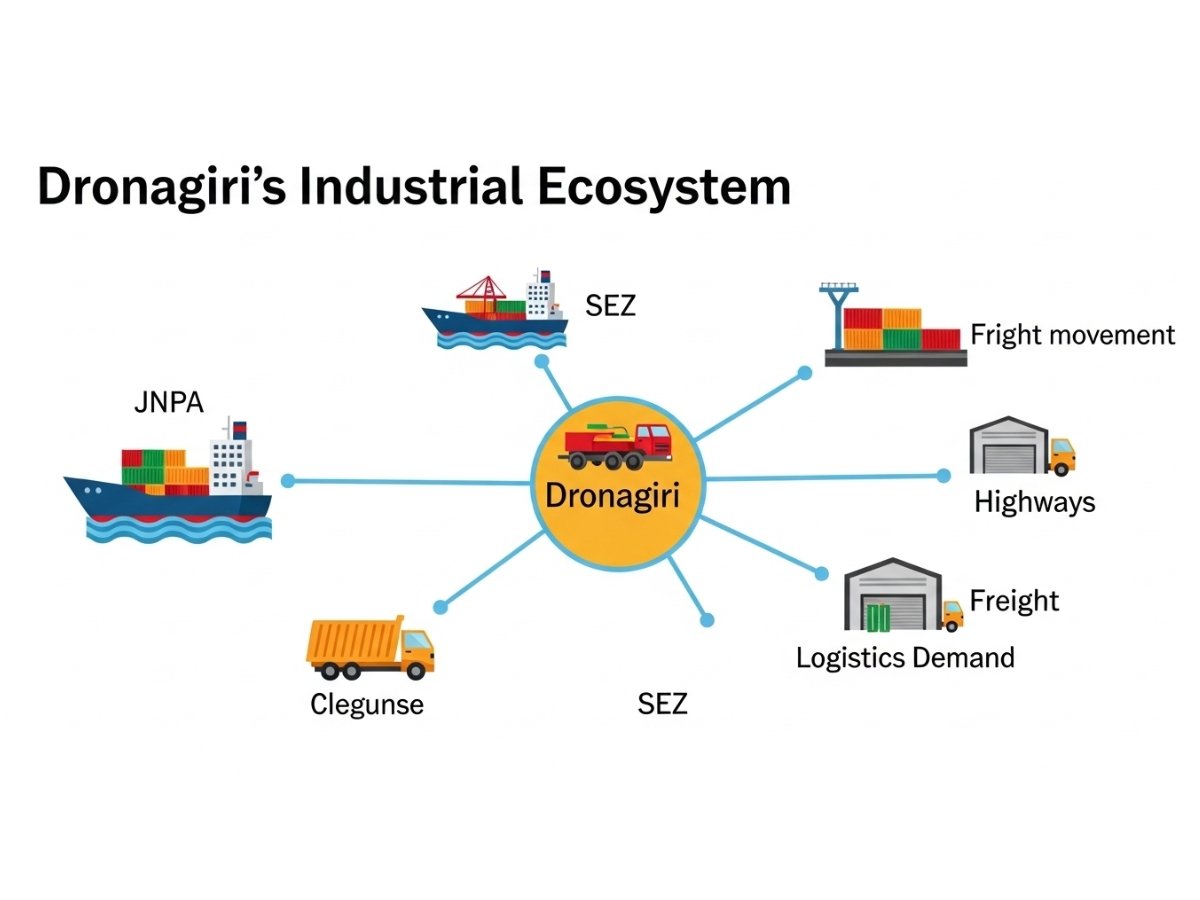
Dronagiri does. Not because every parcel there is automatically great, but because the surrounding macro logic is more industrially coherent.
JNPA is not a future promise. It is an operating trade engine. Official JNPA data says the port accounts for around half of the total containerised cargo volume across India’s major ports, and its FY 2024-25 profile shows 7.30 million TEUs handled, with roughly 53.93 percent of total container traffic handled by all major ports. That matters because industrial and logistics value becomes much more believable when the surrounding cargo ecosystem already exists at scale.
The case gets stronger when you look at JNPA’s institutional ecosystem. JNPA has established a multi-product port-based SEZ under a port-led industrialization framework, and it acts as the developer and Special Planning Authority for that SEZ. A recent JNPA investor brief describes direct access to the port, highway connectivity, Atal Setu linkage, Dedicated Freight Corridor connectivity, Uran suburban rail under development, and NMIA roughly 10 km away. That is a real industrial-chain argument. Not just a brochure line.
This is why Dronagiri industrial growth sounds more convincing when the buyer’s thesis is logistics-led. The freight ecosystem is already visible. The export-import logic is already visible. The institutional industrial intent is already visible. That does not remove execution risk at plot level, but it does make the macro story more grounded.
Land-use practicality versus narrative-led appreciation
This is where many buyers go wrong.
A land parcel can appreciate without being the best immediate industrial decision. A node can become high-visibility without becoming the strongest logistics location. A buyer can be directionally right on the macro story and still buy the wrong product in the wrong pocket.
Dronagiri tends to make more sense when the question is: Will this location become more relevant to freight, warehousing, export-linked movement, or industrial support activity? Ulwe tends to make more sense when the question is: Will this location become more visible, more connected, more desirable, and more valuable as airport-led urban development expands? Those are not interchangeable questions. They lead to different buy decisions. The first is industrial land logic. The second is land appreciation versus industrial practicality.
So when someone asks, “Dronagiri vs Ulwe for long-term investment,” the honest answer is: long term for what? Long-term port-linked industrial growth usually favours Dronagiri. Long-term airport-led land story can favour Ulwe. One is more operational. The other is more narrative-and-absorption driven.
Why airport adjacency alone does not make Ulwe the industrial winner
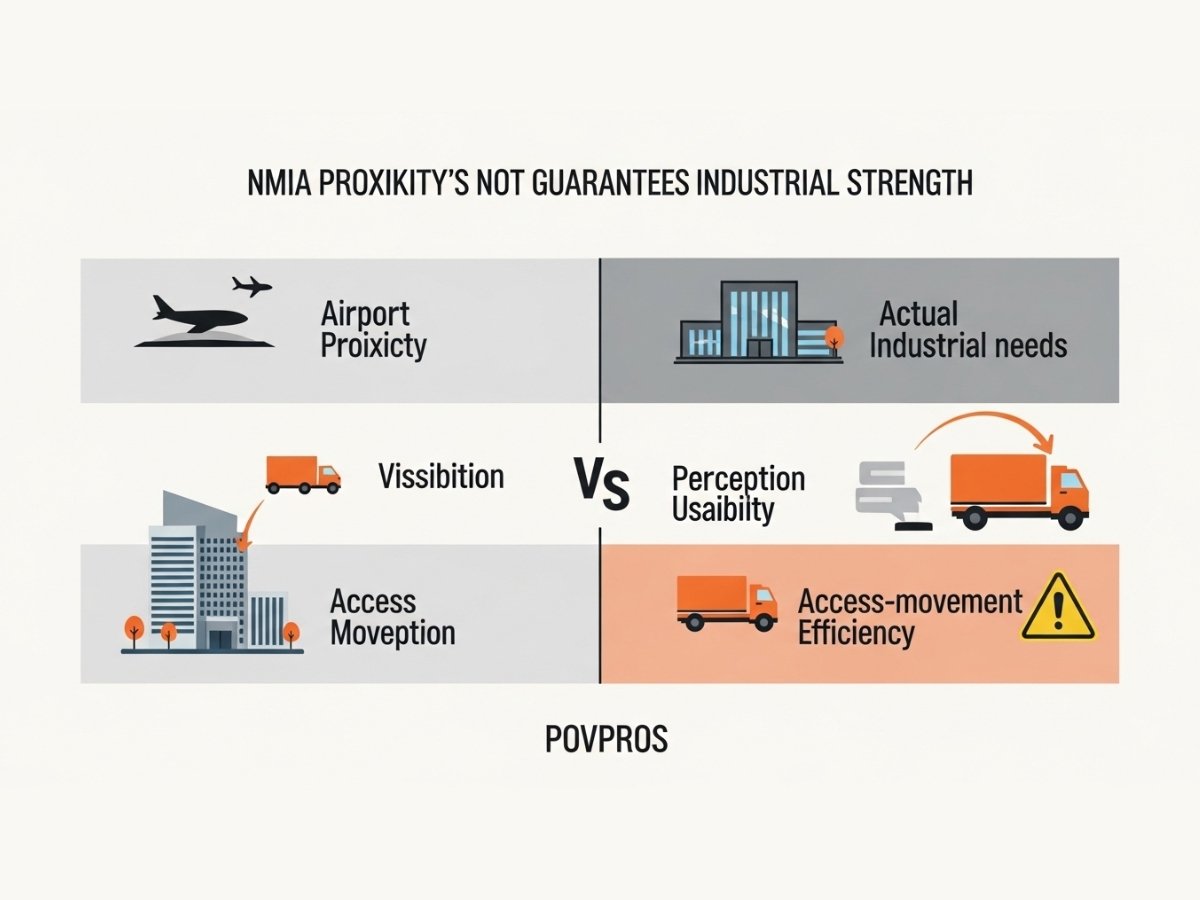
Because airport relevance and industrial relevance are not identical.
CIDCO describes NMIA as one of the country’s largest proposed greenfield airports, planned for at least 60 million passengers per year and 1.5 million tonnes of cargo, with a role in India’s first multi-airport city model. That is a major regional catalyst. But even then, airport adjacency by itself does not automatically create the strongest industrial node for every use case. Passenger flows, hospitality demand, office demand, mobility improvement, premium perception, and commercial spillover often become visible before broad industrial depth becomes visible on the ground.
That is the central mistake in many Ulwe industrial-growth pitches. The airport story is real. The over-translation is the problem. Buyers start assuming that “near airport” automatically means “best industrial bet.” It does not. Cargo-support ecosystems need land-use compatibility, access efficiency, truck movement practicality, storage logic, and real industrial absorption. Without those, airport proximity becomes a pricing story faster than it becomes a strong industrial-use story.
How JNPA-side logistics relevance changes the answer in Dronagiri’s favour
Because port relevance becomes meaningful only when it connects to a working ecosystem. Dronagiri is not just “near JNPA” in a vague sense. Its case is stronger because the broader belt already sits inside a live port, container, freight, and export-oriented industrial conversation.
JNPA today operates five container terminals and remains deeply embedded in the country’s container logistics structure. Its official material also positions JNPA SEZ as a port-based export-oriented industrial platform with multimodal connectivity. When industrial buyers, yard users, freight operators, EXIM-linked businesses, and longer-horizon logistics investors study Dronagiri, they are not building a theory from scratch. They are plugging into an already functioning port ecosystem.
That is why Dronagiri logistics-led growth usually sounds more practical than Ulwe industrial growth. The surrounding chain is clearer. The freight thesis is clearer. The institutional industrial bias is clearer.
Still, buyers should not romanticize the node. Dronagiri can disappoint when the actual asset has weak access, title ambiguity, unsuitable permissions, poor last-mile usability, or pricing that already assumes perfect future execution. Macro strength does not rescue a bad parcel.
Why port proximity matters only if the surrounding industrial chain is real
This needs to be said plainly: being “close to the port” is not enough.
A serious port-linked industrial growth Navi Mumbai thesis needs more than physical nearness. It needs supporting movement of containers, supporting road logic, nearby operational demand, workable industrial land, and a buyer type that genuinely uses or values those advantages. JNPA’s own scale and SEZ-led industrial positioning make the Dronagiri-side story more believable, but the final decision still depends on micro-level usability.
So yes, the JNPA impact on Dronagiri is real. But it becomes investable only when the asset itself is real.
What NMIA changes in Ulwe’s story, and where buyers misread it
NMIA changes Ulwe’s growth story meaningfully. It just does not change it in the way many industrial buyers assume.
Official CIDCO and NMIA material shows the airport is a large PPP-led regional project, with significant passenger and cargo planning, and the airport’s own official newsroom records milestone events such as the allotment of the IATA code NMI in 2024 and the welcome of the first aircraft in October 2024. The airport is also directly tied to Ulwe in the project’s own public-facing presence, including the official project office near Ulwe Gaothan. This means Ulwe airport-led growth is not just rumor anymore. It is a real regional-development fact.
But the first-order impact is not necessarily broad industrial dominance. The more immediate and understandable impact is visibility, access, perception uplift, service-economy opportunity, mixed-use potential, commercial spillover, and long-term land premium behavior. In other words, NMIA impact on Ulwe is very real, but a large part of that value may show up first in urban-commercial form rather than pure industrial suitability.
Airport-led visibility, access, and commercial spillover
Ulwe benefits from being emotionally and geographically attached to the airport story. That matters in real estate. Buyers, businesses, hospitality operators, and commercial investors tend to respond early to visibility, confidence, and access narratives. In many markets, that can lift land values ahead of deep industrial absorption. Ulwe long-term land story becomes stronger precisely because the airport changes how the node is perceived in the larger Mumbai region.
Where the industrial interpretation becomes too aggressive
The overreach begins when investors assume all airport-adjacent appreciation is the same as industrial-chain relevance. It is not. An airport can raise surrounding values without instantly making every nearby parcel the best logistics or industrial purchase. That is why airport adjacency vs industrial suitability must be separated carefully.
If the goal is land appreciation, not immediate industrial use, does Ulwe become more attractive?
Yes, often it does.
If the buyer is patient, land-focused, and willing to wait through absorption cycles, Ulwe can make more sense than Dronagiri. The airport story is large enough to support a long-duration appreciation thesis. That thesis is strengthened by formal project structure, official milestone visibility, and the node’s identity inside a transforming southern Navi Mumbai belt.
But that is still not the same as saying Ulwe is the stronger direct industrial-use bet today. It usually is not.
Which node suits which buyer type better?
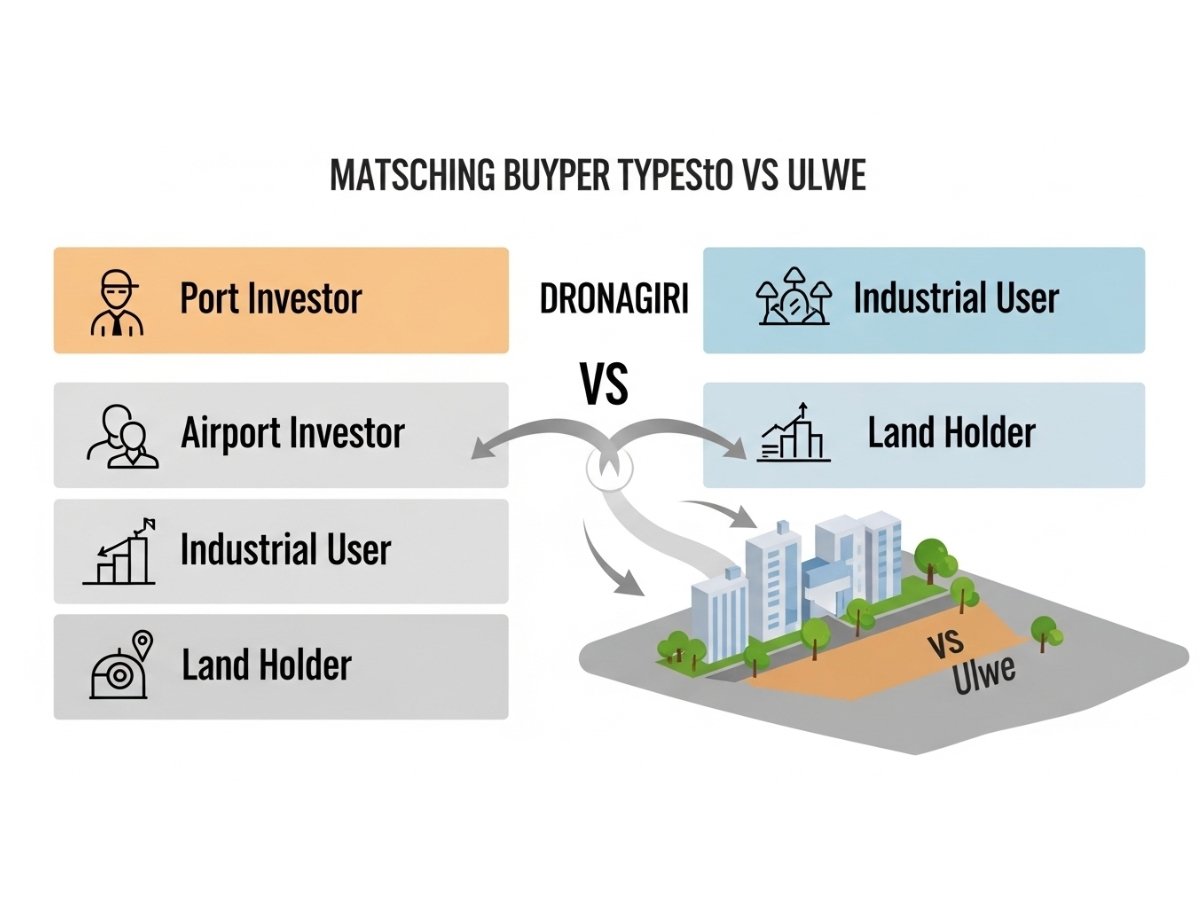
The better question is not “Which node is better?” It is “Which node is better for this specific buyer?”
| Buyer type | Dronagiri | Ulwe | Why |
|---|---|---|---|
| Port-linked investor | Strong fit | Weak to moderate fit | Dronagiri sits closer to a real port ecosystem and industrial-chain logic |
| Airport-growth speculator | Moderate fit | Strong fit | Ulwe benefits more directly from NMIA-led perception and land narrative |
| Long-horizon land holder | Good fit | Strong fit | Ulwe can reward patience where the goal is appreciation, not immediate industrial utility |
| Industrial occupier or EXIM-support user | Strong fit | Selective fit | Dronagiri is more aligned with logistics investor thesis and goods movement |
| Buyer seeking low-theory industrial relevance | Stronger | Weaker | Dronagiri industrial growth is easier to justify from existing infrastructure |
| Buyer relying only on future premium story | Moderate | Stronger | That style of buyer is usually chasing the Ulwe long-term land story |
A clean summary helps:
Port-linked investor
Choose Dronagiri first. The freight narrative is more believable there because the surrounding ecosystem is already active.
Airport-growth believer
Choose Ulwe first. The NMIA-led premium story is more directly tied to Ulwe’s identity and future positioning.
Industrial occupier
Lean Dronagiri unless the Ulwe asset has an unusually strong case on permissions, access, and actual business fit.
Buyer who wants immediate clarity
Be careful with both. Growth stories are strongest at macro level. Deals are won or lost at asset level.
What buyers must verify before paying a growth premium in either node
This is where disciplined buyers separate themselves from hopeful buyers.
Check the exact land title and holding structure first. Then verify permitted use, not assumed use. Study road approach, turning movement, truck practicality, and last-mile friction. Understand whether the price already includes a huge future-growth premium. Verify whether the surrounding belt has actual operating depth or only planned momentum. And most importantly, do not treat “near airport” or “near port” as a substitute for real due diligence.
Official infrastructure can create a valid macro thesis. It does not remove parcel-level risk. JNPA’s trade strength is real. NMIA’s scale is real. CIDCO’s node framework is real. But your specific deal can still be wrong.
Key takeaways
- Dronagiri vs Ulwe is not a debate between a good node and a bad node. It is a debate between two different kinds of growth.
- Dronagiri wins when the decision is being made through the lens of freight, industry, export logistics, and operational relevance.
- Ulwe wins when the decision is being made through the lens of airport-led transformation, land appreciation, commercial spillover, and long-term urban premium.
- The wrong decision usually happens when a buyer mixes those two lenses.
Conclusion
For most serious buyers comparing Dronagiri vs Ulwe for airport and port-linked industrial growth, Dronagiri makes more practical sense. It has the stronger direct industrial logic, the stronger logistics-led investment thesis, and the stronger connection to a real port ecosystem. JNPA’s operating scale, its port-based SEZ, and its broader multimodal positioning make the Dronagiri side easier to justify for industrial-chain buyers.
Ulwe makes more sense when the thesis is different. If the buyer is aiming at airport-led visibility, land appreciation, future mixed-use or commercial spillover, and can wait for the urban premium story to deepen, Ulwe becomes very attractive. NMIA is a serious regional catalyst, and official project facts support that. But it should not be lazily sold as the stronger industrial node just because the airport is nearby.
So the practical answer is simple.
Choose Dronagiri for port-linked industrial growth.
Choose Ulwe for airport-led land story.
Avoid both, for now, if your thesis is still vague, your due diligence is weak, or the pricing assumes a future that the asset has not yet earned.
FAQs
Frequently Asked Questions