
Freehold vs Leasehold in Navi Mumbai: Difference, Resale, & Risk
If you want the direct answer, freehold is usually the stronger and simpler form of ownership, while leasehold gives you rights over the property only under lease conditions. In Navi Mumbai, this matters more than in many other cities because a large part of the city was planned and allotted through CIDCO on leasehold land. In July 2025, CIDCO said eligible residential leasehold plots can be converted to freehold, and that change made this topic even more important for buyers, sellers, and families holding older properties.
A lot of people in Navi Mumbai think they “own the flat fully” and that is the end of the story. Ground reality is different. In many CIDCO-linked areas, your flat papers, society papers, and land title status all matter. That is why freehold vs leasehold is not just a legal term here. It directly affects resale ease, bank loan comfort, transfer cost, and long-term peace of mind.
Quick summary
| Point | Freehold | Leasehold |
|---|---|---|
| What you own | Land and structure ownership rights are much stronger and more permanent | You usually hold rights for a fixed lease period, while the land remains with the authority or lessor |
| Future sale | Usually simpler | Often involves extra rules, permissions, or authority-linked transfer process |
| Loan comfort | Usually better | Can still get loans, but banks may be more careful, especially on older leases |
| Long-term risk | Lower | Depends on lease balance, dues, and lease conditions |
| Transfer fees | No future CIDCO transfer fees after eligible freehold conversion | 50% hike implemented in April 2025 for many registered housing society flats |
| Navi Mumbai relevance | More desirable for long-term clarity | Very common in CIDCO-linked areas |
| Buyer effort | Usually simpler due diligence | Needs more careful checking of lease term, lessor, dues, and transfer rules |
Freehold vs leasehold in Navi Mumbai: quick answer
For most buyers, freehold is the better form of ownership because it gives more control, fewer title-related headaches, and better long-term comfort.
But that does not mean every leasehold property in Navi Mumbai is a bad buy.
Many good societies in Vashi, Nerul, Belapur, Kharghar, Kamothe, and other CIDCO-influenced nodes sit on leasehold land. People have lived in them for years without day-to-day problems. The issue usually appears later, during resale, redevelopment, inheritance, mortgage, or document checking. That is where leasehold starts making a difference.
A practical way to look at it is this:
- If two similar properties are available, and one is truly freehold while the other is leasehold, the freehold one usually gives cleaner long-term comfort.
- But if the leasehold property is in a much better location, has a strong society, good documents, enough lease balance, and clean transfer history, it can still be a sensible purchase.
What freehold and leasehold mean in simple words
Freehold means you own the property with much stronger and more permanent ownership rights. In plain language, there is far less dependence on a land-owning authority for future transactions.
Leasehold means you do not fully own the land forever. You get the right to hold and use the property for a fixed period under lease terms. The land continues to belong to the original authority or lessor.
This is where people get confused in Navi Mumbai.
A buyer may have:
- a registered sale deed,
- a society share certificate,
- possession of the flat,
- municipal property tax bills,
and still be dealing with leasehold land under CIDCO-linked rules.
So the real question is not just “Do I own the flat?” The better question is: What is the status of the land under the flat, and what permissions or transfer conditions apply?
Why this issue matters so much in Navi Mumbai
Navi Mumbai was not built like a random private city expansion. It was planned in a structured way by CIDCO across multiple nodes. Because of that history, leasehold became a normal part of local property ownership.
Why buyers in CIDCO areas hear “leasehold” so often
Reports on CIDCO’s policy direction and later freehold-conversion decision note that land in many Navi Mumbai nodes was originally allotted on leasehold basis. CIDCO-developed areas such as Vashi, Nerul, Belapur, Kharghar, Kamothe, New Panvel, Ulwe, and others were shaped around this model.
Older CIDCO lease arrangements in Navi Mumbai were commonly for 60 years, and a later state decision allowed extension up to 99 years in some cases on payment of premium. That is why some people talk about 60-year lease properties, while others refer to 99-year cases. Both can exist depending on the allotment history and scheme.
Why a flat can look normal but the land title still matters
From the outside, a flat in Vashi or Nerul may look no different from a flat in a freehold pocket elsewhere. The building may be occupied, the society may be functioning, and the resale market may still be active.
But land title still affects the background process. It can change whether authority consent, transfer formalities, extra charges, or old dues become an issue, and it can also affect loan comfort and redevelopment later.
That is why two flats with similar carpet area and similar price can feel very different once document checking starts.
Freehold vs leasehold: the actual difference that affects buyers
Here is the difference that matters in real life, not just in theory.
| Issue | Freehold property | Leasehold property |
|---|---|---|
| Ownership comfort | Stronger and more complete | Limited by lease conditions |
| Need for authority-linked process | Usually lower | Often higher |
| Resale perception | Better buyer confidence | Buyer may ask more questions |
| Home loan comfort | Usually smoother | Depends on lease balance and bank policy |
| Future generations | Simpler inheritance and transfer comfort | More paperwork risk if records are not clean |
| Redevelopment | Usually easier structurally from title perspective | Can involve extra approvals or premiums |
| Surprise costs | Lower chance of authority-linked transfer cost | Higher chance of transfer fees, dues, or NOC issues |
One more reason this topic became urgent is the change in transfer charges. On April 1, 2025, CIDCO revised property transfer fees in Navi Mumbai, with general increases of 5% to 10% depending on size and type, and a 50% hike for flats in registered housing societies and commercial shops. Indian Express also reported slabs ranging from around ₹27,000 for very small units to above ₹2.31 lakh for larger ones, depending on unit size and location.
What this means for ordinary families is simple: leasehold is not just a title concept anymore. It can directly change the cost of selling.
There is one more layer many people miss. NMMC later revised its own property transfer fee policy in 2025 and stated that, in applicable cases, a 0.20% transfer duty would be charged on the document value or Ready Reckoner basis as applicable. This is separate from CIDCO-linked land issues. In other words, municipal transfer charges and CIDCO-linked land transfer charges are not the same thing.
Which one is better in Navi Mumbai
For most end-users and long-term buyers, freehold is better.
That is the plain answer.
But the better property is not always decided by title alone. In Navi Mumbai, planning quality also matters. Some CIDCO-planned leasehold areas offer wide roads, better node planning, stronger layout discipline, and more stable liveability than some freehold pockets developed privately outside that structure.
So the smarter question is not only “freehold or leasehold?” It is “freehold or leasehold in which area, under what paperwork, with what future cost?”
When freehold usually makes more sense
Freehold usually makes more sense when:
- you want long-term title clarity,
- you plan to hold the property for many years,
- you want easier future resale,
- your society may go into redevelopment later,
- you do not want repeated authority-related friction,
- you are comparing two similar properties and one is clearly freehold.
For families, this matters even more. A confusing property title can become a bigger problem during inheritance than during purchase.
When leasehold can still be a workable option
A leasehold property can still be a workable option when:
- the location is excellent,
- the price is more attractive,
- the society is stable,
- the remaining lease is comfortable,
- past transfer records are clean,
- there are no major unresolved dues,
- the bank is willing to finance it without unusual conditions.
That is why many resale buyers in Navi Mumbai still buy leasehold flats. They are not buying blindly. They are buying after checking whether the restrictions are manageable.
What to check before buying a leasehold property in Navi Mumbai
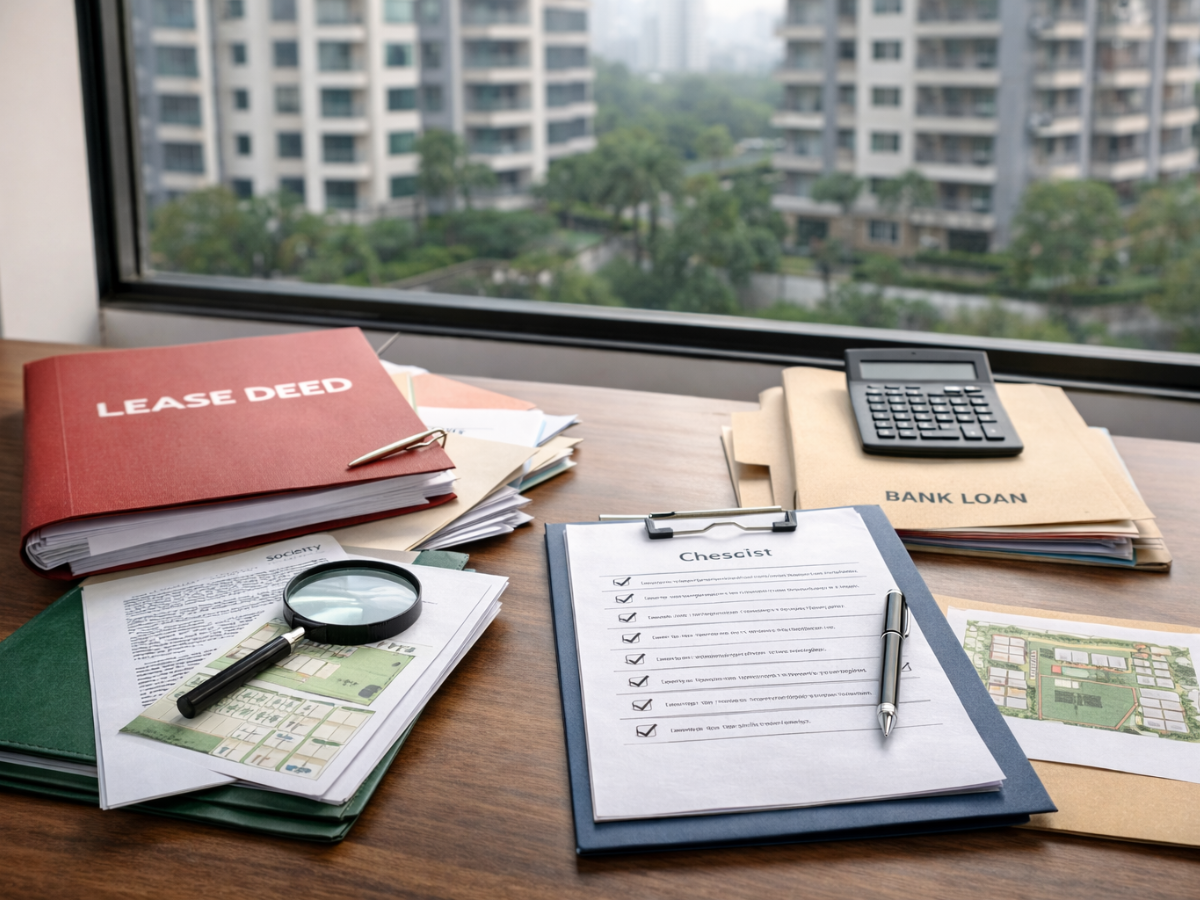
If you are buying a leasehold property, do not stop at the sale deed and society share certificate.
You need to check the full ownership trail properly.
Lease period, lessor, transfer rules, and paperwork
Start with these basic questions:
1. Who is the lessor? Is it CIDCO or some other authority-linked entity?
2. What is the original lease period? Is it a 60-year case, a 99-year case, or a later extended arrangement?
3. How many years are left? This matters for resale and for bank comfort.
4. Has the transfer history been properly updated? In Navi Mumbai, this is where many buyers get careless. A registered transaction alone may not tell you the full authority-side position.
5. Are authority permissions, transfer approvals, or NOCs required in this category? Rules vary by allotment type and document history.
6. Is the society conveyance position clear? A functioning society does not automatically mean the land-title side is clean.
A good local property lawyer should read:
- sale deed chain,
- lease deed,
- society papers,
- allotment documents,
- share certificate,
- property card or land record extract,
- authority correspondence where applicable.
Loan, resale, redevelopment, and future costs
Banks do finance leasehold property, but comfort can reduce when the lease balance is low or title history is weak. In practice, some buyers only discover this late, when the bank asks for extra papers or limits the loan view.
Resale can also become slower because serious buyers ask the same questions:
- How many years are left on the lease?
- Is there any pending CIDCO-related transfer issue?
- Are there unpaid land-related dues?
- Will I have to pay extra transfer charges?
Then come the local terms that confuse many people: Maveja and ALP.
In Navi Mumbai, older projects and some specific plot categories have seen transfer or clearance issues linked to Maveja and ALP. In January 2024, reporting on CIDCO’s Abhay Yojana said recovery of Maveja and ALP would no longer be linked to some occupancy certificate, conveyance NOC, or flat-transfer processes, and that a 50% amnesty had been offered on payable amounts till March 31, 2023. That relief was important, but buyers should not assume any concession is still open today without checking the latest status.
In simple words:
- Maveja is a land-compensation-linked issue that can attach to certain project histories.
- ALP, or Additional Lease Premium, is usually linked to delay or condition-related lease compliance issues.
You do not need to become an expert in these terms. You only need to know one thing: if dues are pending, your transaction can get delayed or become more expensive.
Buyer checklist for leasehold property in Navi Mumbai
Use this checklist before paying token money:
- Check the original lease deed
- Confirm the remaining lease period
- Confirm who the lessor is
- Verify whether transfer approval or NOC is required
- Check if any CIDCO transfer process is pending from an earlier sale
- Check the 2025 CIDCO transfer fee slab for your unit size
- Check society documents and share certificate
- Ask the seller for a No Dues Certificate or a recent Statement of Account from CIDCO to check for pending Maveja or ALP
- Check if any Maveja, ALP, or other authority-linked dues exist
- Ask the bank in writing whether the property is acceptable for loan
- Ask who will bear transfer charges and other title-related costs
- Get a lawyer’s written title note before final commitment
Can leasehold property become freehold in Navi Mumbai
Yes, in eligible cases, it can.
This is the biggest recent shift in the Navi Mumbai property story.
In July 2025, CIDCO said residential leasehold plots can be converted to freehold on an optional basis, provided the lease deed has already been executed. CIDCO also said that after conversion, it will not levy transfer charges for future property transfers, and that the Department of Land Records will maintain and update the rights records for such freehold plots. Reports also said the scheme covers residential plots allotted through tenders, CIDCO housing projects, and 12.5% and 22.5% rehabilitation-linked schemes.
The broad process, as reported across 2025 coverage, is this:
- apply for conversion,
- submit the required documents,
- pay the conversion fee,
- complete registration formalities,
- ensure land records are updated.
Important: Even after your land becomes freehold, you still need to update your name in NMMC/PMC records for property tax, which involves a separate 0.20% municipal fee.
Multiple reports also said the conversion fee is linked to the land’s Ready Reckoner value, with only a percentage of that value charged depending on the applicable rule. Some reports further noted that extra amounts may apply in cases involving subsidised allotments or older lease clauses such as unearned income recovery.
Example box
Example only: Suppose a family owns an older leasehold row house in Nerul or Vashi and plans to keep it for another 20 years or pass it to children later. In that case, converting to freehold may make sense because it reduces future transfer friction and improves long-term clarity.
But suppose a buyer is purchasing a newer leasehold flat in a strong Kharghar society, with good lease balance, clean documents, and no major dues. That property may still be a sensible buy even before conversion.
So the decision is not emotional. It is document-based and cost-based.
Common mistakes buyers make
One common mistake is assuming every property in Navi Mumbai is freehold because it looks like a normal resale flat.
Another is assuming leasehold means illegal or unsafe. That is also wrong.
The real mistakes are more practical:
- not checking the remaining lease,
- not checking the lessor,
- not asking about transfer charges,
- not checking old dues,
- not separating municipal tax issues from land-title issues,
- not asking the bank early enough.
A third mistake is buying only on price. A cheaper leasehold flat can become expensive later if title correction, approvals, or transfer-linked costs show up at the wrong time.
Final tip for buyers, investors, and end-users
If you are choosing between a clean freehold property and a similar leasehold property in Navi Mumbai, freehold usually wins.
It gives better long-term ownership comfort, cleaner resale positioning, and fewer authority-linked hurdles.
But do not turn this into an oversimplified rule. Navi Mumbai has many good leasehold properties in strong locations and well-run societies. A leasehold flat is not automatically a bad property. It becomes a bad deal only when buyers skip document checking, ignore the remaining lease, or fail to understand the future cost.
A practical final view would be this:
- For end-users: Prefer freehold where possible, especially for long holding.
- For investors: Compare title quality along with location, rentability, and exit ease.
- For families buying resale: Never assume the society papers alone are enough.
- For existing leaseholders: If your property is eligible for freehold conversion, it is worth understanding the math seriously because the 2025 policy change can alter long-term ownership comfort in a big way.
For transaction-level decisions, do one more thing. Get a local property lawyer to check the chain before you commit.
That one step can save months of trouble.
Conclusion
Freehold vs leasehold in Navi Mumbai is not a small wording difference. It changes what you truly control, what you may have to pay later, and how easy the property will be to sell, finance, or pass on.
Freehold is usually the safer long-term form of ownership. Leasehold can still work, but only when the papers are clean and the buyer understands the conditions properly.
That is the real takeaway.
In Navi Mumbai, buying smart is not just about location and price. It is also about title clarity.
FAQs
Frequently Asked Questions