
How Kharghar Connectivity Projects Affect Housing Demand
Kharghar connectivity projects are clearly increasing housing demand, but not evenly. Demand rises fastest where a project improves daily commuting in a real, usable way, not just on paper. Metro access, airport access, and future road shortcuts are changing buyer interest, rental pull, and resale confidence in parts of Kharghar. At the same time, some projects are also creating overpricing and speculative expectations, especially where the infrastructure story is stronger than the present ground reality.
For buyers, renters, and investors, the real question is not whether connectivity matters. Of course it does. The real question is which connectivity improvement changes housing demand now, which one mainly improves future sentiment, and which parts of Kharghar benefit more than others.
Which connectivity projects are actually shaping housing demand in Kharghar?
In Kharghar today, five connectivity triggers matter most: the operational Navi Mumbai Metro Line 1, the now-operational Navi Mumbai International Airport, the under-construction Kharghar–Turbhe Tunnel Link Road, the planned Kharghar Coastal Road, and CIDCO’s International Corporate Park, which is not a transport project by itself but becomes powerful because of the transport network around it.
Quick summary
| Connectivity project | Current status | What it changes in real life | Demand effect in Kharghar |
|---|---|---|---|
| Navi Mumbai Metro Line 1 | Operational since November 17, 2023 | Improves internal Navi Mumbai travel and daily commute reliability | Strongest immediate effect on end-user and rental demand near usable metro catchments |
| Navi Mumbai International Airport | Commercial operations started December 25, 2025 | Makes Kharghar more attractive to flyers, airport-linked professionals, and premium buyers | Strong sentiment boost plus real premium demand in better-connected pockets |
| Kharghar–Turbhe Tunnel Link Road | Under construction, target September 2028 | Can sharply reduce road travel time toward Turbhe/Juinagar side | More of a future value driver right now than a present-day demand driver |
| Kharghar Coastal Road | Planned/advancing, work expected from 2026 | Improves airport-side and node-to-node access | Mainly future premium positioning for now |
| International Corporate Park | CIDCO has floated bids in 2026 | Can create large-scale office demand near Kharghar | Long-term structural support for housing demand, especially in growth sectors |
Rail and station-linked connectivity
Kharghar was already a railway-recognised residential node before these new projects started changing the market. That matters because railway and station access still remain the base layer of housing demand. A flat in Kharghar does not become desirable only because of a future airport or future road. It becomes desirable first when daily travel is practical.
That is why locations with smoother access to Kharghar station and nearby transit movement still hold their importance. New projects are adding layers on top of that base, not replacing it.
Metro-linked connectivity
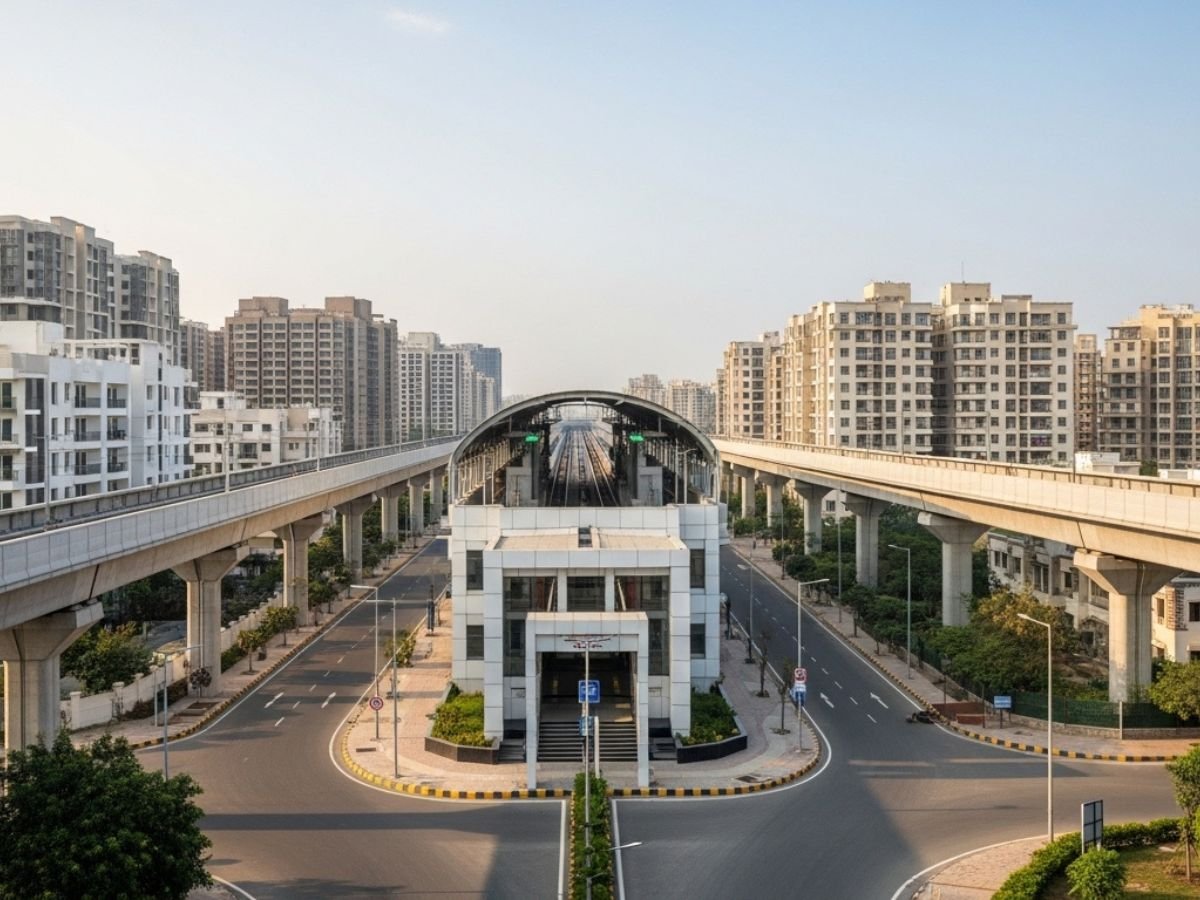
This is the most visible real change so far. Navi Mumbai Metro Line 1, the 11.1 km Belapur-to-Pendhar stretch with 11 stations, began commercial service on November 17, 2023. By November 2025, reported cumulative ridership had crossed 1.15 crore passengers. That matters because it shows the line is not just a symbolic infrastructure asset. People are actually using it.
For Kharghar housing demand, the metro effect is strongest where it reduces routine friction. Families like predictability. Working professionals like commute certainty. Tenants like being able to describe a flat as reasonably accessible without depending entirely on private vehicles or expensive autos. This is why metro-linked convenience generally lifts interest faster than a distant future road promise.
Road and highway access improvements
The Kharghar–Turbhe Tunnel Link Road is one of the biggest long-term road projects affecting how people think about Kharghar. Reported project details say construction began in December 2024, the project cost is about ₹2,099 crore, the route length is roughly 5.5 km including a twin tunnel of about 1.8 km, and the target is September 2028. The big attraction is the claimed reduction in travel time between Kharghar and Turbhe/Juinagar side from around 40 minutes to around 10 minutes.
That kind of shortcut, if delivered well, can change buyer psychology in a major way. But right now, it is more of a future demand multiplier than a present-day demand anchor. Buyers should treat it as positive, but not as something already fully usable.
Airport-related regional connectivity
Navi Mumbai International Airport is now a real operating asset, not just a decade-long promise. Adani Group announcements say the airport was inaugurated on October 8, 2025, and commercial operations started on December 25, 2025. The airport handled over 4,000 passengers on its first day, and Adani’s FY26 update said phase 1 capacity is 20 million passengers per annum.
For Kharghar, this is a big deal. Not because every Kharghar resident will suddenly become a frequent flyer, but because airport proximity changes the profile of the area. It attracts aviation-linked workers, hospitality demand, business travellers, and premium end-users who value faster regional and national access. That tends to improve the market’s image, and image does affect housing demand.
Why does one connectivity project raise demand more than another?
Not all infrastructure influences demand in the same way. In Kharghar, the strongest demand driver is usually the project that saves time every week, not the one that sounds most glamorous.
Daily commute benefit creates stronger real demand
A metro line that people can actually board this week often influences demand more immediately than a premium highway or tunnel that may complete later. That is because housing demand is still driven first by routine use. The homebuyer who has to travel five or six days a week behaves very differently from the investor who is only reading project headlines.
This is also why “walkable or manageable access” matters more than brochure claims. A station on the map is not enough. The route to it must also feel usable.
Regional prestige improves sentiment, but not always immediate absorption
The airport effect is real, but it works in layers. First, it boosts the prestige of the node. Then it improves buyer curiosity and market confidence. After that, the actual demand shows up more selectively in premium housing, executive housing, and better-planned projects.
So yes, airport proximity helps Kharghar. But it does not mean every building in every sector deserves an automatic premium.
Access that saves time matters more than access that only sounds impressive
A future tunnel, a future coastal road, or a future corporate district can absolutely matter. But until the project becomes operational enough to change real travel behaviour, the impact is partly psychological. That can still move enquiries and launches, but it is not the same thing as deep end-user absorption.
That distinction is important. It separates genuine demand from speculative noise.
Which parts of Kharghar benefit the most when connectivity improves?
The short answer is this: areas with smoother access to station movement, metro usability, Central Park-side connectivity, and major internal roads usually benefit first. Areas that are still peripheral in everyday movement may benefit later, especially if corporate and airport-linked demand deepens.
Broadly speaking, older established sectors in the main lived-in belt of Kharghar usually benefit through stability, convenience, and stronger self-use demand. Emerging sectors such as 34, 35, and 36 tend to benefit more from future-oriented narratives tied to metro access, airport ecosystem growth, and the International Corporate Park story. The opportunity may be bigger there, but so is the dependence on execution quality and civic maturity.
Areas closer to station and major arterial roads
These locations usually gain first from any genuine connectivity improvement because they already have a strong base. When a new metro, tunnel, or airport route is added to an already practical location, demand thickens faster.
This is why established sectors often remain safer for end-users. They are not waiting for the entire future to arrive before becoming liveable.
Pockets with smoother access to metro-linked movement
This is where Kharghar’s market becomes interesting. Some parts of the node are benefiting because the metro adds real internal mobility. In such pockets, housing demand improves not just because people like infrastructure in theory, but because the area starts feeling easier to use without depending on a full car commute every time.
Sectors where connectivity improves but internal friction remains
This is the part many generic articles ignore. A sector may look better on paper after a major project announcement, but daily friction can still remain high because of last-mile issues, internal road experience, auto dependency, or patchy civic convenience. If that happens, demand may rise in enquiry numbers before it rises in long-term satisfaction.
Caution
Do not assume that “near airport”, “near metro”, or “near tunnel alignment” automatically means equal housing benefit. In Kharghar, the usable route often matters more than the straight-line distance.
How do connectivity projects affect end-user demand, rental demand, and investor demand differently?
Connectivity helps all three, but not in the same order.
The metro usually helps tenants and commuters the quickest. The airport and corporate park story usually improves investor interest and premium positioning. Families often respond only when connectivity improvement is matched by livability, schools, healthcare, and reliable daily movement.
Does better connectivity always lead to higher property prices in Kharghar?
No. Better connectivity can support higher prices, but it does not justify every price jump.
The main mistake in local real estate conversations is assuming that infrastructure automatically validates any launch rate. That is not how it works. Prices become more sustainable when connectivity improves actual demand, improves liquidity, and attracts steady buyer categories. Prices become fragile when they run ahead of real use.
A good example is the difference between metro-led and tunnel-led impact. The metro is already operational and has demonstrated ridership. So its effect on demand is easier to trust. The tunnel is promising, but still future-facing. So a buyer should value it, but not overpay as if the full benefit already exists today.
The same applies to the airport. Its operation is real, but the exact benefit to a specific Kharghar building still depends on product quality, access route, surrounding environment, and buyer profile.
What usually increases faster in Kharghar after connectivity improves: enquiries, rents, resale demand, or actual end-user buying?
Usually, the sequence looks like this:
1. Enquiries increase first
2. Investor interest and site visits rise next
3. Rental demand improves in better-connected pockets
4. Resale confidence strengthens
5. Deep end-user buying follows more selectively
That order matters. It tells you why headlines can make a market look hotter than it really is. Housing demand becomes truly strong only when end-users start choosing the area because the new connectivity has become part of daily life, not just part of local sales talk.
Where do builders and brokers overstate the connectivity story in Kharghar?
This happens in three common ways.
Future project headlines used as present-value claims
A tunnel planned for 2028, a coastal road targeted for 2028 or 2029, or a new corporate district tendered in 2026 can all support long-term value. But they should not be marketed as if their full effect is already reflected in the ground experience today.
Saying “near” when the last-mile reality is weak
This is classic. A project may be technically near a station, corridor, or airport connector, but the actual experience may still involve awkward internal travel, poor pedestrian access, or expensive last-mile dependence.
Ignoring friction that affects real livability
Kharghar is attractive for many reasons, but it also has practical issues that buyers should not ignore. Local reporting and project discussion around the node have repeatedly pointed to last-mile gaps, civic strain, and uneven quality of lived access even where top-level connectivity is improving. That is why serious buyers should judge the route, not just the brochure.
How should buyers judge whether a Kharghar project is genuinely benefiting from connectivity or just marketing it?
Use this checklist before accepting any “connectivity premium”.
Buyer checklist
- Check whether the connectivity project is operational, under construction, or only planned
- Check actual travel time, not only distance in kilometres
- Check whether the route is usable during normal office hours
- Check whether the project improves your routine, not an imaginary future lifestyle
- Check whether tenants would also value that same location
- Check whether the building is in a sector that already has basic livability
- Check whether the asking price is being justified mainly through future infrastructure
- Check authority references where possible, especially for CIDCO-linked planning and project status
- If under-construction housing is involved, also check MahaRERA details and delivery credibility
A buyer who does this will usually avoid the biggest mistake: paying tomorrow’s price for a location that is still functioning like yesterday’s market.
Is Kharghar’s connectivity-driven demand stronger for ready homes or under-construction projects?
Usually, ready homes benefit faster from real connectivity. Under-construction projects benefit faster from future storytelling.
Ready homes are easier to judge because you can test the route, check the station access, see the internal road condition, and understand the actual neighbourhood. Under-construction projects, on the other hand, often get stronger marketing mileage from the words “airport”, “metro”, “corporate park”, and “future tunnel”.
That does not make under-construction options bad. It just means the buyer must be more disciplined. If the project is being sold mainly on future connectivity, then the margin for overpaying becomes much higher.
So, are connectivity projects making Kharghar a stronger housing market or just a more expensive one?
The honest answer is: both, but unevenly.
Kharghar is becoming a stronger housing market because some of its connectivity upgrades are now real and usable. The metro is operational. The airport is operational. The node is no longer being sold only as a future story.
At the same time, some parts of the market are becoming more expensive partly because future infrastructure is being priced in early. The tunnel, coastal road, and corporate park can all support long-term upside, but their strongest housing impact will depend on execution, last-mile usability, and whether Kharghar’s civic systems keep pace.
So the practical reading is this:
- For self-use buyers: connectivity is making Kharghar stronger if you choose a sector and building with real daily usability.
- For renters and working professionals: metro-linked and station-practical pockets are improving first.
- For investors: the upside is real, especially where future office and airport-linked ecosystems deepen, but entry price discipline matters more than ever.
Conclusion
Kharghar connectivity projects are not affecting housing demand in one simple straight line. The metro has already improved real, lived demand. The airport has upgraded the node’s status and widened its buyer profile. The tunnel, coastal road, and International Corporate Park are strengthening the future case for Kharghar, but much of their impact is still ahead, not fully here yet.
That is why the smartest way to read Kharghar in 2026 is not “connectivity equals guaranteed price rise”. It is this: connectivity is making Kharghar more powerful as a housing market, but the real winners will be the locations where infrastructure improves daily life, not just marketing language. For buyers, that is the difference between choosing a genuinely stronger address and simply paying for a good story.
FAQs
Frequently Asked Questions