
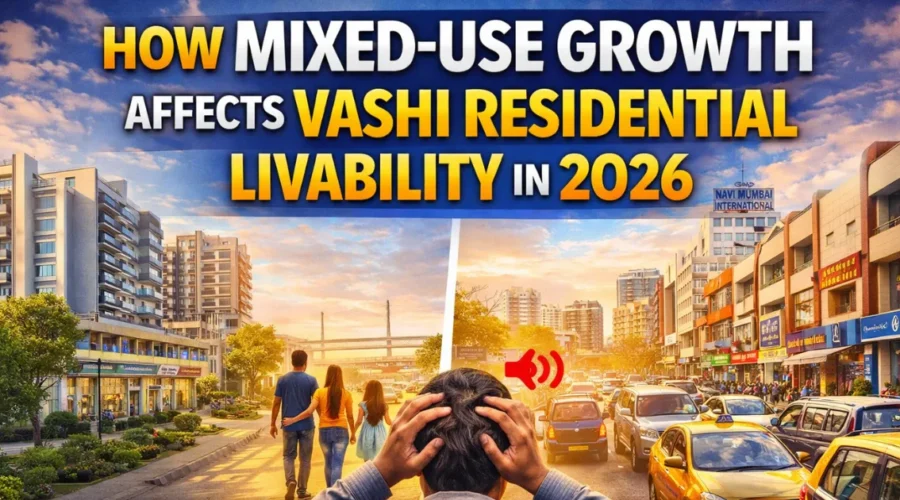
How Mixed-Use Growth Affects Vashi Residential Livability
Vashi’s mixed-use growth makes daily life easier, but it does not make every part of Vashi more comfortable to live in. In practical terms, it improves walkability, access to services, station convenience, and day-to-day efficiency, while also reducing residential calm in some pockets through traffic, parking stress, noise, and commercial spillover. So the real answer depends on one thing more than anything else: your exact micro-location, road type, and whether your building sits in a more residential stretch or a more commercially active one.
Vashi is one of the clearest examples in Navi Mumbai of how convenience and residential peace do not always grow together. That is exactly why people find it confusing. On paper, Vashi looks like an easy yes. It has strong connectivity, established social infrastructure, premium healthcare, schools, station access, highway access, and now even stronger regional value because the Atal Setu has already changed cross-harbour travel and the Navi Mumbai International Airport has started commercial operations.
But living in Vashi is not just about connectivity. It is also about what happens outside your building at 8 PM, where people park, how much road width exists, what kind of shops or offices operate below you, whether your lane is buffered from commercial spillover, and how much urban intensity your family can realistically tolerate.
That is why Vashi should be understood as a tradeoff node. It is one of the most functionally convenient places to live in Navi Mumbai, but in many pockets, that convenience is bought at the cost of peace, acoustic comfort, easy parking, and open breathing room.
What mixed-use growth in Vashi actually means for residents
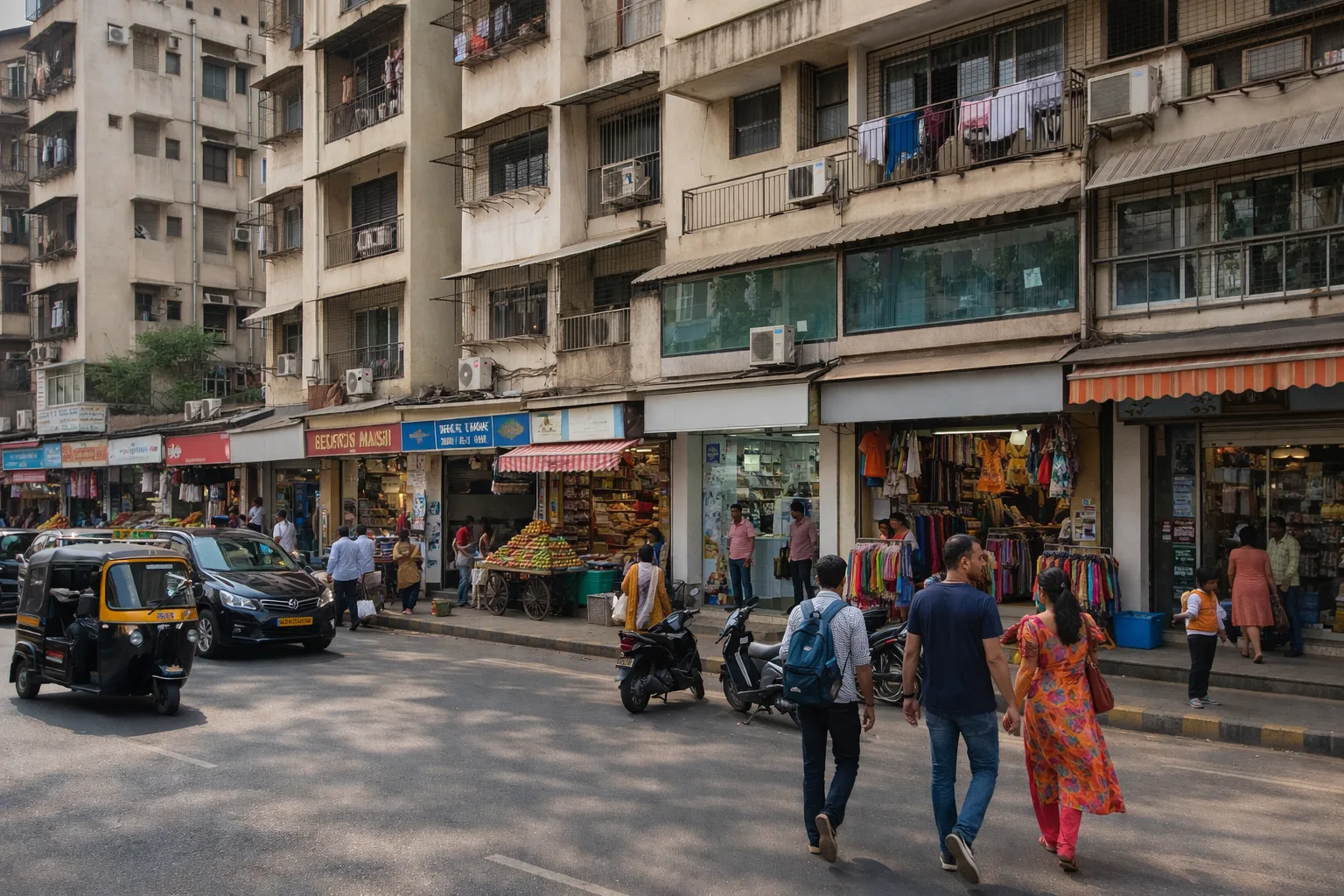
In simple terms, mixed-use growth means residential life and commercial activity are happening in the same local ecosystem, and often in the same building line. A person may live above a pharmacy, clinic, office, café, or service outlet, while also depending on those very businesses for daily convenience.
In Vashi, this is not just an accidental market trend. It is shaped by how the area evolved from older CIDCO planning into today’s NMMC-administered urban pattern, where the Unified Development Control and Promotion Regulations allow mixed-use activity in certain residential zones, especially on wider roads. In plain language, if a building sits on a broad main road, the law is more likely to allow active commercial use on lower floors. If it sits deeper inside a narrower internal lane, the residential character is usually better protected.
For residents, this changes daily life in a very direct way. It creates the “everything downstairs” model. You can get groceries, visit a doctor, use an ATM, pick up medicines, and access transport without planning a separate trip. But the same model also means your building may share limited parking, road space, drainage pressure, and street frontage with high-footfall businesses.
Quick summary: what mixed-use growth gives and what it takes away
| Mixed-use feature in Vashi | What residents gain | What residents may lose |
|---|---|---|
| Shops and services near homes | Faster errands, strong walkability, daily convenience | Noise, crowding, higher footfall, less privacy |
| Building frontage on active roads | Better access to transport and city movement | Traffic exposure, honking, dust, harder vehicle entry-exit |
| Commercial activity nearby | More active streets, stronger tenant demand, better liquidity | Parking pressure, loading-unloading issues, spillover into residential lanes |
| Ground-floor retail and service use | Easy access to essentials and medical support | Early shutter noise, late activity, kitchen exhaust, delivery congestion |
Does mixed-use growth make Vashi more livable or less livable overall?
Overall, it makes Vashi more livable for some lifestyles and less livable for others. That is the most honest answer.
If your definition of livability is speed, access, and convenience, mixed-use growth helps Vashi a lot. If your definition is silence, ease of parking, low sensory load, and uncluttered streets, mixed-use growth often hurts Vashi in its more active pockets.
This is why broad “livability scores” do not tell the full story. A person who values being able to walk to a hospital, school, station, and supermarket may rate Vashi very highly. A family with young children or a work-from-home professional may experience the same area very differently, especially if the home faces a main road or sits above active commercial frontage.
The pressure has also become more visible in the current 2026 context. The Atal Setu has already increased Vashi’s regional importance. NMIA began commercial flight operations on 25 December 2025 and shifted to 24/7 operations in February 2026. These are not abstract infrastructure milestones anymore. They directly strengthen Vashi’s pull as a transit-linked and business-friendly location. That helps demand and access, but it also makes the node stickier, busier, and in some places more commercially intense.
So yes, mixed-use growth improves Vashi’s functional livability. No, it does not improve residential comfort equally everywhere.
Where mixed-use growth helps daily life in Vashi
This is the part competitors often mention but do not explain properly. Vashi’s mixed-use development works because it removes day-to-day friction in a way many other nodes still cannot match.
Better access to shops, clinics, banks, and routine services
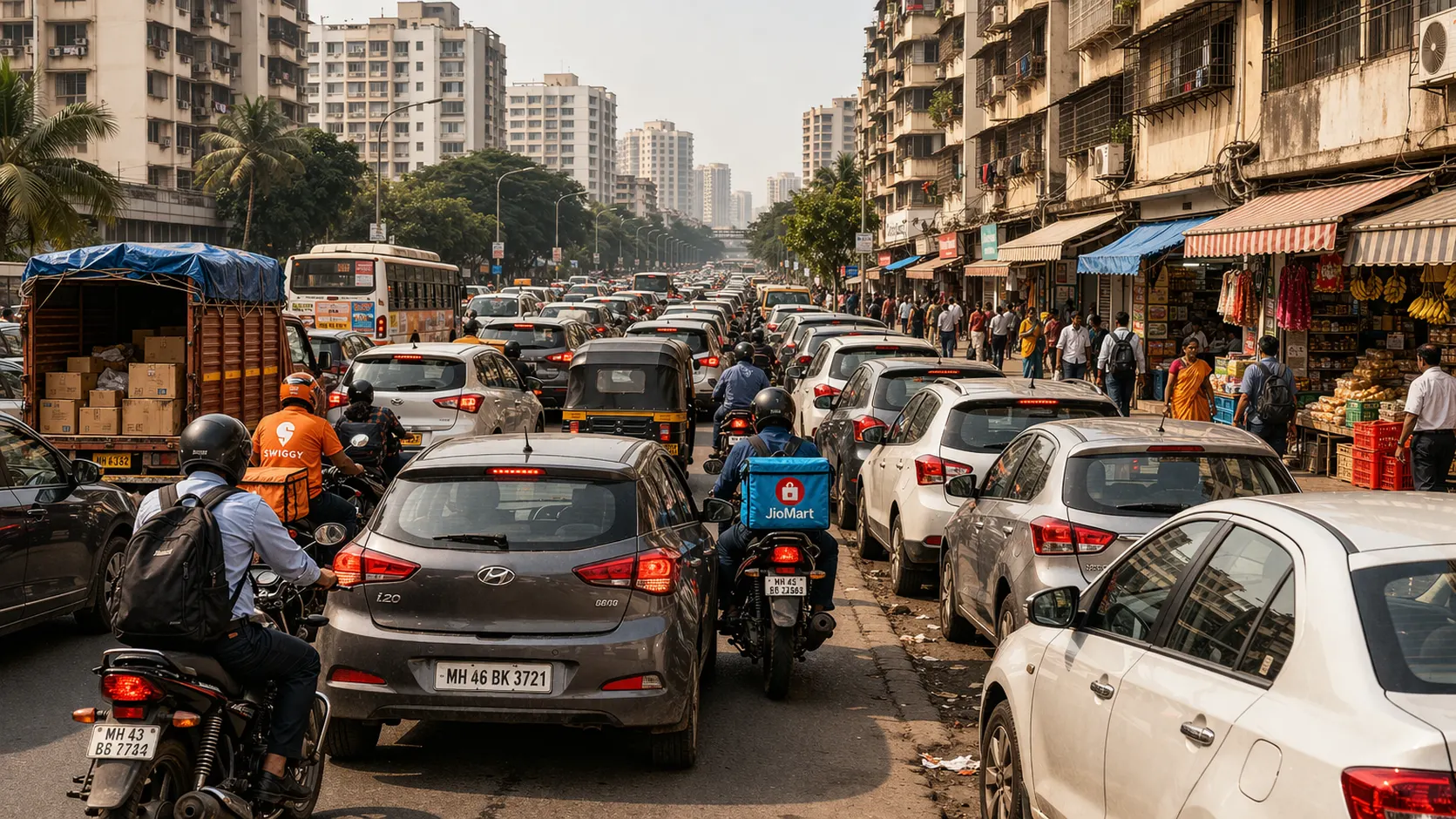
In a well-located Vashi pocket, daily life becomes lighter. You do not need to plan every small task around traffic. Grocery runs, pharmacy visits, clinic access, cash withdrawal, small service needs, and basic eating options are often available within a short walk.
That matters a lot in Indian urban life. It saves time, reduces dependency on vehicles for routine needs, and lowers the mental load of everyday management. For older parents, working couples, and residents who do not want to keep driving for small tasks, this is a real residential advantage, not just a brochure line.
The strongest version of this benefit is visible in Vashi’s more established mixed-use sectors, where social infrastructure is already embedded into the area, not waiting to arrive in the future.
Easier station access and stronger commute practicality
Vashi’s station-led practicality is one of its biggest residential strengths. Mixed-use growth near established transport corridors means residents in many pockets can combine walking and public transport efficiently. That makes daily commuting less chaotic than in nodes where homes and services are physically separated.
The Harbour Line remains a major strength. Add highway access and the time-value shift created by the Atal Setu, and Vashi becomes especially attractive for people whose working life depends on predictability. The point is not that traffic has disappeared. It has not. The point is that Vashi still offers stronger fallback options than many other places.
More active streets can feel safer and more usable
Purely residential silence is not always an advantage after dark. In some parts of Vashi, mixed-use activity creates a better sense of street life in the evening. Lit storefronts, visible movement, and active pedestrian presence can make the area feel less isolated than a quiet inner pocket elsewhere.
That said, this benefit has limits. Active streets can improve perceived safety, but once crowding, parking chaos, and noise cross a certain level, the same street activity starts feeling stressful rather than reassuring.
A practical example helps here. For a resident living near a usable internal stretch with controlled access to a busier road, mixed-use development can work beautifully. They get the convenience without taking the full hit of the traffic. But for a resident in a building fronting a high-footfall commercial road, the same convenience may start feeling like constant public exposure.
Where mixed-use growth starts reducing residential comfort
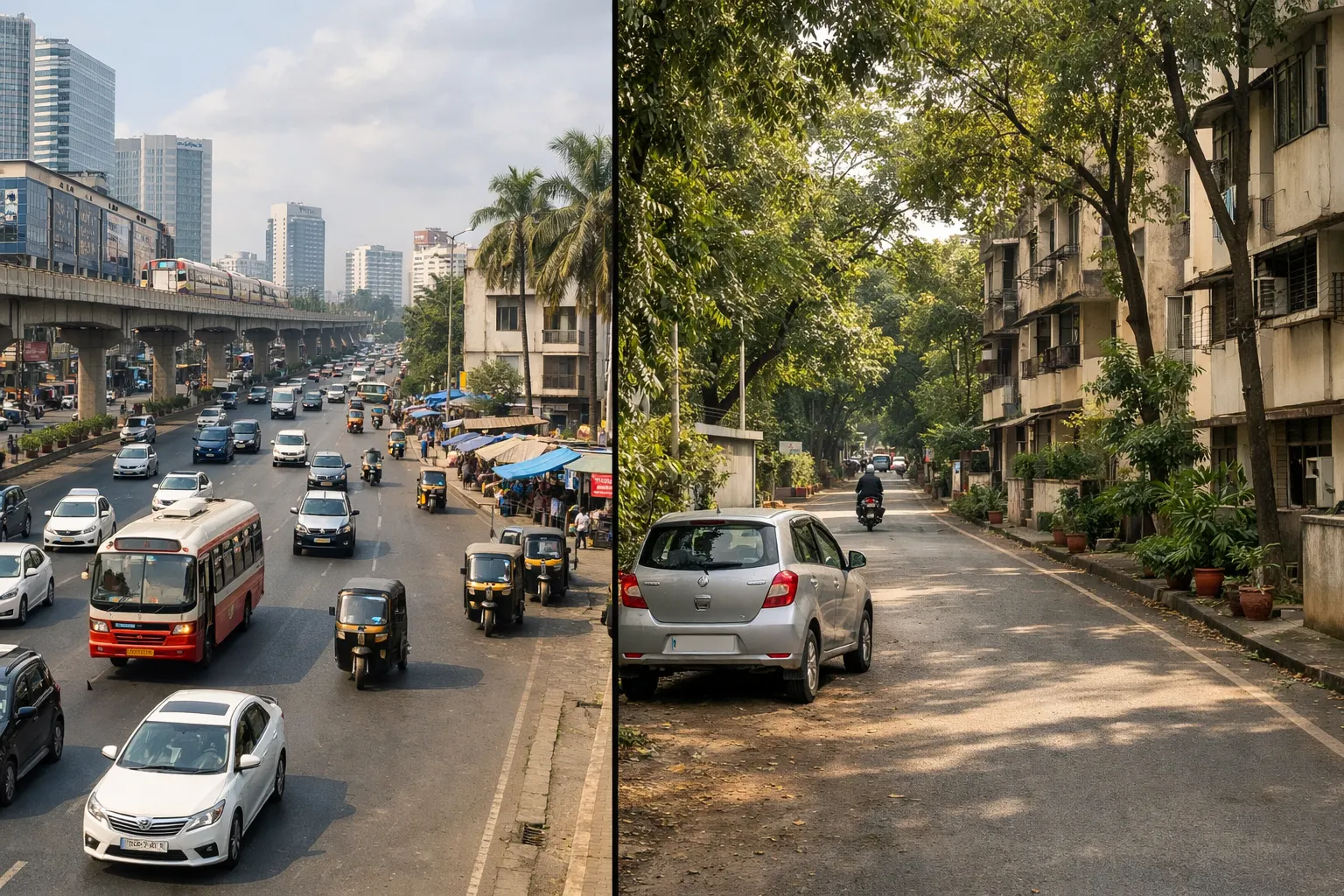
This is where Vashi’s residential livability gets more complicated, and where generic city pages usually fail the reader.
Traffic build-up, signal delays, and commercial vehicle movement
Mixed-use growth puts more people, more vehicles, more deliveries, and more service activity into the same street network. In busy Vashi pockets, especially around the station precinct, Sector 17-type commercial density, and key arterial stretches, that creates a daily pressure cycle.
This is not just about cars moving slowly. It is about what that means for residents. It means harder gate access, more honking, more idling vehicles, tighter turning space, delayed movement within short distances, and more stress for anyone who relies on road-based daily routines.
The Third Vashi Creek Bridge expansion may improve corridor-level movement as it nears completion, but readers should not confuse regional decongestion with instant lane-level peace inside Vashi’s mixed-use pockets.
Parking pressure inside and outside residential buildings
Parking is one of the biggest practical pain points in mixed-use Vashi, and it is getting harder to ignore. When residential roads also serve office visitors, shop customers, delivery riders, cabs, and service vehicles, the conflict becomes physical, not theoretical.
This issue matters even more now because the NMMC’s parking policy and enforcement environment make casual dependence on street parking far less reliable than before. In plain terms, a buyer or renter should not assume that “parking toh mil jayega” is a safe working assumption anymore.
A building can look attractive, but if its daily parking reality depends on outside road encroachment, it is already weaker from a livability point of view.
Noise, crowding, and ground-floor commercial spillover
The biggest emotional difference between a good mixed-use building and a bad one is spillover. A well-buffered building gives residents convenience. A badly exposed building gives residents intrusion.
In active stretches, residents may deal with early rolling shutters, late footfall, door sounds, delivery movement, café or food outlet odors, commercial waste handling, and constant background street noise. Traffic noise in busy mixed-use areas can push well above the safe residential limit, and once that becomes routine, the home stops feeling fully separate from the street.
This is why buyers should care less about whether there is a commercial ground floor and more about what kind of commercial tenancy exists there. A bank, a clinic, and a boutique operate differently from a food outlet, café, or high-frequency delivery business.
Why work-from-home residents may feel this more sharply
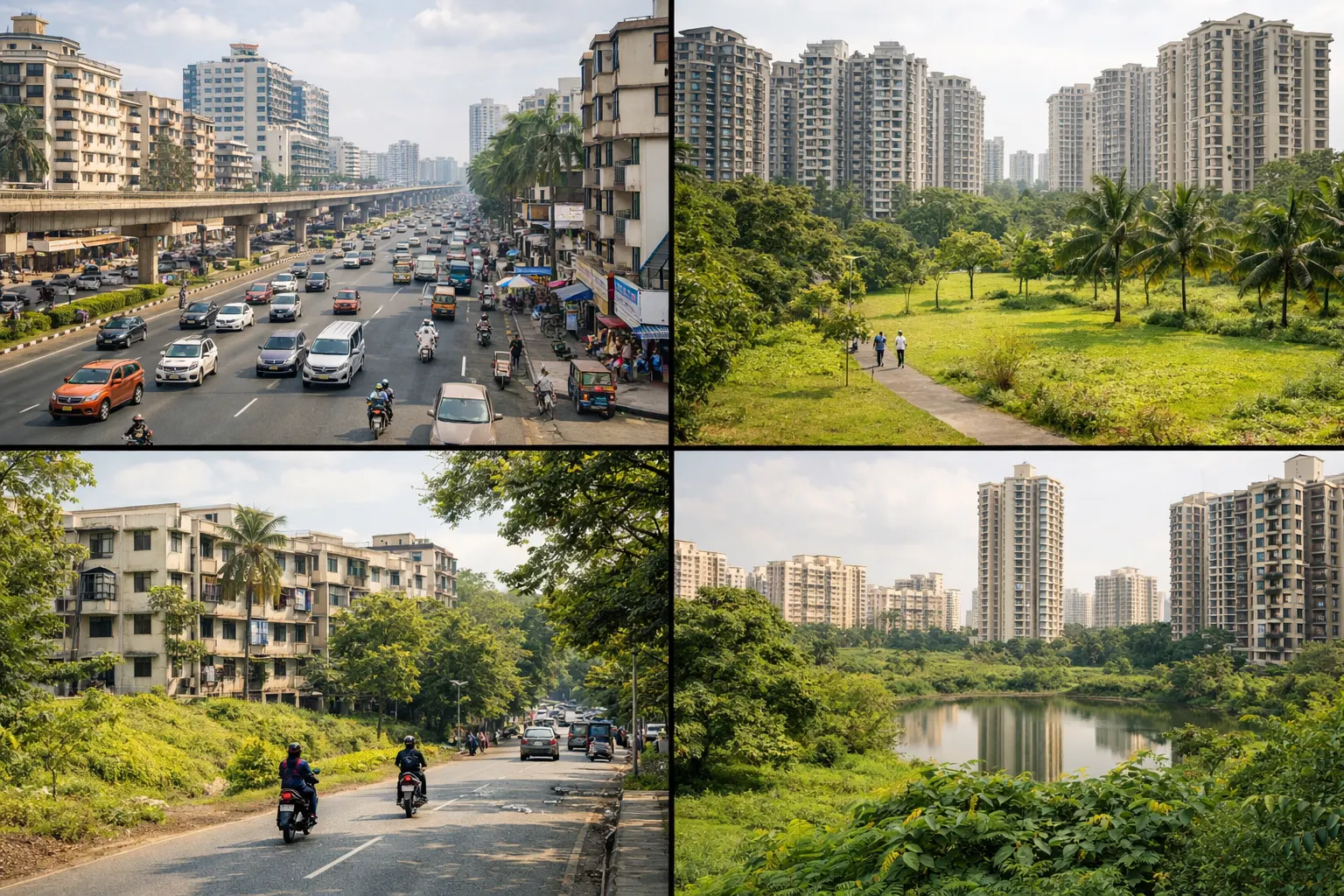
People who spend more hours inside the house feel mixed-use stress more directly. A dual-income couple that is out most of the day may tolerate a busier frontage quite easily. A person working from home, caring for a child, or supporting elderly parents will notice sound cycles, parking disruptions, and commercial noise much more.
That is why one household may call a Vashi location “super practical” while another calls it “too much.” Both can be right.
> Caution: In Vashi, convenience and comfort are not the same thing. A location can be excellent for access and still weak for quiet residential living.
Why livability in Vashi changes so much from one pocket to another
The biggest mistake people make is judging Vashi sector-wise when they should be judging it road-wise and building-wise.
Near-station stretches versus deeper internal residential pockets
Areas close to station-linked activity often offer the highest practical convenience. But they also absorb more movement, more public traffic, and more commercial intensity. Deeper internal pockets, even inside the same broader area, can feel significantly calmer.
That is why one home may feel intense and exposed while another, just a few minutes away, feels far more balanced. Vashi is not one residential experience. It is a collection of micro-pockets.
Main roads versus internal sector roads
This is one of the most important filters in Vashi. Buildings on wider roads are more exposed to legally permissible mixed-use activity and naturally attract more commercial energy. Buildings on narrower internal roads are usually better shielded.
For normal buyers and renters, the official rule can be decoded very simply: look at the street outside the building. A broader road usually means more present or future commercial activity. A narrower internal road usually means better residential protection.
Older mixed-use buildings versus more residentially buffered societies
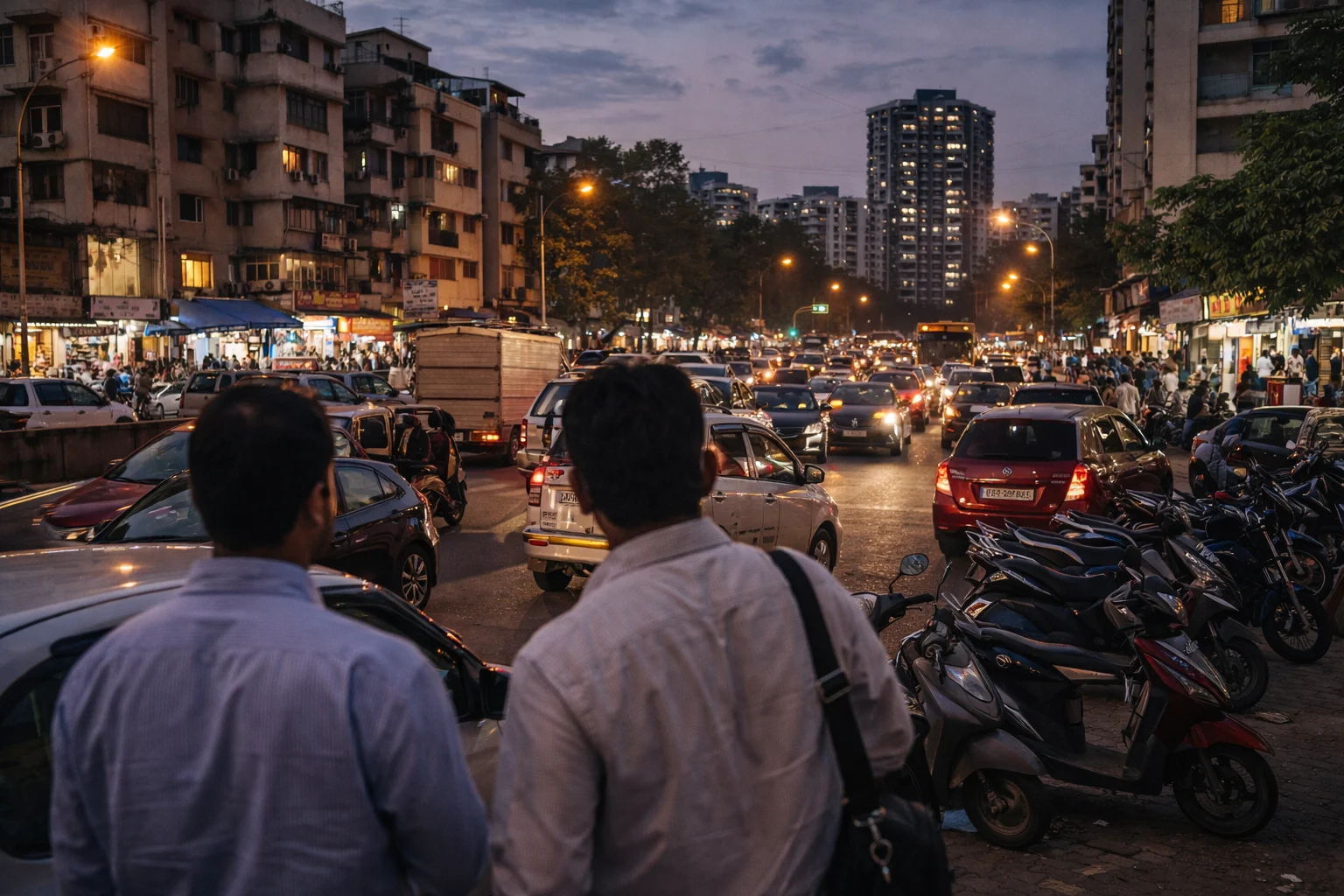
Older CIDCO stock in Vashi can still make residential sense, especially if it sits in a quieter internal pocket. But buyers need to understand two things clearly. First, older stock may come with invisible capex. In many cases, practical renovation and structural improvement needs can add roughly ₹8 lakh to ₹25 lakh to the real entry cost. Second, nearby redevelopment under the Urban Renewal Scheme can change the neighborhood environment over time.
Newer towers and more buffered societies may offer better sound separation, parking systems, and internal amenity protection, but they usually come at a much higher entry cost.
Is Vashi still a good residential choice for families, seniors, and daily commuters?
Yes, but not in the same way for everyone. Vashi remains a strong residential choice for some profiles and a poor fit for others.
For families with school-going children
Families often benefit from Vashi’s strong schooling and healthcare ecosystem. The ability to reduce school commute strain, access pediatric care quickly, and manage daily routines efficiently is a genuine strength.
But families should not romanticize this too much. In more commercial pockets, narrow vehicle-heavy roads, weak informal play space, and high noise can reduce the quality of daily childhood life. Vashi works better for families that value structured convenience more than open, quiet residential breathing room.
For senior citizens
For seniors, Vashi can be excellent where the micro-location is right. Access to pharmacies, diagnostic centers, and hospitals is one of its strongest lifestyle advantages. That can support independence and reduce stress for the whole family.
At the same time, broken pavements, parking encroachment, busy frontages, and heavy road activity can make outdoor walking difficult. So Vashi is good for seniors when the building is buffered, the lane is manageable, and daily essentials remain close without forcing them into chaotic walking conditions.
For office commuters
This is where Vashi often shines. For commuters, especially those who value access to the Harbour Line, highway routes, Atal Setu connectivity, or airport-linked mobility, Vashi’s mixed-use form makes sense. It saves time and reduces friction.
The compromise comes later in the day. Returning during evening peak movement and dealing with internal congestion or parking scarcity is part of the package.
For people who want peace more than convenience
This is where Vashi becomes a weaker fit. If your top priority is acoustic peace, uncluttered internal roads, lower sensory load, and a more relaxed residential rhythm, Vashi’s stronger mixed-use pockets may wear you down over time.
For such residents, nearby alternatives may offer a better everyday life, even if they give up some convenience.
How Vashi compares with Sanpada, Nerul, and Seawoods on livability
Vashi is rarely evaluated alone. Most serious buyers and renters also compare it with Sanpada, Nerul, and Seawoods.
| Node | Best known for | Residential strength | Residential compromise | Best fit |
|---|---|---|---|---|
| Vashi | Maximum convenience and mature urban infrastructure | Strong walkability, services, station access, fast daily functioning | Commercial intensity, parking stress, noise in active pockets | Commuters, busy families, convenience-first households |
| Sanpada | Quieter alternative near Vashi | Better residential buffering, calmer internal feel in many pockets | Slightly less intense convenience than Vashi core | Families wanting access without too much chaos |
| Nerul | Mature greenery and steadier residential feel | Better peace, established community feel, more breathable daily life | Not as aggressively convenient as Vashi in commercial terms | Families, seniors, peace-first buyers |
| Seawoods | New-age convenience with premium ecosystem | Good modern appeal, transit-linked convenience, organized residential image | Traffic waves in certain corridors, premium pricing | Younger professionals, premium urban users |
In practical terms, Vashi is the high-energy option. Sanpada often works for people who want Vashi access without Vashi-level intensity. Nerul suits people who value daily comfort and greenery more than relentless convenience. Seawoods sits somewhere between premium planning and active urban movement, depending on the exact location.
What buyers and renters should check before choosing a home in mixed-use parts of Vashi
This section matters because many people get Vashi wrong not during research, but during inspection.
The 8 PM reality check
Never judge a Vashi mixed-use building only on a Sunday afternoon visit. That is one of the most common buyer mistakes.
Use this practical checklist instead:
- Visit once on a weekday evening around 8 PM
- Check whether residents are struggling to park
- Observe whether cabs, delivery riders, or commercial vehicles are blocking access
- Walk behind the building and inspect service lanes
- See where waste is stored and where exhaust vents are directed
- Notice if the commercial frontage becomes louder after sunset
- Check whether the road outside is a broad active road or a narrower internal lane
- Ask what exactly operates on the ground floor today, and whether tenancy turnover is frequent
- For older buildings, budget honestly for repair and upgrade needs
Building frontage, parking reality, and delivery activity
If a building opens directly onto a major road or a high-footfall stretch, expect more exposure. If it sits one lane in, that small separation can change the experience dramatically.
Also, parking must be treated as a real structural issue, not a negotiable assumption. In 2026, legal and practical parking capacity matters more than broker comfort talk.
Whether the convenience premium is actually worth it for your lifestyle
This is the question that should decide the purchase. Do not ask only, “Is Vashi a good area?” Ask, “Do I really need what this exact Vashi location is selling?”
If your family will use the walkability, station access, clinic access, and service ecosystem every day, the premium may be justified. If you mostly want a calm house, weekend peace, and easier movement for children or seniors, a quieter node may deliver better value even with a slightly longer commute.
When mixed-use growth is actually a positive for residential life in Vashi
Mixed-use growth works well when the building and street design buffer residents from direct commercial pressure. In those cases, people get the upside without taking the full downside.
That usually means street-level activity is kept controlled, residential access remains separate, parking is structurally planned, and the home sits slightly above or away from the most active public movement. In these situations, Vashi becomes very efficient as a residential choice. You get the doctor, pharmacy, groceries, and transport benefits without feeling like you live inside a market.
It also helps explain why Vashi remains such a coveted node despite its tradeoffs. Strong convenience, strong liquidity, strong tenant demand, and strong regional access are not small advantages. They are structural reasons why many people continue to choose Vashi.
When mixed-use growth becomes a residential compromise
It becomes a compromise when commercial life starts consuming infrastructure that residents also depend on. Once roads, parking, pavements, and frontage start functioning more for outside footfall than for people living there, residential quality begins to fall.
This is especially visible on heavily exposed road-facing pockets, dense commercial corridors, and older buildings without enough internal buffering. When you cannot open windows comfortably, when late-night movement becomes routine, when parking is a daily stress point, and when emergency access feels uncertain, convenience is no longer enough to protect livability.
That is the line buyers and renters must watch carefully. Not all mixed-use is bad. But unbuffered mixed-use can be exhausting.
Conclusion
Choose Vashi if your life benefits directly from its speed. It makes sense for commuters, frequent travelers, dual-income households, families that heavily use nearby schools and healthcare, and residents who place a premium on saving time every single day.
Be more cautious if you work from home, have very young children who need safer and quieter everyday surroundings, have elderly family members who need easier outdoor walking conditions, or personally value silence more than convenience. In that case, Sanpada or Nerul may make more practical sense, and in some cases Seawoods may also suit better depending on the exact lifestyle fit.
The key is not to ask whether Vashi is good or bad. The key is to ask what kind of Vashi you are choosing, and what kind of household you are.
FAQs
Frequently Asked Questions