
How Navi Mumbai Was Planned: CIDCO Nodes Explained for Homebuyers
A lot of buyers in Navi Mumbai focus on the usual things first. Price. Location. Connectivity. Builder. Future appreciation. All important. But there is one layer many people ignore until a legal or approval issue suddenly appears. The authority structure. In Navi Mumbai, that matters more than in many other cities because this city was not built in the usual random urban way. It was planned, phased, and controlled through a very different system.
That is why terms like CIDCO, node, NMMC, PMC, leasehold, freehold, OC, and planning authority keep showing up in property discussions here. For a first-time buyer, it can feel unnecessarily confusing. But once you understand how Navi Mumbai was actually created, the confusion drops fast. And honestly, this understanding can save you from very expensive mistakes later.
Quick Summary for Homebuyers
| Term | Simple Meaning |
|---|---|
| CIDCO | Original planner and development authority of Navi Mumbai |
| Node | A planned urban unit within Navi Mumbai |
| NMMC / PMC | Civic authority depending on the area |
| Buyer Focus | Authority, approvals, lease/title structure, taxes, and service systems |
For buyers, this table alone already explains a lot. Navi Mumbai is not just one city operating under one simple authority. It is a layered city where one authority may have originally planned the area, another may handle current civic administration, and a different legal structure may still affect land title or transfer charges.
That is why a flat in Vashi, a tower in Kharghar, and a plot near airport-side influence areas may all fall under very different practical realities. Same city name. Different authority chain. Different buyer risk. Different documentation logic.
What Is a Node in Navi Mumbai?
Simple meaning of node
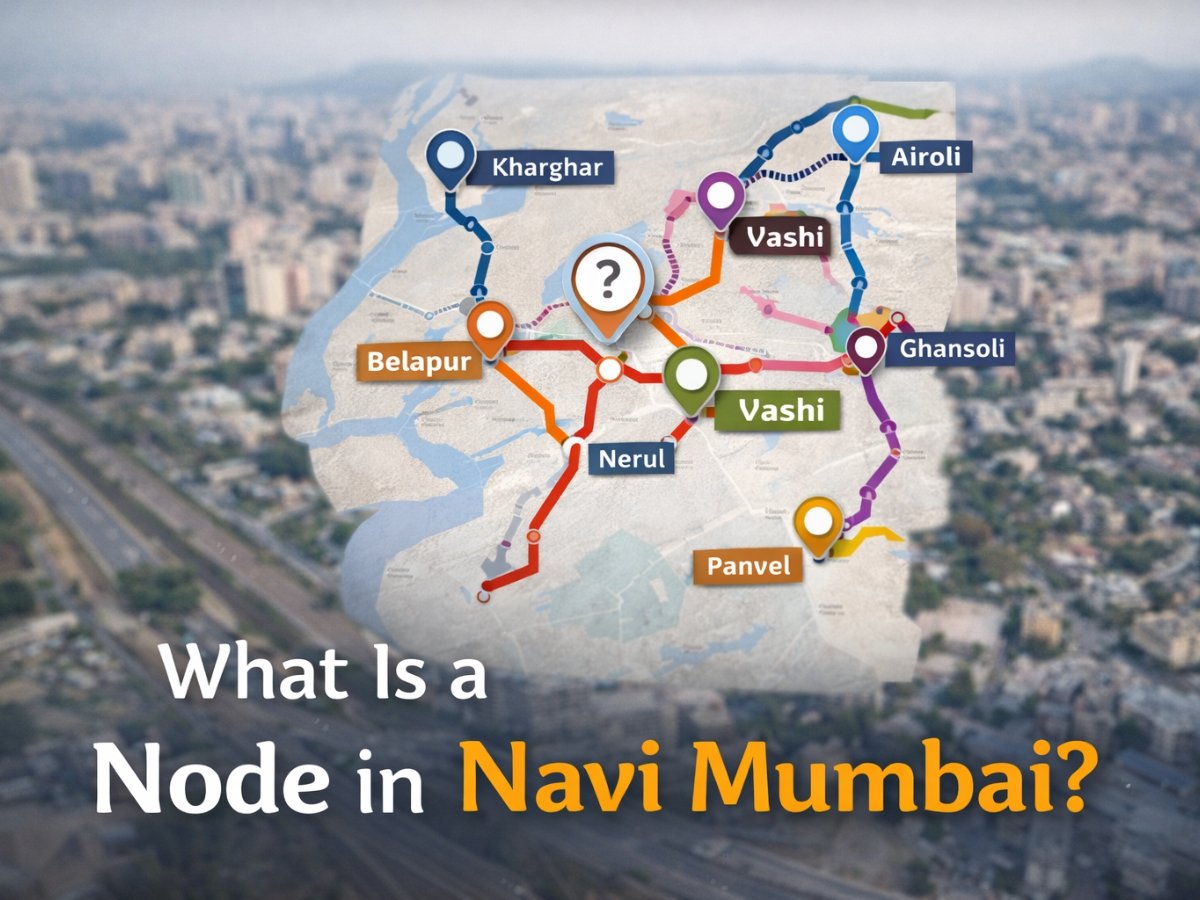
A node in Navi Mumbai is basically a planned urban unit. It is not just a casual locality name. When Navi Mumbai was designed, it was imagined as a series of self-contained urban zones instead of one overloaded central city. These zones were called nodes.
The original planning logic was deeply structured. Each node was supposed to have its own residential sectors, schools, health facilities, business areas, and recreation spaces. In simple words, the idea was that people should be able to live, work, study, and manage daily life within or near their own node without depending entirely on one overcrowded city center.
Why node planning matters for buyers
For buyers, this matters because a node is not just a map label. It often reflects the planning age, infrastructure maturity, social profile, and authority structure of the area. Vashi, Nerul, Belapur, Kharghar, Airoli, Ghansoli, Kamothe, Kalamboli, Panvel all belong to different phases and different administrative realities.
It also affects how a neighborhood behaves in real life. Some nodes are mature and infrastructure-rich. Some are still expanding. Some have stronger civic reliability. Some still carry issues around water, land tenure, or planning transition. So when buyers say “I want property in Navi Mumbai,” the next real question should be: which node, under which authority, and with what land structure?
CIDCO’s Role in Navi Mumbai Planning
Why CIDCO matters
CIDCO matters because without it, Navi Mumbai as we know it would not exist in its planned form. The Maharashtra government accepted the twin-city idea in 1970 and set up the City and Industrial Development Corporation, or CIDCO, as the statutory new town development authority. CIDCO was the body that handled land acquisition, the master-planning model, and early urban development structure.
This is why even today, decades later, CIDCO still appears everywhere in Navi Mumbai real estate conversations. It was not just a builder or a land seller. It was the original planner of the city’s structure, nodes, sectors, land allotment, and much of the legal framework that still affects ownership today.
Where buyers still hear CIDCO today
Buyers still hear CIDCO today because its role never disappeared completely. Even where municipal corporations handle everyday civic matters now, CIDCO may still matter for land ownership history, leasehold status, transfer charges, NOCs, auctions of vacant plots, and freehold conversion issues.
It also remains especially important in newer and greenfield influence areas, particularly around NAINA and airport-side expansion belts, where CIDCO continues to act as a planning authority. So even if a buyer is not directly buying from CIDCO, CIDCO can still be legally relevant to the transaction. That is where people often get confused.
CIDCO vs NMMC vs PMC: What Is the Difference?
Planning authority vs municipal authority
This is the biggest confusion point for most buyers. CIDCO is the original planning and development authority. NMMC and PMC are municipal authorities handling civic administration depending on the area. That means planning history and current civic governance are not always controlled by the same body.
In simple terms, CIDCO planned and developed large parts of Navi Mumbai. Then, as areas matured, local civic administration shifted to elected municipal bodies. So buyers today may be dealing with a property in an area where CIDCO shaped the land and legal structure, but NMMC or PMC handles things like taxes, water, and civic permissions.
Why buyers get confused
Buyers get confused because they hear all three names at once and assume they mean the same thing. They do not. A project may be in a PMC-governed area but still sit on land originally structured through CIDCO. A resale property may fall under municipal taxation today but still carry CIDCO leasehold implications.
This is exactly why generic advice fails in Navi Mumbai. The city is legally layered. And when you ignore that layering, you can misunderstand taxes, approvals, title structure, transfer costs, and even practical lifestyle issues like water supply.
Which Authority Matters in Which Areas?
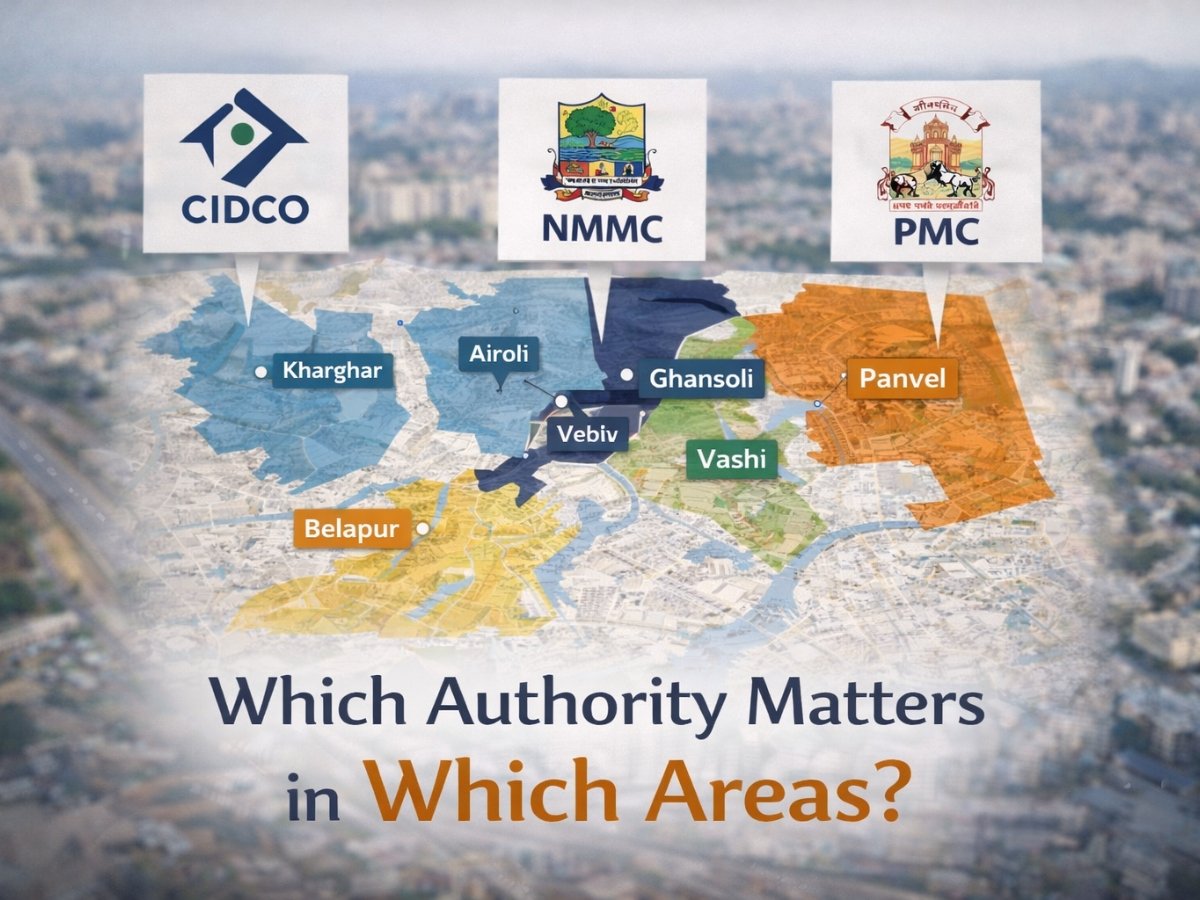
Older Navi Mumbai nodes
The older and more mature northern nodes like Airoli, Ghansoli, Koparkhairane, Vashi, Sanpada, Nerul, and CBD Belapur are governed under NMMC for civic administration. These are the established parts of Navi Mumbai with stronger municipal maturity and generally more stable civic systems.
That does not mean CIDCO is irrelevant there. CIDCO can still matter for land history or vacant plot issues. But from a day-to-day buyer experience, NMMC becomes a key authority for civic administration, property tax, and urban services in these older nodes.
Kharghar, Kamothe, Kalamboli, Panvel-side areas
This is where many buyers make assumptions and get things wrong. Kharghar, Kamothe, Kalamboli, Taloja, New Panvel, and broader Panvel-side expansion belts come under PMC for civic governance, not NMMC. That matters because taxation method, service quality, planning handling, and practical utility experience can feel different from northern Navi Mumbai nodes.
Kharghar is a perfect example. Many people mentally treat it like mainstream Navi Mumbai, and location-wise that makes sense. But administratively, it sits in the PMC side of the jurisdictional divide. That changes property-tax logic, water-supply dependence, and certain approval realities. Buyers should never ignore that.
Airport-side and growth-belt areas
In airport-side influence zones and large greenfield belts, especially under NAINA, CIDCO remains highly relevant as the Special Planning Authority. These are not ordinary mature urban zones. They are part of the next stage of Navi Mumbai’s expansion story.
This is why growth-belt buying needs even more legal caution. The excitement around future infrastructure can be real, but the authority structure is often more complex there. Land pooling, planning schemes, development permissions, and title clarity matter deeply in these areas. A buyer attracted by future upside should become extra careful, not less.
What Homebuyers Should Check Before Buying

Authority jurisdiction
The first question a buyer should ask is simple: Which authority governs this property today? Not just what the broker says. Not just what people casually assume. Confirm whether the property falls under NMMC, PMC, or a CIDCO-led special planning zone.
That one answer influences taxes, approvals, civic complaint systems, water and infrastructure expectations, and sometimes legal interpretation of the land structure itself. In Navi Mumbai, authority jurisdiction is not a side detail. It is part of the asset.
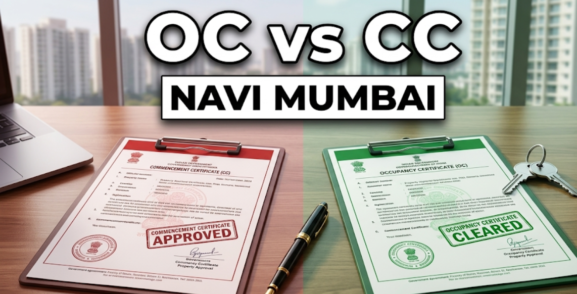
CC, OC, approved plan
Buyers should also check the approval chain carefully. The research is very clear here. A building must move through approval stages including IOA/IOD, CC, and finally OC. Many people confuse CC and OC, but they are not the same. CC confirms building completion as per sanctioned plans, while OC is the final legal permission for occupancy and civic functionality.
This matters a lot because possession without OC can create serious problems. Water, electricity, property tax penalties, and legal habitability all become risk points. So before booking, especially in under-construction or recently completed projects, check the actual approval chain, not just the sales presentation.
Leasehold vs freehold
This is one of the most important checks in Navi Mumbai. A lot of land historically came through CIDCO on a leasehold model, not full freehold ownership. That means the structure may belong to the buyer, but the underlying land carries a different legal logic and often requires CIDCO-related permissions or charges.
The big 2025–2026 shift is that CIDCO has allowed freehold conversion for many residential leasehold plots. That is huge for buyers because it can reduce transfer friction and improve ownership clarity. But you should never assume every property has already become freehold. Verify it. Absolutely verify it.
Tax and service charge confusion
Another common area of buyer confusion is taxes and recurring charges. NMMC and PMC do not function the same way on property-tax methodology. The research also points out meaningful service differences, especially around water reliability between northern mature nodes and southern PMC-side growth belts.
So before buying, do not ask only “What is the EMI?” Ask: what is the annual property tax, who provides the water, what are the service vulnerabilities, and does this location have recurring civic dependency issues? These questions are not glamorous. But they are very real.

Common Mistakes Buyers Make
Assuming all Navi Mumbai areas work under one authority
This is the classic mistake. People think Navi Mumbai is one city with one unified authority structure. It is not. Older northern nodes, southern Panvel-side nodes, and airport-influence greenfield zones can operate under very different combinations of planning and civic control.
Once you understand that, a lot of buyer confusion disappears. Kharghar is not administratively the same as Vashi. Taloja is not the same as Nerul. NAINA-linked land is definitely not the same as a normal resale flat in Sanpada. Same region, different rules.
Ignoring land/title structure
Another huge mistake is looking only at the apartment and ignoring the land underneath it. In Navi Mumbai, title structure can involve leasehold, freehold conversion status, CIDCO transfer issues, and land-record implications. Many buyers focus on the flat’s interiors and skip the deeper title question. Bad move.
Especially in resale transactions, ignoring the land structure can lead to surprise transfer charges, NOC issues, and delayed processing. In some cases, even society transfer confusion gets mixed into the transaction. So title structure should be treated as a first-step legal check, not a last-minute legal formality.
Not checking approval chain
Many buyers also make the mistake of assuming that if the building exists physically, everything is fine legally. That is not how property works. A visible tower is not the same thing as a fully cleared tower. The approval chain matters. The sanctioned plan matters. The OC matters. The authority issuing them matters.
Skipping this check is risky in any city, but in Navi Mumbai it becomes even more important because different authorities and land structures can overlap. So when buyers say “project dekhne me achha hai,” the serious next question should be: “approval chain clean hai kya?”
Final Takeaway for Buyers
The most practical conclusion is simple and important: In Navi Mumbai, location dekhna enough nahi hai, authority structure samajhna bhi equally important hai. That one line honestly captures the entire city’s property logic.
A home in Navi Mumbai is not just about carpet area, tower quality, or future infrastructure story. It is also about who planned the land, who governs the area now, what kind of title sits underneath the property, how approvals were issued, and what civic reality the buyer will actually live with after possession. Understand that layer properly, and you will make much better decisions here.
FAQs
Frequently Asked Questions