How to Check if a Housing Society Is Registered in Navi Mumbai?
you can usually verify whether a housing society is registered in Navi Mumbai through official co-operative records and related government portals. But that check only confirms that the society legally exists as a co-operative body. It does not automatically prove that the building has all approvals, that the flat title is clean, or that the transaction is fully safe. That difference matters a lot before paying token money for a resale flat.
If you are buying in Vashi, Nerul, Belapur, Kharghar, Kamothe, Ulwe, Taloja, or Panvel-side areas, this is one of those checks that looks small but can save you from bigger trouble later. Many buyers hear “society registered hai” and relax too early. In real life, that is only the first layer of due diligence.
Quick Summary
| Question | Practical Answer |
|---|---|
| Can you check if a society is registered? | Yes, usually through official co-operative society records and online government portals. |
| What does registration prove? | That the society exists as a legally recognized co-operative body. |
| What does it not prove? | It does not prove OC, CC, clean title, no disputes, or flat-level legal safety. |
| Why does it matter in Navi Mumbai? | Because society status often affects share certificate transfer, resale comfort, CIDCO-linked paperwork, and buyer confidence. |
| Is online check alone enough before buying? | No. It should be matched with sale deed chain, share certificate, OC where applicable, and local authority-related records. |
What does a “registered society” actually mean in a Navi Mumbai housing context?
A registered housing society means the group of flat owners has been formally recognized under the Maharashtra Co-operative Societies Act, 1960. In simple terms, the society is no longer just an informal resident group or builder-controlled maintenance setup. It becomes a legal entity that can collect maintenance, keep records, issue share certificates, operate bank accounts, and act through a managing committee.
This is important because many buildings function like societies even before they are properly registered. Residents may already be paying maintenance, there may be a committee, and sellers may speak as if everything is formal. But a functioning building and a legally registered society are not the same thing.
In Navi Mumbai, this difference becomes even more practical because old co-operative stock, CIDCO-linked leasehold systems, and newer Panvel-side developments all behave differently on paper.
Registered society vs informal building management
| Situation | What it usually means |
|---|---|
| Registered co-operative housing society | Legal entity exists under the co-operative law framework |
| Ad-hoc resident committee | Residents are managing day-to-day issues, but formal registration may not be complete |
| Builder maintenance setup | Builder may still be controlling maintenance and common-area decisions |
| Society under formation | Registration process may be underway, but full handover may not have happened yet |
Where can you check a society’s registration online or through official records?

The most practical route is to start online and then verify offline if anything looks incomplete, mismatched, or unclear.
The main official route in Maharashtra is the MahaSahakar portal, especially the society validation section. A secondary route is the Office of the Charity Commissioner Maharashtra portal, where society details can sometimes be checked through the “Know Your Society” style search path. For physical verification, the relevant Deputy Registrar or Assistant Registrar office may still be necessary depending on the building’s location and record quality.
For many Navi Mumbai buyers, online results are enough to establish a basic first-level comfort. But if the transaction is serious, especially resale, older society, redevelopment-prone building, or CIDCO-related transfer, you should still match the society identity across documents.
What details you should keep ready before searching
Before you start, collect as many of these as possible:
- Full society name exactly as shown on the share certificate or maintenance bill
- Society registration number, if the seller has it
- Building address
- Flat number and wing
- Area or node name such as Nerul, Vashi, Kharghar, Kamothe, Ulwe, Panvel, Belapur
- Any society letterhead, transfer form, or previous society receipt
Exact spelling matters more than many buyers expect. A small mismatch in the society name, phase name, wing identity, or project block can create confusion.
What proof should ideally appear
Ideally, the search should show a traceable official identity of the society, including some combination of:
- Registered society name
- Registration number
- Status such as approved or valid
- Office or jurisdiction reference
- Related society details matching the building identity
If the seller claims the society is registered but cannot give even the proper registration number, that is not automatically proof of fraud, but it is a sign to dig deeper.
What to do if online results are incomplete
Online results are not always clean, searchable, or buyer-friendly. If records are not visible or are ambiguous:
1. Recheck the spelling using older sale deed and share certificate wording. 2. Try the search with registration number instead of only society name. 3. Ask the society office for a copy of the registration certificate. 4. Ask for the latest audited papers or formal letterhead with the registration number. 5. Visit or send a representative to the relevant registrar office if the deal is substantial.
For CIDCO-linked nodes, physical record trails can be especially important when a transfer or membership issue is involved.
What details should match when you verify a society?
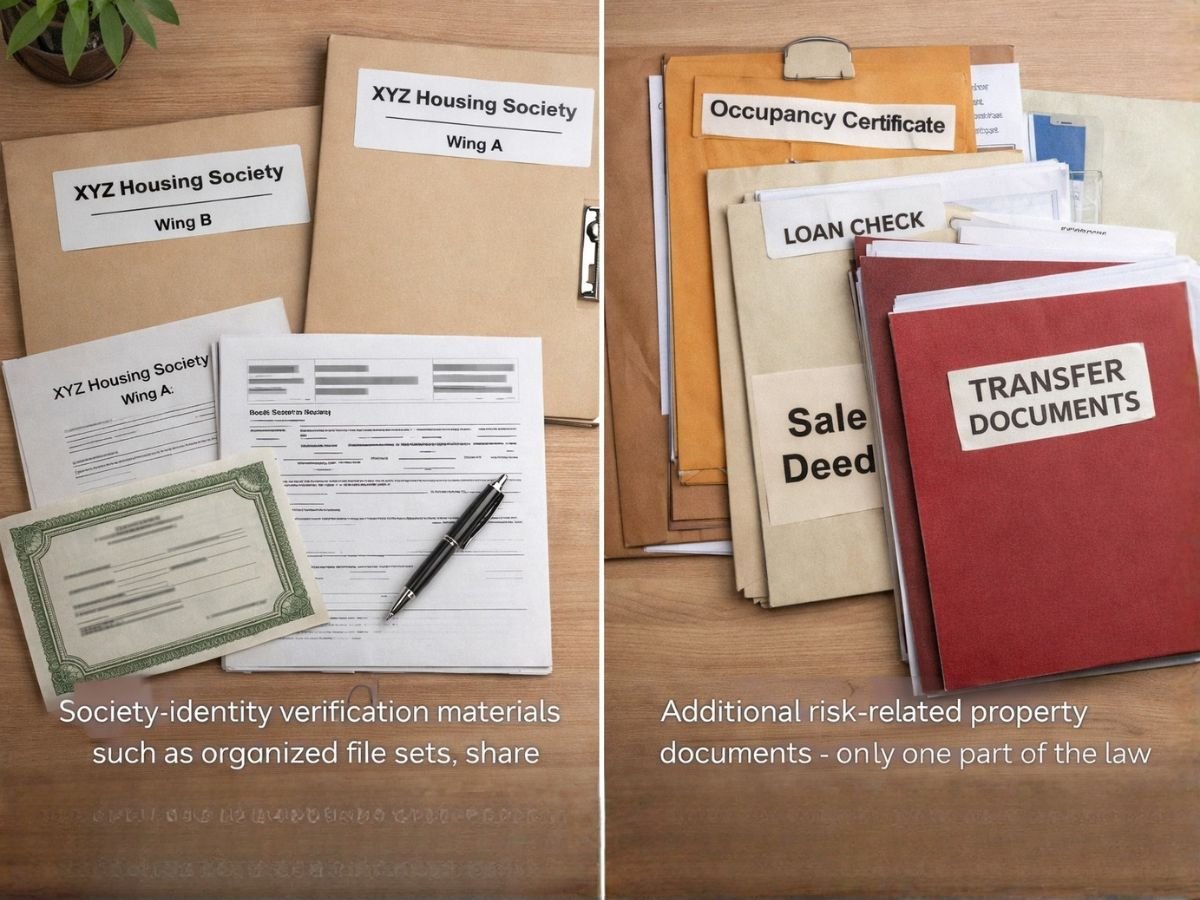
Finding one society name online is not enough. You need identity matching, not just name spotting.
In Navi Mumbai, especially in larger projects with multiple wings or phases, similar names can mislead buyers. A seller may say the project has a registered society, but your specific wing, tower, or phase may still be under formation or separately administered.
Verify these fields carefully
| Item to match | Why it matters |
|---|---|
| Society name | Must match the seller’s papers and society records closely |
| Registration number | Helps confirm the exact legal entity |
| Address/building identity | Ensures the record belongs to the same building or wing |
| Project phase or wing | Important in multi-building developments |
| Share certificate wording | Should align with the society identity |
| Sale deed description | Helps avoid phase-name and layout confusion |
This is one of the biggest practical mistakes in resale transactions. Buyers see a society name, assume the issue is settled, and only later discover that the flat belongs to a different phase or a society whose transfer chain is still messy.
If a society is registered, what does that prove and what does it not prove?
This is the most important part of the whole topic.
A registered society proves that the co-operative body exists legally. It usually means there is a formal administrative structure for members, maintenance, and records. But it does not prove that the building is fully regular in every legal sense.
That distinction is where many buyers go wrong.
What registration usually supports
A registered society usually supports these conclusions:
- The society legally exists under the co-operative framework
- It can collect maintenance formally
- It can maintain member records
- It can issue or transfer share certificates, subject to its internal and legal conditions
- It can act through a committee and deal with society administration
What registration does not guarantee
A society registration certificate does not automatically prove:
- The building has a valid Occupancy Certificate
- The building has a valid Completion Certificate
- The land has been properly conveyed to the society
- The flat title is free from loan, charge, or lien issues
- The seller has cleared all transfer-related dues
- There are no redevelopment disputes or internal society conflicts
- A bank will definitely approve the loan
What registration proves vs what it does not prove
| A registered society usually proves | A registered society does not prove |
|---|---|
| The society legally exists | The building has an OC or CC |
| The society can function as a co-operative body | The flat title is clean |
| Maintenance and member administration can happen formally | There are no encumbrances or disputes |
| Share certificate issuance framework may exist | The society has conveyance or deemed conveyance |
| The committee can act on society matters | That every resale transfer will be smooth |
So yes, society registration matters. But no, it is not a shortcut for full legal due diligence.
Why buyers in Navi Mumbai confuse society registration, share certificate, and legal title
This confusion is very common in old Navi Mumbai buildings.
A society registration certificate belongs to the society as an entity. A share certificate belongs to the individual member as proof of their membership and shareholding in that society. The sale deed remains the core title document for the flat transaction. These three things work together, but they are not interchangeable.
In areas like Vashi, Nerul, Belapur, Seawoods, and older parts of Kharghar, sellers often present the share certificate as if it is the final proof of everything. It is important, but it is not a substitute for the title chain or other approvals.
Simple example
Suppose a flat in Nerul has:
- A valid-looking share certificate
- A functioning society office
- Regular maintenance receipts
That still does not answer whether:
- The original title chain is clean
- The building has proper occupancy status
- The land was conveyed properly
- There are hidden dues or transfer issues
That is why serious buyers should never stop at the sentence: “Society registered hai, tension mat lo.”
How this check differs in older society buildings, CIDCO-linked layouts, and Panvel-side newer areas
This topic becomes far more useful when you understand local area logic.
Older co-operative society buildings in established nodes
In Vashi, Nerul, Belapur, and some older Seawoods or Kharghar pockets, society registration itself is often not the biggest issue. These societies may have been registered for years. The real risk may be elsewhere: incomplete conveyance, poor record maintenance, missing old transfer documents, or redevelopment-related complications.
So in older buildings, society registration is only the starting checkpoint. The smarter question becomes: is the society properly functioning, and are the flat-level papers consistent with it?
CIDCO-influenced ownership and leasehold systems
In many Navi Mumbai nodes, especially those shaped by CIDCO’s leasehold structure, the society’s legal position matters because transfer mechanics can become more layered. Resale comfort may depend not only on society membership and share certificate transfer, but also on CIDCO-related transfer history.
A registered society in Kharghar or Kamothe may still refuse transfer comfort to a buyer if old CIDCO transfer dues were never cleared. This is one of the most practical local traps.
Panvel-side and newer project areas
In Ulwe, Taloja, Karanjade, and some Panvel Municipal Corporation-side belts, society formation delays are more common in relatively new or recently occupied buildings. Sometimes that is just a process delay. Sometimes it is a warning sign that the builder still wants control over maintenance, parking, or common areas.
If a building is several years old and the society is still “under formation,” do not panic automatically, but do not ignore it either.
What if the society is under formation, newly formed, inactive, or hard to trace?
A society under formation is not always a deal-breaker. In a new project, this may simply mean the registration process is still moving through official channels. Under current digital transitions and administrative changes, delays can happen.
But the meaning changes with building age.
If possession has been given recently, under-formation status may be understandable. If the building is older and still has no clear registration trace, that can point to deeper issues such as poor handover, weak compliance culture, builder control, or record gaps.
An inactive or hard-to-trace society is also not a great sign in resale. It may indicate filing failures, weak governance, or internal management problems.
Which other documents should be checked along with society registration before buying a flat?
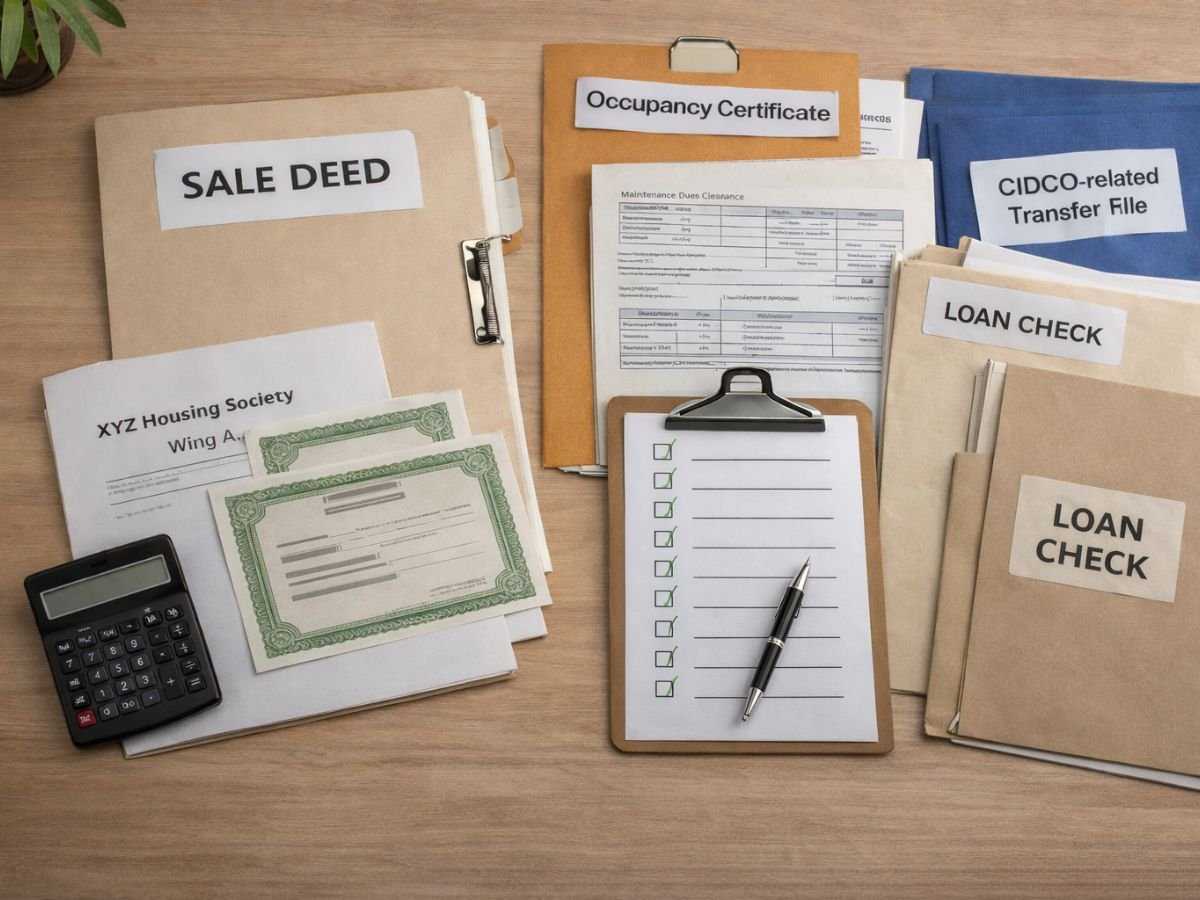
This is where buyers separate safe due diligence from half-due diligence.
Society registration should be checked together with flat-level and building-level documents. Otherwise you are only verifying the shell, not the transaction.
Practical due diligence checklist before resale purchase
| Document or check | Why it matters |
|---|---|
| Sale deed chain | Confirms the ownership trail |
| Share certificate | Confirms society membership position where applicable |
| Society registration proof | Confirms legal society existence |
| Maintenance dues clearance | Prevents inherited dues problems |
| Conveyance or deemed conveyance status | Helps assess land and society rights position |
| Occupancy Certificate where applicable | Important for building legality and buyer comfort |
| CIDCO transfer-related history in applicable nodes | Critical in leasehold-linked locations |
| Loan, lien, or charge check on flat | Confirms flat-level financial risk |
| Society NOC or written transfer position | Helps avoid last-minute membership issues |
In practical Navi Mumbai resale deals, the buyer who checks only one document usually suffers later. The buyer who cross-matches society papers with flat papers usually catches problems earlier.
Red flags that society registration status may not be telling the full story
Some warning signs deserve immediate attention:
- Society name on records does not match seller documents properly
- Seller says society is registered but cannot show a copy or number
- Building is old, but share certificate transfer is still unclear
- Society exists, but there are internal transfer disputes
- Society registration is used as a substitute answer for all other approvals
- In CIDCO-linked areas, historical transfer dues are unresolved
- The building has residents and maintenance but society registration remains vague for years
One realistic Navi Mumbai-style scenario is this: a buyer in Kharghar verifies that the society exists and is registered, feels comfortable, and pays token money. Later, during transfer, the buyer learns that old CIDCO-related dues or past transfer gaps were never regularized. The society then delays membership or share certificate transfer until those issues are resolved. The society was real. The transaction problem was also real.
That is exactly why registration status should be read as useful, but limited.
A simple decision guide: when registration status gives basic comfort and when you need deeper legal review
Registration is enough for basic comfort only when it fits into a cleaner overall document picture.
Lower-risk situations
A society registration check is more useful and reassuring when:
- The society record is traceable and matches the papers
- The building is established and functioning normally
- The seller has a clear share certificate where applicable
- Maintenance dues are formally cleared
- Title chain is available and consistent
- Other project and flat documents do not show obvious gaps
Situations where a lawyer or document expert should step in
You should not rely on a basic online check alone when:
- The building is old but the society is still not clearly registered
- The society is hard to trace or identity details do not match
- The seller is overconfident but document copies are weak
- The project has phase confusion or multiple society names
- CIDCO-linked transfer history is unclear
- Conveyance or redevelopment context looks messy
- There is no clear share certificate path in an old resale building
conclusion
If you want a practical answer, here it is: checking whether a society is registered in Navi Mumbai is a smart and necessary first check, but it is never the final check. It tells you that the society exists legally as a co-operative body. It does not tell you that the building is fully regular, the flat title is clean, or the resale is risk-free.
For buyers in Navi Mumbai, the right approach is a three-layer one: first verify the society, then verify the building or project position, and finally verify the flat-level documents. That is how you avoid the common mistake of mistaking one correct document for full legal comfort.
FAQs
Frequently Asked Questions