

How to Check If a Navi Mumbai Project Has Received All Required Approvals Before Booking
A buyer should not book a Navi Mumbai project just because the broker says it is “RERA approved” or “CIDCO approved.” Before paying any booking amount, you should check at least five things: MahaRERA registration and uploaded documents, the sanctioned plan, the Commencement Certificate for the specific building or floor, the land title and encumbrance trail, and which authority actually controls that location. That is the real pre-booking filter.
A glossy brochure, a sample flat, and a site visit can make a project look safe. But that is exactly where many buyers relax too early. In Navi Mumbai, that is risky because land ownership, planning control, and building permissions do not always sit with one authority in one simple line.
This guide is for that exact moment before booking. Not after possession. Not during registration. Before you transfer money.
Which approvals matter before booking, and which ones belong to later stages
One of the biggest buyer mistakes is mixing up pre-booking approvals with possession-stage certificates. You do not need to ask for an Occupancy Certificate for a tower that is still under construction. But you absolutely do need to check whether the project has the right to be sold and built at all.
Quick approval stage summary
| Project stage | What you should check | Why it matters before booking |
|---|---|---|
| Pre-booking / foundation stage | MahaRERA registration, sanctioned plan, Commencement Certificate, land title report, encumbrance details, draft agreement for sale | These decide whether the project is legally positioned to be marketed and built |
| Construction stage | Quarterly progress updates, phase-wise approvals, any Part CC limitations, disclosed changes | These tell you whether work is moving as promised and whether the approved scope matches what is being sold |
| Completion / possession stage | Occupancy Certificate, Building Completion Certificate, conveyance-related paperwork | Important later, but not the main booking-stage test for an under-construction flat |
So if you are booking now, focus first on the booking-stage essentials. That is where the real protection starts.
Start with MahaRERA, but do not stop there

MahaRERA is the first checkpoint, not the final one. If a project is not properly registered there, the conversation should almost end immediately. But if it is registered, your work is not over. It has only started.
What MahaRERA can confirm publicly
MahaRERA is useful because it forces the promoter to upload important project information and key documents. A careful buyer should not stop at the project status page. Open the project profile properly and check the uploaded documents and disclosures.
At a practical level, you are looking for:
- the promoter name
- sanctioned layout or building approval documents
- Commencement Certificate
- title report
- encumbrance details
- project timeline
- quarterly progress updates
- proforma agreement for sale, where available
This matters because many sales pitches are more ambitious than the legally disclosed project.
What MahaRERA cannot protect you from automatically
MahaRERA does not read the documents for you. It does not stop you from missing a Part CC restriction. It does not warn you if the flat being sold to you is on a floor that is not yet covered by the uploaded construction permission. It also does not replace a proper legal review of land title.
That is why “project is active on RERA” should never be your final conclusion. It is only your entry point.
Why local authority mapping matters in Navi Mumbai
In many cities, buyers can think in a simpler way. In Navi Mumbai, they should not.
The city has a layered structure. CIDCO historically developed and planned large parts of Navi Mumbai and still matters heavily in land and leasehold context. But building permissions for many nodes are handled by the municipal planning authority relevant to that area. That means the authority you must look at depends on where the project is located.
The local logic buyers usually miss
If you are checking a project in older NMMC-side nodes such as Vashi, Nerul, Belapur, Airoli, Ghansoli, or Koparkhairane, the local municipal layer matters differently from a project in the Panvel-side growth belt.
If you are checking Kharghar, Kamothe, Kalamboli, New Panvel, or Taloja, you need to pay attention to Panvel-side planning authority context. At the same time, CIDCO may still matter because the land itself often traces back to CIDCO allotment, lease conditions, transfer charges, or development control history.
And if you are looking at Ulwe, Dronagiri, Pushpak Nagar, or NAINA-side areas, CIDCO’s planning and land role becomes even more directly relevant.
A simple rule
Do not accept blanket phrases like:
- “CIDCO approved project”
- “all municipal approvals done”
- “RERA approved means all clear”
Ask one straight question: Which authority issued the building permission and Commencement Certificate for this exact project location?
If the answer keeps changing during the sales pitch, that is already a warning sign.
The five-document minimum a serious buyer should ask for before booking

This is the real working checklist. If a builder hesitates to show these clearly, slow down.
1) Sanctioned plan
This is the approved plan, not the marketing design. It tells you what has actually been allowed on paper.
Use it to check:
- number of towers or wings
- approved floors
- open space and recreation area
- parking layout
- unit mix
- basic amenity positioning
Why it matters: many brochure promises are still only proposed ideas until they appear in sanctioned documents.
2) Commencement Certificate
This is one of the most important documents at booking stage. It is the legal permission to begin construction according to the sanctioned plan.
But do not just ask, “CC hai kya?” Ask:
- Is it a full CC or Part CC?
- Which building does it cover?
- Up to which floor is it valid?
That last question is critical.
If a tower is marketed as 20 storeys, but the uploaded CC allows construction only up to the 10th floor, then booking a 15th-floor unit is not a small paperwork issue. It means you may be paying for inventory that is not yet cleared.
3) Land title and encumbrance trail
This tells you whether the developer has the legal right to build there and whether the land is carrying financial or legal baggage.
In Navi Mumbai, this becomes more important because many projects sit on leasehold or development-linked land structures, and many are built through arrangements involving original landholders, PAP-linked lands, or joint development structures.
You are not expected to become a property lawyer. But you are expected to ask for clarity.
4) MahaRERA disclosures
Do not just note the registration number. Compare the disclosures with what the site office is telling you.
Check:
- possession timeline
- phase details
- carpet area promises
- promoter identity
- uploaded approvals
- declared litigation or encumbrance disclosures
- quarterly update pattern
A project may look polished offline but tell a more cautious story online.
5) Draft agreement or booking form consistency
This step is often skipped. It should not be.
Sometimes the problem is not only the project approval. Sometimes the problem is the paper handed to the buyer. If the booking form or draft agreement contains vague delivery terms, one-sided cancellation language, or wording that does not match the disclosed project details, pause.
A legal review here is worth far more than a rushed token payment.
How to check land title and past transaction trail without depending only on the builder
The builder’s document file is not the only source. Maharashtra’s registration system gives buyers a supportive way to inspect the transaction trail.
The most useful public layer here is the IGR Maharashtra search ecosystem, especially Index II and document search tools. These can help you see whether a land parcel or past transaction was actually registered, who the parties were, and whether there are visible transaction records tied to the property details.
That is useful. But it is not enough on its own.
Important caution
Index II is a supportive search tool, not complete title clearance.
This is where many buyers get overconfident. They find one document online and feel the title is clean. That is not safe. A proper title review, especially in a complicated Navi Mumbai land context, still needs a lawyer who can read the full ownership chain, lease conditions, development rights, family claims, and financial encumbrances over a meaningful period.
So use IGR search to support your due diligence, not replace it.
What the sanctioned plan should match before you trust the sales pitch
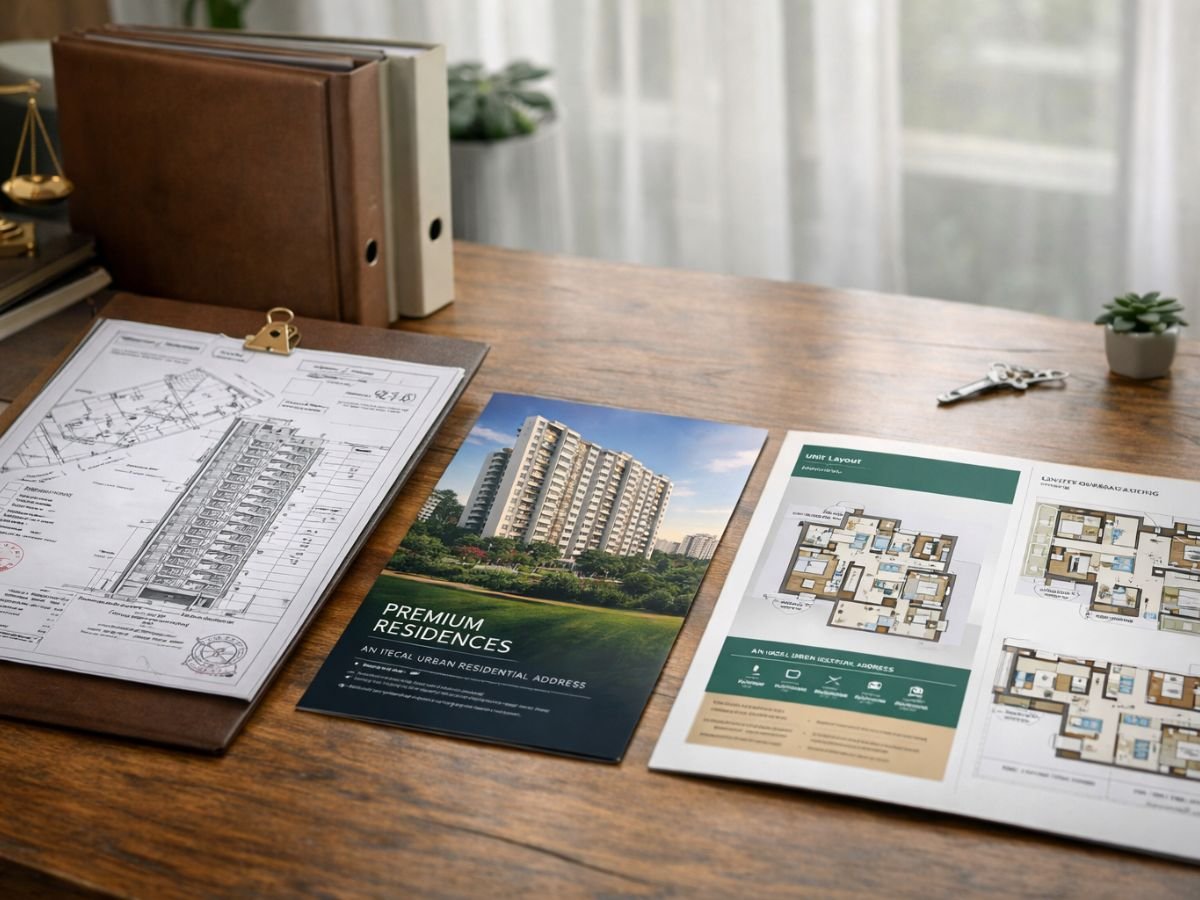
A practical buyer should compare the sales story with the sanctioned paper trail.
That comparison should include:
- tower count
- floor count
- wing structure
- flat configuration
- podium or stilt parking logic
- location of amenities
- open space claims
- any future phase shown as if already approved
This is where inflated marketing often gets exposed.
Example: the Part CC trap
Imagine a project in Taloja, Ulwe, or Pushpak Nagar being sold as a high-rise tower with premium upper-floor options. On MahaRERA, the project looks active. The sales team says approvals are in place. But when you open the actual Commencement Certificate, it covers only the lower floors.
Now the situation changes completely. The project is not necessarily fake. But the specific flat being pushed to you may still sit outside the currently approved construction scope.
That is why document reading matters more than brochure reading.
What “approvals under process” really means at booking stage
This phrase sounds harmless. In many cases, it is not.
If the core approvals required for valid registration and legal marketing are still “under process,” then the buyer should treat the situation very carefully. Pre-launch language, soft-launch language, and “book now, paperwork is almost done” language often create false urgency.
A genuine administrative update for a later phase is one thing. But if the core building permission or valid CC is missing, then the buyer should not treat that as a routine delay.
At booking stage, “under process” should not be read as “almost safe.” It should be read as “show me the exact document first.”
A Navi Mumbai buyer’s red-flag list before booking
Some warning signs are universal. Some are very Navi Mumbai in flavour.
Use this list before you transfer any token amount:
- The sales team gives a MahaRERA number but avoids opening the actual project documents.
- The project has only a Part CC, but the broker is selling higher floors as if full approval is already available.
- The authority name keeps changing during discussion. First CIDCO, then PMC, then “all municipal done.”
- The builder refuses to share the sanctioned plan or says it is confidential.
- The draft agreement is not shown until after the buyer pays a token.
- The land ownership story sounds layered, verbal, or confusing.
- The project is on 12.5% scheme or development-linked land, but the title explanation feels incomplete.
- The real estate agent cannot show their own MahaRERA registration details.
- The pitch depends too much on “airport aa raha hai,” “metro aa raha hai,” or “last few units left,” but very little on actual document proof.
That last pattern is common in fast-moving belts where infrastructure excitement makes buyers impatient.
What you can verify online, what the builder must show, and what needs a professional review
| Verification layer | Who should handle it | What to check |
|---|---|---|
| Online / public verification | Buyer | MahaRERA project status, uploaded documents, quarterly updates, IGR search trail, basic authority consistency |
| Builder-provided verification | Builder or developer | Latest sanctioned plan copy, exact Commencement Certificate scope, project-specific unit details, draft agreement or booking terms |
| Professional verification | Property lawyer / expert | Full title review, encumbrance interpretation, leasehold complications, 12.5% scheme land issues, agreement review |
This is the most practical split for buyers.
This table matters because digital transparency has improved, but not everything can be safely judged from a phone screen.
Should you book, pause, or walk away? A simple decision framework
At the end of all this, you need a decision.
Safe enough to proceed
Proceed only when:
- MahaRERA registration is active
- the key documents are visible and coherent
- the flat you want falls within the valid approved construction scope
- title concerns have been reviewed properly
- the booking form and project disclosures do not conflict
That does not create a 100 percent guarantee. But it does mean you are acting with discipline.
Proceed only after clarification
Pause when:
- a Part CC exists and you need written clarity on the exact approved floors
- the sanctioned plan and brochure are not fully matching
- the land history feels complicated
- the authority chain is still unclear
- the agreement wording needs review
This is not overcaution. This is normal buyer protection.
Do not book yet
Stop if:
- there is no verifiable MahaRERA registration
- the builder will not show the CC or sanctioned plan
- the project is being sold mainly as a pre-launch with approvals “coming soon”
- the floor you are buying is outside the currently approved construction scope
- the title trail raises unresolved litigation or ownership questions
In simple words, if document clarity is weak before booking, risk is high after booking.
Conclusion
If you want the cleanest answer, here it is: before booking a Navi Mumbai project, do not rely on one label such as RERA approved, CIDCO approved, or premium pre-launch. Verify the actual document chain.
For most buyers, the right sequence is simple: 1. Check MahaRERA and open the uploaded documents. 2. Confirm the sanctioned plan. 3. Read the Commencement Certificate carefully, especially if it is a Part CC. 4. Support the title trail using IGR search. 5. Get legal clarity where the land structure or agreement feels complicated. 6. Only then think about the booking amount.
That one extra round of checking may feel slow in the moment. But in Navi Mumbai real estate, slow verification is usually cheaper than fast regret.
FAQ's
Frequently Asked Questions