
How to check lien property in navi mumbai
A lien on property usually means someone else, most often a bank or lender, has a legal or financial claim linked to that flat. In Navi Mumbai, that means you should not assume a flat is clear just because the seller lives there, has society papers, or shows maintenance receipts. Before paying serious money, a buyer should check registered records, loan closure proof, lender NOC, and proper title verification.
That is the short answer. The practical answer is a little deeper.
In real flat deals, people use words like lien, mortgage, charge, and encumbrance very loosely. The danger is not the word itself. The danger is buying a flat without understanding whether any bank, authority, society, or creditor still has a hold over it.
For buyers in Navi Mumbai, this matters even more because property chains can involve old co-operative housing societies, CIDCO-linked leasehold history, resale flats with earlier loans, and under-construction projects where the bigger project itself may have finance attached to it.
Quick summary
| Question | Short answer | Why it matters |
|---|---|---|
| Is a lien the same as an ownership dispute? | No | A seller may be the owner but still not be free to transfer the flat until the claim is cleared |
| Can a flat have a loan claim even if the seller is living there? | Yes | Physical possession does not prove debt-free status |
| Can society papers alone prove there is no lien? | No | Society papers may show membership and dues status, not all bank claims |
| What should a buyer check first? | Original documents, seller’s loan status, IGR search, and legal review | This is where most hidden problems get caught |
| Should a lawyer still verify title? | Yes | Portal checks help, but they do not replace proper title due diligence |
What does “lien on property” usually mean when people talk about flats in Navi Mumbai?
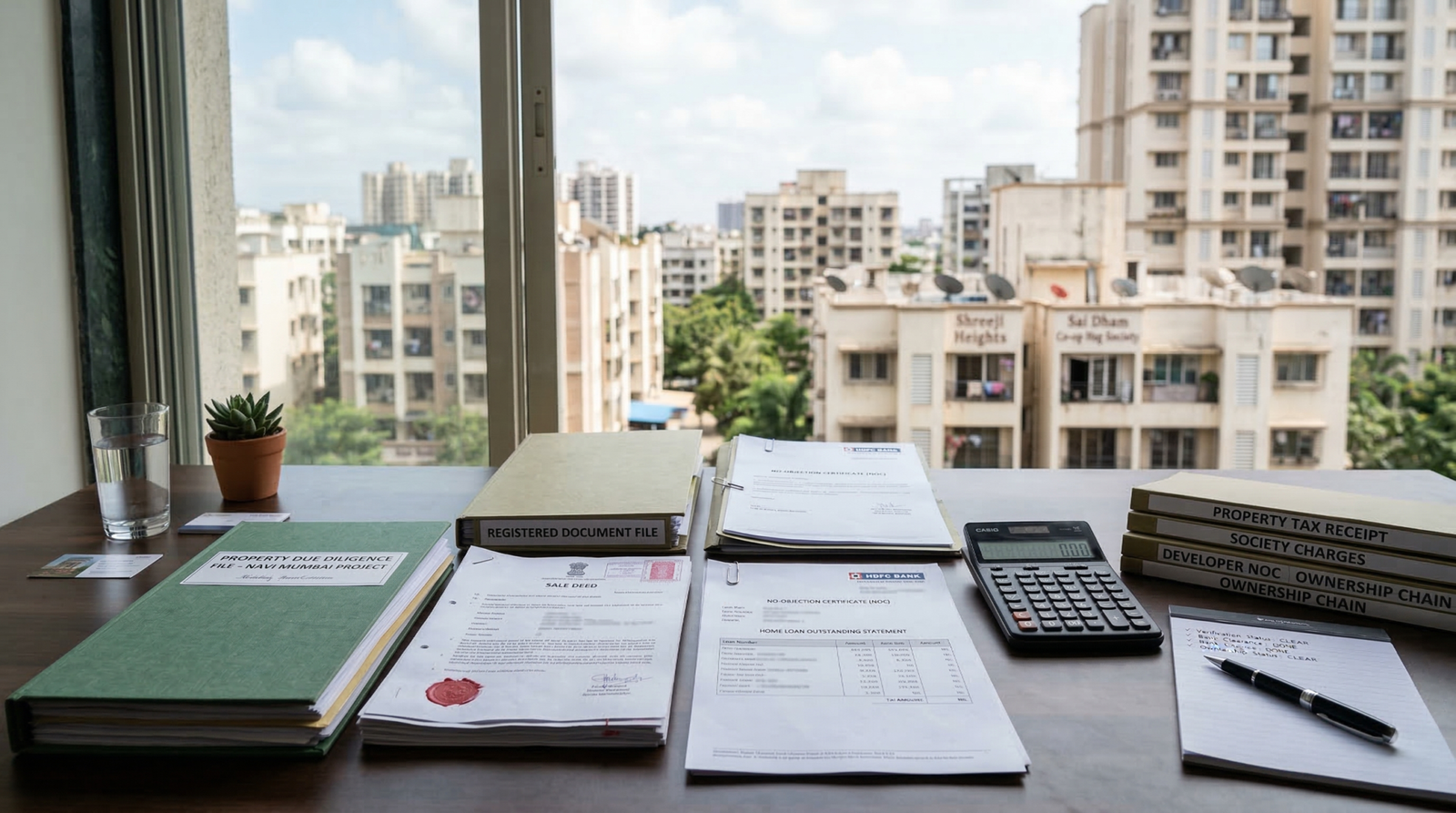
In practical flat-buying language, a lien means the flat is tied to someone else’s claim. Most commonly, that claim belongs to a bank because the owner took a home loan or a loan against property. Sometimes the issue is not a classic bank loan at all. It may be unpaid society dues, unpaid property tax, or another recorded financial burden.
Why this word confuses buyers
The confusion starts because many buyers hear the word “lien” online and then read foreign articles that do not match Indian property reality. In local deals across Vashi, Nerul, Kharghar, Seawoods, Kamothe, or Panvel-side markets, brokers and sellers often use “lien,” “mortgage,” and “encumbrance” as if they all mean the same thing.
They do overlap, but they are not identical.
In real deals, people may say lien when they actually mean mortgage or encumbrance
A mortgage is a specific kind of financial security. An encumbrance is a wider concept. A lien is usually used to describe a claim or hold that affects free transfer of the property.
For a normal buyer, the key point is simple: if the flat is under an unresolved financial claim, you should not treat it as freely transferable until that claim is properly understood and cleared.
Is a lien the same as a mortgage, encumbrance, charge, or bank loan on the flat?
Not exactly. Here is the practical difference.
| Term | What it usually means in practice | Where it may show up | Buyer risk |
|---|---|---|---|
| Encumbrance | Any burden, restriction, or claim affecting the property | Title search, project documents, authority records | Depends on the type |
| Lien | A financial or legal hold linked to a debt or obligation | Lender records, legal claims, dues situations | High if unresolved |
| Mortgage | Property given as security for a loan | Bank papers, registered records, CERSAI-type search | High but often manageable if cleared properly |
| Charge | A claim for dues or liability | Society dues, taxes, statutory claims | Moderate to high depending on amount |
| Home loan | The loan itself | Bank statement, sanction papers, closure letter | Creates risk because the flat secures the loan |
This is why buyers should stop asking only one question: “Is there any lien?” A better question is: “Who has what claim, how much is outstanding, and what exact document proves release?”
Can a flat in Navi Mumbai look completely normal and still have a financial claim on it?

Yes. This is one of the most important truths in the resale market.
A flat can look completely normal. The seller may be living there. Electricity bills may be regular. Society maintenance may be paid. The share certificate may exist. Yet the flat may still be tied to a bank because the original title documents were deposited with the lender for a mortgage.
This is where many buyers get trapped.
A common story goes like this: the seller says the loan is “almost closed,” or says the originals are “with the bank for a few days,” or promises that everything will be released after token payment. That is exactly the stage where buyers must slow down, not rush.
> Practical example > A resale flat in Kharghar or Seawoods may appear fully settled, but if the seller cannot show the original chain of title documents or a fresh loan outstanding letter, you should assume there may be an active lender hold until proven otherwise.
What should a buyer check first before paying token for a flat?
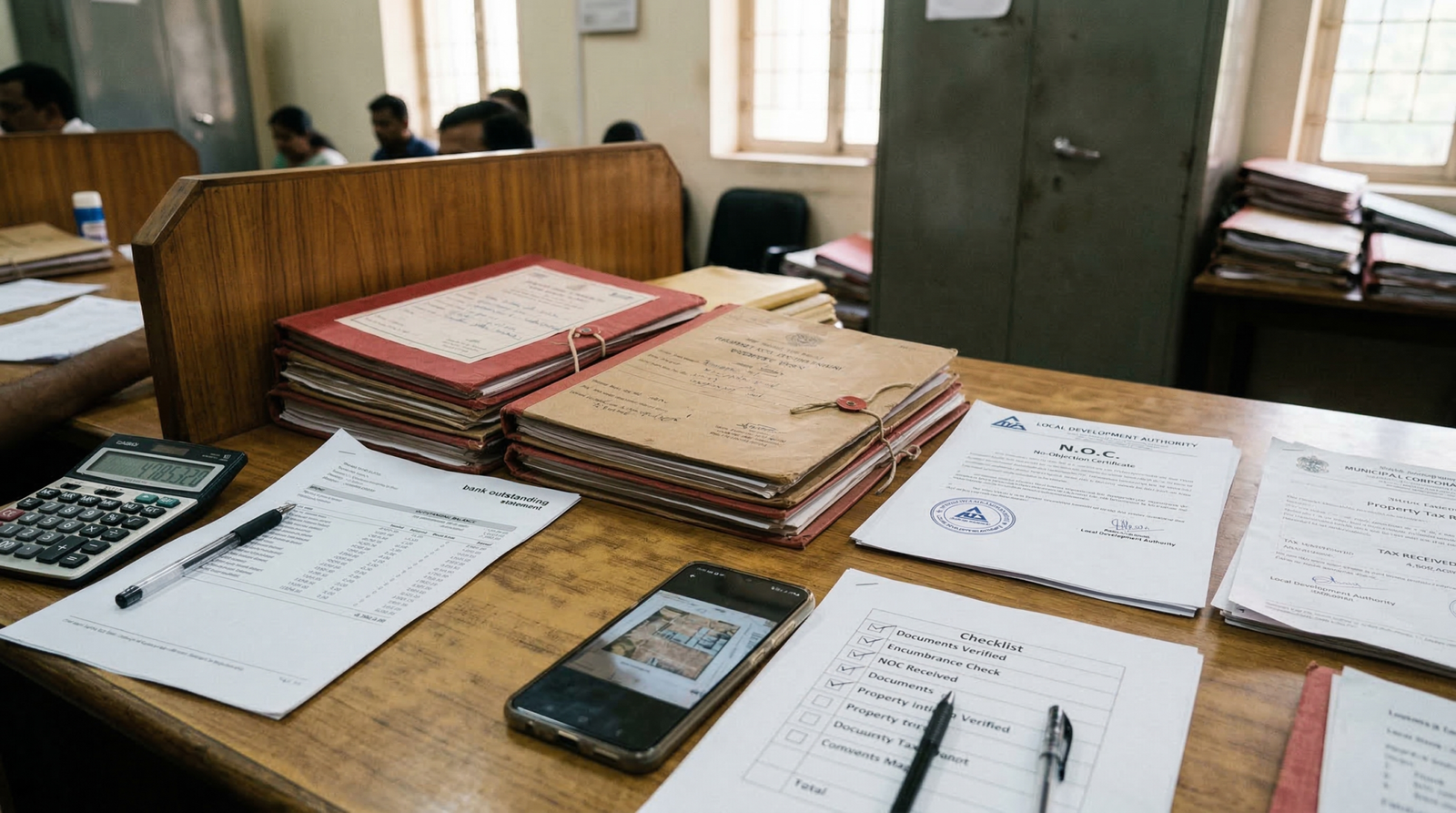
Before token payment, do not chase emotion, urgency, or “market rate is going up” pressure. Do a basic risk filter first.
Token-stage checklist
- Ask the seller clearly whether any home loan, LAP, or other charge exists on the flat
- Demand physical inspection of the original title chain, not just scans or color copies
- Ask for a recent loan outstanding statement if any loan exists
- Ask whether the bank has already issued or is ready to issue a closure or NOC after payment
- Check society dues and property tax status
- Send the document set to an independent property advocate before committing large money
This stage matters because token money is where many avoidable problems begin.
If the seller becomes defensive when you ask for originals, written declarations, or loan status, treat that as a warning sign.
How do you check registered records through IGR Maharashtra, and what can that search actually show?
Maharashtra’s registration department provides a free search to view Index II for registered documents from 1985 onward, and it also offers paid e-search options for deeper title-related document access. The department’s own property verification guidance tells users to check title details through the Sub-Registrar route and also points buyers toward checking local tax dues separately.
What the e-search route can help uncover
In practical terms, this search can help you identify whether sale deeds, assignment deeds, or registered mortgage-related documents exist in the transaction history. It gives buyers a first official window into the registered side of the property chain.
What a registered search may still miss
This is where buyers must stay careful. IGR search is useful, but it is not magic. It mainly shows what has been formally recorded. It may not reveal every real-world problem by itself, especially if the issue is outside the registered document trail, tied to unpaid dues elsewhere, or not yet reflected in a searchable way. That is why a clean search result should be treated as a positive sign, not as total proof of zero risk.
Does CERSAI help in checking whether a property is already tied to a lender’s security interest?
Yes, it can help, and buyers should know about it.
CERSAI provides public search access, including asset-based search, and states that the general public can undertake an online search in the central register on payment of the prescribed fee. Its public search system and fee structure are officially published on the CERSAI site.
For a buyer, the practical use is simple: if a bank or financial institution has recorded a security interest, this search may help surface that risk. It is especially relevant in cases where you are worried about a hidden lender claim.
But again, do not over-trust one portal. CERSAI is a useful layer, not the whole answer.
What papers should the seller or builder produce if the flat is genuinely free from bank claim?
If the seller says the flat is clear, do not settle for verbal comfort. Ask for documents.
The most useful papers are:
- loan closure letter or no-dues certificate from the bank
- NOC or release letter from the lender
- proof that original property documents have been released back by the bank
- complete chain of title documents in original
- a clear written declaration from the seller in the agreement stage
If the earlier loan was formally documented in a way that requires release recording, your lawyer should confirm whether additional documentation is needed to properly show that the earlier charge has been extinguished.
What changes if the flat is in a co-operative housing society, a CIDCO chain, or an under-construction project?

This is where local Navi Mumbai reality matters.
Society resale flat
In a co-operative housing society flat, the society can confirm some things, but not everything. It can help on maintenance dues, transfer status, and whether the member had formally approached the society in relation to a mortgage or transfer. But society papers alone do not prove that no outside lender claim exists.
So yes, take the society no-dues certificate seriously. Just do not treat it as a full lien-clearance certificate.
CIDCO-linked or leasehold-style chain
Many Navi Mumbai properties still carry CIDCO-related history, especially in older or authority-linked chains. CIDCO housing material itself shows that mortgage NOC logic exists in its housing ecosystem, including published Mortgage NOC charges in a 2026 booklet.
That does not mean every CIDCO-linked flat is risky. It means buyers should check whether any CIDCO-side permissions, dues, transfer conditions, or lender-related NOC issues still affect the chain.
Under-construction or recently delivered project
Here the risk shifts from an individual seller’s loan to project-level finance. MahaRERA’s published project-registration guidance requires promoters to submit an encumbrance declaration showing the status of financial encumbrance of the project land or building, and it also refers to an asset-based CERSAI report matching the project details.
That is useful because it gives buyers a real disclosure trail for project-level risk. But it still does not replace private title due diligence on the buyer’s specific unit and deal structure.
Can MahaRERA help you spot risk in a new project or recently launched flat?
Yes, up to a point.
MahaRERA’s project registration framework expects promoters to disclose the financial encumbrance status of the project and to submit supporting finance-related documentation as part of registration compliance.
For a buyer, this means MahaRERA can help you understand whether the larger project carries disclosed finance or encumbrance-related risk. That is valuable in new launches and under-construction projects in areas like Ulwe, Taloja, Pushpak Nagar, or Panvel-side growth corridors.
But it is still project-level visibility. It is not a replacement for unit-level document review, agreement drafting, and independent legal verification.
What are the biggest red flags that a flat may have a lien, loan issue, or unresolved charge?
Watch for these signs:
- the seller avoids showing original documents
- the seller pushes for quick token payment before verification
- the flat is priced unusually low without a clean explanation
- the seller says the loan is “almost closed” but gives no recent bank statement
- the seller wants loan-closing funds sent to their personal account instead of properly routed settlement
- society transfer status is unclear
- property tax or dues position is vague
- the seller refuses a written declaration on encumbrance status
One red flag may not kill the deal. But multiple red flags together should slow you down immediately.
If a lien or lender claim is found, should you walk away or can the deal still be structured safely?
Not every lien means the deal is dead.
If the flat has a normal existing home loan with a known bank, the transaction can often still happen safely through a controlled structure. Usually, that means the outstanding amount is quantified and the lender gets paid correctly so the charge can be released.
If the issue is only society dues or municipal dues, the deal may still proceed if the dues are clearly measured and cleared before or at registration.
But if you see multiple claims, broken document chain, ongoing serious legal dispute, missing originals, or confusing lender history, that is where walking away may be the better decision.
The point is not “never buy a flat with an existing loan.” The point is “never buy a flat with an unresolved and poorly documented claim.”
Who should verify what: buyer, bank, broker, society, and advocate?
A lot of buyers assume the bank or broker will catch everything. That is a mistake.
- Buyer: do first-level checks, ask hard questions, inspect originals, and verify story consistency
- Bank: checks enough to protect its own lending exposure
- Broker: helps coordinate, but their verbal assurance has no legal value
- Society: confirms dues and transfer-side issues within its own scope
- Advocate: checks title chain, risk points, and whether the deal papers actually protect you
If you skip the advocate because “bank loan is already approved,” you may still miss problems that matter to you even if they do not bother the bank immediately.
Before registration, what is the safest final clearance checklist?
Before the final sale deed stage, confirm these points calmly and in writing:
- original document chain is physically available for handover
- loan closure proof and lender NOC are in place, if applicable
- society dues are cleared
- property tax dues are checked and cleared
- electricity and utility dues are cleared
- agreement terms on payment routing are being followed exactly
- any authority-linked permissions or NOCs relevant to the property chain are in place
- your advocate has reviewed the final document pack, not just the first set shared weeks earlier
This is the stage where buyers should become more strict, not more relaxed.
Conclusion
A lien on property is not just a legal word. In a real Navi Mumbai flat deal, it can decide whether your purchase stays smooth or turns into a stuck, risky, expensive mess.
The safest approach is layered, not lazy. Check the originals. Ask for written loan status. Use official search routes like IGR Maharashtra and CERSAI where relevant. Use MahaRERA for project-level disclosure where applicable. Take society and authority-side dues seriously. And let an independent property advocate review the chain before you trust the deal.
That is how buyers avoid paying real money for a flat that only looked clear from the outside.
FAQs
Frequently Asked Questions