

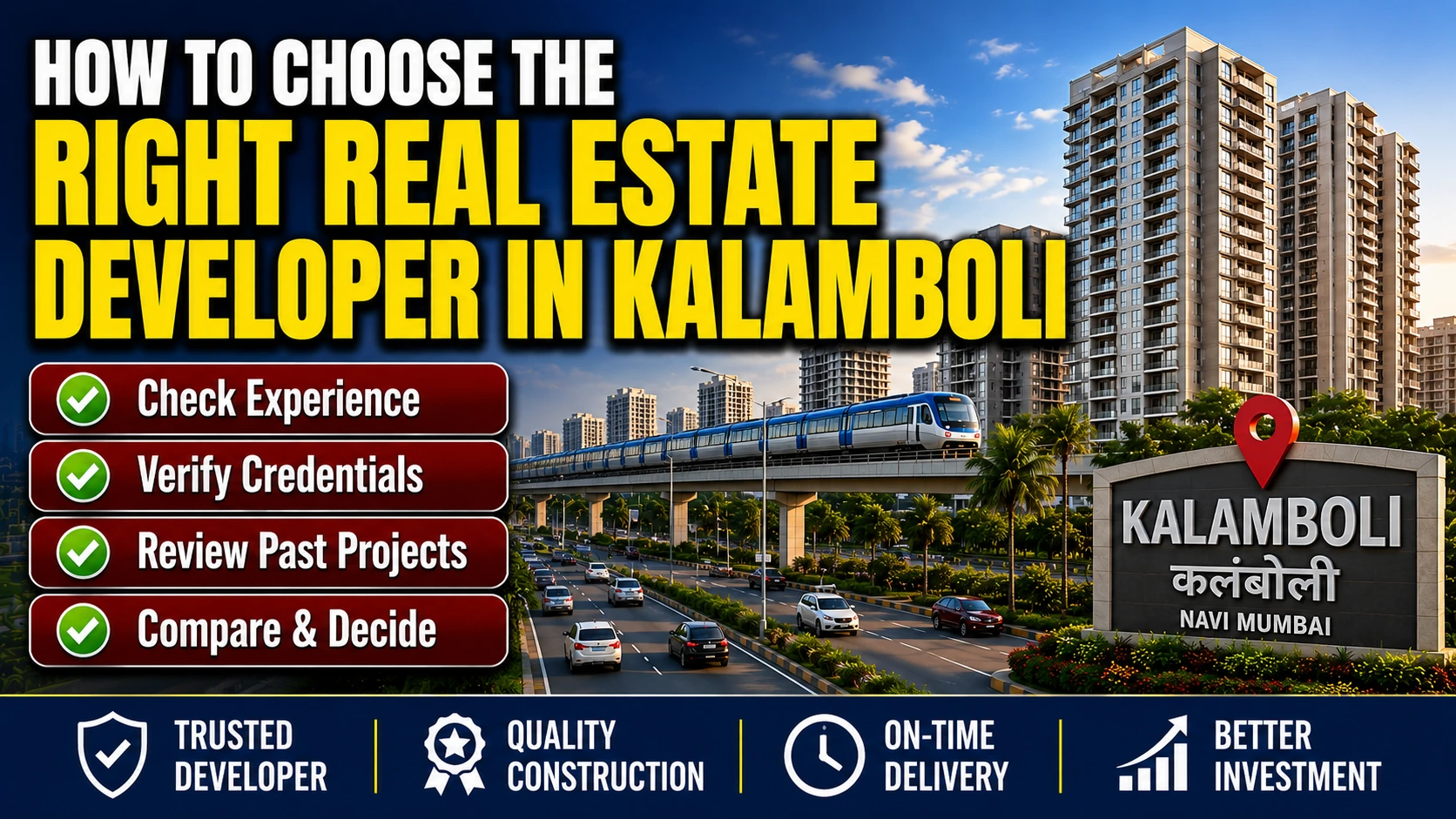
To choose the right real estate developer in Kalamboli, buyers should check the developer’s past delivery record, MahaRERA details, legal documents, construction quality, pricing transparency, completed projects, buyer feedback, and possession history before paying token money. In Kalamboli, this is especially important because projects may involve PMC approvals, CIDCO-origin land, leasehold issues, PAP or 12.5% scheme plots, monsoon risks, and heavy infrastructure-led growth expectations.
Kalamboli is no longer only known for its steel market, truck terminals, and logistics movement. It is now also becoming a serious residential choice for families, working professionals, MSME owners, and investors looking at the Panvel-Kalamboli growth belt. Its location near the Sion-Panvel Highway, Mumbai-Pune Expressway, NH-48, NH-66, Roadpali, Kamothe, Kharghar, Panvel, Taloja, and the upcoming airport corridor makes it attractive.
But a good location does not automatically make a project safe. The right developer must be legally clear, financially stable, transparent with documents, strong in construction quality, and honest about pricing and possession. This article is for general buyer awareness. Before booking or signing an agreement, buyers should verify documents with a qualified legal professional.
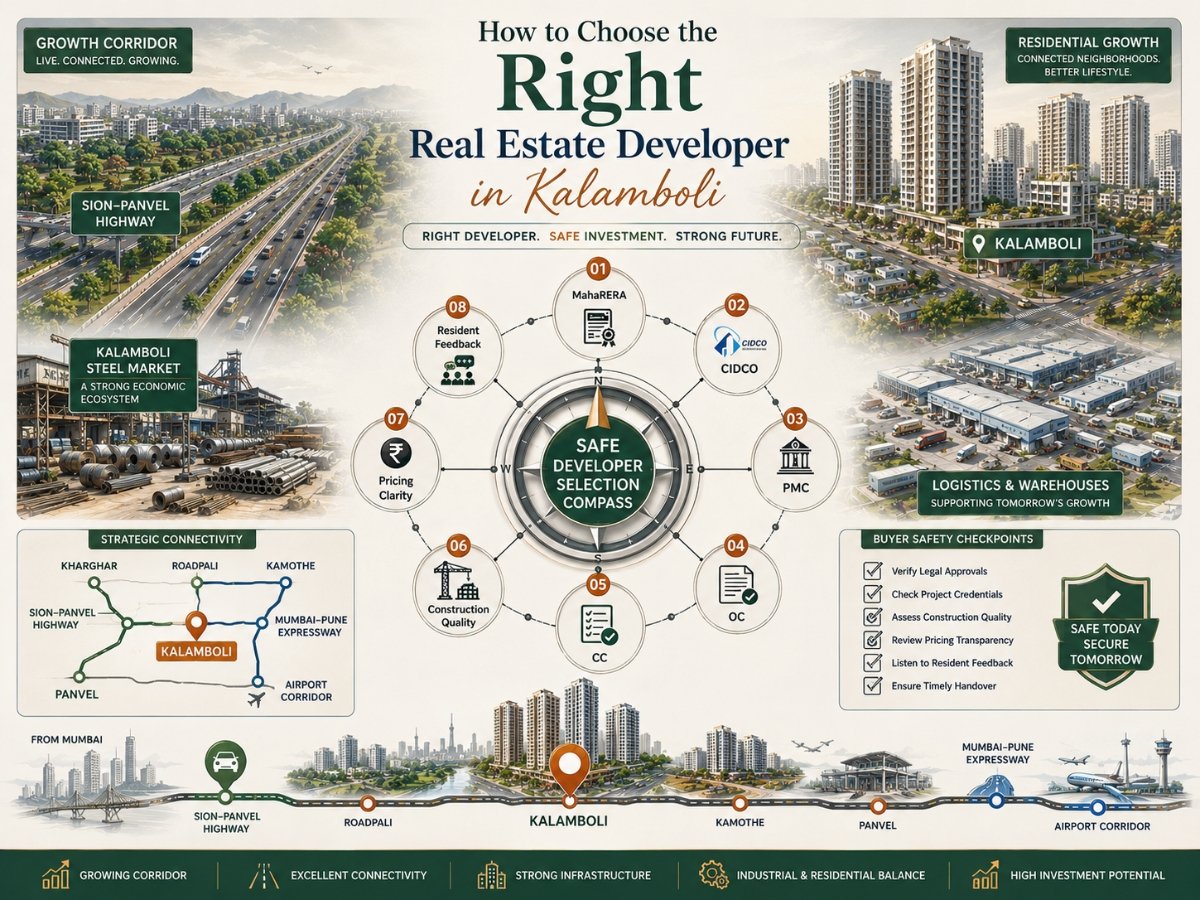
Quick Summary: How to Choose the Right Real Estate Developer in Kalamboli
The safest way to choose a real estate developer in Kalamboli is to verify the builder, the land, the approvals, the construction, and the total cost before paying any token amount.
| What to Check | Why It Matters in Kalamboli | Good Sign | Red Flag |
|---|---|---|---|
| MahaRERA registration | Confirms regulatory registration and project disclosures | Valid registration with clear project details | No RERA number or mismatch in project details |
| Developer track record | Shows how the builder performs after selling flats | Completed projects with OC and resident satisfaction | Delayed older projects or poor maintenance |
| CIDCO and PMC documents | Kalamboli has CIDCO land history and PMC civic authority relevance | Clear allotment, lease, transfer, CC and OC documents | Confusion about which authority approved what |
| PAP or 12.5% scheme plot clarity | These plots may carry title and heirship risks | Proper tripartite agreement and CIDCO NOC | Missing NOC or unclear original allotment |
| Construction quality | Coastal monsoon and local drainage issues expose weak construction | Dry basements, good plastering, working lifts | Leakage, damp walls, rust, poor common areas |
| Pricing clarity | Base price can differ heavily from final cost | Written all-inclusive cost sheet | Verbal discount, hidden PLC, parking or maintenance |
| Occupancy Certificate | Needed for legal possession and resale safety | Final OC available before possession | Fit-out possession without OC |
| Buyer feedback | Existing residents reveal actual builder behaviour | Positive after-sales and society handover record | Repeated complaints about leakage, delay or corpus issues |
If you remember only one thing, remember this: do not choose a developer in Kalamboli only because of price, brochure, brand name, or sales pressure. Choose only after written legal, technical, and financial clarity.
Why Choosing the Right Real Estate Developer Matters in Kalamboli
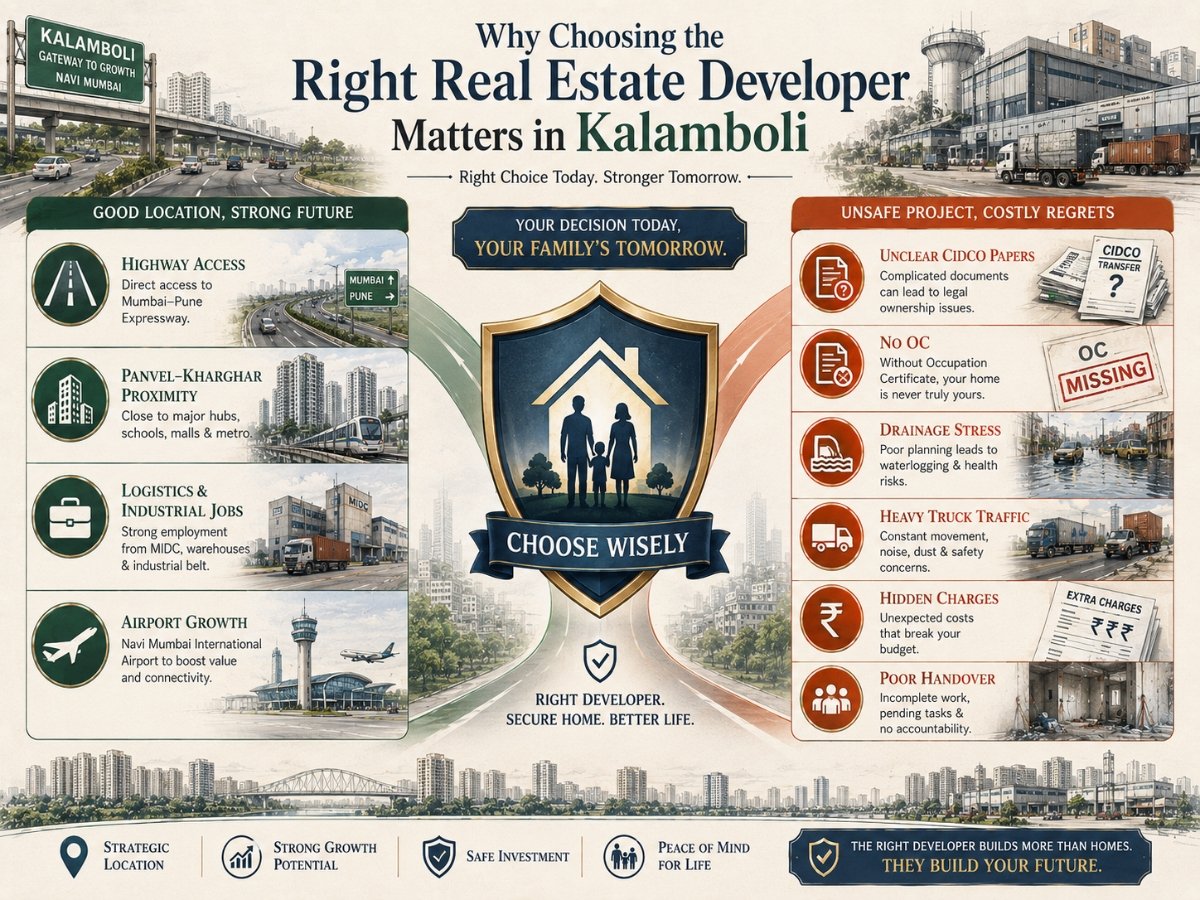
Kalamboli is a practical and strategic real estate market. It has strong road connectivity, access to industrial and logistics employment, proximity to Panvel and Kharghar, and long-term growth potential due to regional infrastructure. At the same time, it is also a market where buyers must be extra careful.
Kalamboli has a mix of residential towers, older CIDCO-era pockets, Roadpali-side residential growth, logistics-linked areas, commercial pockets, and projects influenced by nearby industrial belts. Some projects are in better residential micro-locations, while others may face truck traffic, drainage concerns, pollution carryover, or weaker civic surroundings.
This is why the developer’s role becomes critical. A good developer cannot change the entire location, but they can reduce buyer risk through:
- Clean legal title
- Proper approvals
- Strong construction quality
- Transparent pricing
- Timely OC
- Proper society formation
- Honest after-sales support
A weak developer, even in a good Kalamboli location, can create years of stress through delayed possession, unclear CIDCO documents, fit-out possession without OC, leakage issues, hidden charges, and poor society handover.
For related buyer research, readers can also refer to [questions to ask before buying a flat in Navi Mumbai](ADD INTERNAL LINK HERE).
Understand the Developer’s Past Track Record
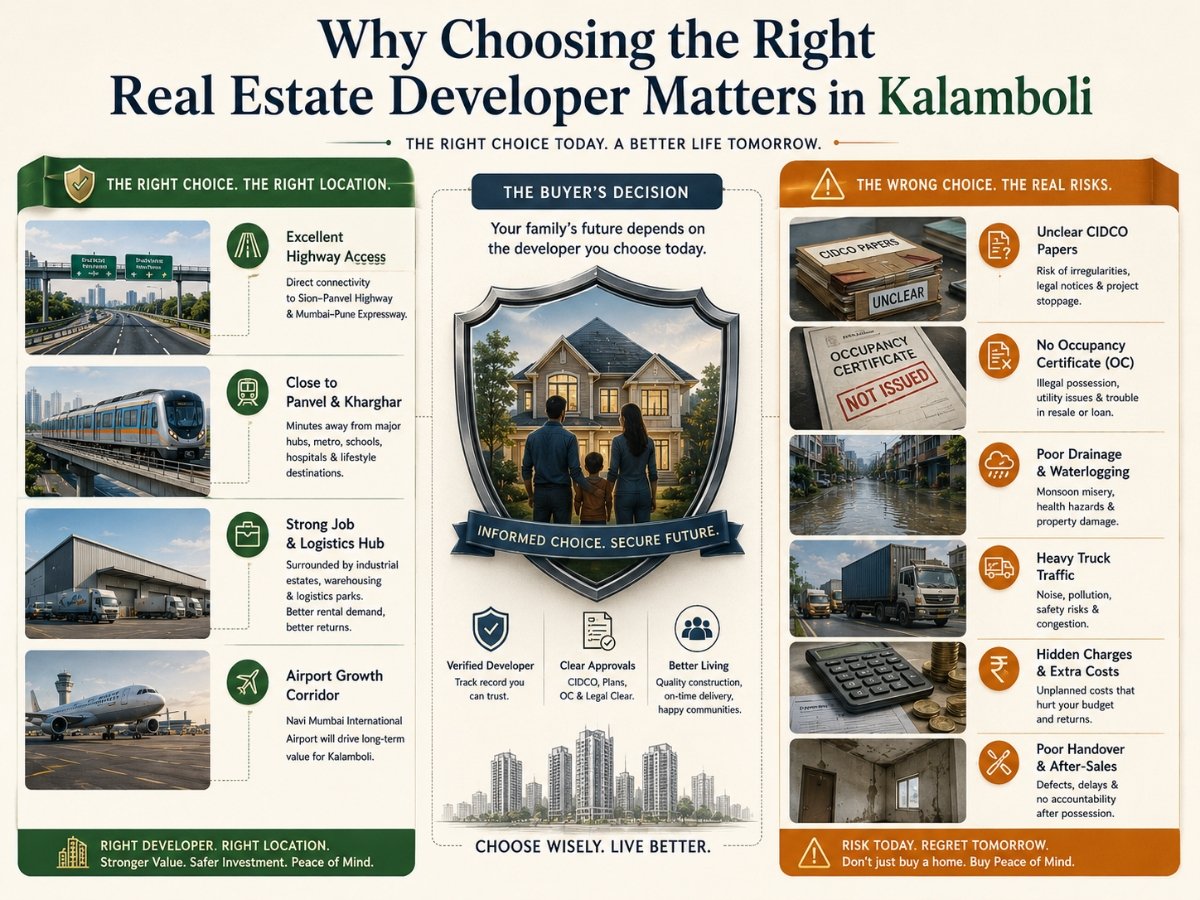
A developer’s past record is one of the strongest indicators of future behaviour. Sales offices show the best version of a project. Completed buildings show the truth.
Check Completed Projects Before Trusting New Launches
Before trusting a new launch in Kalamboli, check what the same developer delivered earlier. Do not look only at the elevation, lobby, or brochure images. Visit a 5-to-10-year-old project if possible.
Check:
- Was possession given near the promised timeline?
- Did the project receive Occupancy Certificate?
- Are residents satisfied with the construction?
- Are lifts, pumps, security systems, and common areas maintained?
- Did the builder form the society properly?
- Was the maintenance corpus handed over clearly?
In Kalamboli and nearby Roadpali, Sector 16, Kamothe, Panvel and Kharghar belts, many local and mid-tier developers have built multiple projects. A serious buyer should compare their older work before trusting their newest marketing.
A developer is not judged by the best 3D render. A developer is judged by how the building looks after five monsoons.
Visit Older Buildings Developed by the Same Builder
An older building tells you what the sales brochure will never say.
When you visit an old project by the same builder, look carefully at:
- Basement parking walls
- Leakage marks near shafts
- Paint peeling on external walls
- Water stains near windows
- Lift condition
- Lobby maintenance
- Drainage arrangement
- Quality of internal roads and ramps
- Security and fire safety provisions
This is especially important in Kalamboli because some areas face monsoon waterlogging concerns, drainage stress, and heavy vehicle movement. If a builder has poor waterproofing or weak basement design, the problem usually appears quickly during the monsoon.
Speak to Existing Residents and Buyers
Existing residents are often the best source of truth. Speak to people who have already lived in the developer’s completed project for at least one or two years.
Ask them:
- Did the builder respond after possession?
- Were promised amenities delivered?
- Were there leakage or plumbing issues?
- Was society formation done properly?
- Was the maintenance corpus clearly handed over?
- Are there water supply problems?
- Did the developer delay OC or conveyance?
Do not speak only to the sales team’s suggested residents. Try to speak to people independently in the building, parking area, nearby shops, or society office.
Check MahaRERA Registration and Project Transparency
MahaRERA registration is a basic requirement for under-construction projects, but it should not be treated as the final proof of developer quality.
Why MahaRERA Is Important for Kalamboli Buyers
MahaRERA helps buyers check project registration, promoter details, completion timelines, complaints, litigation disclosures, and project status. For Kalamboli buyers, this is important because delays may happen due to approval issues, land matters, finance problems, or construction slowdown.
Before paying token money, buyers should verify the exact MahaRERA registration number on the MahaRERA website. Do not accept only a logo on the brochure or a verbal statement that “RERA is done.”
MahaRERA is a buyer’s first filter. It is not the complete due diligence.
What to Verify on the MahaRERA Website
On the MahaRERA website, buyers should check:
| MahaRERA Detail | What Buyer Should Check |
|---|---|
| Project name | It should match the project being sold |
| Promoter name | It should match the developer or legal entity |
| Registration validity | Registration should be active and valid |
| Completion date | Compare RERA date with sales team’s verbal possession promise |
| Building details | Check wings, floors, and project scope |
| Encumbrances | See whether loans or charges exist on the project |
| Litigation | Look for disclosed legal cases or disputes |
| Extension history | Multiple extensions may indicate delay risk |
| Complaints | Check if buyers have filed complaints against the project |
A common issue is that sales teams may promise an earlier possession date, while the MahaRERA completion date is much later. Buyers should plan finances based on the written and legally visible date, not only on sales talk.
Why MahaRERA Alone Is Not Enough
MahaRERA registration is important, but it does not guarantee:
- Excellent construction quality
- No leakage
- No future delay
- Clear CIDCO title
- Smooth society handover
- Fair pricing
- Good after-sales support
In Kalamboli, land history matters. If the project is on CIDCO-origin land, PAP land, or 12.5% scheme plot, independent title verification is necessary. A MahaRERA-registered project can still face practical problems if the land title, CIDCO transfer, OC, or construction quality is weak.
Check Legal Documents Before Booking a Flat
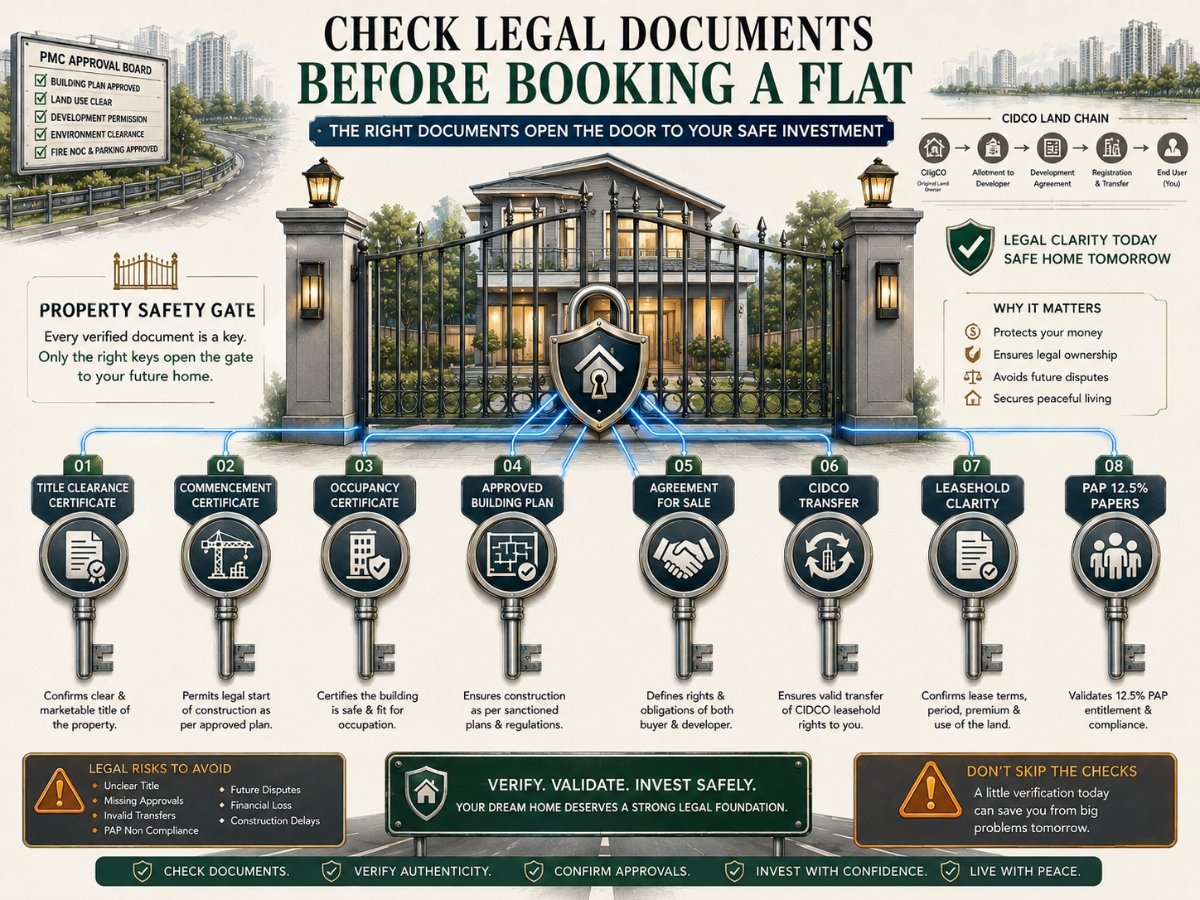
Legal document checking is not a formality. It is the foundation of safe property buying. Before paying token money, ask for copies of key documents and review them with a property lawyer familiar with Navi Mumbai, CIDCO, and PMC-related matters.
Title Clearance Certificate
The Title Clearance Certificate shows whether the developer has proper legal rights over the land. In Kalamboli, this is important because land may involve CIDCO allotment, leasehold structure, PAP plot history, Gaothan expansion influence, or earlier transfers.
A proper title check should include a continuous chain of ownership and a search report, commonly for 30 years. If the land has family disputes, unpaid transfer charges, missing heir consent, or unclear allotment history, the buyer may face serious problems later.
Commencement Certificate
The Commencement Certificate, or CC, proves that the authority has allowed construction up to a particular level. Buyers should not only ask whether the project has CC. They should ask whether the CC covers the exact floor they are buying.
For example, if a buyer is booking on the 14th floor but the current CC allows construction only up to the 10th floor, that is a major risk.
Occupancy Certificate
The Occupancy Certificate, or OC, confirms that the building is complete and legally fit for occupation as per the authority’s conditions.
For ready-to-move flats, OC is non-negotiable. Avoid accepting “fit-out possession” without OC. Without OC, buyers may face problems with legal occupancy, utilities, resale, bank finance, and society regularization.
Final payment should ideally be linked to valid OC availability, especially in ready or near-ready projects.
Approved Building Plan
The approved building plan is more important than the marketing floor plan. Buyers should compare the builder’s brochure with the stamped approved plan.
Check:
- Exact flat layout
- Approved floors
- Refuge areas
- Parking layout
- Fire safety provisions
- Open spaces
- Common areas
- Carpet area as per RERA
If the actual construction does not match the approved plan, the buyer may face future legal or possession complications.
Agreement for Sale
The Agreement for Sale is the main legal contract between buyer and developer. Do not sign it casually.
Check:
- Exact flat number and carpet area
- Total consideration amount
- Payment schedule
- Possession date
- Delay compensation clause
- Parking details
- Taxes and maintenance charges
- Amenities promised
- Material specifications
- Cancellation terms
- Force majeure clauses
- CIDCO leasehold or transfer obligations, if applicable
For more legal clarity, readers can refer to [agreement to sale vs sale deed](ADD INTERNAL LINK HERE).
CIDCO Transfer and Leasehold Clarity
Many properties in Navi Mumbai, including Kalamboli, have CIDCO-origin land history. Buyers must understand whether the land is leasehold, whether transfer permissions are complete, and whether any CIDCO-related premiums or NOCs are pending.
If the project involves CIDCO land, check:
- Original CIDCO allotment letter
- Lease deed
- Transfer documents
- CIDCO NOC
- Payment receipts for transfer charges or premiums
- Leasehold or freehold conversion status, if applicable
For detailed reading, use [leasehold to freehold conversion](ADD INTERNAL LINK HERE).
Kalamboli-Specific Documents Buyers Should Check Before Booking
Kalamboli has its own legal and authority-related complexities. It falls under the Panvel Municipal Corporation for civic administration, while CIDCO remains relevant for land title and nodal planning history in many cases.
| Document / Check | Why It Matters | What Buyer Should Verify |
|---|---|---|
| MahaRERA registration | Confirms project registration and disclosures | Project name, promoter, deadline, complaints |
| Title Clearance Certificate | Confirms legal development rights | 30-year search and clean ownership chain |
| Commencement Certificate | Confirms construction approval | Floor being purchased is covered |
| Occupancy Certificate | Confirms legal possession | Final OC for ready-to-move flats |
| Approved Building Plan | Confirms sanctioned layout | Match plan with flat and floor sold |
| CIDCO allotment/lease documents | Important for CIDCO-origin land | Allotment, lease, transfer, NOC |
| PAP or 12.5% scheme documents | High-risk if unclear | Tripartite agreement and CIDCO NOC |
| Society formation status | Important in older/resale projects | Society registration and conveyance |
| Conveyance or deemed conveyance | Confirms transfer to society | Builder has not retained land control |
CIDCO Allotment and Transfer Documents
For CIDCO-origin plots, buyers should verify the original allotment and transfer history. In resale transactions, unpaid CIDCO transfer charges or incomplete lease documents can delay registration or future resale.
Do not rely only on the seller’s word. Ask for document copies and payment receipts.
PAP Plot or 12.5% Scheme Plot Clarity
PAP or 12.5% scheme plots require extra caution. These plots are linked to land compensation given to Project Affected Persons. Developers may purchase or develop such plots, but the title chain must be checked carefully.
Buyers should ask for:
- CIDCO allotment letter
- Tripartite agreement between CIDCO, PAP, and developer
- Consent of required legal heirs, where applicable
- Final CIDCO NOC
- Advocate-certified title report
If these documents are unclear, do not pay token money without expert legal verification.
NMMC, PMC or CIDCO Approval Relevance
Kalamboli falls under PMC for civic administration, property tax, and many approval-related matters. CIDCO remains relevant because of land ownership history, leasehold structure, transfer rules, and original node planning.
This creates confusion for many buyers. A simple way to understand it is:
| Authority | What It May Relate To |
|---|---|
| PMC | Civic administration, building permissions, OC, property tax, local services |
| CIDCO | Land allotment, leasehold title, transfer/NOC, nodal planning legacy |
| MahaRERA | Project registration, timeline, buyer disclosures, complaints |
Buyers should not accept random authority documents. The right document should come from the right authority.
For more clarity, read [CIDCO and PMC differences](ADD INTERNAL LINK HERE).
Society Formation and Conveyance Status
A developer’s job does not end when keys are handed over. Society formation, maintenance fund handover, and conveyance are also important.
In older or resale projects, ask:
- Is the society registered?
- Has the builder handed over accounts?
- Is the maintenance corpus clear?
- Has conveyance or deemed conveyance happened?
- Are there disputes over parking, terrace, open space, or future FSI?
If a builder delays society formation, residents may struggle later during redevelopment, repairs, major maintenance, or resale.
Compare Construction Quality and Actual Site Progress
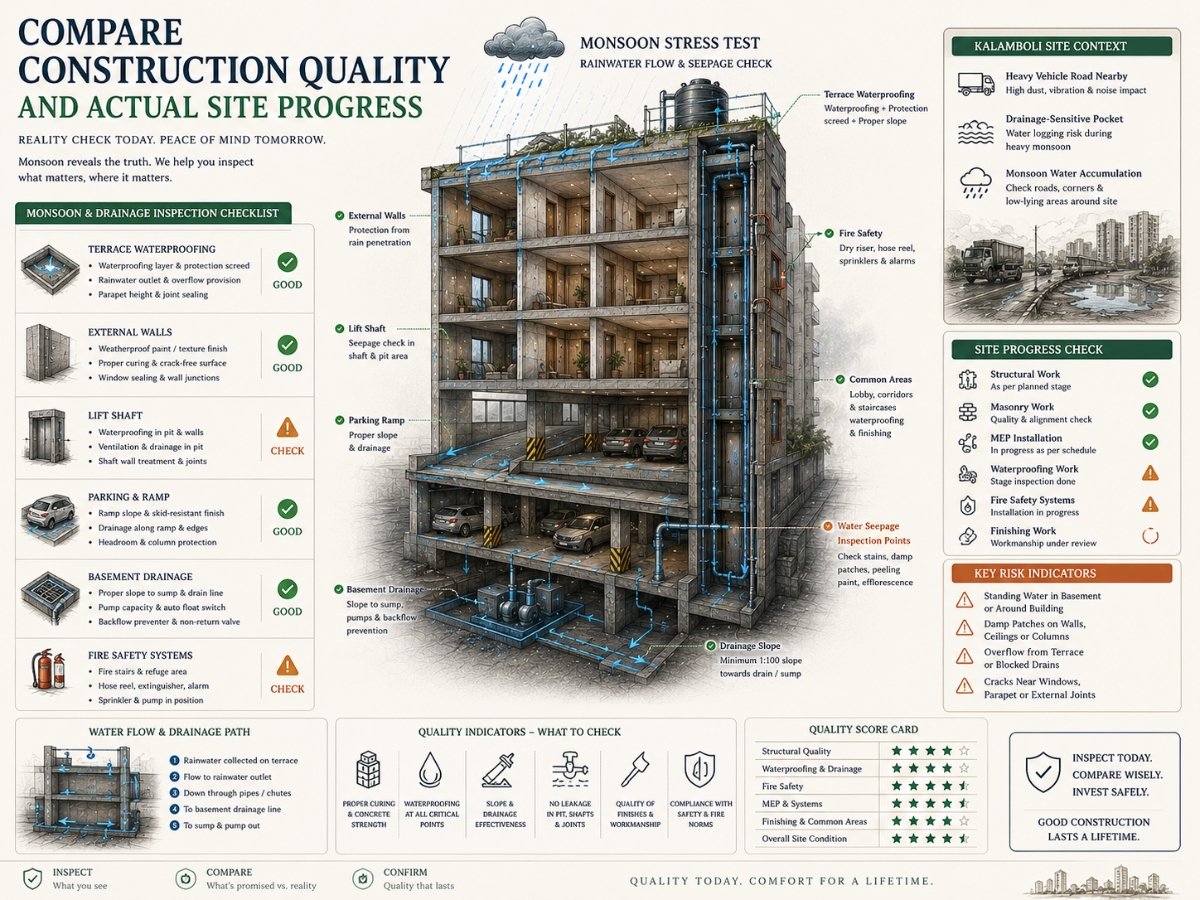
Construction quality directly affects long-term safety, maintenance cost, and resale value. In Kalamboli, this becomes more important because buildings must handle coastal humidity, heavy monsoon, drainage stress, and in some pockets, industrial pollution exposure.
Visit the Actual Construction Site
Do not book only from a sales office or sample flat. Visit the actual site.
Observe:
- Is work genuinely progressing?
- Are enough workers present?
- Are materials stored properly?
- Is steel rusted or exposed?
- Is cement protected from rain?
- Are safety practices visible?
- Is the site clean and managed?
- Does the pace match the promised possession date?
If possible, take a civil engineer or experienced person for site review.
Compare Sample Flat and Real Flat Specifications
Sample flats are designed for selling. They may use better lighting, smaller furniture, premium fittings, and visual tricks.
Check the actual agreement specifications for:
- Flooring brand or equivalent quality
- Window type
- Door quality
- Bathroom fittings
- Electrical points
- Kitchen platform
- Wall finish
- Ceiling height
- Actual RERA carpet area
Never assume that the sample flat finish will automatically be delivered unless it is written in the agreement annexure.
Check Lift, Lobby, Parking and Common Area Quality
Common areas often reveal whether the developer is cost-cutting.
Check:
- Lift brand and capacity
- Backup power arrangement
- Basement ventilation
- Parking ramp width
- Fire safety systems
- Lobby finish
- Staircase condition
- Drainage slope
- Security cabin and entry design
In Kalamboli, where many families use cars and two-wheelers for daily movement, parking usability matters. A flat may look good, but if parking is cramped, basement leaks, or lifts fail frequently, daily life becomes frustrating.
Check Monsoon Performance and Leakage Issues
Monsoon is the real test of construction quality in Navi Mumbai. In Kalamboli, buyers should be extra alert in low-lying or drainage-sensitive pockets, especially near areas affected by holding pond and Roadpali-side waterlogging concerns.
During or after rains, check:
- Basement water marks
- Damp walls
- Water seepage around windows
- Drainage overflow
- External plaster cracks
- Terrace waterproofing
- Lift shaft seepage
- Parking water accumulation
A building that fails in the first few monsoons can become expensive to maintain for years.
Understand Pricing, Hidden Charges and Payment Terms
A low advertised price is not the final cost. In real estate, the only price that matters is the full amount needed to get legal possession.
Ask for an All-Inclusive Cost Sheet
Ask the developer for a printed, all-inclusive cost sheet on official letterhead.
It should include:
- Base price
- Floor rise
- PLC, if applicable
- Parking charges
- GST
- Stamp duty
- Registration
- Legal charges
- Development charges
- Clubhouse or amenity charges
- Electricity and water connection
- Advance maintenance
- Corpus fund
- Any other deposits
A ₹55 lakh advertised flat can become much more expensive after all charges are added. Do not compare projects by base price only.
Check Parking, Floor-Rise, PLC and Maintenance Charges
In Kalamboli and Roadpali projects, check these charges carefully:
- Is parking included or extra?
- Is parking open, covered, mechanical, or stilt?
- What is the floor-rise charge per floor?
- Is there Preferential Location Charge?
- What is the advance maintenance amount?
- How many months of maintenance are collected?
- Will maintenance cross the GST threshold for monthly society maintenance?
Heavy amenities may look attractive, but they also increase long-term maintenance. Calculate the 10-year cost, not just the booking price.
Understand GST, Stamp Duty and Registration Cost
Under-construction properties attract GST as applicable. Stamp duty and registration are statutory costs and vary based on buyer profile, property value, and prevailing government rules.
Buyers should verify current rates before booking. For budgeting, use a tool like [stamp duty calculator](ADD INTERNAL LINK HERE).
Do not assume the home loan will cover every cost. Stamp duty, registration, GST, and other upfront charges may require separate cash planning.
Avoid Verbal Price Commitments
In real estate, verbal promises are not enough.
If the sales team says parking is free, floor rise is waived, modular kitchen is included, or maintenance is discounted, ask them to write it in the booking form and agreement.
A simple rule works well: if it is not written and signed, it does not exist.
Check Developer Reputation Beyond Online Reviews
Online reviews are useful, but they must be read carefully. Many 5-star reviews only talk about sales staff behaviour, not actual possession or construction quality.
Read Google Reviews Carefully
While reading Google reviews, search for words like:
- Delay
- OC
- Possession
- Leakage
- Maintenance
- Parking
- Society
- Water
- Refund
- Agreement
Ignore generic reviews like “good project” or “nice staff” unless they give specific details.
Look for Repeated Complaint Patterns
One complaint may be personal. Repeated complaints are a pattern.
Be cautious if multiple buyers mention:
- Delayed possession
- Poor waterproofing
- Lift breakdowns
- No OC
- Hidden charges
- Bad after-sales support
- Unclear maintenance accounts
- Society handover delay
Patterns matter more than isolated comments.
Speak to Local Brokers and Residents
Local brokers, nearby shopkeepers, material suppliers, and residents often know which developers pay dues on time and which builders have a weak reputation.
However, do not depend fully on one broker. Some brokers may be financially linked to the project. Speak to more than one source and cross-check everything with documents.
For local support, readers may refer to [real estate agents in Kalamboli](ADD INTERNAL LINK HERE).
Check Litigation or Delay History Where Possible
Buyers can search the developer name, promoter entity name, and project name on MahaRERA and other public legal information sources where applicable.
Check whether the builder has:
- Repeated MahaRERA complaints
- Long possession delays
- Legal disputes over land
- Consumer complaints
- Unclear project extensions
- Pending OC problems
A reputed developer is not always the right developer if the specific project has unclear approvals, delayed possession, hidden charges, or weak after-sales support.
Big Builder vs Local Builder: Which Is Better in Kalamboli?
There is no single correct answer. The better choice depends on your budget, risk tolerance, lifestyle needs, and project documents.
| Factor | Big Builder | Local Kalamboli Developer | Buyer Decision Point |
|---|---|---|---|
| Project scale | Larger projects, more amenities | Smaller standalone buildings | Do you need lifestyle amenities or practical housing? |
| Pricing | Higher brand premium | Usually more budget-friendly | Compare all-inclusive cost, not base price |
| Carpet area | May have higher loading | Often more functional layouts | Check exact RERA carpet area |
| Maintenance | Often higher due to amenities | Usually lower | Calculate 10-year maintenance cost |
| Legal systems | Stronger internal compliance in many cases | Varies widely by builder | Verify documents in both cases |
| Execution speed | Large phases may take time | Smaller projects may finish faster | Check actual site progress |
| Resale visibility | Brand may help resale | Local demand may support resale | Check micro-location and OC status |
| Risk | Lower abandonment risk in some cases | Higher if title or finance is weak | Verify past record and title deeply |
Advantages of Big Real Estate Developers
Big developers may offer:
- Better amenity planning
- Stronger brand recall
- More structured documentation
- Better resale visibility
- Better appeal for investors and tenants
- More organized project management
They may be suitable for buyers who want a branded environment, long-term rental appeal, or a township-style lifestyle.
Advantages of Local Kalamboli Developers
Local developers may offer:
- Better carpet area for the same budget
- Smaller and faster projects
- Lower monthly maintenance
- Practical layouts
- Better understanding of local authority processes
- More negotiation flexibility
For end-users who want a functional flat, manageable maintenance, and a practical location, a strong local builder can be a sensible choice.
When a Smaller Developer Can Be a Better Choice
A smaller developer can be better when:
- The project has clean title
- CC and OC status are clear
- Construction quality is good
- Previous projects are well maintained
- The flat offers better usable space
- Maintenance is reasonable
- Society handover record is strong
Do not reject a local builder only because the name is not famous. But do not trust them without legal verification either.
When a Big Brand May Still Be Safer
A big brand may be safer when the buyer is:
- An NRI or outstation investor
- Looking for easier resale recognition
- Seeking corporate tenant appeal
- Prioritizing amenities and brand comfort
- Uncomfortable with smaller-builder risk
Still, the specific project must be checked. Brand name alone is not due diligence.
Check Location Fit Before Choosing the Developer
In Kalamboli, location fit matters as much as developer quality. A good developer in a poor micro-location may still result in daily inconvenience.
Mature Nodes Like Kharghar, Kamothe, Panvel and Roadpali
Kalamboli buyers often compare nearby mature or semi-mature pockets like Kharghar, Kamothe, Panvel and Roadpali.
Each has a different living profile:
- Kharghar has stronger lifestyle and education appeal but generally higher pricing.
- Kamothe is dense and practical but may face parking pressure.
- Panvel has wider growth and transport relevance but varies heavily by exact area.
- Roadpali is residentially organized in parts but may have connectivity and pollution concerns depending on pocket.
A Kalamboli buyer should compare not only flat price, but also daily access, school distance, water reliability, traffic, pollution, and resale demand.
For area comparison, use [Kalamboli real estate guide](ADD INTERNAL LINK HERE).
Growth Nodes Like Taloja, Pushpak Nagar, Ulwe, Dronagiri and New Panvel
Growth nodes are driven by future infrastructure and long-term appreciation expectations. They may offer lower entry prices, but present-day livability can vary.
Compared to these, Kalamboli has stronger current road connectivity and logistics relevance. But buyers must check whether the exact project is too close to freight movement, drainage-sensitive pockets, or industrial influence.
Do not buy only because someone says “airport benefit will come.” Future growth is useful only if the present project is legally safe, well built, and practically livable.
Why Location Quality and Developer Quality Must Be Checked Together
A good flat requires both:
- Good developer quality
- Good location quality
If the location is affected by heavy truck traffic, weak drainage, pollution carryover, or poor access, even a good building may struggle in resale and rental demand. If the location is good but the developer has unclear legal documents, the buyer is still at risk.
This is called asset-location fit. The project should match the micro-location.
Questions to Ask a Developer Before Paying Token Money
Before paying token money, ask direct questions and demand documentary proof. Do not feel shy. A genuine developer should be able to answer clearly.
Is the Project Registered on MahaRERA?
Ask for the exact MahaRERA number. Then verify it yourself on the MahaRERA website.
Do not pay token money for a “pre-launch” or “soft launch” without proper legal clarity.
Can You Share the Approved Plan, CC and Legal Documents?
Ask for:
- Approved plan
- Commencement Certificate
- Title report
- MahaRERA certificate
- CIDCO documents, if applicable
- Draft Agreement for Sale
- OC, if ready-to-move
If the developer says documents will be shown only after token payment, treat it as a serious warning.
Is the Quoted Price Fully All-Inclusive?
Ask this exact question:
“What is the final amount I must pay to receive legal possession, including taxes, parking, GST, stamp duty, registration, maintenance, corpus and all other charges?”
Then ask for it in writing.
What Is the Written Possession Timeline?
Check the possession date in:
- Sales commitment
- Draft Agreement for Sale
- MahaRERA portal
If all three are different, use the legally visible and written date for your planning.
What Happens If Possession Is Delayed?
Ask about delay compensation. The Agreement for Sale should not unfairly protect only the builder. Delay compensation should align with applicable RERA provisions.
Do not accept vague answers like “nothing will happen, sir, we will give before time.”
Is the OC Already Received or Expected Later?
For ready-to-move flats, ask for the final Occupancy Certificate.
For under-construction projects, ask when OC is expected and whether final payment is linked to OC.
Avoid taking fit-out possession without OC.
Red Flags When Choosing a Real Estate Developer in Kalamboli
| Red Flag | What It May Mean | What Buyer Should Do |
|---|---|---|
| Pressure to pay token immediately | Sales pressure to avoid due diligence | Walk away or pause until documents are checked |
| No written cost sheet | Hidden charges may appear later | Demand official all-inclusive pricing |
| No legal documents before booking | Possible title or approval issue | Do not pay token without review |
| CC does not cover your floor | Your flat may not be legally approved yet | Verify floor-wise approval |
| No OC for ready flat | Illegal or incomplete possession risk | Avoid final payment or possession |
| Delayed older projects | Pattern of poor execution | Check MahaRERA and resident feedback |
| Poor maintenance in old buildings | Weak after-sales or poor construction | Visit completed projects |
| Verbal promises only | Promises may not be enforceable | Put everything in writing |
| Unclear CIDCO or PAP documents | Land title risk | Hire a specialist lawyer |
| Fit-out possession push | Builder may be avoiding OC-related issues | Refuse possession without OC |
Pressure to Pay Token Money Quickly
Statements like “price will increase tomorrow” or “last flat left” are common in sales. A genuine deal will survive one or two days of document checking. Never let urgency replace due diligence.
No Written Clarity on Charges
If the developer cannot provide a clear cost sheet, the buyer may face surprise demands later for parking, maintenance, GST, legal charges, or other items.
Delayed Older Projects
Past delay is not always a permanent disqualification, but repeated delay across multiple projects is a warning. Check old projects and MahaRERA timelines.
Poor Maintenance in Completed Buildings
Poor maintenance may indicate weak materials, bad handover, or poor planning. Visit older buildings before trusting new promises.
Weak Legal Transparency
If the developer avoids sharing title, CC, CIDCO, or agreement documents, stop the process until legal review is complete.
Too Many Verbal Promises
Free parking, waived charges, modular kitchen, rental guarantee, or early possession must be written. Verbal promises have little practical value.
Real Estate Developer Shortlisting Scorecard
Use this scorecard before making the final decision.
| Factor | What to Check | Good Sign | Red Flag |
|---|---|---|---|
| Past Delivery Record | Projects launched 5-10 years ago | Delivered with OC near timeline | Multiple delayed or stalled projects |
| Legal Transparency | CC, title, RERA, CIDCO documents | Documents shared before token | “Pay first, documents later” |
| Construction Quality | Old buildings and current site | Dry walls, good lifts, no seepage | Leakage, rust, flooding, cracks |
| Pricing Clarity | All-inclusive cost sheet | Written total cost | Vague verbal price |
| Location Suitability | Sector, road access, drainage, pollution | Residentially suitable pocket | Truck route, flood risk, pollution exposure |
| After-Sales Support | Society, corpus, repairs, complaints | Smooth handover and support | Builder control continues for years |
| Buyer Feedback Pattern | Reviews and resident interviews | Specific positive feedback | Repeated same complaints |
A practical scoring method is to rate each factor out of 10. If a developer scores poorly in legal transparency, OC clarity, or pricing clarity, avoid the project even if the location looks attractive.
Common Mistakes Buyers Make While Choosing Builders in Kalamboli
Trusting Only Brand Name
A big brand can still have delays, high maintenance, smaller usable carpet area, or project-specific issues. Check the exact project, not only the company name.
Ignoring Legal Document Verification
Do not rely only on the bank’s legal check. Banks mainly protect the loan. Buyers must protect ownership, livability, resale value, and long-term safety.
Booking Only Because of Discount or Offer
Offers like zero EMI, free gold, free modular kitchen, or limited-period discounts can distract buyers from real risks. A discount is useless if the title is unclear or possession is delayed.
Not Visiting Completed Projects
This is one of the biggest mistakes. A completed project shows the developer’s real quality after weather, usage, and maintenance pressure.
Depending Fully on Broker or Sales Team Promises
Brokers and sales teams may be helpful, but they are not replacements for legal verification. Every important statement must be supported by a document.
How to Verify a Real Estate Developer Before Final Decision
Step 1: Check MahaRERA Details
Search the project and promoter on the MahaRERA website. Check registration, possession timeline, project details, extensions, complaints, and encumbrances.
Step 2: Visit the Project Site
Check real site progress. Observe the construction pace, materials, safety, and overall seriousness of execution.
Step 3: Visit Completed Projects
Visit at least one old project by the same developer. Speak to residents. Check lifts, leakage, parking, water, society handover, and maintenance.
Step 4: Review Legal Documents with an Expert
Hire a property lawyer familiar with Navi Mumbai, CIDCO, PMC, leasehold land, and 12.5% scheme plot issues. Do not depend only on verbal legal confidence from the sales office.
Step 5: Compare Total Cost with Other Projects
Compare all-inclusive pricing, not base price. Include GST, stamp duty, registration, parking, floor rise, maintenance, corpus, and other charges.
Use [stamp duty calculator](ADD INTERNAL LINK HERE) and related buyer tools where useful.
Step 6: Take Final Decision Only After Written Clarity
Book only when:
- Legal documents are checked
- Cost sheet is written
- Possession date is clear
- Specifications are written
- OC/CC status is clear
- CIDCO and PMC relevance is understood
- All promises are recorded
Final Checklist Before Choosing a Real Estate Developer in Kalamboli
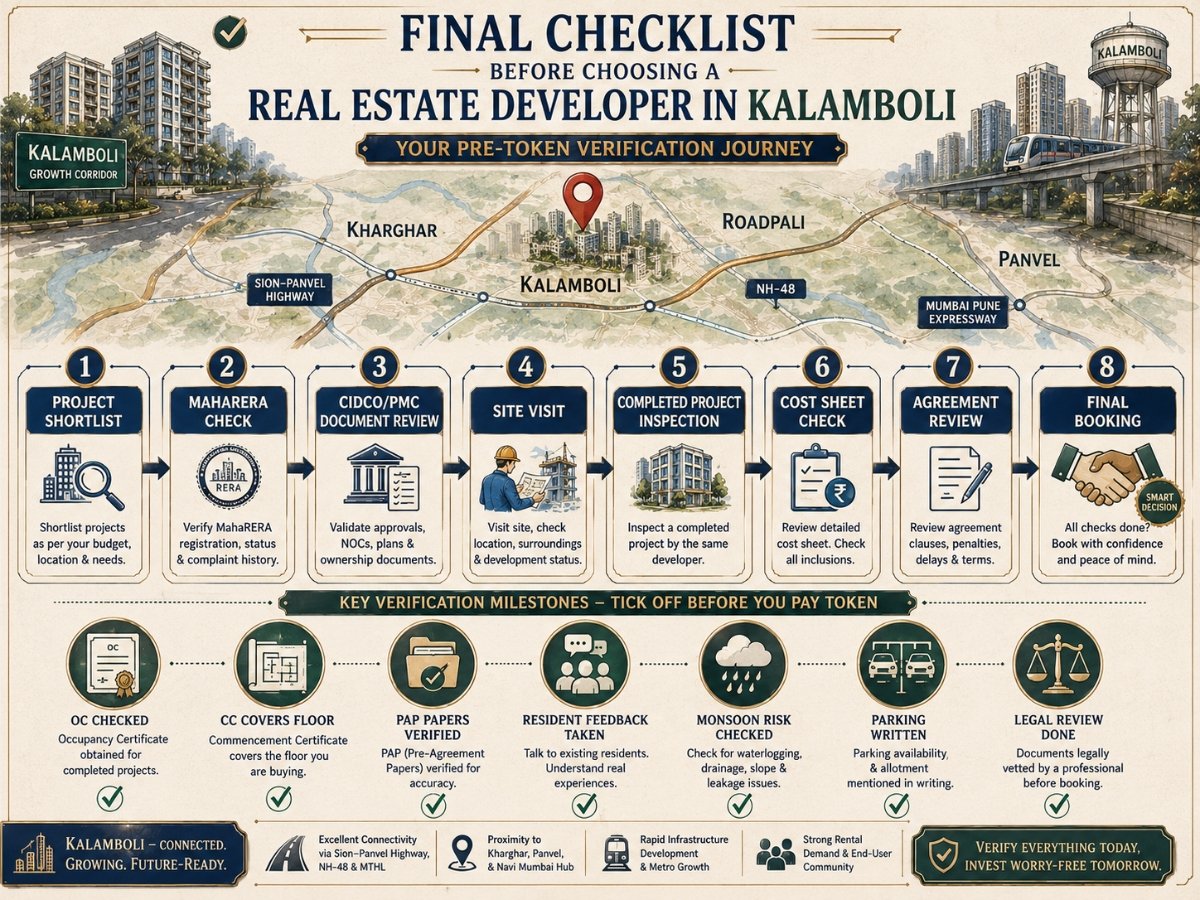
Use this before paying token money or signing any agreement:
- Verify MahaRERA registration number
- Check possession date, delays, complaints, encumbrances on MahaRERA
- Ask for Title Clearance Certificate and 30-year search report
- Verify Commencement Certificate (covers your floor)
- For ready flats, check Occupancy Certificate (OC)
- Compare approved plan with sales plan
- Check CIDCO documents, PAP or 12.5% scheme if applicable
- Confirm approval authority (PMC or CIDCO)
- Visit a completed project by the same developer
- Speak to residents about construction quality and maintenance
- Inspect project during or after monsoon
- Get all-inclusive cost sheet
- Confirm all charges (parking, GST, stamp duty, etc.)
- Put all promises in writing
- Review Agreement for Sale with a lawyer
- Check society formation and conveyance (for older projects)
- Avoid fit-out possession without OC
- Finalize only after full legal and financial clarity
Conclusion
Kalamboli offers strong practical value for homebuyers and investors because of its road connectivity, logistics importance, proximity to Panvel, Kharghar, Roadpali, Taloja, and the wider airport-linked growth belt. But this opportunity comes with local risks that buyers should not ignore.
The right real estate developer in Kalamboli is not simply the one with the biggest hoarding, lowest price, or most attractive sample flat. The right developer is the one with a clean title, valid approvals, transparent pricing, good construction quality, realistic possession timeline, valid OC process, clear CIDCO and PMC documentation, and a proven record of supporting buyers after possession.
MahaRERA registration is important, but it should not be treated as the only proof of developer quality. Buyers must also verify completed projects, legal documents, total cost, construction quality, location suitability, and resident feedback.
The final verdict is simple: choose the developer who gives written clarity before token money, not excuses after booking.
FAQs
Frequently asked questions