
To choose the right real estate developer in Mahape, buyers should check the developer’s past delivery record, MahaRERA details, legal documents, CIDCO or NMMC approvals, construction quality, pricing transparency, completed projects, buyer feedback and possession history before paying token money. In Mahape, this is especially important because the area is not a purely residential node. It is strongly influenced by Mahape MIDC, Millennium Business Park, Thane-Belapur Road, CIDCO land rules and mixed commercial-residential activity.
Mahape is a practical, employment-led real estate market. It attracts people working around MBP, TTC-MIDC, Ghansoli, Rabale, Kopar Khairane and Airoli. But buying property here needs more caution than buying in a mature residential node. A good developer in Mahape is not only someone who builds attractive flats. The developer must also handle land approvals, legal clarity, monsoon-resistant construction, industrial-adjacent site planning and transparent pricing.
This article is for general buyer awareness. Before booking a flat, paying token money or signing an agreement, buyers should verify all documents with a qualified property lawyer and check project details on official platforms such as MahaRERA, CIDCO, NMMC or the relevant authority.
Quick Summary: How to Choose the Right Real Estate Developer in Mahape
The safest way to choose a real estate developer in Mahape is to verify legal documents, completed projects, pricing clarity and buyer feedback before paying token money.
| What to Check | Why It Matters in Mahape | Good Sign | Red Flag |
|---|---|---|---|
| MahaRERA details | Confirms project registration, timeline and litigation information | Registered project with clear possession date | Lapsed status, missing details or litigation pattern |
| Legal documents | Mahape has CIDCO, NMMC and MIDC-linked complexities | CC, title report and approved plan shared before token | “Pay first, documents later” |
| Land status | CIDCO leasehold, PAP or 12.5% plot issues can affect ownership | Clear transfer chain and legal opinion | Unclear CIDCO transfer or pending dues |
| Completed projects | Shows actual delivery quality | Older buildings maintained well | Seepage, poor lifts, bad maintenance |
| Pricing | Final cost can rise due to GST, stamp duty, parking and PLC | Written all-inclusive cost sheet | Verbal price commitments |
| Location fit | Mahape is commercial and industrial-adjacent | Project suits buyer’s lifestyle or rental goal | Buyer expects Ghansoli-like family ecosystem |
| Buyer feedback | Reveals real post-possession experience | Consistent resident satisfaction | Repeated complaints about delay or OC |
Why Choosing the Right Real Estate Developer Matters in Mahape
Mahape is different from nodes like Vashi, Nerul, Seawoods or Kharghar. It is heavily connected to the TTC-MIDC industrial corridor, Millennium Business Park, data centres, warehouses, IT/ITES offices and the Thane-Belapur Road belt. This gives Mahape strong rental and commercial relevance, but it also creates a more complicated property-buying environment.
A buyer must understand three local realities.
First, Mahape is not a classic family-first residential node. Nearby Ghansoli and Kopar Khairane have stronger residential sectors, railway station access, markets, schools, hospitals and daily-living infrastructure. Mahape, by comparison, is more work-centric.
Second, approvals can involve different layers of authority depending on the project location. NMMC, CIDCO and MIDC relevance must be checked carefully. A project near an industrial or commercial pocket may need more legal clarity than a straightforward residential building in a planned CIDCO sector.
Third, the consequences of weak due diligence can be serious. If a building does not have proper approvals, Commencement Certificate or Occupancy Certificate, the buyer may face utility issues, resale problems, penal charges or even action from civic authorities.
Understand the Developer’s Past Track Record
A developer’s past record is usually more reliable than a sales presentation. In Mahape and nearby areas, buyers should not judge a builder only by brochure design, sample flat interiors or launch pricing. The real test is what the builder has already delivered.
Check Completed Projects Before Trusting New Launches
Before booking in a new project, ask the developer for a list of completed projects in Mahape, Ghansoli, Kopar Khairane, Rabale, Airoli or other nearby Navi Mumbai locations.
Check:
- Was the possession delivered close to the promised timeline?
- Did the project receive Occupancy Certificate?
- Were amenities completed as promised?
- Was the society formed properly?
- Were residents satisfied after possession?
If the builder has no completed project in the Navi Mumbai belt, be more cautious. A developer may be good in another city but still struggle with CIDCO, NMMC, MIDC or local land documentation in this region.
Visit Older Buildings Developed by the Same Builder
A five-year-old building tells the truth better than a sample flat. Visit at least one or two older projects by the same developer, preferably during or after monsoon.
Check the external paint, basement, lifts, lobby, parking, terrace waterproofing and common areas. In the Mahape-Ghansoli belt, monsoon performance matters because access roads, underpasses and low-lying pockets can face waterlogging or seepage issues.
A good older building should not look tired within a few years. The basement should not smell damp. Lift maintenance should be regular. The society should not be struggling because the builder failed to hand over documents or maintenance funds.
Speak to Existing Residents and Buyers
Speak to residents without the builder’s sales team present. Ask simple questions.
- Was possession delayed?
- Did the builder support after handover?
- Was the maintenance deposit properly handled?
- Did the society receive documents?
- Are there leakage issues?
- Are there pending disputes?
This one step can save lakhs of rupees and years of stress.
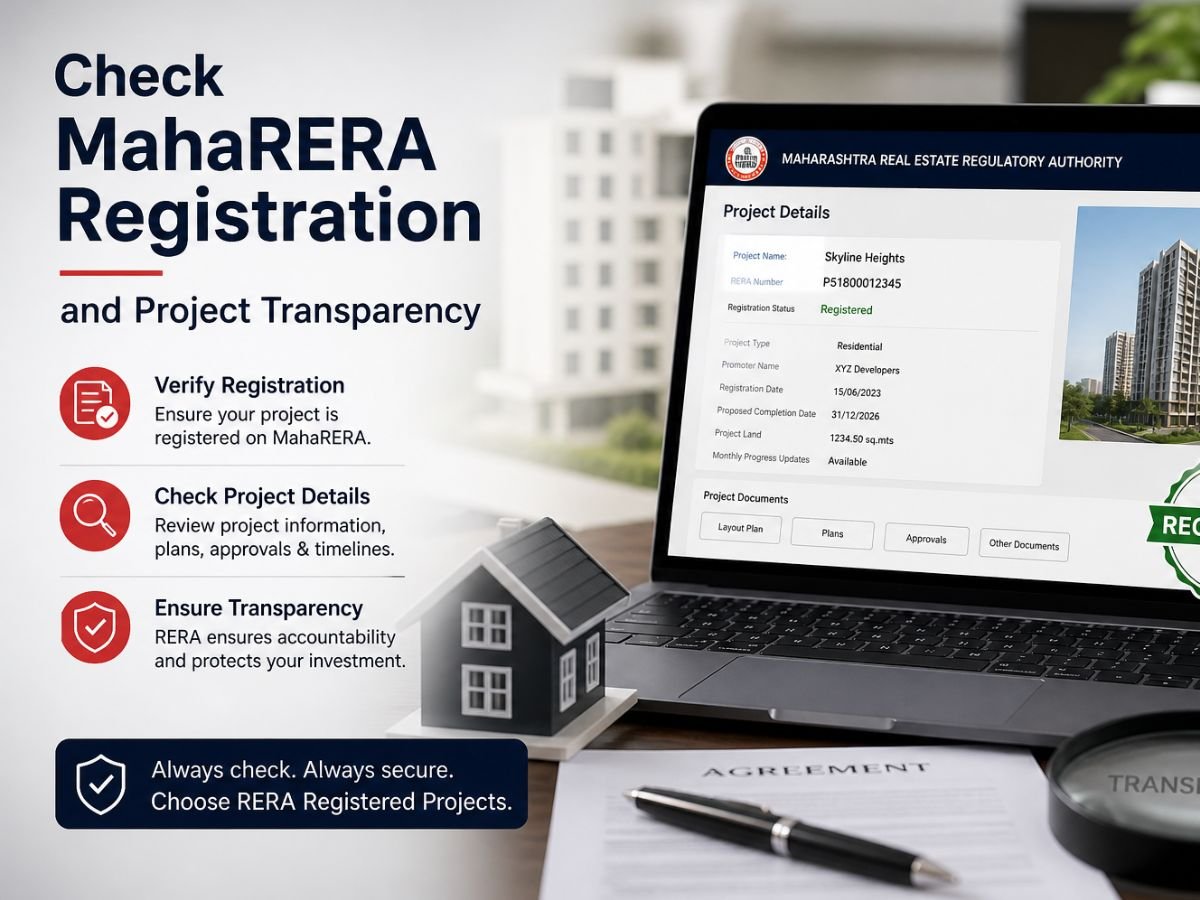
Check MahaRERA Registration and Project Transparency
MahaRERA is an important starting point for checking a project, but it should not be treated as the final proof of developer quality.
Why MahaRERA Is Important for Mahape Buyers
MahaRERA helps buyers check whether the project is officially registered, what the declared possession date is, whether there are litigations and whether the developer has uploaded key project information.
For Mahape buyers, MahaRERA is useful because the area has commercial, industrial and residential overlaps. A buyer should not rely only on a project brochure or verbal claim. The RERA registration details should match the project being sold.
What to Verify on the MahaRERA Website
Check these details carefully:
| MahaRERA Check | What Buyer Should Verify |
|---|---|
| Registration number | It should be active and match the exact project name |
| Project status | Avoid unclear, lapsed or disputed status without explanation |
| Promoter name | It should match the developer or legal selling entity |
| Declared possession date | Treat this as the legally important timeline |
| Carpet area | Should match the Agreement for Sale |
| Litigation tab | Check if there are disputes or legal matters |
| Encumbrance details | Check if the land or project has financial or legal burden |
| Uploaded documents | Compare with what the developer shares offline |
If the sales team says possession will happen in 2027, but MahaRERA shows a later completion date, buyers should treat the MahaRERA date as more reliable.
Why MahaRERA Alone Is Not Enough
MahaRERA registration does not guarantee construction quality, perfect legal title, timely possession or good after-sales support. A project can be RERA registered and still have delays, poor maintenance or unresolved buyer complaints.
Use MahaRERA as a diagnostic tool, not as blind assurance. Combine it with site visits, legal review, completed project inspection and local reputation checks.
Check Legal Documents Before Booking a Flat
Legal documents are the foundation of property safety. In Mahape, this is even more important because land history, CIDCO involvement, MIDC influence and NMMC approvals may differ from project to project.
| Document | Why It Matters | What Buyer Should Check |
|---|---|---|
| Title Clearance Certificate | Confirms developer’s legal right to sell | Ask for advocate-certified title report |
| Commencement Certificate | Confirms permission to start construction | Check approved floors and issuing authority |
| Occupancy Certificate | Confirms legal habitability | Do not accept possession without OC in ready projects |
| Approved Building Plan | Shows sanctioned layout | Compare with actual construction |
| Agreement for Sale | Legally binds buyer and developer | Review possession, payment and penalty clauses |
| CIDCO Transfer Documents | Important for CIDCO-origin land | Verify transfer chain and pending dues |
| Tripartite Agreement | Crucial for PAP or 12.5% plots | Check CIDCO, original allottee and developer link |
| Society Conveyance | Important after possession | Check if older projects completed handover |
Title Clearance Certificate
The Title Clearance Certificate should confirm that the developer has a clear and marketable title or valid development rights. For CIDCO-origin plots or PAP plots, title history can be complex.
Buyers should ask for a proper title report, preferably covering a long document history, and get it reviewed by a Navi Mumbai property lawyer.
Commencement Certificate
The Commencement Certificate proves that the developer has permission to begin construction. In Mahape, buyers should check whether the CC comes from the correct authority based on the project’s location and land status.
Also check whether the CC covers the floor where your flat is located. Permission for lower floors does not automatically mean upper floors are legally approved.
Occupancy Certificate
The Occupancy Certificate is extremely important. It confirms that the building has been completed as per approved plans and is legally fit for occupation.
Do not treat “fit-out possession” as final legal possession. Without OC, buyers may face problems with water connection, property tax, resale, home loan, insurance and civic compliance.
Approved Building Plan
Ask for the approved plan and compare it with the actual project layout. Check parking, amenity area, floor plan, open space, entrance, staircase, fire safety and lift positions.
If the sales plan and approved plan do not match, get legal clarification before booking.
Agreement for Sale
The Agreement for Sale is more important than brochure promises. It should clearly mention carpet area, total consideration, payment schedule, possession date, delay compensation, parking details and specifications.
Before signing, read it with a lawyer. Do not accept clauses that shift unclear future charges completely to the buyer without explanation.
CIDCO Transfer and Leasehold Clarity
Many Navi Mumbai properties have a CIDCO land background. Buyers should check whether the land is leasehold, whether any transfer charges are pending and whether any freehold conversion process applies.
For CIDCO-origin properties, unclear transfer documents can create future resale and loan problems.
Mahape-Specific Documents Buyers Should Check Before Booking
Mahape buyers should not follow a generic flat-buying checklist. The local land and approval context must be checked properly.
CIDCO Allotment and Transfer Documents
If the land has CIDCO origin, ask for the allotment letter, transfer order and relevant permissions. A proper paper trail should show how the developer received the right to develop and sell the project.
PAP Plot or 12.5% Scheme Plot Clarity
In Navi Mumbai, many projects are linked to PAP or 12.5% Gaothan expansion plots. In such cases, the buyer should check the Final Order, Tripartite Agreement and transfer documents between CIDCO, the original landholder and the developer.
This is not a small technical point. If the foundation document chain is weak, the flat purchase becomes risky.
NMMC, PMC or CIDCO Approval Relevance
For Mahape, NMMC, MIDC and CIDCO relevance must be checked based on exact location and land use. Do not assume every project follows the same approval path.
Ask the developer which authority approved the project and verify documents accordingly.
Society Formation and Conveyance Status
For completed projects, check whether the society was formed and whether conveyance or deemed conveyance was completed. A building without proper society handover can face long-term maintenance and redevelopment problems.
Compare Construction Quality and Actual Site Progress
A developer’s quality is not judged only by elevation design or entrance lobby. In Mahape, construction must be durable enough for monsoon, industrial dust, heavy traffic movement and long-term maintenance.
Visit the Actual Construction Site
When visiting the site, look beyond the sales office.
Check:
- Actual construction progress
- Material storage and site cleanliness
- Worker safety and supervision
- Access road condition
- Drainage near the plot
- Surrounding traffic and noise
- Distance from industrial pockets or heavy vehicle routes
A project may look good in digital renders but feel very different on the ground.
Compare Sample Flat and Real Flat Specifications
Sample flats often use lighting, mirrors, smaller furniture and design tricks to make rooms appear larger. Compare the sample flat with the actual carpet area and technical specifications mentioned in the agreement.
Ask for written confirmation of flooring, doors, windows, sanitaryware, electrical fittings, tiles, lift brand and common area specifications.
Check Lift, Lobby, Parking and Common Area Quality
Common areas show how serious the developer is. Good developers maintain quality not only inside flats but also in lifts, parking, lobby, staircase, fire systems and drainage.
In Mahape, basement and podium parking deserve special attention because water seepage can become a recurring issue in monsoon.
Check Monsoon Performance and Leakage Issues
If possible, visit the site or older completed projects during monsoon. Check for damp patches, basement waterlogging, wall cracks, terrace leakage and efflorescence on walls.
In and around Mahape, Thane-Belapur Road and underpass flooding issues are important reminders that drainage and waterproofing cannot be ignored.
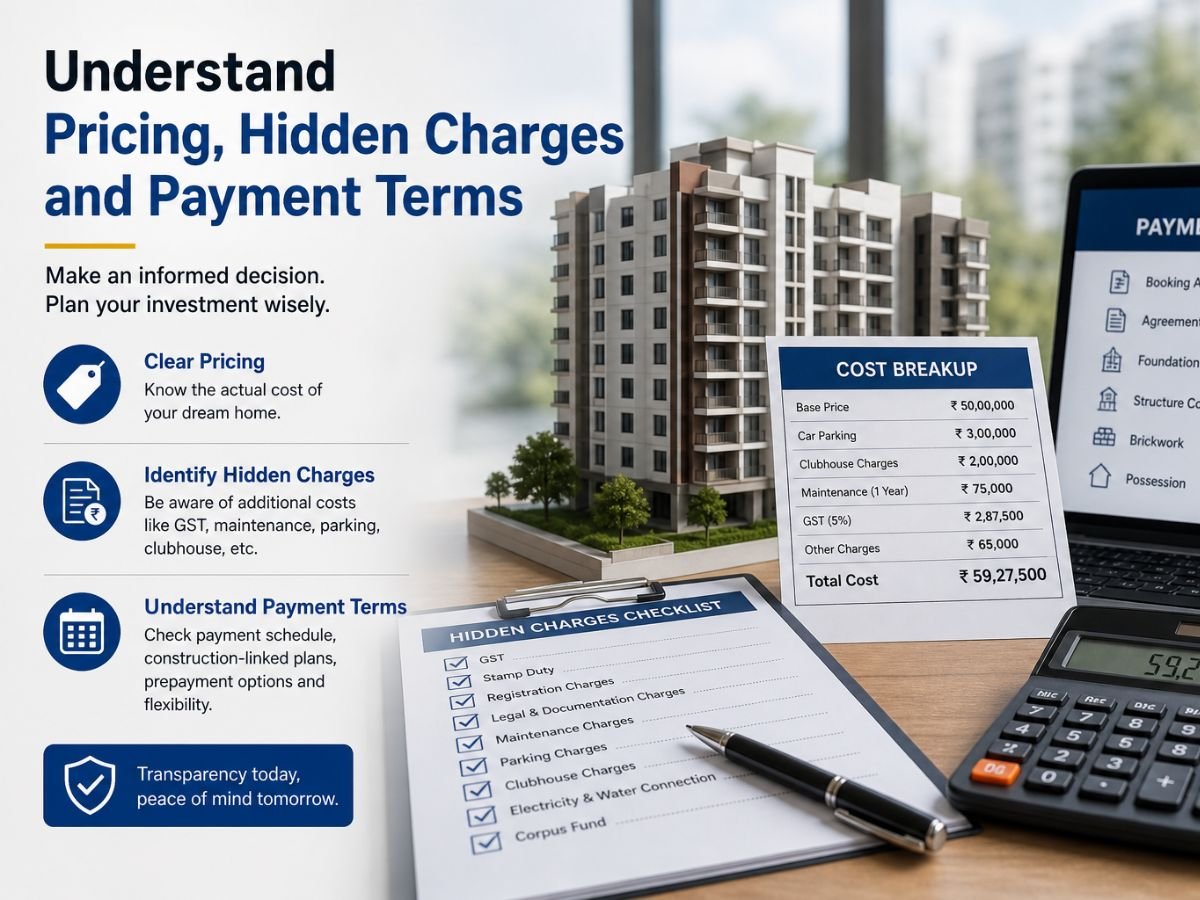
Understand Pricing, Hidden Charges and Payment Terms
The advertised flat price is rarely the final cost. Buyers should calculate the full out-of-pocket amount before paying token money.
Ask for an All-Inclusive Cost Sheet
A trustworthy developer should provide a written cost sheet on official letterhead.
It should include:
- Agreement value
- GST, if applicable
- Stamp duty
- Registration
- Parking charges
- Floor-rise charges
- Preferential Location Charges
- Legal charges
- Maintenance deposit
- Corpus fund
- Clubhouse or amenity charges, if any
- Society formation charges
- Other deposits
If the developer refuses to give written clarity, treat it as a red flag.
Check Parking, Floor-Rise, PLC and Maintenance Charges
Many buyers plan their budget based only on base price. Later, they discover lakhs of rupees in add-ons.
Ask whether parking is included or charged separately. Check whether floor-rise applies from a certain floor. Ask whether PLC is charged for view, road-facing unit, corner flat or amenity-facing flat.
Understand GST, Stamp Duty and Registration Cost
For under-construction properties, GST may apply as per current rules. Ready-to-move properties with valid OC are generally treated differently for GST purposes.
Stamp duty, registration and other statutory costs should be calculated before final commitment. Buyers can use a [stamp duty calculator](ADD INTERNAL LINK HERE) and [property tax calculator](ADD INTERNAL LINK HERE) for planning.
Avoid Verbal Price Commitments
Never rely on verbal pricing. If the salesperson says “everything is included,” ask them to send the final cost sheet from the official company email ID.
A professional developer will not hesitate to put charges in writing.
Check Developer Reputation Beyond Online Reviews
Online reviews are useful, but they can be manipulated. A smart buyer looks for patterns, not just star ratings.
Read Google Reviews Carefully
Read negative reviews first. Look for repeated complaints about possession delay, leakage, poor maintenance, rude staff, OC issues or hidden charges.
One bad review may not mean much. But the same complaint repeated by several buyers deserves attention.
Look for Repeated Complaint Patterns
A pattern matters more than isolated feedback.
Red flags include:
- “Possession delayed again”
- “No OC yet”
- “Maintenance very high”
- “Builder not responding”
- “Society handover pending”
- “Leakage after one monsoon”
- “Parking not allotted clearly”
Speak to Local Brokers and Residents
Local brokers, society members and residents often know which developers are reliable and which ones create post-possession problems. Speak to more than one person, because one opinion can be biased.
For professional help, buyers can consult [real estate agents in Mahape](ADD INTERNAL LINK HERE) or [real estate agents in Navi Mumbai](ADD INTERNAL LINK HERE).
Check Litigation or Delay History Where Possible
Use MahaRERA and legal review to check if the developer has repeated litigations or delayed projects. A developer who frequently asks for extensions should be evaluated carefully.
Big Builder vs Local Builder: Which Is Better in Mahape?
There is no single answer. A big builder is not automatically safer, and a local builder is not automatically risky. In Mahape, the right choice depends on documentation, delivery record, site quality and local approval handling.
| Factor | Big Developer | Local Mahape / Navi Mumbai Developer |
|---|---|---|
| Brand comfort | Usually higher | Depends on track record |
| Pricing | Often higher due to brand premium | Often more competitive |
| Local approval knowledge | May depend on local team or JV partner | Often stronger with CIDCO/NMMC processes |
| Amenities | Usually better in large projects | Usually practical and project-specific |
| Delivery risk | Lower if execution is strong | Lower only if past record is strong |
| Buyer support | More structured | Can be faster if promoter is accessible |
| Best for | Buyers wanting brand comfort and scale | Buyers wanting local efficiency and value |
Advantages of Big Real Estate Developers
Big developers may offer stronger systems, better project planning, professional documentation, branded construction partners and better amenity design. They may also be easier for NRIs or outstation buyers to trust.
Advantages of Local Mahape Developers
A reputed local developer may understand CIDCO paperwork, NMMC approvals, PAP plot issues, local brokers, society handover and practical buyer expectations better than a national brand entering the area for the first time.
When a Smaller Developer Can Be a Better Choice
A smaller developer can be a better choice if:
- They have completed projects nearby
- Their legal documents are clean
- Residents give positive feedback
- Construction quality is visible
- Pricing is transparent
- Society handover history is good
When a Big Brand May Still Be Safer
A big brand may be safer if the project is directly executed by the main developer, documents are clean, construction is funded properly and the project has a strong delivery plan.
Buyers should also check whether the big brand is actually developing the project or only lending its name through a joint venture.
Check Location Fit Before Choosing the Developer
A good developer cannot fully correct a wrong location choice. In Mahape, location fit is one of the most important decisions.
Mature Nodes Like Ghansoli, Kopar Khairane, Airoli and Vashi
Ghansoli, Kopar Khairane, Airoli and Vashi have stronger residential ecosystems. They offer better railway access, markets, schools, hospitals, parks and family-friendly neighbourhood structure.
If the buyer wants long-term family living, these mature nodes may suit better than deep industrial-adjacent pockets of Mahape.
Growth and Commercial Pockets Like Mahape MIDC, Rabale, Turbhe, Juinagar and Thane-Belapur Road Belt
Mahape MIDC, MBP, Rabale, Turbhe and the Thane-Belapur Road belt are more work-driven. They may suit investors, business owners, working professionals and rental-focused buyers.
For residential buyers, the exact project location matters. A flat near heavy vehicle movement, industrial activity or weak drainage may not suit every family.
Why Location Quality and Developer Quality Must Be Checked Together
A reputed developer in a compromised location may still create lifestyle problems. A lesser-known but reliable developer in a better-connected residential pocket may sometimes be the smarter choice.
Before booking, visit the area during office hours, evening traffic and monsoon if possible. Check noise, access roads, public transport, safety, pollution, parking pressure and daily convenience.
Questions to Ask a Developer Before Paying Token Money
Token money should not be paid casually. Before token payment, the buyer has maximum negotiation power.
| Question | Why It Matters | Proof to Ask For |
|---|---|---|
| Is the project registered on MahaRERA? | Confirms legal registration | MahaRERA number |
| Can you share the approved plan, CC and legal documents? | Confirms basic approval clarity | Digital copies before token |
| Is the quoted price fully all-inclusive? | Prevents hidden charges | Signed cost sheet |
| What is the written possession timeline? | Verbal timeline has no value | MahaRERA possession date |
| What happens if possession is delayed? | Checks RERA compliance | Delay compensation clause |
| Is the OC already received or expected later? | Critical for legal possession | OC copy or written timeline |
| Are there CIDCO dues or transfer charges? | Avoids future liability | No-dues or transfer proof |
| Can I review the Agreement for Sale before token? | Protects buyer legally | Draft agreement copy |
Is the Project Registered on MahaRERA?
Ask for the exact MahaRERA number and verify it yourself. Do not accept screenshots without cross-checking.
Can You Share the Approved Plan, CC and Legal Documents?
A serious buyer has the right to review documents before payment. If the builder says documents will be shown only after token, be careful.
Is the Quoted Price Fully All-Inclusive?
Ask this directly and get the answer in writing. Hidden GST, parking, PLC or maintenance charges can disturb the full budget.
What Is the Written Possession Timeline?
The written timeline matters, not the sales pitch. Check the date on MahaRERA and the Agreement for Sale.
What Happens If Possession Is Delayed?
The agreement should explain delay compensation clearly. Avoid vague answers.
Is the OC Already Received or Expected Later?
For ready-to-move flats, ask for the OC copy. For under-construction projects, ask when OC is expected and what happens if it is delayed.
Red Flags When Choosing a Real Estate Developer in Mahape
| Red Flag | What It May Mean | Buyer Action |
|---|---|---|
| Pressure to pay token quickly | Developer wants to stop due diligence | Do not pay without documents |
| No written clarity on charges | Hidden cost risk | Demand all-inclusive cost sheet |
| Delayed older projects | Weak delivery discipline | Check MahaRERA history |
| Poor maintenance in completed buildings | Low construction or after-sales quality | Visit older projects |
| Weak legal transparency | Approval or title risk | Consult property lawyer |
| Too many verbal promises | Future dispute risk | Ask for written confirmation |
| Fit-out possession without OC | Illegal or incomplete compliance | Do not take possession |
| Unclear CIDCO transfer | Future resale and title risk | Verify CIDCO documents |
Pressure to Pay Token Money Quickly
“Offer valid only today” is a common pressure tactic. A real property decision should not be rushed.
No Written Clarity on Charges
If the builder avoids giving written cost breakup, assume more charges may come later.
Delayed Older Projects
Check whether the developer’s older projects were delayed. Repeated delays are a pattern, not bad luck.
Poor Maintenance in Completed Buildings
A building that looks weak after only a few years indicates poor material quality or poor post-possession support.
Weak Legal Transparency
A transparent developer shares documents. A risky developer delays document sharing.
Too Many Verbal Promises
Future metro access, highway improvement, rent guarantee and amenity promises should not be accepted unless written into official communication or legal documents.
Real Estate Developer Shortlisting Scorecard
Use this scorecard to compare two or three developers before deciding.
| Factor | What to Check | Good Sign | Red Flag |
|---|---|---|---|
| Past Delivery Record | Completed projects and timelines | On-time or near on-time delivery | Repeated extensions |
| Legal Transparency | CC, title report, agreement draft | Shared before token | Refusal or delay |
| Construction Quality | Old projects, basement, lifts | Dry, maintained, functional | Seepage and poor upkeep |
| Pricing Clarity | Total cost sheet | Written and itemized | Verbal estimates |
| Location Suitability | Access, noise, drainage, social infra | Matches buyer purpose | Industrial discomfort ignored |
| After-Sales Support | Society formation and handover | Smooth handover | Builder control continues |
| Buyer Feedback Pattern | Reviews and resident feedback | Consistent satisfaction | Repeated complaints |
Common Mistakes Buyers Make While Choosing Builders in Mahape
Trusting Only Brand Name
A big name does not remove the need for legal checking. Even reputed developers must prove approvals, title clarity and delivery discipline.
Ignoring Legal Document Verification
Some buyers check brochures but not CC, OC, title report or CIDCO transfer documents. This is risky in Navi Mumbai.
Booking Only Because of Discount or Offer
A discount is meaningless if the project has unclear approvals, weak construction quality or hidden charges.
Not Visiting Completed Projects
Never judge a developer only by a sample flat. Completed buildings reveal the real quality.
Depending Fully on Broker or Sales Team Promises
Brokers and sales teams may be helpful, but their verbal promises are not legal protection. Verify independently.
How to Verify a Real Estate Developer Before Final Decision
Step 1: Check MahaRERA Details
Search the project on the MahaRERA website. Check registration status, possession date, promoter name, litigation, encumbrances and uploaded documents.
Step 2: Visit the Project Site
Visit the actual site. Check access, traffic, nearby industrial activity, drainage, construction progress and surrounding civic infrastructure.
Step 3: Visit Completed Projects
Visit older projects by the same developer in Mahape, Ghansoli, Kopar Khairane, Airoli or nearby areas. Speak to residents.
Step 4: Review Legal Documents with an Expert
Show the title report, CC, approved plan, draft agreement, CIDCO transfer documents and PAP-related documents to a qualified property lawyer.
For related legal understanding, read [agreement to sale vs sale deed](ADD INTERNAL LINK HERE).
Step 5: Compare Total Cost with Other Projects
Compare the full cost, not only base price. Include GST, stamp duty, registration, parking, maintenance, corpus and other charges.
Step 6: Take Final Decision Only After Written Clarity
Do not pay token money until legal documents, price, possession date and key promises are confirmed in writing.
Final Checklist Before Choosing a Real Estate Developer in Mahape
Use this checklist before making payment:
- MahaRERA registration number checked on the official portal
- Promoter name and project details verified
- MahaRERA possession timeline checked
- Litigation or extension history checked where available
- Commencement Certificate reviewed
- Approved building plan reviewed
- OC checked for ready-to-move property
- CIDCO leasehold or freehold status understood
- CIDCO transfer documents checked where applicable
- PAP or 12.5% plot documents verified, if relevant
- Title Clearance Certificate reviewed by a lawyer
- Agreement for Sale reviewed before signing
- Written all-inclusive cost sheet received
- Parking allocation written clearly
- GST, stamp duty and registration costs calculated
- Completed project visited
- Existing residents or buyers spoken to
- Site progress physically checked
- Monsoon flooding and access road risks checked
- No verbal promises accepted without written proof
- Final payment linked to legal possession and OC clarity
Conclusion
Choosing the right real estate developer in Mahape requires a more careful approach than choosing a builder in a straightforward residential node. Mahape has strong commercial and rental relevance because of Mahape MIDC, Millennium Business Park and the Thane-Belapur Road corridor, but it also has legal, location and infrastructure complexities that buyers must not ignore.
The right developer should have clean MahaRERA details, clear legal documents, strong completed projects, transparent pricing, good resident feedback and proper CIDCO/NMMC approval handling. The wrong developer may offer attractive pricing but create long-term problems through hidden charges, delayed possession, unclear OC, weak construction or incomplete society handover.
A reputed developer is not always the right developer if the project has unclear approvals, delayed possession, hidden charges or weak after-sales support. For Mahape buyers, the best decision is not the most emotional one. It is the one backed by documents, site checks, resident feedback and written clarity.
FAQs
Frequently asked questions