

How to Negotiate Commercial Property Prices in Navi Mumbai
If you want to negotiate commercial property prices in Navi Mumbai properly, do not focus only on the quoted rate per sq ft. Focus on the total deal cost, the unit’s usability, and the local friction attached to it here you can find more ways, How to Negotiate Commercial Property Prices in Navi Mumbai. Buyers usually get better leverage in urgent resale deals, awkward or oversized units, weaker upper-floor retail, late-stage builder inventory, and properties with legal, transfer, vacancy, or occupancy friction. That is where real negotiation starts.
Commercial negotiation in Navi Mumbai is not the same as bargaining for a flat. A shop, office, showroom, or pre-leased unit has to be judged by rentability, running cost, and exit ease. A unit that looks “cheap” on paper can still become expensive once GST, CAM, fit-out, parking, property tax, or CIDCO transfer issues come into the picture.
This is the practical way to think about it: do not negotiate only the price. Negotiate the weak points of the asset.
Quick summary
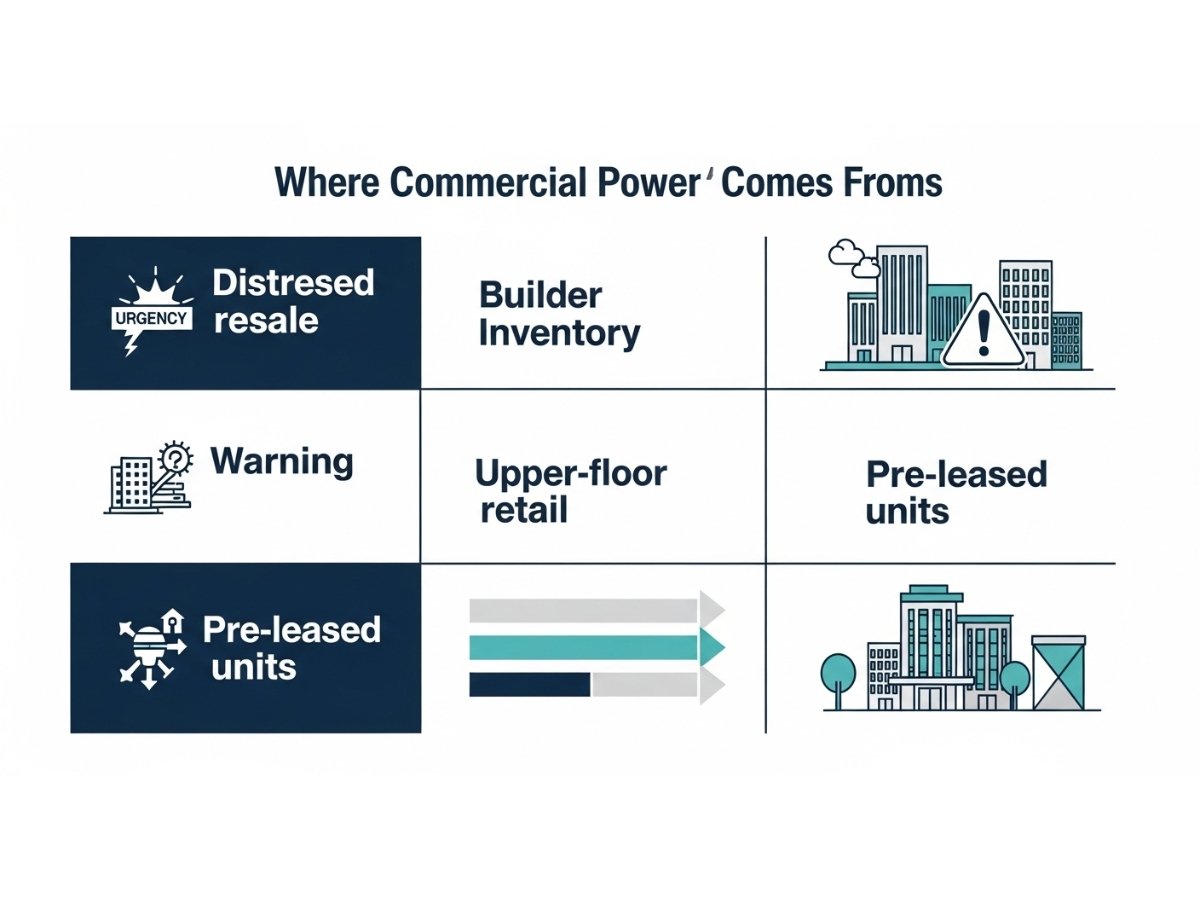
| Situation | What usually gives you negotiation power | What to negotiate | What not to assume |
|---|---|---|---|
| Distressed resale unit | Seller urgency, long listing age, vacancy, old building condition | Base price, dues settlement, transfer-cost allocation | Do not assume every old unit is cheap for a good reason |
| Late-stage builder inventory | Unsold stock, quarter-end pressure, project cleanup | Base rate, floor-rise, PLC, parking, fit-out support, payment terms | Do not assume GST disappears because builder offers a discount |
| Upper-floor retail | Lower tenant depth, weaker walk-in business, visibility issues | Base price, CAM support, parking, signage rights | Do not assume low price means good leasing ability |
| Bare-shell office | Fit-out burden, large capex before use | Base price, fit-out period, parking, CAM escalation | Do not ignore interior cost of ₹800 to ₹1,000 psf range |
| Pre-leased unit | Lease expiry risk, weak tenant profile, low deposit, inflated headline yield | Capital value based on yield risk | Do not buy only because “9% assured return” is written somewhere |
| Internal or awkward unit | Poor frontage, odd layout, pillar problem, low natural visibility | Base price and structural concessions | Do not compare it directly with main-road facing stock |
What matters more in Navi Mumbai commercial deals: the quoted rate or the full deal cost?
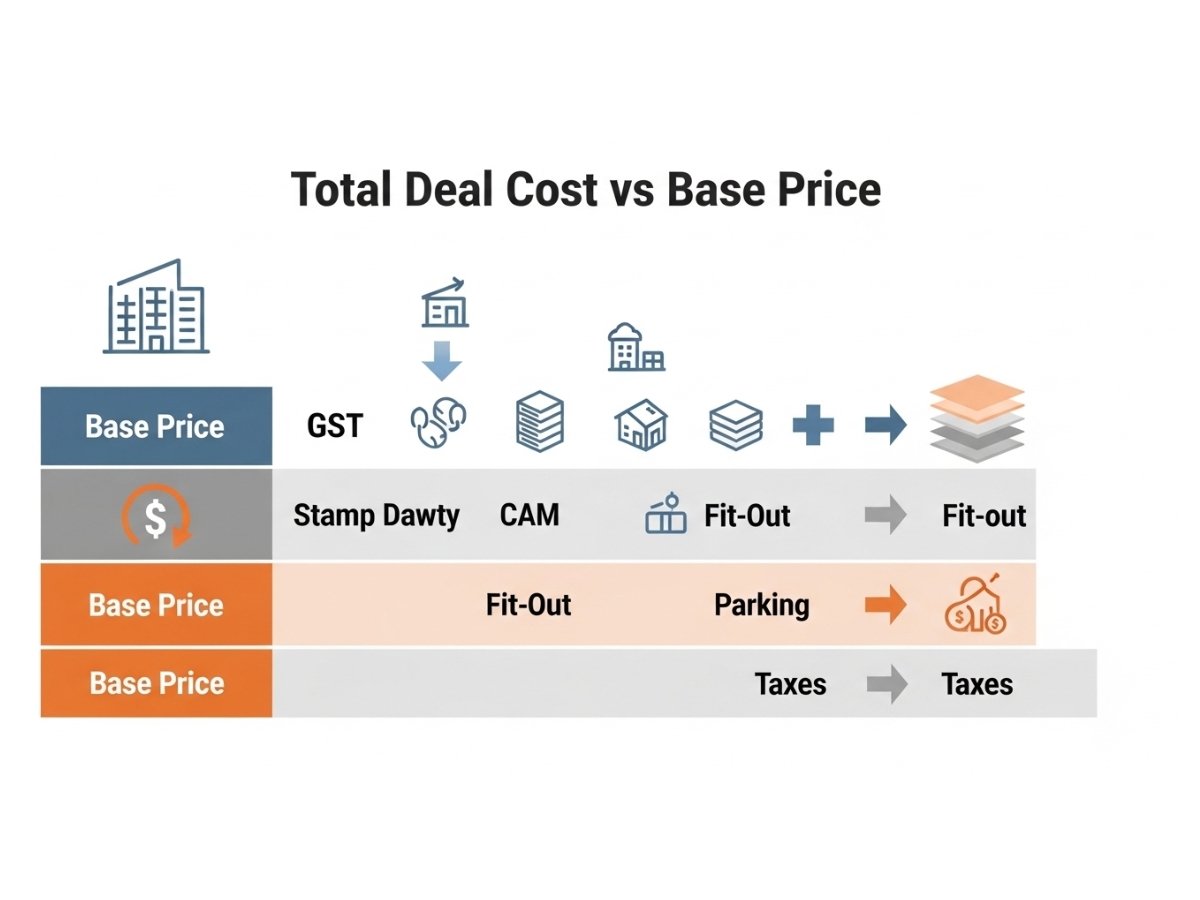
The full deal cost matters more. In many Navi Mumbai commercial deals, the base price is only the first layer. The real mistake is winning a small discount on the headline number and then losing much more through taxes, maintenance, fit-out burden, and authority-side charges.
A buyer may feel happy after negotiating a lower rate, but the effective cost can still rise sharply once the rest of the deal is added. That is why commercial property price negotiation in Navi Mumbai has to be done through a total acquisition cost lens.
Costs that are usually fixed
These are generally not negotiable with the government:
- Commercial stamp duty
- Registration charges
- GST on under-construction commercial units
- NMMC or PMC-side property tax obligations
- Other statutory costs that attach by law, not by sales strategy
The important point is this: even when these costs are fixed, they still affect your negotiation because they change what you can realistically afford.
Costs that are often negotiable
This is where your actual negotiation energy should go:
- Base rate per sq ft
- Floor-rise premium
- Preferential location charges or PLC
- Parking price or allocation
- Brokerage
- CAM terms and escalation
- Fit-out contributions or rent-free fit-out period
- Payment schedule flexibility
- In resale, who clears pending dues and who absorbs transfer friction
Why a lower base rate can still be a worse deal
Suppose Deal A comes at a lower base price, but the CAM is ₹25 psf per month, parking is compulsory and expensive, and the office is bare shell with heavy fit-out needs. Deal B has a slightly higher base rate, but CAM is closer to ₹10 to ₹12 psf, parking is included, and the seller gives a fit-out period or a cleaner ready-to-use space. Many buyers still pick Deal A because the rate “looks better.” That is exactly how overpayment happens in commercial real estate.
In Navi Mumbai, this is especially important because recurring holding costs and authority-side frictions can quietly destroy the value of a so-called discount.
When do buyers actually get real negotiation power in Navi Mumbai commercial property?
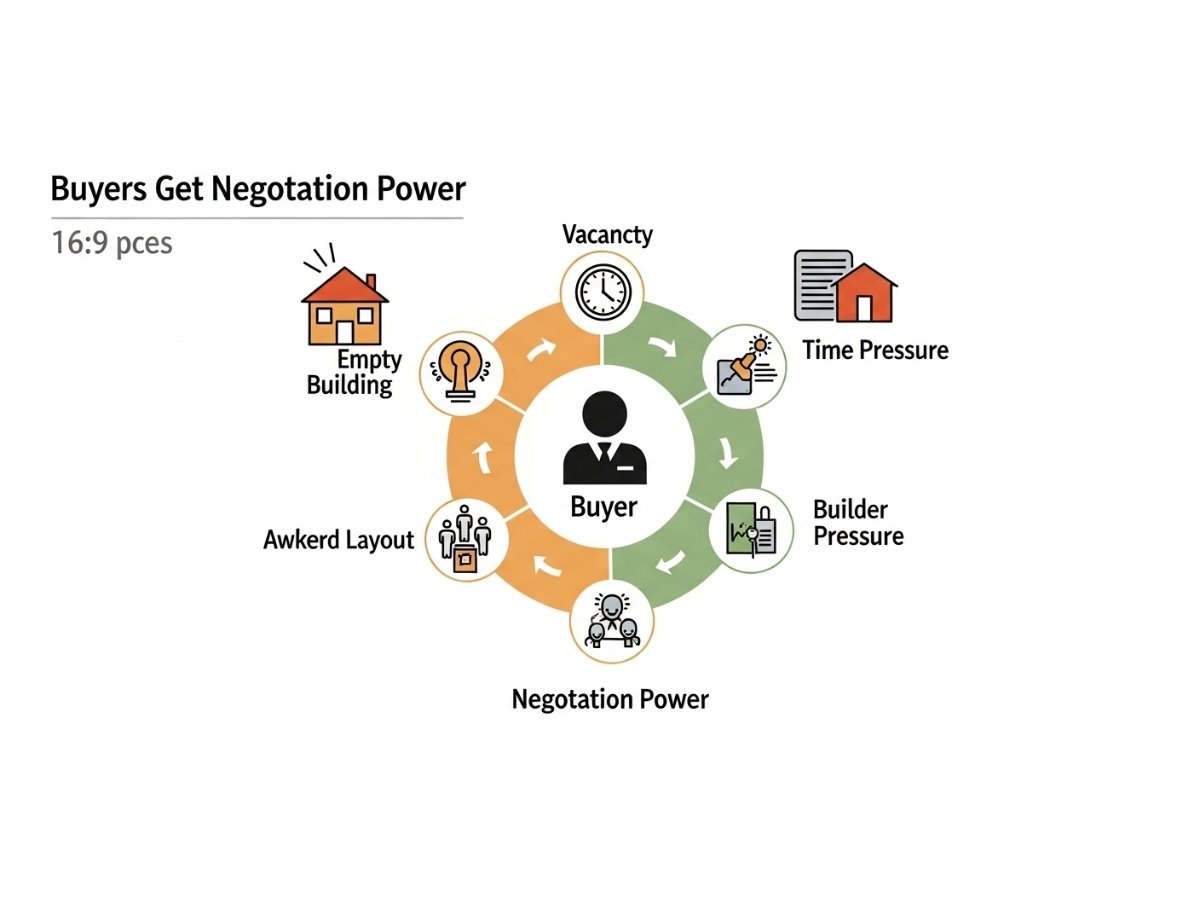
Real leverage appears when the unit has a weakness that narrows its buyer pool, tenant pool, or financing comfort. Sellers stay firm when the asset is easy to rent, easy to use, and easy to exit. They become flexible when the asset has friction.
Resale deals with urgency, vacancy, or weak unit fit
This is where buyers often get the cleanest direct price reduction. A resale owner may want fast liquidity, may be tired of a vacant unit, or may be holding a property that the market does not absorb easily. That usually happens with:
- oversized commercial units
- awkward floor plates
- older offices with tired services
- upper-floor retail
- internal shops with weak frontage
- buildings with visible vacancy
In such cases, a serious buyer with clarity and funds can negotiate more confidently than in a hot, well-occupied main-road retail deal.
Builder inventory that needs closure, cleanup, or stock movement
Builder negotiation is different. Developers often protect the headline price, but they may still bend through structure. That is why you may get:
- waiver of floor-rise
- softer PLC
- better payment schedule
- additional parking
- fit-out support
- rent-free possession period in some cases
- extra commercial benefit packaged without openly slashing the rate
Late-stage inventory, year-end cleanup, and high unsold stock usually increase buyer leverage.
Units that look expensive because of friction, not because of demand
This is one of the most useful negotiation ideas in Navi Mumbai. Some units are not overpriced because demand is strong. They are overpriced because the seller is quoting as if the unit has no friction, even though it clearly does.
That friction can be:
- poor parking practicality
- upper-floor retail in a non-destination building
- weak signage visibility
- internal access
- heavy loading on super built-up area
- CIDCO transfer complications
- old building systems
- unfinished local ecosystem
That is your negotiation argument. Not emotion. Not random bargaining. Specific, provable friction.
What should you check before making your first offer on a shop or office?
Never negotiate blind. First check whether the unit is genuinely usable for business and rentable for the market it targets.
Unit usability checks
For shops, ask:
- Is the frontage strong enough for signage and visibility?
- Is the shutter width practical?
- Is the depth usable, or too long and awkward?
- Is it on a floor where actual buyers will come?
For offices, ask:
- How efficient is the carpet area?
- Are there pillar issues?
- Is the ceiling height workable?
- Can the space take commercial power load?
- How much fit-out capex will be needed before operations start?
A low rate is not useful if half the space is dead space.
Building and occupancy checks
Look beyond the unit. Check the building:
- vacancy pattern
- lift condition
- common area quality
- visitor parking
- employee access
- loading and unloading comfort
- older service issues
- society or maintenance discipline
In legacy pockets of Vashi and some older commercial stock, parking scarcity itself can change the negotiation outcome. In newer mixed-use belts, oversupply can do the same.
Legal and authority-side checks
Before your first serious offer, confirm:
- OC status
- project stage reality
- pending property tax dues
- society dues
- leasehold or title status
- transfer process friction
- whether the building sits in an NMMC or Panvel-side civic context that changes taxes or usage handling
In CIDCO areas, transfer-side costs and permissions can become a major commercial issue, especially in resale. A cheap base price means very little if the transfer side is messy or expensive.
How should builder deals and resale deals be negotiated differently?
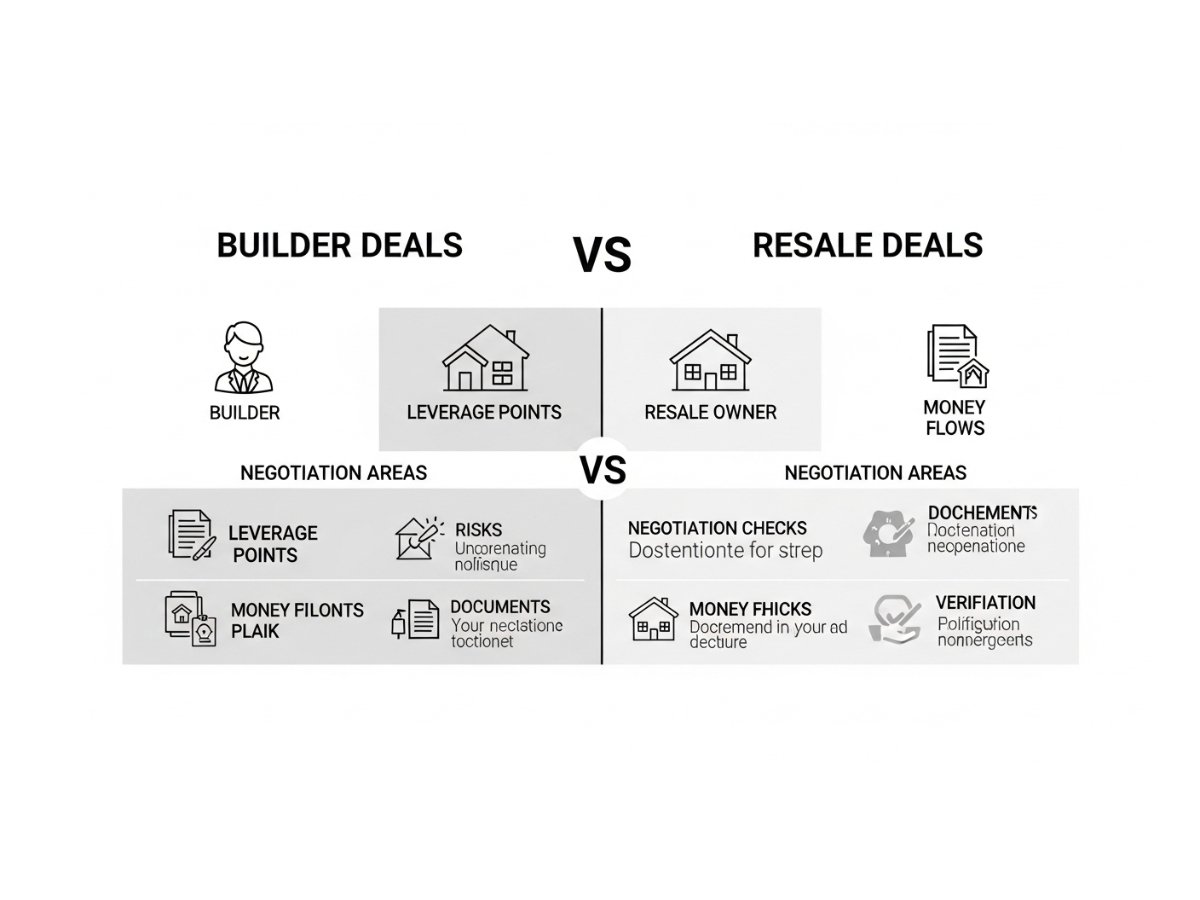
They should be negotiated very differently because the motivations, risks, and cost structure are different.
| Parameter | Builder deal | Resale deal |
|---|---|---|
| Main buyer concern | GST on under-construction units, possession risk, project execution | Title clarity, dues, transfer friction, building condition |
| Where negotiation usually appears | Floor-rise, PLC, parking, payment plan, fit-out support | Direct base price, dues clearance, transfer cost sharing |
| Best leverage point | Unsold inventory, quarter-end pressure, delayed demand absorption | Seller urgency, vacancy, age, awkward unit fit, repair burden |
| Key verification | MahaRERA registration, timeline history, OC path | Title chain, society NOC, tax dues, CIDCO lease status |
| Typical pattern | Smaller visible discount, larger hidden concessions | More direct capital-value correction |
What usually works in builder negotiations
With builders, do not chase only a lower headline number. Ask:
- Can floor-rise be waived?
- Can PLC be reduced?
- Can parking be bundled?
- Can payment milestones be softened?
- Can fit-out support or a commercial possession benefit be added?
This matters because GST on under-construction commercial property is a real cost layer. If you ignore structure and fight only on the rate, you usually leave money on the table.
What usually works in resale negotiations
In resale, the best leverage usually comes from:
- seller urgency
- age of the building
- repair burden
- local vacancy
- inefficient layout
- tax or society dues
- transfer friction
- low tenant depth for that unit type
This is where direct price negotiation becomes stronger. In many resale cases, the argument is simple: “This unit is not comparable to better-performing stock in the same node.”
Under-construction versus ready-possession changes the math
A ready commercial unit with OC may look more expensive at first glance, but it avoids the under-construction GST layer. Sometimes the ready resale deal is actually cleaner and more economical. Sometimes it is not, especially if transfer costs, poor condition, or hidden dues are severe. That is why buyers should compare effective cost, not brochure logic.
Which commercial property types in Navi Mumbai usually offer more room to negotiate?
Not all commercial assets give equal negotiation room.
Shops and showrooms
Strong ground-floor retail in proven commercial stretches usually gives the buyer less room. If the shop has visible frontage, walk-in logic, and a healthy catchment, the seller knows it. Discounts in such units are often tighter.
But the opposite is also true. Upper-floor retail, internal shops, or shops with weak frontage may show far more flexibility. The risk, of course, is that the same factors that help you negotiate may also hurt leasing later.
Offices
Offices often give more room than strong retail, especially when they are bare shell or large. A 1,000 sq ft office is one thing. A much larger office plate with expensive fit-out needs and a narrower tenant pool is another. The bigger the capex burden before usability, the stronger your negotiation position usually becomes.
Pre-leased units
Pre-leased commercial property negotiation is not normal price haggling. Here, you are buying a yield stream. So ask:
- How many years are left in lock-in?
- Who is the tenant?
- Is the lease genuine and sustainable?
- Is the rent artificially high for the first phase?
- What is the deposit structure?
- What happens after lease expiry?
If vacancy risk is near, the capital value should reflect that. A pre-leased unit is only as strong as the lease quality.
Larger or awkward commercial units
These can offer the highest price flexibility, but only for buyers who understand the downside. Large floor plates, difficult subdivision, awkward pillars, or niche usage requirements reduce the buyer pool. That gives leverage. It also increases future exit risk if you buy carelessly.
How do Vashi, Belapur, Airoli, Nerul, Seawoods, Kharghar, Panvel and other pockets change negotiation power?
Negotiation power changes sharply by node because business demand is not uniform across Navi Mumbai.
Mature business nodes where buyer leverage is usually tighter
Vashi, CBD Belapur, and stronger parts of Nerul are mature commercial belts. Occupancy, established business movement, and known demand make sellers more confident. Here, deep base-price cuts are harder unless the unit itself is weak.
In such pockets, buyers may get better results negotiating:
- parking
- CAM terms
- repair or fit-out support
- dues settlement
- internal unit-specific adjustments
Selective premium pockets where pricing looks strong but depth can still be narrow
Seawoods and some premium-facing belts can look powerful because of brand halo, location appeal, or infrastructure pull. But not every nearby unit performs equally. A main-road facing, highly visible unit is very different from an internal one riding on the same area name.
So the rule is simple: do not negotiate at node level alone. Negotiate at micro-location and unit level.
Growth-led or mixed-demand pockets where negotiation may be easier but risk is higher
Kharghar, Panvel, Ulwe, Taloja, and some emerging corridors often give buyers more negotiation room because supply is broader and not every commercial pocket has proven demand depth yet. That does not make them bad markets. It simply means the buyer has to ask a harder question:
Am I negotiating a good future asset, or am I getting trapped in a weak commercial location with temporary discount appeal?
That question matters a lot in infrastructure-led markets.
What numbers should you carry into the negotiation room?
Carry numbers, not opinions. A serious buyer should enter the discussion with four things: 1. asking rate 2. likely deal rate range 3. total acquisition cost 4. realistic rent and yield picture
Do not use the Ready Reckoner as if it is the true market price. In Maharashtra, it is mainly a government benchmark for stamp duty and registration purposes. It is useful as a reference point, not as a magic weapon against every seller.
Worked example: why the cheaper quote may not be cheaper
Let us say an office is quoted at ₹2.50 crore for 1,000 sq ft.
If achievable rent in that micro-market is around ₹1.20 lakh per month, annual gross rent is ₹14.4 lakh. Gross yield is only one layer. From there, you still need to think about:
- local property tax burden
- CAM
- non-recoverable expenses
- fit-out capex
- vacancy risk
- leasing downtime
Now imagine you negotiate the base value down to ₹2.35 crore, but the office still needs ₹8 to ₹10 lakh of fit-out and sits in a building with aggressive monthly CAM. Your effective return may still remain poor.
That is why negotiation should sound like this: > “At this total acquisition cost, the net yield and usability do not justify the quoted value. Either the base price needs correction, or the structure has to improve.”
That is a much stronger commercial argument than saying, “Please reduce because my budget is lower.”
Which local legal and authority-side issues can strengthen your negotiation position?
In Navi Mumbai, legal and authority-side issues are not background details. They directly affect pricing power.
MahaRERA and builder-side checks
For under-construction commercial projects, verify:
- registration details
- timeline history
- possession extensions, if any
- compliance visibility
- project stage reality on ground
If the project has visible execution delay or heavy stock pressure, that changes your leverage. But use this carefully. A curable delay is a negotiation point. A fundamentally broken project is a risk signal.
CIDCO leasehold, transfer, and freehold angle
In many CIDCO nodes, resale negotiation gets shaped by transfer-side costs and permission logic. As per policies introduced in mid-2025, CIDCO’s transfer-cost structure and freehold conversion pathway have become far more relevant to resale pricing. For buyers, the practical point is not only the rate itself. The real question is:
Who will bear this friction, and how much does it reduce the clean value of the asset?
In some deals, it is reasonable to push for:
- seller to clear transfer-related dues before execution
- seller to absorb part of the burden
- sale value correction if the title remains operationally heavier than a cleaner alternative
NMMC or Panvel-side dues and usage realities
Commercial holding cost matters. Pending property tax dues, usage mismatch, or building-level procedural issues can change the value of the deal. Buyers should not treat these as “small issues to solve later.” In commercial property, they directly affect yield, operations, and resale comfort.
A practical step-by-step negotiation framework for commercial buyers in Navi Mumbai
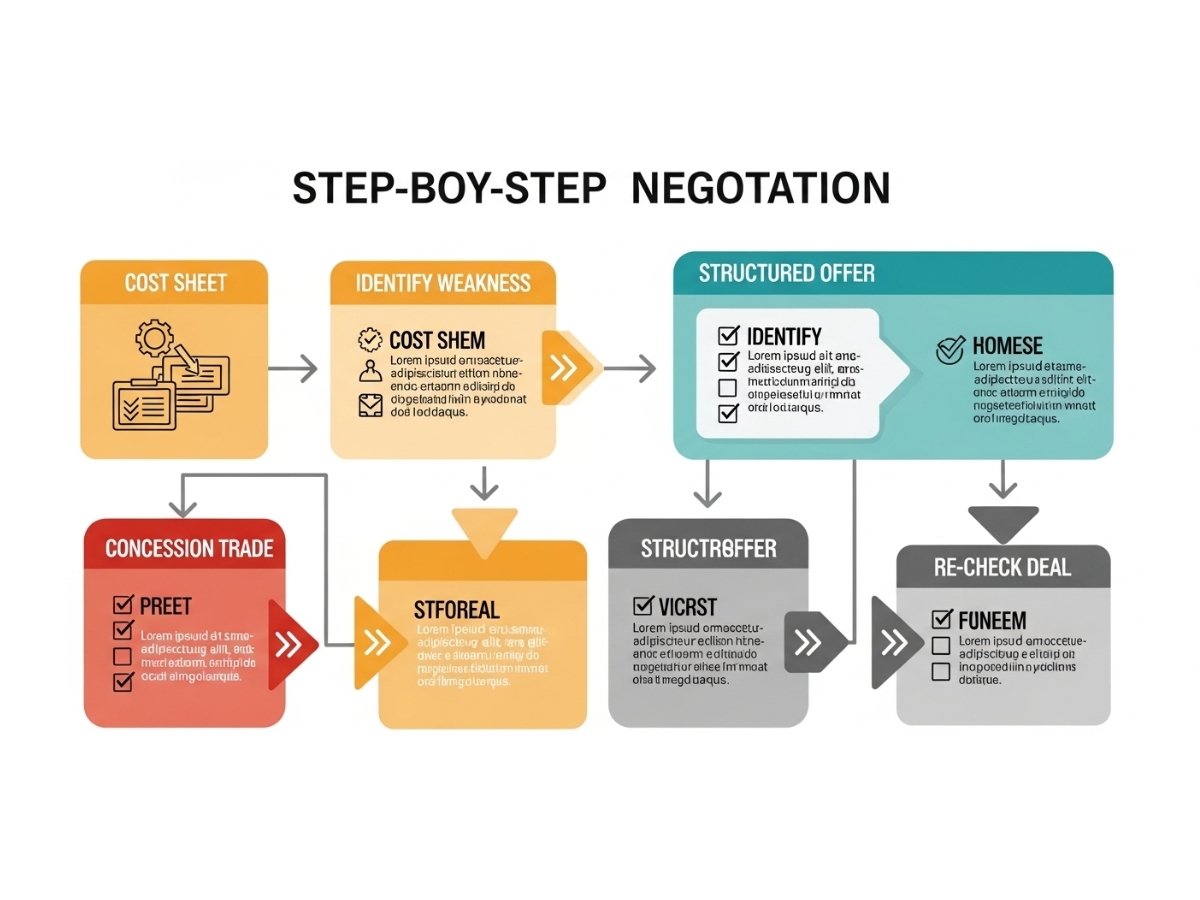
This is the simplest working framework.
Step 1: Build your total cost sheet
Add:
- base asking price
- GST if under-construction
- stamp duty and registration
- expected CAM
- parking cost
- fit-out cost
- dues and transfer burden, if applicable
Now you know the real cost.
Step 2: Identify the unit’s real weakness
Find the thing that reduces demand:
- weak frontage
- upper floor retail
- awkward layout
- heavy fit-out requirement
- parking issue
- vacancy pattern
- title or transfer friction
- low rental viability
That weakness is your negotiation anchor.
Step 3: Make the first offer in structure, not just number
Do not say only: “My offer is ₹X.” Say: “I can consider this value if parking is included, CAM escalation is capped, and the seller clears pending dues.”
That is how serious buyers negotiate commercial property.
Step 4: Trade concessions properly
Never give ground for free. If the seller refuses a lower base rate, shift to structure:
- lower CAM
- parking bundled
- fit-out support
- better payment terms
- seller clears dues
- transfer cost sharing
Step 5: Re-check the deal after every concession
A small win can be cancelled by a hidden loss. Recalculate after every major change.
Step 6: Do not rush the token
Before money moves, legal and document review should be clean enough for comfort. This is especially true in resale commercial assets.
What mistakes make buyers think they negotiated well when they actually overpaid?
This happens all the time.
The first mistake is winning a small base-price reduction but accepting inflated CAM. Over time, that can quietly wipe out your “discount.”
The second mistake is buying on super built-up comfort and ignoring true usable area. If the loading is high and the layout is inefficient, the cheap rate is an illusion.
The third mistake is ignoring fit-out. Bare-shell offices and some commercial units need heavy capital before they can function or earn rent. If you do not model that, you are not negotiating properly.
The fourth mistake is trusting a pre-leased story without reading the lease quality. A high headline yield is useless if the lease is weak, temporary, or close to expiry.
The fifth mistake is treating CIDCO transfer-side friction or local tax dues as paperwork issues. In Navi Mumbai, these can be financial issues, not just procedural ones.
Conclusion
The right way to negotiate commercial property prices in Navi Mumbai is to stop thinking like a brochure buyer and start thinking like an operator or investor. Do not chase only the cheapest rate. Chase the cleanest total deal for the most usable unit in the most workable location.
In practical terms, the best negotiation results usually come when you understand three things clearly: what part of the cost is fixed, what part is flexible, and what weakness in the unit or deal the seller cannot easily hide. If you can read those three layers properly, your negotiation becomes sharper, calmer, and far more profitable.
FAQs
Frequently Asked Questions