
Kharghar Commercial Property Guide: Best Areas, Prices, Risks and Buyer Checks
Kharghar can be a good place for commercial property, but only when the asset matches the location and the business type. It is not one uniform market. Some pockets work better for station-linked offices, some for high-street retail, and some are still more appreciation-led than tenant-ready. In Kharghar, road visibility, nearby residential catchment, metro or station access, parking, and actual building occupancy matter far more than brochure language.
If someone is looking at commercial property in Kharghar only because it is growing, that is not enough. The better question is this: growing for what? A clinic, a coaching setup, a small office, a shop, and a larger investor-driven commercial purchase all need different location logic.
Quick Summary
| Buyer / User Type | Does Kharghar make sense? | Best fit | Main caution |
|---|---|---|---|
| Small office buyer | Yes, selectively | Sector 2, Sector 10, Sector 14, Sector 30 | Do not overpay for a building with weak tenant demand |
| Shop or retail investor | Yes, in stronger retail belts | Sector 7, Sector 10, Sector 15, Sector 20 | Passing traffic is not the same as usable footfall |
| Clinic / medical user | Yes | Near healthcare and established residential belts | Check parking, access, and floor suitability |
| Coaching / education user | Yes | Sectors 15 and 17 side | Student demand is strong, but unit size and access matter |
| Long-term appreciation investor | Yes, but with patience | Sectors 34, 35, 36 | More future-led, not always immediately rent-ready |
| First-time commercial buyer | Only with due diligence | Ready, legally clear, occupied locations | Commercial mistakes are costlier than residential ones |
Who should actually consider commercial property in Kharghar?
Kharghar is not for every commercial buyer in the same way. It suits some profiles very well and is only average for others.
For self-use business owners, Kharghar makes the most sense when the business depends on one of these: local family catchment, student demand, professional services, healthcare traffic, or a clean planned environment with better approach roads than many older suburbs. That is why offices, clinics, coaching centres, salons, gyms, service businesses, and selected retail formats can work here.
For investors, the answer depends on whether they want rental income now or appreciation later. Core Kharghar is more stable and easier to understand. Upper Kharghar can offer lower entry prices and future upside, but it is not always equally liquid or equally tenant-friendly yet.
For first-time commercial buyers, this market can be attractive but risky. Commercial property is less forgiving than residential property. A bad commercial unit can stay vacant, need high fit-out cost, or attract weaker tenants even inside a growing area.
What kinds of commercial property make the most sense in Kharghar?
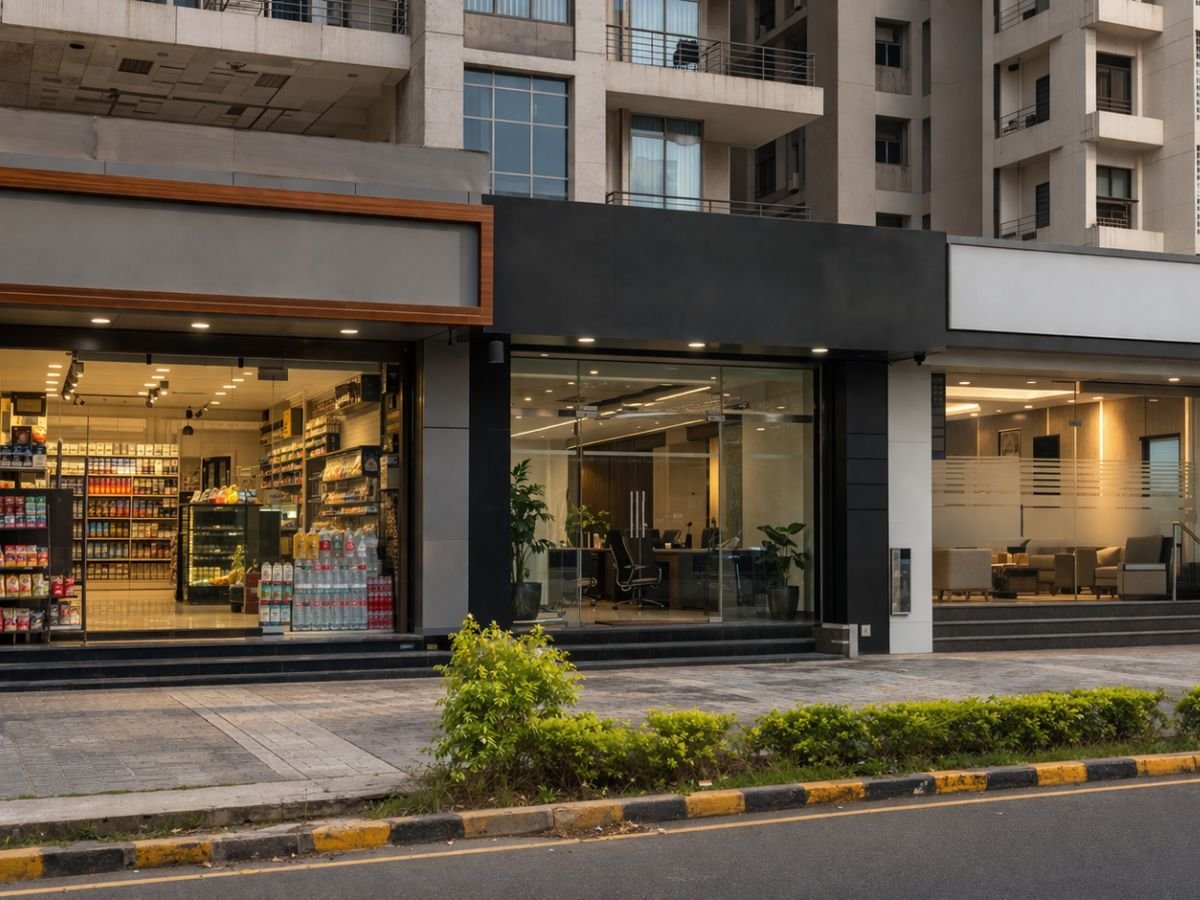
Kharghar does not reward every commercial format equally. Some asset classes have much stronger local demand support.
Shops and retail units
Retail works best where there is daily visibility, surrounding residential density, and a reason for people to stop. In Kharghar, high-street ground-floor retail is generally more practical than assuming every inside-building commercial unit will succeed.
Sectors 7, 10, 15, 17, and 20 are more relevant for this discussion because they combine either stronger residential ecosystems, better lifestyle demand, or more usable frontage. Premium retail, cafes, salons, medical retail, and everyday service shops can perform better here than in purely future-facing pockets.
Office spaces and professional units
Office space in Kharghar works best when it solves cost, access, and image together. That is why Sector 2 and other better-connected office pockets remain important. Station-side and metro-influenced offices usually have stronger liquidity because employees and clients can reach them more easily.
Professional offices for consultants, accountants, legal advisors, designers, recruitment firms, travel agencies, and small corporate teams can work well in properly maintained buildings. Grade A features such as power backup, elevators, parking ratio, internal washrooms, and better loading efficiency matter a lot more in office property than many first-time buyers assume.
Clinics, coaching, and service businesses
This is one of Kharghar’s strongest commercial strengths. The healthcare and education ecosystem creates recurring, non-cyclical demand. Sectors 10, 12, and 15 benefit from medical activity, while Sectors 15 and 17 gain from the student and coaching economy.
This matters because commercial success becomes less dependent on broad market hype and more dependent on daily need. A pharmacy, pathology lab, specialist clinic, tutorial space, or vocational training office often performs better in such ecosystems than a generic speculative office purchase.
Showrooms and larger frontage-led units
Larger frontage-led commercial units need visibility, easier parking logic, and brand-facing value. Sectors near key roads and premium residential belts have better suitability for this. But these are not plug-and-play assets. They work only when the product category actually matches the area’s spending profile.
Which parts of Kharghar work best for commercial property, and why?
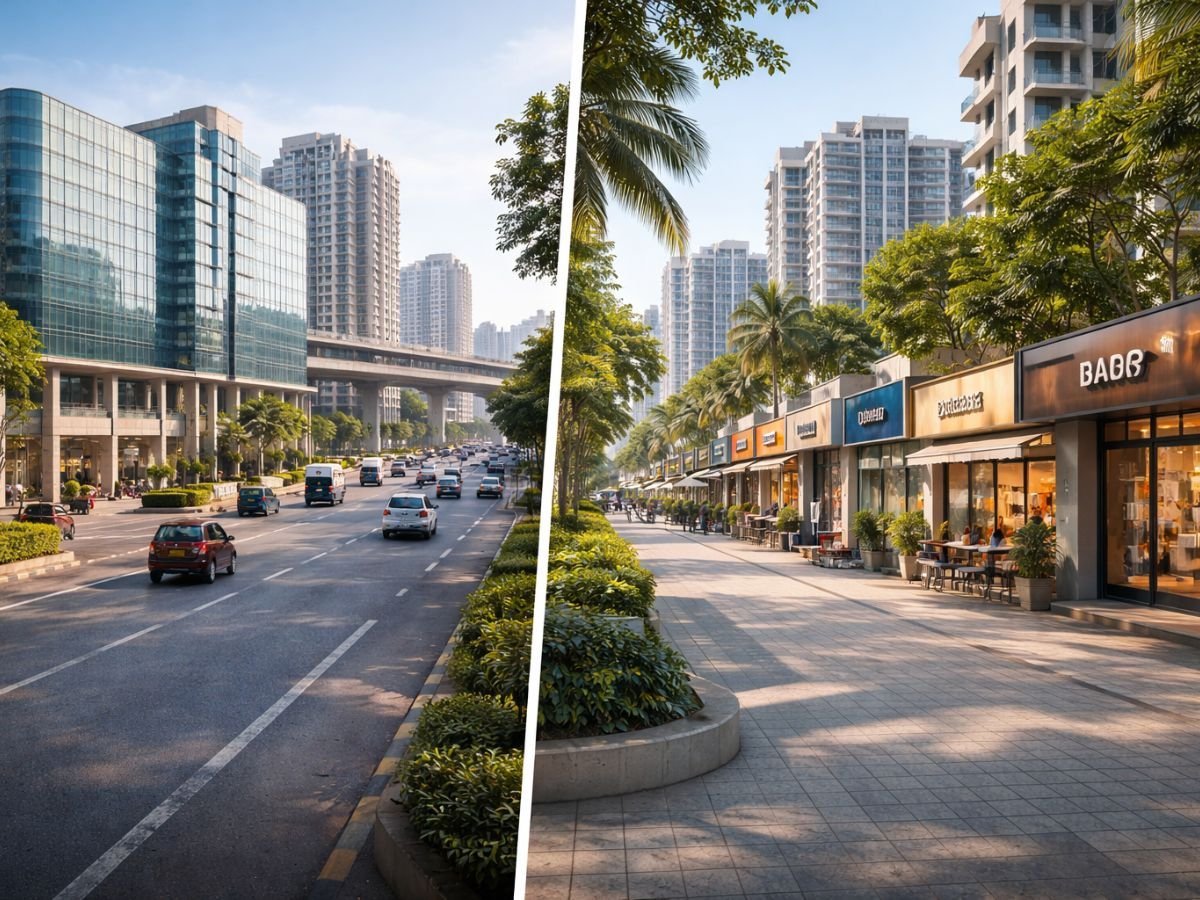
This is where most weak articles fail. Kharghar is not one commercial map. It is better understood as core commercial pockets versus appreciation-led expansion zones.
Station-influenced pockets
Sector 2 is one of the most important commercial references in Kharghar because of its station-side advantage. This area is stronger for professional offices, branch setups, and businesses that depend on commuter convenience. Units near the railway station or with easier metro connectivity usually enjoy higher liquidity and better tenant interest.
For office users, this matters more than broad city growth stories. A smaller, usable office near real transport access often beats a larger, cheaper office in a weaker pocket.
Main-road and visibility-led pockets
Sectors 7, 10, and parts of the stronger internal roads benefit from better visibility and established activity. These sectors are more relevant for premium retail, restaurants, showrooms, and experience-led businesses.
Sector 7 in particular has the advantage of lifestyle value because of its proximity to Central Park and premium residential catchments. This type of area is more suitable for businesses that need branding, frontage, and a better customer profile.
Residential catchment-led internal sectors
Some sectors may not look dramatic on paper, but they work because people already live there and spend there. That is important for daily-needs retail, clinics, coaching, pharmacies, and family-oriented services.
Sector 15 and Sector 17 stand out because of their institutional and student ecosystem. They do not depend only on prestige. They benefit from repeat demand.
Pockets that depend too much on future promise
Sectors 34, 35, and 36, often grouped with Upper Kharghar, are more appreciation-led at this stage. They matter for investors who can wait. Prices here have remained lower than the core commercial belts, which creates entry opportunity. But this is not the same as saying every asset here is ready for immediate high-quality tenancy.
That distinction matters. A future-growth zone can still be a weak current-yield zone.
Is Kharghar better for shops, offices, or long-term investment?
The most honest answer is that Kharghar is not strongest in just one category. It offers different strengths in different micro-markets.
For shops and retail, Kharghar works best in established, visible, residentially supported sectors. Ground-floor high-street retail is usually more dependable than blindly buying a commercial box inside a newer complex.
For offices, the node is attractive because it offers lower operational cost than traditional Mumbai commercial districts while still improving in connectivity. Metro access, station reach, and newer office stock give it real office potential, especially for SMEs and professional users.
For long-term investment, Upper Kharghar and infrastructure-linked corridors can be interesting. The International Corporate Park vision, NMIA effect, metro connectivity, and regional integration all support a long-term rerating story. But that story is stronger for patient investors than for buyers expecting instant rent and easy resale in every project.
What drives success in Kharghar commercial property on the ground?
Commercial property works on daily behavior, not only on macro stories.
First, footfall is not the same as passing traffic. A road may look busy, but if vehicles do not stop, pedestrians do not linger, and parking is poor, the unit may still underperform.
Second, surrounding residential catchment matters. A shop under a tower is not valuable just because it exists. It becomes valuable when enough people around it actually need the service regularly.
Third, metro and station access help some formats more than others. Offices, coaching spaces, and clinic-linked visits benefit strongly from transit access. A niche lifestyle business may care more about the spending profile of nearby residents.
Fourth, building occupancy matters. A fancy mixed-use project with low actual occupation can disappoint both investors and self-use buyers. In commercial real estate, a partly empty building sends a signal to tenants.
Buy or rent: what makes more sense for businesses in Kharghar?
For many businesses in Kharghar, renting first is the smarter move. This is especially true if the business is new, still testing demand, or requires significant customer behavior validation.
Buying makes more sense when:
- the business has stable cash flow
- the location is already proven
- the unit is legally clear
- the buyer understands fit-out cost, maintenance, and exit risk
Renting makes more sense when:
- the business is still finding product-market fit
- the owner is not sure which Kharghar micro-market suits them
- the unit type is expensive relative to expected revenue
- flexibility matters more than long-term asset ownership
Commercial property can create prestige, but that should not become the decision driver. The real decision is whether buying the space improves business economics.
What price logic should buyers and investors use before calling Kharghar a good deal?
Price alone is a poor decision tool in commercial property. A cheaper commercial unit in a weak location can be more expensive in the long run than a costlier unit in a proven belt.
The research pattern for 2025-2026 suggests broad commercial price bands in Kharghar ranging roughly from around ₹12,000 to ₹20,000 per sq. ft. in stronger sectors, while some emerging sectors may sit lower, around ₹9,500 to ₹11,500 per sq. ft. But these are only directional bands, not universal truth for every project or floor.
What matters is this:
- Can the unit actually attract a tenant?
- What rent can it realistically command?
- Is the yield justified after vacancy, maintenance, and fit-out assumptions?
- Is it a core Kharghar asset or an Upper Kharghar appreciation bet?
A premium price only makes sense when the unit has real advantages such as visibility, better connectivity, stronger building quality, or stronger local demand.
What should you check before buying commercial property in Kharghar?

This is the section that can save real money.
Commercial buyer checklist for Kharghar
- Check the original allotment letter and lease deed where relevant
- Confirm the title chain properly, especially in resale cases
- Verify the final transfer NOC, not just verbal assurance
- Check whether the land use and unit use are officially permitted for commercial or mixed use
- Verify MahaRERA registration for under-construction projects
- Study possession reality, not only possession promises
- Understand the CIDCO leasehold framework before committing
- Ask clearly about transfer charges, NOC requirements, and resale-related cost layers
- Check carpet area, not just super area
- Ask about parking ratio, visitor parking, and actual on-ground parking convenience
- Review maintenance charges and total occupancy cost
- Inspect signage visibility, access, and floor efficiency for your use case
Kharghar’s CIDCO-linked leasehold structure is especially important. Buyers should not treat it like a fully straightforward freehold market unless the property documents clearly support that. Transfer-related cost and compliance can materially affect the deal.
What are the biggest mistakes buyers make in Kharghar commercial property?
The most common mistake is buying the story instead of the asset.
Some buyers hear airport, metro, corporate park, and future growth, then assume any commercial unit in Kharghar will do well. That is not how this market works.
Other common mistakes include:
- confusing a residentially popular area with a commercially strong one
- paying a premium for a building with weak actual occupancy
- ignoring parking and access
- valuing road exposure without checking stoppage and walk-in behavior
- treating appreciation-led sectors as if they are already mature rental markets
- underestimating transfer charges, maintenance, and fit-out cost
A commercial unit should be judged like a working business tool, not only like a property investment brochure.
When does Kharghar beat other Navi Mumbai locations for commercial property, and when does it not?
Kharghar can beat some other nodes when the buyer wants a balance of planned layout, improving infrastructure, educational and medical demand, and relatively better long-term rerating potential.
Against CBD Belapur, Kharghar may feel more growth-oriented and more flexible for newer entry points, but Belapur still holds stronger institutional and government-linked office gravity.
Against Vashi, Kharghar may offer better future upside and lower entry cost in some pockets, but Vashi remains stronger for established commercial intensity and mature business movement.
Against Kamothe or Panvel-side budget markets, Kharghar often offers a more polished user environment and stronger premium perception. But budget-driven buyers may still find cheaper entry outside Kharghar.
So the answer is not that Kharghar is best for everyone. It is best for readers who want a planned, improving commercial node and are willing to choose carefully within it.
Conclusion
Who should buy, who should rent, and who should wait?
Kharghar is a good commercial property market, but it is a selective market, not an automatic one.
Buy now if you are choosing a proven micro-location, a legally clear asset, and a unit that matches real demand such as office, clinic, coaching, or strong retail.
Rent first if you are a business owner still testing the market, unsure about the best sector, or not yet confident about long-term lock-in.
Wait and watch if you are considering only future-led emerging pockets but need immediate rental certainty or low-risk entry.
The strongest Kharghar commercial decisions are not made by asking whether the node is growing. They are made by asking what type of commercial asset this exact location can realistically support today, and what it can become over the next few years.
FAQs
Frequently Asked Questions