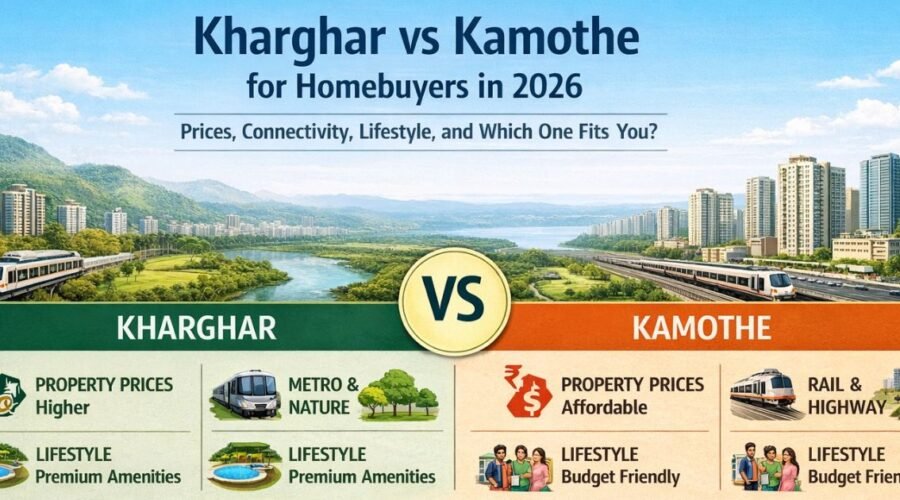
Kharghar vs Kamothe for Homebuyers in 2026: Prices, Connectivity and Which One Fits You
If your budget allows a comfortable stretch, Kharghar is usually the better buy in 2026 for lifestyle, metro support, schooling ecosystem, and long-term address value. If your budget is tighter and you want more carpet area, easier rail dependence, and a more practical entry price, Kamothe is often the smarter choice. The real answer, though, depends on your commute, your family size, and exactly which sector or society you shortlist.
Quick Summary: Kharghar vs Kamothe at a Glance
| Factor | Kharghar | Kamothe | What it means for a buyer |
|---|---|---|---|
| Typical 2 BHK market band | Around ₹1.01 Cr to ₹1.65 Cr on 99acres; Magicbricks average around ₹1.28 Cr | Around ₹86 lakh to ₹1.18 Cr on 99acres; Magicbricks average around ₹88.5 lakh to ₹90.2 lakh | Kamothe usually gives a clear price advantage for similar apartment categories. |
| Railway practicality | Kharghar station works well, but many deeper sectors are not truly walkable | Mansarovar and Khandeshwar are more useful for a larger share of residents | Kamothe often feels easier for daily train commuters. |
| Metro reality | Line 1 Belapur to Pendhar is operational | Line 2 Taloja to Khandeshwar is approved, not operational yet | Kharghar has the live metro advantage today. Kamothe has future upside, not present-day metro convenience. |
| Lifestyle feel | More open, more aspirational, stronger park-and-campus feel | More functional, denser, more utility-driven | Kharghar feels better to live in if daily environment matters a lot. |
| Budget-to-space value | You often pay more for the external environment and pin code | You usually get more carpet area for the money | Kamothe is usually better for budget-led self-use buying. |
| Civic caution | Premium image does not remove water-supply risk in some sectors | Budget value does not remove drainage and older-building risk in some pockets | In both nodes, society-level due diligence matters more than brochure language. |
Kharghar or Kamothe in 2026: which one should most homebuyers choose first?
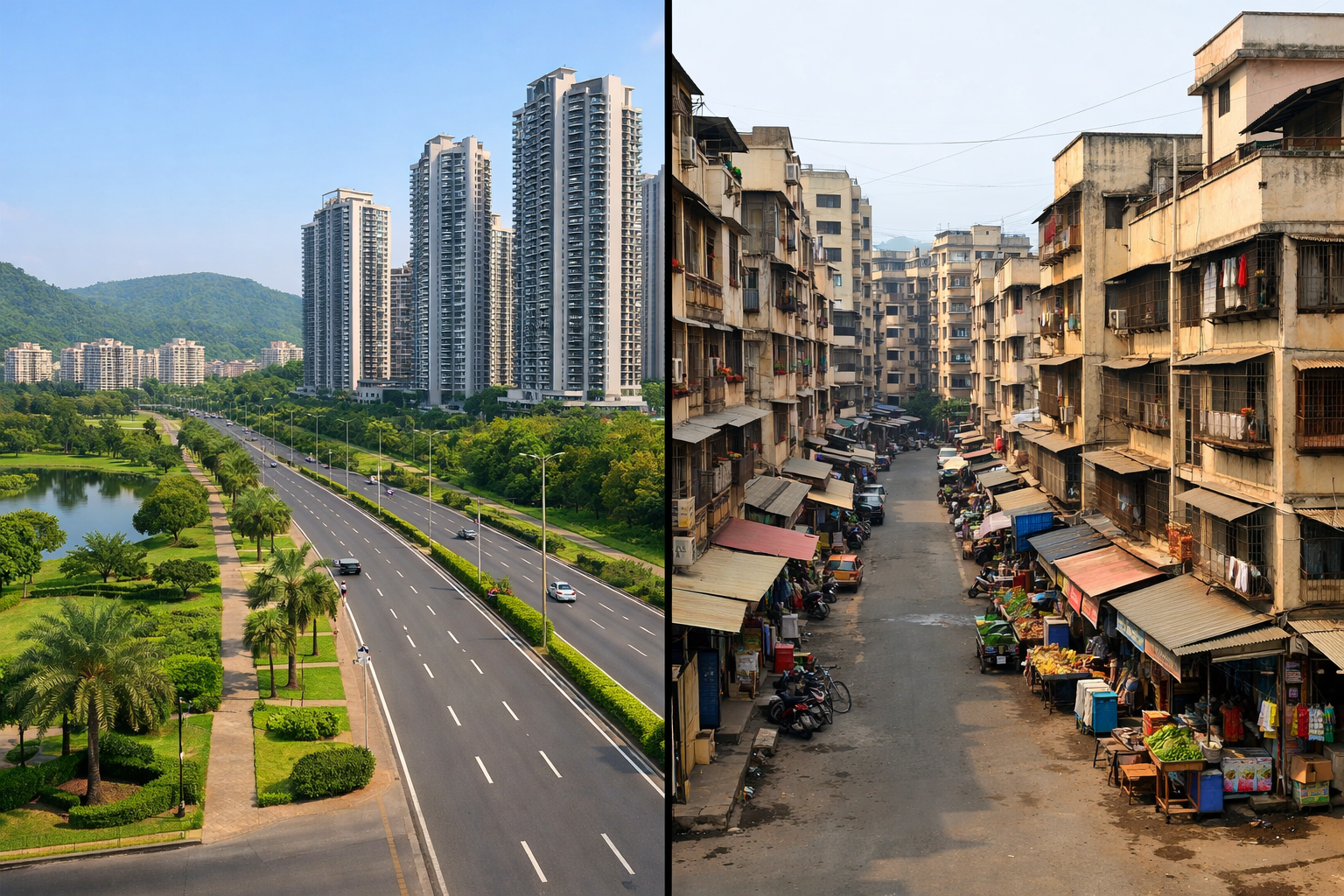
For most end-users, the cleanest answer is this: choose Kharghar if you can buy there without choking your monthly cash flow. Choose Kamothe if buying in Kharghar would force you into an uncomfortable EMI, a smaller flat, or a weaker building just to get the name.
That difference matters because the price gap is not small anymore. Current portal-based ranges show Kharghar 2 BHKs broadly landing around ₹1 crore-plus and going well beyond ₹1.5 crore in stronger pockets, while Kamothe still has a meaningful sub-₹1.2 crore band for 2 BHK stock. That is a serious financial difference for any family buying with a home loan.
So the decision is not really “premium vs affordable” in a shallow way. It is more like this: Are you paying extra for something your family will genuinely use every day, or are you paying extra just to say you bought in Kharghar?
Why buyers compare Kharghar and Kamothe so often in the first place
These two nodes get compared again and again because they sit in the same larger Panvel-side decision zone. A buyer doing site visits in this belt can move between both markets quickly, and both are part of the same broader migration story for people leaving costlier or more congested parts of Mumbai and Navi Mumbai. Both also now sit within the Panvel Municipal Corporation framework after CIDCO stopped levying service charges in the handed-over nodes from November 1, 2022.
But the feel is not the same at all. Kharghar was planned and marketed as a more expansive, premium urban node with stronger open-space identity. Kamothe was always more mid-segment and utility-focused. That old difference still shapes how both places behave in 2026, even though both have moved up in value.
What do you actually get for your budget in Kharghar vs Kamothe?
The biggest buying difference is what your money buys in real life.
In Kharghar, a 2 BHK commonly sits in the low-₹1 crore to mid-₹1.5 crore zone depending on sector, age, and amenities. Magicbricks currently shows an average around ₹1.28 crore, while 99acres bands stretch roughly from ₹1.01 crore to ₹1.65 crore. In Kamothe, 2 BHK listings still sit materially lower, with 99acres showing about ₹86 lakh to ₹1.18 crore and Magicbricks showing an average around ₹88.5 lakh to ₹90.2 lakh.
That means a buyer with roughly ₹1.15 crore to ₹1.20 crore has very different options in the two nodes. In Kharghar, that buyer may end up choosing an older 2 BHK, a less convenient sector, or a tighter carpet area. In Kamothe, the same budget often opens up more breathing room, sometimes even better size-value or a stronger society choice within the mid-market segment. Based on current listing bands, that is one of the clearest reasons Kamothe remains relevant.
Where Kharghar usually asks for a premium
Kharghar’s premium is not just random. Buyers are usually paying for some combination of these factors:
- better overall node perception
- operational metro support today
- stronger schooling ecosystem
- broader open-space character
- higher long-term address appeal
That premium is easier to justify for self-use buyers who care about everyday environment, children’s schooling, and a more polished node-level identity. The premium becomes harder to justify when the flat itself is too compromised.
Where Kamothe usually gives more space for the money
Kamothe’s advantage is not “cheapness” anymore. That old idea is outdated. It is more accurate to call it better budget efficiency. A buyer here is often getting a stronger size-to-price equation, more practical rail dependence, and easier entry into ownership without the same financial stretch.
Which one feels better for daily life after possession, not just during the site visit?
For pure lifestyle, Kharghar usually wins. That is the honest answer.
The node has a wider, more open feel, and its identity is shaped by larger roads, educational institutions, Central Park, and a generally more aspirational residential image. For families with children, or buyers who want a place that feels more relaxed and more “settled” in a premium sense, Kharghar usually leaves a stronger impression. The operational metro also improves how some deeper belts connect internally.
But Kamothe has a practical strength that many Sunday site visits fail to capture: daily utility. In many parts of Kamothe, ground-floor retail, clinics, basic shopping, and quick everyday errands feel closer and more integrated into the residential pattern. That makes ordinary life easier, especially for households that value walkable essentials more than visual openness.
So the better node depends on what “better life” means to you. If it means parks, image, open environment, and premium schooling, Kharghar usually wins. If it means easy daily functioning and stronger budget control, Kamothe often wins.
Which node works better for commuting in real life?
This is where many buyers get the answer wrong.
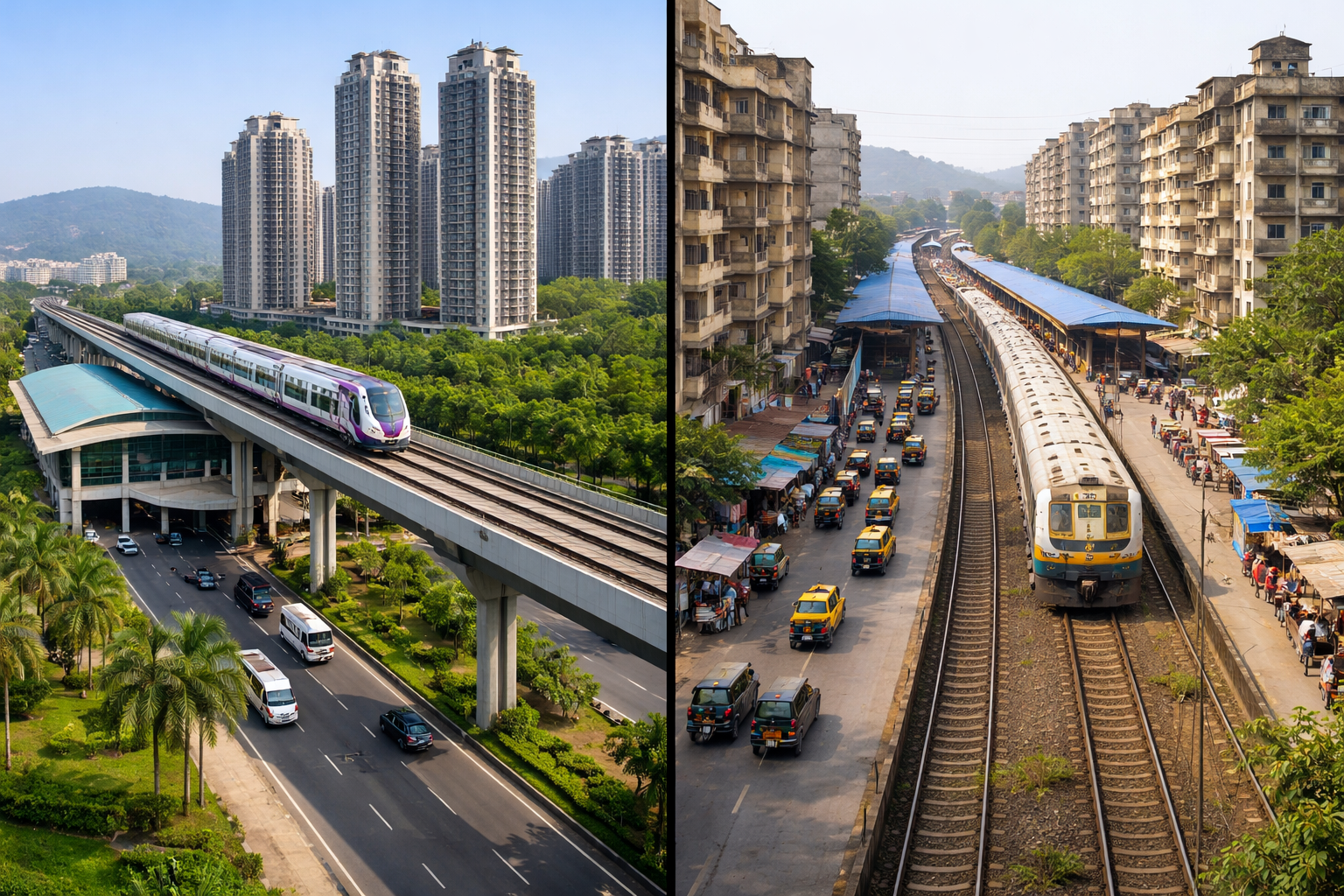
Kharghar has the stronger metro story today because Navi Mumbai Metro Line 1 from Belapur to Pendhar is operational. That is not a future promise anymore. It is a live advantage for intra-node movement and for people whose travel logic connects well with the Belapur side.
Kamothe, however, often works better for railway-first buyers because Mansarovar and Khandeshwar are more practical for many residential pockets there. Also, the newly approved Navi Mumbai Metro Line 2 from Taloja to Khandeshwar, with an 8.15 km route, eight stations, and a state-cleared budget of ₹5,575 crore, is an important future catalyst for Kamothe. But future is the key word here. It is approved, not operational.
If you depend on railway access
Kamothe often has the edge because more of its housing stock sits in a tighter, more station-oriented pattern. If your daily routine is built around Harbour Line trains, Kamothe can be more practical than a deep Kharghar sector that still needs auto or feeder movement before the actual rail journey starts.
If metro access changes your route logic
Kharghar is ahead right now. That advantage is real for people whose routine uses the Belapur-Pendhar corridor or who want metro-backed internal mobility today, not someday.
If your travel is Panvel-side, Belapur-side, or Mumbai-side
For Panvel-side movement, both can work. For railway commuters toward Mumbai, Kamothe can feel more efficient. For people who value a mix of metro and broader node infrastructure, Kharghar feels stronger. This is exactly why commute type should come before brochure quality.
For first-time homebuyers, where is the safer decision in 2026?
For most first-time buyers, Kamothe is the safer financial decision.
Why? Because home buying safety is not only about future appreciation or pin code prestige. It is about whether your EMI stays manageable, whether your maintenance remains reasonable, and whether you have some financial breathing space after registration, interiors, and emergency costs.
A Kamothe 2 BHK typically sits in a lower entry band than Kharghar, which reduces down-payment pressure and monthly EMI burden. That can be the difference between “we bought a house” and “we are house poor.”
Quick checklist for first-time buyers
- If buying in Kharghar means you must compromise heavily on carpet area, be careful.
- If buying in Kamothe lets you stay below a risky EMI level, that matters more than image.
- If your family will actually use Kharghar’s lifestyle benefits every single day, the stretch may still be justified.
- If you are buying your first flat mainly for stable self-use, budget comfort usually matters more than aspirational branding.
For investors, is Kharghar the stronger hold or is Kamothe the smarter entry point?
For long-hold capital positioning, Kharghar has the stronger story. For entry-level investor practicality, Kamothe often makes more sense.
Kharghar benefits from infrastructure momentum that includes the already operational Metro Line 1 and the longer-term commercial narrative around the International Corporate Park. It also has a stronger premium image, which can support value preservation better over long holding periods. But the entry ticket is higher, and that naturally compresses rental yield. Current rental and sale bands from live portals broadly support that pattern.
Kamothe, on the other hand, still sits in a more liquid mid-market ticket size. That matters because more buyers can afford it, more tenants can target it, and exits are often easier in the sub-₹1.2 crore category. Its future metro approval also keeps speculative interest alive, though that should not be confused with present operational convenience.
So the simple investment split is this:
- Kharghar: stronger for patient, premium-leaning capital hold
- Kamothe: stronger for easier entry, liquidity, and mid-budget rental practicality
Does civic and planning context change the buying decision here?
Yes, more than many buyers realize.
A lot of buyers still think in old CIDCO-era terms, but both Kharghar and Kamothe are now under the Panvel Municipal Corporation for civic maintenance and property-tax collection in the handed-over framework. CIDCO stopped levying service charges in these nodes from November 1, 2022. That means resale buyers should not just ask for society maintenance details. They should also check whether the property is cleanly updated on the PMC side and whether any older dues issue is still floating around.
The water story is also more complicated than “same city, same supply.” Panvel Municipal Corporation’s environmental reporting notes that Kharghar and Taloja receive water through CIDCO from Hetavane Dam, while Kamothe receives water supplied by NMMC from Morbe Dam and treated at the Bhokarpada plant. That administrative split helps explain why neighboring areas can still experience different supply realities.
This is exactly why local buying decisions in Navi Mumbai should never be made from portal photos alone.
Which sectors or micro-pockets deserve more attention before you shortlist a project?
This is where the real due diligence begins.
In Kharghar, the premium image can mislead buyers into assuming that all established sectors are equally trouble-free. That is not true. Local reporting and resident complaints have repeatedly highlighted water stress and tanker dependence in parts of Kharghar, including sectors such as 16, 19, 20, and 21. Hindustan Times also reported residents saying Kharghar and Taloja usually need over 100 MLD while only a much smaller portion was effectively available to Kharghar and Taloja at the time discussed.
In Kamothe, the caution is different. The node can offer good utility and rail practicality, but some pockets face drainage or monsoon waterlogging concerns, and older buildings can vary sharply in quality. A cheap-looking deal in an aging building without good upkeep can become expensive later.
Caution box for site visits
- In Kharghar, ask the society directly about tanker use, summer water timings, and monthly water-related costs.
- In Kamothe, ask about monsoon waterlogging, transformer or power issues, and the actual age and maintenance quality of the building.
- In both nodes, check distance to station or metro in real walking minutes, not just what the broker says.
- “Near station” and “premium sector” are not proof of easy daily living.
When is it worth stretching your budget for Kharghar, and when should you not?

Stretch for Kharghar when your family will truly use what Kharghar offers.
That usually means one or more of these are true:
- you want a more premium family environment
- school access matters a lot
- you value open spaces and overall urban feel
- metro convenience helps your routine
- you are thinking long term and can afford the premium without stress
Do not stretch for Kharghar if the stretch forces you into a bad flat decision. A family of four buying a cramped unit, in a compromised society, in a water-stressed belt, just to secure the Kharghar name, is not making a premium decision. It is making an emotional one.
When does Kamothe become the smarter buy, and when can it disappoint?
Kamothe becomes the smarter buy when the same overall budget gives your family a clearly better home.
That could mean a larger 2 BHK, a more comfortable 3 BHK possibility, a stronger resale segment in your budget bracket, or simply a lower EMI burden that keeps life stable. For many practical end-users, that is not a compromise. That is the better decision.
Kamothe disappoints when buyers ignore society quality. Some older stock can look fine on listing portals but underperform on parking, facade condition, waste handling, lift quality, or long-term maintenance standards. In Kamothe especially, society filtering is everything.
Kharghar vs Kamothe by buyer type
| Buyer type | Better fit usually | Why |
|---|---|---|
| First-time budget buyer | Kamothe | Lower entry cost usually reduces EMI pressure. : |
| Family with young children | Kharghar | Better lifestyle environment and stronger premium schooling ecosystem. |
| Daily Mumbai railway commuter | Kamothe | Mansarovar and Khandeshwar often work more practically for regular rail use. |
| Buyer who will use metro today | Kharghar | Operational Metro Line 1 is already a present advantage. |
| Long-term capital-hold buyer | Kharghar | Stronger premium positioning and wider macro story. |
| Yield or liquidity-focused buyer | Kamothe | Lower ticket sizes often make tenanting and exit easier. |
| Buyer wanting maximum carpet area | Kamothe | Better budget-to-space ratio in current bands. |
| Buyer wanting stronger brand value | Kharghar | Kharghar still carries the better address pull. |
Conclusion
Choose Kharghar if you want a better overall lifestyle, stronger long-term address value, metro-backed convenience today, and you can afford the premium without damaging your financial comfort.
Choose Kamothe if you want the more sensible self-use purchase in a tighter budget, better space for the money, practical railway dependence, and a property that feels easier to buy, hold, and live with.
For most buyers in 2026, the smartest approach is not to ask, “Which node is better?” It is to ask, “Which node gives my family the better life without making the loan a burden?” In that question, the honest answer often becomes very clear.
FAQs
Frequently Asked Questions