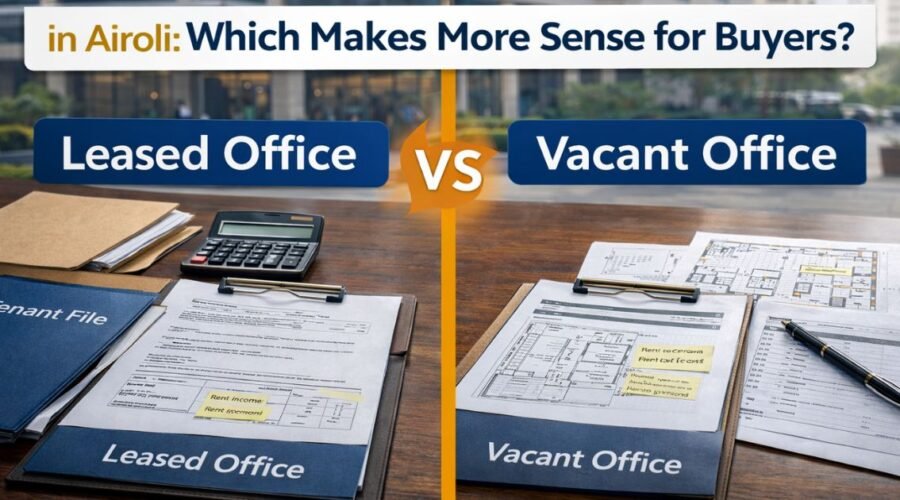
Leased Office vs Vacant Office in Airoli: Which Makes More Sense for Buyers?
In Airoli, a leased office usually makes more sense for income-first investors only when the tenant quality, rent sustainability, lock-in period, and building strength are genuinely strong. A vacant office usually makes more sense for self-use buyers, active investors, and buyers who want better control over fit-out, leasing, and future exit. So this is not just a lease-versus-vacancy question. It is really a decision about income quality, control, risk, and resale flexibility.
A lot of commercial buyers approach this choice too casually. They see a pre-leased office and assume it is safer. Or they see a vacant office and assume it is dead inventory. In Airoli, both assumptions can go wrong. The better answer depends on the asset, the tenant, the micro-location, the zoning reality, the fit-out burden, and the buyer’s own purpose. That is exactly where this topic becomes useful.
Quick Summary
| Buyer situation | Leased office usually fits better | Vacant office usually fits better |
|---|---|---|
| Wants immediate rent from day one | Yes | No |
| Needs office for own business use | Rarely | Yes |
| Wants control over layout and fit-out | Limited | Strong |
| Comfortable paying a premium for stability | Yes, if lease quality is real | Usually no |
| Wants lower entry price and flexibility | Usually no | Yes |
| Can handle leasing downtime and capex | Not necessary initially | Necessary |
| Wants broader future buyer pool at exit | Sometimes | Often better |
| Depends heavily on current tenant quality | Very high | None at purchase |
Airoli’s office market is not uniform. That matters a lot here. A weak leased office in a second-grade building can be a worse buy than a vacant office in a stronger business environment. This is where most generic commercial property content falls apart.
Who should buy a leased office in Airoli and who should avoid it?

A leased office in Airoli usually suits the buyer who values current income more than operational control.
This is typically a better fit for HNIs, NRIs, passive investors, or business owners who want rent to start immediately and are willing to pay a premium for that visibility. Airoli-specific gross rental yields are commonly discussed in the broad 6.5% to 8% range in the better cases, though these are gross numbers and should never be treated as clean net return figures.
Buyers who usually fit leased office better
- Investors seeking immediate rent flow
- Buyers servicing debt who want income support from day one
- Buyers who do not want to manage early tenant acquisition
- Investors buying in stronger managed office ecosystems with good occupier depth
- Buyers who can actually read a lease deed and judge lock-in quality, not just headline tenure
Buyers who often get misled by leased office
- Buyers who assume any rent means safety
- Buyers who do not understand the difference between lease tenure and lock-in period
- Buyers attracted by a high quoted yield without checking whether the rent is sustainable
- Buyers who may need the office for self-use soon
- Buyers with low reserve capital who cannot absorb a sudden vacancy shock
This last point is important. A commercial tenant can leave even when the brochure pitch looks solid. Short lock-in dynamics and tenant relocation risk can quickly expose the weakness of an over-pitched pre-leased asset. A nine-year lease does not mean much if the effective lock-in is short and the tenant is likely to move.
Who should buy a vacant office in Airoli and when is it actually the smarter move?
A vacant office in Airoli usually suits buyers who want control and can execute.
That includes self-use corporate buyers, scaling businesses, and active investors who are willing to improve the office, target the right tenant, and wait through an initial leasing phase if necessary. In Airoli’s tech and corporate ecosystem, a good vacant office is not automatically weak stock. In the right building, it can be a better long-term play because it gives the buyer fit-out freedom, tenant selection control, and a broader future exit path.
When vacant office gives better control
A self-use buyer usually benefits from vacant space because they can shape the office around actual business operations. That means workstation planning, security layout, cabin count, conference requirements, server zones, HVAC expectations, branding, and future space logic all stay in the buyer’s control.
This is especially relevant in Airoli because occupier demand is not generic. Airoli demand is closely linked to IT, GCC, engineering, and enterprise-led office use rather than loose mixed commercial demand.
When vacant office becomes dead inventory
Vacant office becomes dangerous when the buyer is undercapitalised, buys in a weak location, or underestimates capex and downtime. Fit-out costs are not a minor detail here. Medium-spec office buildout costs for Mumbai and Navi Mumbai are often discussed in an estimated range of about ₹5,788 to ₹6,588 per sq ft, which can materially change the investment math.
So a vacant office is not “cheaper and therefore better.” It is better only when the buyer has enough capital discipline and chooses the right asset.
In Airoli, what matters more than the leased vs vacant label itself?
The asset matters more than the label. That is the real answer.
In Airoli, the long-term performance of office space depends more on building quality, commuter practicality, office usability, and zoning alignment than on whether the unit is occupied today.
Tenant quality
For a leased office, the tenant is part of the product. A rent cheque alone is not enough. Buyers need to understand whether the tenant is strong, whether the business is stable, whether the rent is realistic, and whether the lease has enough residual lock-in to support the sale premium. Tenant quality matters more than tenant presence.
Building quality
A Grade-A or well-managed business environment usually outperforms weaker stock over time, even if the weaker stock is currently leased. That is a crucial Airoli-specific insight because the node has a mix of stronger managed IT environments and weaker standalone or mixed-use stock.
Office usability and floor efficiency
A large office with poor planning is not automatically better than a smaller efficient one. Buyers should assess actual usability, power backup, lift handling, parking, access control, and maintenance discipline.
Micro-location and commuter practicality
Airoli’s office demand is linked heavily to its TTC corridor role, access to Thane-Belapur Road, Airoli railway connectivity, and its practical position for workforce movement from Navi Mumbai, Thane, and nearby Mumbai belts. Commuter practicality is not a side issue. It is a demand driver.
Why some leased offices in Airoli look safer than they really are
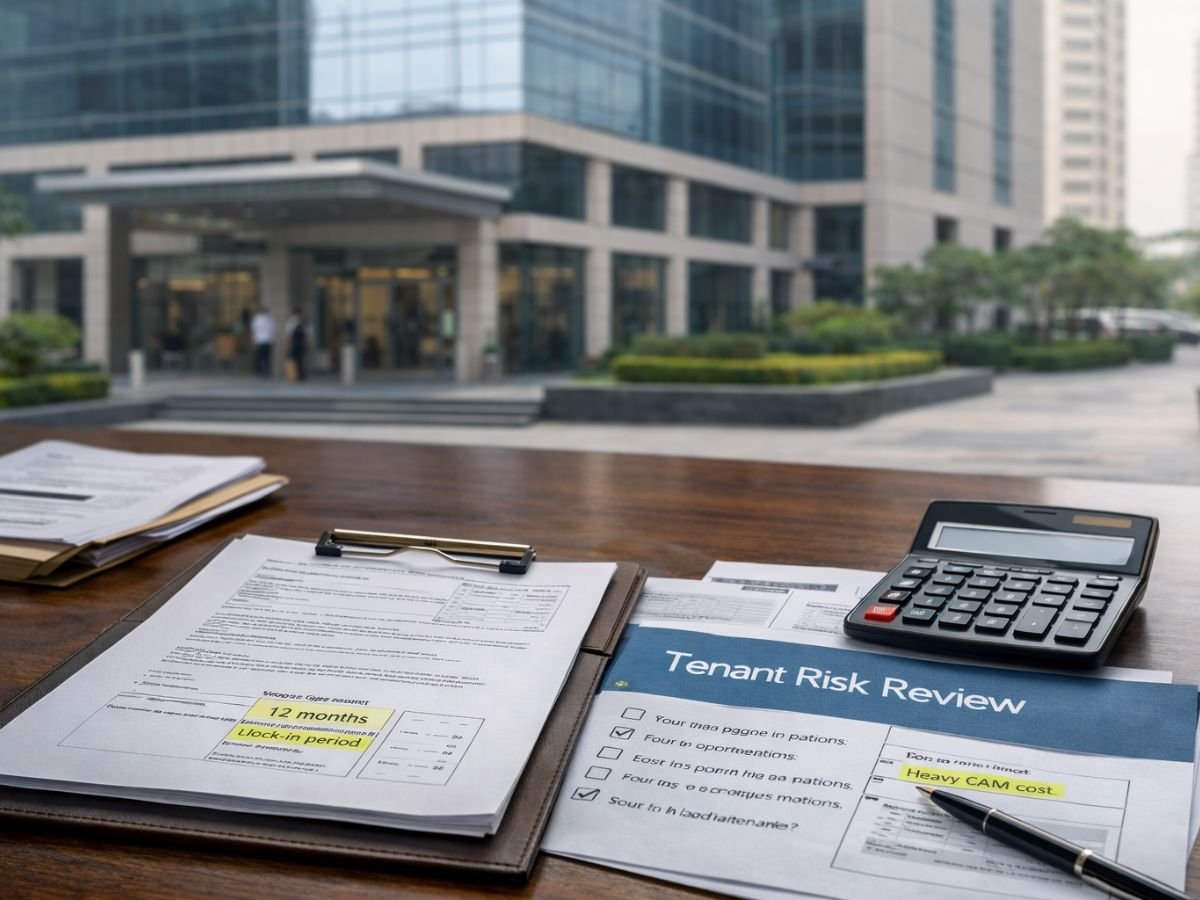
This is where many buyers make the costliest mistake.
A high yield on paper can be a trap. Some pre-leased offices may be marketed with inflated rent arrangements that are designed more to boost sale value than to reflect sustainable income quality. That means the buyer pays a premium for income that may not survive the first churn cycle.
High yield but weak tenant
If the tenant is weak, unstable, or overly dependent on a fragile business model, the asset is riskier than it looks. A quoted 8% or 8.5% gross yield is not automatically attractive if the tenant may exit, renegotiate, or default.
Rent that is above sustainable market level
Some deals look strong only because the rent is temporarily above market reality. That can create false comfort. Once the first term ends, the buyer discovers that the office does not really support that income level.
Short lock-in dressed up as stability
A long lease tenure is not the same as a strong lock-in. A nine-year paper lease with only a one-year effective lock-in is not a secure income asset.
Single-tenant dependency and exit risk
A leased office can also become harder to exit if the tenant is nearing expiry, in distress, or if the office fit-out is too specialised to reuse. In such cases, the buyer is not purchasing a stable financial product. They are purchasing an office with a near-term operational problem.
Warning signs checklist for a bad leased office
- Rent looks too high for the building and pocket
- Lock-in is expiring within 12 to 18 months
- CAM and landlord obligations are vague
- Tenant quality is weak or hard to verify
- Tenant use may not align cleanly with local zoning or MIDC conditions
- Office interiors are too specialised to reuse easily
- The premium over comparable vacant stock looks excessive
Why some vacant offices in Airoli can become stronger long-term buys
A good vacant office can create more long-term value than a weak leased office.
Better entry price
Vacant offices usually come without the full pre-leased premium. That lower capital basis can improve margin of safety, especially if the buyer is entering a stronger building or campus-style office ecosystem.
Freedom to lease to the right occupier
A buyer of vacant space can target a better future tenant rather than inheriting the wrong one. In Airoli, that matters because stronger corporate occupiers often want specific infrastructure, compliance comfort, and tailored fit-out conditions.
Better self-use and future conversion flexibility
A vacant office can later be:
- used by the buyer’s own business
- leased to a chosen corporate occupier
- sold to another self-use buyer
That is a wider strategy range than a pre-leased office tied to a sitting tenant.
How should buyers compare pricing between leased office and vacant office in Airoli?
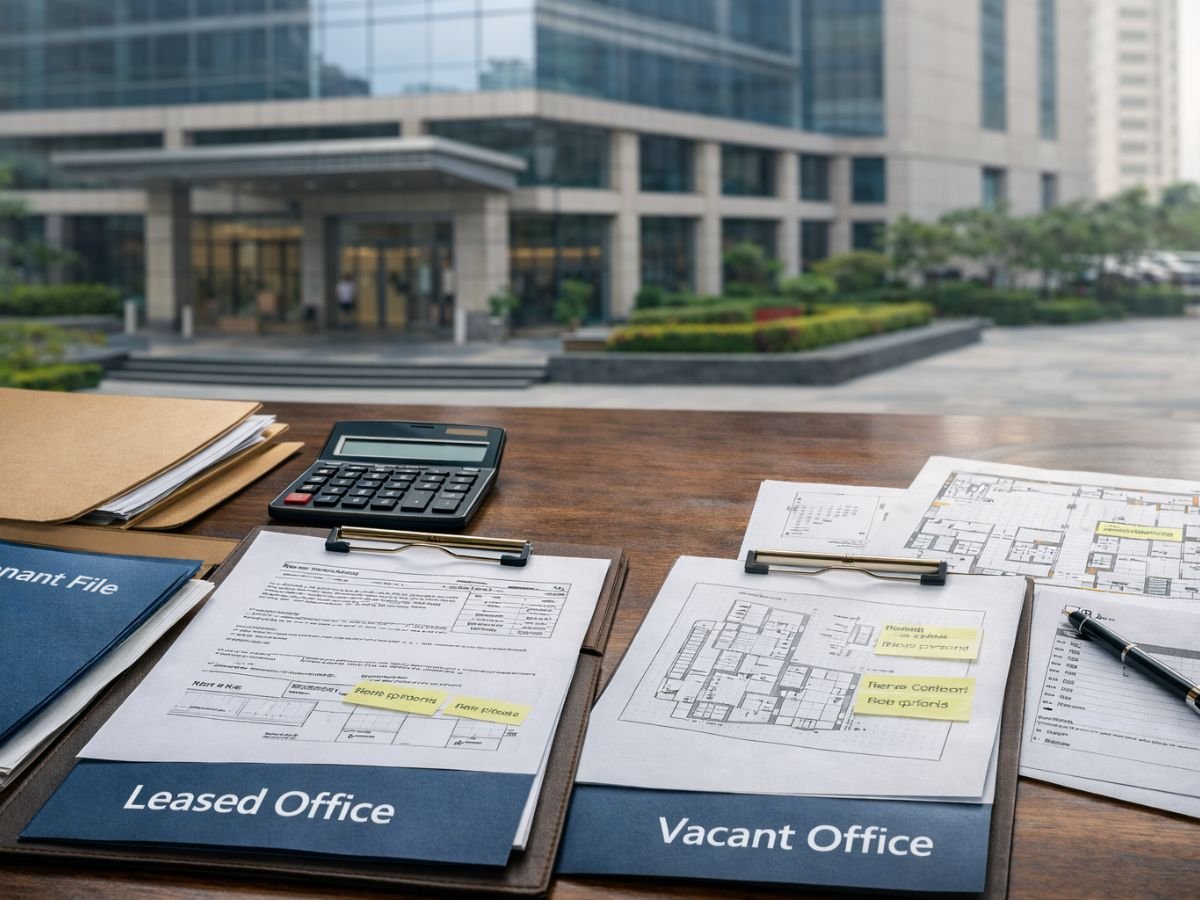
The right way to compare is not by headline yield alone. It is by total financial logic.
Buyers should examine whether the premium being demanded for a leased office is actually justified by the quality of income and the protection built into the lease. If the leased office is priced around 20% above a comparable vacant office, that premium should be tested against expected downtime, fit-out cost, brokerage, and holding cost on the vacant alternative.
A simple practical scenario
Imagine two similar offices in Airoli:
- Office A is leased and priced at a 20% premium because it has an existing tenant
- Office B is vacant and cheaper, but needs a warm-shell or fit-out investment
Now assume Office B needs roughly ₹6,000 per sq ft in fit-out. If Office A has only a short residual lock-in, weak tenant quality, or above-market rent, the buyer may actually be overpaying for fragile income. On the other hand, if Office B is in a stronger building and can attract a better long-term occupier, the vacant office may produce better five-year value despite early capex.
That is why the real comparison is:
- income premium today
versus
- control, repricing ability, and future tenant quality tomorrow
Does micro-location inside Airoli change the answer?
Yes. Very strongly.
Airoli should not be treated as one uniform office market. Stronger managed IT park environments, smaller mixed-use pockets, and older peripheral stock do not behave the same way.
Office parks and stronger managed commercial environments
In better institutional-style office environments, a vacant office can still be a very strong buy because the larger ecosystem itself supports tenant attraction. These areas usually have stronger infrastructure, better maintenance, more professional occupier appeal, and lower perception risk.
Smaller mixed commercial pockets
In weaker or more fragmented locations, a vacant office becomes riskier because leasing depth may be thinner. In such areas, a genuinely stable leased office with a reliable local occupier can sometimes be the safer decision.
Transit and daily staff convenience angle
Airoli’s office market is fundamentally enterprise-driven. That means proximity to station access, Thane-Belapur Road movement, and daily employee convenience affect leasing velocity and tenant retention.
What documents and checks matter more for leased office and what matters more for vacant office?
The checks are not identical. Buyers should not treat them as identical.
For a leased office, the lease deed becomes central. For a vacant office, title, approvals, and future usability become more important at the start.
Extra checks for leased office buyers
- Registered lease deed
- Actual lock-in period, not just total lease tenure
- Escalation clause
- Security deposit transfer treatment
- CAM responsibility and landlord outgoings
- Tenant business strength
- Tenant use compliance with local zoning or MIDC conditions
- Whether the office fit-out becomes a liability if tenant exits
Extra checks for vacant office buyers
- Title clarity
- MahaRERA status where relevant for under-construction or recently completed stock
- Land and building approval position
- Fit-out budget realism
- Leasing depth in that specific building and pocket
- Whether the building and land fall under CIDCO or MIDC-related transfer or use restrictions
Local authority checks that actually matter
- NMMC commercial property tax is a major factor in net yield math
- CIDCO transfer charges can materially affect exit
- MIDC subletting and zoning rules matter in parts of the Airoli and TTC belt
- IGR Maharashtra Ready Reckoner rates are useful as stamp duty floor benchmarks, not as actual market-value truth
Which one is usually easier to exit in Airoli: leased office or vacant office?
There is no fixed winner. Exit depends on what exactly is being sold.
A leased office can sell faster if the tenant is strong, the lock-in is long enough, and the income is believable. But once that lease weakens, the exit can become difficult because the next buyer starts discounting vacancy risk immediately.
A vacant office may take longer to sell in some cases, but it also appeals to a wider pool, especially self-use buyers. That broader buyer universe can become an advantage.
There is another local complication. CIDCO’s revised transfer fee framework from April 1, 2025 can become very heavy for larger commercial assets, especially for properties above 200 sq m, where the cited figure rises sharply. So the article must stay honest: short-term flipping logic in such cases becomes much harder, and holding-period discipline matters more.
Final decision framework: choose leased office in Airoli if these 5 things are true, choose vacant office if these 5 things are true
Choose a leased office in Airoli if:
1. The main goal is immediate income, not self-use 2. The tenant is strong and verifiable 3. Residual lock-in is comfortably long, ideally around three years or more 4. The rent looks sustainable for the building and pocket 5. The net yield still makes sense after tax, maintenance, and vacancy-risk thinking
Choose a vacant office in Airoli if:
1. The main goal is self-use or future self-use flexibility 2. The office is in a strong managed environment with real occupier depth 3. The buyer can handle fit-out capex and possible downtime 4. The entry price offers a real discount compared to comparable leased stock 5. The buyer wants freedom to target the right future tenant or future end-user exit
Conclusion
Leased office versus vacant office in Airoli is not a simple safer-versus-riskier choice. A leased office is basically a financial product whose value depends on tenant quality, lock-in strength, realistic rent, and true net yield. A vacant office is more of an operational asset whose value depends on entry price, fit-out strategy, leasing depth, and future flexibility.
For passive investors, a genuinely strong leased office can make sense. For self-use buyers, control-first buyers, and active investors who understand Airoli’s office ecosystem, a good vacant office can be the better long-term decision. In the end, the smarter buyer is not the one who chooses “leased” or “vacant” by label. It is the one who understands what kind of Airoli office is actually being bought.
FAQs
Frequently Asked Questions