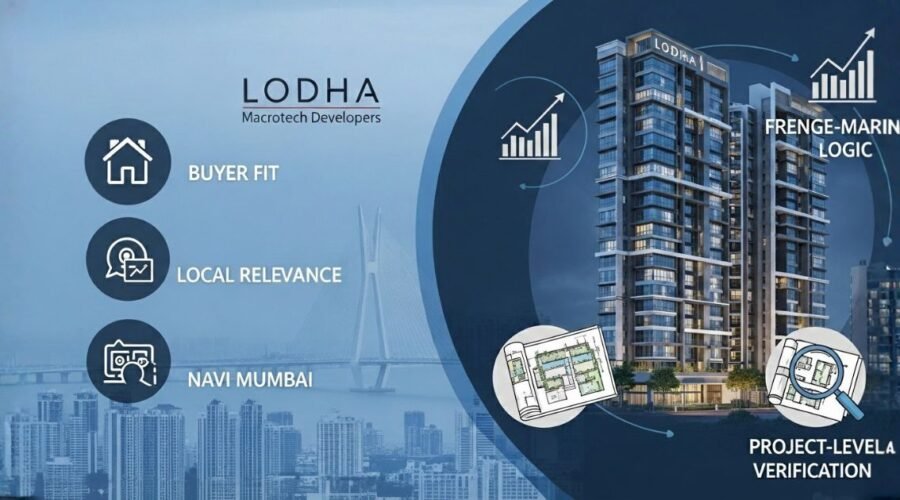
Lodha Group Navi Mumbai: Buyer Fit, Local Relevance and What to Verify
Lodha Group, now legally Lodha Developers Limited and still often searched as Macrotech Developers, is worth considering for Navi Mumbai buyers only in selective cases. It matters mainly on the Taloja-side fringe and in the wider Palava-Taloja-Shilphata belt, not as a deep builder across Vashi, Nerul, Seawoods, Belapur, or central Kharghar. So the right way to judge Lodha is simple: project by project, phase by phase, and location by location, not by brand name alone.
Many buyers search this topic with the wrong starting assumption. They think a large Mumbai-region brand automatically means equal strength across all Navi Mumbai nodes. That is where the confusion begins. Lodha is a major MMR developer, yes. But for Navi Mumbai readers, the real question is narrower: where does Lodha actually matter, who should shortlist it, and what should be checked before paying token or booking amount?
Is Lodha Group actually a serious option for Navi Mumbai buyers?
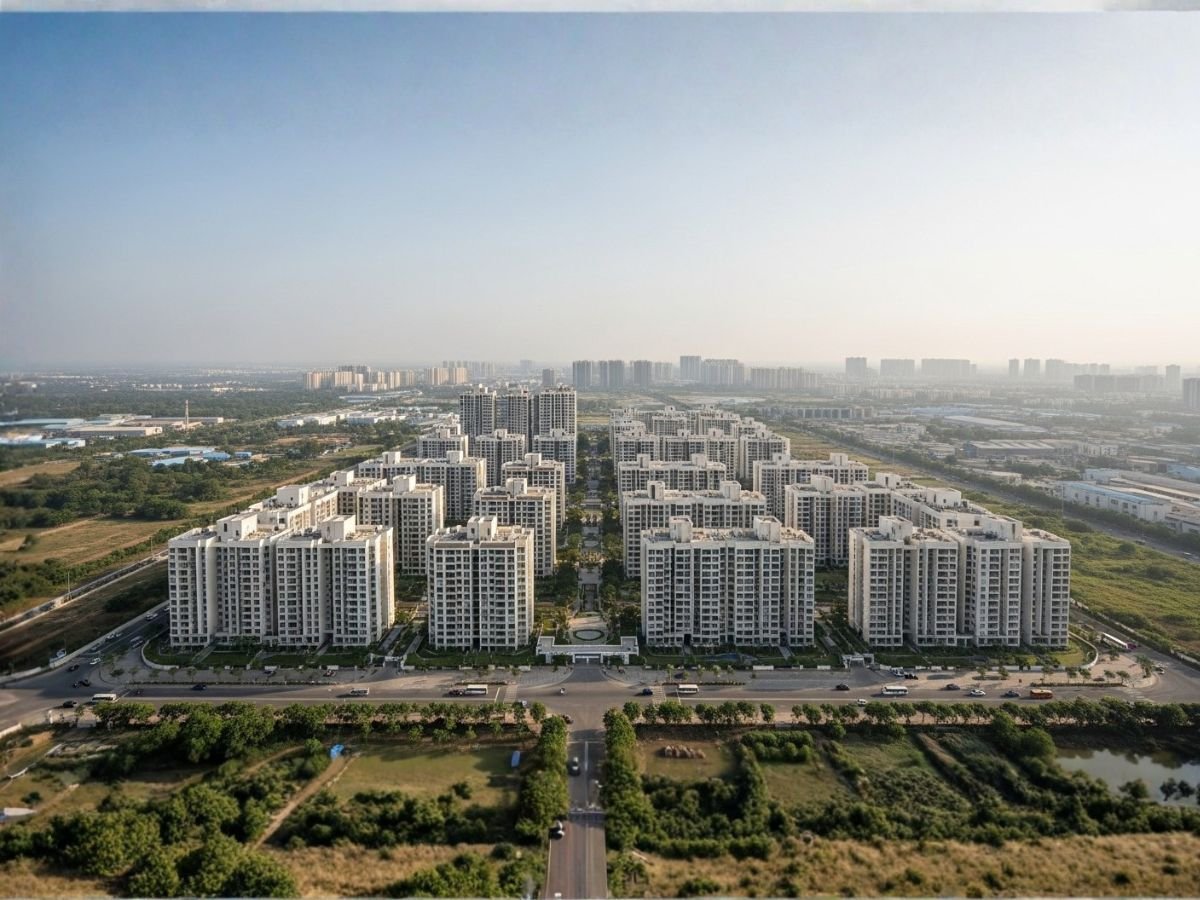
Yes, but only for the right type of buyer. Lodha belongs on a shortlist when the buyer is looking at the Taloja-side periphery, wants a branded township-style product, or is evaluating logistics and industrial exposure near Taloja MIDC and the airport-port corridor. It is not the obvious first choice for buyers who want mature-node Navi Mumbai living.
Quick summary
| Reader type | Is Lodha relevant? | Why | What to verify first |
|---|---|---|---|
| Budget end user | Yes, selectively | Lower ticket entry into a branded township-style environment | Exact carpet area, phase possession, daily commute reality |
| Long-term investor | Yes, selectively | Future connectivity can improve the fringe belt over time | Infrastructure timeline vs your holding period |
| Industrial or logistics user | Strongly yes | Taloja-side warehousing and industrial relevance is real | Access, specification, operational suitability |
| Mature-node Navi Mumbai upgrader | Usually no | Lodha does not have the same depth in Vashi, Nerul, Seawoods, or Palm Beach-type living | Whether you are actually comparing the right geography |
| Buyer who wants large usable carpet | Often no | Lodha’s compact configurations may feel too tight | Layout efficiency and real liveability |
The practical verdict is this: Lodha is a serious option for a specific edge-of-Navi-Mumbai decision, not a blanket answer for the whole city.
Why do people still search “Macrotech Developers” when the brand is Lodha Group?
Because for years the listed corporate name and the consumer-facing brand did not fully match in public memory. Many older documents, investor references, legal records, RERA references, portal listings, and search results continued to use Macrotech Developers. That made buyers wonder whether Macrotech and Lodha were separate companies.
For practical buyer use, the confusion can be settled simply. If you see older references to Macrotech Developers in connection with Lodha projects, that is part of the same main listed real estate business. But buyers should still read the exact company name on booking forms, allotment letters, demand notes, home-loan paperwork, and project registration documents, especially when they are checking recent records against older listings.
This section matters because many generic builder pages skip it completely. They assume the reader already understands the name issue. In reality, many normal buyers do not.
Where does Lodha’s Navi Mumbai relevance actually come from?

Lodha’s relevance in the Navi Mumbai conversation comes from geography at the edge, not dominance across the whole city. That distinction changes the answer.
Residential relevance
For residential buyers, Lodha becomes relevant mostly in the Taloja-facing fringe belt, especially where the decision is less about classic CIDCO-node living and more about whether a branded township near the bypass belt makes sense at a given budget.
This is where products like Lodha Crown Taloja enter the conversation. The appeal is not large carpet. The appeal is a branded environment, controlled access, amenities, internal ecosystem, and lower entry ticket than what many buyers would need in more established Navi Mumbai locations.
But there is a trade-off. In this model, buyers often get a smaller internal home in exchange for a bigger external lifestyle ecosystem. For some families, that works. For others, it does not.
Wider MMR relevance that still matters to Navi Mumbai readers
A second layer of relevance comes from the wider MMR overlap. Some buyers searching “Lodha Group Navi Mumbai” are not really looking inside core Navi Mumbai at all. They are comparing places like Palava-side developments, Taloja-side fringe locations, and Navi Mumbai-adjacent growth belts because those still compete for the same buyer budget.
That is why this article should not treat “Navi Mumbai” and “near Navi Mumbai” as the same thing. They overlap in decision-making, but they are not identical markets. A buyer considering Seawoods, Nerul, or established Kharghar is making a very different choice from someone considering a township-style project off the Taloja bypass logic.
Industrial and logistics relevance
This is where Lodha has more obvious strategic weight. Business users, warehouse occupiers, supply-chain operators, and investors looking at the JNPT-NMIA-Taloja corridor should take Lodha more seriously than a typical retail homebuyer article would suggest.
So if your use case is warehousing, industrial occupancy, or logistics infrastructure near Taloja MIDC, Lodha’s relevance is not just marketing language. It becomes a more direct business-location question.
Is Lodha a Navi Mumbai builder, or a wider MMR brand that sometimes overlaps with Navi Mumbai decisions?
The more accurate answer is the second one.
Lodha is better understood as a large MMR brand that overlaps with some Navi Mumbai decisions, rather than as a builder with equal depth across all Navi Mumbai nodes. This is an important correction because it prevents the wrong comparison.
A buyer should not assume that a strong brand in the wider region automatically means strong on-ground fit for every node. A Lodha project on the Taloja-side periphery should not be mentally treated the same way as a builder deeply embedded in Vashi, Sanpada, Nerul, Belapur, Seawoods, or central Kharghar.
That does not make Lodha weak. It just means the reader must classify the brand correctly. Big brand scale and local node depth are not always the same thing.
Which type of buyer should shortlist Lodha, and who should probably look elsewhere?
This is where most builder pages fail. They describe the brand but never tell the reader whether it fits their real life.
End users
Lodha makes sense for end users who want:
- a branded, gated, township-like environment
- a lower entry ticket than mature Navi Mumbai nodes
- lifestyle amenities that smaller local projects may not match
- patience for location maturation
It makes less sense for end users who want:
- large carpet area for the price
- walkable established-node living
- immediate station-led convenience in a mature urban fabric
- the feel of older, settled Navi Mumbai neighborhoods
A family choosing between a compact branded 2 BHK on the fringe and a larger local-builder flat in a more functional everyday location should not pretend those are the same purchase. They are not.
Investors
Lodha can make sense for investors with a longer holding horizon, especially if they are consciously betting on infrastructure-led improvement in the wider Taloja-Palava-Shilphata side. But this only works if the investor accepts that future upside and present-day convenience are different things.
Investors looking for easy resale comfort inside already established premium Navi Mumbai micro-markets may prefer other locations or other builder categories.
Industrial or commercial users
This is a clearer fit. If the decision is linked to warehousing, logistics, manufacturing support, supply-chain operations, or port-airport corridor efficiency, Lodha’s industrial platform deserves more attention than its residential brand conversation alone suggests.
Buyers who need established-node Navi Mumbai living
These buyers should usually look elsewhere first.
If your ideal life is closer to Palm Beach Road behaviour, Seawoods mall-station convenience, Nerul daily urban integration, Vashi business convenience, or central Kharghar’s more settled layout logic, Lodha is usually not your natural first shortlist. You are probably looking at the wrong product category.
What should you verify before trusting any Lodha project linked to the Navi Mumbai market?
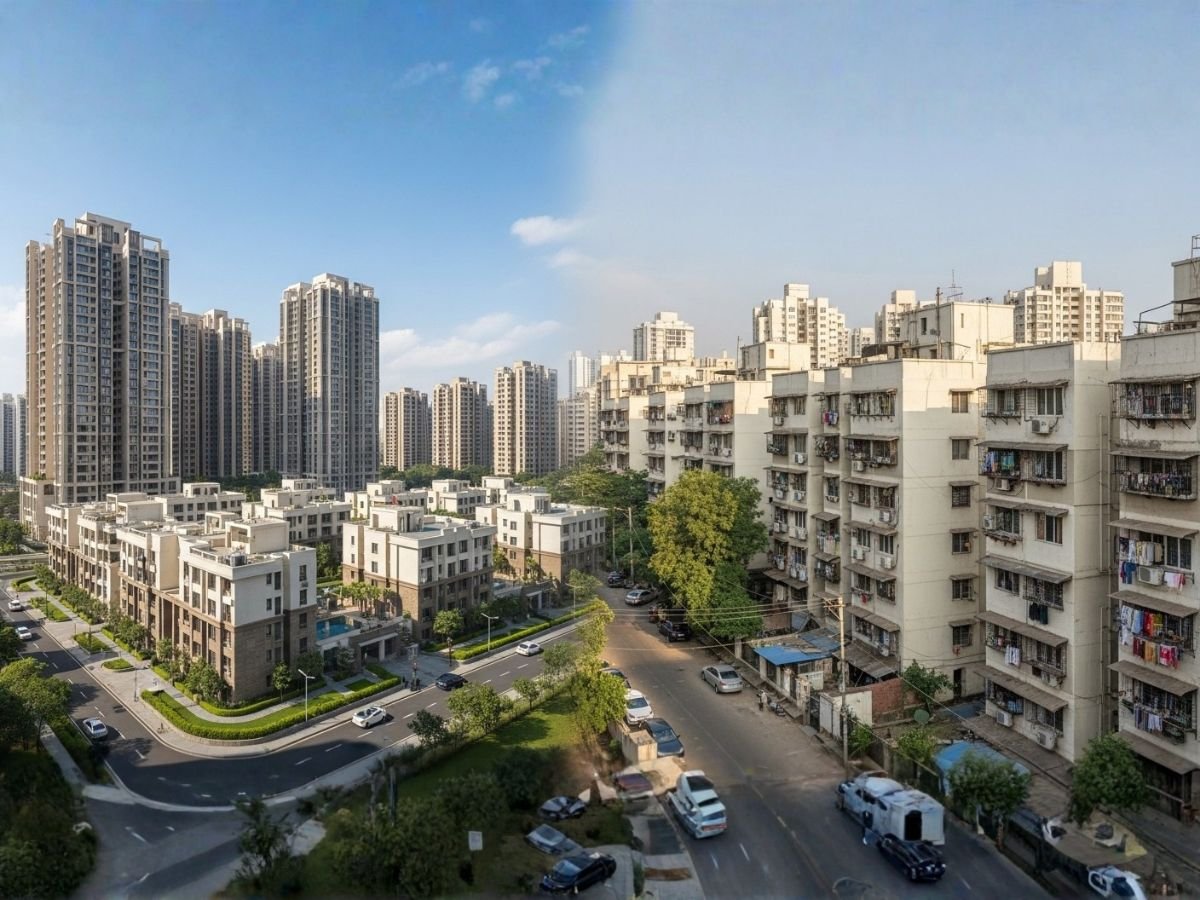
This is the section that matters most. Do not let brand scale replace verification.
Project-level checks
- Ask for the exact MahaRERA number of the exact phase or tower, not only the township name.
- Check whether the unit is in a ready, near-ready, or still-under-construction phase.
- Read the promised possession date for your exact registration entry.
- Confirm the carpet area, because compact branded products can look attractive on total ticket price while still feeling small in daily use.
- Ask for the maintenance structure clearly. Township amenities are not free to run.
Location and authority checks
- Understand whether the location behaves like a planned CIDCO-linked urban node or a more fringe municipal belt.
- Verify which local authority context affects your everyday experience, approvals, utilities, and post-possession expectations.
- Physically check the access road, last-mile entry, market convenience, school and hospital reach, and actual public transport usefulness.
- Do not judge the location from brochure maps alone.
Price-to-liveability checks
- Compare not just base price, but price versus usable carpet, commute cost, maintenance burden, and daily friction.
- Ask yourself one blunt question: is the lower ticket price solving my problem, or only hiding a compromise I will regret later?
- If you work in Airoli, Ghansoli, Rabale, Mahape, Belapur, or Vashi, test the route at real office hours. Do not assume future infrastructure has already arrived for your daily life.
Where can buyers misjudge Lodha in the Navi Mumbai context?
This happens more often than people think.
The first mistake is treating near Navi Mumbai and inside mature Navi Mumbai as the same market. They are not. A township on the Taloja-side fringe may be sold with strong future-connectivity language, but that still does not make it equal to living in a mature node today.
The second mistake is assuming township scale solves everything. It does not. A large clubhouse, gardens, internal retail and security can improve internal quality of life, but they do not automatically fix external commute stress, authority differences, or micro-location friction.
The third mistake is trusting brand over phase reality. A large brand can still have different delivery stages, different tower timelines, and different levels of immediate readiness within the same wider township.
The fourth mistake is confusing “good entry price” with “good long-term fit.” Sometimes a compact, lower-ticket branded home is exactly right for a young family. Sometimes it becomes a daily space compromise that starts hurting after possession.
A simple example makes this clearer. A first-time couple with a limited budget, one car, and a five-year horizon may find Lodha’s fringe-township logic reasonable. A family of four wanting bigger rooms, railway dependence, and smoother daily urban integration may be better off with a larger flat from a local developer in a more functional micro-market.
How should Lodha be compared with local Navi Mumbai developers?
The fair comparison is not “big brand versus small brand.” The fair comparison is what each developer type is actually better at.
Lodha usually has the advantage in:
- brand visibility
- township-style planning
- amenity scale
- ability to create a controlled internal ecosystem
- attracting buyers who want a known name at a lower entry ticket
Local Navi Mumbai developers often have the advantage in:
- stronger micro-market familiarity
- better fit in established or naturally evolving local node behaviour
- larger carpet for the money in some cases
- more direct alignment with everyday city use
- better suitability for buyers who care more about practical local integration than brand aura
So the better question is not “Who is better?” It is “Better for what?”
If the buyer wants a compact branded product with township features, Lodha may win. If the buyer wants more usable home space, older-node familiarity, or more organic city convenience, a local builder may suit better.
Conclusion
Lodha should be shortlisted in the Navi Mumbai context when you are making a Taloja-side or Navi Mumbai-adjacent fringe decision, when you want a branded township format, when you accept compact carpet in exchange for amenities, or when you are evaluating industrial and logistics relevance in the larger corridor.
Lodha should not be treated as an automatic shortlist for buyers who want mature-node Navi Mumbai living, larger internal homes, effortless station-led daily life, or a builder whose strength is deeply spread across Vashi, Nerul, Seawoods, Belapur, and similar established zones.
So the clean decision filter is this:
Shortlist Lodha if you want branded township-style living or strategic corridor exposure and are comfortable doing strict project-level verification. Skip Lodha first and look elsewhere if your priority is settled-node Navi Mumbai life, bigger carpet, immediate convenience, and stronger local urban integration.
That is the real answer. Not “Lodha is good” or “Lodha is bad.” Lodha is relevant, but only when the use case is right.
FAQs
Frequently Asked Questions