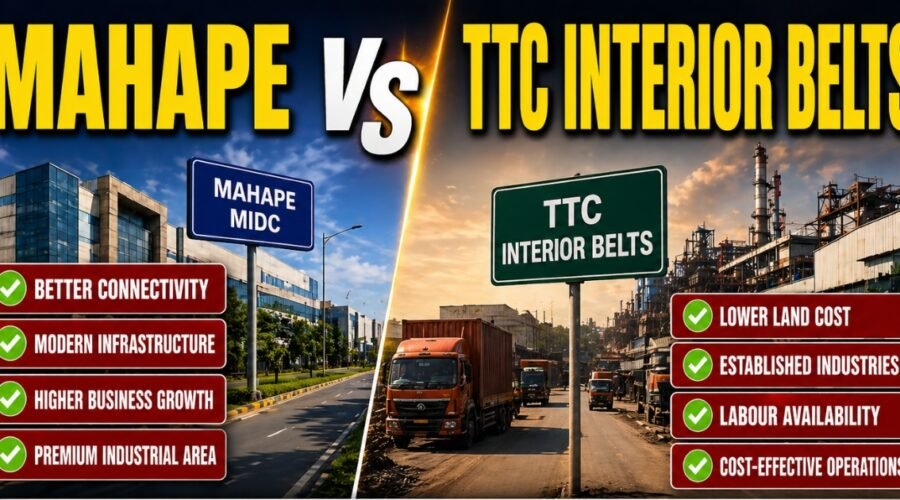
Mahape vs TTC Interior Belts: Which Area Fits Which Business?
Mahape is generally a better fit for businesses that need staff access, client visits, office-linked operations, electronics assembly, IT support, testing, repair, and a cleaner industrial environment. TTC interior belts such as Rabale, Pawane, and Turbhe are better for cost-sensitive, loading-heavy, storage, fabrication, workshop, warehousing, and machine-linked businesses. The right choice depends less on the map location and more on daily workflow, vehicle movement, power load, staff commute, compliance, and building suitability.
Quick Answer: Should Your Business Choose Mahape or a TTC Interior Belt?
If your business moves more people, data, clients, small components, and technical teams, Mahape will usually make more sense. If your business moves more machinery, raw material, trucks, pallets, finished goods, or heavy inventory, a deeper TTC interior belt may work better.
This is the simplest way to understand Mahape vs TTC interior belts.
| Business need | Better fit | Why |
|---|---|---|
| Electronics assembly, testing, repair, ESDM work | Mahape | Cleaner environment, better staff access, office-linked industrial use |
| IT support, back-end office, technical service team | Mahape | Better commuter access and more suitable corporate image |
| Client-facing B2B office with light operations | Mahape | Easier for visitors, vendors, and employees |
| Heavy fabrication, machining, welding, metal work | TTC interior belts | Better suited for noisy, movement-heavy, work-floor activity |
| Storage, dispatch, packaging, warehousing | Rabale, Pawane, Turbhe side pockets | More usable volume, loading space, and practical industrial layouts |
| Cost-sensitive manufacturing | TTC interior belts | Lower entry cost in many pockets, subject to building condition |
| Investor looking for stable office-industrial tenants | Mahape | Better fit for organised light-industrial and IT-linked tenants |
| Investor looking for practical MSME tenants | Interior TTC belts | Stronger demand from local industrial users, but higher due diligence needed |
The important point is simple: Mahape is not automatically better because it looks cleaner, and interior TTC belts are not automatically better because they are cheaper. A wrong location can quietly increase your operating cost every single month.
What Do “Mahape” and “TTC Interior Belts” Actually Mean for a Business Owner?
Mahape and the deeper TTC interior belts are part of the larger industrial ecosystem of Navi Mumbai, but they do not behave the same on the ground. Many listings use broad terms like “TTC MIDC” or “MIDC industrial property” without clearly explaining the exact pocket. That can mislead first-time tenants and investors.
For a business owner, the exact lane, building type, road width, loading access, staff commute, and permitted use matter more than the general area name.
Mahape as a More Visible, Access-Friendly Industrial-Commercial Pocket
Mahape works like a bridge between industrial use and office-linked business use. It has a stronger presence of IT/ITES, electronics, testing, technical services, back-end operations, light assembly, and organised industrial offices.
The Millennium Business Park ecosystem has also shaped Mahape’s image as a more corporate and staff-friendly pocket compared to many deeper industrial roads. This does not mean every building in Mahape is modern or perfect. But broadly, Mahape suits businesses where employee movement, client meetings, vendors, documentation, internet connectivity, and office usability matter.
A company running electronics repair, small assembly, product testing, engineering support, or a back-end technical team may find Mahape more practical than a deep industrial shed where staff access becomes a daily headache.
TTC Interior Belts as Deeper Working Industrial Pockets, Not One Uniform Market
The phrase “TTC interior belts” can include different ground realities around Rabale, Pawane, Turbhe, Kopar Khairane-side internal industrial roads, Ghansoli-side industrial stretches, and other deeper MIDC pockets.
These areas are more work-floor driven. They are built around movement, output, storage, loading, machinery, raw material, repair work, and lower-visibility industrial operations. In many pockets, the environment is more rugged. Roads may be busier with goods vehicles. Buildings may be older. Some sheds may have better usable volume than polished RCC units, but they also need stronger checking.
This is why one should not compare Mahape and TTC interior belts only by rent per sq ft. A 5,000 sq ft Mahape RCC unit and a 5,000 sq ft Pawane shed may be completely different products in practical use.
Which Business Types Fit Mahape Better?
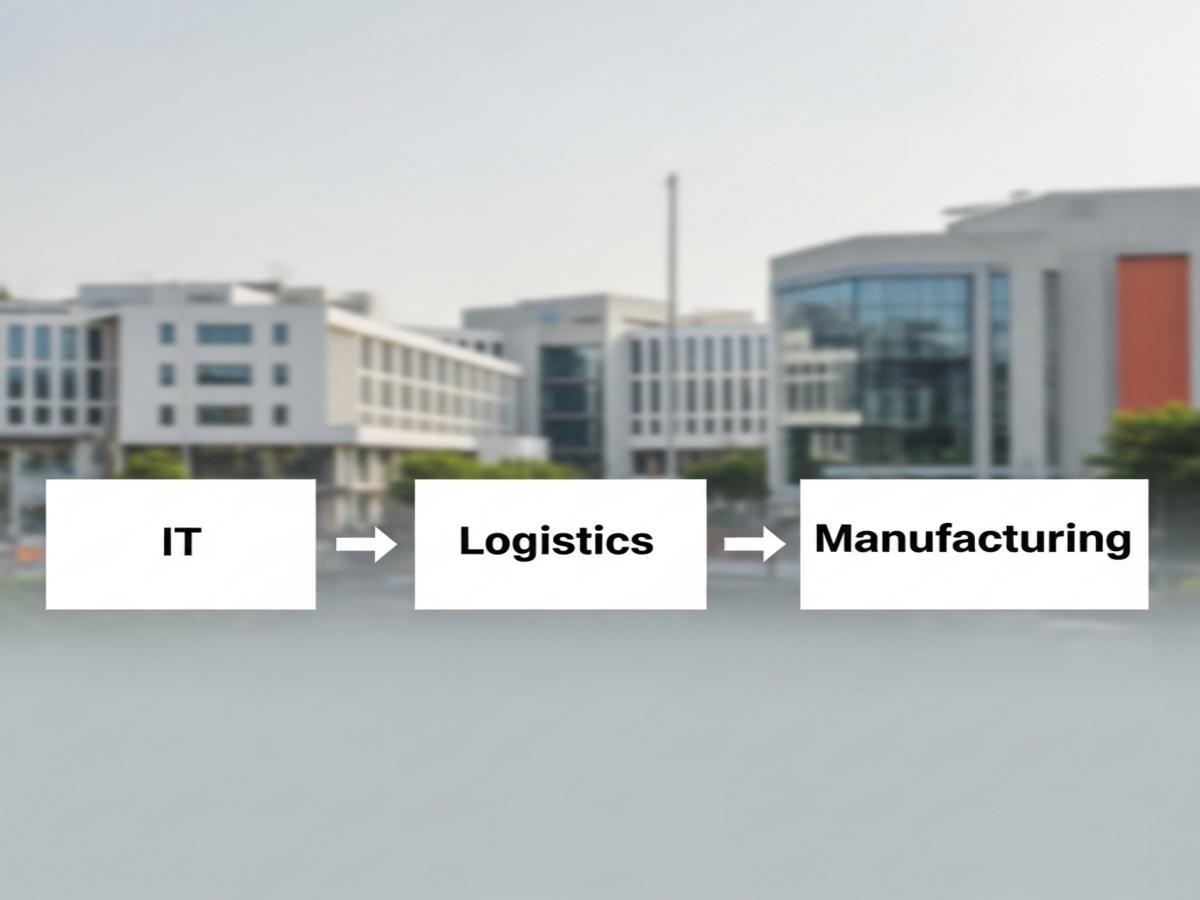
Mahape fits businesses that need cleaner operations, better staff access, office usability, and a more organised environment. It is not the best answer for every industrial user, but it is often a strong fit for businesses where people movement is as important as goods movement.
Electronics, Assembly, ESDM, and Light Engineering Units
Mahape is suitable for electronics assembly, testing, repair, light engineering, ESDM-related work, calibration, product servicing, and small component handling.
These businesses usually need a mix of technical staff, admin staff, small inventory movement, clean internal areas, internet connectivity, and vendor coordination. They may not require large open yards or heavy truck staging every day.
For such users, Mahape’s premium can be justified because the business depends on a smoother working environment. Staff should be able to reach the unit without too much last-mile struggle. Clients or vendors should not feel that they are entering a deep, difficult-to-access industrial pocket.
IT Support, Back-End Operations, and Office-Linked Industrial Users
Mahape also works well for back-end offices, IT support teams, technical service operations, engineering design support, data-related support teams, and hybrid office-industrial businesses.
These users may require office cabins, meeting rooms, server or equipment rooms, small storage areas, service counters, and employee-friendly movement. The business may not be purely commercial, but it is also not pure manufacturing.
For them, the right question is not “Where is the cheapest unit?” The better question is: “Where will my staff come daily without friction, and where can my clients or vendors visit without difficulty?”
Businesses That Need Client Visits, Staff Access, and Better Visibility
Mahape is also better for businesses where image matters. A B2B service provider, automation company, equipment distributor, technical repair company, industrial consultant, product testing firm, or office-linked trading business may benefit from being in a more visible and accessible pocket.
This does not mean every Mahape building has premium infrastructure. Parking, lift condition, water, power backup, fire safety, maintenance, and internet still need to be checked building by building. But as a location type, Mahape is usually more suitable for businesses that cannot operate from a hidden, rough, internal industrial lane.
Which Business Types Fit TTC Interior Belts Better?
TTC interior belts make more sense when the business is more concerned with usable work area, loading, storage, raw material movement, power, machinery, and operating cost than corporate appearance.
For many practical industrial users, a deeper pocket may be a smarter choice than Mahape. The condition is simple: the selected unit must pass physical, legal, and utility checks.
Fabrication, Workshop, Repair, and Machine-Linked Businesses
Fabrication units, welding workshops, metal work, machining, repair workshops, machine component manufacturers, industrial service units, and similar activities often fit better in interior TTC pockets.
These businesses may generate noise, vibration, dust, and frequent goods movement. They need stronger flooring, proper power load, loading space, and practical access for raw material. Paying a Mahape premium for glass façade appeal may not help such businesses.
For these users, Rabale or Pawane-side industrial pockets may be more practical, provided the specific unit allows the activity and has the right physical capacity.
Storage, Dispatch, Packaging, and Loading-Based Businesses
Storage, packaging, dispatch, warehouse-linked operations, industrial distribution, cold storage support, and logistics-linked activities often need wide access, loading area, vehicle circulation, usable height, and internal movement.
In many cases, the deeper TTC belts can offer more functional layouts than Mahape’s office-style or RCC building stock. A shed with better clear height, larger gate, stronger floor, and easier goods movement may be more useful than a polished building that cannot handle regular loading.
However, this must be physically verified. Never assume a unit is suitable for truck movement only because the broker calls it “industrial.”
Cost-Sensitive Users Who Can Manage Older Buildings and Deeper Access
Interior TTC belts are also useful for cost-sensitive businesses. A small manufacturer, packaging operator, industrial repair unit, storage user, or local MSME may prefer a deeper pocket because the business does not need daily client visits or polished surroundings.
But the lower rent should not be treated as pure savings. Older buildings may need electrical upgrades, slab repairs, drainage work, extra security, pest control, employee transport, or internal fit-out. In some cases, the upfront cost can reduce the rent advantage.
Mahape vs TTC Interior Belts: Practical Comparison for Business Use
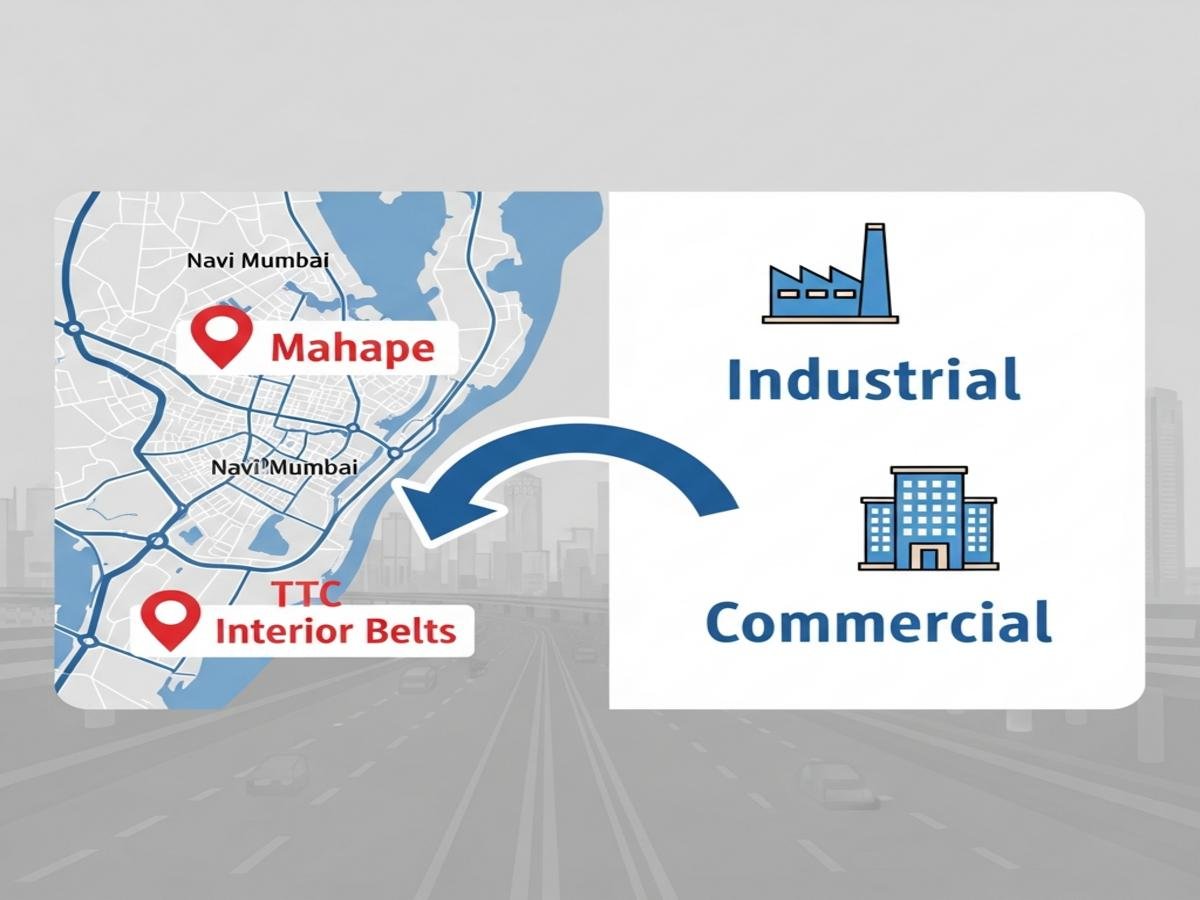
The real comparison is not “better area versus worse area.” It is “which area reduces friction for your business type?”
| Factor | Mahape fit | TTC interior belt fit | What tenant or buyer should check |
|---|---|---|---|
| Staff commute | Usually better for office-linked and staff-heavy teams | Can be difficult in deeper roads and late shifts | Station access, bus route, shared auto availability, night safety |
| Client visits | Better for regular client, vendor, or investor visits | Less suitable for premium or frequent visitor movement | Road approach, building image, parking, reception access |
| Rent and deposit | Often higher where access and building quality are better | Often more affordable, but varies by pocket and building | Total cost, not only base rent |
| Truck access | Suitable for light commercial vehicles in many cases | Often better for loading-heavy users | Road width, turning radius, gate height, loading bay |
| Loading and unloading | May be restricted in office-style buildings | Usually more practical in sheds and galas | Truck timing, loading area, floor level, internal circulation |
| Power load | Suitable for light industrial, office, IT, service use | Better for machine-heavy users if sanctioned load exists | Existing sanctioned load, upgrade process, backup requirement |
| Internet and office usability | Usually stronger for back-end and IT-linked users | Varies heavily by building and lane | Fiber availability, backup internet, internal wiring |
| Building age | Mix of RCC and office-industrial stock | More legacy sheds and older industrial buildings | Structural condition, leakage, slab strength, fire exits |
| Parking | Better in some planned buildings, still needs checking | Can be chaotic in older pockets | Staff parking, visitor parking, goods vehicle waiting |
| Fire and safety | Must be checked building-wise | Must be checked more carefully in older sheds | Fire NOC, exits, extinguishers, storage safety |
| Drainage and monsoon risk | Varies by building and road level | Some interior pockets need stronger checks | Plinth height, waterlogging history, drain condition |
| Expansion | Better for office-linked scaling | Better for work-floor and storage scaling if space is available | Adjacent space, FSI rules, road width, permissions |
| Resale/liquidity | Better for organised office-industrial buyers in some cases | Strong for practical industrial buyers if documents and access are clean | Legal title, MIDC transfer, tax dues, building usability |
A small but serious point: the same business can get two completely different outcomes in two properties only 2 km apart. In TTC, micro-location matters.
If Staff Commute Matters, Which Area Is Easier to Run Daily?
If your business depends on staff attendance, Mahape usually has an advantage. This is especially true for back-end offices, IT support teams, electronics assembly, technical service centres, and admin-heavy operations.
Mahape’s access to the Ghansoli and Kopar Khairane side, along with its link to the Thane-Belapur Road belt, makes it easier for many employees to commute compared to deeper internal industrial roads. For day shifts, this matters. For night shifts, it matters even more.
In interior pockets, the last-mile problem can become a hidden cost. Staff may need shared autos, company transport, or pickup-drop arrangements. Some roads may not feel comfortable late at night, especially for women employees or young staff. Food options, walkability, lighting, and public transport frequency can also affect retention.
A cheaper unit can become expensive if the company starts losing employees, paying for transport, or dealing with delayed attendance every week.
For staff-heavy businesses, check these before finalising:
- Distance from the nearest practical station or main road
- Availability of shared autos or NMMT buses during working hours
- Safety and lighting for evening and night shifts
- Nearby food options and basic worker convenience
- Parking or pickup-drop space
- Whether employees can realistically reach daily without frustration
This is where many first-time tenants make a mistake. They check rent properly but do not test the commute at actual office timing.
If Truck Movement Matters, Which Area Creates Less Operational Friction?
Truck movement is a completely different decision from car access. A property can look excellent for a director’s car and still fail for a 20-foot or 40-foot vehicle.
For loading-heavy businesses, interior TTC belts often work better than Mahape because many older industrial pockets were built around industrial movement. Sheds and galas in Rabale, Pawane, or Turbhe-side pockets may offer wider entries, better loading space, higher clear height, and more practical goods movement.
But this is never automatic. The exact road and compound matter.
Before renting or buying, physically check:
- Can the regular delivery vehicle enter the lane?
- Can it reverse safely?
- Is there enough turning radius near the gate?
- Is there a proper loading and unloading area?
- Is the gate height suitable?
- Can goods move inside without blocking other units?
- Is there space for waiting or staging?
- Are peak-hour restrictions affecting dispatch timing?
- Is the floor strong enough for the intended load?
Heavy vehicle movement in Navi Mumbai is also affected by traffic restrictions during peak commuter hours. As per the research dossier, heavy vehicle restrictions are commonly enforced from 08:00 to 11:00 and 17:00 to 21:00. Businesses that depend on frequent dispatch should plan timing carefully instead of assuming trucks can move whenever required.
For some businesses, one missed dispatch window can disturb the entire production cycle.
How Do Rent, Deposit, and Usable Space Differ Between Mahape and Interior TTC Pockets?
Mahape usually commands a premium where the property has better visibility, better access, office usability, RCC structure, and a cleaner business environment. Interior TTC pockets may offer lower base rent or larger usable industrial space, but the real comparison should be total cost of occupation.
Indicative market patterns from the research dossier suggest Mahape industrial plots and RCC structures may often be seen around the ₹40 to ₹52 per sq ft range, while Rabale and Pawane industrial sheds and warehousing spaces may commonly fall around ₹33 to ₹45 per sq ft. These are only approximate bands and can change sharply by building condition, clear height, road width, floor strength, fit-out, and market timing.
The smarter way to compare is not just rent per sq ft. Compare usable value.
A 10,000 sq ft unit in Mahape may include office corridors, cabins, lobby areas, parking constraints, and lighter loading access. The same 10,000 sq ft in Pawane may offer more open industrial floor, better vertical volume, and more practical storage movement.
But the reverse can also be true if the interior unit is old and poorly maintained. A lower-rent shed may need spending on:
- Electrical upgrades
- Power load improvement
- Flooring or slab repair
- Leakage control
- Fire safety work
- Drainage correction
- Security
- Employee transport
- Internal office fit-out
- Pest control and housekeeping
This is why the correct question is not “Which area is cheaper?” The correct question is “Which area gives the lowest practical operating cost for my business?”
Which Area Is Better for Investors Looking for Industrial Tenants?
Investors should not evaluate Mahape and TTC interior belts the same way an owner-user does. A tenant chooses based on daily operations. An investor must think about tenant depth, vacancy risk, lease stability, maintenance burden, legal clarity, and resale liquidity.
Mahape Investor Logic
Mahape may attract more organised tenants in IT/ITES, electronics, light assembly, back-end operations, engineering support, technical services, and office-linked industrial use. These tenants may value access, image, internet, staff commute, and clean building condition.
For investors, this can mean better tenant quality in certain properties. But the entry price may also be higher. The yield may look lower if the property is bought at a premium.
Mahape works better for investors who want a more office-industrial tenant profile and can afford to buy or hold a better-quality unit.
TTC Interior Belt Investor Logic
Interior TTC belts may attract local MSMEs, fabrication units, storage users, warehousing operators, repair workshops, packaging businesses, and practical industrial tenants. These tenants may care less about building appearance and more about usable area, loading, power, and rent affordability.
The risk is different. Older buildings may need more repairs. Tenant turnover may be higher in some pockets. Compliance gaps, unpaid dues, parking conflicts, or poor maintenance can reduce net returns.
One important MIDC point from the dossier is subletting. Legal subletting of MIDC leasehold property typically requires formal permission and payment of applicable charges. The research dossier states that subletting charges can be 3% of the prevailing MIDC land rate annually for industrial or commercial use, and 1% for IT/ITES use. These rules directly affect investor calculations and should be verified from MIDC before relying on rental yield assumptions.
What Should You Check Before Leasing or Buying in Either Area?
Whether the property is in Mahape or a deeper TTC interior belt, never finalise only because the rent looks good or the location sounds familiar. Industrial property mistakes are expensive because the problem usually appears after token, deposit, shifting, or machine installation.
Use this checklist before committing.
| Check | Why it matters |
|---|---|
| Exact MIDC plot, sector, road, and pocket | “TTC MIDC” is too broad; the exact micro-location decides usability |
| Permitted industrial use | Your actual activity must match allowed use and required permissions |
| MIDC leasehold and transfer status | Buying usually means transfer of leasehold rights, not simple freehold ownership |
| MIDC dues, water bills, lease rent | Pending dues can create transfer or occupation issues |
| NMMC property tax dues | MIDC clearance does not automatically mean NMMC dues are clear |
| MPCB consent requirement | Pollution category and activity type must be verified |
| Fire safety | Especially important for storage, chemicals, electrical load, packaging, and older sheds |
| Power load | Sanctioned load must match machinery, HVAC, servers, or production requirement |
| Loading access | Truck entry, turning radius, gate height, and unloading space must be tested physically |
| Floor loading and clear height | Essential for storage, machinery, fabrication, and heavy inventory |
| Drainage and monsoon history | Older interior pockets need careful plinth and waterlogging checks |
| Internet and telecom | Critical for IT, back-end, electronics, and service operations |
| Rent agreement clauses | Check lock-in, escalation, repair responsibility, deposit, subletting, and permitted use |
| Occupation documents | Check building approval, OC or relevant occupation-related documents where applicable |
There is also an important tax point. The research dossier notes that NMMC has authority to levy property tax on industrial units within the MIDC TTC area, as affirmed through legal proceedings. For buyers, this means checking only MIDC dues is not enough. NMMC property tax dues must also be verified separately.
Similarly, for pollution-linked activities, an MIDC property does not automatically mean the business can operate any process inside it. MPCB consent may be required depending on the activity, category, scale, technology, and emissions.
When Is Mahape the Wrong Choice Despite Looking Better on Paper?
Mahape is the wrong choice when the business needs heavy industrial depth more than accessibility or image.
A heavy fabrication unit, steel-handling operation, large storage business, vibration-heavy machine unit, noisy workshop, or frequent truck-based operation may struggle in Mahape if the building and road are not designed for it. Paying extra for a cleaner location will not help if the business cannot unload raw material comfortably.
This is called over-specifying the location. The business pays for visibility, polished surroundings, and office appeal, but its real requirement is floor strength, goods access, truck staging, power load, and low-friction work movement.
For example, a steel fabrication operator may like a Mahape RCC unit because it looks organised. But if steel delivery trucks block the lane, neighbours complain about noise, and internal loading is weak, the business will face daily trouble. In that case, a deeper Rabale or Pawane unit with the right industrial layout may be more practical.
Mahape is also not ideal if future expansion requires large low-cost space. For businesses that need more floor area every few months, the premium can become difficult.
When Is a TTC Interior Belt the Wrong Choice Despite Being Cheaper?
A TTC interior belt is the wrong choice when the business depends on people, clients, brand image, or clean daily operations.
This is the cheap rent trap. A back-end office, IT support company, premium engineering service, client-facing consultant, electronics service brand, or staff-heavy unit may choose a deeper pocket to save rent. Later, the company may struggle with staff attendance, poor last-mile access, weak building image, safety concerns during late shifts, limited food options, or low employee comfort.
In such cases, the saving in rent may be smaller than the hidden cost of attrition, transport, housekeeping, delays, and lower client confidence.
Interior pockets also need stronger checks for drainage, older structures, fire safety, air quality, and neighbouring use. Some industrial pockets around Turbhe, Khairane, and nearby areas have faced reported civic and environmental concerns related to odour, emissions, or monsoon waterlogging. This does not mean every property is bad. It means the buyer or tenant must check the exact lane and building before committing.
For a clean technical office, a cheaper shed in a gritty industrial pocket can damage productivity. For a factory, it may be perfect. The business type decides the answer.
Business Fit Matrix: Choose Mahape or TTC Interior Belt Based on Your Activity
| Business activity | Better fit | Why | Must check before finalising |
|---|---|---|---|
| Electronics assembly | Mahape | Needs cleaner environment, technical staff, office linkage | Dust control, |
FAQs
Frequently Asked Questions