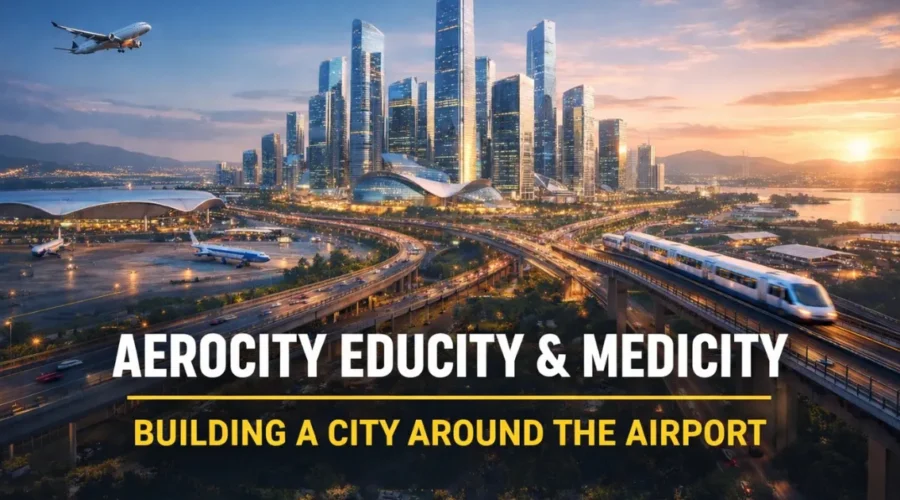
Navi Mumbai Aerocity & Allied Hubs (Educity, Medicity): The Airport City Master Plan
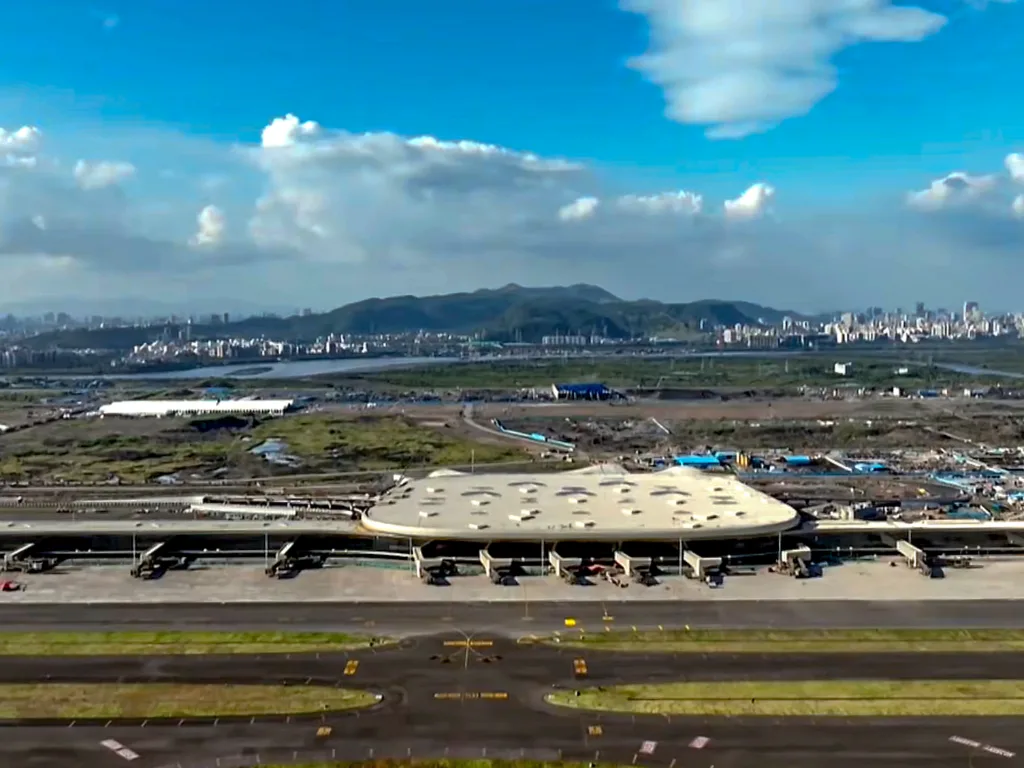
I remember sitting in a tiny café in Vashi about five years ago, listening to a local developer talk about “the airport effect.” Back then, it felt like a distant dream-something we talked about while stuck in Sion-Panvel Highway traffic. But standing in Ulwe today, looking at the massive terminal structures of the Navi Mumbai International Airport (NMIA) rising from the dust, that dream has shifted into a high-gear reality.
We aren’t just building an airport; we are witnessing the birth of a 667-acre “Aerotropolis.” This isn’t just organic urban sprawl where houses pop up and then we realize we forgot to build roads or offices. This is a scientifically engineered ecosystem. CIDCO (City and Industrial Development Corporation) has moved beyond the old school “residential colony” mindset and is now playing a global game. With the Navi Mumbai Aerocity, alongside the proposed Educity and Medicity, the Ulwe-Panvel corridor is being redefined as a “live-work-play-invest” triangle that could honestly give BKC or even parts of Dubai a run for their money by 2030.
Navi Mumbai Aerocity - A New Urban Hub
So, what exactly is an “Aerocity”? If you’ve been to Delhi’s Aerocity, you know it’s a high-end cluster of hotels and fancy offices. But Navi Mumbai is taking that concept and putting it on steroids. Spanning 667 acres directly adjacent to NMIA, this is planned as the economic heart of the region. The logic here is simple: Why should an airport only be a transit point? CIDCO wants it to be a destination. They’ve appointed Nippon Koei India Pvt Ltd as the consultant to finalize this master plan by early 2026. This isn’t just about landing planes; it’s about capturing the “time value” of business travelers. Imagine flying in from Singapore, finishing a board meeting in a Grade-A office just five minutes from the terminal, and staying in a five-star hotel-all without ever touching the congested streets of South Mumbai.
Zoning in Aerocity: The 1:1:1 Philosophy
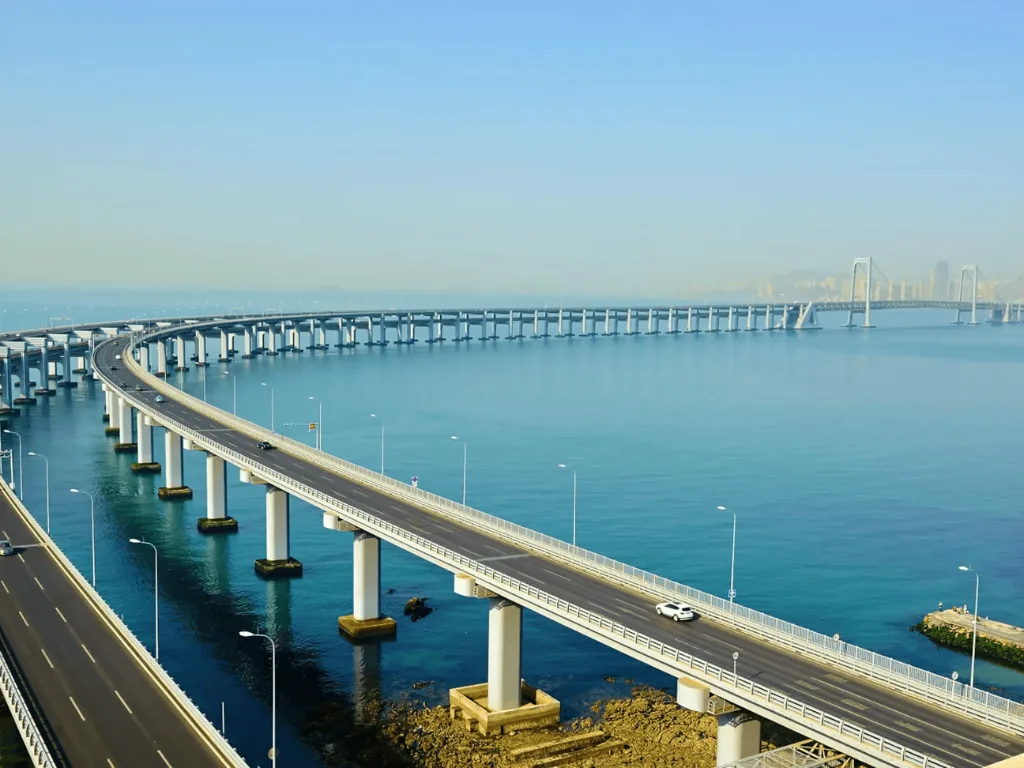
The planning here is remarkably balanced. Unlike many parts of Mumbai where commercial towers are suffocated by slums or aging chawls, the Aerocity follows a strict land-use distribution. CIDCO has signaled a 1:1:1 ratio for its core components:
- Commercial (123 acres): Dedicated to high-end corporate offices, regional headquarters, and trading hubs.
- Residential (123 acres): Not your average “1BHK for investment” blocks, but workforce-proximate urban living designed for airport staff, pilots, and corporate executives.
- Retail, Entertainment & Leisure (123 acres): This is the “fun” bucket-shopping malls, cinema clusters, and importantly, the hospitality (hotel) sector.
- Industrial & Logistics (298 acres): The heavy lifter. This zone will leverage the airport’s cargo capacity and the proximity to JNPT (Nhava Sheva) port.
Current Status and Momentum
As of early 2026, we are in the “Activation Phase.” The bid for master planning was a competitive affair, showing just how much the private sector wants a piece of this. Once the master plan is set in stone by the end of this year, expect a flurry of plot auctions. For anyone watching the real estate market, this is the “calm before the storm.” Once CIDCO starts auctioning these plots to major developers like Godrej, Adani, or international REITs, the price floor in Ulwe and Pushpak Nagar is going to shift permanently.
International Corporate Park vs. Aerocity
A question I often get from investors is: “Wait, isn’t there already a business district in Kharghar?”
Yes, that’s the International Corporate Park (ICP), often dubbed “BKC 2.” It’s important to distinguish the two. The ICP in Kharghar is about 10-12 km away and is designed as a pure business district-think massive office towers, insurance hubs, and IT parks. The Aerocity, on the other hand, is an “Airport-Linked” ecosystem. It lives and breathes on transit. While ICP caters to the settled workforce of Navi Mumbai and Thane, the Aerocity is for the global traveler and the logistics industry. They aren’t competitors; they are siblings. One provides the massive office space, while the other provides the high-speed connectivity and hospitality.
Educity: The Knowledge Hub
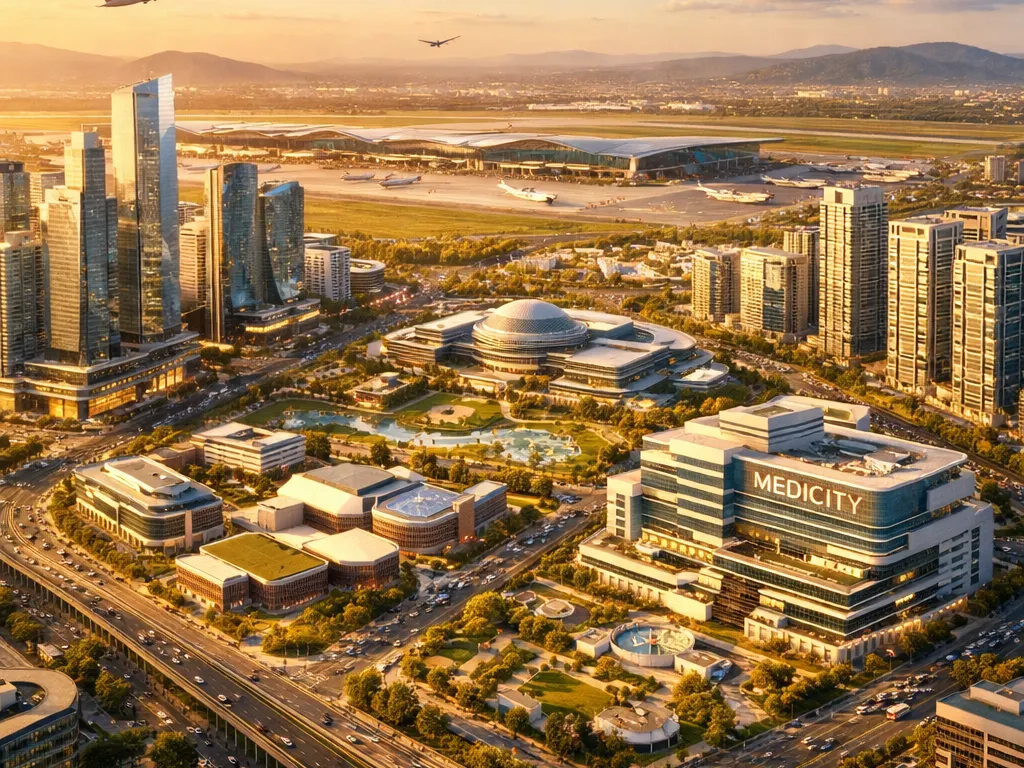
Education is often the “forgotten” pillar of urban growth, but CIDCO seems to have learned from the mistakes of the past. Within a 10km radius of the airport, there is a dedicated plan for Educity. Think of this as a specialized cluster for international universities, R&D centers, and aviation academies. Why put it near the airport? Because global talent follows connectivity. An international research firm or a flying school needs to be where its students and partners can fly in and out easily.
Why Educity Matters for the Region
I’ve seen how neighborhoods change when a major university moves in. It’s not just about the students; it’s about the “knowledge economy.”
- Talent Pool: Companies in the Aerocity will have a direct pipeline of skilled graduates.
- Student Housing: This will create a whole new rental market in nearby nodes like Kalundre and the NAINA (Navi Mumbai Airport Influence Notified Area) regions.
- Vibrancy: Education hubs keep a city young and active even after office hours.
While the exact location is still being refined (likely near the Pushpak Nagar or the KSC new town region), the commitment to earmarking land for education is a huge win for the “liveability” index of Navi Mumbai.
Medicity: Healthcare & Biotech Hub
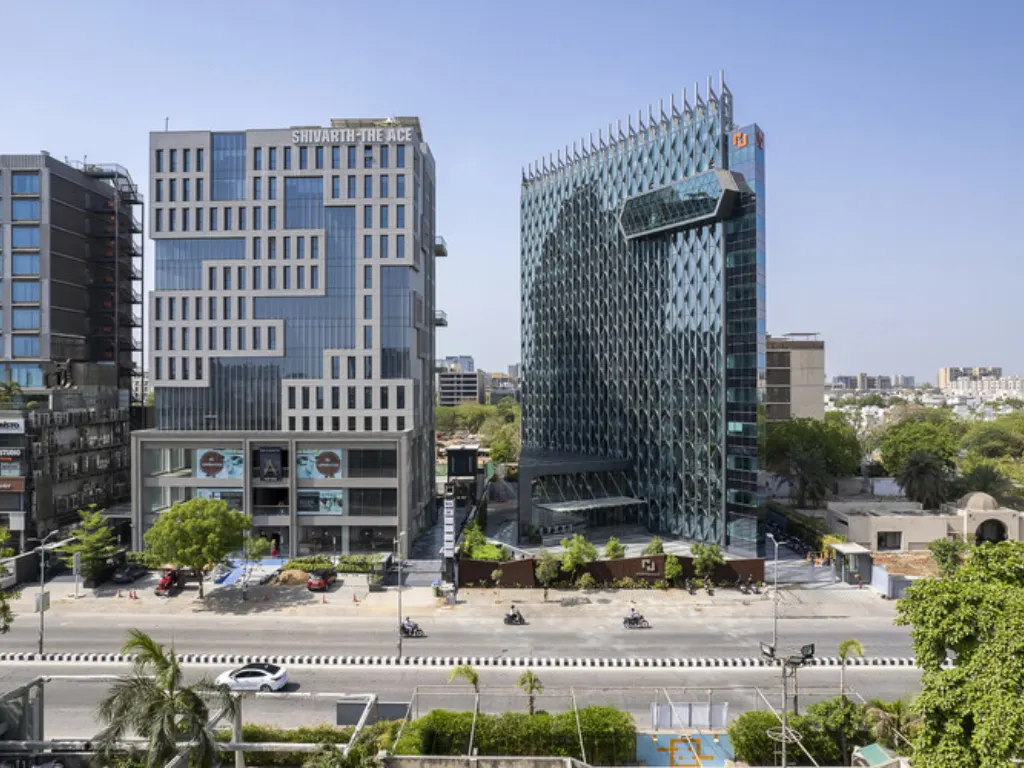
Health is the new wealth, and CIDCO’s Medicity plan is a testament to that. We are looking at a dedicated district for multi-specialty hospitals, medical colleges, and pharmaceutical research units. The synergy here is brilliant. Imagine “Medical Tourism.” A patient from the Middle East or Southeast Asia can fly into NMIA and be in a world-class hospital within 10 minutes. No more navigating the nightmare of Mumbai’s inner-city traffic to reach a specialist.
Synergy with the Ecosystem
The Medicity won’t just serve international patients. It will be the primary healthcare provider for the millions of residents moving into the NAINA and Ulwe belts. In a post-pandemic world, having a specialized biotech and healthcare hub near a major logistics center (the airport) is a strategic masterstroke for vaccine and medicine distribution.
The Integrated Ecosystem: A "15-Minute City"
When you put the Aerocity, Educity, and Medicity together, you get what urban planners call a “15-minute city.” This is the dream, isn’t it? A place where your office, your kid’s college, and your doctor are all within a short drive or a quick Metro ride.
This integration is what will drive the “stickiness” of the population. People won’t just come here to work and then run back to South Mumbai. They will stay. This creates a self-sustaining cycle:
- Fly in for a conference (Aerocity).
- Learn at a global institute (Educity).
- Heal at a top-tier hospital (Medicity).
Live in a modern township (Ulwe/Pushpak Nagar).
Real Estate Demand and Local Price Rates
Let’s talk numbers, because that’s what really matters when the rubber meets the road. I remember when Ulwe was just a series of “under construction” boards. Today, it’s a bustling hub, but the prices are still somewhat “entry-level” compared to what they will be once the first flight takes off.
Currently, if you are looking at residential property in the immediate vicinity of these hubs:
- Ulwe: ₹9,500 to ₹14,000 per sq. ft. (depending on the sector and proximity to the station).
- Pushpak Nagar: ₹8,500 to ₹11,500 per sq. ft. (this area is very close to the Aerocity and is seeing massive interest).
- Kharghar (near ICP): ₹12,000 to ₹18,000 per sq. ft.
For commercial rentals, we expect Grade-A office spaces in the Aerocity to start at ₹90-₹130 per sq. ft., which is highly competitive compared to BKC’s eye-watering rates.
Available Shops and Commercial Presence
If you walk through Sector 19 or 23 of Ulwe today, you can already see the “infrastructure of daily life” taking shape. You have outlets like Reliance Smart, DMart Ready, and local favorites like The Big Cup Theory or Hotel Mauryas. As the Aerocity develops, we expect high-street retail brands and international chains like Starbucks and H&M to anchor the 123-acre retail zone.
Connectivity: The Multiplier Effect
The Aerocity doesn’t exist in a vacuum. It’s being plugged into the most expensive infrastructure grid India has ever seen.
- Atal Setu (MTHL): I’ve driven across it recently, and it’s a game-changer. It puts the Aerocity 20 minutes away from Sewri. That is a sentence I never thought I’d say in my lifetime.
- Metro Line 8 (Gold Line): This is the “Airport-to-Airport” line. It will connect the existing CSMIA (Mumbai Airport) to NMIA. For a business traveler, this is the ultimate convenience.
- Thane-NMIA Elevated Road: A ₹6,363 crore project that will ensure residents of Thane and Mulund can reach the Aerocity without getting stuck at the Kalwa or Vitawa bottlenecks.
A Glimpse into the Future: 2030 and Beyond
I often wonder what a child born today in Navi Mumbai will see when they turn 15. By 2040, the Aerocity won’t just be a “project”-it will be a mature metropolitan center.
We are looking at a three-phase growth:
- 2025–2030 (Activation): The airport opens. The first few hotels and offices in the Aerocity come online. Residential prices in Ulwe see a sharp 30-40% jump.
- 2030–2040 (Expansion): The Educity and Medicity become fully operational. Global corporations move their regional HQs here. The “Gold Line” Metro becomes the busiest line in the city.
2040–2050 (Maturity): Navi Mumbai Aerocity becomes a global benchmark, similar to Dubai South or Singapore’s Changi district.
Is It a Good Investment?
I’ll be honest with you-I’m biased. I’ve seen Navi Mumbai grow from a “pensioner’s paradise” to a “powerhouse.” But let’s be objective.
The Pros:
- Scarcity: There is no other 600-acre master-planned land parcel left in the Mumbai Metropolitan Region.
- Government Backing: CIDCO is under immense pressure to make this a success.
- Global Interest: When Adani is involved, the scale is usually massive and international.
The Cons:
- Gestation Period: This is not a “buy today, sell tomorrow” flip. It’s a 5-to-10-year play.
- Infrastructure Delays: While the airport is on track, secondary infra like the Educity campuses will take time to materialize.
But if you have the patience, the Navi Mumbai Aerocity is perhaps the most significant urban development project in India today. It’s a chance to invest in a city that is being built properly for the first time in our history.
Conclusion
Navi Mumbai Aerocity is emerging as one of India’s most ambitious airport-led urban developments. With world-class infrastructure, strong connectivity, and integrated zones for business, real estate, education, and healthcare, it has the potential to reshape the future of Navi Mumbai.
For investors and residents alike, Navi Mumbai Aerocity represents long-term growth, strategic location, and the next big opportunity in Mumbai’s urban evolution.
FAQ's
Frequently Asked Questions