Navi Mumbai Commercial Real Estate Guide: Offices, Shops and Warehouses
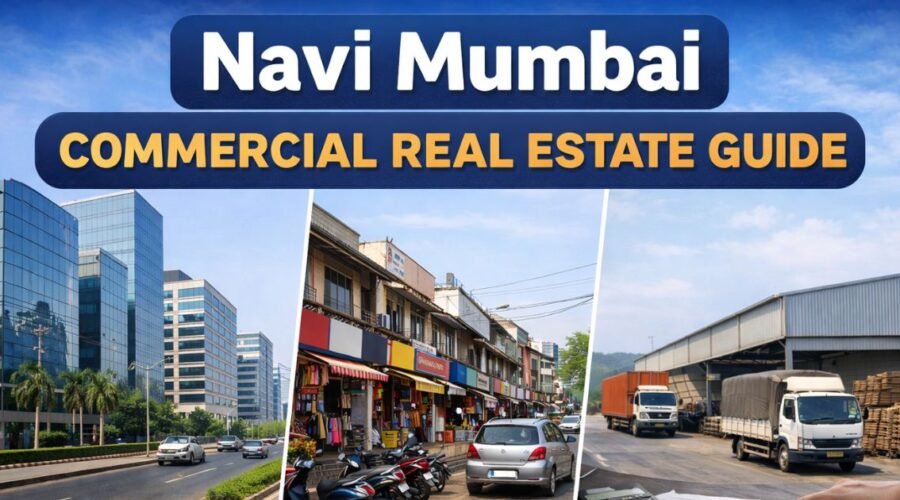
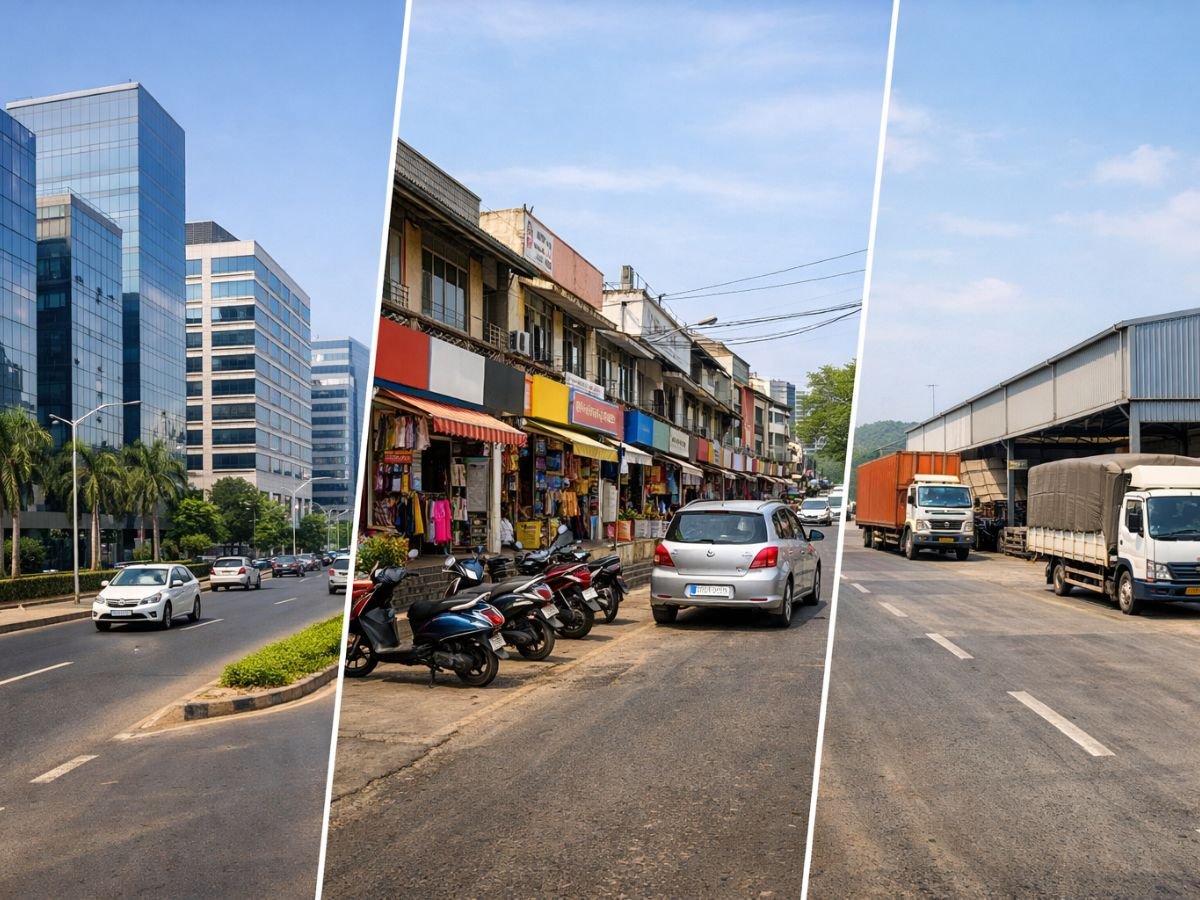
Navi Mumbai commercial real estate is not one single market. CBD Belapur, Vashi, Airoli, Ghansoli, and Mahape work better for office-led demand. Station-linked pockets, dense residential nodes, and selected high streets work better for retail. Turbhe, Kalamboli, Taloja, and Panvel-side belts make more sense for logistics and industrial-linked commercial. So the right decision here depends less on hype and more on use case, tenant profile, access, sanctioned use, and local authority clarity.
If you are searching for one simple answer, here it is: Navi Mumbai is a strong commercial market, but only when the property matches the kind of business or tenant it is supposed to serve. A polished office tower is not automatically a good shop investment. A cheap small commercial unit is not automatically a good rental asset. And a location that looks weak for walk-in retail may still be very strong for warehousing, back-office use, or B2B operations.
That is exactly where most generic articles fail. They talk about “good ROI” and “great connectivity” without telling you what actually works on the ground. This guide is meant to fix that.
Navi Mumbai commercial real estate is not one market, so what exactly are you buying into?
| Commercial use | Best node type in Navi Mumbai | Why it usually works | Biggest caution |
|---|---|---|---|
| Office / corporate space | CBD Belapur, Vashi, Airoli, Ghansoli, Mahape, selected Juinagar-Nerul pockets | Better business image, established office ecosystem, easier employee access | Many mid-tier office buildings still struggle if parking, floor plate, or approach road is weak |
| Shop / daily retail | Station zones, dense residential sectors, old business markets, selected high streets | Walk-in demand, daily churn, service-based tenant demand | Many "commercial" ground floors do not get real footfall |
| Showroom / frontage-led retail | Main roads, transit-linked commercial, destination retail corridors | Visibility and signage matter more than tower branding | Poor parking or wrong frontage can kill sales |
| Clinic / professional suite | Belapur, Nerul, Kharghar, Vashi, Seawoods, residential-commercial mix pockets | Stable nearby catchment, repeat visit demand | Check sanctioned use carefully before setting up |
| Warehouse / logistics-linked | Turbhe, Pawne belt, Kalamboli, Taloja, Panvel-side logistics corridors | Utility-driven demand, freight movement, industrial ecosystem | Access, truck movement, loading, and legal use matter more than looks |
| Investor-led commercial | Depends on tenant type, not only location | Good returns are possible when tenant replacement is realistic | Overpaying for small-ticket commercial is a common trap |
Before comparing nodes, first identify the category of commercial property you are evaluating. This step sounds basic, but it changes everything: pricing logic, tenant demand, vacancy risk, and even document checks.
The bigger point is simple. Navi Mumbai has at least four commercial markets inside one city: office/corporate, retail/high-street, station-linked convenience commercial, and logistics-industrial commercial. If you mix them together, the analysis becomes useless.
Should you lease or buy commercial property in Navi Mumbai right now?
For many readers, this is the real question. Not “where should I buy,” but “should I buy at all?”
In Navi Mumbai, leasing often makes more sense for first-time operators, especially when the business is still testing location fit, customer profile, or revenue stability. Buying can make sense later, or immediately, if the business is stable, the property is clearly usable, and the capital lock-in will not harm operations.
When leasing makes more sense
Leasing is usually smarter when:
- your business is new or unproven
- customer walk-in is uncertain
- you may expand, shift, or shut a branch within two to three years
- you need working capital more than long-term ownership
- you are entering a node like Kharghar, Panvel-side, or a newer corridor where commercial demand is still evolving
A lot of business owners underestimate this. They spend heavily on a “small commercial investment” and then realise the location is wrong, parking is poor, or walk-in traffic is weaker than expected.
When buying makes more sense
Buying can make sense when:
- the business is stable and location-dependent
- you are in a proven office or retail corridor
- tenant demand is not dependent on one project or one future promise
- you are buying for self-use and want control over branding, fit-out, and continuity
- you have done document checks and understand leasehold issues where applicable
The trap of buying small-ticket commercial only because it looks affordable
This is one of the most common mistakes in Navi Mumbai. A small office or shop may look attractive because the entry price feels manageable. But if the building has weak occupancy, poor approach road quality, limited parking, or unclear tenant demand, the “affordable” asset can become dead capital.
Commercial property is not like residential. In residential, a modest flat still has basic use value. In commercial, wrong product selection can mean weak rent, long vacancy, and poor resale liquidity.
Which Navi Mumbai nodes make the most sense for office space?
Office demand in Navi Mumbai is not evenly spread. It follows business corridors, commute patterns, established institutional presence, and building quality.
CBD Belapur and Vashi for established office positioning
CBD Belapur remains one of the strongest office addresses in Navi Mumbai because it combines administrative importance with practical business use. Government offices, banks, legal services, finance-linked firms, and professional offices already have a reason to be here. Small and mid-sized office units also fit naturally in this market.
Vashi is different, but equally important. It is one of the most established commercial nodes in the city and still works because of its long-standing business identity, strong connectivity, and supply constraints in better pockets. Sector 17 remains powerful for business visibility, while larger office stock and modern formats benefit from broader Vashi-Juinagar-side movement.
Airoli, Ghansoli and Mahape for IT, back-office and corridor-driven demand
This belt works less like an old-style business district and more like a functional corporate corridor. If the tenant profile is IT, support services, tech-enabled operations, or back-office activity, these areas make a lot of sense. Access to Thane-Belapur road, industrial-commercial history, and corporate ecosystem matter here.
But even in this zone, not every building is equal. Good floor plates, reliable utilities, decent parking, and employee-friendly access still decide tenantability.
Nerul, Juinagar and Seawoods for selected mixed office-commercial demand
Nerul is one of those nodes that does not always get top billing in generic commercial lists, but it stays relevant because the residential base is strong and the commercial ecosystem is mature enough. It works well for education, consultancy, professional services, and selected office users.
Juinagar has gained more attention because of large-format commercial development and corridor-level transformation. Seawoods, meanwhile, benefits from transit-oriented development and strong mixed-use relevance. This does not mean every commercial asset there is a great office investment. It means the better-located stock has a real support system around it.
Where Kharghar and Panvel-side office buying needs more caution
Kharghar is evolving. It has educational density, growing professional demand, and lower entry compared to Vashi or Belapur. For clinics, coaching, boutique offices, and selected startups, it can work very well. But it is still not interchangeable with Belapur or Vashi.
Panvel-side office commercial is even more case-specific. In some pockets, future growth may be strong because of airport and logistics expansion. But office buying based purely on future corridor hype needs caution. The tenant depth must be visible, not only imagined.
Where does retail or showroom commercial actually work in Navi Mumbai?
Retail success in Navi Mumbai depends on velocity and visibility. In simple words, people must actually pass by, notice the property, and have a reason to enter.
Station-linked convenience retail
Retail near important station zones often works because footfall is built into the location. This is not glamorous, but it is reliable. Convenience stores, quick-service food, mobile shops, service retail, and small-format daily-use businesses perform better in these zones than in isolated commercial towers.
That said, not every station pocket is equally strong. Exit-side movement, pedestrian flow, surrounding income profile, and practical visibility all matter.
Dense residential catchment retail
This is where Kharghar, Nerul, parts of Seawoods, and selected Vashi or Belapur sectors become interesting. If a node has working residential density, schools, clinics, daily use movement, and stable middle to upper-middle-class families, retail can perform even without a railway-station advantage.
This kind of retail is often better for:
- salons
- clinics
- coaching institutes
- cafes
- pharmacy-led stores
- service brands
- boutique showrooms
- food outlets with repeat local demand
Destination retail and frontage-driven showroom corridors
Some commercial spaces work mainly because they are visible from a major road or because the surrounding commercial strip has already become a destination. In such cases, frontage, signage, vehicle access, and parking become more important than tower branding.
A showroom without visibility is not really a showroom asset. It is just a large expensive room.
Why many ground-floor “commercial opportunities” do not become strong retail assets
This is worth saying clearly. A ground-floor unit is not automatically a retail winner. If the surrounding catchment is weak, the internal layout is awkward, the frontage is poor, the road is too fast-moving, or parking is missing, the unit may struggle for years.
A lot of buyers see “ground floor commercial” and assume low vacancy. That is not how it works.
Which belts are stronger for warehouse, logistics-linked and industrial commercial property?
This side of the market follows a completely different logic. Warehousing, transport offices, industrial storage, and trade-linked commercial do not depend on polished glass towers. They depend on utility, movement, access, and ecosystem depth.
Turbhe-Pawne-MIDC style utility-led commercial
Turbhe is one of the most practical B2B zones in Navi Mumbai. It benefits from its position near APMC, industrial corridors, and wholesale movement. For service providers, wholesalers, distribution-linked businesses, and transport-linked offices, this belt remains highly relevant.
It may not look like a premium corporate district, but that is the wrong benchmark. It performs because business activity is already embedded there.
Panvel-Kalamboli-Taloja belts
Kalamboli and Taloja matter because they sit closer to the freight, port, and industrial ecosystem. For warehousing, heavy storage, steel-linked business, logistics servicing, and industrial supply-chain support, these locations have a natural advantage.
Panvel-side commercial also gains importance because of the broader airport and corridor expansion story. But again, the right approach is not blind hype. Use-case fit must still lead the decision.
JNPA-linked and cargo-influenced logic
Whenever Panvel, Kalamboli, or Taloja commercial is being sold as “future ready,” ask one practical question: future ready for what exactly? If the answer connects logically to freight movement, port-linked logistics, storage, hospitality spillover, airport servicing, or corridor trade, it may have merit. If the answer is vague appreciation talk, be careful.
What occupiers should check beyond size and rent
In warehouse or industrial-linked commercial, these factors often matter more than a slightly lower rate:
- truck movement feasibility
- road width and turning access
- loading and unloading ease
- power and utility support
- sanctioned use
- operational timings and local restrictions
- distance to freight corridors and industrial demand centres
How should you compare a commercial property before paying office or shop rates?

This is the section most readers should save.
Commercial property screening checklist
- Is the property type right for your use: office, shop, showroom, clinic, warehouse, or mixed support use?
- Is there real access by station, road, or daily catchment?
- Does the frontage match the business type?
- Is visibility strong enough from the actual direction people come from?
- Is parking workable, not just “available in theory”?
- Can goods be loaded and unloaded if needed?
- Are lift and service access practical for the intended business?
- Is the building already showing healthy occupancy?
- Can a replacement tenant be found easily if the current one leaves?
- Is the internal layout usable, or will fit-out cost become too high?
- Are maintenance costs manageable relative to rent potential?
- Is the use sanctioned clearly, or are you depending on informal adjustment?
If a property fails three or four of these checks, the problem is usually not the price negotiation. The problem is the asset itself.
What local approvals, title checks and authority records matter before you sign or buy?

This part matters more in commercial than many first-time buyers realise.
MahaRERA checks for under-construction commercial
If the commercial unit is part of a project that is still under construction, do not rely only on brochures, sales pitches, or promised timelines. Check project registration and status through MahaRERA. This is one of the simplest filters available, and yet many buyers skip it.
IGR Maharashtra valuation, stamp duty and registration flow
For registration, valuation, and stamp duty logic, IGR Maharashtra remains central. Ready Reckoner rates matter because they form the legal floor for registration value, not because they perfectly reflect the live market. In practical terms, they help you understand how the state will view the property for registration purposes.
If you are buying in a high-rise commercial tower, also understand that floor-related premium may affect the registration-side value structure in relevant cases.
CIDCO, NMMC and PMC context where it changes the answer
This is where Navi Mumbai differs from a simpler one-authority market.
A large part of Navi Mumbai has CIDCO legacy and leasehold context. That means transfers can involve CIDCO rules, NOC requirements, and, in some cases, charges linked to unearned income or transfer structure. Ignore this and you may discover problems later.
On the municipal side, NMMC and PMC context matters because tax systems, records, and compliance environment can differ across the belt. NMMC-side and Panvel-side commercial should not be treated as identical from a holding and compliance perspective.
Zoning, user fit and sanctioned-use caution
This is non-negotiable. A space that looks useful for office, clinic, coaching, or retail use is not enough. It should also be legally fit for that use. Misuse of residential or wrongly sanctioned space can create operational and legal risk later.
Also, if the building does not have a proper Occupancy Certificate where it should, that is a serious red flag.
What usually kills returns in Navi Mumbai commercial real estate?
Commercial returns do not usually fail because the city is weak. They fail because the asset selection was wrong.
The common reasons are:
- buying a shiny but under-occupied office building
- paying high rates for a small unit with weak tenant replacement
- assuming retail will work just because the unit is on the ground floor
- ignoring access, parking, or loading problems
- overpaying because of airport, metro, or corridor hype before actual demand stabilises
- confusing asking rent with sustainable rent
- buying in a new commercial supply zone without checking whether occupiers are actually moving in
The lesson is simple. In commercial real estate, product-market fit matters more than brochure confidence.
What kind of commercial asset fits your budget, goal and risk level?
Not every buyer should chase the same kind of commercial asset.
| Buyer type | Usually better fit | Why it fits better | Main caution |
|---|---|---|---|
| Self-use office buyer | Belapur, Vashi, Nerul, Airoli-Ghansoli belt | Better business image and client comfort | Do not overbuy space |
| Self-use shop buyer | Dense residential node or station-linked retail | Real daily catchment matters | Avoid isolated podium-style retail |
| First-time commercial investor | Smaller proven office or retail in mature node | Lower experimentation risk | Don't chase only low ticket size |
| Clinic / consultant | Kharghar, Nerul, Belapur, Vashi | Nearby family catchment and repeat visits | Check sanctioned use carefully |
| Franchise / food outlet | High-street or transit-linked retail | Brand visibility and churn matter | Parking and frontage can decide survival |
| Warehouse / logistics buyer | Turbhe, Kalamboli, Taloja, Panvel-side | Utility and movement-driven demand | Legal use and access are critical |
| Long-term growth investor | Kharghar, selected Juinagar-side, Panvel corridor | Better upside if real demand matures | Future upside is not guaranteed |
Should you choose ready commercial, under-construction commercial or older resale stock?
Ready commercial usually offers the most clarity. You can see the building, occupancy, access, parking, and actual demand. For buyers who want income visibility or self-use certainty, this is often the safer route.
Under-construction commercial can work, but only selectively. The upside is better entry timing and possible appreciation if the project and location both deliver. The downside is obvious: execution delay, demand mismatch, or supply overshoot.
Older resale stock is often underrated. In commercial real estate, a slightly older building in a proven location can be better than a new tower in an unproven market. Location depth still beats fresh paint.
Which Navi Mumbai commercial locations suit which business type best?
A CA, lawyer, consultant, or financial service office will usually feel more natural in CBD Belapur or Vashi, where the business ecosystem already supports that kind of work.
A coaching centre, clinic, wellness operator, or neighbourhood service brand may do better in Kharghar, Nerul, or Seawoods-side residential-commercial pockets, where recurring local demand is stronger.
An agency, tech support office, or back-office setup can fit more naturally in Airoli, Ghansoli, Mahape, or selected larger-format corridors.
A showroom or branded food outlet needs visibility-led retail, not just carpet area. So Vashi high-street zones, strong residential-commercial strips, and transit-linked retail can work better than an isolated mall-like promise.
A warehouse, distribution office, or industrial service operator should focus on Turbhe, Kalamboli, Taloja, and Panvel-side logistics-linked pockets, where operational movement is the real driver.
Conclusion
Navi Mumbai is one of the most practical commercial real estate markets in the Mumbai region, but it only rewards buyers who think in terms of use case, tenant profile, and local node logic. Belapur, Vashi, Airoli, Ghansoli, and Mahape are stronger for office-led demand. Station-linked and dense residential pockets are better for retail. Turbhe, Kalamboli, Taloja, and Panvel-side belts are stronger when logistics and industrial utility matter.
So do not ask only, “Is this commercial property good?” Ask the better question: good for whom, good for what use, and good under which authority and access conditions? That is the question that usually separates a strong commercial decision from an expensive mistake.
FAQ's
Frequently Asked Questions