Navi Mumbai Municipal Corporation (NMMC): Areas, Services & Property Taxes
Navi Mumbai Municipal Corporation, or NMMC, is the main civic authority for the northern and central part of Navi Mumbai, and it handles practical city services like roads, sanitation, health, property tax, water-related services, certificates, and local complaints. But not all places casually called Navi Mumbai come under NMMC. Areas like Kharghar, Kamothe, Kalamboli, Taloja, and New Panvel are part of Panvel-side civic governance, while CIDCO still matters in many land and redevelopment matters.
That one distinction saves a lot of confusion.
Many people search for Navi Mumbai Mahanagar Palika when they want to do something urgent: pay property tax, check a water bill, file a complaint, get a birth certificate, or find the correct ward office. Others are buyers or renters trying to understand a more basic question: which authority actually controls the area they live in or want to move to?
This guide is built for that exact confusion. Not as a textbook article. As a practical Navi Mumbai explainer.
Quick summary: what NMMC does and when it matters
| Question | Practical answer |
|---|---|
| What is NMMC? | Navi Mumbai Municipal Corporation, the civic body for major northern and central Navi Mumbai nodes |
| What does it handle? | Roads, sanitation, drainage, public health, property-tax-related services, water-related services, complaints, ward administration, and citizen services |
| Does all of Navi Mumbai come under NMMC? | No |
| Which areas are commonly associated with NMMC? | Belapur, Nerul, Vashi, Turbhe, Koparkhairane, Ghansoli, Airoli, and Digha side |
| Which areas create confusion? | Kharghar, Kamothe, Kalamboli, Taloja, New Panvel, Ulwe, and Dronagiri |
| Is NMMC the same as CIDCO? | No |
| Is NMMC the same as Panvel Municipal Corporation? | No |
| Why does this matter? | Because tax payment, complaints, certificates, redevelopment, and area due diligence all depend on the correct authority |
What exactly does NMMC do in day-to-day city life?
In simple terms, NMMC is the authority people deal with for routine urban life in the parts of Navi Mumbai under its civic control. That means the body responsible for the kind of things residents notice only when they stop working properly.
If the road outside a node is damaged, if drainage is overflowing, if garbage collection is irregular, if a local health service is needed, if a property tax bill has to be paid, or if a civic complaint has to be registered, NMMC becomes relevant.
This is where many generic pages fail. They define the corporation, mention a few services, and stop there. But residents do not search for NMMC because they want a formal definition. They search because they need action.
In practice, NMMC’s role covers:
- civic maintenance in its jurisdiction
- local road and drainage-related response
- sanitation and solid waste systems
- public health infrastructure and hospitals
- property tax collection
- water bill administration and related service workflows
- birth and death registration pathways
- complaint handling through ward offices and grievance channels
That is the everyday side of NMMC. CIDCO may have planned large parts of Navi Mumbai historically, but the person filling potholes, collecting waste, or processing municipal tax and local service complaints in an NMMC-controlled area is not CIDCO. It is the municipal system.
Which areas of Navi Mumbai usually come under NMMC, and where do people get confused?

This is the most important local question in the entire topic.
NMMC is generally associated with the northern and central developed belt of Navi Mumbai in the Thane-side jurisdiction. The eight core ward areas people should know are:
- CBD Belapur
- Nerul
- Vashi
- Turbhe
- Koparkhairane
- Ghansoli
- Airoli
- Digha
If you live in one of these core belts, or in the urban fabric closely tied to them, NMMC is usually the first authority you should think about for municipal services.
Localities that readers commonly associate with NMMC
These are the places where NMMC understanding is usually straightforward:
- Vashi
- Sanpada-Turbhe side civic belt
- Nerul
- Seawoods-Belapur side urban zone where the broader civic linkage points back to NMMC structures
- Koparkhairane
- Ghansoli
- Airoli
- Digha
Localities where people should double-check authority instead of assuming
This is where many people waste time.
A large part of southern Navi Mumbai in everyday language is still called “Navi Mumbai,” but the civic authority is not NMMC. That includes:
- Kharghar
- Kamothe
- Kalamboli
- Taloja
- New Panvel
These are Panvel-side municipal areas in practical civic terms, not NMMC areas.
Then there are nodes such as Ulwe and Dronagiri, where people often make even riskier assumptions because of airport-area growth, CIDCO planning, and changing local administrative overlays. In such locations, you should not assume authority based on WhatsApp forwards, broker language, or what a society member casually says. Check the actual tax and civic documentation first.
Practical rule: if the node is south of CBD Belapur and especially in the Kharghar to Panvel belt, do not assume NMMC. Verify the authority before filing complaints, checking taxes, or judging civic accountability.
NMMC vs CIDCO vs Panvel Municipal Corporation: who handles what?
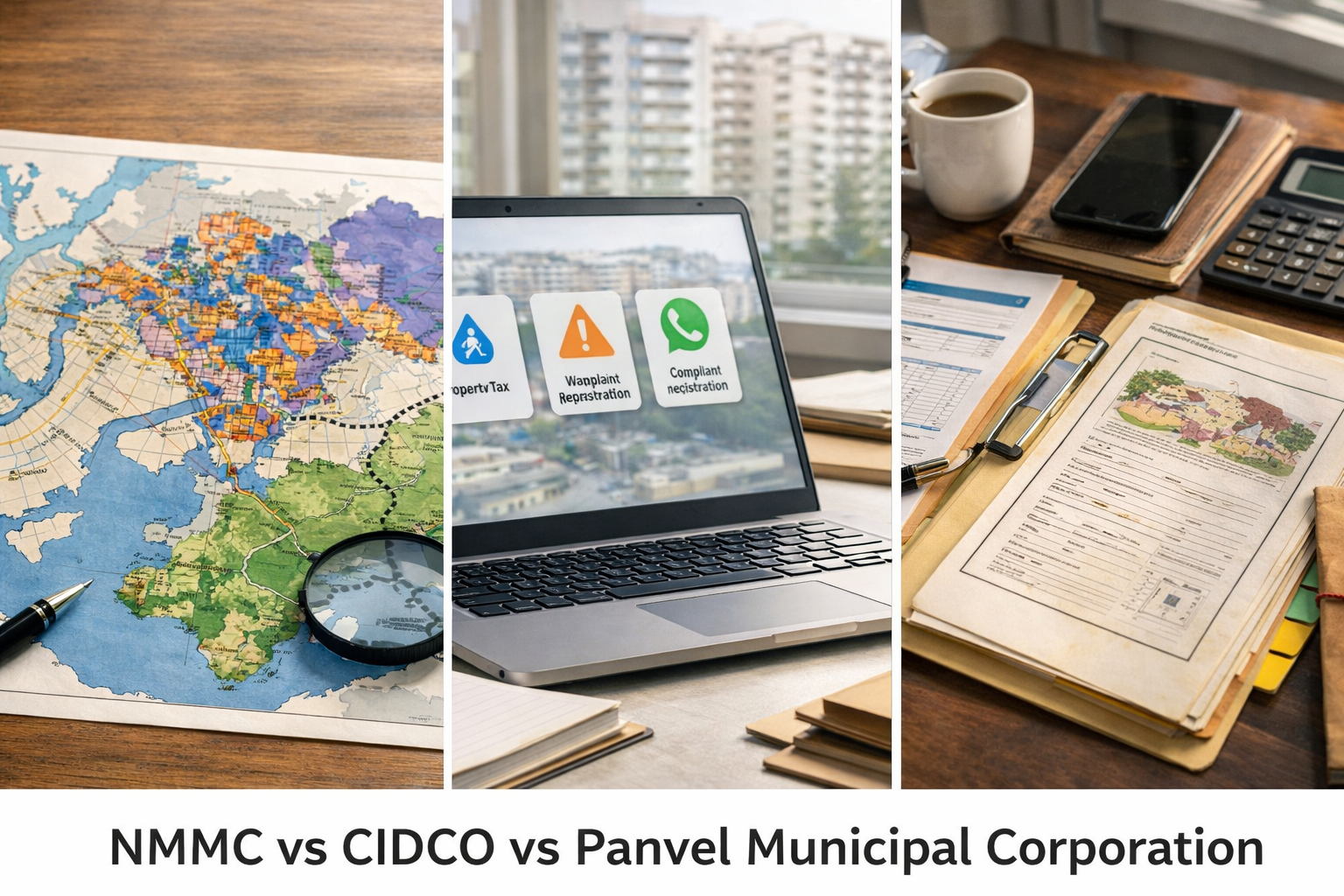
This is the section most readers actually need, even when they do not realize it yet.
| Authority | What it mainly does | Where confusion happens |
|---|---|---|
| NMMC | Municipal services, local civic maintenance, tax-related services, water-related services, complaints, health, ward administration in its jurisdiction | People think it governs all of Navi Mumbai |
| Panvel Municipal Corporation (PMC) | Municipal governance for major southern Navi Mumbai nodes like Kharghar, Kamothe, Kalamboli, Taloja, and New Panvel | People living there still search for NMMC out of habit |
| CIDCO | Original development authority, land ownership patterns, leasehold control, planning influence, NOCs in many real estate and redevelopment matters | People confuse development authority with day-to-day civic authority |
The cleanest way to understand this is simple:
- NMMC is about everyday municipal governance in its area.
- PMC is the municipal body for many southern nodes people still casually club into Navi Mumbai.
- CIDCO is not your usual garbage-complaint authority, but it still matters deeply in land, lease, redevelopment, and planning-related issues.
That is why a resident may pay municipal dues to one body but still need CIDCO in a redevelopment or leasehold matter.
This is also why so many real estate buyers get confused. They assume one authority controls everything. In Navi Mumbai, that is rarely true.
What services can residents actually use through NMMC?
NMMC is not just a nameplate authority. Residents usually search it for real use-cases. The most common ones are these:
Services most residents search for first
- property tax payment
- water bill checking and payment
- birth certificate access
- death certificate access
- complaint registration
- ward office contacts
- emergency and civic helpline access
The strongest article on this topic must explain not only what services exist, but also which ones are fully digital and which ones still require offline follow-up.
That distinction matters a lot.
A resident may think, “If I can pay online, I can also complete everything online.” But that is not always true. Regular bill payment may be digital, while name transfer or record correction may still require ward-office submission.
When online service is enough and when office follow-up may still be needed
For routine bill access and standard service checks, the digital route is usually enough. But when ownership, name transfer, older records, or document mismatch is involved, ward-level physical submission may still be required.
That is normal in municipal systems. The mistake is assuming the portal is the entire process.
How to use the NMMC website without getting lost
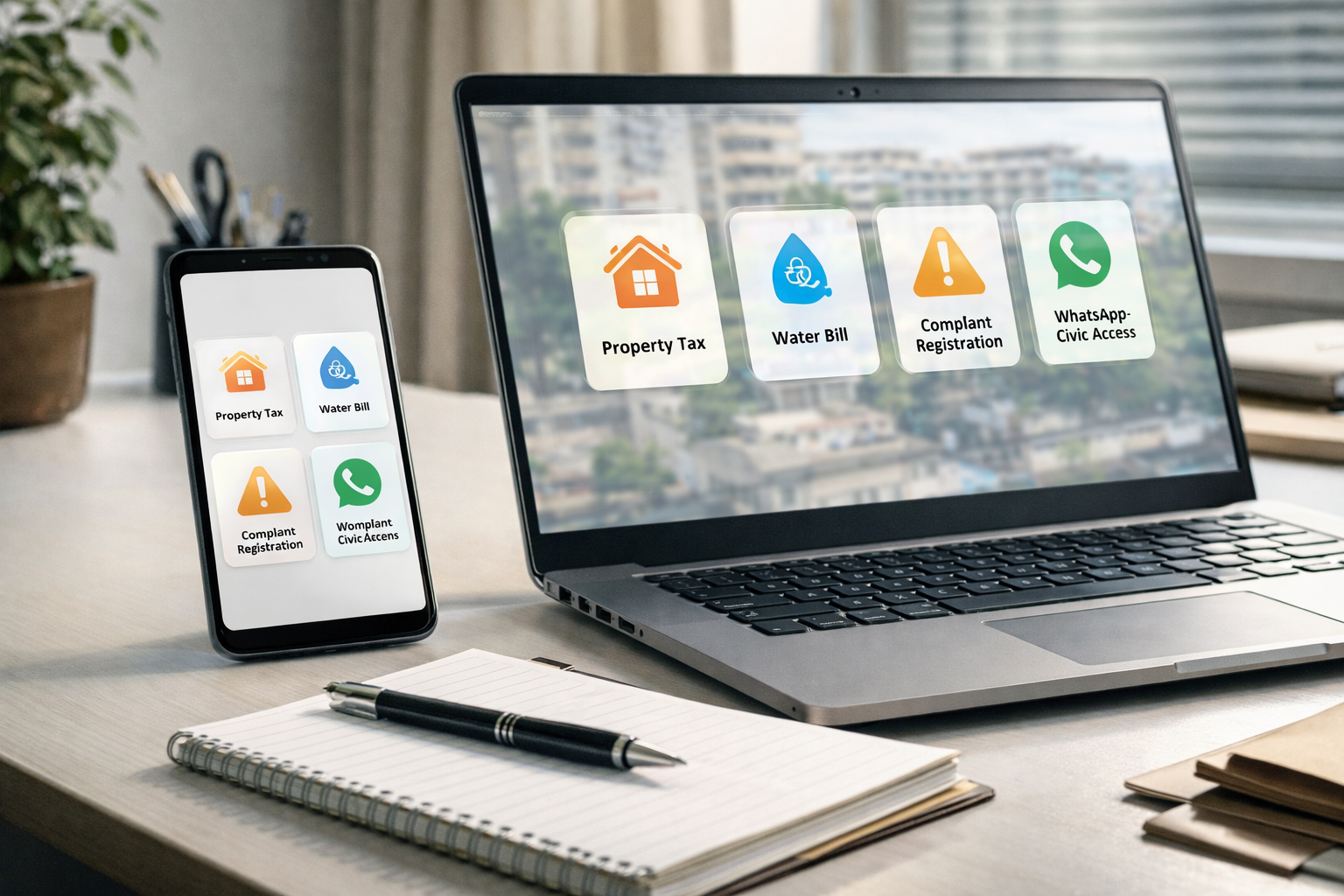
Municipal websites are useful, but they are not always easy.
A normal resident usually lands on the site looking for one thing, then gets pulled into menus, department tabs, or old-style navigation. The easiest way to think about the NMMC ecosystem is by task:
- paying or checking dues
- finding a certificate path
- registering a complaint
- locating the correct ward office
- checking contact numbers and emergency channels
For property tax, one important practical detail is the Property Code. Without that, the process becomes slower. For water-related workflows, the Consumer Number matters in the same way.
A very useful local detail here is that property tax visibility and payment have also been pushed through a WhatsApp-based municipal channel, which is more friction-free for many residents than traditional portal browsing. For a city like Navi Mumbai, where many users want quick mobile-first action, that matters.
If you are not getting clarity online, the smart move is not endless browsing. It is to identify your ward office and escalate there with your papers ready.
Property tax, water bill, and certificates: which NMMC tasks matter most for residents?
This is the section with the highest day-to-day utility.

Property tax payment
For standard online payment, the key identifier is the Property Code. This is the first thing owners should keep saved. Many people search only when the due date is close, then waste time locating the code.
Property tax name transfer
This is where real confusion begins.
Paying tax online does not automatically transfer ownership records. A property tax name transfer, commonly treated like mutation in practical language, is not a fully digital end-to-end process. It requires offline submission to the concerned ward office.
Commonly required documents include:
- registered sale deed
- society NOC
- latest paid tax bill
- indemnity agreement or affidavit on the required stamp paper
This is exactly the kind of step that generic articles skip, and it is the reason many new owners keep paying dues while the municipal record still shows the previous owner.
Water bill and water-related change
Water bill access typically depends on the Consumer Number. A practical sequence also matters here: the property tax name change should be completed first, because water-related name transfer follows that chain. A separate charge may apply for water bill name transfer.
Birth and death certificates
These are high-intent searches, especially for families. But one more practical reality matters here: older records and newer records may not always follow the same smooth path. In many cases, newer registrations are easier to access digitally, while older documentation may still require ward office or facilitation-centre interaction.
Example: A flat buyer in Nerul completes registration, starts paying property tax, and assumes municipal ownership records are updated automatically. Months later, while applying for a water bill name correction or using municipal paperwork for another purpose, the old owner’s name still appears. The problem was not payment. The problem was skipping the offline name-transfer step.
Where should you complain if there is garbage, drainage, road damage, water shortage, or a local civic issue?
For residents, this is probably the most practical part of the article.
If the issue is a normal civic failure in an NMMC area, the complaint should begin with the proper NMMC channel, not with random social media tagging and not with CIDCO by default.
The modern complaint workflow is increasingly linked to the NMMC Daksh app model, which is useful because it is not just a loose complaint box. It supports tracked complaint logic, photo-based evidence, and time-bound handling expectations.
That makes a big difference.
If a streetlight is dead, a drain is blocked, garbage is not being lifted, or a local road defect is affecting daily movement, a documented complaint route is stronger than an informal one.
Issue-to-action guide for residents
| Issue | Start here first | Why |
|---|---|---|
| Garbage not collected | NMMC complaint channel / Daksh / ward route | This is a civic maintenance issue |
| Drainage overflow | NMMC complaint route | Local municipal engineering response matters |
| Road potholes in NMMC area | NMMC complaint route | It is a core civic issue |
| Water bill or service confusion | NMMC water-related service path / ward follow-up | It is linked to municipal utility administration |
| Property tax mismatch | NMMC tax service path / ward office | Often needs record-level correction |
| Redevelopment land NOC issue | CIDCO plus municipal authority as applicable | This is not purely a routine civic complaint |
| Internal society plumbing or building internal matter | Housing society or builder first | Not every issue is municipal |
If the issue is urgent and local, ward-level escalation matters. If the issue is not even in an NMMC area, starting on an NMMC complaint platform may lead nowhere.
That is why authority identification comes before complaint filing.
When should a resident deal with NMMC, and when should they look at CIDCO, society, builder, or another authority instead?
This is where time gets saved.
You should usually start with NMMC when the issue is about public civic function in an NMMC-controlled area:
- roads
- drainage
- sanitation
- public complaints
- tax-related municipal service
- water-related municipal workflow
- ward-office civic matters
You should usually look at CIDCO when the matter is tied to:
- leasehold rights
- redevelopment NOCs
- land-origin issues
- layout or development-control complications
- specific planning or plot-ownership overlays
You should usually start with the housing society or builder when the issue is:
- internal leakage inside the building system
- society-level maintenance failure
- internal pump, tank, or structure management
- builder defect liability in the early stage
This difference sounds basic, but in Navi Mumbai it is not basic at all. It changes outcomes.
Why this matters for buyers, renters, and new residents in Navi Mumbai
For buyers, authority confusion can become a due-diligence mistake.
Many people judge an area only by branding. “Navi Mumbai” sounds orderly, planned, and premium. But governance still has to be checked node by node. Municipal quality, complaint response, tax pathway, redevelopment complexity, and land paperwork are not all controlled by one body across the whole region.
For renters, the authority affects practical life more than they expect. If water service complaints, road conditions, garbage response, and ward handling differ across jurisdictions, daily experience changes too.
For investors, there is another layer. A good-looking location is not enough. One must still verify:
- which authority governs the area
- whether project paperwork is proper
- whether the civic side and the land side are both clean
- whether any redevelopment or approval matter may later involve CIDCO even inside a developed urban node
This is especially important in a region where local marketing language can blur reality. Terms and labels used in real estate selling do not always match municipal truth.
Common mistakes people make while dealing with NMMC
The most common mistake is simple: assuming all of Navi Mumbai comes under NMMC.
The second is assuming an online payment means the entire municipal record is updated.
The third is using the wrong complaint route for the wrong authority, then blaming the system when the complaint does not move.
Another frequent mistake is treating CIDCO and NMMC as interchangeable. They are not. One may matter for land or redevelopment, the other for daily civic functioning.
And one more mistake deserves special mention: trusting local hearsay more than actual tax records, ward mapping, and authority documents. In Navi Mumbai, that can waste a lot of time.
Conclusion
Navi Mumbai Municipal Corporation is not just a government name people search once and forget. It is the practical civic authority that affects daily urban life across a major part of Navi Mumbai. But the most important thing to understand is this: NMMC is not equal to all of Navi Mumbai, and it is not the same as CIDCO or Panvel Municipal Corporation.
If you remember only one lesson from this guide, remember this one. First identify the correct authority. Then begin the task.
That one step can save a resident from the most common Navi Mumbai problem of all: going to the wrong system for the right issue.