Navi Mumbai SEZ Reliance – From SEZ to Economic Hub”
What Is the Reliance Navi Mumbai IIA?
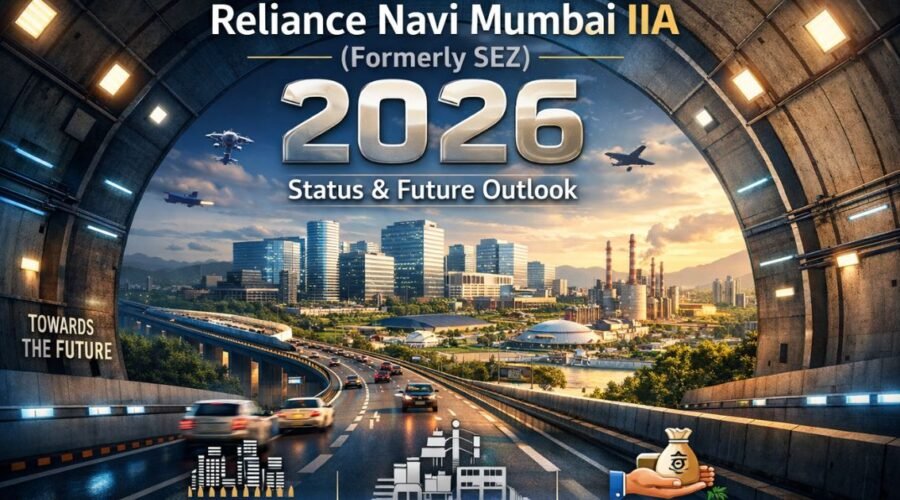
The Reliance Navi Mumbai Integrated Industrial Area (IIA) is among the largest industrial and logistics developments in Western India. Spread across more than 5,200 acres in Ulwe, Dronagiri, and Kalamboli, this project was earlier known as the Navi Mumbai Special Economic Zone (SEZ).
That identity has now changed decisively. The acquisition in late 2024, where Reliance Industries Limited secured a 74% controlling stake for ₹1,628 crore while CIDCO retained the remaining 26%, set the stage for the rapid on-ground development that became clearly visible throughout 2025 and now defines the project’s active execution phase in 2026. This acquisition marked a turning point, transforming a long-stalled plan into an active, execution-driven industrial ecosystem.
By 2025, on-ground activity had visibly increased. Land grading, boundary fencing, internal road planning, and utility provisioning began, especially in the Dronagiri belt. This is no longer a speculative proposal. It has entered a measurable development phase.
Fast Facts: What You Need to Know
Project Name: Reliance Navi Mumbai Integrated Industrial Area (IIA)
Current Status: Converted from SEZ to IIA; Reliance Industries holds a controlling 74% stake following the late-2024 acquisition
Location: Navi Mumbai, covering key nodes such as Ulwe, Dronagiri, and Kalamboli
Total Area: Approximately 5,200 acres
Investment Value: ₹1,628 crore, representing Reliance’s stake acquisition
Strategic Edge: Direct connectivity to JNPT, Mumbai Trans Harbour Link (MTHL), Dedicated Freight Corridor (DFC), and the Navi Mumbai International Airport (NMIA)
Why the SEZ Was Converted Into an IIA
India’s older SEZ framework imposed export-heavy compliance rules. Companies were expected to primarily export goods, which restricted flexibility for firms that also wanted to serve domestic markets. Over time, this rigidity slowed growth across multiple SEZs nationwide.
The shift to Integrated Industrial Area (IIA) status removes those constraints. Under the IIA framework, businesses gain significantly more operational freedom. Companies are now permitted to manufacture for both domestic and export markets from the same location, develop commercial, industrial, and limited residential infrastructure within the zone, and operate without the heavy export-linked compliance burdens that earlier restricted SEZ projects.
For Maharashtra, this policy shift was practical rather than symbolic. The conversion unlocked the true economic value of strategically located land near a major port, a new international airport, and India’s financial capital.
The Three Strategic Nodes Explained
The Reliance Navi Mumbai IIA is not a single uniform land parcel. It is structured around three distinct nodes, each serving a specialized role within the larger ecosystem.
Ulwe: Corporate, Technology, and Services
Ulwe’s biggest advantage is proximity to the Navi Mumbai International Airport (NMIA). This makes it ideal for:
- Corporate offices and regional headquarters
- IT and technology parks
- Data centers and digital infrastructure
- Light manufacturing and precision assembly
Ulwe already supports a growing residential population. With metro connectivity, arterial roads, and airport-driven demand, it is positioned as the white-collar and services-facing node of the IIA.
Dronagiri: Port-Centric Logistics and Warehousing
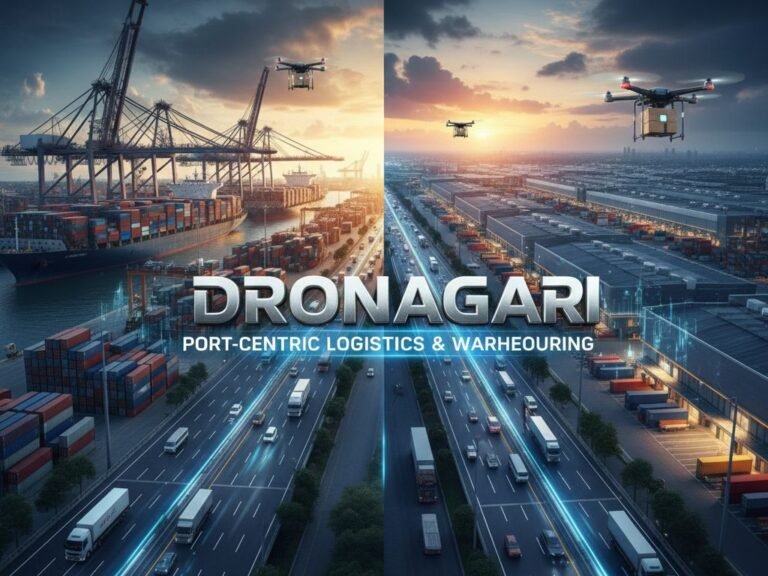
Dronagiri lies closest to JNPT, India’s largest container port. This makes it the backbone of logistics activity. Development here will focus on:
- Grade-A warehousing
- Container Freight Stations (CFS)
- Bonded and customs-compliant storage
- Cold chain and temperature-controlled facilities
For import-export businesses, shorter port access directly translates into lower logistics costs and faster turnaround times.
Kalamboli: Distribution and Heavy Trade
Kalamboli already functions as a major steel and commodities trading hub. The IIA strengthens this role by integrating it with modern infrastructure and expressway connectivity. Expect:
- Regional distribution centers
- Heavy goods handling terminals
- Improved trucking and freight aggregation zones
Kalamboli’s connection to the Mumbai–Pune Expressway gives it unmatched access to the wider Maharashtra market.
Connectivity: The Real Competitive Advantage

Industrial success depends on how efficiently goods, people, and data move. The Reliance IIA benefits from multiple national-scale infrastructure projects.
Mumbai Trans Harbour Link (MTHL)
The 22-kilometer MTHL connects South Mumbai (Sewri) to Navi Mumbai (Nhava Sheva). Commute times have dropped from nearly two hours to under twenty minutes. This single link makes executive travel, talent mobility, and corporate integration dramatically easier
Dedicated Freight Corridor (DFC)
The Western DFC connects Mumbai to Delhi via high-speed freight rail. Manufacturers operating from the IIA can now reach North Indian markets within 24 hours, reducing inventory holding costs and improving supply-chain predictability.
Navi Mumbai International Airport (NMIA)
NMIA will play a critical role in air cargo logistics. High-value and time-sensitive goods such as electronics, pharmaceuticals, and precision equipment benefit directly from airport-adjacent industrial zones.
| Metric | Value |
|---|---|
| Total Area | 5,200 acres |
| Stake Acquisition Value | ₹1,628 crore |
| Reliance Ownership | 74% |
| CIDCO Ownership | 26% |
| Distance to JNPT | ~5 km (Dronagiri) |
| Distance to NMIA |
Target Industries and Business Use-Cases
The IIA is designed as a multi-sector industrial ecosystem rather than a single-use zone. It is expected to attract heavy engineering and industrial manufacturing units, pharmaceutical production supported by cold-chain logistics, electronics assembly and packaging facilities, IT services and backend operations, large-scale e-commerce fulfillment centers, and integrated logistics and supply-chain management firms.
The plug-and-play model significantly reduces setup timelines, allowing companies to begin operations in months rather than years.
Employment and Economic Impact
Large-scale industrial developments generate layered employment beyond factory floors and warehouses. Direct employment is created within manufacturing units, logistics parks, and corporate offices. Indirect employment emerges through transport operators, security services, maintenance teams, and utility providers. Over time, induced employment grows in housing, education, healthcare, and retail as the surrounding population expands.
Conservative estimates suggest 50,000+ direct jobs once the IIA reaches maturity, with many more indirect opportunities across Navi Mumbai.
Impact on Surrounding Real Estate
Reliance-led infrastructure historically alters local property dynamics. The IIA is expected to do the same.
Ulwe sectors 16 to 25, Dronagiri and adjacent CIDCO nodes, and nearby areas such as Pushpak Nagar and Navade are expected to experience spillover demand as employment density increases. As workforce migration accelerates, demand for housing, retail outlets, and social infrastructure in these micro-markets is likely to strengthen steadily.
As employment density increases, demand for housing, retail, and social infrastructure will follow. Compared to established nodes like Vashi or Nerul, entry prices remain relatively accessible.
| Hub | State | Size | Core Advantage |
|---|---|---|---|
| Reliance Navi Mumbai IIA | Maharashtra | 5,200 acres | Port + Airport + Expressway |
| GIFT City | Gujarat | 886 acres | Financial services |
| Dholera SIR | Gujarat | 22,000 acres | Long-term greenfield |
| Jewar Airport Hub | Uttar Pradesh | 5,000+ acres | NCR air connectivity |
| Sri City | Andhra Pradesh | 7,500 acres | Manufacturing focus |
Is the Project Really Moving Forward?
Yes. The December 2024 acquisition was followed by measurable execution throughout 2025:
- Boundary demarcation and fencing
- Land grading and internal road planning
- Utility corridor development
- Access road widening
This positions Maharashtra competitively against Gujarat and Uttar Pradesh’s industrial corridors.
The Reliance Navi Mumbai Integrated Industrial Area represents a structural shift in Maharashtra’s industrial strategy. With policy flexibility, private capital, and world-class connectivity converging in one location, the project has moved beyond intent into execution. For businesses, investors, and job seekers, this is not a development to ignore it is one that will define the region’s economic trajectory through 2030 and beyond.
FAQs
Frequently Asked Questions